SIF Portfolio: Why Revolution Bars won’t be joining the portfolio

Last week’s biggest investing sensation was probably the profit warning from Revolution Bars Group. The bar operator’s share price has fallen by about 40% over the last five days, and is now trading at an all-time low of about 120p.
The Stock in Focus portfolio appears to have narrowly dodged a bullet with this share. Revolution Bars came close to qualifying for my screen on a number of occasions. But the stock never quite ticked all of my boxes at once, saving the portfolio from a potentially hefty loss.
Of course, Revolution Bars may bounce back strongly from here. More importantly, the stock could be an outright bargain at the current level of about 120p. Paul Scott gave his detailed view on the stock here and appears to remain bullish.
I too can see the appeal of the stock at current levels. It’s highly cash generative and well financed. Trading on a forecast P/E of about 8.4 with a prospective yield of about 4%, Revolution looks very cheap indeed to me. Return on capital employed rose to 15% last year. Even if the group stopped opening new bars tomorrow, the current valuation ought to allow for decent returns.
Overall, Revolution’s financials appear to paint a picture of affordable growth. This is the core requirement for the SIF portfolio, so why aren’t I filling my boots with cheap stock this week?
Screening test fail
Leaving aside the portfolio’s current lack of cash, the reason I’m not buying Revolution Bars for the SIF portfolio is simply that it doesn’t satisfy all of my screening rules.

Readers who’ve followed this column over the last year may be able to guess why. Revolution Bars’ share price collapse means that its one-year relative strength (RS 1y) is now negative.
This was a factor that prevented me adding a number of otherwise attractive stocks to the portfolio in the wake of last year’s Brexit sell off. For a long while, I was tempted to remove this constraint for this year, but in the end I opted to leave it unchanged.
The reason for this is that relative strength is the main indicator of momentum in my screen. And although poor momentum can be a contrarian buying indicator, I’m not sure it fits well with my fixed nine-month holding period and focus on growth.
Bulls won’t like this
The reason for my continued faith in relative strength is that falling momentum often takes longer than expected to reverse.
As Paul Scott commented last week, it’s hard to understand why rising wage costs and business rates have come as a surprise to Revolution. Although the game of musical chairs in the CFO’s office may be to blame, there could be other as-yet unrecognised problems.
How strongly is this business really growing? The year-to-date LFL sales growth of 1.7% isn’t exactly dazzling. Given that inflation is starting to creep into high street prices, I’d hazard a guess that this means LFL volumes have been broadly flat over the year.
It might be that Revolution’s bars are struggling to deliver much growth, once their novelty wears off. My impression is that many cities are in danger of reaching ‘peak bar’, with on-trend new watering holes opening constantly. It may be that fickle consumers are constantly moving onto the next big thing, rather than developing a loyalty to this particular brand.
The commentary relating to the sales performance of new bars is slightly odd, too. “Underlying sales performance” is described as “on track”, yet the company says new bars are taking longer than expected to reach full profitability. As Paul pointed out on Friday, these claims seem contradictory.
The explanation may lie in the use of the word “underlying”. But we probably won’t know much more until perhaps July, when a pre-close trading update is likely. In the meantime, I think it’s fair to say that it’s possible to put both bullish and bearish interpretations on last week’s trading statement.
A contrarian bargain?
I’ve put forward a more bearish view of Revolution Bars in the section above. But I’m not sure if this level of caution is really necessary. The firm’s history since its flotation has been of rising profitability and self-funded expansion. Cash generation has been consistently strong and the group has been able to fund new bars and pay a rising dividend, while maintaining a net cash position.
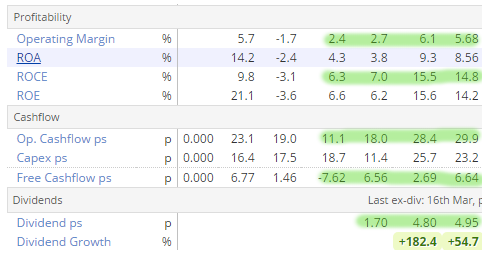
Stockopedia’s algorithms also take a broadly positive view on the stock, but this has changed significantly as a result of last week’s slump.
Here’s how Revolution was classified on 10 May, a week or so before the bad news hit the market:
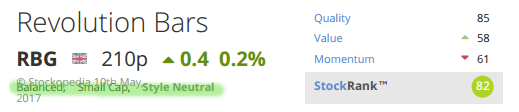
I’ve highlighted the styles, as they’ve got confused with the copyright/date stamp. Apologies for this.
The key thing here is to note the high StockRank of 82 and the StockRank Styles classification of Revolution as a Neutral stock, with a Balanced RiskRating.
Fast forward to today, and things have changed considerably:
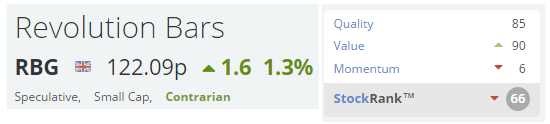
The StockRank has fallen to 66 and Revolution is now classified as a Contrarian stock with a Speculative RiskRating. The green colour of the text indicates that the Contrarian style is one which has historically outperformed the market.
However, the shift from Balanced to Speculative RiskRating indicates a greater level of volatility may now be likely. This suggests that Revolution’s future progress may be less predictable than it has been so far.
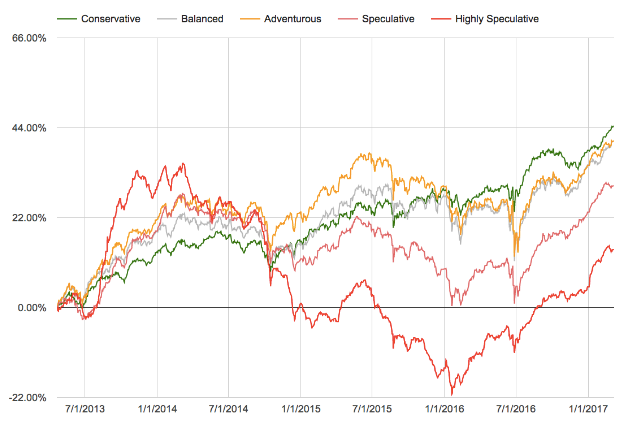
Although this doesn’t necessarily apply to Revolution Bars specifically, it’s worth noting that Stockopedia’s historic data shows that a basket of Balanced stocks tends to outperform a basket of Speculative stocks over longer periods:
For more on RiskRatings, check out Ed’s new guide to this feature.
Would I buy Revolution Bars?
Although part of my personal portfolio is now invested in the SIF portfolio stocks, the majority of my own investment follows a value strategy. I’m quite comfortable buying after big falls if I believe the stock is cheap enough.
I won’t be adding Revolution Bars to the SIF portfolio unless it qualifies for my full screen, but I will be keeping an eye on the stock. At the current valuation, I’d argue that the company only needs to perform averagely well in order to offer attractive value.
Disclosure: Roland does not own shares of Revolution Bars Group.
Disclaimer
This is not financial advice. Our content is intended to be used and must be used for information and education purposes only. Please read our disclaimer and terms and conditions to understand our obligations.

11 comments
Could be a last chance, currently, to short sell this company.
Try going to one on a Friday or Saturday night at 11pm after pay day...you'll get a pretty good view if there is demand or not.
Sorry - but one days good revenue does not make up for 7 days of fixed (and necessary variable) costs
So Im a fictitious 30 something (I have been there and done that), Im 43 really
I walked past a Rev bar just tonight and it was dead.. They have a licence to 12... All the clever people were in the guitar and pitcher (i m not advertising) which also has a licence to 12 and is very close and you can sit outside by the river
Rev bars are for lads..(who in groups wont get in so
Dont bother)... Sorry you cant convince someone who wad a hardened drinker and drunk london dry
Many a time. Theres lots of places cheaper where you dont need a mortgage to get a round
What your looking for is repeat customers who go there every time not once and never again
I dont know about other locations but the Rev near me is not as popular as the local fancy pub chain. Sorry weatherspoins doesnt have music , is pretty depressing and I can assure you boys only go there cos its cheap then move on pronto (my dad loves it and hes 66..lol)
Unless you were super geeky and plotted every rev bar on a map versus its competition I think you are flogging a dead horse... A round of vodka and cokes for 5 of you will be £40
With the young 30 something this is just not sustainable.
Interesting you mentioned the walkabout pubs. When the visa rules changes and the oz jobs picked up back home it killed them.All the aussies went home and I remember frequenting them in covent garden and shaftsbury avenue..Now closed down...
Im not sure if walkabout owned the locations or leased them but some were super fabulous locations that gave the brits a taste of aussie culture within the uk, a place full of aussies watching sport and kiwis and some South Africans, it was great... A meeting place where you would return to be with your mates and eat /talk/drink
Theres no culture in Rev bars , no wanting to return. In a Rev bar, its just another place that sells expensive drink in an expensive locations and is haemorrhaging cash. In my location if they sold for flats they would get £50-100million. I know this as new flats up the road are now going for 2 million.
You could easy squeeze in 20 flats in this location
Im sorry but there are some corker shares out there which will make you a lot more and keep bringing in the cash
BUR, FORT,SOM, TAP (And dare I say IAG as a riskier one)
I am learning to invest in what I know ( the legal and banking sector), so take this with a pinch of salt and may be Im speaking tosh
I see countless news articles on how pubs are closing at record rates. Theres a revolution bar in my SW london town by the river and for £8 I can have a vodka and coke...
With demographic change and the huge influx of new workers on low wages and zero contracts how are these places ever going to survive. The only way is if they own the building which they could sell for flats. Its true,brits can drink a lot... But with the influx of the posh coffee shops and ivy type restaurents and cultures that dont drinks gallons like the brits....these revolution places are liike white stiletos.... From the past
Avoid , your probably flushing your money down the toilet......
@RedRichmond. Interesting thoughts. I have been involved in the bar industry before at board level, at one of Revs direct competitors. I think that there will always be demand for places where people can have a good time and where boys can meet girls. The overall size of demand for such places is probably falling, as you suggest. The question then is why should people come to you over the competition. From what I know of Revs they are well run and well invested. Yes, they are more expensive than a weatherspoons but people going there aren't looking for a weatherspoons experience - cheap pubs, coffee shops and expensive restaurants are not direct competitors. Try going to one on a Friday or Saturday night at 11pm after pay day...you'll get a pretty good view if there is demand or not.
Better capital sold intertain (the walkabout chain) in 2016 for £39.5m - which looking at their announcements was a c.7x EBITDA multiple. If a large pub chain would pay 7x for walkabout is it not reasonable to think that they may pay a similar multiple for Rev? That would be a substantial premium to the current share price.
Risk ratings tell you about the past, nothing more.
RBG had a profit warning on Friday. It's share price has fallen by more than 40% - it's risk rating has risen from low to speculative.
So, here's the question: is the share price today riskier than it was a week ago?
Possibly, if the fundamentals deteriorate. Otherwise not, imo.
As discussed extensively when the new classifications were introduced, "risk" was identified with "volatility" i.e. Likelihood of price movement up or down as opposed to "probability of loss". There was quite a broad range of views on whether this was the best approach to take.
The big fall last Friday (and further drop this week) has increased the expected volatility of the stock on the assumption of future performance being linked to past, although I agree with the inference in your question that the probability and extent of a further loss from here (the second possible definition) is arguably lower now on the basis that the substantial fall makes the stock much more cheaply priced using conventional metrics such as p/e or earnings yield.
Gus.
I think it was Nick Ray that posted an interesting analysis of price falls over a mid term time frame being more likely in the cheap end of the market than in the very expensive. DYOR.
It is interesting to note that on the basis of effectively a single sample (the -40% drop on Friday) the volatility has gone from below average in the stock univers ("Balanced") to quite strongly above average ("speculative").
This is perhaps a timely reminder of the nature of stock returns. Taleb would call the Friday event a "black swan". Many people think of that as "something very unlikely to happen" but in fact it means an unlikely event which actually occurs more often than you would expect by assuming a normal distribution (or in the case of returns, log normal.)
This sort of thing happens because the distribution of stock returns has "fat tails" - the extreme cases occur more often than in a normal distribution. This statistic is called kurtosis and it is curiously difficult to measure. Because its value indicates whether rare events are more or less rare than usual, you often find that if you do not have enough samples then you cannot capture any sufficiently rare events to accurately measure it.
The situation with RBG is a perfect case in point. A single "black swan" has completely changed Stockopedia's view of the volatility and if it were to report the kurtosis then that would have dramatically shifted too.
[By the way, where has the "html" view in the editor gone to? I rely on that to fix things up when the editor makes a mess -- as it is prone to do!]
Bed news tends to come in three's - to me, its an avoid
At SP now valuing RGB at under 4 times ebitda, I would say that even without much, if any growwth, the valuation is now compelling, if not a screaming buy. This is nicely below what a small (mediocre private company would sell for. It's also into yield territory: with no debt, the dividend could even be raised whilst the growth story takes a pause for breath. The only thing holding it back is the expectation of further declines based on research that shows that further underperformance can often follow a significamt profit warning - i.e. it takes some time for recovery to take hold. I for one made a purchase at 127 and would significantly top up at 110.