Small Cap Value Report (Fri 6 Dec 2019) - DUKE, HYNS, NAR

Good morning!
I'll start today's report with Duke Royalty (LON:DUKE) and Haynes Publishing (LON:HYNS). and then will see where to go from there.
Duke Royalty (LON:DUKE)
- Share price: 48p (+0.7%)
- No. of shares: 240 million
- Market cap: £115 million
Many of you will be familiar with this one: it provides investments to private companies in the form of royalties.
We can think of it as a type of corporate mortgage: the investee pays flat payments to Duke over a very long period of time (e.g. 30 years). There is no final maturity date on which the principal is paid back - the principal is considered to be paid back over the course of the agreement.
Except there is one major difference, namely, that the payments aren't flat. They increase or decrease (subject to a floor and a cap) in line with revenue changes at the investee.
It's a bit like if the bank increased your mortgage payments by 5%, whenever your income increased by 5% (or reduced them if your income declined).
It's an innovative structure, and I was a shareholder here for a while (not currently).
These interim results appear to be in line with expectations. In terms of net income, the company earned £3.3 million, versus forecasts in the market for full-year net income of £6.9 million.
EPS is 1.65p, versus full-year forecasts for 3.3p.
The Chairman would like people to focus on "net cash inflow from operating activities", a simple measure of cash generation. By this measure, Duke generated cash of £3.9 million. This consists of:
- £4.4 million received in royalty payments
- £600k in interest received
- £1.1 million in operating expenses paid
Some quibbles
I have a few minor qualms about this, which would make me want to focus on the income statement more than cash flow.
Firstly, Duke's payments to its suppliers, i.e. operating expenses paid, don't happen exactly in line with when these costs are incurred.
For example: in FY 2019, Duke incurred operating expenses of £1.845 million. In H1 2020 (the period reported today), these were £1.255 million. From the income statement:
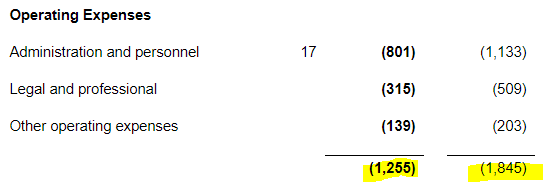
But Duke didn't pay these amounts in cash to its suppliers, as you can see on the cash flow statement. It paid only c. £1.4 million last year, and only £1.1 million in H1 (as I mentioned above):
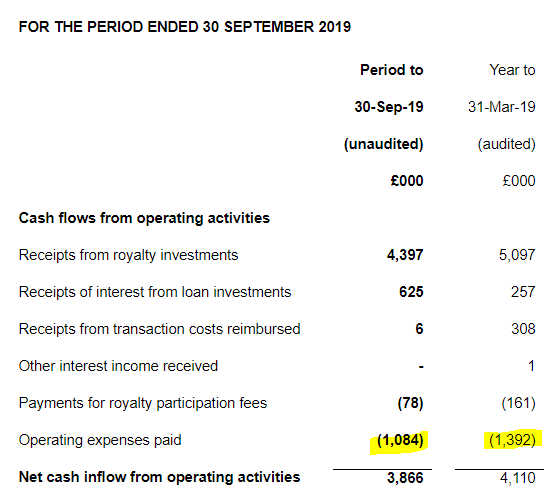
So you miss out on the real costs incurred if you're only watching the cash flow statement.
Secondly, taxes don't appear to get a mention when it comes to cash flow.
Taxation expense of £400k was incurred in H1, and the total (current and non-current) tax liability on Duke's balance sheet increased by this amount, implying that no tax payments were made by Duke. This would help to explain why tax payments can't be found on the cash flow statement!
That £400k expense is worth noticing for Duke's shareholders. Duke is headquartered in Guernsey and is tax-free in that jurisdiction, but it still has to pay some tax in the UK. Depending on the timing of tax payments, you could miss it if you only look at the cash flow statement
Thirdly, the cash flow statement conceals the fact that most of the royalty investments are amortising and will abruptly come to a halt at some point in the future.
I grant that this problem is very far away. And royalty payments could and should increase over time, due to revenue growth at the investees. But I think it's an important point to understand. Most of the royalties are not perpetuities, i.e. the payments will not last forever. So treating these payments as a measure of ongoing earnings could be a little aggressive.
The income statement doesn't suffer from this problem, since it should reflect the changing value of the royalties, in line with their projected performance until expiry.
Of course the income statement isn't perfect, either. It is more subjective, since it require inputs such as a discount rate to value the portfolio, and there is no objectively correct discount rate to apply.
Even so, I think the £3.3 million net income figure is worthy of shareholder attention, since it includes all of the operating and taxation expenses incurred.
Dividend - Duke has been heavily supported by a number of institutional investors, who I suspect are using it to help their equity income strategies. The dividend has been a major priority from the start. The quarterly payment is currently 0.75p, for a yield of 6.25% against the current share price. Forecasts suggests that these payments will be increased again, soon.
Debt facility - as noted previously, Duke can borrow up to £50 million from Honeycomb Investment Trust (LON:HONY), at 7.25% plus one-month LIBOR. The borrowings shown on today's interim balance sheet were paid off by a £17.5 million equity fundraise in October.
Outlook - there is no information given on the financial performance by individual investees in this report, but the outlook statement is confident.
My view - I think these are good results. As many of you will know, I sold out of Duke in August. But I acknowledge that the company's performance thus far is faultless, in the sense that none of the investees have defaulted and that a rising stream of quarterly dividends has been paid on time.
Long may it continue!
If you find this company interesting, I'd recommend that you take a look at the investees and see what you think. Some of the big ones include Lynx Equity (UK), SijfaCruises and Trimite.
How would you expect these businesses to hold up in a recession? Would you be happy holding most of their enterprise value (on the assumption that the equity value left after Duke's refinancing is not too large)? Are you comfortable with the notion of lending to them using borrowed funds? Ask yourself the tough questions. Or ask the company - they are very open to communicating with their shareholders.
I'll continue to watch this one from the sidelines, for the time being.
Haynes Publishing (LON:HYNS)
- Share price: 438p (+3%)
- No. of shares: 15 million
- Market cap: £66 million
This interesting little business put itself up for sale last month, following the death of its founder. It said that it wanted to be part of a larger organisation with more financial resources.
It is known for making manuals for cars, motorcycles and more. It also has impressive data services in the form of HaynesPro and Oats.
Many formal sale processes happen during a period of disaster but that is not the case for Haynes. Today's update confirms that H1 PBT is up by 37%.
Chairman comment:
"I am pleased to report another strong period of trading for Haynes, driven entirely by organic growth, with both revenue and underlying profit tracking ahead of the prior year.
Our strong performance is underpinned through our sustained investment in product innovation, content integration and growing data coverage, which continues to generate value for all stakeholders of the Group."
My view
There's not much to analyse in this update. For what it's worth, I do have a positive impression of Haynes and find the decision to sell a little perplexing, since the company appears to be capable of making nice profits on its own.
A son of the founder is the CEO, and the Haynes family still owns the majority of the shares. I'm sure they thought long and hard about what would be in the best interests of all stakeholders in the busihess.
There is no word of any bid for the business yet, and predicting the eventual sale price is not exactly easy. Stocko gives it a ValueRank of only 29 but the digital nature of the current business could allow for it to be sold at a hefty multiple.
The forecast P/E multiple according to Stocko is in the region of 16x.
Northamber (LON:NAR)
- Share price: 47.75p (+6.1%) (not the real price, wide spread)
- No. of shares: 27 million
- Market cap: £13 million
Statement regarding David Phillips
Please note that I have a long position in this share.
This is very sad news regarding Mr David Phillips.
Mr Phillips founded Northamber in 1980, and had a long and illustrious career at the helm of this tech "distie".
I met him at a few Northamber AGMs, and he was a generous host at every meeting. My condolences to his friends and family.
From an investment point of view, Northamber has fascinated me for a long time. It was one of my original "value" investments, but the value never properly emerged during my original holding period.
I held it from 2013 to 2016, selling it for a small profit not far from where I had originally bought it, c. 31p.
The experience taught me that pure value wasn't necessarily a very good strategy. Deep value investments could drift along for many years, achieving little.
I noted last month that Northamber's reported net assets were £16.6 million, but that this was before the sale of its warehouse for £10 million more than its book value.
Having looked at the numbers again today, I couldn't resist buying back into this company. To fund the purchase, I sold Record (LON:REC).
Even adding on the cash from the warehouse sale doesn't fully describe the value opportunity here, in my view.
The company also owns an 18,000 square foot office building, Namber house, in Chessington. It was originally bought for around £3 million, in 2001, when it was newly built. But Northamber's "land and buildings" on its balance sheet are now only considered to be worth £1.6 million.
I don't know what this building is worth, but the freehold of a similar-looking office in Leatherhead which also has plenty of parking spaces is currently for sale at £318/sqare foot.
If the Northamber office was worth that, it would fetch £5.7 million, raising the value of the balance sheet by another £4 million. That would bring total balance sheet value to over £30 million, when you include the proceeds from the warehouse sale (but before taking operating losses into account).
That value estimate for Namber House as an office could be completely wrong, but there is an alternative. In 2014, Kingston Council granted prior approval for a change of use of the building to 28 residential units: 20 one-beds, 6 two-beds, and 2 three-beds with parking.
And that's not all. According to the most recent annual report, the company had tax losses of £4.7 million. But these can't be found on the balance sheet, "due to the uncertainty there will be sufficient taxable profits in future to absorb them".
These tax losses should be more than enough to avoid corporation tax on the sale of the warehouse and the office (if indeed the office is sold), with plenty of surplus tax assets left over that.
As for the core distribution business, it has been loss-making for nearly a decade but the losses aren't huge in comparison to revenues and maybe there is a rival who would pay something for it, if that's the direction the Board decided to take. I wonder what they might do.
I swore off deep value investing a few years ago but having looked at these numbers today, I couldn't resist trying one more time.
Appropriately, Northamber passes the "Ben Graham NCAV Bargain Screen" according to Stocko. And that's before taking into account the sale of the warehouse, the potential value of the office, and the tax losses.
Ok, that's it for the week. Thanks everyone!
Graham
Disclaimer
This is not financial advice. Our content is intended to be used and must be used for information and education purposes only. Please read our disclaimer and terms and conditions to understand our obligations.

16 comments
In relation to Northamber (LON:NAR) I believe that trading losses can only be carried forward against future profits of the same trade, so if that's what the 4.7m is then I don't think it could be used to cover a future capital gain.
I find Haynes Publishing (LON:HYNS) perplexing. It was on my watch list that I didn’t get round too, price went up a lot, too much for me, but it has a lot going for it, big back catalogue, IP, digital strategy..... then puts itself up for sale, with little market reaction. I partly think it has a lot of potential as a short term position with a tight stop, upside bid optionality but I don’t know. Something seems quite odd with this situation.
I tried to buy £5000 worth of Haynes shares a few weeks ago, but HL told me they couldn't supply that many shares.
Graham
That is a superb piece on Duke Royalty (LON:DUKE) well done. I have a small long position and whilst I am happy to leave that on for now your piece gives a really interesting perspective that I'm not sure I had properly calibrated into my investment thesis. Thanks
Some new videos today published today by piworld:
Sosandar (LON:SOS) the full results presentation, given by management last week during the results roadshow. They are very enthusiastic how it is going, with a record revenue in November. Through, increased investment in product, staff and marketing, including TV advertising. Here's the presentation by Co-Founder & CEO, and Head of finance.
For weekend watching, the second part of The Market Maker: what do market makers do? Insights from an ex Director of Marketing Making at Winterfloods. Part 2 builds on part 1, with more insights into how market makers set the price. We learn more about dark pools, tree shakes and much more. And yes, market makers can and do, get it wrong!
Here again, is The Market Maker - Part 1, in case you missed it last week. Discussing risk management, setting a price, the spread, and much more.
Happy watching!
Duke Royalty (LON:DUKE) .....Post interim results conversation with the CEO and FD.
£115m mkt cap. October raise of £17m at 44p.
CEO happy with life, operational cash flow up 200% pleased him. 2020 will see a focus on extending stock coverage with brokers and has three already. Operational leverage will be evident in 2020 as full team in place (8) to handle deals. New financial terms agreed earlier in the year. Asset diversification important and an 'around about 3p ' for a FY dividend. The hopper is filling and all deals will 'be accretive'. More in the members note.
James Halstead (LON:JHD)
In the AGM statement and trading update today, they state
"Our cash balances remain robust although the new rules on accelerated quarterly UK corporation tax payments, with six instalments in the financial year, will mean a one-time effect of some £4 million."
I have been completely unaware of this as an issue. Will other companies be affected?
DWit199
"Our cash balances remain robust although the new rules on accelerated quarterly UK corporation tax payments, with six instalments in the financial year, will mean a one-time effect of some £4 million."
I have been completely unaware of this as an issue. Will other companies be affected?
I wasn't aware of this either - the links i have looked at suggest for profit over 20 mill per year new rules are that the four on account payments are earlier than were made previously - there didn't seem to be specific mention of 6 payments though - perhaps that includes balancing adjustments ??
IF my calcs are correct based on what i looked at then previously/smaller companies pay.0% of corp tax at half year end and 50% of corporation tax at full year end.
Larger companies now pay 50% at half year and 100% at full year.
So its a swap from being 6 months o/s to nothing o/s at year end and half year end - Halstead had 10.4 (5.2 mill hit estimated based on above maths) mill tax per latest accounts so numbers don't match exactly but figures will always be estimated in year and i am probably missing something.
When they say one-time effect - it is actually a permanent ongoing situation where such large companies will have less cash at bank than they would have had (if we presume they pay in full on time). Practicably speaking though the reduced cash will have a matching lower current liabilities payable - i am guessing most companies window dress their year end balances somewhat anyway so perhaps this forced adjustment will make such window dressing slightly less severe than it would have been all other things being equal.
CT installment payments was introduced in 2017 and active for APs after April 2019 for "large" and "very large" Co.s.
Most profitable PLC's will be affected but it should be manageable, though it can take a couple of years to adapt cash and treasury management for the outflows - I am expecting to see reference to CT installments in ARs for the next 18 months.
Graham,
On a quiet, wet Friday 1 week before the UK election, a moment for some wider thoughts?
Is the GE material or just a sideshow for the UK stockmarket on a 6month and 5 year basis?
Peter
There's a Ben Hobson disuussion on this topic.
DUKE....reads ok, £5.9m income, PBT £3.7m. R emember, raised £17.5m @ 44p in October (and the shares slumped to 42p before the pre 1H rally!) Divi upped in Q2 to 0.75p so 2.95p FYe? Interesting that opps team now at 'sustainable level' giving 'operational leverage'. No colour on the 12 partner investments. New LTIP awards and less director fee info than last time! Have Neil on the phone in an hour.
While the new revolving credit facility is on improved terms, an "interest rate equal to one-month LIBOR plus 7.25% per annum" still seems ridiculous considering where rates are at the moment. Maybe this is indicative of the risk profile...
Duke Royalty (LON:DUKE)
Numbers look good - I do wonder what would happen in a recession tho'.
"I am pleased to report the results for the Group for the six-month period ended 30 September 2019 ("Interim 2020"). Interim 2020 was a period of ongoing rapid development for the Company with revenue, profitability and cashflow all increasing materially year on year, as well as further deployment of capital into its royalty portfolio. The Group also strengthened its operational team."
Jim
Hi Jim
"what would happen in a recession" - a great question that should be applied to ALL companies! And it is a relevant question for Duke Royalty (LON:DUKE).
Best
Graham
My morning smallcap tweet:
Haynes Publishing (LON:HYNS) Mobile Streams (LON:MOS)
Haynes Publishing (HYNS) guides H1 adj pretax up 37%, cf FY f/c up 39%. Should support the formal sale.
Mobile Streams (MOS) CEO resigns (he sold his shares this week) but stays as an employee in the role of non-board VP Business Operations. Only 2 weeks ago, after a rescue placing, he said "the Company can now move forward with the exciting developments it has identified in what we hope is a new chapter as a public company."