Small Cap Value Report (Mon 20 August 2018) - MUL, CWD, Housing Market, KWS

Good morning!
Many executives and financial types are lying on a beach somewhere as I type, leaving us to soldier on without quite as many game-changing RNS announcements as we normally do.
Still, we have a couple of things worth looking at:
- Mulberry (LON:MUL) is down significantly after 'fessing up to its House of Fraser exposure (£3 million), so let's take a look at that stock.
- Countrywide (LON:CWD) has been rebuffed by shareholders after trying to introduce a new remuneration policy along with its refinancing.
- Keywords Studios (LON:KWS) has made another acquisition, so it's a good day to catch up on developments there.
Resource Stocks
There are requests in the comments for me to look at some resource stocks. Long-time readers will know that my policy is to avoid the sector. Sorry about that.
Mulberry (LON:MUL)
- Share price: 462p (-19%)
- No. of shares: 60 million
- Market cap: £277 million
House of Fraser and UK Trading Update
Another retailer comes clean on its House of Fraser exposure.
Earlier this month, Paul contributed a comment on French Connection (LON:FCCN), suggesting that its bad debt exposure to HoF was up to around £2 million (£50k at each of c. 40 stores).
Mulberry now says that it anticipates £3 million of exceptional costs, or about £140k per concession. This is a mix of bad debt, loss of value in fixed assets and potential restructuring costs. Perhaps this is a bad sign for French Connection - whose shares are down by about 3% today.
Mulberry's £3 million hit is, however, much smaller than its total decline in market cap today.
We also have a nasty trading update: the UK market remains "challenging", and if these trends continue in H2 then profit for the full year will be "materially reduced". No numbers are given, so investors are left to guess at how bad the situation might be.
My view
I've been interested in this share for a while. The problem is that it has always had such a high rating, it's been beyond the levels where I could justify a purchase.
But the share price is now at the cheapest level since 2010. Definitely helps to bring it back onto my radar!
In June, I covered the company's preliminary results statement. Excluding expansion costs in Asia, it made PBT of £11.3 million. If we assume a 20% tax rate for simplicity, this leaves us with £9 million of adjusted net income. Not bad.
The Asian expansion is critical to the long-term value of the business. I see it as potentially following in the footsteps of Burberry (LON:BRBY) (in which I have a long position), where 45% of the stores and 40% of sales are in the Asia Pacific region. Mulberry is still near the beginning of this journey.
In the short-term, the problem is the UK business (responsible for more than 80% of retail sales in FY 2018).
It had already been disclosed that Mulberry's UK like-for-like sales were down 7% for the 10 weeks to June. With today's announcement, we can presume this isn't getting any better.
Therefore despite being interested in this company, I'm not in any rush to buy these shares. I expect them to drift lower as the financial performance deteriorates in the short-term.
See the woeful Momentum rating (and Value is of course pretty bad, too):
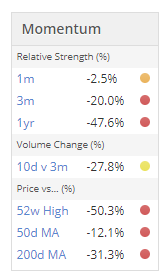
The thing about Momentum is that it tends to persist for longer than people expect it to (on the upside and the downside).
So I expect there will be cheaper opportunities to buy this share as stale bulls from 2011-2013 head for the exits.
At some point in the future, it should be possible to buy this when earnings are rising, the brand is succeeding and the earnings multiple is reasonable.
One other hugely important factor is that 91% of Mulberry shares are held by just three entities.
This might help to explain the strange pricing of the company in recent years. Small investors who have wanted to participate have only been able to trade 9% of the company.
Finally, as an anecdote, I have noted that Mulberry.com is rated "Bad" by trustpilot, while Burberry.com is rated "Average", based on similar numbers of reviews. One other small reason why Burberry deserves a better rating than its smaller, handbag-focused competitor.
Countrywide (LON:CWD)
- Share price: 14.3p (-2%)
- No. of shares: 422 million
- Market cap: £61 million
Proposed Remuneration Policy and Countrywide AGP
One gets the feeling that there is lots unsaid with this announcement.
Following "constructive and supportive" consultation meetings with major shareholders, the Board has withdrawn its proposed new remuneration policy.
I've trawled through the Prospectus and managed to find details of the Aggregate Growth Plan - why not just call it a bonus scheme! It's on page 261 of the document (out of 315 pages).
According to the plan, managers:
will share among them 10 per cent. of any value created above this hurdle, which will be paid in the form of shares at the end of the performance period which must then be held for a further two years.
The "hurdle" was going to be 15% per annum compound growth in the market cap of CWD until December 2021.
It's an example of a type of remuneration policy that I hate: handing over massive chunks of value to managers on the basis of increases in the share price. We do see this type of thing all the time.
I prefer to see managers being paid well in cash for achieving proper objectives like ROCE, net income or other KPI targets.
Countrywide also follows the common practice of excluding share-based payments from the "adjusted EBITDA" it reports to shareholders. So shareholders are asked to pretend that the dilution of issuing shares to managers doesn't happen.
It's good to see that in this case, the institutions finally said enough is enough.
It looks like a poor-quality business to me, so I'm not going to research the shares in any further detail.
Housing Market
In a separate but related development, I note that the latest asking price figures from Rightmove (LON:RMV) show the fastest ever drop for the month of August.
The main source of weakness was London, where prices fell by 3.3% and are now down by 1.2% year-on-year. Prices are still up year-on-year on a national basis.
What do readers think about the outlook for the UK housing market?
For example, I thought this was a startling statistic:
The number of EU-born workers in the UK increased by 7,000 from Q1 2017 to Q1 2018, compared with an increase of 148,000 from Q1 2016 to Q1 2017.
What a big difference.
The reduced inflow of labour is said to be contributing to rising salaries and better benefits in a wide variety of sectors, as employers struggle to fill vacancies.
Won't this also have an effect on the housing market, especially in London which many migrants automatically choose as their destination?
It's a complicated issue, but I feel safe in the assumption that everyone connected to the housing industry would have a financial interest in seeing more people coming to Britain, rather than fewer.
Keywords Studios (LON:KWS)
- Share price: 1831p (+3.5%)
- No. of shares: 63.6 million
- Market cap: £1,165 million
Acquisition of Studio Gobo and Electric Square
Keywords provides outsourced services to the video games industry. We last covered it in April. It has grown via a very long series of acquisitions.
This is an up to £26 million purchase of two related companies based in Brighton and Hove.
It marks further expansion in Keywords' game development capabilities, a key focus for it at the moment.
Gobo adds considerable expertise and scale to Keywords' new and growing video game development business. It significantly increases Keywords' access to the UK's talent pool of video games developers, growing our total UK game development team to 220, in combination with our existing 50-strong team at d3t, whilst also expanding our worldwide game development team, which includes Snowed In, Sperasoft, and GameSim, by over a third to 610 people.
Gobo's underlying EBITDA for the year ending July 2018 is expected to be £3.6 million.
Keywords is paying £15 million for this upfront, and a further £11 million if there is a "substantial increase" in EBITDA over the 12 months following completion.
My view
I'm impressed by Keywords' achievements. The pace of acquisitions has been dizzying - something like twenty since the start of 2017. So far, it appears to have executed them very well.
On the other hand, I don't know why the market values its earnings so highly. At the end of the day it is just doing the work that its clients (the video game publishers) don't want to do themselves, and that they prefer to outsource.
Video game industry fundamentals are good, and Keywords does have first mover advantage and the advantage of being the largest outsourced service provide to the industry. This is definitely worth something.
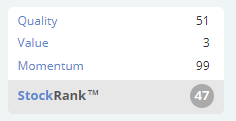
But I share Stocko's puzzlement at the pricing:
Suggestions
I appreciate all the comments/feedback! When it comes to suggestions, feel free to fire away every morning with your ideas. This is a team sport, after all.
There are no absolute rules about what we cover in the main report. In general:
- I usually don't cover resources/energy, pharmaceuticals/biotech or investment funds. I tend to focus on the financial and consumer goods sectors. Paul has his own favourite sectors (e.g. retail).
- We prefer companies in the £10 million - £400 million market cap range. Flexible on this.
- Interesting news that day, especially full-year or half-year results. Trading updates are often worth a mention, although if they only say "in line with expectations" then we will probably give them a miss.
- Companies we have written about before (i.e. that we know something about already) and genuinely think are interesting are more likely to get coverage.
- Companies which multiple readers have requested are more likely to get covered, too.
Going to call it a day there! Have a great evening.
Graham
Disclaimer
This is not financial advice. Our content is intended to be used and must be used for information and education purposes only. Please read our disclaimer and terms and conditions to understand our obligations.

40 comments
Keyword Studios
I share your ambivalence on this one Graham. I want them to succeed, but can’t help feeling there are too many deals here. 99pc of the time acquisition vehicles in any sector, crash and burn. It looks to be on a pe of c35x- so valuation multiple v.high. Any Sellers out there ?
"99pc of the time acquisition vehicles in any sector, crash and burn"
Really?!
Is this fact or opinion?
This was a particular interest to me regarding the housing market.
The number of EU-born workers in the UK increased by 7,000 from Q1 2017 to Q1 2018, compared with an increase of 148,000 from Q1 2016 to Q1 2017.
With the numbers of migrant workers decreasing, the number of new builds still going up are we likely to see a shift from supply and demand swinging the other way? I will personally watch this space closely, if that is the case then house builders may be in for a decline.
Does anybody have any information as to whether the new builds are for social housing or first time buyers?
We are at an interest time whereby there are various changes happening that may depress house prices in the near future (I say depress and not crash as that is a little extreme). For example, Net migration decreasing, interest rate rises, uncertainty towards brexit, and a whole host of tax hurdles from the government to make it harder for landlords to add to their portfolios.
Interested to hear others thought on this subject.
Just some background comments on the housing market as a whole. I agree with Daniel that there will be a negative impact on many businesses connected to the housing market in the next few years. This is due to a number of economic factors and government policies which are intended to "slow down the market". (Note, I invest in both shares and buy-to-let property).
There is a widely followed theory in the property investment world called the "18-year property cycle", which is based on Ray Dalio's thinking on "how the Economic Machine works". He has a really nice 30-minute video on YouTube (search Ray Dalio How the Economic Machine Works), and for those who haven't heard of Ray Dalio, more here https://en.wikipedia.org/wiki/... For more on the 18 year property cycle, this is a good place to start https://www.propertygeek.net/a...
According to the cycle theory, property is now entering the "mid-cycle wobble", a time when it will become harder to sell property, and prices will fall slightly, but not crash. This mid-cycle wobble is thought to be down to a number of factors: Brexit uncertainty, a slowdown in economic migrants (as you point out), stamp duty increases, changes to buy-to-let tax-relief rules and increased scrutiny of LTV ratios for portfolio landlords. Many of these changes together make high-priced, low-yielding property unattractive to investors. It will become attractive to investors again when prices fall or rents rise.
On the other side, the lower pound has encouraged overseas investment (especially in Manchester and Liverpool), low-rate credit has been readily available and the internet has made it easier for people to be flexible in where they work, supporting migration of people and companies to areas of the country where property costs are lower. Hence, prices in the North of England rising faster than the South.
Help-to-Buy also plays a significant role at the lower end of the market. This has helped to push up prices of lower priced new-build property by increasing the supply of low-rate credit to first-time buyers. The first-time buyers who use help-to-buy are taken out of the market for similarly priced second-hand property, reducing demand for those properties even further. One beneficiary of this is quoted housebuilders, who's shares have all enjoyed a good run since the Brexit vote. There was a noteworthy share-price wobble in the sector last August when it was rumoured that the government was scrapping help-to-buy. More here https://www.ft.com/content/d02...
Finally, Stamp Duty has a big part to play in all of this as well. A £500,000 property will incur £15k stamp-duty for a home buyer and £30k for an investor, thanks to the 3% surcharge on all additional properties. This puts London at the bottom of the list for any investor. And for anyone moving houses at the £500k+ level, Stamp Duty is a major cost, and sometimes a factor in deciding whether to move at all.
This does make it more attractive to extend your house rather than move. Witness the number homes that have been extended in your area. Beneficiaries of this trend are consumer-focussed building supplies firms like Norcros (LON:NXR) (I hold) and Howden Joinery (LON:HWDN).
So, sellers of certain types of property will be negatively impacted by a lack of buy-to-let investors, a lack of first-time buyers AND a lack of economic migrants. One bright point is that the cycle theory says that the next 5-7 years will see even faster growth in property prices before we get a crash.
A valuable comment, thank you. G
Graham,
re MUL (sorry can't get tickerisation to work)
A little scuttlebutt(ish) I know but hopefully still worth mentioning. My wife used to frequently buy Mulberry handbags and very much liked the price as they were 'affordable luxury'. They were still an unbelievable (to me) £500-£1000 each and seemed to have the status that made them appealing to my wife's generation of thirty-somethings.
I believe they then went up market and tried to go to a much higher price point. This failed as if you are going to spend a lot, apparently you buy Gucci/Burberry/Prada etc, so they went back to where they were. The net effect is that demand apparently is gone, as the previous must have bags ie 'The Alexa' have just lost their lustre. The main thing I'm feeling right now is I know way too much about handbags!
Nevertheless, add into that the fact that they sold through House of Fraser, which never seemed to have a defining shopper to me, I see little to make the Mulberry product, which is essentially handbags, appealing as they have lost their traditional (profitable) market with the attempted change of strategy and never reclaimed it. So for my money a traditional luxury company eg Burberry (LON:BRBY) is a much more appealing investment before you even compare valuation as their product is well defined, proper luxury and has global appeal and most of all has enduring appeal.
Cheers
Since we're talking about handbags today, IMO £KORS (I hold) is the standout value proposition in the affordable luxury space. They have very reasonable P/E and P/FCF compared to some in the sector, cracking ROCE, ROE and stockrank, neglible debt (were debt-free prior to purchasing Jimmy Choo recently, and are now paying that down), and appear to be on the cusp of returning to growth.
And to add to the handbag discussion... for my money Paris-listed LVMH is a decent alternative to Burberry (LON:BRBY). It trades on a 25x PE multiple (Burberry (LON:BRBY) is around 32x!) and you get some diversification in terms of brands and products (they own some big-name champagne houses, luxury watch brands as well as fashion and leather goods). Like an upmarket £ULVR!
Good suggestion danielbird193! Having watched Burberry (LON:BRBY) performance and been slightly concerned by how much market faith is being placed in the new management/creative team a quick comparison to LVMH (MC FP) has thrown up (vs £BRBY):
A market cap of 14.7x that of Burberry (LON:BRBY)
A cheaper PE, EV/EBITDA, P/BV etc and most importantly when looking at historical ranges not so extreme vs historical average.
Interestingly, a quick chart comparison over 2 years shows that Burberry (LON:BRBY) has in fact only just been playing catch up during 2018, so over 2 years they have performed about the same.
My conclusion, thanks for flagging the alternatives as it has prompted me to think further on Burberry (LON:BRBY) and whilst I will continue to hold Burberry (LON:BRBY) I like the idea of having an international switch idea to ponder on.
Thanks.
Anecdotal material here. I work in a bar and chat to a lot of guys in the building trades. They tell me the work is now in the north and midlands. The wages on offer in London are no longer sufficient for the expenses of working there.growth seems to continue but outside the capital.
Thanks for that! G
I think its stuff like Countrywide that is so disgusting. Here is the price two years ago:
24/08/2016 271.40
So shareholders have lost around 95% of their money in two years, the share price is now just 14p and the directors want a huge incentive? Those who bought in 2014 or prior have been wiped out completely.
The stock market has far too many "lifestyle companies" as it is, where the sole objective seems to be to pay large director salaries often through yet another placing.
Based on recent experience of trying to sell a one-bedroom flat in suburban South-East London, I'd say that a 3.3% fall in asking prices seems to understate the actual weakness I have seen in the market. My property (along with lots of others) has been sat on the market for weeks and I've found it difficult to attract viewings, despite one price cut and the agent doing everything possible to drum up interest. I accepted one offer only to have it withdrawn a couple of weeks later due to the buyer having an offer accepted on another property.
Brexit and immigration will undoubtedly have something to do with it. I suspect recent changes to the buy-to-let tax regime (both mortgage interest payments and the new 3% stamp duty on second homes) have had quite an impact on properties like mine as well. All-in-all it's not a good time to be selling property, and I don't see that changing any time soon.
What does that mean for investors? Obviously bad news for the likes of Countrywide (LON:CWD) and Foxtons (LON:FOXT) which have already taken a hammering. Probably bad news for big-ticket consumer stocks like £AO as well, because moving house stimulates demand for white goods. Are there any companies could do well from a stagnating housing market? I'm tempted to take another look at Paternoster Resources (LON:PRS) and Grainger (LON:GRI) which are both property funds with exposure to "build to rent" developments... but in general I think a weak housing market is a bad sign for the economy overall.
I've enjoyed your macro thoughts on the FTSE and the housing market over the last couple of days Graham. Much appreciated.
It's worth keeping in mind that some of the shares affected by the housing market also depend on the number of housing transactions and not just house prices. Transaction numbers did hold up for 2017-18 and the latest monthly data in fact gets published tomorrow (Tuesday) so that might be worth taking a look at too!
https://assets.publishing.service.gov.uk/government/uploads/system/uploads/attachment_data/file/727273/UK_Tables_Jul_2018__cir_.pdf
I also wouldn't be surprised if transaction numbers become affected by the number of first-time buyers who then can't afford to trade upwards - e.g. move from a flat to a house. I live in a two bed flat in zone 4 Greater London and the chances of me buying a house in the same area are nil unless I get lucky in the marriage stakes!
Thanks for the insights Paraic! G
Mulberry (LON:MUL) seems to fall down the gap between 'normal' and 'luxury' goods (- just my opinion).
They used to sell menswear - and I think still sell womenswear.
Until I read that 91% of the shares are held by 3 people, I really wondered what I was missing.
They are not hermes or burberry.
To make me interested the SP should be closer to 200 than 460 (- just my opinion)
Indeed, back in 2009, eps was 4.5 and the sp was about 70-100
In 2018, eps is 12.0 and the sp was ~460-1000
Agreed, it needs to fall a lot further to look invest-able (or the international expansion needs to really take off at pace).
Lawyers Pinsent Masons have drawn attention to the significant risk that a no-deal Brexit poses to the flow of personal data within and between firms. This may be a significant issue for many companies that are regularly discussed here (most e-commerce companies, for example).
Here's an extract from their report
Flanagan said: "Assuming we are not in the EEA when Brexit occurs, the UK will become a 'third country' for the purposes of EU law, which will potentially impact personal data exports from EU to UK. While an adequacy decision is likely to be the least disruptive option for UK businesses, the prospect of a ‘no deal’ Brexit makes the likelihood of an immediate adequacy decision unlikely, not least because to seek an adequacy decision a country must already be outside of the EU, and historically adequacy decisions have taken on average around 28 months to be granted."
While the UK has implemented the EU's General Data Protection Regulation (GDPR) in full via the new UK Data Protection Act 2018, the inclusion of exemptions around immigration and the existence of significant powers for UK authorities in relation to communications surveillance, as included the Investigatory Powers Act 2016, could potentially cause issues for the UK when seeking an adequacy decision, Flanagan said.
"With that in mind, we are increasingly seeing clients prepare for an outcome whereby no adequacy decision is immediately available on 29 March 2019 or indeed at all," she said. "The GDPR sets out that it is not permissible to transfer personal data outside of the EU to a third country without an adequate safeguard in place, and infringement of this provision could result in a fine of 4% of a business' annual global turnover or €20 million, whichever is highest."
Adept Telecom (LON:ADT) announce acquisition of Shift F7, which is earnings enhancing from completion. Turnover £5m EBIDA £0.7m. For which they are paying £5m less net debt and tax liabilities (est. £0.5m). Shift F7 offers outsourced managed IT & telecoms solutions (incl IT support, hosted IT, cyber-security, data connectivity and next generation IP telephony services).
The Adept Telecom (LON:ADT) strategy and vision is outlined in this interview by Judith MacKenzie, Downing LLP with Ian Fishwick, CEO.
https://www.piworld.co.uk/2018/08/20/judith-mackenzie-meets-adepts-ceo-ian-fishwick-july-2018/
As well as the £5 million initial consideration there is an earn out of up to £2.9 million payable based on business performance in the 12 months post acquisition.
Upto £7.9m for EBIDA of £0.7m is an 11x multiple - not eye-watering, but not exactly the bargain that the headline initial payment makes it seem!
But Ian Fishwick sticks his hands in his pockets and buys £38k - Ok not material but his holding is now 3%. I've held for 2+ years and very happy
So what was the rejected Remuneration Supertrough (thanks Mr. C) at Countrywide (LON:CWD) ?
As I read the ridiculously voluminous circular (315 pages - skip to page 292) at
https://www.countrywide.co.uk/...
it is all to do with mcap : "The hurdle is a compound annual growth in the market capitalisation of the Company immediately following the transaction, of 15% a year over the performance period" (3 years).
For this the maximum remuneration is shown as:
Chair £6.8m
MD £9.1m
CFO £8.4m
That is for the mcap moving from £40m to £61m over 3 years for a company whose share price is now less that a quarter of its level 3 months ago.
Bargepoles out - the plan may have been withdrawn but the people who thought it was a good idea are still there..
You are right sharw. Performance related bonuses should relate to specific over-performance by the Board of Directors. The board of Countrywide (LON:CWD) need to be showing that they are doing better than the market as a whole (benchmarked to beat a relevant market indicator) and to be providing improved shareholder returns (benchmarked against a market comparator for eps growth, free cashflow...). Above all the target must not be something that directors will aim for to the detriment of the overall health of the business.
There was that nice phrase in Pink Floyd's Have a Cigar
"I'll tell you the name of the game, boys
It's called riding the gravy train"
Yes shar - it's awful stuff.
On the numbers, though - I think the likelihood of those maximum rewards being achieved is very low, based on the upper limits:
"The incentive pool value will be limited to no more than 5 per cent. of the total value created, calculated as the growth in market capitalisation from the start to the end of the performance period."
(page 261/315)
So unless I am reading it wrong, the market cap would have to increase by several hundreds of millions of pounds over the period in order to trigger those max payments.
And increasing the market cap by 15% compound per annum would not trigger any AGP payments at all, let alone the maximum payments.
All the best
Graham
I think you can safely assume that the thumbs downs were because it was a resources stock which are not usually covered here.
I know you are not so keen on resource stocks but if you have a chance to review and comment on Kenmare Resources (LON:KMR), I would fine it very interested in you assessment and analysis.
Janes
I don't know why you got three thumbs down on your suggestion, it seems a bit harsh as everyone is surely welcome to make a suggestion on coverage, provided that it relates to an RNS on that (or very recent) day...? Maybe these people got out the wrong side of bed this morning. Anyway, I'll give you a thumbs up to try and soften the blow... especially on a Monday morning! If anyone doesn't like a suggestion, why not be nice and just ignore it? :-/
I had a quick look at the Kenmare Resources (LON:KMR) results (I don't hold), but although the financials look rather improved I think this is largely boosted by commodity price increases and quantity of ore shipped, the actual production figures look rather disappointing to me with every ore mined down - this was partly flagged in Q1 due to outage, but hasn't recovered properly from the looks of things. Closing stock of finished product is also vastly reduced, which doesn't quite stack up with the H2-upbeat tone. (I don't hold, and won't be doing so).
On what looks like a quiet news day there might be a case (if he had the inclination) for Graham commenting on the 'difficulties' of junior resource stocks, using ARC Minerals (LON:ARCM) as an example. I'm sure it would be interesting.
Thanks as always for your informative, clear and very readable writing.
I was surprised to see just how hard Mulberry (LON:MUL) shares fell on this morning's RNS. A £3 million hit would be 43% of last year's profit before tax, on top of which they report "challenging" UK trading, so not a pretty picture. On the other hand, they had £25 million cash in the bank at 31 March 2018 and no debt. This isn't terminal, and if the company can continue to report progress in international sales (which grew 20% in the last financial year) then I think this could become and interesting recovery play at some point.
One thing I've always liked about the company is that its accounts are very simple and straightforward, with a full reconciliation between adjusted and reported figures.
I don't currently hold but will be watching closely when they publish interims later in the year.
The Mulberry (LON:MUL) Stock Report suggests that Sales have not grown in the past five years.
The p/e of 48x seems excessive in this context, no?
Talking of "irrational exuberance" I'd be interested in Graham's thoughts on Mulberry.
Its aspirations to become a global luxury brand seems to have caught the market's attention and given it a very high valuation, but today's RNS seems to suggest it's just a struggling retailer - down 30% as I write.
I think I'll stop being provocative and go and have breakfast now.
Phil
Hi Phil - yes, planning to look at Mulberry (LON:MUL). Cheers. G
"blue-sky resource stocks liable to irrational exuberance."
There is an argument if you take out "resource" that this is a pretty good description of Versarien.
Just another collaborative agreement - there seems to be very little actual current revenue from graphene - this is one I'll wait out until the numbers become more apparent.
Good Luck
Phil
Yes I have to agreed Edward about Versarien, it seems to announce game-changing deals every few weeks, but in nearly every case without any significant financial details. It wouldn't surprise me if most are worth a few thousand pounds and most will have vaporised within a couple of years.
Peter, if you did some in-depth research on Versarien (LON:VRS) , rather than just reading their RNS's, it is likely you might come to a rather different conclusion about their prospects.
The rub is though that the same could be said of any number of "story stocks", some of these will no doubt go on to be the best thing since …
Equally though many will not. It is not unreasonable therefore imho to take a cautious approach and wait for some material evidence of profitable commercialisation and a demonstration that these companies have a funding path through to profitability.
(Not specifically a comment on Versarien (LON:VRS) , just the "type")
That was the joke, Mr. Canham.
Apologies Joules.
Humour gene not working at 8am - must remember to take more caffeine.
Phil
Nah letap73, Graham doesn't cover blue-sky resource stocks liable to irrational exuberance.
In other news, Versarien (LON:VRS), loss-making 2-d miner, has announced a potentially game-changing RNS with AIXA, a SOuth Korean composites manufacturer, to build smart home panels, electric vehicles etc etc. https://www.investegate.co.uk/versarien-plc/vrs/collaboration-agreement-with-axia-materials/201808200700042241Y/?fe=1&utm_source=FE%20Investegate%20Alerts&utm_medium=Email&utm_content=Announcement%20Alert%20Mail&utm_campaign=Versarien%20PLC%20Alert
I am going to suggest ARC Minerals (LON:ARCM). A small mining company which could be subject to a potential takeover?
This is sort of company that can be easily ramped. I have only suggested this company on the basis that those with a more discerning eye can look through the accounts and state the investment case for and against in a rational fashion.
Some of us are not confident investors - so a few comments here could be educational and useful.
My morning smallcap tweet: Countrywide redefines 'supportive'.
Lidco (LON:LID), Countrywide (LON:CWD), Mulberry (LON:MUL)
LiDCO Group (LID) H1 trading slow but expects a much stronger H2 as more customers sign up to the HUP programme. Board still expects the year to 31 January 2019 to be a year of further growth of LiDCO sales.
Countrywide (CWD) After 'constructive and supportive' shareholder consultations over proposed Absolute Growth Plan (ie new Remuneration Supertrough) , they tell CWD board to get lost.
Mulberry (MUL) warns material FY sales hit from poor trading and £3m bad debt from House of Fraser.