Small Cap Value Report (Mon 6 Apr 2020) - Covid Thoughts, HAT, RCH, IDP, SCS

hGood morning!
FTSE futures are up at the dizzy heights of 5575 - apparently due to signs that the spread of Covid-19, and deaths associated with it, may be slowing down.
This is the placeholder for your early comments - more to follow.
Cheers
Graham
Covid Thoughts
Wow, it's a sea of blue in my portfolio today. I'm sure many of you are seeing some recovery shoots, too.
Experienced voices in the investing community have been cautious about the recent recovery, viewing it as a temporary reprieve before the next leg down.
The main factor is clearly the duration of lockdown, and the extent to which economic activity can normalise in the weeks/months ahead.
There are some signs that the panic might recede, for example here are the total UK cases:
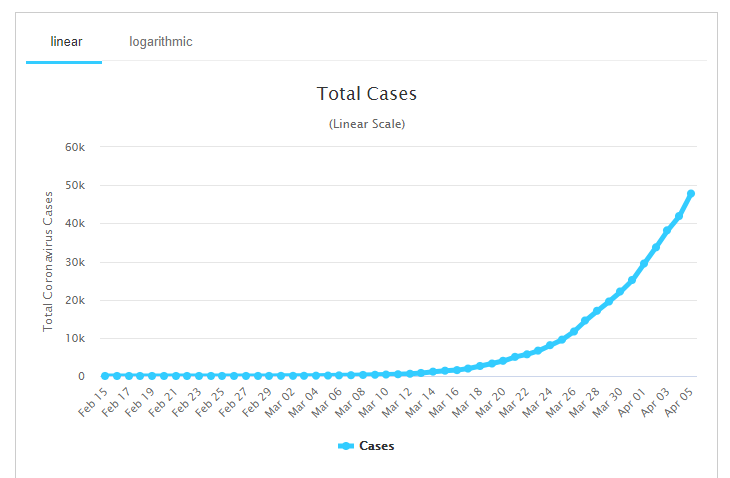
That might look very bad, but you need to put it on a logarithmic scale to see the rate of increase (thanks to Worldometer for these charts):
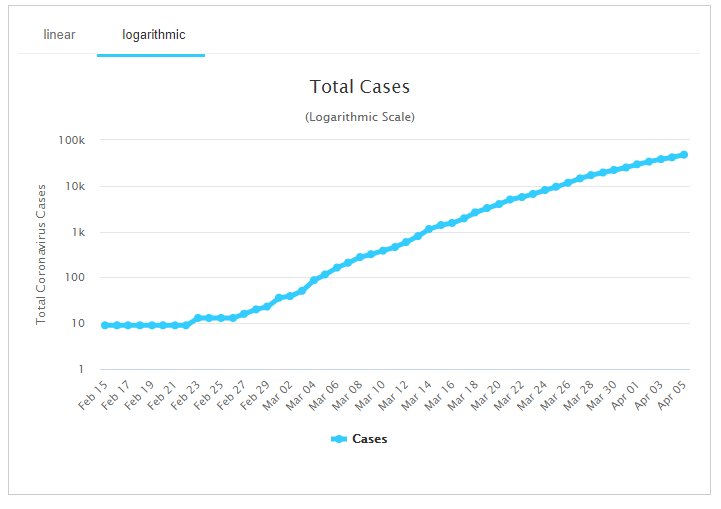
As the logarithmic chart weakens, the percentage increase in cases per day starts to reduce (e.g. the total number of cases increases by 1%, instead of 10%).
Obviously I'm leaving out the fact that millions of people in the UK could well have had the virus without getting a test (because they were asymptomatic or because no test was available).
But governments tend to act on official data, no matter how bad it is (since it's the only data they have). These are the numbers which inform the news media and the debate. So there is some merit in watching them, if only to predict what other people might make of them. And they show definite signs of slowing down.
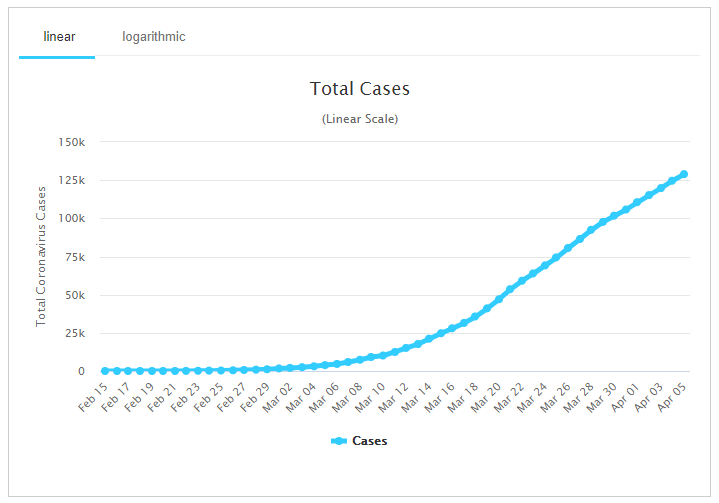
Here are the same charts for Italy, which as you will know was one of the first countries to be gripped by the virus, and is still one of the most badly-affected countries.
Linear:
Logarithmic:
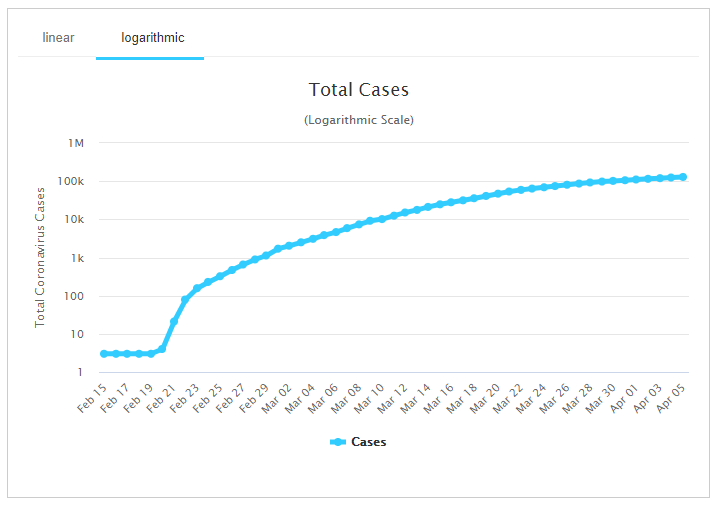
This logarithmic chart shows the recorded growth of the virus in Italy now running at very weak levels. I don't know if this will stimulate the risk tolerance needed to get the country moving again, but it's a start.
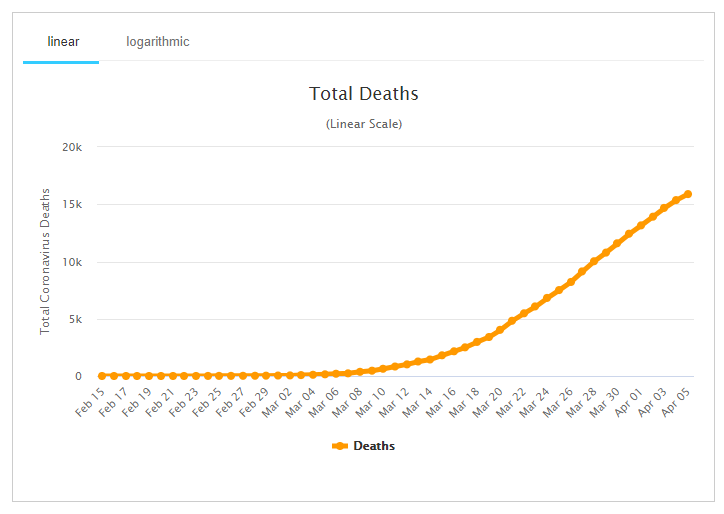
Let's also look at the death numbers in Italy.
Again, the quality of this data is very bad. For one thing, it doesn't show the presence of other conditions. But let's look at the data anyway, since it's been making headlines.
Linear scale:
Logarithmic scale:
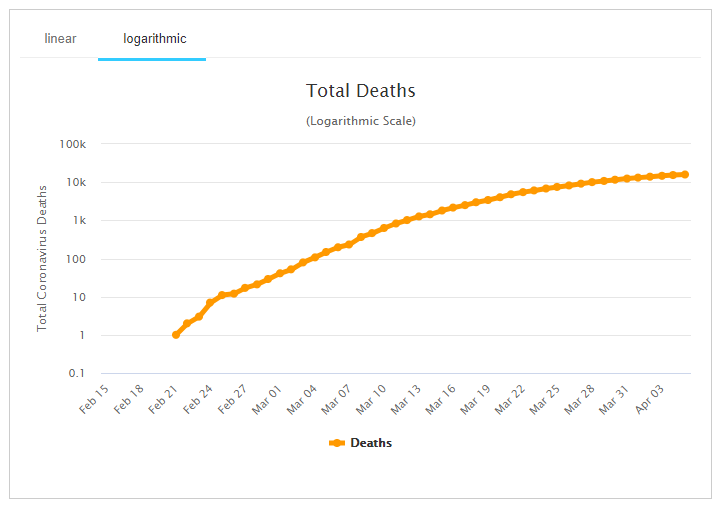
When viewed from this angle, the trend doesn't look too threatening. It looks like the exponential growth is over, and a stable situation is emerging (or has already emerged).
Remember that the main argument for lockdown across Europe has been to prevent hospitals from becoming overcrowded and overwhelmed. But if recorded cases and deaths are stable in France, Italy and Spain, and the overall trend has been tamed, that might help to inspire the confidence needed for a little bit of risk-taking.
I don't think anybody expects an immediate return to every aspect of normal life. Few political leaders will want to be responsible for a secondary surge of infections and deaths. The recovery won't be easy. But a gradual easing of the rules is becoming more likely, as the argument strengthens for the healthy majority to get back to work.
Anyway, this is why your shares up today - the rate of infection is weakening in several countries, and starry-eyed investors are starting to price in the end of total lockdown, sooner rather than later.
On with it! - I should probably talk about some small-cap shares now.
I don't think I should worry about spending time on the Covid-19 issue, though - it's the issue facing the vast majority of companies right now. For many of them, the duration and extent of lockdown will directly determine their profitability this year and may even determine whether or not their existing equity survives.
Some shares I'm looking at today:
- H & T (LON:HAT)
- Reach (LON:RCH)
- Innovaderma (LON:IDP)
- SCS (LON:SCS)
Estimated timings: seeking to finish by 1.30pm. EDIT: Finished at 2pm.
H & T (LON:HAT)
- Share price: 307.66p (+3.6%)
- No. of shares: 40 million
- Market cap: £122 million
Please note that I have a long position in HAT.
This pawnbroker has seen strange times in its 120-year history. The mandatory closure of its stores for health reasons must rank up there as one of the stranger ones.
As a provider of financial services, I thought H&T might stay open, in a limited way. Banks and building societies are still open, after all.
But retail stores have been asked to shut, and H&T is also in the retail business.
It was already public knowledge the H&T's stores were shut:
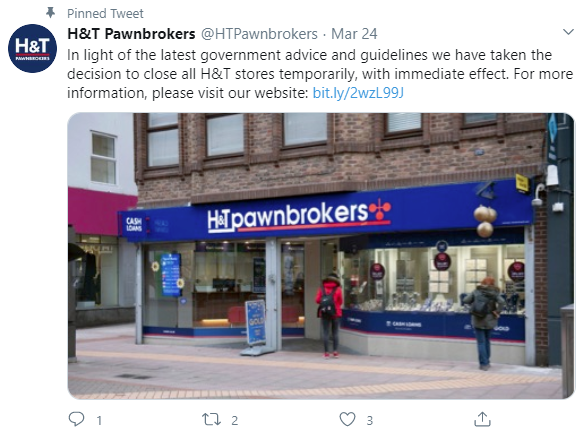
I heard the news myself on Twitter, and the company's website was updated, too. A brief RNS at the time would have been appreciated I guess everyone was very busy!
Interest holiday for pawnbroking customers - this is a very nice move, although it's necessitated by the current lack of an online option for the repayment of pawnbroking loans.
Unsecured personal loans don't get an interest holiday, since they do have an online portal.
Dividend cancellation - the cancellation of this 7p dividend will save the company nearly £3 million. I totally support this. The most important thing for now is balance sheet strength, not paying shareholders.
Salary cuts - the CEO and Chairman have reduced their salaries by 50%, while branches are closed.
These salary cuts are in line with my high expectations of HAT management.
For further background: the CEO owns over 1 million shares in the company, and earned a base salary of just £256k in 2018 (the most recent year for which the data is available).
His total pay in 2018, due to a small annual bonus for that year, was less than 10% of the value of his shareholding. He has been with the company for over 20 years.
Before the crisis
The CEO's long-term commitment and shareholding in the company were big factors in my willingness to trust H&T's acquisition strategy. It bought 70 stores and 159 loan books last year from defunct rivals The Money Shop and Albemarle Bond.
At the end of 2019, H&T had borrowings of c. £26 million (total facility size: £35 million) and cash of £12 million, so net debt was £14 million.
Despite the acquisitions, cash inflows from a placing and from operations meant that year-end net debt/EBITDA was less than 0.5x, and EBITDA/interest was an enormous 30x.
I was looking forward to seeing these metrics strengthen even more, if the pace of acquisitions slowed (which appeared likely). The outlook for dividends was excellent, too (the cancelled 7p final dividend compares to 6.6p in 2019).
The positives seemed to vastly outweigh the one primary negative, which was an FCA investigation into H&T's unsecured loans. This investigation caused the company to stop issuing any high-cost short-term loans (c. 4% of revenues).
Current position
The focus has now shifted to survival, and management are confident:
This decision not to pay a final dividend strengthens the Board's view that the group remains appropriately capitalised with recurring strong cash flows at this unprecedented point in time. This action, together with a series of significant measures to reduce costs and tightly manage cash flow, further strengthens our financial position and liquidity.
Today's RNS confirms that it is benefiting from the business rates holiday, the job retention scheme and "other government initiatives".
As with other High Street names, the main ongoing cost is likely to be rents. I am happy for H&T to do whatever it needs to do, to ensure that it can trade through this with its existing equity intact.
Some numbers in this paragraphs would have been very helpful:
H&T has cash on hand and unutilised headroom on its banking facility, together with stocks of gold jewellery. However, in the current extraordinary climate the board believes it is prudent to maximise the group's resilience in the face of this exogenous shock.
If we go back to the December 2019 result, H&T had cash plus unutilised headroom of £12 + £9 = £21 million. Of course, some cash is needed operationally so not all of this could be burned through - and covenants always need to be satisfied.
Inventories were big, too: £29 million.
I would hate to see the company melting its own gold to stay alive, as Albemarle Bond did in its 2013 death throes (I suffered my one and only wipeout from that disaster). However, as a last resort measure it could have some merit. I hope it doesn't come to that.
Using information in the footnotes for the 2019 final result (Note 12), I am led to believe that the annual rent bill at H&T used to be in the region of £6 million, or £500k per month.
This will have increased thanks to store growth since then. But if I compare the company's recent cash plus headroom to the likely rent bill, the odds still look favourable to me for the company's survival.
This may help to explain why the shares are only down by 7% since the beginning of March.
The outperformance has helped H&T to become 12% of my personal portfolio, and my second-largest holding.
Reach (LON:RCH)
- Share price: 82.5p (-8%)
- No. of shares: 299 million
- Market cap: £246 million
Covid-19 Update on Key Mitigating Actions
The media industry has been devastated by the Covid-19 crisis.
It's not that people don't want to read the news - far from it.
There is simply no point in advertising products which are A) forbidden by the lockdown or B) unaffordable in the current economic climate.
And while online news has never been more in demand, the demand for printed copies of newspapers is not the same.
Daily trips to the newsagent have been replaced by weekly shopping trips which resemble something out of a dystopian horror movie.
Cost cuts - senior executives at Reach, including all Board members, are taking a 20% pay cut. Bonus schemes are suspended and the LTIP may or may not get paid.
All staff face a 10% pay cut (though not below Living Wage) and 20% of staff will move to the job retention scheme (or its equivalent in Ireland).
No dividend - as of March 26th, Reach still planned to pay a dividend. It has changed its mind.
Balance sheet - net cash of £20.4 million as of year-end and £65 million in banking facilities (subject to covenant).
My view - I've had to remind myself what is the "catch" with this share (it can't really be trading a P/E multiple of 2.6x?)
Ah yes, the pension scheme deficit. This has been most recently recorded at £296 million (on an accounting basis). Nearly £50 million was paid into it by Reach in 2019.
According to the most recent results statement:
Contributions have been agreed at £48.9m for 2020, £56.1m per annum for 2021 to 2023, £55.3m per annum for 2024 to 2026 and £53.3m for 2027.
The good news is that RCH's annual cash flow from operating activities has been running much, much larger than these promises.
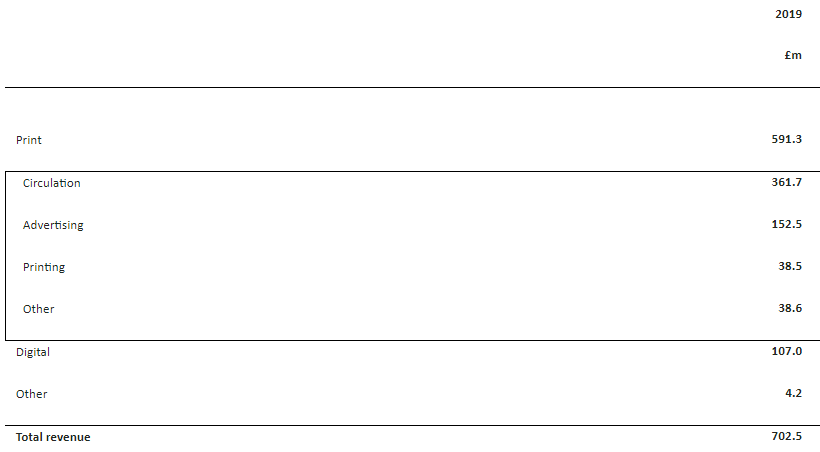
The bad news is that RCH is still primarily a print, rather than a digital business:
Source: Reach.
Last year, Print revenues were £591 million out of the £702.5 million total.
This is slightly overstated, since "Advertising" includes digital classified ads. Even so, Digital still has a long way to go, to catch up with Print. The decline in Print circulation is relentless, and is almost certainly being accelerated by the Covid-19 crisis.
I do think this share could be "cheap", in cigar-butt style: it is possible that the Print business may have more puffs left for shareholders than the share price gives it credit for.
It's tempting, but I would need to research it more.
The StockRank is an excellent 95.
Innovaderma (LON:IDP)
- Share price: 46p (+21%)
- No. of shares: 14.5 million
- Market cap: £7 million
Sales for this consumer products company have "significantly slowed" at physical retailers, though it continutes to distribute to Superdrug, Boots and Tesco.
It's not all bad news:
The Company's DTC channel, which accounted for c.60% of revenue in FY2019, continues to perform very well.
Balance sheet - at the end of March, "the Company had sufficient levels of cash and no debt". Assessing a debt facility, as a precaution.
Operationally - no problem with supply chain or deliveries and inventory levels are healthy.
My view - like many other shares, it would not surprise me if this one was currently undervalued (assuming that life goes back to normal in the short- to medium-term).
With IDP, you also get the small company discount (many investors will automatically ignore a company as small as this).
As noted before, it capitalises the amounts it spends to grow its customer list, and doesn't amortise this spending. That remains a concern to me, as it creates a risk in my mind that the reported profits aren't entirely believable.
SCS (LON:SCS)
- Share price: 152.4p (-2%)
- No. of shares: 38 million
- Market cap: £58 million
Interim dividend and Board update
This Sunderland-based home furnishings group suspends the dividend which had already been declared.
Additionally, the outgoing CEO has agreed to postpone his retirement for six months. He will stay until at least July 2021.
It appears to be trading below net cash - as of March 23rd, it had cash of £75 million after borrowing £12 million from the bank. So the net cash was c. £63 million.
Survival chances look good.
Hanging up my pen there for today. Thanks everyone!
Graham
Disclaimer
This is not financial advice. Our content is intended to be used and must be used for information and education purposes only. Please read our disclaimer and terms and conditions to understand our obligations.

48 comments
I am just starting to look at SCS, rather belatedly as my interest was first raised by the Mello mention a few months ago. Just a couple of points hit me:
Yes, it had 82.3m cash on the last balance sheet. But it has 81.1m payables, and only 4.8m receivables. So not much of the cash cannot be counted as free cash for valuation purposes. (I think Abtan's point is along the same lines)
And they have concessions in House of Fraser, who are about to close many of their stores - does anybody know how much revenue and margin HoF stores generate?
Scs (LON:SCS)
Hi QVG
Here is the post (from July 2020) where I estimated that the company's true cash position was probably closer to £12m-£13m at the end of June 2020.
It's likely that it is higher than this now given the material increase in sofa demand in the UK up to Christmas.
Nonetheless I agree that the company's true cash position is quite difficult to determine, which makes it so much harder for me to press the buy button.
https://www.stockopedia.com/content/re-small-cap-value-report-thu-30-july-2020-nxr-scs-igp-vlx-aiea-blv-645428/?comment=62#62
The House of Fraser concessions closed a while ago (2019?) so nothing to worry about looking forward.
Cheers
Abs
Just checked ShortTracker for SCS. Relieved to see it is not yet listed.
One point to add to the Scs (LON:SCS) commentary.
Cash is received from the customer or financing partner, at the latest, a few days after delivery.
It is highly likely therefore that the £63m of net cash @ 23rd March includes all or most of the receivables due from customers already.
Payments to suppliers, however, are made 45 days after delivery.
The company has not stated an up-to-date Payables figure, so for all we know that £63m could all be due to suppliers within the next 6 weeks, leaving the company with a precarious cash position.
For reference Payables was £71m as at 25th January 2020.
A
Hi Timmar, Not sure about everyone having a tracker, but who knows in a world of hysteria. I think far easier when they have the antibody test, mass test and then decide if a bigger issue than any other virus or condition that can kill those who are already mostly ill. Needs to be a response proportionate to the problem, and that is the question that matters. If they do manage this testing it will be binary for all the leisure firms in that if the disease is widespread it changes everything.
Thankyou dmjram for the volume info.
Huge difference in share price behaviour between the 2 pawnbrokers H&T and Ramsden since virus outbreak .Any views about which would be the preference buy now ?
Covid next steps, and next leg down, China style civil liberties coming to a town near you. The governments all seem to be following the same protocol. I don't quite know what to make of this, the disease isn't going away & this seems like more madness but i cannot see leisure or people businesses returning to normal for a long time. ‘Flatten the curve to allow hospitals to cope’ doesn't resonate with forced isolation for asymptomatic cases.
The Spanish government is planning to focus on the carriers of the coronavirus who do not have symptoms and who are working in essential services. Healthcare employees, workers in senior residences, police, delivery workers, staff from the food supply chain… They all form part of a flow of silent transmission of the coronavirus that the government wants to halt so that there are no new outbreaks once the social distancing measures are lifted.
To achieve this, there are two approaches being prepared. Firstly, mass testing of the population in order to locate all of these cases. Secondly, preparing infrastructure so that they can be isolated and that they don’t infect people close to them. The Spanish prime minister, Pedro Sánchez, on Sunday called on the premiers of Spain’s regions to send a list of public and private infrastructure that can be used to house those infected with the SARS-CoV-2 coronavirus but do not require hospitalization.
https://english.elpais.com/society/2020-04-06/spanish-government-preparing-centers-to-isolate-asymptomatic-covid-19-patients.html
Typhoid Mary? This policy is offers a way out - and the corollary is tight borders with mandatory testing for everybody entering the country. Others have voiced concerns about the impact on the travel industry - sounds like Spain will become as safe as can be expected, but in the new normal, package holidays and other visits are bound to become more expensive. Whither Stockopedia's favourite (Dart) now?
Typhoid Mary? This policy is offers a way out - and the corollary is tight borders with mandatory testing for everybody entering the country.Typhoid Mary?
Typhoid Mary on a grand but temporary scale ... and it isn't necessary:
There are already initiatives in Europe and the US to address the privacy concerns and the use of fake apps can be blocked using real-time authentication at entrances - we can repurpose the existing card payment network to do this right now.
To make this work you need mass testing and proper self-isolation support but none of it is rocket science. The biggest issue is protecting the old and vulnerable and allowing them any quality of life while this goes on; hopefully treatments will improve to the point where it isn't a death sentence.
Travel will difficult for a while, I imagine we'll see virus passports and probably point of disembarkation testing. The weak operators will go to the wall but the stronger ones will eventually emerge in a better position. Could be a long haul though.
timarr
In principle that's the right sort of approach. But I can see some difficulties.
Thoroughly secure measures to prevent misuse of data, that are trusted.
Many people don't have smart phones. You could issue smart wrist bands, but those would take time to design and produce.
In reality I find it hard to see this govt, or probably any UK govt making such a system compulsory, so how well will it work with say only 50-60% of the populations using it? You could tell all the non users to stay at home, but there are plenty in the UK, many in powerful positions, who would be apoplectic at the idea. Perhaps if it's presented with sense and enthusiasm people could be persuaded that as a temporary measure it's a better option than the current type of lock down, or incremental easing and reintroduction of it, which seems to be the only real alternative at present.
Hi peterg
Privacy can be handled. Look at https://www.howwefeel.org/ or PEPP-PT. The technology exists to do this in a privacy supporting way if the will to use it can be found.
82% of the UK population already has a smartphone - that might be enough anyway - but the wristbands also already exist - this is a reuse of existing technology. It's probably most needed for the most vulnerable - but it might be easier just to give everyone a cheap smartphone. After all, money is no object, what difference does another billion or so make?
It wouldn't be compulsory on the population - not at all. But it would be compulsory on supermarkets, shops, gyms, post offices, theatres, cinemas, etc ... you can stay at home or opt in.
Hopefully all temporary but we need to at least consider that Covid-19 will be a recurring issue for a generation.
timarr
How do you tie the technology to the right person? What is to stop an infected person borrowing the phone of an uninfected person?
I presume a photo is included with the app, in the same way that it is with a digital railcard ?
I think Reach (LON:RCH) will be able to postpone their pension contributions under recent guidance issued by the Pensions Regulator. Might improve their chances of survival.
Jim
"claimed it was possible to test the whole UK population every week i.e. 10 million tests a day. He claimed there were enough PCR machines and people to use them to achieve this"
Unless this is done at home this will just increase the spread of this virus? How many testing centres would there need to be, for 10 million people? If testers have to wear new PPE each time or decontaminate every test, if will need a lot of time and equipment, PPE and staff are in short supply. Where will you get all the PPE and staff from? If each tester did 100 tests a day you would need 100,000 staff.
True, but unemployment will be high. Job creation for the new economy.
The indices have rallied but volume so far is anaemic - that suggests its retail buyers and not institutions i.e. the relevant money leading the rally.
Until the institutions start buying there's a huge risk it's built on sand as there are still too many unknowns e.g. how long will you be protected given you've already been infected and recovered?
Biggest upside impact would be the result of trials saying safe drug XYZ is effective against the virus and reduces hospitalisation/morbidity etc. If/when that happens all the talk of need to test everyone once a week will disappear and the world will be back to normal much sooner than waiting for vaccines and/or mass testing and isolation.
How do anaemic volumes move indices (and therefore total valuations) by several percent?
When the big players are sitting on their hands, it only takes relatively small volume retail buying to move prices.
Hi dmjram,
Where are you getting your volume information from, im not saying you are wrong, i would like a reliable source of volume.
We are at the start of a job loss led recession, doesnt seem to me s&p should be up 5% ..
Hi John,
It's all here on the site eg FTSE100 and DAX:
https://www.stockopedia.com/index-prices/ftse-100-index-FTSE:UKX/chart/
https://www.stockopedia.com/index-prices/xetra-dax-index-ETR:DAX/chart/
On the FTSE you can see how its tended to drift back higher on lower volume and plunge rapidly on high - early March shows this perfectly.
The 20th March was a textbook day - very high volume and a bad close down by the low suggesting institutions selling stocks into the attempted rally, classic "sell the rip" bear market behaviour instead of "buy the dip" bull behaviour.
Since then you'll see the volume has come in steadily from the sell off peaks and daily volatility reducing - the big players not committing either way and waiting for developments.
If you're interested in reading up on analysing price/volume re indices, Bill O'Neill's "How to Make Money in Stocks" has a good chapter.
"Experienced voices in the investing community have been cautious about the recent recovery, seeing it as a temporary reprieve before the next leg down."
Unfortunately Graham, we all know that we are behind the curve. Our 'testing' is basically woeful, and Dr John Campbell (of Youtube fame) states that the case rate can easily be multiplied by 10, (possibly 20) therefore suggesting a case rate of at least 500k.
When the NHS become overwhelmed and the tragic death rates start to race to 'peak', (as will the US) in the next week or two, we'll see "the next leg down."
I have been tempted to buy dips, but refrain due to aforementioned rationale. Sitting in cash and shorting on rallies.
Unfortunately Graham, we all know that we are behind the curve. Our 'testing' is basically woeful, and Dr John Campbell (of Youtube fame) states that the case rate can easily be multiplied by 10, (possibly 20) therefore suggesting a case rate of at least 500k.
I was watching Sky News with Adam Boulton an hour ago. There was a professor from one of the specialist medicine Schools in London who actually claimed it was possible to test the whole UK population every week i.e. 10 million tests a day. He claimed there were enough PCR machines and people to use them to achieve this and if the only restriction was a lack of re-agent chemicals then this could be sorted. If everyone is tested once a week, in theory at least, we can return to normal.
Of course, Adam Boulton treated him as some kind of nutter, and he may be, but this is the kind of ambitious testing regime we really need to get out of this mess as quickly as possible and at least have some kind of economy left.
All the best, Si
Hi Si
The testing issue is - largely - a red herring. Current bottlenecks will be overcome - it may take a week or six but eventually we'll sort out the supply chain.
In the short-term the immediate testing need is NHS staff in order to manage the peak of infections in (hopefully) the next two to three weeks. That's where the real issue is.
Testing people in the community will simply cause different groups to break the lockdown either because they know they're OK or because they can't be arsed while their friends have been let out. Even if they could the government isn't going to allow community testing until the peak is passed and they've figured out a post lockdown strategy.
Clearly that strategy will depend on gradually lifting restrictions, maintaining isolation for vulnerable groups, some level of technology mediated contact tracing and lots and lots of testing. But you couldn't pay me to invest in any company that has a business that relies on having lots of people crammed together indoors - they're months away from business as usual - whatever that will look like post-virus.
timarr
Hi Si
The testing issue is - largely - a red herring. Current bottlenecks will be overcome - it may take a week or six but eventually we'll sort out the supply chain.
Everyone I have heard who is a specialist in this area, including a recent Ted Connect on-line interview with Bill Gates, has stated categorically that the solution is to greatly increase testing and the ultimate does seem to be to test everyone at regular intervals and then contact trace as per South Korea. Anyway, I was just reporting what I heard someone far more qualified than me state i.e. we have the ability to do 10 million tests a day. It could be that he is just one of Taleb's IYI's (Intelligent Yet Idiot).
I am not going to pretend I know anything about this topic so have no interest in speculating; when you know you don't know something, what's the point?
All the best, Si
"When the NHS become overwhelmed and the tragic death rates start to race to 'peak', (as will the US) in the next week or two, we'll see "the next leg down.
FWIW I think that maximum 'popular'pessimism will occur just after the peak when the number of deaths (key metric discussed) has passed but the govt still feels unable to do much to lift restrictions . However, the professional "big money" will start to lift a bit sooner. So that means in only about 10-15 days!
Those with cash must even now be picking whose balance sheet to support via Placings/ Rights Issues . In weak sectors like restaurants those that get help and survive will rapidly regain much, but not all, of what they have lost since a lot of capacity is going to come out; others will be diluted to hell by re-capitalisation but cling on; and many will fail.
So it's going to be an(other) interesting month for small investors! We can be nimble but we will be badly informed. There will be a lot of insider trading but even silent Placings where legitimate offers are struck by Directors with big shareholders/strategic new investors will undercut us. This board and community will need to be very vigilant.
Personally, I am writing to a lot of companies asking them not to forget their small shareholder base despite the need to act fast eg by having Open Placings ie a bid for X shares at the price offered to big institutions. However, I hope smarter and better informed investors are also writing and I would be delighted to copy/paste/endorse on well written requests by others. Can Stockopedia help organize us to speak with a louder and more coherent voice?
Can I also repeat my plea for guidance towards online educational tools on how small shareholders could/should interact with Placings etc.
Will put my head above the parapet and say I think we've already hit the peak. Look at the 3 day rolling average - unless today is higher than 700 we're at the peak. If everyone behaves responsibly for a few more days we might just be coming out of the woods.
And the announcements from Austria and Germany about how they plan to come out of lockdown over the next 6 weeks are most encouraging.
See you on the other side!
I think it is too early to tell, cases are still increasing and so are hospital admissions. Italy had similar but then spiked up again. If cases are increasing it usually follows that deaths will also, there is a about a 10 day lag. Isolation seems to work, so it's possible we are near the peak but I will want to see the next few days figures before I'm convinced. The worldwide figures fell yesterday which is encouraging. Looks like Italy, Spain, France and Germany have past their peaks.
"Obviously I'm leaving out the fact that millions of people in the UK could well have had the virus without getting a test (because they were asymptomatic or because no test was available).
But governments tend to act on official data, no matter how bad it is (since it's the only data they have)."
Thank you Graham for a great post. Fully agree with above approach. Regardless of how reflective (or not) the data is of ground reality, it's what governments (and markets) respond to.
My only reservation is that current rally is happening on reducing volume, suggesting there may not be that much steam behind it?
Vertu Motors (LON:VTU)
Vertu Motors chief executive Robert Forrester interviewed on our Car Dealer Live broadcast 3rd April 2020.
https://cardealermagazine.co.uk/publish/vertu-motors-boss-robert-forrester-car-dealer-live-midday-tuesday/189057
Various news sources are reporting that Austria will be the first European country to start lifting lockdown measures.
The country is planning to reopen non-essential shops of less than 400 sqm and DIY shops on 14 April followed by all shops and malls on 1 May. (Reuters)
From then onwards, hotels and restaurants will open step-by-step from mid-May at the earliest. No events will be held until at least late June. (The Guardian)
The easing of the lockdown is dependent on the public continuing to observe general lockdown measures.
I live in Vienna and this was announced by the Chancellor this morning. We have been in lock down for three weeks, generally very well observed with all government run parks closed.
It is important also to note that from today it is mandatory to wear masks in supermarkets and on all public transport, and strongly advised to do so whenever leaving the house. All police will wear masks. Further, we could not enter my local food store without using the hand sanitizer provided at the entrance.
Morning!
I have been thinking carefully about bank covenants recently. For example this from Elementis (LON:ELM)
"Elementis has secured a relaxation of its banking covenants from 3.25x to 3.75x net debt/EBITDA*. This will apply for two testing periods (i.e. 30 June 2020 and 31 December 2020)."
At first glance this doesn't give them much extra headroom. But after thinking it over, it occurs to me that covenant tests probably work on a trailing 12 month basis. If so, a short sharp recession (as some are mooting) would have a relatively smaller impact, as it would be "cushioned" by the rest of the 12 month period.
I am not 100% sure this is correct - comments welcome!
Following my small review of AVCT the other day I note this morning they have raised more money via a subscription, £3.75m. So cash position at 31 Dec 2019 was £8.71 m. They burn around £1m a month so that pushes it back to circa £5m. So they have just added £5.75m which should cover this year. Of course everything is going swimmingly well!! Revenues up 100% (but of course that doesn't justify the mkt cap). I have bought some more of these over last couple of days for full transparency. I think the story of targeted chemotherapy is potentially fantastic. Tufts are a respected university and their research must hold weight. But the management really have not handled things well. That said the CEO identified the opportunity and has persisted over the years so he deserves much respect. He is a scientist probably not a business man, but there is no shame in that. Shares off a touch.
Ah but there is a difference here. Avacta (LON:AVCT)'s CEO gets paid for his persistence. Shareholders (so far at least) are doing the paying. Wishing you well that the research turns in to profits and not just a promising sounding story.
Good points both Julianh and IncredibleMosesLeroy. Thanks for your input.
Looking at the share price all the way back to 2003 is a good starting point for Avacta (LON:AVCT)
This looks like almost 17 years of raising cash and diluting shareholders. Anyone buying this would presumably need to convince themselves that this time is different.
Morning, I work in Health Economics and specialise in submissions of drugs to UK /EU27 regulators. It seems to me (pure anecdotal evidence coming up) that 3/4 of the oncology drugs that pass through our firm's doors bill themselves as 'targeted chemotherapy'. I don't know a thing about Avacta (LON:AVCT), but don't let that marketing get you too excited.
My morning smallcap tweet: Part 2/2
Mountfield (LON:MOGP) Versarien (LON:VRS) CentralNic (LON:CNIC) Innovaderma (LON:IDP) SEC Newgate SpA (LON:SECG) Eenergy (LON:EAAS) RDI Reit (LON:RDI) APQ Global (LON:APQ) H & T (LON:HAT) Quixant (LON:QXT)
Mountfield Group (MOGP) record rev in FY19 but does not give a figure! Profit flat due to lower margins. All of CAF's major sites are operating but all of MBG's major sites are closed. Covid has delayed the receipt of orders. Order book ~£5.6m, lower YoY. Co is working within its banking facilities but no other reassurance.
Versarien (VRS) admits that investment from Beijing Institute of Graphene Technology 'agreed' last April won't happen.
CentralNic Group (CNIC) has not experienced interruptions in its services to customers or in its supply chain, and trading is in line with market expectations.
InnovaDerma (IDP) continues to provide uninterrupted services to customers. Covid has significantly slowed sales through bricks and mortar channels. "We continue to distribute to our retail partners including Boots, Superdrug and Tesco which are defined as essential businesses/services by the UK Government and remain open." Direct-to-consumer channel (c.60% of rev) continues to perform very well.
SEC Newgate (SECG) CFO resigns. He is thanked. Excellent start to FY performing at above budget profit levels but expects to be adversely affected to varying degrees by covid. Co has committed banking facilities available with maintainable covenants.
eEnergy Group (EAAS) no signed projects have been cancelled, although some school installations have been delayed to the summer holidays. This will hit FY rev and earnings. "Schools closures has led to a spike in interest in eLight's Light-as-a-Service (LaaS) [Whaaaat?] proposition. Many schools are looking to complete maintenance and upgrade projects, including switching to LED lighting." Cash at hand €1.4m. LaaS = premises can switch to LED lighting for a fixed monthly service fee, avoiding any upfront payments.
RDI REIT (RDI) Rent collected across UK portfolio (excluding UK Hotels and London Serviced Offices) was 74%, adjusted for tenants paying monthly. Europe was 97%. Hotels: no rental payments expected for Q ending 31 May. Cash at hand £85m following disposals. May pay div.
APQ Global (APQ) very difficult trading conditions during Feb due to extreme market movements. Covid made March bad, hitting NAV. NAV $10.40 = 840p ps. No covenants breach. Suspends divs. SP is 14p, spread 3 to 25p! How can the NAV be 840p?
H&T Group (HAT) has closed stores and declared an interest holiday on outstanding secured loans. Passes div. CEO and chairman have halved pay while stores are closed.
Quixant (QXT) FY rev down 20%, adj pretax $10.7m down 41%. Blames decline in Gaming due to major customers facing stiff competition. Densitron Broadcast strategy remains very positive. Going concern - material uncertainty.
M Winkworth (LON:WINK) finals are out today, and show steady progress. Revenue and profit are both up about 10%. There is hardly a mention of the virus, but they normally declare a second interim dividend around the 16 April. It will be interesting to see if that happens.
My morning smallcap tweet: Part 1/2
Gresham House Strategic (LON:GHS) Symphony Environmental Technologies (LON:SYM) Be Heard (LON:BHRD) Angling Direct (LON:ANG) City of London (LON:CIN) Argo Blockchain (LON:ARB) Restaurant (LON:RTN) Sigmaroc (LON:SRC) Arrow Global (LON:ARW) Stobart (LON:STOB) RBG Holdings (LON:RBGP) React (LON:REAT) Novacyt SA (LON:NCYT) Spectris (LON:SXS)
Gresham House (GHS) FY(March) Total Shareholder Return of -5.2%. NAV 1062.2p. Will hike div 15%. 19% in cash. "Overall, the portfolio holdings have strong financial positions going into this period of uncertainty and recession. Many have net cash positions such as Centaur Media, Brand Architekts and MJ Hudson. Others have very low levels of financial leverage such as our holdings in Augean and IMImobile."
Symphony Environmental (SYM) Q1 rev up 56% to £2.4m. Co does not expect to need any additional cash in the next 12 months. Limited supply-chain delays which have been quickly overcome, has not affected manufacturing. "Enquiries for our d2p (designed to protect) anti-microbial and other protective products (see www.d2p.net) are growing at a much faster pace." No FY guidance.
Be Heard Group (BHRD) trading was in line until covid. Effect can't be quantified yet. Cash at hand £2.4m and access to a £2m credit.
Angling Direct (ANG) Feb resilient with rev up 23.3%. Stores closed but online sales remain robust for now. Guides material reduction in FY21 revenue and profitability. Has secured a short term £2.5m credit facility.
City Of London Group (CIN) has a very small loan book, expects little credit impact from COVID. Subsidiary Recognise is progressing with its application to the PRA for a banking licence. Subsidiary Milton Homes believes sales may slow and reversions may increase.
Argo Blockchain (ARB) March mining revenue £1.8m (Feb: £2.5m). Algorithmic difficulty increased early in the month and Bitcoin slumped mid March.
Restaurant Group (RTN) increased flexibility in banking facilities, Executive pay cuts. No H1 covenant test. One of the six NEDs resigns to cut costs. Six NEDs!
SigmaRoc (SRC) Q1 rev up 87%, ahead of analyst estimates but guides substantially reduced revenue and EBITDA performance in Q2. Group remains active across all sites (except Channel Isles) supplying product where doing so is an economically viable. Co has enough cash for even a protracted period of disruption.
Arrow Global Group (ARW) no meaningful operational and financial impact on the Group so far. Will pass div. Arrow Global has £153m of credit headroom. No FY guidance.
Stobart Group (STOB) cutting costs, looking at further funding options. Does not reassure on balance sheet. Southend airport's global logistics operation continues to operate as normal. Risk to Stobart Energy's ongoing operations is the availability of waste wood. Construction slowdown and closure of Household Waste & Recycling Centres has reduced the volume of new waste wood available. This may hike prices for an extended period. Looking at options to accept different specifications of waste wood fuel.
RBG Holdings (RBGP) the professional services group says moving to remote working, Rosenblatt has seen no change in existing instructions with work proceeding as planned across all practice areas. At Convex Capital covid has the potential to delay the completion of certain transactions. Div payment postponed. "Confident that the Company will come through the present situation in a strong position."
React Group (REAT) experiencing high demand to provide decontamination and infection control services. Its maintenance business largely operates in the Healthcare, Road and Rail sectors, all of which have yet to see material changes to operations. Group in a good position to meet or exceed FY management expectations.
Novacyt (NCYT) France has approved its COVID-19 test.
Spectris (SXS) Manufacturing facilities remain operational. Guides Q1 LFL sales down 10%. Strong balance sheet and liquidity position. Special dividend withdrawn and final dividend postponed. All manufacturing sites around the world continue to operate. Chinese factories have now returned to full operation but elsewhere working below full capacity. Year started broadly in line with expectations, except in China, where LFL sales notably lower in February. Net cash £53m and with a cash balance of c. £240m.
H & T (LON:HAT) has withdrawn its 7p dividend. It's finally announced to the market (other than its website) that it has closed its stores and given an interest holiday to customers with secured loans until stores reopen. Chairman and CEO have taken 50% salary reductions during closure. Benefits from rates holiday and furlough programme.
Not sure why it has taken so long to announce the store closures. Ramsdens Holdings (LON:RFX) made this announcement on 25 March.
The below is an excerpt from an article in the FT today - some interesting food for thought in terms of not only which sectors and businesses may emerge from the wreckage, but also the timing for this across the sectors (and the consumer demographics too). It seems likely that the eventual lifting of measures will not be evenly spread and that some areas may be permitted and able to get back up and running a lot sooner than others, and with some facing much longer lockdown periods than others, which could mean we need more stringent stress testing when screening for stocks in certain industries.
"The Ifo report argues for a “risk-adjusted” strategy whereby some age groups, regions and social and business functions can resume activity before others. Schools could begin lessons, given the lower risk of severe symptoms in children and the burden of closure on working parents, but older people and high-risk groups may remain cloistered for months. Highly automated factories could start up but nightclubs would be at the back of the queue."
BIACS
Yes, Denmark is expected to lift their lockdown after Easter - they were the first to impose one and it's worked pretty well. It'll be a staggered resumption and some turn taking will go on - so half of children go to school one day and the other half the next. We're still waiting for details but I'm pretty sure the borders will remain closed - the Danes aren't too impressed by the Swedish herd-immunity approach.
Roughly, I think we can divide companies into five categories (remembering that in a recession most will see earnings fall anyway):
Add companies and sectors as you see fit ... I'd expect 1 to 4 to mainly trade through with increasing degrees of pain and lots of failures in 5. And it's likely the economy will reopen from 1 to 5 in that order (well 1 and 2 are still open).
As for how lifting lockdown works, I'd suggest watching the Danes. Also huge amounts of effort everywhere going into Bluetooth contact tracing apps, there's likely to be a technological component to getting everyone back out in the real world.
timarr
Hi timarr
I picked up this graphic from Twitter over the weekend which I think is both helpful in itself (although several sectors aren’t covered) and a useful way of looking at one’s investment during this period - it is my first time posting an image on Stockopedia, so hopefully it works OK.
Cheers
Simon
That is one plausible outcome that in today’s world would be defined as positive. On the other hand we have to bear in mind examples like Japan, which had brought in tough measures in February has been relaxing them as cases declined. Covid cases are now increasing again and today Japan has been forced to backtrack and bring in a state of emergency in seven prefectures, including Tokyo and Osaka.
On the other hand we have to bear in mind examples like Japan, which had brought in tough measures in February has been relaxing them as cases declined. Covid cases are now increasing again and today Japan has been forced to backtrack and bring in a state of emergency in seven prefectures, including Tokyo and Osaka.
Who knows what will work, no doubt it will involve a certain amount of backtracking as we learn what does and doesn't - we don't yet know how persistent the virus will be, for instance.
However, on Japan Abe has consistently prioritised the economy - there's been no lockdown in Tokyo and everyone was out last weekend enjoying the cherry blossom. Restaurants and metros have been packed. Almost no testing. It's a poster boy not for what happens when restrictions are lifted but for what happens when you don't put them in place.
It's going to be a long time before borders are fully open again, that's another thing we need to bear in mind. Lots of staycations for the near future and not a lot of business travel.
timarr