Small Cap Value Report (Fri 22 Nov 2019) - Woodford, IDP, CMCX, SIS, REC, CFYN

Good morning!
Let’s see what the RNS has in store for us today.
Today's report covers:
- Woodford
- Innovaderma (LON:IDP)
- CMC Markets (LON:CMCX)
- Science in Sport (LON:SIS)
- Record (LON:REC)
- Caffyns (LON:CFYN)
Finished at 3pm.
What Went Wrong at Woodford
This is a popular topic. I was calling out a few of Woodford's terrible companies years ago (Allied Minds (LON:ALM), discussed here yesterday, and RM2) but I never took the time to examine the structure of his entire portfolios.
Ed Croft has done that for the Woodford Equity Income Fund, and the results are fascinating. It turns out there were huge style shifts in this fund, and inconsistencies between the strategy that Woodford said he was going to employ, versus what he actually did.
The online webinar is here and Tamzin at PI World has also published the presentation of the results at Mello last week: here's the link. If you look carefully, you'll see myself and Mark Simpson (@DangerCapital) in the crowd!
Innovaderma (LON:IDP)
A quick note on Innovaderma, which I've been covering recently - most notably on 6 Nov, when I remarked that the company's capitalisation of its marketing expenses was "highly suspect". By capitalising these costs, and not amortising them, reported profits are higher than they would otherwise be.
The CEO, Kieran Callan has been in touch to offer me some insight on this point.
He told me that historically, the company capitalised about £3.50 per customer in terms of marketing spend, which was just a fraction of the total customer acquisition cost. They did this on the basis of the company's predominantly direct-to-consumer strategy involving lots of repeat purchases (i.e. they expected to get a healthy payback from the expense).
He acknowledged that there hasn't been any amortisation of this database yet, but said that this would change going forwards. He also said that the capitalisation of marketing costs would be lower this year, and in future, as the company has found diminishing returns from marketing spend as it grows.
As far as the auditors are concerned, he assured me that everything was above board and in line with IAS 38 (Intangible Assets).
My view - I appreciate Mr Callan reaching out to me, to offer some insights on an important point. If capitalisation is more modest in future, and is matched by reasonable amortisation, then I'll be happy to take a different perspective on the company's results.
CMC Markets (LON:CMCX)
Thanks to Leo (@LeoInvestorUK) for pointing me in the direction of CMC's investor presentation from yesterday.
After a strong start, CMC shares spent the rest of the day sliding.
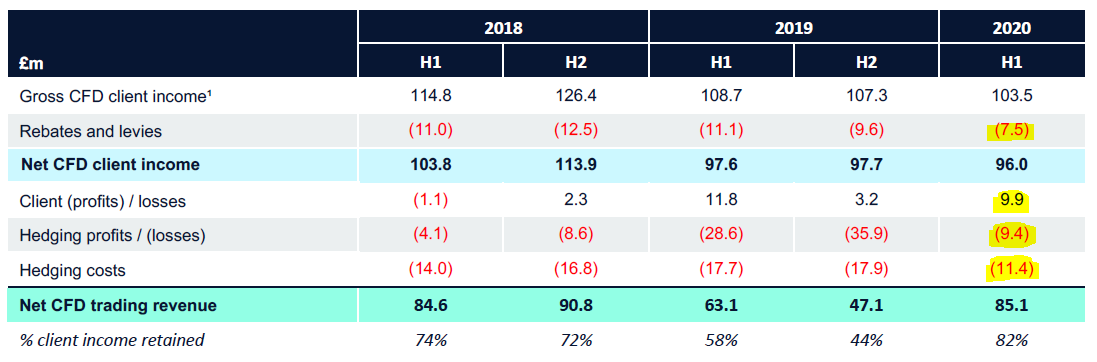
As pointed out to me by Leo, the reason could be this slide from this presentation (page 12):
Sorry if the text is a bit small.
As you can hopefully see from the above, rebates and levies only fell by £2 million compared to H2 2019.
The main boost to profitability came from reduced hedging losses, which were down by £26.5 million.
Reduced hedging costs (£6.5 million reduction) and increased client losses (£6.7 million increase) also played a part.
The explanation is as follows.
Under the revised risk management approach, we:
• Use technology to analyse data to make better informed hedging decisions
• Internalise a greater proportion of net client exposure over longer periods, resulting in lower hedging costs
CMC internalise client trades through the natural netting of client positions and hedge externally when board-approved market risk limits are hit.
• We still hedge a significant portion of our risk
My view
The huge reduction in hedging losses doesn't scare me - this number seems to have been disproportionately large in previous periods, which would back up the company's statement that their hedging strategy needed to change.
Hedging losses fell to approximately match the profits the company made from client losses (£9.4 million versus £9.9 million), and this also makes sense. I will be looking out for these numbers to track each other more closely from now on.
With hedging costs having dropped so dramatically, there is clearly less external hedging taking place. I suppose the worry for investors (and clients, for that matter!) is whether the new hedging strategy is sufficient to de-risk the business.
Many of you will remember that Plus500 (LON:PLUS) hid the extent to which it was exposed to client P&L. Instead of hedging externally, it relied primarily on internal hedging, preventing clients from trading when risk limits were met, monitoring correlations between related instruments, or simply booking their clients.
CMC have made a good effort to be transparent but what we're missing is a full disclosure of how much risk has been hedged and how much has been left unhedged. I've seen charts for this in CMC's previous annual reports - hopefully we will get another chart for this in the next annual report.
Science in Sport (LON:SIS)
- Share price: 47.16p (-2%)
- No. of shares: 123 million
- Market cap: £58 million
I've been watching this for what feels like ages, wondering if it might eventually come good in terms of profitability.
Today it reports that it will make a small EBITDA loss for FY December 2019, rather than the expected £0.3 million EBITDA profit. An increase in the price of whey and FX exposures are blamed.
But it's not all bad. Sales are slightly ahead of expectations, and as such are continuing to grow very quickly. Synergies arising from the acquisition of PhD Nutrition are being achieved in line with plan.
Outlook:
The outlook for the remaining few weeks of the current year and for 2020 continues to be strong, underpinned by a robust innovation pipeline, the current year's operational progress and a continued strategic focus on e-commerce and international markets.
My view
The CEO is always very happy with this company's progress, but I've always been wary of its lack of profitability, due to very heavy marketing spend.
Maybe I'm too cautious, and building the customer base as quickly as possible will turn out to have been the right move, in hindsight?
But the share price is currently testing its all-time lows, and the vastly increased share count will have played a part in that. Regular dilution inevitably takes a toll on share price performance.
Perhaps dilution worries can finally begin to fade? Today's RNS also informs us that the cash performance is in line with expectations - the company will have around £5.3 million at year end. This is up slightly from £5 million at the half-year.
And the CEO says that "our cash position is healthy, allowing us to be confident in our long term growth trajectory."
If the cash position has indeed stabilised, and can start to grow from here, then I might finally be tempted to have a nibble on these shares. This is yet to be proven, and the shares remain on the watchlist for now.
Record (LON:REC)
- Share price: 38p (-6%)
- No. of shares: 199 million
- Market cap: £75 million
Please note that I have a long position in REC.
The market had been looking forward to these results, with the share price making some good gains over the past few months.
It turns out that they are indeed decent results, but the market may have priced in something a little better.
Record is a currency manager which offers a variety of hedging products to institutions.
H1 performance
As had already been disclosed in the Q2 trading update, there were solid inflows in H1, and assets-under-management-equivalent (bit of a mouthful!) ticked up to nearly $60 billion. Equity markets also helped to boost this number. The number of clients improved from 65 to 70.
Frustratingly, the company recorded no performance fees in the period (during the previous 12 months, these added up to £2.3 million). Again, this is something we already knew from the trading update.
In the absence of performance fees, revenues consisted only of the basic management fees, which declined by £300k to £11.1 million.
Record has consciously allowed its standard management fees to decline, but the hope was that these might be replaced by performance bonuses. It hasn't happened in this particular six-month period.
More promisingly, the company is branching out to new asset classes, beyond equity futures which it already executed on behalf of clients. I look forward to seeing a new source of revenue under "other investment services income".
Staff are well-incentivised, earning 31% of operating profits in a profit share. The CEO owns 2.6 million shares.
Numbers
Net assets remain strong at £26.5 million, including about £23 million in cash and short-term instruments. That accounts for a significant portion of the market cap.
PBT comes out at £3.2 million for H1, down versus £4 million last year. £2.5 million after tax.
Dividend is unchanged. REC currently yields around 6%, as most earnings are distributed.
My view
I no longer intend to hold this one for the long-term, as I am worried about competitive pressures on fees leading to a secular decline in profitability.
That having been said, the company remains in the black with a very strong operating margin and rock solid balance sheet. There has been a noticeable uptick in AUME and client numbers, which can't be denied. There are still some attractive features.
I was thinking about selling in it January, when the share price was around 28p - 29p. Not selling it then has turned out to be beneficial. But I will probably give in to the temptation to sell it before long.
Note that the StockRanks adore it, giving it a rating of 99/100. Quantitatively, it looks almost perfect!
Caffyns (LON:CFYN)
- Share price: 375p (-10%)
- No. of shares: 3 million
- Market cap: £11 million
This family-held motor retail business is proving to be the Value Trap which the StockRanks identified it to be a year ago.
Profitability has fallen close to zero in the latest H1 period, versus pretax profits of £700k in H1 last year. It was right to price this at a cheap multiple.
New car unit deliveries are down by 14.5%.
Used car unit sales are much flatter (only down 2%) and aftersales revenues are up 2%, but it's not enough to prevent a dismal result.
The company says there were supply problems for new cars, which is undoubtedly true. The EU's Real-Driving Emissions regime affected deliveries around the time of the September registration plate change.
Pension: one of the footnotes to this report tells me how much the pension deficit increased, and various other details, but it doesn't give the raw size of the pension fund.
Two minutes later, I am reading footnote 20 to the Annual Report for 2019. As of 2017, the actuaries measured pension scheme assets of £90.4 million and a deficit of £13.5 million, implying that there were liabilities of £104 million. Pretty big for a company with this market cap!
Litigation: there are legal proceeding in which Caffyns is named as a defendant, in relation to the VW diesel emissions defeat device. VW is indemnifying Caffyns, so this shouldn't hurt the company or its investors.
Net debt is £13 million.
My view: too small, too illiquid for most of us here. And the pension deficit and bank debt are a turn-off, too. I will continue to steer clear of this one.
That's it from me for the week. Thanks as always for your comments - I read everything, even if I don't reply to them all.
Have a good weekend!
Best wishes,
Graham
Disclaimer
This is not financial advice. Our content is intended to be used and must be used for information and education purposes only. Please read our disclaimer and terms and conditions to understand our obligations.

31 comments
If there's any value in Caffyns (LON:CFYN) it is the in the property value. I've never been sufficiently interested in recent years to check it out, and they do buy and sell sites. Accumulated a tidy holding many years ago - more than paid its way with yield and share price rises - but no longer hold. Extremely cyclical. Very tightly held family company - but many shareholder links with management must be becoming more distant. One day they'll sell up, but who knows when or what for.
Graham
Thanks yet again for your excellent market commentary. Explanation of your thought processes really helps my investing knowledge. On another topic unless I missed it ....how did you find the movie you watched (The Irishman) and did you order a large coke? Coming back to investing, as a secondary school Physics teacher I have recently started a lunchtime investment club for the 6th form. If you ever fancy making a webcast to inspire them on their investment journey that would be fantastic.
Tom Winnifrith, crazy name, crazy guy. Doncha just luv him. One of lil ole Glanda's hunky shorters. Not so short eh Winnie?
With apologies to Glenda, but that was the best I could come up with on the spur of the moment.
Love it. Thanks Genda!
I think those of us who use to read Private Eye, are probably aware of the old Glenda Slag column feature.
This was a satire of many of the then well known female tabloid Gossip columnists, who had an almost schizophrenic view of people that featured. One minute praised to the hilt, the next entirely rubbished. The two views were run side- to -side in the Glenda Slag column in an amusing contrast.
Thus it is with the T Winnifrith approach, that one week people are praised or referred to as friends,and then later referred to in less than complementary terms.
It is obviously more than a stylistic pose, so signals quite an odd take on the world.But he's done some good work, and some occasional writing which shows he has ability.
piworld have just published the Creightons (LON:CRL) interim results webinar. A fascinating little company. Know their market back to frront, very nimble operators, making the most of every opportunity.
https://www.piworld.co.uk/2019/11/22/creightons-crl-interim-results-presentation-for-period-ending-30-9-19/
Re Record (LON:REC) I was a holder in the past until I discovered that Neil Record funds the Global Warming Policy Foundation, a man-made climate change denying lobby group that was stripped of its charitable status after breaching rules on impartiality. I think I may have raised this here before. For me, this goes in the folder of unethical investment, because of the views of its founder and major shareholder. I felt that holding shares in Record (LON:REC) would indirectly lead to financial support for an organisation that I am opposed to.
Speaking to the CIO of a highly successful hedge fund recently (who knows Record) it is clear that he is one of those autistic people who believe their view is infallible. Some of those traits can be useful in his business. For a while. As Woodford and others have found out. He (the CIO) summarised the position on the GWPF's approach to man-made climate change (it's all too expensive to deal with) very well. If Record and his ilk are right what's the worst that can happen? We will have wasted some money. If he's wrong, we're doomed. Why take the risk? Obviously, this is a personal view and others may be more comfortable with holding this share despite the views of the company's founder.
Even climate change deniers must admit that fossil fuels are a finite resource. I am also tired of people picking and choosing acceptance of those bits of science which suit them. Grrr....
B2V
It may have begun as a purely business to consumer spread betting operation but Cmc Markets (LON:CMCX) seems to be increasingly focusing on institutional markets. The result is that some 28% of its total net operating income is now coming from institutional clients of which it has some 300. Purely speculation on my part but I suspect that at some point it may sell off the retail division and concentrate on its business to business offering. It also appears to resemble a technology company offering proprietary software solutions rather than a financial services group. In which case, a revaluation could be in the offing.
Some very good points have been made about the company's hedging policies. Unfortunately, I suspect that there is scope for what might be described as “Aggressive accounting". However, as Cruddas pointed out in the webinar “We love regulatory changes”. These changes seem to have given the company a smaller but more lucrative retail client base. And, I would suggest, a client base with more predictable trading patterns. That might be facilitating the “Natural offsetting of clients' positions”. And helping it to reduce its hedging costs.
I continue to hold.
Re: WOODFORD. The analysis done on Woodford's portfolio's is indeed useful. However it was blatantly obvious to anyone with experience in investing in biotech stocks that he was buying lottery tickets as early as 2016. I made a number of posts on ii in 2016 trying to warn private investors about this, describing Woodford's Patient Capital Trust as "an accident waiting to happen" (I don't think I subscribed to Stockopedia at that time). How could he possibly have succeeded when he does not have the experience to understand the biotech or other tech sectors? I would emphasise that this judgement involved little or no skill on my part, just enough experience of biotech investing to understand that Woodford did not understand what he was doing. I think the fundamental lesson to learn is never invest in funds/ITs unless you have enough knowledge to be able to assess the quality of the fund manager.
I'm clearly missing something so please somebody explain.
Looking at CMC Markets (LON:CMCX) and the graphic in the report the company appears to have hedging losses which offset against client losses (ie. company gains), which is broadly what hedging is about and should be expected. It is almost one-for-one in the latest period, but much less so in the past but that's by-the-by.
BUT what is the "hedging costs" line? It appears there is an additional cost here, which is way too disproportionate to the underlying "problem" of customers potentially making money. Clearly I am missing something but why not abandon hedging altogether, accept that customers might make money, but reduce to (close to) zero the hedging costs?
CMC Markets (LON:CMCX)
dealtn
Clearly I am missing something but why not abandon hedging altogether, accept that customers might make money, but reduce to (close to) zero the hedging costs?
The mass of bods speculating mean you will always have situations where a market is lopsided. It might for example be bitcoin if 90% of their customers bet on the price to go up they would lose a fortune if they didn't hedge that exposure and the price went up 50% overnight. That hedge will ensure exposure is limited to a lesser or greater degree at a cost to their margin . Just look at the 3 month amount that Plus manager to lose to their customers where they advised they were mitigating risk. Hedging to some degree is fundamental to the business survival for any particular market that is lopsided by way customer is placing their cash to the extent that potential losses would be beyond acceptable limits.
I did 25 years in the city, the majority as a market maker. I get what hedging is, and why it is (sometimes) necessary. What I am questioning is the cost of it here and how the accounting treatment works.
Hedging, surely, is just covering open net positions, therefore if 68% of your punters lose money (or whatever the percentage is) then hedging will always lose money. Only when their clients make money will they make a profit hedging !
Does Winnifrith disclose what position he holds in the companies that he comments on? If he doesn’t one can’t but help think on many occasions his commentary is self serving and he is nothing like the “champion” of the small private investor simply publishing a subscription newsletter.
Graham and Paul disclose their positions in their Stockopedia reports so if they are enthusiastic about a stock they hold we can all factor that in.
As for Winnifrith being “the first” to spot problems with Woodford I very much doubt that.
I spent pretty much the whole of yesterday looking at CMC Markets (LON:CMCX) . Here I present the postmortem.
An alternative history
On 3rd October CMC issued an H1 trading update saying that stockbroking revenue had doubled to £14.4m (mainly due to a partnership with ANZ which had been previously announced) and that "CFD business net trading revenue" was £85m versus £63m last time because "changes to the internal business model have resulted in the retention of a greater proportion of client income". They also reported that operating costs would be "moderately higher than the prior year".
Seeing that £85m was close to their 2018 H1 and H2 figures prior to the ESMA (European Securities and Markets Authority) regulations limiting gearing etc. came in to force, I concluded that they had now successfully mitigated / recovered from the disruption this had caused.
Adding 14 and 85 together, plus 1 or 2 for interest income, I came up with £100m net operating income. I increased last year's H1 operating expenses of £63m "moderately" to get around £70m, leaving the operating profit up from £8m to to £30m.
Spotting the negative tax rate in H1 to 30/9/2018, I looked at the FY 2019 annual report and saw they would continue to benefit from Australian tax credits and the tax rate guidance was 13-15% for FY 2020. Assuming unchanged finance costs and a 14% tax rate I came up with 8.6p EPS for H1 alone compared to brokers full-year consensus of 7.3p.
I bought around 112p and enjoyed several days run-up to around 130p but still felt they were undervalued. I assumed the "new business model" involved higher quality customers with lower acquisition costs and/or some pricing changes.
Last week / early this week I reviewed the company ahead of the scheduled results. I was disappointed to find no research available on Research Tree, but saw the consensus on Stockopedia had only increased to 11.7p. Looking again I saw no significant H1/H2 seasonality behind EMSA and growth noise, and so felt more like 16p was likely. Given the price had drifted back I therefore added on valuation and the potential for further upgrades.
Yesterday at 7am I initially pleasantly surprised to see the tax rate was lower than expected. Reading further I saw in the CEO's review: "we now internalise a greater proportion of our net client exposure over a longer period of time...reducing hedge transaction costs" which was implied they were taking greater risks. I was pleased with the spike on the open and sold some of the shares I'd bought a few days before for a quick profit.
As the 10:30 webinar approached I downloaded and printed the slides to make notes on, careful to exclude the 10 solid-blue title pages. Skimming through slides I saw the page that Graham refers to above showing that the balance of client profits and hedging losses had come in from consistent losses in the past to zero this time, and that the costs of hedging had come down from around £18m recently to £11m. The former suggested they had been lucky this year, and the latter that they'd significantly reduced the amount of exposure that they hedged. I glanced at the live share price on my IG account and saw it ticking down - perhaps "being lucky" wasn't such a good business model? I decided to sell a few more.
What actually happened
I was not a shareholder on 3rd October having sold on disappointing full-year results due to impatience and an desire to increase the focus of my portfolio, rather than any serious analysis. I did not even read their H1 update.
At 7am yesterday I saw the headline figures and concluded that they were trading very significantly ahead of broker forecasts and that they now looked far too cheap. I concluded that the effect of ESMA had now been fully mitigated. I was pleased to buy a few minutes in at 135.8p. After an "irrational" fall I then added more at 128.5p.
I decided to attend the webinar to understand some of the detail. As it started the price fell further - what was going on? Struggling to read the tiny slides on the screen I decided to download and print them for annotation. Turning up the webinar volume only partially drowned out the racket from the printer, but a few minutes later I had my pile of sheets, albeit rather damp and expensive-looking from page after page of solid blueness.
In time we got to page 12 and the chart Graham produced above. Ahh, that's why the share price is falling! Frozen and unprepared I neither bought nor sold for the rest of the day.
Conclusion
Don't buy shares without properly researching the company and being properly prepared. Of course I already knew this, having enjoyed much improved results since I went full-time and concentrated on fewer companies. Indeed I enjoyed such a run of good luck recently that I explicitly cautioned myself against getting too cocky. The day before doing exactly that.
Both CMC Markets and IG Group now appear to be both cheap and returning to growth, but I need to properly understand their business models.
I think Cmc Markets (LON:CMCX) is an excellent business. They have done an excellent job in adapting to the new ESMA regulations. I understand why some are nervous about their exposure to risk and question whether CMC have just had a lucky half year. I don't take this view. The board have identified their previous poor performance in hedging clients positions as being a major drag on profits. As a result they have taken steps to revise their strategy in this area. As far as I can tell, their strategy has been to neutralise as much as possible their client exposure. They have achieved this through a data led approach which has enabled them to make more efficient and better informed hedging decisions. The change in the ESMA regulations has also helped since clients are no longer able to operate using such high leveraged positions. They are also holding positions open for longer periods. These factors have meant their risk book is much easier to manage. For these reasons, I tend to believe the current performance is not just down to luck. I guess we will find out when the full year results are out next year.
It is also worth pointing out that CMCX is becoming far more than just a CFD provider. Their stockbroking partnership with ANZ bank is growing very nicely. To add to this they are concentrating their efforts on becoming ever more B2B focused. Their strategy is to move away from risk and focus on providing cutting edge technology for the B2B market.
All in all, I'm a big fan. I believe CMCX offer good value at current levels.
The most likely cause of the Woodford debacle and its consequential losses for investors is that Woodford thought he could do exactly as he pleased and not suffer any consequence whatsoever.
Will he ever be called to account? No. Rules and laws are only for little people.
Bonitabeach
I think that most serious investors know enough about Tom Winnifrith to realise that he often has interesting information – even if he makes his point somewhat aggressively.
I would also suspect that many of Woodford investors have never heard of Tom Winnifrith and therefore unlikely to have been influenced by his views.
The key issue is that there is an oversight problem with Unit Trusts which allows Woodford situations to occur. If the FCA was more effective it would be a useful start
Graham, if you do get a chance to look at Manolete Partners (LON:MANO) results posted yesterday, that would be much appreciated. The downward share movement was totally at odds with the apparently decent results, so maybe you can spot why there were so many sellers.
Hi Gerard, I'm sorry I won't get around to Manolete Partners (LON:MANO). G
I sold mine - IMHO lack of movement in book value shows they are not making as much as you might think.
Although it may elicit some negative responses, I would like to draw attention to Tom Winnifrith's role in exposing the issues with the Woodford vehicles. Credit where credit is very much due. He and his team did some fantastic forensic work on WEIF and Woodford Patient Capital Trust (LON:WPCT) at least 18 months ago. He seems to have it in for Ed and Paul which goes beyond normal professional rivalry but share-dealing is a mucky game and I generally trust his motives in exposing this type of problem. There seems to be little evidence that his reputed evil short-selling has resulted in him becoming fabulously wealthy.
I know about Tom's early involvement in exposing the Woodford debacle because I provided him with some information from an interim role that I had as CFO of one of his investments. Management were so scared that Woodford would prevent them from continuing to blow through £2m plus per month of OTP's money that we had to prepare a script and learn it off by heart for Board presentations. When the Board Meeting was duly held, Woodford seemed completely uninterested and had absolutely no grasp of the cashflow implications. The MD of the company told me that he was leaving the company because the investor was a 'complete numpty'. This was over four years ago. The investment continues to burn through large chunks of OTP's money with no prospect of breakeven in sight!
Mammyoko: thanks for your highly amusing comments on one of Woodford's investments. As regards Tom Winnifrith's activities regarding Woodford and his funds, you are undoubtedly right that he was the first to raise many of the issues publicly. But few people listened to him or promoted his views because of his approach to the world. Making personal attacks on folks like me and Ed Croft, and lots of other people which are mostly unjustified means that the national media simply won't repeat his views. As I have told him. The result is that a lot of good analysis that he and his team does goes unnoticed by investors. His writing style is rather like that of Sun journalists or those of the National Enquirer in the USA - full of expletives and simple rudeness. That puts off a lot of people.
Yes, it is a pity that Tom Winnifrith feels that he has to be so shrill to get noticed. And a pity that he puts a lot of people off because of his rudeness and lack of sensitivity. I am not a psychiatrist but I suspect he would make an interesting case study.
Be that as it may, I think one ignores Shareprophets views at your peril. That is not to say that they are anywhere near invariably right, but their cynicism is often well thought through. And turns up information that lazy City analysts don't have the time to consider. What surprises me is that, with the exception of Chris Bailey, their long-side views are (at least when I last looked) so poorly-performing. Being a cynic doesn't seem to help you to spot winners, just losers.
I always check on Shareprophets before I hit the buy button. It doesn't always stop me from buying but it does act as a useful check on whether there i an angle that I am missing.
A fascinating post. Not so much about TW - gave up on shareprohets some time ago when I got fed up of the constant politicizing by TW.
But your comments about Woodford are illuminating - and chime with my belief that the vast majority of fund managers are at best nimwits and worst slightly crooked. There are of course some excellent ones out there as well.
But people forget that fund management is a business as well, designed to attract funds to get every increasing fees.
And I’m sure that if the average fund manager treated funds under management as if it was their own money at stake they would do a far better job.
I gave up years ago paying someone else to invest my money when I can do a better job - and so can most, thanks to cheap fees and abundance of information. I’d rather buy a tracker or ETF than 99% of the the funds out there.
It really is a crazy world that people like Woodford can get away with losing small investors millions of pounds, and yet still claim their large fees!
Anyway, rant over. Thanks for the insight.
Just published on piworld, Ed Croft's presentation at Mello London November 2019.
Ed uses the research tools offered by Stockopedia to expose the investing themes across the lifetime of the Woodford Equity Income Fund. Although nothing can be done to reverse events for Woodford holders, there are insights we can all learn for our own more successful investing; especially with the help of Stockopedia! Highly recommended.
Thanks Tamzin! G
Thanks. And the recorded webinar is also well worth watching. Ed certainly knows how to get the deepest insights from using the Stockopedia tools!
My morning smallcap tweet: Brave Bison butts holders
Science in Sport (LON:SIS) Kin and Carta (LON:KCT) Brave Bison (LON:BBSN) Caffyns (LON:CFYN) £STHR
Science in Sport (SIS) guides FY rev slightly ahead of market expectations but small EBITDA loss instead of +£0.3m. Blames whey price increase and FX.
Kin and Carta (KCT) £13.6m placing at 89p (nil discount) to fund acquisition.
Brave Bison (BBSN) guides FY rev £16m (£21m and adjusted EBITDA -£0.7 million (+£0.8m), significantly below market expectations. Blames Facebook's new publishing policies and weak H2 at APAC branded content division.
Caffyns (CFYN) weak H1 with rev down 7%, UL EPS 4.3 (34.3). Outlook: supply issues improved, cautiously optimistic.
SThree (STHR) changes ticker to the trendy STEM. What a waste of time.
Thanks, as ever, for your witty & useful daily round-ups MrC.
With regard to Kin and Carta (LON:KCT) 's placing, note that the share price has drifted down from a peak of 100p to close yesterday at 89p which, coincidentally(!) is the same as the placing price announced today! Hmmm....Nil discount?
I'd complain to the FCA & LSE, but neither take any notice of no-bodies such as me nor any interest in suspect share price movements in smallcaps, based on my own experiences and those of other private investors I've heard about.