Small Cap Value Report (Mon 8 July 2019) - TRAK, XAR, ATQT, FST

Morning folks,
The assortment of updates today looks like this:
- Trakm8 Holdings (LON:TRAK) - final results (shares down 18%)
- Xaar (LON:XAR) - trading statement ( shares up 5%)
- ATTRAQT (LON:ATQT) - trading update
- Frontier Smart Technologies (LON:FST) - statement by Science (LON:SAG) on 35p bid
Trakm8 Holdings (LON:TRAK)
- Share price: 18.5p (-18%)
- No. of shares: 50 million
- Market cap: £9 million
Trakm8 Holdings plc (AIM: TRAK), the global telematics and data insight provider, announces its final results for the year ended 31 March 2019 (FY-2019).
I've never invested in Trakm8 Holdings (LON:TRAK) or in the "good" telematics company, Quartix Holdings (LON:QTX). But I've analysed both of them in some detail before - see my review of Trakm8's results last year, when the share price was 94p.
Trakm8 shares once enjoyed an enormous valuation, at 400p. But the reality of poor cash generation and volatile performance has squeezed the life out of the shares. It is now below our £10 million market cap requirement for coverage, so this could be the last time I look at it.
Today's results are predictably bad: everything is going the wrong way. The company is loss-making and net debt has increased to £5.6 million.
What's gone wrong?
"Sales related challenges and contract delays" - the products aren't required urgently enough by customers, in other words.
Outlook
Trakm8 is looking for a low double digit (i.e. 10%-12%) increase in revenue and "small adjusted profitability" in the current financial year.
It again says that great things are expected in the second half of the year.
FY 2020 is "more significantly second half loaded than ideal", due to the launch of the AA Smart Breakdown service and some contract wins.
Jam is always just around the corner! Investors should note that H2 last year produced no jam, despite the company's expectations.
The Chairman acknowledges that previous expectations were set too high, and promises that things will be different this time around:
Given the disappointing failure to predict the outcome last year, it is prudent to be tempered in our outlook but current market expectations are for a relatively modest recovery (low double digit growth) in our revenues and very modest adjusted profitability for the financial year as a whole. The Board is confident that this will be achieved.
My view
I remain deeply cautious in relation to this company, for similar reasons to last year. Let's update my analysis under the same headings as last time:
Balance sheet
Equity has increased slightly to £22.1 million, thanks to investors putting more money in - good.
However, tangible equity has halved to £1 million.
Net debt has increased to £5.6 million and I note that the company says it has drawn £4.4 million from a £5 million facility with HSBC. It confirms that it had cash of £1.2 million and undrawn facilities of £650k at year-end, i.e. spending power of £1.85 million.
That doesn't sound like a lot of headroom to me, but Trakm8 says it "has sufficient cash resources and ample headroom for the foreseeable future", even in adverse trading conditions.
I'm not convinced. Maybe for 12 months, but surely another year of heavy losses and cash burn would leave it in a precarious situation? Trakm8 also discloses:
On 27 June 2019 the Group entered into an Amendment and Restatement Agreement with HSBC that amended the covenants on both the term loan and revolving credit facility, following the waiver of existing covenants during the year.
I doubt that HSBC is very pleased about waiving and amending covenants. Raising more equity might be a good idea, to prevent financial distress.
Cash flow
Cash generation was disastrous this year. Net cash from operations was negative, and then large development costs sucked even more cash out of the business than last year.
I noticed before that the company makes very heavy use of R&D tax credits. Without these tax credits, cash flow would have been even worse by another £1 million this year.
Creating and amortising intangible assets
The pile of intangible assets continues to grow. I admitted last year that this is a key point of uncertainty: if you think that Trakm8's intellectual property is valuable, then you might see the current share price as a huge buying opporunity. The company itself says:
Trakm8 continues to focus on owning the intellectual property ('IP') we use in our solutions, and we see this as one of our key competitive advantages. Telematics systems are complex; but because we own all the elements that encompass a solution (with the exception of the mobile networks) we have the ability to understand and resolve problems more easily than our competitors.
From the point of view of a simple financial analyst, what I can see is cash going out the door every year, and I can't see much evidence that the IP is worth a lot.
In FY 2019, Trakm8 once again capitalised more development costs than it amortised. In other words, it claims that the IP on its balance sheet is getting more valuable, thanks to all of its development spending.
£3.4 million was spent (£2.8 million internally and £600k on an external purchase), while only £1.5 million was written off.
Exceptional items
The company again makes heavy use of exceptional items to massage the adjusted numbers.
It has added two new categories of exceptions: "new product component refit costs" and "exceptional communication correction costs" - what on earth?
Reading the details, it sounds like the company messed up in a couple of different ways, and then decided to put the costs down as "exceptional". But what assurances do we have that costly mistakes won't be made in future - not much, I reckon!
(I've had to delete the picture here due to formatting difficulties.)
So we have a small, loss-making business, with a market cap of £9 million, which says that it had more than £3 million of exceptional costs over the past two years. It paid out nearly half a million pounds worth of share-based bonuses over this period, and these are also excluded from "adjusted" operating profits. Total adjustments to operating profit over the past two years add up to nearly £4 million.
For what it's worth, director remuneration has been running at around £1 million/year, too.
Put it all together, and you get a picture of a very poor-quality business. It might turn around, but there are many reasons to think that it might not.
Stockopedia calls it a Value Trap, with "Value" being its only redeeming characteristic:
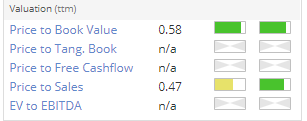
Personally, I don't even see it as having much "value" to speak of, since its intangible assets could be written down at the stroke of a pen.
Xaar (LON:XAR)
- Share price: 94.2p (+6%)
- No. of shares: 78 million
- Market cap: £74 million
Xaar plc ("Xaar" or the "Group"), a world leader in industrial inkjet technology, provides its scheduled trading update for the six months ended 30 June 2019
This is another share which used to have a mighty valuation. Xaar was a FTSE-250 member at one point!
Trading in H1 is in line with expectations.
Revenue is expected to come in at £23 milliion. This includes a £4 million reduction from some inventory being sent back to the business to be reworked, due to age.
H1 revenue last year was £35 million, including £10 million of "one-time royalties".
So if you exclude the inventory reversal and the one-time royalties, you can get to an "underlying" revenue increase this year (from £25 million last year to £27 million this year). Maybe that's reasonable?
Xaar makes industrial printheads, which I think is fair to say is an unglamorous industry. I've kept just half on eye on this story, believing that valuation might overshoot to the downside as it goes deeper into small-cap territory, due to lack of interest among investors.
It reports today that underlying trading has stabilised in printheads. New products are performing extremely well in terms of year-on-year sales growth, though we need to balance this against sales declines in older products.
In addition to printheads, there are a Systems business doing very well and partnership activities to develop 3d printing.
Cash sits at £21.6 million, almost 30% of the market cap.
My view - I continue to believe that this could make a nice purchase at the right price. However, it is forecast to remain loss-making until at least 2021 and so I am looking for more evidence of underlying growth and a restoration of profitability before swinging the bat at this one.
ATTRAQT (LON:ATQT)
- Share price: 35p (+3%)
- No. of shares: 180 million
- Market cap: £63 million
This makes "SaaS solutions that power exceptional online shopping experiences". Clients have included ASOS (LON:ASC) and Boohoo (LON:BOO). See the Customer section of its website.
Trading is in line with expectations and the integration of acquired businesses is proceeding in accordance with plans.
And more good news: it's getting multi-year contract renewal from customers, i.e. revenue should be more predictable for future periods.
My view - valued at 3x this year's sales and with EPS forecasts having nudged down over time, I'd be cautious about this.
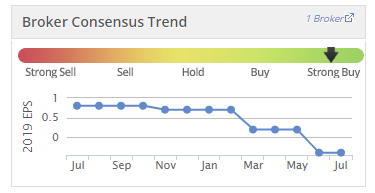
On the other hand, if it does hit next year's forecasts then it will make it to breakeven. Maybe there is a case to be made for it?
Frontier Smart Technologies (LON:FST)
- Share price: 35p (-1.4%)
- No. of shares: 40.7 million
- Market cap: £14 million
Science (LON:SAG) restates its case and says it does not anticipate increasing its 35p offer for FST.
As I said last week, FST looks vulnerable to this 35p offer. The statement by FST on Friday made no particular promises and provided no details in terms of the alternative joint venture plan, and Science is unimpressed:
"...in the opinion of Science Group, Frontier has repeatedly taken actions which have had the effect of frustrating the proposed acquisition of Frontier by Science Group. This latest "concept" of a non-specific strategy being proposed by the Frontier Board can only be regarded similarly"
I can't disagree with this and am leaning heavily in favour of the idea that the 35p bid would be a reasonable outcome for FST shareholders.
I can't see anything else that is of interest today, so will leave the report there. Mondays can be quiet sometimes - oh well!
Cheers,
Graham
Disclaimer
This is not financial advice. Our content is intended to be used and must be used for information and education purposes only. Please read our disclaimer and terms and conditions to understand our obligations.

29 comments
Hi Graham,
Think you may be a little unfair to describe Xaar (LON:XAR) industrial print heads as unglamorous. Having worked in the industrial ink jet business for 10 years + I can attest that there is a lot of technology that goes into industrial printhead manufacture - particularly contactless ink jet printing. The design and manufacture requires a combination of technological skills including front end and internal software design, electronics to control physics of ink delivery and chemistry to develop inks suitable for a variety of substrates. Unfortunately as a long term holder of Xaar (LON:XAR) having bought in at £5.00 after a halving from £11+ I am disappointed that they haven’t been able to translate their technology IP into market leading products as yet (!). I had hoped that as one of the few remaining independent industrial ink jet companies they might be a tempting acquisition target at the current valuation but that doesn’t seem to on the cards either. I fear I will remain disappointed!
Hi ACounsell, you are right, there is a lot of impressive technology in ink jets (and you would know this much better than me).
I was trying to say that it was an unglamorous sector as far as private investors are concerned - I don't think the average investor can relate to Xaar or find the motivation to study printheads. But I should have phrased it differently!
Also I can see where you were coming from in terms of the takeover possibility. It's something that I too think is possible but I've been waiting for the turnaround to work, before dipping my toe in. You were early to the party, but I will probably be late.
If I'm not mistaken, Trakm8 Holdings (LON:TRAK) were the company where the management reset their options to a lower strike price recently.
One upside of the poor company performance is no immediate prospect of them benifitting from this greed.
If I'm not mistaken, Trakm8 Holdings (LON:TRAK) were the company where the management reset their options to a lower strike price recently. One upside of the poor company performance is no immediate prospect of them benifitting from this greed.
I don't follow the company but that may be the case. Repricing "out of the money" options is the kind of thing we've come to expect from unscrupulous AIM management teams.
The update today was particularly poor, not just because the numbers are not great, but because the directors have decided to throw one of their sales teams under the bus in public without any admission of who is driving the bus. Who employed the sales team and monitors performance? According to Stocko the company only has 240 employees and so the directors should be more hands on and deal with it rather than blaming individuals in public and reducing employee morale in the process.
I suspect Graham is correct and the intangibles (IP etc.) are worth nowhere close to what they are valued at in the accounts. It seems to me the jig is nearly up.
All the best, Si
Did anyone here go to the @SOLI results presentation and update on prospects at lunchtime today? If so, was anything important said?
re Mercia Technologies (LON:MERC) (now called Mercia Asset Management) a note on Research tree from Edison today: ''The shares continue to trade at a significant discount to NAV (0.77x), even before considering the embedded value of Mercia Fund Managers (10p+).''
Mercia Technologies (LON:MERC) reported today. The figures look OK to me (though I'd welcome Graham's expert view). The outlokk from the CEO says:
re: Trakm8 Holdings (LON:TRAK)
Si, thanks for the input. Hopefully it doesn't wind up as a zero for holders.
Trakm8 continues to focus on owning the intellectual property ('IP') we use in our solutions, and we see this as one of our key competitive advantages. Telematics systems are complex; but because we own all the elements that encompass a solution (with the exception of the mobile networks) we have the ability to understand and resolve problems more easily than our competitors.
Sorry, but as an engineer I have to say this is utter garbage. The IP has clearly not differentiated the company's products at all over the years and has merely served to run down cash because of the cost of developing and maintaining it. And unfortunately the company has been part funded by the UK tax payer through the silly R&D tax credit system .
The crux of the problem is that the company has been incredibly badly managed over the years and targeted the wrong line of business without being agile enough to see the writing on the wall and change direction. Like many small UK technology companies, it should never have been listed.
All the best, Si
Justmo
Maybe that is true. As I say, I do not exclude blatant negligence from criticism, especially from companies with the budgets and expertise at hand.
There is Catch 22 to all regulatory processes. For example to prove my id for many banking and legal purposes, I have to send passport/driving licence and utility bill info to a whole variety of bodies. In that process, I am already putting myself at risk, to prevent risk, on the basis that these won't be abused accidently or otherwise.
My sympathies if you have been affected by poor processes, but there is a lot of consequences for a regulatory process that in my view has created a great deal of uncertainty and perhaps feeds on itself.
Became so disillusioned with IPOs such as £Luceco and UP Global Sourcing Holdings (LON:UPGS) that abandoned them altogether. Sure enough managed to miss a good one ..AJ Bell.
Not at all a small cap but BA owner International Consolidated Airlines SA (LON:IAG) has just been slapped with a GDPR fine of £183,390,000 for a data breach. That's not even the maximum permitted. IAG are appealing, obviously.
If this is going to be a common feature from now on we probably need to factor this into valuations of companies that operate online and rely on our personal data to make money. It's a bit of a minefield, although in this case the breach seems clear enough.
https://ico.org.uk/about-the-i...
timarr
That breach has more consequences for IAG I would think, if this is the level of fine taken.
There is a class action lawsuit ongoing, which I think they would have to settle in one way or the other.
They can afford it, of course. But for a firm with large revenues and small margins this seems a huge threat.
There is a class action lawsuit ongoing, which I think they would have to settle in one way or the other.
Yep, it's a misunderstood area of GDPR, but consequential damages are permitted. The real pain would come if the hackers lifted username and password details from the IAG site and then used them to breach other sites. At that point the costs could be multiples of the fine.
Basically companies need to stop using email addresses and static passwords to protect user data. Up until now it's been easier to ignore the problem because the costs fall on customers and banks (who have to issue new cards and deal with refunds).
timarr
Have to say I'm happy to see the fine levied on International Consolidated Airlines SA (LON:IAG). Their IT systems are a ramshackle mess and something like this was always waiting to happen. They got rid of their in house team and outsourced everything for cost savings. Sometimes there are consequences for that.
They don't want to understand that they are in fact an IT business whether they like it or not. And if the only language they will listen to is money then perhaps they're listening now.
I wonder whether there is an illusion that business systems are safe from hacking. I am not trying to exclude negligence from the process of protecting Customer Data, which obviously should be taken very seriously.
However, GDPR is a a bottomless pit of nebulous obligations. As we have seen from Morrisons, someone with a criminal intent within a company can leak personal data, for retributive purposes, and still the Company gets fined.
There is no such thing as a foolproof system, so showboating fines by a regulator, where since their funding has been reduced has an active interest in showing Parliament it is doing its thing, and justifying its own existence, and supporting itself from the sins of other, I don't know is an entirely healthy process.
I remember someone on this discussion thread saying they thought that GDPR was no big issue. I honestly feel they haven't experienced the never ending process of replying to technical questionnaires, and big company lawyers trying to impose draconian liabilities onto companies in their supply chain, that have become part of the game of this process. It has became a burdensome grit in commercial life, and whilst I think aspects of it are useful, like demonstrating you have technical and organisational matters in place to prevent data breach, if someone targets you, there is still a reasonable chance they will inflict some damage on you.
Well, GDPR doesn't require that systems are foolproof. But it does require that businesses assess risks and put in place mitigation measures. The Morrisons case is to go before the Supreme Court so that's not settled yet. Even so, you have to question how an employee can copy 100,000 staff records without them knowing.
In general, any business that uses email address and a static password is a sitting target for a breach. If it happens they should get fined, it's not hard to introduce two factor authentication to block that sort of attack. If you're using state of the art authentication and have proper access control systems in place then you're mostly covered technically.
But the fines don't go to the ICO, they go to the Treasury to prevent the conflict of interest that would arise otherwise.
timarr
I think for large consumer bodies the obvious risks are are in their engagement systems.
However, it is not hard to see all normal electronic communications systems as a basis for cock ups, and I see a growing encumbrance to business if the necessary processes override commercial convenience. That may just become a factor of life, barring some unforseen technical revolution.
At a high level, many ordinary businesses and suppliers do not seem to be aware of the requirements on them. And its a game of pass the legal parcel for many large corporations, that is proving a time consuming process for contractual engagements.
The fact that the decision on Morrison's at the appeal stage, shows us that the finger is already tilting the justice scales, and I am not convinced that Treasury budget dance, and Regulator adjustments of fines will have no connection.
With respect I think you are simplifying an increasing burdensome body of regulation. That it has some good outcomes, I don't doubt. I am afraid we'll have to agree to disagree on that one for the time being on the uncertainty it brings to business life.
The underlying reasion for IT failures and cybersecurity vulnerabilities is the poor quality of most software development. Much software is built using components taken from internet sites, with little documentation and no warranties. Developers rely on being able to find errors through testing, when academics and some software engineers have known (and shown decades ago) that even heroic and impractical amounts of testing cannot find most defects in today's complex IT systems.
This situation can only get worse unless there is a revolution that introduces rigorous engineering disciplines into the way software is developed. GDPR and other regulation (such as HSE's new Operational Guidance for the inspectors that regulate high hazard industries) may cause companies to invest in better quality I. If so, it will be to everyone's benefit.
The underlying reasion for IT failures and cybersecurity vulnerabilities is the poor quality of most software development. Much software is built using components taken from internet sites, with little documentation and no warranties. Developers rely on being able to find errors through testing, when academics and some software engineers have known (and shown decades ago) that even heroic and impractical amounts of testing cannot find most defects in today's complex IT systems.
I completely agree. I've been an engineer for 38 years and IMHO modern day software engineers are lazy and generally incompetent when understanding the security aspects of software design. They readily re-use third party components and libraries that have not been fully tested or are even of unknown provenance. Back in the day, software was built in-house from the ground up. Of course, the driver for the modern approach is the increasing drive to get a product to market and to keep costs as low as possible.
However, many of these attacks are caused by human engineering i.e. spear phishing. It only takes one person clicking on a malicious link to let the hackers through the front door. As long as your employees are connected to the internet there is a danger, no matter how secure your IT systems are.
This situation can only get worse unless there is a revolution that introduces rigorous engineering disciplines into the way software is developed.
Apart from a few industries that have economics that can live with the high cost involved, rigorous engineering disappeared stage left many years ago. As a rigorous engineer I can't bloody wait to retire! :-)
All the best, Si
With respect I think you are simplifying an increasing burdensome body of regulation. That it has some good outcomes, I don't doubt. I am afraid we'll have to agree to disagree on that one for the time being on the uncertainty it brings to business life.
But that rather assumes that the ideal situation is one that provides certainty to business regardless of the impact on personal privacy. Having been on both sides of the GDPR fence I can attest to the fact that it's an overly bureaucratic pain in the arse, but it's also a consequence of companies failing to self-regulate.
Almost inevitably technical innovation outstrips the ability of regulators to regulate and in the meantime the innovators have the chance to make supra-normal profits. However, eventually the regulators catch-up and then businesses have a choice - regulate themselves or try to use their economic rents to lobby against the regulations in order to maintain their profits.
Almost always companies opt for the latter and almost always this eventually fails. GDPR is a consequence of this, PSD2 another. It's almost guaranteed that governments will soon regulate to capture more taxes from online companies as well. All of these things will expose online businesses to new costs and reduce their margins. It's an inevitable part of the innovation cycle.
A lot of the expectations about the profitability of online companies have been founded on the temporary excess profits that the first and second movers have achieved. That's ending - companies can't expect to continue to make lots of money without being required to take responsibility for the privacy and security of the data they hold.
Up until GDPR if something went wrong then the costs fell on consumers and banks. While the regulation has many faults it does at least push the burden back on the companies responsible for the problems. No doubt it will evolve into something more manageable over time, but the issues of managing consent and data privacy won't be going away.
timarr
I forecast that the same will happen in a few years time over cybersecurity vulnerabilities. It's unacceptable that companies can sell products that expose their customers to serious risks without carrying some liability for the consequences.
Currently, software companies successfully argue that regulation would suppress innovation.
In my opinion, regulation that requires higher quality usually stimulates innovation, because small companies are agile and use the opportunity to disrupt their larger competitors (which is one reason why the complacent incumbents lobby against regulation).
I haven't noticed that there is a lack of innovation in children's toys, or medical devices, for example, despite both being quite highly regulated in some aspects.
I haven't noticed that there is a lack of innovation in children's toys, or medical devices, for example, despite both being quite highly regulated in some aspects.
Of course, there are already cybersecurity issues with children's toys:
https://www.euractiv.com/secti...
And with medical devices:
https://www.forbes.com/sites/z...
Although this is my absolute favourite, unbelievable though it is:
https://www.wired.com/story/in...
But overall it's all part of the Internet of Things revolution. As this article quotes:
https://www.bbc.co.uk/news/tec...
timarr
This is a great comment. Fascinating perspective. Thanks.
I commented on IAG's IT being in a poor state back in June 2017 when they turned up in Roland Head's screen. What I didn't think it responsible to say at the time was that the mess revealed by their various systems failures just screamed out that they were a wide open high profile target for hackers. I'm not at all surprised that some hackers worked that out for themselves.
The size of the ICO fine reflects their view of the appropriateness or otherwise of the measures that IAG had in place to protect the personal data they held, as well as their failure to report the breach within the required timescales.
https://www.stockopedia.com/content/is-international-consolidated-airlines-heading-for-a-crash-landing-196495/
Trident,
Maybe you haven't had your details compromised through the apathetic nature of some of these companies. Lucky you. I can assure you it's not very nice waking up to find your details on the internet because companies haven't bothered to protect your details, and then the company often refuses to remove your details from their database unless you send them even more personal details.
Some people have incurred huge financial loss together with constant threats, email spoofs, and so on.
If there is no fine in place then companies can continue to be lax.
For those who read Part 1 of the IPO Study, I posted Part 2 over the weekend: link below.
IPO Analysis Part 2.“D” Listers, Frauds, Buy-Outs and Nomads.
This covers the "missing" 133 IPOs many of which had delisted or been bought out . Includes observations on the 541 total set.
Thanks very much for this, I started reading Part 2 over the weekend, and will finish it this week. It's a really interesting analysis.
Ta
Chris
My morning smallcap tweet:
Corero Network Security (LON:CNS), Trakm8 Holdings (LON:TRAK)
Corero Network Security (CNS) wins orders worth $1m.
Trakm8 (TRAK) FY dismal, in line with April guidance. A very un-AIM honesty (as well as blaming cutomers): "The Fleet Management sales team simply failed to win enough business." Outlook: "Revenues from new insurance contract wins expected to impact strongly [but] Given the disappointment of last year, we are being prudent with our outlook, with market expectations of a relatively modest recovery (low double digit growth) in revenues with small adjusted profitability."