Small Cap Value Report (Thur 5 Sep 2019) - BOO, Tough markets, MPAC, ALT, BKS

Good morning!
Thank you for the suggestions.
Today I have covered:
- Boohoo (LON:BOO)
- MPAC (LON:MPAC)
- Altitude (LON:ALT)
- Beeks Financial Cloud (LON:BKS)
I did not get to cover these three, but Avation (LON:AVAP) received some intelligent commentary in the thread below, if you're interested.
- Avation (LON:AVAP)
- HSS Hire (LON:HSS)
- Vertu Motors (LON:VTU)
Boohoo (LON:BOO)
- Share price: 272.4p (+12%)
- No. of shares: 1.2 billion
- Market cap: £3,160 million
A brief but very positive H1 update from Boohoo. Performance is ahead of expectations.
Consequently, the board now anticipates that results for the current financial year will be ahead of previous guidance, with Group sales growth now expected to be between 33% and 38% (against previous guidance of 25% to 30%).
Assuming 35% sales growth, total revenues would climb to £1,155 million in the current financial year.
The company's broker thinks that only a tiny fraction of the revenue growth will come from Bohoo's recent acquisitions (MissPap, Karen Miller and Coast). So it's nearly all organic growth from Boohoo, Prettylittlething and Nasty Gal.
As far as profitability is concerned, EBITDA margin is set to stay around 10%, so the EBITDA result this year should be in the region of £115 - £120 million. The adjusted pre-tax profit forecast is now £96.7 million (previously £90.4 million)..
My view: I'm impressed, of course. Boohoo has a great track record of profitable growth and of beating expectations.
As mentioned before, one of the things which holds me back from investing is the fact that Boohoo only owns 66% of PLT. Last year, out of £47.5 million in group net income, £10 million was attributable to the minority shareholders (i.e. to the family behind Boohoo (LON:BOO) ).
Maybe this doesn't matter, if the total pie will ultimately prove big enough to justify today's market cap of around £3 billion?
Elsewhere, I note that the valuation of Marks and Spencer (LON:MKS) has dropped to sub-£4 billion. Seems to be only a matter of time before Boohoo eclipses the traditional, legacy retailer.
Tough markets
Has anybody else noticed how extreme market sentiment has become, with respect to "quality" versus "non-quality" stocks? Maybe it's just me, but it seems that the disparity has never been higher. Perhaps there could be a study on the dispersion of valuation multiples, and trends in this over time?
For example, we have Boohoo (LON:BOO) at a PER of 40x while Marks and Spencer (LON:MKS) languishes at less than 10x. One of them is online and growing, while the other is a legacy retailer and is shrinking.
As a general observation, there seem to be fewer companies these days which aren't classified either as "quality/growing" or "poor quality/shrinking". There are good companies and there are bad companies, and fewer in the middle.
I'm finding it easy to get frustrated in these markets, and I don't think I'm alone. The "value" strategy has not worked for a long time, and is still not working. I've adjusted my quality filter to be ever more selective, but it's still hard to understand why some stocks remain so cheap. Looking for value can feel like a complete waste of time, when value stocks are continuously getting cheaper.
It also feels like we've had a lot of mishaps, failures and accounting scandals on AIM over the past year. In recent months, Burford Capital (LON:BUR) has dominated the headlines. The CAKE fiasco is not so long ago, either. Think of GOAL, FLYB, ESL, STAF, etc.
This FT article (which I think I discovered via a Stocko reader) generated quite a lot of comments, not all of them favourable. It describes how AIM fundraising has "slowed to a trickle" and how the performance of the top AIM companies has been rather poor over the past 12 months.
From an index point of view, AIM has never been a great performer, and it has been a particularly tough place to be over the past two years. It has performed significantly worse than the FTSE All-Share:
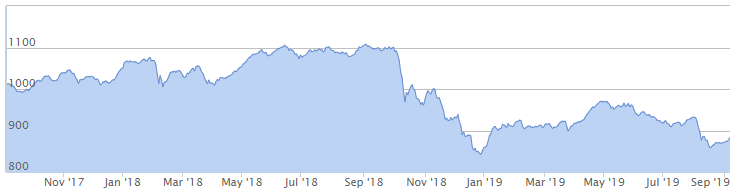
The other point about AIM is that returns tend to be highly concentrated in just a few winners, while most shares achieve little for investors.
While that's true for most indexes, I'd be shocked if it didn't apply even more to AIM, where many of the companies are highly speculative and ultimately prove to be worthless, than it did to other markets.
It's also a very unequal index: the likes of Boohoo (LON:BOO) and Fevertree Drinks (LON:FEVR), with multi-billion pound valuations, move the needle in ways that the vast majority of companies are unable to, even if they succeed.
My point is that when you have an index where most shares are losers, and the index itself has performed poorly, then you have a really tough investing environment. Throwing darts might work in some markets, but it probably won't on AIM.
The political risk to inheritance tax relief is another factor which could smash AIM valuations at some point - perhaps it already has, to an extent?
Anecdotally, I've noticed that lots of my investing friends had a great H1, but the last two months have been much tougher. The flow of profit warnings in popular small-cap stocks has seemed relentless (e.g. most recently Somero Enterprises Inc (LON:SOM) and Altitude (LON:ALT) ).
And when you consider that the big-cap FTSE-100 index has also been a terrible performer, it's a wonder that investors in the UK market aren't more depressed.
Meanwhile, the din of politics is impossible to ignore, with the huge distraction that it brings and the uncertainty that it spreads to financial markets.
What I'm doing
Looking forward, I plan to make the following changes, gradually, to make my investing life better from now on:
- more index trading and investing - I think I have a good sense for value in the indexes, and it suits my temperament, so I'll be doing more of this.
- more shorting - I probably find it easier to detect a bad business than a good business, so I'll keep doing this.
- more US investing - the US market has many of the best companies in the world, and I'll increase my allocation to them from now on
- less value investing - I need to be more selective in future, letting fewer companies in to my portfolio because they are "value". I need long-term holds, which means I need to be extra strict on quality, and less strict on value.
By gradually making these changes, I hope to move on from the frustration of seeing cheap shares remain cheap for extended periods of time, and use some extra tools to enhance my overall returns.
Some motivational thoughts
When the stock market has been rubbish for a while, you start to see people dropping out of it - they give up and move into cash or property instead.
I don't think we are at peak despondency yet, so there could be a lot more to come. When we get into a full-blown economic downturn and/or when politics becomes even more chaotic, that might be the point of peak depression. That's when people will walk away from the stock market and never come back (as many people did in 2008).
Continuing to invest in that environment won't be easy, but it is the point when investing is the most profitable, from the point of view of your long-term returns. That's the point when you get the most attractive bargains, if you have the courage to buy them.
In the wise words of Buffett: "the stock market is a device for transferring money from the impatient to the patient".
The Stocko community is a sophisticated bunch, and many of you will have been through more market cycles than I have, but perhaps these comments will help some of the less experienced investors to think twice before selling out of their portfolios at the worst possible time.
MPAC (LON:MPAC)
- Share price: 213.75p (+6%)
- No. of shares: 20 million
- Market cap: £43 million
This is a "global packaging and automation solutions group".
See my coverage of the trading update in July.
This stock used to be all about "can it survive its pension fund?"
It's now more about profitability and exactly how much cash will be left over for shareholders, after making payments to the pension fund.
H1 results
Some fine numbers here.
- Revenues +62% to £45.8 million (of which £5.5 million was generated by an acquired business)
- PBT £2.9 million (versus a loss last year)
- underlying PBT £4.5 million (breakeven last year)
Guidance
The company explains that its order book at the start of 2019 was much higher than at the start of 2018, and that's what helped it to generate such a big result in H1.
The order book at the end of H1 2019, however, is only "broadly comparable" to the order book at end of H1 2018.
So it sounds like many more orders will be needed to sustain the growth into H2, and this is less certain:
..there remains the potential for forecast orders to be delayed due to general economic uncertainty for the medium term, driven by macro-economic and political circumstances outside of the control of the Group. Therefore, the Board anticipates that, while the results for 2019 will be above current market expectations, primarily as a result of an increased number of repeat projects and by operational efficiencies, the medium-term economic outlook, driven by macro-economic factors, is less certain.
Pension
We already knew there was good news on the pension front, thanks to the trading update.
The actuarial deficit is £35 million as of June 2018, compared to £70 million three years earlier, and is expected to be eliminated by July 2024.
My view
I can't predict this company's order flows and there are still quite a few years until the pension issue will finally be resolved. That said, full marks to Mpac for trading through their difficulties and apparently coming out the other side. Investors are right to feel optimistic.
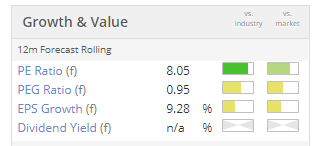
Stocko aptly rates it as a Turnaround:
Altitude (LON:ALT)
- Share price: 57.2p (-38%)
- No. of shares: 69 million
- Market cap: £39 million
Trading update and notice of interim results
Commiserations to those who held this overnight and have seen a very large drop overnight. This is another stock that is frequently mentioned among private investors.
While the growth numbers given for H1, objectively speaking, aren't terrible, they have resulted in a significant cut to forecasts.
In the words of the broker (via Research Tree): "forecasts are pushed back a year".
The FY December 2019 forecasts are changed as follows:
- Turnover £11.9 million (from £18.5 million)
- EBITDA £1 million (from £6.5 million)
- PBT £0.2 million (from £5.9 million)
These come out as huge percentage reductions because Altitude was supposed to be on the cusp of breaking into strong profitability. However, that "cusp" is now 12 months longer than previously thought.
Altitude runs a US-based promotional products platform, and investors believe that it could benefit from network effects as the suppliers and buyers of these products use the Altitude platform to transact.
From a balance sheet point of view, Altitude reports £3 million in cash (with no borrowings) and says that its US business is now self-funding.
It also says that "the business model is working, is scalable and is commercially attractive to both sides of the marketplace".
I'm inclined to think this is worth looking into. Official forecasts have been put back by a year, but if they are achieved then the company will generate adjusted PBT of £5.7 million next year (FY 2020). As a marketplace, it could have very attractive economic characteristics for investors.
The company recently announced a change of accounting reference date, from December to March, and this will create the mess in the accounts that it always does. As is often the case, the company put forward a convincing-sounding rationale for this change.
Beeks Financial Cloud (LON:BKS)
- Share price: 81.7p (+3%)
- No. of shares: 51 million
- Market cap: £42 million
Beeks Financial Cloud Group plc (AIM: BKS), a cloud computing and connectivity provider for financial markets, is pleased to announce its final results for the year ended 30 June 2019.
Beeks provides financial institutions with access to servers near financial exchanges.
Because it charges customers on a monthly basis, it calls itself an "Infrastructure-as-a-Service (IaaS) provider". Any company that charges customers more than once now calls itself "as-a-Service".
Results
These are solid results, with revenues up 32%, though underlying PBT only increases by 11% in response.
The "annualised monthly committed recurring revenue" (what a mouthful!) is now £9.1 million, which I will simply call the run-rate of revenue.
Gross margin has declined by a few percentage points to 49.6%, which Beeks says was anticipated as two new data centres have not yet reached breakeven. The depreciation charge has increased, as capex growth has outpaced sales growth.
Pre-tax profits remain small relative to the market cap but are forecast to more than double in the current financial year to £2.2 million, before rising to £2.9 million in FY 2021.
Outlook statement is confident:
Overall, the business is delivering on its early promise, using the enhanced profile and strengthened balance sheet resulting from the IPO in 2017 to capitalise on the growth in demand for Infrastructure as a Service offerings within financial markets. We are confident the quality of our service will see our client list continue to grow in the year ahead, and we look to the future with confidence.
My view - this looks and sounds like a decent outfit. I don't understand why someone else couldn't build a similar company if they were willing to spend the money on servers in good locations, but see for yourself what you think of the company's analysis of its competitive positioning:
We have... a strong competitive advantage through the breadth of our connectivity to trading venues, the sophistication of our self-service web portal, and the breadth of our services. We now have a foot-hold in all asset classes of note, meaning we can enter into contract discussions with any financial institution within the trading ecosystem. We believe we are now one of only very few businesses with this breadth globally and are unique in delivering these services via the cloud.
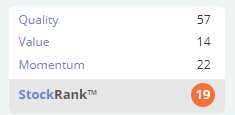
Stocko is cautious, classifying it as a Falling Star:
Out of time for today, thank you for your comments and feedback as always.
Paul is back tomorrow.
Cheers,
Graham
Disclaimer
This is not financial advice. Our content is intended to be used and must be used for information and education purposes only. Please read our disclaimer and terms and conditions to understand our obligations.

48 comments
All factor stats are dominated by the definitions and data sets used. Momentum is the easiest to measure, but definitions still vary.
I use my very personal somewhat vague definitions. Quality is steady (low standard deviation), usually with a moat. Growth is growing at x% faster than average; usual definitions assume that growth should invariably be present and generally - that's not my experience in practice. Value is much cheaper than it ought to be; usual definition seems to revolve around low PEs or other low valuation metrics.
As a PI, I am predominantly a value investor. REITs are an exception. Nevertheless I do have growth shares. It was gratifying to see the valuation rise in my Boohoo (LON:BOO) holding today exceeded the amount of my original investment. When I bought it, it was a value purchase even though the PE was high.
Although they are "cheap", shares in declining businesses are never value buys unless the management is fully focused on the fact that the business is declining. Statistical definitions nearly always get this wrong. Declining businesses can be turnaround opportunities or asset plays (or &etc) but they are never value unless you can add up all the receipts during the decline and see that they exceed the present price. Even if they could, management will usually gamble to make things get better and that almost invariably fails. The best way to see businesses like this is as speculative and a bet on the exceptional capability of the current management. Can work but usually doesn't.
Buying decent businesses cheap always works in the end.
Buying duds never does unless you are lucky and/or good at getting out in time.
Value requires knowing the difference.
FUTURE FUTR has so far delivered brilliant returns on investments and for investors. The results due on Nov 15th are clearly going to be spectacular and I guess will be examined on two counts especially - are the accounting profits being realised as cash returns (look at cash/debt position, RoA, RoCE and free cash flow) and are the prospects for next year (Sept 20) still looking good - there will clearly be a huge slowdown in the nominal growth rate as this year has been hugely impacted by the acquisition (especially) of Purch. Some of you will know that there was an attempted bear raid a few months ago which produced possibly (I hope!) the most spurious contra arguments I have yet heard. Well, they were just lies really.
I don't pretend to understand the business more than superficially but it strikes me that it does have a very large moat inasmuch as it needs to be really well managed and the model really well executed in order to grow and monetize the online magazine product. The US is now easily the biggest actual and target market. It does not, I think, have the gearing of (say) a software company that just has to add subscribers to a largely fully- developed product and the gross margins go up. Future has to keep its readers and advertisers stimulated and satisfied. When I have doubts I always return to the video results presentations and satisfy myself that the CEO, in particular, seems to be in superb control of her business even with the rapid growth of product offering and staff. I have made big mistakes with high flyers in the past but I don't want to let this one go.
Re Altitude (LON:ALT)
One of my red flags is changes of accounting date. The motives usually quoted for doing this normally seem superficially plausible, but in many instances to me do not pass the smell test.
Its strange how they most precede, or follow difficult trading circumstance. They also usually refer to circumstances that they want to benchmark as the new normal, forgetting that if they were accommodated within their current trading year, they still reoccur. A bit like swapping a weighted H2 to being a weighted H1.
They muck up prior year comparisons, and basically seem to allow management usually a further breathing space when they hope something better can be headline reported at year-end, albeit on an extended basis.
I guess there can be circumstances when it makes sense to change you accounting year-end, but I fear the history is usually a CEO/CFO ruse to buy time.
Graham re Tough Markets
We all know that cyclical shares do well in an economic upswing, & relatively poorly in a downswing.
Similarly, factors also vary in efficacy through the economic cycle.
Durng an economic slowdown (where the UK economy currently is), the Value factor tends not to be rewarded. Instead, investors tend to pay up for growth.
JP Morgan have attempted to identify which factors work best & when:
Curiously in the 'Recovery' phase (when emerging from a recession), those stocks with the worst Quality & worst Momentum perform best. This should be bourne in mind by investors who prefer to consistently invest in high QMV 'Super' stocks.
Thanks Howard (M) for reposting that JPM cycle chart - I was scratching my head trying to think which thread it had been posted on last.
It shows the economic cycle and its generally regarded that the stock market cycle precedes it, so the market drop since last summer would indeed be consistent with the view that we are now in the slowdown phase.
It is difficult though in my mind to use these thing predictively - you can have short cycles and long cycles (and one sitting inside the other!) . The FTSE 250 (said to be most representative of the UK domestic economy) fell by around 18% from last summers peak to late December and is now 13% above the low (via c. +15% in April). So the bullish could argue that we are past the worst and the economy should turn sometime soon - I'm not convinced by that, but in all honesty I do not really have a clue.
Graham, as I have mentioned to you before running a number of short positions is very helpful for reducing market risk. I run a long/short book and this year 80% of my returns are from short positions, despite markets being up broadly. There have been some easy short situations such as Metro, WPCT, Debs, AO, M&S, Thomas Cook to name but a few. There is asymmetric risk being short but there are plenty of struggling businesses around at the moment where the risk of a surprise take out are very low.
HB
"I need long-term holds, which means I need to be extra strict on quality, and less strict on value."
it's always tricky. Some styles can persist for a long time, only to be overtaken by something else.
Although it's fashionable to bash Woodford these days, he was prescient about predicting the ascendancy of quality shares in an FT article in 2010, IIRC. I remember the date because it was about the time Terry Smith launched his Fundsmith fund. His fund went on to give excellent returns. Undoubtedly Smith is a good stockpicker, but you have to ask yourself if he was helped by favourable style headwinds.
To what extent can we expect this to continue?
I think it was about a year or so ago Woodford said that there was near a record level of disparity between quality and value shares, the implication being that it would be value shares that would outperform.
Woodford's credibility has since gone down the plughole, of course, due to a combination of holding illiquid stocks and some really ropey value shares.
That doesn't necessarily mean that he is wrong in principle, though. Or maybe he is. I don't know. It might be, for example, that the shadow of 2008 lingers on. Value shares with poor capital structures may get slaughtered if interest rates rise just a little. We could have a major economic downturn, which will also slaughter these so-called "cheap" shares.
I don't know what the answer is. Probably when you hear the "death of" something, that's the time to invest. Are we at the "death of" value? I could flippantly say "answers on a postcard please", but I would actually be genuinely interested in hearing considered responses to the question.
"I don't think we are at peak despondency yet"
I'd agree. The markets have been a grinding one, rather than an atmosphere of despair. A recession would really remind us of what a tough market would be like. The markets seem fairly priced at the moment, so my best prediction for the markets is "more grinding".
We've got no reason for economic enthusiasm, and the market certainly seems cognizant of potential dangers. So who knows, maybe ol' Boris will pull a rabbit out of the hat and the markets could actually rise.
I try not to be too clever these days. A combination of low debt (PBT>3X net debt) and a nice divvie yield (say 4%+) is a pretty simple strategy to follow, and very low maintenance. Safe company, good value. Maybe throw in a momentum score for good measure.
Mark
A good comment and echoes my sentiments. I tend to adhere to more traditional valuation yardsticks and as you say these have not proved reliable recently but I take the view they will at some time. The penalty dished out to smaller companies when they fail to meet expectations is a good example of the type of market we now have and will continue to do when we have the likes of Trumps tarriffs and Brexit affecting the UK economy as it will do for sometime to come, leaving aside the portent of a Corbin lead government which seems more credible given the antics of BJ
Although the AIM index has not been a very impressive performer, AIM100 has been excellent right up until about August 2018 since when it has really struggled.
More generally, all factors (Q V M) have stopped providing a returns excess over the index since about the middle of last year. But as many have observed, V (as measured by Stocko anyway) has not really performed for quite some time. Value is a perhaps a special case though. The "sweet spot" for Value as defined by Stocko seems to be somewhere near the middle (50) rather than as high as possible but it does not seem to be very selective for "performance over the next year".
I think the instant availability of data on a stock's price history and fundamentals have caused a continual chase after the small number of really top performers. I can try as many clever screens as I like, but I usually find that the stocks I identify are already listed in one of Stocko's "top ten" on the Home page and the battle seems to be to notice when the circus has moved on and your chosen stocks have fallen out of favour.
Hi (I hope this is not too OTT, but it might interest some)
REf investing styles this year conversation.
I was a QM investor. Mid-year I realised QM was not working for me this year. Luckily for me Jack Corsellis started posting his Stocko Technical Analysis thread explaining in detail Wyckoff technical analysis (and much more). See here https://www.stockopedia.com/content/technical-analysis-comment-stocks-for-video-review-489681/
I watched first video 05/07/19, then every one since. I applied principles as quickly as I got to grips with them. The graphs below suggest that abandoning QM for Wyckoff is beginning to work (for me).
First (1 - light orange line) I began exiting any holdings which clearly did not align with a sensible Wyckoff chart/volume structure. At that point I was 60% invested 40% cash. I am now 25% invested, 75% cash so very low risk (see marker 3).
Second (2 - light grey line) after period of getting a working knowledge of Wyckoff my invested portfolio finally began to outperform the FTSE 100 (blue line), and now exceeds it (see marker 4).
Third (3 - Light orange line) my invested portfolio is now performing at over double my previous performance with less than 50% of the what was my invested capital, so risk/return ratio is significantly stronger.
Fourth (4 - light grey line) after further absorption of Wyckoff and introduction of strict buying/scaling in & stop loss rules and investing using Wyckoff structures, my portfolio is now exceeding FTSE 100.
Fifth (5a - dark orange & 5b light orange) small increases of invested capital seem to be returning quite noticeable positive outcomes for the £value of gained capital.
Obviously there is no silver bullet, but this suggests changing investing styles (quite dramatically) can be sensible, as several comments above are suggesting they are doing. Also, as CHarlie Munger points out use as many mental models as you can possibly absorb because this can add to ones investing tool kit.
I fully accept, that these stats are over a very short period (2 months). But for me, I am feeling more positive than I have been all year, about how to be in this market in these dynamic conditions.
Regards
Howard
Did you buy his course?
Any good?
Been following Jack for a while on YouTube, he does come up with some interesting ideas which I have found both rewarding and thought provoking.
Hi Old ManFit
Yes I did buy Jack's course.
I have session 9 & 10 left to go. I parked sessions 9 and 10 because the earlier sessions had furnished me with so much to begin to implement I wanted to try a few things out before working towards the concluding sessions.
IMO the course is very well worth it. His pace of explanation, clarity of thought and articulation are just spot on to help you absorb the richness of the Wyckoff methodology.
To put it bluntly, the course and Jack's YouTube vids have already paid for themselves several fold.
But the interest is far from just financial.
To my mind and previous experiences what Jack explains makes great sense to me. I feel I have elevated my comprehension of Mr Market far beyond my previous levels.
Encouraged by the course and Jack's vids I have elevated my levels of investing disciplines and these have given me a heightened sense of security in handling my portfolio (see for example my posting #1 on this thread https://www.stockopedia.com/content/how-should-i-use-stop-losses-510216/
And then on same thread, posting #9
I hope that helps. Very happy to respond to further questions should you have any.
Regards
Howard
There is an interesting discussion over on The Investors Podcast with Tobias Carlisle regarding value.
I would encourage a listen for those interested - there is also a discussion on the most recent one regarding shorting Netflix.
Regards,
Sully.
Graham - excellent piece on tough markets - thanks
Graham
Very interesting article on tough markets. I noticed that you didn't comment on the recent share price fall in B.P. Marsh & Partners in which I think you hold (or previously held) a long position. Is seems oversold to me. Do you have any views on this please?
Hi Kevfle, I still hold B.P. Marsh & Partners (LON:BPM) and don't plan to sell at current levels. I might write something up on it soon, if I get a chance. The profit warning was a disappointment but I think LEBC might be more diversified than the sp fall suggets. We shall see. G
Fascinating views on the macro as ever Graham.
As I think I may have said to you a few days ago I am seeing some echoes of the 90s, with "sexy" stocks soaring whilst boring ones wither. Back then the buzz word was dot-com, nowadays there are several; blockchain (perhaps) ,"Artificial "Intelligence"" and '#aaS' ("as a Service"). I will know we have reached peak madness when Lookers or Pendragon start calling their HP deals AaaS - although the idea that the white good box shifter AO World is apparently a software/IT business is quite mad enough for me.
Twenty years on and it's once again an established fact that this new fangled internet thingy will kill off traditional business as we know it. (Don't get me wrong I'm not a flat-earther but I think perception often races far ahead of reality.)
It's certainly a tough time for a value investor (although I have morphed somewhat that's still predominantly how I would describe myself). Back in the late 90s I was hoovering up value bargains, which unfortunately got smashed every bit as much as their sexier cousins in the crash. However, with a little bit of patience they mostly paid back admirably in the end.
This time around, with I like to think a wiser head, there's much less buying going on and far more stocks being added to my watchlist.
As I've said before I have no feel for 'timing' the overall market so I have adopted a policy of using a broad portfolio of very small 'shorts' to offset my 'longs' and be roughly market neutral. Even with this safety blanket, I'm not finding it easy to buy these days.
Graham re Tough Markets - Yes an excellent observation about Quality vs. Value. I used to be a largely bargain Value investor, until I realised that the shares within my portfolio that multi-bagged were all expensive Quality shares. Even with all the political uncertainty over the last months my now Quality based portfolio has done remarkably well.
For curiosity and to try to input some objectivity I have used company Q and V scores as a measure of Quality and Value. Taking a look at my portfolio of 28 companies 85% have a Q Score >80 (ranging from Bioventix (LON:BVXP) at 99Q down to the lowest SimplyBiz (LON:SBIZ) at 65 Q. Not one of the 28 companies is less than the market average of 50 Q.
Conversely looking at the V scores, almost 80% of the portfolio have a V score <50, which are thus more expensive than the market average. The lowest V score (and one of the best performing) is Ab Dynamics (LON:ABDP) at 2V and the least expensive a Value punt Billington Holdings (LON:BILN) with 93V.
My theory is that during troubled times there is a flight to Quality companies that have a higher probability of continuing to grow their earnings. At the other end electronic media disseminate company information so rapidly that truely undervalued Value stocks are very difficult to find and are more prone to unexpected profit warnings. If recession does hit it may be all change and Value make a comeback, but for the moment I am very happy with a high Q, low V approach. I should maybe mention that I like a high QM combination too.
abtan - re Boohoo (LON:BOO), isn't that £28M for a full year though and they've only just completed purchase of MP/Coast/KM so shouldn't you be showing, say, £14M, as their contribution to the 19/20 revenue?
I think today's guidance is for an increase of 33% to 38%. My calculator probably isn't as good as your spreadsheet but if we accept their top guidance figure of 38% and allow £14M for the new aquisitions then I make organic growth a shade over 36%. Given that there will be fairly sizeable costs incorporating the new aquisitions into their operations then I'm more than happy with that.
But then, after today's rise so far, this is now nearly 10% of my pension so I may be expected to say that - many thanks once again to Paul for flagging this up in the very early days......but "buy and hold" is becoming a bit scary.
Boohoo (LON:BOO)
I'm not having a good day with this, which is clearly weakening my point, so apologies again, and yes, you are correct.
For some reason I thought the acquisition happened ages ago, but it literally was just a month ago.
So yes, assuming:
1) £14m for half a year's worth of new acquisition revenue
2) top of guidance is hit, and
3) MissPap isn't a large contributor to revenue
gives the 36% organic growth you mentioned.
I still think this is good growth by itself, but there is definitely an underlying rapid downward trend.
For the avoidance of doubt I sold out back in May.
Ta
Hi Graham,
Really enjoyed the Tough markets section and for sharing your thoughts. Its much appreciated.
Imran.
MPAC (LON:MPAC) hmmm strip out cash and you've got a business that looks like it will do 26p of EPS for a price of 150p = 6* earnings. Pension deficit and contributions reduced and should now be in surplus over next 4 to 5 years from what I can see. That should remove one big suppressant of the share price.
Also worth noting that they have some land (currently refused planning permission) that once they do get planning through should be worth north of 100p NAV so that could be an interesting bonus upside.
Noted the short term caution around investment decisions in the macro environment, but that doesn't read to me as though it is likely to impact on current or next year forecasts.
Looks like management have done a good job over last couple of years. I hold and continue to like.
Altitude (LON:ALT) down 37% that seems too much given the update is delayed revenue due to execution, if you believe that, and the market doesn’t unless you also view that these swings are algo driven, which I do partly. 200 + odd further members signed upto AIM is also very positive. Tempted to buy here.
No position in Boohoo (LON:BOO) but I am actually quite surprised by the share price reaction today.
Year-on-Year revenue growth for the last financial year was 48%
Year-on-Year revenue growth to Q1 2019 was 39%
Guidance for the full year is reported today as c35-36%
Presumably this 35-36% growth includes the additional of 3 new brands acquired over the last 6 months
I'm not sure how much MissPap did in sales last year, but stripping away the £174m sales that Karen Millen and Coast generated in their last accounts, that leaves, roughly, organic growth of just 15%.
With Boohoo, PLT and NastyGal growing at 27%, 42% and 153% respectively to Q1 that seems like a big slowdown for the Full Year.
Or perhaps my maths is wrong?
Thoughts appreciated
A
BooHoo only acquired the online business of Karen Miller and Coast. Are you using the whole turnover in your comparison?
Boohoo (LON:BOO)
I am indeed! Thank you for spotting the error.
Online sales for KM and Coast was £28m.
So organic growth (excluding MissPap) is down to at most 32%
On its own that still looks great, but compared to the previous results that is some slowdown, especially vs Q1 of this year alone.
A
Article has Aug not Sept in title ??
Thanks for spotting that Peter - I will fire my assistant.
G
Anyone have a view on Future (LON:FUTR) it is one of my biggest holdings and goes against the stockopedia recommendation which calls it a Momentum trap with a stock rank of 41?
Today's trading update shows trading to be Materially ahead of expectations
Trading for the final quarter of the current year in the Group's core operations is stronger than the Board's previous expectations. We have seen a positive performance from Amazon Prime Day related activity and strong ongoing trading in the US, as well as some additional benefits from foreign currency translations. Full year EBITDA is now expected to be materially ahead of current Board expectations.
Due to its acquisitions the Balance sheet may not be the best in the world but leverage is said to be at x1
The Group continues to show positive momentum in revenue growth in all our core areas and our cash conversion continues to be excellent, with year-end leverage expected to be under 1x.
BOO trading forcast today"ahead of expectations" up around 12% today. Revenues for 2019 £857M 2020 £1131M est. Net profit 2019 £37.8M 2020 £60.5M est. Sales growth at 45.6%. Now cutting new high;s.
Thanks, Carcosa very comprehensive analysis, as always.
On JohnEustace's point about the B737 Max, I agree it can only be good for Airbus & maybe indirectly AVAP. I think Boeing have a lot to do to re-build trust & possibly the FAA as well. It appears there was a high degree of self-certification in getting the MAX certified - incredible !
Dennis.
Drifting off topic a bit but many years back I worked for a major Boeing supplier and had enormous respect for Boeing's engineering. I've been really shocked to see what has happened since the McDonnell Douglas merger. If the 737 Max never flies again? Well there's a black swan risk for the markets.
Am I the only one that thinks yesterdays price action in Altitude (LON:ALT) was odd? Todays trading update wasn't scheduled or pre-announced. I noticed yesterday Altitude (LON:ALT) went to a 5 month low on more than double 50 day average volume.
Seems quite the coincidence.
No position
Altitude (LON:ALT)
I was expecting a TU today - RNS 15th August in CEO comments ".....we will provide a further trading update on 5th September."
Given the lack of information on AIM revenue and startling forecasts isn't it quite probable people were reducing/selling prior to the update which did hold IMO the possibilty of quite some downside risk.
Phil
Just watching
Altitude (LON:ALT)
I hold but not a large holding as this is more one of those asymmetric trades rather than a long term hold. I have had a number of email conversations with the CEO about consistent communication using KPIs. Nicola would respond by saying KPIs would give too much away to competitors, really ?? She comes across, and is, inexperienced. I also didn’t understand why they moved away from the one kpi they did have on users of the platform connecting customer to suppliers, I didn’t agree with her explanation that it was less important on focusing on the AIM users so isn’t relevant, but isn’t the platform a key differentiator and higher margin? Her view was yes but it’s still not as important, ok fair enough but why drop the KPI??? Inconsistent...
Jury is out still.
Hello again!
Graham - any interest in covering the beaten down but high yielding £ALU today. it's now very cheap and the market seems lo like todays results (I hold this one!)
Morning Graham,
Altitude have clearly disappointed today. Don't hold myself but was watching it and was aware there's a following amongst stockopedia users and some respected twitterati. So this is just a request to start a discussion really, and invite anyone really in the know to help us with a deeper dive. It looks interesting but seems to be stuttering, not being very shareholder friendly, and there was a large director sale recently.
£MPAC half year results look good, with a return to profit (both underlying and reported) and a forecast of the full year being above expectations, though with cautious remarks about macro uncertainties.
An EV that is less than half the MCAP, and falling pension contributions also add comfort for holders, of which I am one.
I'd welcome your views Graham, if you have the time and interest.
MPAC (LON:MPAC)
Hi FREng, I'm on it. G
Graham :
That was my initial reading too, but I don't think it is actually the case.
The acquisition delivered £5.5m in H1 but that was only two months, so if we assume £16.5m for H2 that requires the existing business to deliver £33.1m in H2 to deliver the forecast FY revenue, that's still 10% up on H2 last year but not as big a stretch as it seemed at face value.
I do though note the tone of caution and uncertainty and I think I would want to understand more about how prospect and orders flow through to revenue. From some of the comments it sounds as though they would too!
Thanks - that's a balanced analysis and very helpful
Graham
If these interest you I would like to hear your thoughts on £AVAP and £BKS (I hold both)
£AVAP - nice results and a consistent long term profits growth story. The key risk here would be a collapse in the value of second hand aircraft which would affect the value of AVAP's assets (leased planes) and their ability to sell on should any of their customers (airlines) go under.
£BKS:
* good strong revenue and profits growth
* revenue run rate is already well ahead of 2018-19 revenues so revenue and profits should increase this year anyway and should increase significantly with further customer wins
* reduction in reported eps is due to the increase in shares in issue at IPO (last year. Now that the shares in issue are (hopefully) stable eps should start to rise in line with post tax profits
* EBITDA figures are (as usual) meaningless. BKS's main costs are the deployed equipment. Leaving these costs out a KPI makes no sense. EBITDA is not (as some say) a surrogate for cashflow. The best surrogate for cashflow is... cashflow. And BKS's cashflow includes the capital expenditure on new equipment. (Apologies for the rant)
Beeks (BKS) is looking good this morning. Headline is revenues up 32%, profit up 22%, and as they promised getting larger Tier 1 customers.
£AVAP Avation issued their prelims today. The company is the only traditional commercial aircraft leasing company listed on the LSE. Others can be found listed in the USA and Hong Kong but most are privately held.
I have been a relatively long term shareholder of Avation and intend to remain invested for the foreseeable future.
Perhaps worthwhile to see their issued highlights:
Key Financial Results• Fleet assets increased by 22% to $1.27 billion as at 30 June 2019;
• Lease rental revenue increased by 21% to a record $117.7 million;
• Net profit after tax for the year increased by 28% to a record $25.7 million;
• Earnings per share (“EPS”) increased by 25% to 40.3 US cents;
• Interim dividend per share of 8.5 US cents declared, taking total dividends for the financial year to 10.5 US cents (2018: 7.25 cents), an increase of 45%;
• Dividend yield increased to 3.1% for the year up from 2.4%;
• Weighted average cost of debt declined from 5.0% to 4.6%; and
• Net asset value per share increased 7% year on year to £2.95 per share.
I think it's fair to say that's rather positive overall.
There is however one issue that I will require clarification, perhaps during today's conference call, and that is a Net loss on the cash flow hedge of $18m. That is significant. Really significant in my view.
Comparing two measure to forecasts (from Sharepad):
Revenue +1.1%
EPS +30 %
Revenue: Given the nature of aircraft leasing there really should not be any significant errors in forecasting this number.
EPS: What is hard to estimate is the value of aircraft sales. Avation did exceptionally well on this measure selling two aircraft 10% above book. I had penciled in about 5%. It also underpins the liquidity and realisable value of the fleet (as opposed to book value). They also have tax credits to deploy.
Avation have a progressive dividend policy and this continues with another hefty hike in the dividend, although at any one time the yield is 'relatively' small given the continual share price increase!
Credit rating agencies are essential to the businesses. Avation and the credit rating agencies look at various target ratios, for example principle ones are (according to my numbers):
Net Debt to Equity < 4 = 4.2
EBITDA to Interest Ratio >2 = 2.3
EBIT Interest Cover (>1.5) = 1.4
Funds From Operations to Debt (> 7-9%) = 5.5%
Overall the balance sheet leverage = 5.8
Profit After Tax ROE is 10.7%
A word of caution here, The above numbers are calculated using my methodology which I have used for several years. They will not tally with what Avation/Auditors would say however by me being consistent I can see trends emerging so I find it useful for that purpose.
From what I see, based on previous years, Avation are pushing up the amount of financing to the max. As the risk decreases through fleet and customer expansion then they seem happy to take on more financial risk; although one could argue the fleet is really worth a lot more than audited numbers show so it's not as bad as it appears. ROE is flattered by the sale of aircraft. This is something they can now start to doing with increasing regularity; although I note in today's prelims they have, unusually, no aircraft up for sale.
I have always been saying that Avation share price should be at a premium to book value. At yesterday's CoB share price was 294p. (+25% from last year) Book value is 295p but at todays exchange rate it is nearer £3.08. For two years now Avation have demonstrated that the fleet (especially the A321 fleet representing 31% in value) is worth an additional 10% in realisable value. That works out to around an additional book valuation of $38m or roughly an additional 60p. Whilst I would hesitate to say investors should buy Avation shares on that basis I would say that it provides a level of comfort for existing shareholders to allow them to sleep at night! Given the growth trajectory Avation consistently demonstrated over the years (This year an additional 12 aircraft) there is no reason to suggest growth is going to disappear.
General
Avation is a very very small leasing company. They perhaps rank around 45th in the world in terms of aircraft assets. This is an advantage in a competitive market. Avation offers investors the opportunity to own part of growth company.
The principle business is essentially obtaining a customer who has placed an order for an aircraft from the aircraft manufacturer and providing a Sale and Leaseback service for that airline. i.e. they obtain finance in order to take ownership rights of the aircraft, give that cash to the airline, at time of aircraft delivery, in exchange for a monthly lease. The lease rate is fixed throughout the term of the lease and is generally sufficient to pay off the finance by the end of the lease agreement (i.e. becomes unencumbered), at which time the aircraft can be leased out again, albeit at a lower rate.
There are, as expected, a number of nuances to be considered. In some circumstances the airline want to retain ownership of the aircraft at the end of the lease. This would be achieved by a finance lease as opposed to an operating lease. The aircraft, owned by Avation, can be sold by Avation at any time during the lease (with the lease still attached). Avation can also re-finance at any stage to obtain a cheaper loan cost. Within the leasing industry all of this is very standard.
Another major factor to consider is the residual value of the aircraft. The higher the residual value the higher the second/third lease rate can be and the more valuable the scrap recovery can be. Forecasting residual values is where things can get 'messy' trying to predict residual values for many years into the future is problemattic. Residual values depends on many factors, such as operating cost, maintenance cost, fuel costs, airframe history, replacement technology, country/regional legislation, economy etc. Fortunately there is a whole industry out there which provides insights into these factors. However, for various reasons the more new the aircraft in the Avation fleet is, the better. And Avation have a very young fleet.
Avation's Competitive Advantage
One of their primary differentiators is that they do not pre-order aircraft from Boeing/Airbus/ATR and hope to get a customer. The bigger leasing companies have to place orders with the manufacturers years in advance and in sizeable quantities, taking on the risk that the market may change between ordering an aircraft and having to deliver it.
Being a small company means that they are ideal to place one, two or just three aircraft with an airline, after they have a contract in place to deliver it, whereas the large leasing companies would pass over that sort of quantity in favour of 20, 50 100, 200 aircraft...
The Market - Looking Forward:
There is a wealth of date available on the web regarding the Aircraft market.
There have been a near unprecedented number of airline bankruptcies and defaults in 2019 already the market for SALB aircraft has been particularly difficult over the last 12 months with lease margins decreasing and lease yields falling. Whilst as a general statement that seems true there remains a great deal of variance between the different aircraft types.
What has been noticeable to me is that this year Avation have entered into x2 ATR agreement with an airline (US-Bangla) of very questionable reputation. ATR scaled back production in recent times (a few years ago they flooded the market with ATR's and then there was an unexpected glut of aircraft on the market looking for new homes). In 2020 the first cargo versions will be coming of the production line for FedEx and I (hope) that also help to reduce the passenger variant production capability, driving up demand for the ATR72-600. The number of new narrowbodied A321 placed the last year by Avation is nil. So based on Avation's activities this year it would seem that the wider industry woes are being noticed by Avation.
On the positive side, five A220's were placed. For various reasons I would like to see Avation place a lot more of this aircraft type in the near future, indeed become something of a specialist in it. In today's prelims they provide positive indications that further jet aircraft acquisitions are on the agenda, in addition to the usual lower value ATR's
It would not be at all a bad thing for Avation to have a quieter year in 2020/21 than in previous years. Those 2021 revenues ($140m++) are already ~19% more than today's announced revenue numbers and building up a cash pile will assist in improving some ratios. The sale of one or more aircraft will not go amiss either and there is always the potential of placing a one-off widebodied aircraft again. In Summary, Avation have plenty of options on what to do next although I do suspect near term high value aircraft deliveries are likely to arise from the secondary market.
US Libor and 5yr swap rate has been reducing. This may have a negative impact on margins. Certainly so for the larger lessors but Avation may be able to navigate around that.
One interesting new development this year is that Avation have entered into the engine leasing business. This tends to be a very lucrative source of income, although it does take more administration and there is always a risk that the engine becomes unserviceable due to the need for a modification. There is much to learn about this part of the business. I would like to know much more about this.
Overall I look forward to another successful year for Avation.
£AVAP. Carcosa. Thank you for this excellent summary. I hold (since September 2016)
Michael
Great write-up Carcosa. The results back up their simple pitch to investors that their business doubles every three years and the share price has tended to follow likewise.
The other market factor that occurs to me to ask about is the disruption caused by the Boeing 737 Max grounding. Avation are Airbus only so not directly affected, but airlines with Max aircraft in their fleets or on order have been scrambling to lease replacements. That should further underpin the Avation asset values. But the ability to pick up further new A3xx aircraft without pre-orders may not be there.
Edit - Correcting myself - They have 1 Boeing 777 and 1 Boeing 737-800 on the books
I also own Avation (LON:AVAP) and like Carcosa and John like the simplicity of the model. Price tends to lag investment, so I can see momentum over next 12 months.
One item not mentioned so far is the massive undersupply of new planes in the market. This is not going to change anytime soon and in fact is getting worse. Avation (LON:AVAP) holds a bunch of options over new planes that are therefore very valuable but held at zero on the balance sheet.
I agree with Carcosa that the share should trade at a premium to NAV (most competitors do) and should also factor in the value of these new plane options, circa 30p of NAV worth. I think a fairer value currently would be 350-360p.
I think I may have just convinced myself to top up - quick someone douse me with cold water!!!!
My morning smallcap tweet:
Altitude (LON:ALT), Gabelli Value Plus + Trust (LON:GVP)
Altitude (ALT) H1 trading. Rev up 42%, less than expected. Warns on FY. I hold.
Gabelli Value Plus+ (GVP) proposed tender offer cancelled because a GM has been called to to propose a continuation vote.