Small Cap Value Report (Tue 27 Aug 2019) - FTSE Contrarianism, CPR, CLG, SONG, COG

Good morning!
I'm back to look after the SCVR for a few days.
After some musings on the FTSE, I will look at:
- Carpetright (LON:CPR)
- Clipper Logistics (LON:CLG)
- Hipgnosis Songs Fund (LON:SONG)
- Cambridge Cognition Holdings (LON:COG)
FTSE Index - Contrarian Trading
It may not be the most exciting financial instrument in the world, but the FTSE remains an object of fascination for me.
This instrument was trading above 6700 in mid-2007. It previously broke that level in 1999 and 2000.
Twenty years later, anyone who was waiting for some decent capital appreciation has been disappointed. Despite reaching 7900 last year and 7700 this year, it is now threatening to return back to the 7000 level. Over a very long period of time, it has made very little progress.
Now it is true that the dividends have been strong, and if you reinvested them, then your portfolio has done ok. But the capital value of the index hasn't gone anywhere.
There are several possible explanations for this, and I think "the truth" lies somewhere in the middle:
1) FTSE-100 is a poor-quality index whose companies are structurally unable to generate compound returns.
2) The FTSE-100 is currently exposed to severe macro-economic risks (e.g. Brexit, recession), which require the index to carry a large discount.
3) (related to 2) The pound sterling is temporarily undervalued. When it strengthens, the value of foreign earnings will decline in GBP terms. The FTSE needs to be discounted to prepare for this.
4) The FTSE-100 is undervalued.
Personally, I am leaning toward 4) as the primary explanation for the FTSE's current level, with a little bit of 1) and 2) and 3) as well.
Indeed, I have added to my leveraged long position in the FTSE this morning, via put options.
While I have mostly avoided leverage in the past, and remain very cautious about using it, I can't resist taking a big position in the UK index at this time.
Even allowing for the fact that it's a low-growth index, the P/E ratios which it offers make little sense to me:
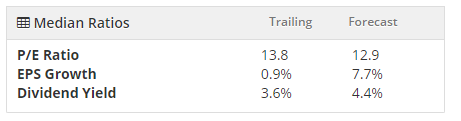
I don't currently expect interest rates to rise. And especially if they don't rise, then the dividend yield offered by the FTSE is really good value right now, in my opinion.
If UK price inflation picks up, that would still favour the FTSE, in my view, as many of the companies would be able to increase their sale prices simultaneously (e.g. the commodity sector, consumer goods).
Sector Concerns
Financials make up around 20% of the value of the FTSE. If we had another banking crisis, then of course that would be a big blow.
But if you look at the share prices of the big banks, they are already looking quite beaten up.
Barclays (LON:BARC), for example, sports a P/E ratio of 6x and a forward dividend yield of 6.5%. Its price to tangible book value is .4x (all numbers according to Stocko).
In a similar way, Lloyds Banking (LON:LLOY) has a P/E ratio of 6.5x, a dividend yield of 7% and a price to tangible book value of 0.9x. The yield at HSBC Holdings (LON:HSBA) is also 7%.
While I wouldn't be interested to own these shares individually, buying them as a sector group within an index at current levels doesn't scare me. One or two of them could have a problem, sure, but the basket as a whole might still offer decent value (assuming that we don't have another global financial crisis and bank crisis!)
The big-cap energy sector is another area where buying individual stocks isn't something I normally do, but where I think the group as a whole may offer value within the index.
Royal Dutch Shell (LON:RDSB) currently offers a 6% dividend yield and a PER of 10x. Glencore (LON:GLEN) trades around book value and offers a dividend yield of more than 6%. The yield at BP (LON:BP.) is nearly 7%. This is a basket of shares where I'm happy to be long at current levels.
Summary
When trading the index, I don't get to enjoy this yield directly, but I do get to enjoy any change in the market's perception of what this yield is worth.
The FTSE is in a perfect storm right now of Brexit concens and recession fears. International investors don't want to know about it, and British investors are unable to take up the slack, riddled with fear of Brexit and another recession. And for the average investor, the fiasco at Woodford may have knocked confidence in the funds industry.
I think it's exactly at times like this that someone with a bit of additional risk tolerance and a longer time horizon, can potentially get some great bargains, both at an individual stock level and also from the point of the index. Let's see if the FTSE turns out to be a bargain at current levels.
Disclosure: the breakeven levels for my FTSE trades are around 6400-6500.
Carpetright (LON:CPR)
- Share price: 14.75p (+9%)
- No. of shares: 304 million
- Market cap: £45 million
Long-term shareholders have been devasted by this company's decline but more recent buyers have something to think about today, which might be positive. A major shareholder has bought up the company's credit facility from its banks. It's a £40.7 million facility.
In addition, the major shareholder is going to fully support the banks in their provision of Carpetright's £6.5 million of overdrafts. It's a quirky structure but it effectively means that the shareholder is replacing the banks in both the RCF and the overdrafts.
The shareholder is a hedge fund which owns almost 30% of the shares, just below the level which triggers a mandatory takeover bid.
Some important comments by the company:
In connection with the arrangements Meditor did not seek any assurances from the Company, did not propose board representation and did not request structural changes in the business. Meditor has confirmed it now intends to engage with the Company with a view to providing a more stable and longer-term funding platform.
My view
I've heard some of the comments from sell-side analysts on this stock today, and I share their caution.
While this might be good news, that depends on Meditor's plans and on future negotiations.
Meditor might want to protect the value of its existing equity investment by providing a more generous lending platform to Carpetright. But for all I know, it might instead plan to take control of more of the equity. As the new principal lender, I'm guessing it has the whip hand.
Carptetright's most recent annual results (FY April 2019) disclosed a material uncertainty about its ability to continue as a going concern, depending on future trading and whether it could renegotiate its lending covenants. If it does seek to renegotiate covenants in future, it will be renegotiating with Meditor.
This share remains far beyond my risk tolerance. Just goes to show that even after a CVA and a rescue fundraise, a company can continue to struggle. This share is for traders and insiders only, in my view.
The StockRanks rate it as a Value Trap, which sounds about right.

Clipper Logistics (LON:CLG)
- Share price: 224.5p (-0.2%)
- No. of shares: 102 million
- Market cap: £228 million
Trading update and notice of full-year results
Readers may know this as the outsourced logistics supplier to Sosandar (LON:SOS). It's "a leading provider of value-added logistics solutions and e-fulfilment to the retail sector".
Today's update confirms that the company is trading well and revenue for FY April 2019 will be "slightly ahead of current market expectations".
However, due to some timing issues on the recognition of contracts, EBIT for FY 2019 will be £20.2 million, "moderately below expectations". For what it's worth, I can see an FY 2019 EBIT forecast of £23.5 million.
But the company says that there will be an uplift for FY 2020, as the lost profit is recognised the following year, instead.
My view - I tend to steer clear of this sector, but have a positive view of this company. If the market as a whole wasn't so weak, I would be shocked that its share price had been hammered so hard in recent months (it was >300p in May). Last year, it approached 500p at the peak.
Current pricing seems very reasonable: PER around 11.5x, and a single-digit EV/EBITDA multiple. For fans of this company who have researched it properly, I imagine that now could be a decent entry point.
It was previously rated as a growth share, and is now being rated as a more run-of-the-mill support services company:

Risks might include weakness among its clients in the online retail sector (the likes of Sosandar (LON:SOS) and £BOO). On the other hand, as a "picks-and-shovels" type of service provider, maybe it will enjoy some insulation if that sector retrenches?
It's too tricky for me, so I'm on the sidelines.
Hipgnosis Songs Fund (LON:SONG)
- Share price: 105p (unch.)
- No. of shares: 341 million (pre-Placing)
- Market cap: £358 million
Proposed placing of ordinary shares
This unusual fund, which buys music catalogues, is raising an extra £72 million.
It last raised money at 102p, and previously raised money at 100p. It is now raising at 105.5p.
While that's not conclusive evidence of anything, it does at least suggest that the company is creating value and that its incremental value is being recognised in subsequent fundraising rounds.
Its most recent two quarterly dividends have been 1.25p each. For yield hunters, this could be worth a look.
Cambridge Cognition Holdings (LON:COG)
- Share price: 32p (-49%)
- No. of shares: 24 million
- Market cap: £8 million
Commiserations to anyone who was holding this last night.
This company has had a few issues around revenue recognition in the past (like so many others lately), but today's update can't be blamed on accounting problems.
H1 revenues are down from £2.75 million to £2.17 million, and losses are increasing. It is hoping to work its way back to breakeven by Q4 2020.
My view - too speculative for me, I'm out (dropping coverage).
That will do for today, thanks everyone.
Cheers,
Graham
PS: I hope you find my new picture slightly less offputting - "no more squinting", as a reader put it!
Disclaimer
This is not financial advice. Our content is intended to be used and must be used for information and education purposes only. Please read our disclaimer and terms and conditions to understand our obligations.

38 comments
An index does not show the performance on an investment in it unless it is a total return index like DAX30. To be tautological the only measure of return is the total return. An accumulation fund / etf, or if you can find it a long term TRIUKX chart or data series gives a better idea.
Interesting point but all it tells me is that holdings indexes is not a good way to invest at all because you need to account for the companies which have been bought out or went bust.
If you own the ones which were bought, you gained. If the latter, you lost. However this is key to showing the full picture.
Since the final trading day of 1999, former household names such as Abbey National, ICI and Norwich Union have disappeared entirely after mergers or takeovers. Other famous brands such as Cadbury’s Schweppes, British Airways and NatWest live on but as part of bigger companies.
In 1999, the telecoms and first internet boom was in full swing and phone companies and technology companies made up more than 20% of the index, according to figures from stockbroker Hargreaves Lansdown. Now they account for about 7% of the list.
BT and Vodafone made up almost 14% of the FTSE between them and were the second and third biggest companies in the country. Both are still in the index but companies that fell out after the dotcom collapse of 2000 included Marconi, which went bust, Colt Telecom and Cable & Wireless.
+around half have delisted, went bust or got bought by overseas companies since 1999. (ICI/Reuters etc.)
If my memory is correct, Norwich Union simply renamed as Aviva, which is still in the index. Cadbury's and Schweppes are no longer in the UK index, but part of larger US companies (Mondalez and Dr Pepper Snapple?)
That's a big decline for the Telecoms since 1999! I wonder how the big consumer defensives such as Unilever, Diageo, Reckitt etc will have fared when we look back in another 20 years. Will Shell & BP still be drilling oil, will they have transitioned to green energy companies, or will they be much smaller?
Thanks for your more general musings on the FTSE Graham. I always enjoying reading these - alongside the standard small-cap coverage. So please keep it coming. Should be an interesting autumn all round!
One thing to notice is that although the FT100 has gone nowhere since 2000, the FT250 has done well. There seems to be little in the way of value discrepancy, suggesting that as a class, mid-caps are better bets than large-caps.
I also think that the vast majority of FT100 shares are too highly leveraged, and earn poor returns on capital, making them poor bets in general. I once solicited ideas for LTBH shares, and one suggestion that cropped up was Vodafone (LON:VOD). I rejected it for the reasons just mentioned.
Another thing to watch out for is that the FT100 index can go through spells where a cyclic sector is at its high point, such as we had with miners some time ago. Investing in these could spell disaster.
I'm not saying never invest in large-caps, of course. I do, for example, own some shares in Royal Dutch Shell (LON:RDSA).
Ref FTSE
This instrument was trading above 6700 in mid-2007. It previously broke that level in 1999 and 2000.
In hindsight it seems pretty obvious that the logical conclusion is that the ftse was way overvalued around these peak quoted times - the dropback in price from prior highs suggests this was the case. If we say 5000 level average in the 00's and 6500 average in the 10's - we are now at 7000 - does that not make the performance look way less bad? . don't know but i am guessing anyone who has steadily been adding since 1999 will probably have averaged a purchase price of below 5700? - so not such awful returns really if we look as how crapola bank interest returns have been in the last few years.
An interesting read, Graham.
I would suggest other reasons that the FTSE has barely moved are:
I also give a thumbs up for the new photo - much more suave and sophisticated ;-)
I know this is all a bit 'rough' but...
The UK equity-risk premium is about 5.5%
The yield over the next year is ~(3.6+4.4)/2 = 4%
Base rates are 0.75%
Productivity grew ~0.8% to Q1 19
4 + 0.75 + 0.8 = ~5.5%
... so you could argue that the ftse is about fairly valued.
What's the conceptual logic behind this? Adding up these three variables and noting they are roughly equivalent to the UK equity risk premium?
Hi Graham, when you buy PUT options they make money when the underlying market drops, not rises... or are you going long via spread bets, and using PUT options to limit your downside risk?... or are you selling PUT options - which IMO would be dangerous given all the macro factors at the moment.
Martin, I am doing the dangerous thing which nobody wants to do. G
Ahhh. Can't quite bring myself to say good luck as i'm on the other side of the trade! :)
But FWIW i do think the FTSE will be the most resilient of the major indices in a correction... My FTSE puts are small in comparison to those on the Dow, S&P, Nasdaq, Dax & Stoxx 50.
Hi Graham
Thanks for the interesting viewpoint and comments. You mention that you "don't currently expect interest rates to rise. And especially if they don't rise, then the dividend yield offered by the FTSE is really good value right now" I tend to agree with you if it proves true that rates are not going to rise, BUT (and it's a big but - hence the block capitals...) there has to be a higher than usual risk of rates rising currently with a potential hard Brexit on the cards. The sequence of events of 'Brexit shock - pound further slump - serious currency weakness - rate rises to help combat weakness' is a possibility, depending on how bad the currency slump were (if it's only 10% or so then I expect the powers that be will actually quite like that as it will make the economy more competitive internationally which is likely quite helpful in a Brexit aftermath, but if things continued to dive 20 or 30% and we experienced a serious problem (especially if Brexit complications play out worse than expected ... even a 'temporary' set of major trade issues would hammer the pound and then speculators would get involved etc. and the whole thing snowballs) then I would expect emergency rate rises would follow to stem the tide. It's a difficult balancing act though with the historically toppy housing market the BoE are not going to want to send property into a spin by going in too hard with rate rises one would think, unless its a real crisis situation. Fascinating few months ahead anyway, but I am reluctant to place a bet on the index either way at the moment... and, come to think of it, I expect therein might lie the biggest of all the reasons the FTSE is currently struggling as some major institutional money is playing wait and see with Brexit and nobody is willing to bet on London right now (discounted index or no discounted index) until there is some clarity and would rather put their money somewhere less complicated. I suppose you could argue this is potentially part of reason 4, though reason 4 assumes everyone is wrong and it will all come right - which we don't know yet (but we all hope so!). I guess all this comes down to "will Brexit be better or worse than the market currently expects it to be - good luck to anyone trying to predict that!
Sorry for the slight stream of consciousness. Well done to anyone brave enough to brave the whole thing and who is still reading...
BIACS
Graham, interesting view on the FTSE. I'm interested in why you use options rather than a geared instrument such as SG's ETP, called FTSE X5 Daily Long?
I haven't researched that product Gerard, but I find that the fees associated with those sorts of products can be high, and they are more complicated if you want to really understand how they work. But there are probably some good structured products which I haven't discovered. G
Morningstar quotes an annual charge of 0.7%, but I'm not sure how all the derivative costs are factored in. The trouble with options on the other hand is that they expire, but these ETPs don't.
Gerard, it's too long to explain in a comment but you need to investigate "daily rebalancing". These ETFs are designed to be held for less than a day. A long term holding will destroy your returns. The more volatile the underlying (FTSE 100 over the next few months?) and the greater the leverage (5x) the worse the performance.
Whatever else may be said about Graham's trade, it does not suffer from this weakness.
If you think FTSE's history of index gains is not promising probably not good for your health to look at AIM's!
Interesting comments on the poor capital performance of the FTSE over 20 years. A 5th contributor that probably should not be overlooked is that the FTSE was clearly very overvalued at the end of 1999., halving over the next 2 years.
When the FTSE 100 started at 1000 in 1984, the Dow Jones was only 1,200. So today, approx 7,100 compared to 26,250.
hi Graham,
How we can buy put option (FTSE)..Any CFD providers give that facility?
Graham, Your point (3) re FTSE is wrong, surely with a weaker Pound, this means you are getting more Pounds to the Dollar (lets say), this implies that even if your foreign earnings remain the same then your earnings in Pounds would be more. Am I missing a point ?
I think Graham is giving an explanation of the view that if you think the risks are assymetric (ie GBP has close to bottomed), then future expectations would be of a lower FTSE100 level from a ccy point of view - and there might be some discounting today of that GBP profile.
Graham - I like the new profile picture...no more squinting !
Shailen, thanks for clearing that up, re: GBP recovery.
On the profile picture - glad you like it - much better now!
Graham. You make some interesting points regarding the FTSE. As a more technical trader myself when it comes to indices, I fear the techs point to further downside pressure. I see a head and shoulders in the FTSE 1 month with a lower second shoulder ( apologies if anyone has dropped off at this point) and its a similar story with the US indices. I dont like the trade situation and Trumps tweets which have big market moving impact do not help either. I also dont like what is happening with HK demonstrations which are being contained for now but I do worry about contagion out there. Individual stocks get the full fundamental analysis from me and dont usually work so well from the technical approach. So I have taken about 30% off the table and will look to invest again if I see a move lower of another 10% ( FTSE) . I also hold a leveraged ETF which gives me protection if and when the FTSE drops further. Just thought i would share my thoughts. Good luck to everyone.
Thanks for the input, grout.
Hi Graham, interesting commentary there. When you say "the breakeven levels for my FTSE trades are around 6400-6500." - taking account that you are long, did you mean 7400-7500, or have you some large bets ongoing from 2016 and earlier?
@elviron, it's because I'm trading options on the FTSE, not the FTSE itself. G
"Indeed, I have added to my leveraged long position in the FTSE this morning, via put options." I'm not sure I follow this. Put options are used when betting that the market will fall and yet you stated that your position is long on the FTSE. You've used put options as insurance for your longs?
And who bought your options?
Graham, or someone who thinks the same way. They underwrite your put, they take your premium.
Implying that Graham is selling put options therefore...which would make his position entirely long (long on the puts and long on his spreadbet). How therefore is his "breakeven" 6400 to 6500?
That CPR RNS looks worrying. It implies that some sort of "debt restructuring" is on the way. Is another debt for equity swap on the way?
Gostevie - as you say that is unusual but maybe it's to appeal to institutions who might want to buy meaningful amounts that are just not available in the market. I was just quoted and bought a few more at 104.29 but for an amount that isn't going to be of interest to many.
I'm sure though that we can all name situations where institutions have been big buyers of placings where the share price has subsequently gone a lot lower.
I don't know if this will fall within Graham's area of interest, but Hipgnosis Songs Fund (LON:SONG), which basically buys the rights to receive royalties to popular music song catalogues, has announced a placing to raise funds to enable it to make further investments:
https://www.investegate.co.uk/...
Unusually for a placing, it is at a very slight premium to the current share price.
I find this company interesting as it operates in a very specific niche area and its founder Merck Mercuriadis has a massive amount of experience in the music industry. It pays a quarterly dividend.
Gostevie
Disclosure: I hold a long position in SONG.
I make that £415m total raised to date by £SONG including this latest announcement.
It was interesting that they originally wanted to get shareholder approval to borrow the money this time but the large investors preferred to put more of their own money in.
I'm guessing they have deals in the pipeline that they are keen to close.
I'm a small holder since launch.
RNS after the close - 48m shares taken up out of up to 68m offered
My morning smallcap tweet: Cognition needs think
Cambridge Cognition Holdings (LON:COG), Renold (LON:RNO), Malvern International (LON:MLVN)
Cambridge Cognition (COG) giuodes FY rev £5.5m (2018: £6.13m), loss £2.6m (£1.44m). Blames weak sales in the core clinical trials business, increased R&D. Will cut cists and 'improve commercialisation'. Wouldn't you always be iming to improve commercialisation? Plans to breakeven in Q4.
Renold (RNO) accounts investigation complete - only slightly worse than sated in July. Adj op profit for FY 2019 overstated by £1m.
Malvern (MLVN) secured loan of up to £6.6m to repay shareholder loan at an onerous 10% PA + 1.25% fee + warrants of up to 5% of cap. Lender is Boost & Co. I hold.