Small Cap Value Report (Tue 23 April 2019) - ZIRP Absurdity, ANG, FRAN, KWS, TLY, FJET, SONG

Good morning!
I'd like to thank you all for staying with us through the recent changes.
Let's see what's going on in the RNS:
- Angling Direct (LON:ANG) - trading update. New store opened in Nottingham on Friday, Like-for-like sales growth very strong.
- Franchise Brands (LON:FRAN) - AGM statement. "Overall, the group is trading well."
- Keywords Studios (LON:KWS) - acquisition in Japan for JPY 120 million (£800k).
- Totally (LON:TLY) - healthcare contract worth £13.5 million in Newcastle (not sure what the margins are).
- Fastjet (LON:FJET) - small underlying loss in Q1. Might make a small underlying profit in FY 2019. Severe currency issues in Zimbabwe.
- Hipgnosis Songs Fund (LON:SONG) - buys a major music catalogue including "Havana" (1.5 billion hits on YouTube). Price not given.
ZIRP Absurdity
I was thinking about putting an update out on the general state of the markets, and have been prodded into doing so by a comment in the thread below.
These two words sum up my thoughts: ZIRP Absurdity.
For those who aren't economics nerds, ZIRP stands for the "Zero Interest Rate Policy" favoured by so many central banks since the global financial crisis.
If the interest rate is close enough to zero that it makes it makes little difference, we can still refer to it as ZIRP. The Bank of England, for example, has inched up the Bank Rate only to 0.75%, and I would say that is close enough to zero that it makes little difference.
From the 1950s until the financial crisis, Bank Rate was in a range of 4% to 16%.
The USA recently escaped from ZIRP: the US interest rate is now within a 2.25% - 2.5% range.
With US government debt ballooning to $22 trillion, however (more than 100% of GDP), the prospect of much higher rates appears unlikely. Indeed, the Federal Reserve stopped increasing rates at the end of last year, and might even start cutting rates again over the next 12 months.
The Eurozone remains mired in ZIRP and only a few months ago finally halted its QE programme.
What it means
All of this easy monetary policy means an excess supply of funds flowing into risky assets and an intense competition for yield.
And as investors have realised that interest rates aren't going to normalise any time soon, there has been a squeeze higher in global equity markets.
The NASDAQ has surged by 30% since Christmas Eve and is back around its all-time highs. I believe that this index is most representative of the risk-taking fervour that has taken hold of investors.
It has been 11 years since Western economies had "normal" interest rates. It has been 11 years since a major crash in our asset prices. A new generation of investors and financial professionals has no living memory of these things, and will be uncomfortable if they experience normal rates or a market crash at some point in the future (which they surely will).
I do think there is still some relative value to be found in the UK, if we can avoid the many poor-quality companies which litter the LSE, both of the small-cap and large-cap variety.
The FTSE-100 Index is more firmly priced now, at 7500. You may remember that I was enthusiastic and had my " buying boots" on a couple of months ago, but I have to be a little bit more tactical at this level.
According to Stocko, this index currently offers a median forecast P/E ratio of 14.1x and a median forecast dividend yield of 4.1%: not bad. I wouldn't say that I'm priced out at this valuation, but I'm more balanced.
For example, I'm no longer an enthusiastic seller of puts on the FTSE, and might even end up buying some more bonds with spare cash. My portfolio is currently 92% in equities, and 8% in bonds.
The S&P 500 might also offer pockets of value, with a median P/E ratio of 17.5x according to Stockopedia (the average P/E ratio is much higher at 22x).
The Danger Areas
The global tech sector (including the NASDAQ) is where the froth is heaviest and valuations are at their most dangerous.
For example, the loss-making Lyft ($LYFT) has IPO'd, and Uber wants to follow soon. Pinterest ($PINS) (also loss-making) has listed, as of last week. Airbnb wants to join the party. There are plenty of others keen to IPO over the summer.
While they might be great companies, you can be sure that valuations are heavy when they all rush to sell stock to the public at the same time.
I call this "late bubble investing".
Yesterday, Tesla ($TSLA) (where I have a short position) gave a presentation in which Elon Musk declared that there will be 1 million Tesla "robo-taxis" next year, i.e. cars fully capable of driving themselves with nobody in them (pending regulatory approval), and will be able to compete with Uber and Lyft. He has claimed that the net present value of a single "robo-taxi" vehicle will be c. $200,000.
I believe that this is a fantasy and I agree with the Twitter user "TeslaCharts" who describes the company as "the poster child of ZIRP absurdity". Tesla is just the most prominent and most absurd example of a company which would not exist in its current form in a sober economic environment.
There is one key difference between the present environment and the dot-com boom of the late 1990s. In the 1990s, there were plenty of pre-revenue companies enjoying rich stock market valuations. They merely needed to promise that they had a large "addressable market".
In the present environment (perhaps because of the growth of the venture capital industry?), loss-making high-tech companies are achieving huge growth and huge valuations while still unlisted, and only several years later are they foisted upon the public markets. So they are at least generating revenues when they list and should therefore be less speculative, though profits remain elusive.
If we only stick to UK small-cap stock-picking, then perhaps we don't need to worry about these macro issues. Personally, I favour the risk reduction that can be achieved when I own some bonds and have some international exposure, so I find it helpful to track these topics. I hope you've found it helpful, too. Let me know if you disagree with anything I've said!
Angling Direct (LON:ANG)
- Share price: 73p (+8%)
- No. of shares: 65 million
- Market cap: £47 million
Replacement - New Store Opening and Trading Update
Slightly embarrassing mix-up at Angling Direct this morning - the original RNS has been replaced.
Some great news for investors:
- 27th store opened.
- Like-for-like sales up 28.5%, overall sales up 50.7% (in February and March).
- UK store roll out programme "on track".
I've just opened up a broker note from February. It has an FY January 2019 revenue forecast of £44 million, and an FY 2020 revenue forecast of £54 million (an increase of 23%).
So trading in February and March appears significantly ahead of expectations. It would have been helpful if the trading update had made some reference to this!
Note that there was a small acquisition in late February, and this will have boosted total revenues in March.
My view
Usually macro factors are blamed when things go wrong at a retail company, even though management might bear most of the blame.
But when things are going well, it's only right to congratulate management for getting things right. The CEO of Angling Direct attributes the company's strong progress to "our strategic focus on customer experience and service, as well as positioning our stores in the correct locations".
Perhaps it's not more complicated than that: the management at Angling Direct have done a good job at picking the right locations, and have made some other correct decisions.
As noted previously, the most recent Angling Direct broker forecasts indicate that the company will remain loss-making this year.
If it crossed the threshold to profitability, that might help the shares to re-rate higher but they already look rather expensive to me: the market cap is worth more than £1 million per store, using the future store count.
E-commerce sales are growing strongly, so you might be able to make an argument for the market cap using that side of the business. Online sales were more than half of the company's total sales in FY January 2019. Online sales are growing in Germany, France and the Netherlands.
I would buy this at a lower level, but I'm priced out of it currently.
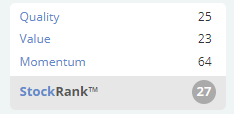
StockRanks agree with me:
Franchise Brands (LON:FRAN)
- Share price: 87.5p (+3.5%)
- No. of shares: 77 million
- Market cap: £68 million
AGM Statement and Q1 Trading Update
Another update without reference to prior expectations, but the market is happy with it and the numbers are positive:
- Q1 system sales at Metro Rod +12.9%
- B2C brands (ChipsAway, Ovenclean and Barking Mad) have all had "a positive start to the year".
My view
It's only a short update, so I won't dwell on it.
According to a note published today on Research Tree, Franchise Brands is forecast to make adjusted PBT of £3.5 million this year, followed by £4.2 million next year.
Unfortunately, I am priced out of it at the current market cap.
In its favour, I would point out that Nigel Wray is a 28% shareholder at Franchise Brands (LON:FRAN). He enjoyed huge success with Domino's Pizza (LON:DOM) and understands the profitability that a franchising business model can achieve. I wonder how large he thinks this one could eventually grow to!
Keywords Studios (LON:KWS)
- Share price: £14.72 (+0.1%)
- No. of shares: 64 million
- Market cap: £942 million
Keywords, the video game support services provider, makes a fresh acquisition - the latest in a long line of deals for this industry consolidator. This deal looks small in the grand scheme of things and is not the company's first play in Japan.
My view - Keywords doesn't fit with my preference for organic growth and my avoidance of "buy-and-build" (when looking at non-financial companies), so it's not on my radar or watchlist for a potential purchase.
I do admire its track record of successful integration so far - when it is at more normal P/E rating (e.g. a couple of months ago), I think I can understand why people find it attractive. Congrats to those who have held it for a few years and enjoyed huge capital gains!
Please see my comments from earlier this month for a more detailed review of the company.
Totally (LON:TLY)
- Share price: 11.8p (+1%)
- No. of shares: 60 million
- Market cap: £7 million
Vocare awarded new contract worth up to £13.5 million
A large contract in revenue terms: £1.94 million p.a. to provide urgent care services for Newcastle Gateshead. Services include an Urgent Treatment Centre and GP Visiting Services.
This follows a range of contract extensions won a couple of weeks ago.
I have no idea what the margins on these contracts are (probably v. small) or if this company is worth anything, but I'm happy to pass the idea along to others who may wish to research it in greater detail.
Fastjet (LON:FJET)
- Share price: 1.475p (+3.5%)
- No. of shares: 3,800 million
- Market cap: £56 million
I've been making fun of analysing this company for several years now, and have been astonished that a well-known, reputable UK fund manager continues to throw good money after bad in support of it.
This fund manager participated in yet another equity fundraising in November 2018, many years after the original idea to invest in Fastjet should have been abandoned.
Despite the company avoiding a technical administration, the equity base has effectively been restructured with its wet-lease supplier, Solenta Aviation, now owning 60% of Fastjet's shares.
Solenta appears to be a proper commercial outfit, and I guess its involvement should be considered a positive.
Fastjet's CEO since 2016 is also a much better choice of CEO compared to his predecessor, having strong experience in the aviation industry in Africa.
So I am pleased to see that the company is making progress towards breakeven: it suffered a small underlying operating loss in Q1 2019, and is looking for a "marginal" underlying operating profit in the current financial year.
My view
Despite these positives, it remains uninvestable to me and off the scales in terms of where it lies on the risk spectrum.
After restructuring and divestment, Zimbabwe now accounts for 74% of Fastjet's revenue. The Zimbabwe unit recorded a profitable Q1. But it's still much too soon for shareholders to celebrate.
Readers of this report will have some awareness of the problems in Zimbabwe, given Paul's coverage. The country is a mess as far as monetary policy is concerned (even worse than the West), and the government has tried to introduce a new currency. Fastjet and its Zimbabwean customers need to manage volatile inflation, a shortage of "hard currency" (i.e. US dollars), and restrictions on the ability to move money across borders.
I continue to believe that this company is worthless. Or if it does have some equity value, I suspect that Solenta will control all of that value at some point in the future.
Hipgnosis Songs Fund (LON:SONG)
- Share price: 103.3p (-0.7%)
- No. of shares: 341 million
- Market cap: £352 million
Acquisition of Music Catalogue
This unusual fund - focusing on songs - picks up the catalogue from Brittany Hazzard, known as Starrah. Her songs include Havana and Girls Like You. Starrah and her manager are also joining the fund's Advisory Board.
Hipgnosis has raised a gross total of £350 million from investors since IPO last year, with placings at 100p and 102p.
The original placing was used to purchase music catalogues at a historic P/E multiple of 12.6x, so there is potentially some value to be had. Might be worth researching in greater detail.
That's it for today, thanks everyone for your input!
Best,
Graham
Disclaimer
This is not financial advice. Our content is intended to be used and must be used for information and education purposes only. Please read our disclaimer and terms and conditions to understand our obligations.

35 comments
Hi Graham and thanks for your thought provoking piece on ZIRP
See you soon.
The tech will be capable enough long before humans are ready to accept that it is capable enough.
I agree, but that's no surprise, and it's something autonomous car manufacturers and investors need to take on board.
None of the issues of acceptance are helped by people like Musk continually puffing up what Tesla currently or may produce, since every failure to deliver just increases scepticism and distrust.
Wish I could fail like Musk.
One of the biggest issues regarding autonomous cars is the significant proportion of the population who will demand a far higher standard of driving from the AV car than the general public currently manage themselves. Huge numbers of imaginary scenarios where the AV may fail will be rolled out as objections but seldom contrasting that with the carnage caused by the lorry driver who falls asleep at the wheel, the car driver who causes carnage when distracted on the phone or trying to change his music selection, or the huge number of collisions caused by the human drivers’ visual blind spot (the AV having no blind spot).
The tech will be capable enough long before humans are ready to accept that it is capable enough.
I believe that all new cars are soon to have automatic emergency braking. Perhaps we will wake up one day and find that 95% of the driving is being done for us anyway (auto gear box, auto parking, auto braking, auto lane guidance, etc.).
I really, really, really don't want a self-driving car. Am I unusual ?
No
The FT has noted with amusement that most forecast TSLA makes are normally in units of 500,000 for sales, manufacturing targets etc.(whilst reality differs). I guess it helps not to have to adjust the template announcements?;-). However, for this one they seem to have upgraded the unit to 1,000,000.
Obviously the new hype needed extra hype to get over the ennui reception of previous hype!!
Coincidentally (or not) Tesla are due to release quarterly results after the close tomorrow. The self driving hype tells me that Mr. Musk may be looking to divert attention and the results may not be great. Call me suspicious.
If only to remind me of the extraordinary times in which we live, the chart below (Produced in 2015) is well worth another look. In essence, it demonstrates just how low current interest rates really are. And by low, I mean really low. Although the chart goes to 2015, interest rates since then have risen only marginally. It shows that rates were at their lowest levels in the developed world for some 5,000 years; since the time of the Pharaohs. Just what this means is anyone's guess. But it does not seem to bode well for asset prices. How and when “Normal” levels of interest rates will return is still unclear. And, as Graham points out, this is some eleven years after the financial crash that triggered the move towards ultra-low rates.
As a slight aside, I have attached a link to an article produced recently by Bloomberg. It demonstrates the financial strain felt by many Canadians. The sub-text seems to be that it will be very difficult to increase interest rates any time soon.
https://www.marketwatch.com/story/charting-the-lowest-interest-rates-in-5000-years-worst-commodity-returns-in-80-years-2016-06-14
https://www.bnnbloomberg.ca/maxed-out-48-of-canadians-within-200-of-insolvency-survey-says-1.1247336#_gus&_gucid=&_gup=twitter&_gsc=Y04pIgg
Graham. Great ZIRP analysis. The FT ran an article today drawing attention to the increasing debt in the UK in both the private and personal sectors, which supports the points you put forward. Increasingly it seems, as Mark Carney said, our funding requirements (and economic growth) depend on the kindness of strangers. It's good to see the attention that you and Paul give to balance sheet strength - the differentiator if there was a market collapse.
on £TSLA
" He has claimed that the net present value of a single "robo-taxi" vehicle will be c. $200,000."
... if that is the case, surely the right thing to do is to stop selling cars to people.
I eagerly await the Tesla that comes with a built in flux capacitor as that has an infinite NPV :)
on autonomous cars
I see fully autonomous cars appearing on British roads about the same time as we switch over to fusion power - in about 15 years time - which has been the time-horizon for the last 50 years or so.
The issue is not just processing speed and cost of sensors, it is that the real world is very complex and uncontrolled.
Some may call it AI but when an autonomous car can be tricked into changing lanes by 3 white stickers on a road and a person can fool an AI recognition system into not recognising them as a person just by holding a picture in front of their chest, I would not call it "Intelligent" enough to be used in the wild.
I do see driver aids becoming more widespread, and in highly controlled environments (Motorways possibly) can see some sort of 'hands free' mode becoming widely used - indeed I think some modern mercs can do that.
Underneath it all, when there is an crash (and it was the car's fault), the default is the person who is at fault is the person controlling the car, not the software that controls the car.
$TSLA
I just want to expand on this point:
"Some may call it AI but when an autonomous car can be tricked into changing lanes by 3 white stickers on a road and a person can fool an AI recognition system into not recognising them as a person just by holding a picture in front of their chest, I would not call it "Intelligent" enough to be used in the wild."
You'll see people making the arguments that people don't go around putting stickers on the road. No they probably won't. But what if you're driving down the road a minute after some recycling has just been picked up. A few bits of paper happen to have fallen out and have landed in just such a way that your autonomous vehicle ends up driving itself into a wall. Or into a head on collision with somebody.
But if anybody has been asleep at the wheel it is the authorities. I can't believe that $TSLA is allowed to update its Autopilot functionality over the air seemingly with very little oversight. So the driver has to be alert and ready to take control at any moment. So they use it for a few months and get used to its foibles. An OTA update occurs which results in the car trying to aim for a barrier where it has never did so before. The driver has to be alert to this and if he is momentarily distracted for any reason and doesn't react in time, then it is 100% the fault of the driver. This is regulatory capture writ large.
(Short $TSLA )
Re TSLA
I think you have to draw a massive distinction between the current "auto-pilot" and what full autonomous self-driving claims to provide.
The currently available auto-pilot is little more than adaptive cruise control plus lane following. When a system can lose sight of where the road is and hand control back at any instant, then it is not autonomous self-driving. It would be like being driven by a partially-sighted driver who occasionally says "I can't seem to see the edges of the road any more." Anyone who takes their own eyes off the road for a second while being "driven" by such a system has more faith than I do!
On the other hand, true autonomous self-driving is intended to allow there to be no other driver in the car. That is a hugely different proposition. As to whether Tesla can get there next year, or even in the next five years with systems "in the wild", I'd say it seems unlikely (notwithstanding the video that I linked earlier.)
(And by the way, many other manufacturers now have adaptive cruise control plus lane following.)
I'm very dubious about Musk's claims but I see that Tesla have posted a video of "full self-driving". Admittedly the roads look fairly quiet, but it's the first time I've seen a Tesla cope with junctions and traffic lights without handing back to the driver:
https://www.youtube.com/watch?v=tlThdr3O5Qo
It's only two minutes long so worth a quick look.
Of course technically doing it once for a video is not the same thing as solving it in general and resolving the regulatory requirements.
If you wish to live in the past then fine. But here's an article from a reputable source which is recent and also discusses the redundancy issue and why the claim is for "New" cars: https://www.theverge.com/2019/4/22/18511594/tesla-new-self-driving-chip-is-here-and-this-is-your-best-look-yet
To achieve full redundancy, you need to tackle much more than the microprocessor. The failure modes of every single part of the system need to be considered & mitigating actions taken.
Regarding the TSLA debate, here's a story from 2016:
https://electrek.co/2016/10/19/tesla-fully-autonomous-self-driving-car/
"We are excited to announce that, as of today, all Tesla vehicles produced in our factory – including Model 3 – will have the hardware needed for full self-driving capability at a safety level substantially greater than that of a human driver."
It is a recycled promise.
Angling Direct (LON:ANG)
Mcap £1millionish per store , lot of dosh for Rods , Reels n Ragworm.
Thanks for the article Graham
I've a feeling we'll be driving cars ourselves for a long while yet. Our roads are simply too complex for software to understand in enough detail. My road has two sets of white lines painted down the middle, because the contractors failed to scrub the old ones away properly. Which will it follow?
Can a self-driving car understand the instruction given by a police car not to overtake, or to pull over? There are probably thousands of such scenarios.
More worrying is how internet-connected self-driving cars can potentially be manipulated to cause damage by malicious actors. I can forsee a future when at a certain time of day, thousands of self driving cars crash at full pelt, because someone managed to upload some malicious firmware. Car firms have been notoriously lax about their online security thus far for internet enabled cars.
Unfortunately, people tend to focus on the positives of technology. Especially firms like Tesla who have to move fast and innovate to survive, or journo's who make a living about writing about such things. I'm sure driver automation will increase, but it will be more along the lines of driver aids to mitigate our mistakes, than full driver replacements.
I would enjoy seeing the outcome of an autonomous vehicle attempting the Swindon magic roundabout without creating chaos.
Graham I totally agree with you about the ZIRP absurdity. Outside Japan, Zero rates and QE were initially (and maybe justifiably) introduced to try to avoid a financial/ economic collapse at the end of 2008/2009. Then these extraordinary measures were justified to prevent just an “ordinary” recession and then even more recently to avoid a period of low growth. The two main causes of the 2008 crisis, in my opinion, were overly lax monetary policy since the dot.com bust (Greenspan put and Bernanke put), coupled with lax bank capital controls. The latter may have been fixed but the former has been added to in spades. There are so many self-evident financial bubbles now, I fear what will happen when the music finally stops.
I read an interesting book about this from Thomas e woods (meltdown). Well worth a read. It may change your mind on wether what was done in 2008 was justifiable? In it they talk about the Austrian school of economics, the Fed, Fannie Mae Freddie mac etc. At the heart of it though was our current fiat currency and the central banks ability to control interest rates. It's seems intuitive that this system would cause a misallocattion of resouces as it does today. All in my opinion of course......
Morning Graham!
Excellent intro comments about risk from ZIRP, I agree with everything you say.
Regards, Paul.
Thanks Paul!
G
The Tesla web site also clearly states that ALL Tesla models are capable of upgrades to FULL self driving mode & strongly implies that is without supervision.
My understanding is full self driving requires redundancy in the safety critical systems, such that if there is an electronic failure in one ECU, a back up ECU takes over. The link below explains this.
https://www.extremetech.com/extreme/262510-new-report-self-driving-cars-ranks-tesla-dead-last
I'm not sure if ALL Tesla cars have this redundancy, but either they have it and Tesla would be incurring considerable additional cost per car or Tesla might be disingenuous with their claims. If the latter, then there must be another litigation risk.
Jonesj,
Re-read the website
Interesting how you omitted the word "New" and then went on to deride them in your final paragraph.
Your comments make little difference.
1 Tesla have had similar claims on their website for quite some time.
2 Even if the claims were applicable only to NEW cars, the principle would still be the same. Either they are incurring additional cost by having the redundancy on every new car, or the cars are not capable of software upgrades to full self driving.
Some of the information floating around suggests they may not have the redundancy.
Compare with a certain other car manufacturer, where one safety critical system clearly shows 3 parallel ECUs and 2 parallel actuators.
Happy Easter Graham. I look forward to maybe meeting you at Mello this year. I see VLE is hitting its 1150 for a second time. I don't own but one thing I note is for an acquisitive business it carries low goodwill/intangibles. I am very negative about these particular entries into a Balance Sheet as personally I believe management have just paid too much on the whole for other peoples assets. As I look through bal sheets I think there is an inverse correlation between the size of these factors and management quality. Anyway just a thought for this morning should anyone be thinking the same or indeed opposite.
Like you, I am put off companies that have a negative NTAV. Paul has said the same thing but not always made this a strict rule. Although eventual write-offs of these amounts is always portrayed as a non-cash exceptional adjustment, I have noticed that the markets usually treat such write-offs as a negative and the share price suffers when they are announced. Goodwill write-offs are an admission, as you say, that the management over-paid for an acquisition. Goodwill in a balance sheet is a potential admission that a company over-paid for an acquisition and, in my experience as an FD, is usually an area where an auditor is least comfortable and most open to persuasion. I think the auditors probably console themselves with the expectation that any analyst worth his/her salt will automatically assume that anything taken to goodwill should be written off despite the company carrying it on its balance sheet.
Obviously, some goodwill does have an economic value but I believe that it is usually of limited duration and very rarely of a value equal to the carrying value on the balance sheet. I would think a return to the obligation to write off goodwill over a fixed period would sharpen a few minds and possibly lead to the avoidance of some value destruction. However, possibly I am being too optimistic about that. But it always astonishes me how little attention investors both private and institutional pay to the quality of the assets in the balance sheet. I suspect that for some of these they are fully aware of the risks of buying a company with a weak balance sheet but that they hold their noses when hitting the buy button if the market is feeling firm as it is now. My observation would be that many companies with weak balance sheets were punished in the late 2018 sell-off and I was frequently surprised to hear people ask why when it seemed to me clear that it was due to their weak balance sheet or high level of debt to ebitda.
Thanks for that Mammyoko very insightful.
Hi Camtab. Happy Easter to you, too and I look forward to meeting you at Mello!
Yes, we have to be aware of intangibles on the balance sheet. I don't mind buying a company with a lot of intangibles, but I'll always try to understand what they are doing there.
Graham
Hi Graham, I like the new format that Paul started last week, with an early doors quick summary of the action. I think that Pual was offering an off-the-cuff opinion on the company news as well, which was great. Might you do the same? Otherwise, it just ends up being a factual summary of what many of us have already read in the RNS.
Just looking for comments along the lines of: "looks promising at first scan" etc.
Just to mention that Angling Direct will be exhibiting and presenting at the Mello2019 event on Friday 17th May
Http://melloevents.com/event/event-exhibitors/
They will be doing two presentations so one in the morning and one afternoon.
More info and tickets here...Http://melloevents.com/event/
If you want a 40% discount you can use this code in the box Stocko40
Graham, I like your state of the market and economic analysis, and i'd love to hear your opinion on why government bond and share prices are both rising, usually its one or the other, not both together.
PS, look what I found, its thde big man himself
https://www.piworld.co.uk/2019...
My morning smallcap tweet: Angling higher
Totally (LON:TLY), Angling Direct (LON:ANG), Fastjet (LON:FJET)
Totally (TLY) wins 5 year £2m PA contract from the NHS.
Angling Direct (ANG) reports a startling 30% LFL increase in stores in February and March. ANG doesn't credit the weather. No new FY guidance.
fastjet (FJET) Messy FY & Q1 trading stmt due to restructuring: FY rev-cont up 166%, 45% in Zim and 575% in Mozambique ( only operated for two months in 2017). Op loss pre exceptional $17.3m ($11.2m loss). Q1 loss $0.2m ex $6.2m FX loss in Zim. Guides FY marginal underlying operating profit excluding Zim FX loss. No thanks.