Small Cap Value Report (Wed 31 Oct 2018) - VCP, CRAW, FJET, NXT, CCC

Good morning! There are lots of comment-worthy news stories today.
To get us started, we have an updated comment from Paul Scott on Victoria (LON:VCP).
I'd also like to mention:
- Crawshaw (LON:CRAW) - intention to appoint administrators
- Fastjet (LON:FJET) - funding update
- Next (LON:NXT) - trading update
- Computacenter (LON:CCC) - Q3 2018 trading update
This section written by Paul Scott.
Victoria (LON:VCP)
- Share price: 375p (-4%)
- No. of shares: 125 million
- Market cap: £470 million
Victoria (LON:VCP) has issued an update regarding its possible bond issue, here;
Credit rating and response to speculation
This carpet maker has given more details about its proposed bond issue, to replace the exiting bank borrowings. Summarising it, with my comments:
Credit rating - Fitch has given the rating BB(stable) for the intended bond issue. Using a table shown on Wikipedia, this doesn't look very good - it's in the bracket described as non-investment grade, and speculative. "Higher degree of default risk, speculative" are the description provided by Google for BB credit rating bonds. So not something to brag about, I would suggest. The interest rate would therefore tend to be higher than better quality bonds.
"Misleading rumour & speculation" - what does the company expect, if it drops a bombshell on the market, with no explanation? At the same time as issuing a profit warning, which is what happened here.
Banking relationships (with HSBC and Barclays) - Victoria says;
Firstly, the Company continues to have a close and positive relationship with its lending banks, HSBC and Barclays, and continues to operate with significant headroom with respect to its covenants under the existing 2-year facilities put in place in August 2018.
Our lending banks are acting as joint global coordinators and bookrunners on the potential Bond issue and have been working with us on the project since April of this year.
That's reassuring on the banking covenants.
What I don't understand is this. If the banks are happy with their existing lending to Victoria, then why have they been working with the company to get their lending repaid through a bond issue? That just doesn't make sense to me!
More detail is given about why the company thinks a bond issue makes sense for Victoria;
Long term (5 year) funding of a bond - but this could also be done via a term loan from the banks. Maybe the banks don't have the appetite for long term lending to Victoria?
Fixed rate funding - again, this could also be achieved through conventional bank borrowings, adding an interest rate swap or cap if needed.
Flexibility - but not specified why a bond is seen as more flexible than bank borrowings. I would have thought the opposite is the case. Bank borrowings can be easily amended, whereas bonds are usually set in stone.
Depth of the bond market - suggests perhaps that the banks are at or near the limit that they want, in terms of exposure to Victoria.
Discretionary nature of this bond exercise;
The potential Bond issue is an entirely discretionary exercise, and a final decision will be made at the Company's discretion in the coming days on whether to move ahead or retain the existing facilities;
The potential Bond issue is an entirely discretionary exercise, and a final decision will be made at the Company's discretion in the coming days on whether to move ahead or retain the existing facilities.
Paul's opinion - the proof of the pudding is in the eating. So let's see what terms (if any) are agreed for the bond issue. I cannot see the logic for replacing cheap bank borrowings with a (probably more expensive) junk bond. Whatever the company says, this suggests that the banks may not want continued exposure to Victoria. Why else would they be co-operating with the company to get all their debt repaid? I could understand if the banks wanted to lower their exposure, but it's perplexing as to why they are happy to see it all repaid.
The share price has fallen because of the profit warning a few days ago, and the bombshell announcement (with no explanation or detail) as to the bank borrowings being repaid through a bond issue.
Maybe the share price would go up again, once the refinancing has happened? That would depend on the terms of the refinancing. If the bonds are expensive, then that would reduce profits available to pay out in dividends.
I shall monitor things closely, but personally I remain of the view that this share looks too risky to hold unless/until the refinancing has completed.
Graham's view
I would take a slightly more positive stance toward this announcement than Paul does.
Credit rating: Firstly, I think it's a fine achievement to get a BB rating from Fitch. That's only one notch below investment grade.
Readers will be aware that I have invested heavily in US junk bonds in my personal portfolio. To put it bluntly, there is no shame in having a junk rating.
Companies whose junk bonds I own through a fund include Fiat Chrysler (automobiles), CenturyLink (telecoms), MGM Resorts (hotels and casinos), Symantec (software), Royal Bank of Scotland, Dell, Hertz, Avis, etc. They are all geared to varying extents but they are still decent businesses and most of them should have little difficulty in repaying their debts.
Based on my limited knowledge of Victoria, I would find it strange if it had secured an investment-grade credit rating. BB is, in my view, an impressive rating for it to have achieved.
Tesla's credit rating, for example, is only B.
You can of course make the argument that credit rating agencies aren't particularly good at their jobs, and frequently get it wrong. I have sympathy with that point of view, but statistically there is good evidence that credit ratings do help to predict default probabilities.
So overall I would view it as a very positive piece of news that a BB rating has been achieved from Fitch. They will have done their own due diligence on the company, and that's got to be worth something. It will be interesting to see what Standard & Poors thinks.
Flexibility/Duration/Depth of Bond Market: Again, I agree with the company's overall perspective on this. The bond market is enormous (greater depth) and is more suitable for a long-term funding solution than bank loans.
While it's true that you can have bank loans which are structured to be fixed-rate, long-term, and covenant-lite, these are features which are more commonly found with bonds.
Bond investors tend to put large amounts of capital into a company and then take a patient, hands-off approach for many years, whereas bankers usually want to engage in detailed monitoring of a company's short-term performance.
So if you're running a large, growing business and you have the choice, I'd say that you'd nearly always prefer to issue a bond rather than take out a bank loan. Then you can get on with running the business, without worrying about meeting your banker every couple of months. Bonds are just a more attractive way to borrow.
Interest Rate: This is a fair point from VCP bears. The interest rate of the bank loan is apparently c. 2.9%. Using very crude methods, I can estimate that a BB bond issue from Victoria would cost 4%. But there's no real way of knowing what the cost might be at this stage.
The angle from the company is that it would rather have the certainty of a fixed rate rather than a variable rate bank loan. That's sensible. So long as the fixed rate isn't so much higher that it's unaffordable.
Summary: I would still have no interest in buying VCP shares, since I try to avoid highly acquisitive companies. But I agree that it should consider issuing €450 million in bonds, rather than continuing to use bank loans for borrowings of this size.
Crawshaw (LON:CRAW)
- Share price: 2p (suspended)
- No. of shares: 113 million
- Market cap: £2 million
Intention to appoint administrators
This chain of butchers bites the dust.
Five days ago, Paul said he would be surprised if it succeeded in raising additional funding. Indeed, it has failed.
I wonder if there might be a little bit of equity value here? I accept that it's not very likely. But I noticed that cash was at £3.3 million in July, with a cash burn of £1.4 million over the previous six months. Maybe there is still some cash left?
Today, the company says:
"...in order to protect both shareholders and creditors, the Board has taken the decision to place the Company into administration and intends to appoint administrators shortly with the purpose of seeking buyers for the Group's business and assets on a going concern basis."
The administration isn't just for the protection of creditors - it's for the protection of shareholders, too. It's a hint that there could be a little bit of equity value left to preserve. Could more than one bidder emerge for what's left of the business?
Probably not. Commiserations to anyone still holding this one.
Fastjet (LON:FJET)
- Share price: 1.8p (-23%)
- No. of shares: 621 million
- Market cap: £11 million
I'm amazed that this African airline is still here. It should have died a long time ago.
Today's funding update has something new. Usually, the company is simply running out of money.
Today, we learn that it is also negotiating with its creditors "to reduce the outstanding balances due to be paid and reduce the burden of interest and capital repayments".
I imagine that such a conversation would go like this:
FJET: We can't pay you back, can you forget about the money we owe you please?
Creditor: No.
As of 24 October, the company had $0.7 million of cash that wasn't restricted. That's not enough with which to run an airline. If it can't raise fresh equity AND/OR reach agreement with its creditors in the coming days, it will be game over.
My view: the most shocking thing about Fastjet is how it was backed again and again with customer money by supposedly respectable fund managers. I'd rather not name them here but the shareholder register is public information, so feel free to look them up.
Next (LON:NXT)
- Share price: £51.72 (-2.5%)
- No. of shares: 140 million
- Market cap: £7,162 million
(Please note that I currently hold NXT shares.)
There is no change to Next's full-year sales and profit guidance:
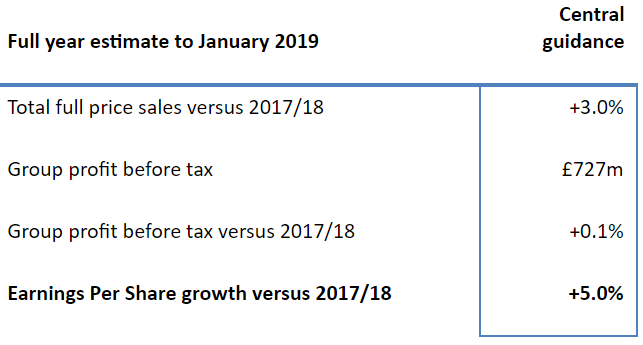
Note the very slight expected increase in PBT for the year of just 0.1%. Essentially flat.
In Q3, online full-price sales continued to make great progress (+12.7%) at the expense of retail sales (-8%).
The overall Q3 full-price sales growth (+1.3%) was slow compared to the entire year-to-date performance (+3.1%).
This is another position where I could think about topping up, if the share price remains weak while business performance is stable.
My main concern is that I don't want my portfolio to be too heavy in retail. So I am most likely to do nothing for the time being.
Stocko algorithms continue to love it:
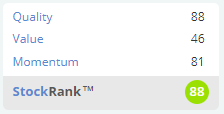
I'm surprised the Value Rank isn't a little higher, given the P/E rating of just 12x. It looks to me as if one of the reasons it's being penalised is that its industry peers are quantitatively much cheaper.
But I think it's industry peers should be cheaper, because Next is better.
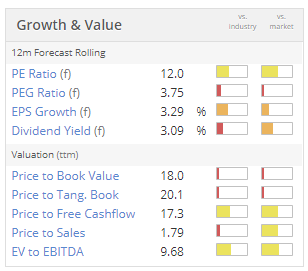
In an industry where uncompetitive businesses are prone to becoming worthless, I am happy to pay that little bit more for a company which is definitely much better-quality than most of its peers.
Computacenter (LON:CCC)
- Share price: 1100p (-12.4%)
- No. of shares: 114 million
- Market cap: £1,255 million
Covering this provider of IT infrastructure services in response to reader requests, much as I did in January.
I'm not an expert on this company but overall I've had a positive impression of it. It has also enjoyed a high StockRank (92 as of yesterday).
Key elements of today's Q3 update:
- revenue down 3%, blamed on tough comparisons. Q3 2017 had shown abnormally high growth against 2016.
- UK revenue down 9% with particular weakness in Technology Sourcing. Technology Sourcing is essentially a software distribution business.
- Germany +1%, France -6%, International +13%.
Outlook - improved growth in Q4, "but not to the levels seen in the first half of the year".
The anticipated trading result for the year as a whole is in line with expectations, but the share price reaction says to me that investors are doubtful that Q4 will produce the required growth.
There are also a few question marks over the drivers of the business:
As we look out further into the future our pipeline for Professional Services is building nicely while the Infrastructure Managed Services market place is somewhat more challenged which is making growth more difficult. However, we remain confident in our ability to gain Infrastructure Managed Services market share due to our focus on innovation and productivity improvements.
My view - I don't see any reason to change my overall positive view of the company, even with the loss of revenue momentum this quarter.
It's not something I personally would invest in, because it looks to me like a combination of IT managed services and technology distribution, and these don't seem like very attractive sectors. But within these sectors, Computacenter might be the best of the bunch. It has an excellent long-term track record of profitability.
That's it for today, thanks for dropping by!
Graham
Disclaimer
This is not financial advice. Our content is intended to be used and must be used for information and education purposes only. Please read our disclaimer and terms and conditions to understand our obligations.

40 comments
News released this morning that Victoria (LON:VCP) have pulled their proposed high yield bond issue ...... on the grounds that the proposed yield was too high. Full text of the release pasted below. Wonder if history might show this to have been something of a “Ratners” moment for an emperor with no clothes?
Gus.
————-
Victoria PLC
('Victoria' or the 'Group')
Update on Bond
The board of Victoria ("the Board"), the international designers, manufacturers, and distributors of innovative flooring, confirms that it has resolved to continue with the Company's existing bank facilities, rather than refinance them with a senior secured note ("the Bond") as proposed last week. Whilst we continue to believe that, in terms of structure, the Bond would have been suitable for the Group to meet its long-term financing objectives, the indicative pricing for the Bond, which was higher than had been anticipated, was such that it did not warrant changing the Group's debt financing arrangements at this time.
Geoff Wilding, Chairman of Victoria PLC, commented:
"We embarked on the Bond process in good faith and with the intention of delivering benefits for all shareholders in the form of long-term funding at an attractive, fixed interest rate.
It is very disappointing that despite the positive, stable credit ratings, the indicative pricing for the Bond moved unfavourably over the course of last week, particularly when there have been no fundamental changes to the Group or its business.
I want to reassure shareholders that, as with our strategy of only paying the right price for acquisitions, the Board applies a high degree of rigour to our long-term financing arrangements. Therefore, as we continue to have a close and positive relationships with our lending banks and operate with significant headroom with respect to covenants under our existing 2-year facilities put in place in August 2018, we will continue with these facilities. The banks have been, and continue to be, very supportive of our strategy and performance. Any suggestion to the contrary is untrue.
Nevertheless, last week was not the Board's finest hour in terms of the clarity of our communication. For the last six years, the Board has endeavoured to maintain an open dialogue, fully appreciating that it is the shareholders who own the company. Unfortunately, we placed too much emphasis on technical guidance and market convention and not enough common sense was applied in terms of communication with shareholders. By failing to communicate clearly last week and in the run-up to the Bond launch, the Company needlessly left shareholders feeling uncertain about the future. Critically, this also left an open goal for those with less than pure motives to spread outrageous untruths. This has damaged the value of the shares, although, of course, there has been no impact on the underlying business, which is high quality and continues to successfully design, manufacture, and distribute flooring products around the world as it always has done.
Victoria's operational management are firmly focused on delivery of our organic strategy. Separately, the Board continues to identify and very selectively pursue attractive acquisition opportunities. We have adapted our usual acquisition structure in such a way that remains attractive to potential vendors but ensures that future acquisitions remain value-enhancing for shareholders by reducing requirements for new equity whilst staying within our internal debt limits. As such we continue to see opportunity to pursue our acquisition strategy to meaningfully enhance the Group alongside organic growth.
The Board continues to believe that Victoria is well placed to deliver growth in shareholder value.
re Crawshaw - being a cynic even there is any cash in the business, most will get eaten up in the administrator's fees!!
Enjoyed today's report due to the discussion on Victoria plc...2 honest views which is rare to see and learned something from Nicobus !
Since GW took over VCP has paid around 3% for debt capital. If the current loans are replaced with BB rated bonds then hard to imagine a coupon under 5%, more likely starts with a 6 or 7. Never met GW, but he appears an usually feisty CEO, imagine he is playing hardball from a weak position. Maybe this turns into an equity funding at a deeply discounted rights issue from SP levels. Interesting situation.
This might be complete horsecr4p but banking regulations and specifically capital requirements are changing.
Interestingly (very fast and loose with the word), this would reduce the return on regulatory capital for loans to business.
European banks are big financiers of agriculture (think credit agricole) and that is hideously unprofitable. DB has asked lower credit grade customers to find alternative lenders on expiry, because they cannot generate return on capital (given current interest rates I assume) and I expect a lot of banks are thinking along similar lines.
RBS during their announcement mentioned reducing exposure to the industry and I imagine they are not alone in this mindset.
This transaction allowed bank to cut capital requirement and earn fees (infinite return on regulatory capital) while cutting industry exposure.
For the banker it makes sense.
For the issuer, in line with comments it only makes sense if the cost is manageable given other benefits like market depth, covenants etc.
Vulture funds that try to take control well below the BB level - have a lot of respect for these guys - they genuinely are the smartest guys in the cloud since they take a lot of risk #howardmarks.
All of that said - I'm not investing in a balance sheet like that - having learned a lesson (more than once) that I should already have learned a long long time ago
thanks for the reminder dfx.
Not now listed Touchstone Group PLC (probably just me and Mr Birch left holding shares here)
Any holders should have received their 7.5p per share dividend this month - accounts were released July but i only just noticed them now
Stewth is it really 9 years since this company delisted.
Anyone interested in dfx? Software company was over 440 pence last year. Closed as highest gainer of day today at 10.5p. Obviously small cap now although it was not so last year! Has good support from much larger company. Punting money only but worth a look as a special situation.
Graham & others,
Thanks for your comments on Victoria (LON:VCP) , interesting. Maybe I'm being too paranoid.
If VCP can get a bond issue away on reasonable terms, then great, it will certainly de-risk things.
I'd rather sit on the sidelines unless it's sorted out though. In any case, the balance sheet is too weak to consider an investment for me.
Regards, Paul.
I am much less convinced by the view that as a basic principle, a bond issue is a better idea than bank debt to finance a business - and I have seen both work and fail multiple times. Bond issues tend to be very inflexible, because if there is a covenant or similar breach then it is extremely difficult to achieve consensus on waiver terms and the trustee is in no position to exercise any discretion. It ultimately comes down to the specific terms negotiated on each deal but, in genera,l if I was a relatively small or medium sized business, I would steer well clear of a bond deal - and as an investor I avoid companies that go this route. I am not invested in Victoria (LON:VCP), but if I was then I would be highly alarmed by this switch in financing strategy and I would really struggle to see it as other than bad news.,
I agree with the statement that a bond is not necessarily preferable to taking out bank debt. It all depends on the size and requirements of the business at the time. As you say, small and medium-sized businesses don't need to issue bonds.
But Victoria doesn't qualify as an SME. It is a large business with over 2,000 employees and over £300 million in bank borrowings (March 2018). At this sort of size, I think it's normal that a company would ask the question as to whether the bond markets could play a role. All the best, G.
Computacenter (LON:CCC)
I havent looked at this one in quite a while
Share price 1100p
Market cap £1.4 Billion
EPS 2017 65p - 2018 forecast 73p - 2019 81p
So potentially pe of 15 - seems reasonable for growth rates expected- how in the bag are these projections? they seem quite optimistic but we are close to end of 2018 year now.
dividend 2%
Decent EPS growth - not sure how much of this is organic?
Debt seems minimal
Notes
share count decreasing - i like that
High debtors and creditors figure - high debtors is always somewhat risky from pimping up the numbers perspective. Note high debtors figure is partly explained by high turnover.
Seems interesting if you believe there will still be reasonable organic growth into the future.
does anyone have any thoughts as to how futureproof their income sources are likely to be going forward. They have growth at present but could they be eaten away by smaller or nimbler competition?
GYG (LON:GYG) - are taking a hard hammering after issuing a second profit warning in as many months.
The company came to Aim less than eighteen months ago at a placing price of £1.00. Heavily backed by Woodford Investments, who hold of 22% of the equity. I would suggest that todays news from the company has done nothing in reviving Mr Woodford's flagging reputation as ' the best fund manager of his generation'.
I was reflecting this lunchtime at how many profit warnings I feel I've seen recently so wanted to check the stats. Looking at EY's profit warnings monitor, 2018 isn't actually higher than recent years: https://www.ey.com/uk/en/issues/capital-and-transactions/restructuring
However, they note that the standout exception are 'general retailers' who are at a seven-year high for profit warnings. General financials, electronics, support services, travel/leisure, and media companies also seem to be issuing a lot of profit warnings at the moment. I am of the view that travel/leisure companies have been particularly affected by the unusually warm weather and the World Cup this year so there might be some opportunities in that sector. On The Beach (LON:OTB) has had a lot of share price weakness for example.
Also interesting to note the median share price fall for profit warnings is 21% - this is the highest median ever recorded by EY suggesting investors are reacting particularly badly to profit warnings at the moment.
Victoria (LON:VCP)
Paul - I have some expertise in this area so some comments below:
More detail is given about why the company thinks a bond issue makes sense for Victoria;
Long term (5 year) funding of a bond - but this could also be done via a term loan from the banks. Maybe the banks don't have the appetite for long term lending to Victoria?
It could do but banks are reluctant to hold large amounts of leveraged debt on their balance sheets with 5 year + tenors. It would require a larger club of bank lenders to raise c.£250m of debt. The debt package would come with controls in place which may not offer Victoria the flexibility they require.
Banks love issuing bonds as it is capital light financing - i.e. no need to use the balance sheet (unless providing a Bridge) but still make a c.2% fee on the issue which drops straight to their bottom line. The risk is mainly reputational - i.e. that they promise to get an issue away at x% price and it fails or prices higher than expected.
Fixed rate funding - again, this could also be achieved through conventional bank borrowings, adding an interest rate swap or cap if needed.
Yes, but a swap comes at a cost which needs to be factored in to the overall cost of capital calculation. There's also a cost to breaking a swap if refinancing.
BB financings are not as 'junk' as you'd imagine. Current average European new-issue yields for BB fixed rate notes are priced at 3.56% and have been as low as 3% earlier this year. Pretty competitive pricing vs the risk !
Flexibility - but not specified why a bond is seen as more flexible than bank borrowings. I would have thought the opposite is the case. Bank borrowings can be easily amended, whereas bonds are usually set in stone.
The main benefit of issuing Bonds vs Bank debt is flexibility. They are repayable on redemption with no amortisation and no maintenance covenants (net debt / EBITDA for example). There is little bondholders can do before a payment default whereas banks would step in a lot earlier due to more onerous conditions / triggers in the loan document.
Shareholders will be able to sleep easier at night with 5 year committed financing in place ahead of Brexit / elections / trade wars etc.
Depth of the bond market - suggests perhaps that the banks are at or near the limit that they want, in terms of exposure to Victoria.
Yes, they are at the limit of what is probably achievable with bank financing. Bond market offers extra liquidity (when it's open!) to 'tap' bondholders for further cash if required in the future.
Hope that helps!
EDIT: Sorry Graham, just seen your comments which I wholeheartedly agree with!
Nicobos, thanks for the contribution. It seems like you echo many of the points made in my own response to Paul. G
Victoria (LON:VCP)
I wonder who the target market for the bonds are. It could put effective control, if there were to be a serious deterioration into some 'friendly' hands, rather than Bankers who look after their own interests primarily. So it may be a case of advance planning for that eventuality.
So, it will be interesting to hear is holding the bonds if indeed this ever comes to fruition.
Trident, I would not hold any faith in the bonds being in”friendly” hands. The bond holders will be different from the shareholders, and each side will look out for themsleves (as they should).
While being BB, the buyers (if any) of the bonds are likely to be institutional. But if the company were to run into difficulty, and say the bonds become distressed (yielding>10%), it is likely that these institutions will sell and the bonds will get bought by specialist distressed funds, who will be legal experts in how to maximise their bargaining position in any restructuring.
None of this is to say that Victoria (LON:VCP) might not prosper. But be aware that in nearly every situation where there is a restructuring and there are a significant numbers of bonds outstanding, these bonds at the time will be held by legally savvy distressed funds (not the original purchasers). In such a scenario, these distressed funds are much more likely to play hard-ball than the banks.
Wimbledonsprinter
Fair point.
Computacenter (LON:CCC)
Re Crawshaw (LON:CRAW) - I was made an insider on this a little while ago, so wasn't able to comment on its potential fundraising. I had a look at the fundraising figures, and it looked a hopeless case, so I declined to invest. Post-restructuring, Crawshaws would have been far too small to justify its central costs, including the costs of being listed on the stock market.
Therefore Administration is the only logical outcome. It will be interesting to see if management salvage any remaining value for the existing shareholders, or if it's sold off for a song to management, or some other third party?
It's amazing how quickly this unravelled, from being an exciting, profitable roll-out, to going bust today. It seems to have been run into the ground by incompetent former management. Although I would also question whether the business model ever made sense? Low margin, highly competitive sector, with fixed costs, in areas of declining footfall.
Bad luck to holders.
Regards, Paul.
Good morning!
I've had a look through the update today from Victoria (LON:VCP) and have added an update to my article from last week, which was critical & suspicious of the turn of events at Victoria.
As it's a significant update, here is my latest view (which I have also posted as an update in last week's article);
UPDATE 31 Oct 2018 - Victoria (LON:VCP) has issued an update regarding its possible bond issue, here;
Credit rating and response to speculation
This carpet maker has given more details about its proposed bond issue, to replace the exiting bank borrowings. Summarising it, with my comments;
Credit rating - Fitch has given the rating BB(stable) for the intended bond issue. Using a table shown here on Wikipedia, this doesn't look very good - it's in the bracket described as non-investment grade, and speculative. "Higher degree of default risk, speculative" are the description provided by Google for BB credit rating bonds. So not something to brag about, I would suggest. The interest rate would therefore tend to be higher than better quality bonds.
"Misleading rumour & speculation" - what does the company expect, if it drops a bombshell on the market, with no explanation? At the same time as issuing a profit warning, which is what happened here.
Banking relationships (with HSBC and Barclays) - Victoria says;
That's reassuring on the banking covenants.
What I don't understand is this. If the banks are happy with their existing lending to Victoria, then why have they been working with the company to get their lending repaid through a bond issue? That just doesn't make sense to me!
More detail is given about why the company thinks a bond issue makes sense for Victoria;
Long term (5 year) funding of a bond - but this could also be done via a term loan from the banks. Maybe the banks don't have the appetite for long term lending to Victoria?
Fixed rate funding - again, this could also be achieved through conventional bank borrowings, adding an interest rate swap or cap if needed.
Flexibility - but not specified why a bond is seen as more flexible than bank borrowings. I would have thought the opposite is the case. Bank borrowings can be easily amended, whereas bonds are usually set in stone.
Depth of the bond market - suggests perhaps that the banks are at or near the limit that they want, in terms of exposure to Victoria.
Discretionary nature of this bond exercise;
The potential Bond issue is an entirely discretionary exercise, and a final decision will be made at the Company's discretion in the coming days on whether to move ahead or retain the existing facilities;
My opinion - the proof of the pudding is in the eating. So let's see what terms (if any) are agreed for the bond issue. I cannot see the logic for replacing cheap bank borrowings with a (probably more expensive) junk bond. Whatever the company says, this suggests that the banks may not want continued exposure to Victoria. Why else would they be o-operating with the company to get all their debt repaid? I could understand if the banks wanted to lower their exposure, but it's perplexing as to why they are happy to see it all repaid.
The share price has fallen because of the profit warning a few days ago, and the bombshell announcement (with no explanation or detail) as to the bank borrowings being repaid through a bond issue.
Maybe the share price would go up again, once the refinancing has happened? That would depend on the terms of the refinancing. If the bonds are expensive, then that would reduce profits available to pay out in dividends.
I shall monitor things closely, but personally I remain of the view that this share looks too risky to hold unless/until the refinancing has completed.
Paul, re Victoria (LON:VCP), having worked in a large bank for a while, here are some thoughts. The existing 2 year bank facilities are shorter term than is usual. Banks love the fees from arranging bond offerings as it generates returns without capital being tied up. It may therefore be that the banks put in place the facilities with a soft commitment to get a mandate to issue a bond to refi their debt once Victoria had completed further acquisitions. That makes the most sense of the facts to me. I hold Victoria (LON:VCP) although luckily reduced before their profit warning - which as you rightly say has been v. badly managed. My view is that Victoria (LON:VCP) needs to stop acquisitions, start paying down debt and demonstrate that it can generate cash. That should see the SP recover. I think that the valuation on an EV/EBITDA basis is undemanding but there have been too many acquisitions of late and management should focus on delivering operationally for the time being.
Crawshaw - a reminder to be very wary of hot shot execs from big companies promising riches in small caps.
They very often don't have the skill set needed, being used to huge teams to support them.
The notable exception being their skills of the highest order in giving slick presentations to extract money for themselves from the company and from investors for the shares. The vision is always compelling, most often in stark contrast to reality.
Good Morning Graham,
Nasty reaction to Computacenter (LON:CCC) results, this morning, and the share price currently hovers just below the price paid in the tender offer some time ago.
Thanks,
IG
Bearing in mind Computacenter (LON:CCC) have left full year expectations unchanged and their share price has dropped 17% we can expect the valuation rank within stockopedia to get a good boost when the calcs are done. Seems a completely ridiculous overreaction and I'm desperately fighting the urge to average down.
No position in Computacenter (LON:CCC) as yet, but has been on the radar but had concerns about valuation.
From what I can read, they have 10% growth in revenue YTD (not bad at all) and they haven't warned on profits or said they are reliant on the q4 to achieve the result.
Puts them at sub 15x earnings for what seems a cash generative and high return business.
I'm very tempted to purchase.
Computacenter (LON:CCC) quite probably overdone - the first half was excellent and they returned £100m, so I suppose this fall is because the market assumed the good times were a-rolling and this update dashed their expectations. That and Brexit worries probably spooked them.
A couple of months ago it was described as overvalued, so that probably hit its price too. I did well out of CCC, but for perspective, sold out last year at £8!
Yes, I think valuation of 16x-17x might have been just a bit too racy for Computacenter (LON:CCC).
I know Graham does not cover mining stocks. Is there anyone else who would feel qualified to comment on Sylvania Platinum (LON:SLP) first quarter report published earlier today?
With some diffidence (I am no pro), I comment on Sylvania Platinum (LON:SLP) as follows:
"The gross basket price for PGMs [Platinum Group Metals] for the quarter was $1,149/ounce, a 2% decrease on Q4 FY2018 $1,167/ounce. The decrease in ounces quarter on quarter as well as the slightly lower basket price resulted in the net revenue dropping 14% to $17.2 million."
So they processed a bit less, and their sale prices were a bit lower.
"The Group cash balance at 30 September 2018 was $17.7 million (including guarantees), a $3.7 million increase on the previous quarter's $14.0 million."
This looks to be broadly positive.
"In light of the current South African political environment, the ZAR/USD exchange rate remains just as volatile trading above ZAR14.00 to the USD for most of the quarter."
Its costs are in S African Rands, but it reports in US Doilars.
"The all-in sustaining cost for the Group increased by 9% against Q4 FY2018 ..."
Your guess is as good as mine as to what this really means.
My take on all this is that it's doing ok and would do better if the metals prices went up a bit, and there was less exchange rate volatility. Sometimes there are power cuts or labour disruptions. So it's not one for widows and orphans. But fundamentally, its business model (using updated methods to extract PGMs from on-the-surface slag heaps, which is far lower cost than digging underground) looks sound to me.
I hope this helps. Apologies if those more knowledgeable than me think I am talking bollocks!
Regards,
Ricardo
Disc - I hold
Thanks Ricardo,
I appreciate your 'having a go' and found your comments useful. I, too, have no idea what "the all-in sustaining cost for the group" is all about. Perhaps, someone else can step in to clarify.
My own inexpert assessment of the report was "nothing to write home about" but nothing much to worry about either. It looks as good an investment for the long-term this morning as it was yesterday afternoon. That seems to be your view, as well.
I also hold.
For Sylvania Platinum (LON:SLP) "all-in sustaining cost for the group" = what it sounds like. The reason for the long winded title is that miners also sometimes report cash costs, but if you run a mining company without reinvesting you pretty quickly run into problems.
HENCE dump operations Cash Cost Per 4E PGM oz = $508 down 8% versus previous quarter
BUT "All-in cost" = $593 down 3% versus previous quarter
I'll have a go at Sylvania Platinum (LON:SLP) - I'm long. But again I'm not a mining expert. But even if I was a mining expert, in my experience they seem to get stuff wrong as often as anyone else.
Background: it’s not really a platinum “miner” like Lonmin (LON:LMI) et al, instead it has a process for extracting platinum from chrome tailings. This means it consistently reports lower costs than the large South African platinum miners which are 10x bigger by revenue (but not market cap!)
Results: Volumes are down -6% to 19,137 4E PGM ounces produced in first quarter of the new financial year (year end is June) v Q4. Reason given: “Utility infrastructure and supply of power continues to present challenges to existing operations and the execution of expansion projects” – makes sense…this is South Africa. This means revenue down 12% on Q4 in USD, but only 3% in local currency.
Net profit down -3% in USD Q1 v Q4 to $3.785m but actually up 8% in local currency terms, so they’ve kept their costs under control.
SDO* Cash Cost Per 4E PGM oz is $508 per ounce, and all in cost is $593 per ounce – that compares to the platinum spot price of $842.05. The story is not just about platinum spot though, which has remained depressed but Palladium has risen 15% from July 2018 and Rhodium increased 10%. This has been helpful for the “basket price”, albeit lower than for the previous quarter.
Outlook: no real outlook statement but “group production forecast of 76,000 to 78,000 ounces as announced in the Annual Report in August 2018” is reiterated.
I own it - and am a happy holder.
If you’re interested in platinum (I find the stuff fascinating) there’s lots of information on https://www.platinuminvestment.com/ who I’ve done a bit of work for in the past. Disclosure: I’m long.
*SDO = Sylvania Dump Operations. This is the main business, they have a couple of other low cost projects.
If you're very interested in platinum.
I'd be interested in any comment/views on Computacenter (LON:CCC) and Just (LON:JUST) please, both of which have announced trading updates. Computacenter (LON:CCC) update looks rather mixed and challenging, although results are to be in line. The Just (LON:JUST) update shows a big increase in revenue once again, of 40%; the back book issue remains.
Does anyone know who/what The Spruce House Partnership is? They seem to have increased their stake in Victoria (LON:VCP) quite a bit over recent days.
Meanwhile, from Fastjet (LON:FJET) - Whilst discussions to date with certain shareholders and creditors have been positive, discussions are ongoing and there can be no guarantee of a successful outcome. If the Company is unable to carry out an equity fundraise and/or reach an agreement with its key creditors in the coming days, the Group would be unable to continue trading as a going concern. I can't imagine anyone is still holding this pile of nonsense!
They are New York based, activity below:
https://www.sec.gov/cgi-bin/browse-edgar?action=getcompany&CIK=0001389653
I was curious as to its SR composition, noting that it is rated as a highly speculative, sucker stock.
So the only value is in 'value' and not much of that.
Drilling down into the value we have:
(note: despite selecting UK focus this seems to be vs Europe)
So Ranked P/S is the only thing going for it, in factor terms. From the popup (if you hover over the green bar):
Fastjet's P/S is ranked
1175th out of 6975 Companies
in the Europe Market.
( Market Median: 1.36 vs. FJET: 0.36 )
Pile of nonsense, indeed.
Hi andrea - I managed to cover Computacenter (LON:CCC) by the finish, thanks for the suggestions! G
My morning smallcap tweet: Farcejet fooked? Crawshaw crashes into admin.
Oncimmune Holdings (LON:ONC), Crawshaw (LON:CRAW), GYG (LON:GYG), Fastjet (LON:FJET)
Oncimmune (ONC) FY pretax -£6.34m (-£5.32m). Talks with US distributor end "as a firm timetable for agreement and implementation cannot be committed to by both parties" Lots of jam tomorrow.
Crawshaw Group (CRAW) intends to appoint administrators shortly with the purpose of seeking buyers for the Group's business and assets on a going concern basis. Unable to raise funds to restructure of the business.
GYG (GYG) Guides FY revenue and profit significantly below market expectations. Rev c.€44m, EBITDA loss of c. €1.2m. Passes div. Reasons for for miss include "Owners choosing to extend the use of their yachts in the current Caribbean season, given the hurricane disruption in the region last year" It's tough out there people.Cools on future expectations.
Fastjet (FJET) still no new funding. Able able to continue operating beyond the end of October due to some improvement in trading and cash generation. Well that's handy it being the 31st. Begging lenders to reduce the outstanding balances due to be paid and reduce interest and capital repayments. Sounds like a bust.
Interesting RNS from Victoria (LON:VCP) this morning, headed 'Credit Rating and Response to Speculation':
https://www.investegate.co.uk/victoria-plc/rns/credit-rating-and-response-to-speculation/201810310701047907F/
(Edit: Crawshaw (LON:CRAW) is in administration)