Small Cap Value Report (Wed 4 Dec 2019) - LGRS, QUIZ, PCF, SAA, LOOP, NUM, IPX, CCT

Good morning!
Lots on the newswire today, including:
- Loungers (LON:LGRS)
- QUIZ (LON:QUIZ)
- PCF (LON:PCF)
- M&C Saatchi (LON:SAA)
- LoopUp (LON:LOOP)
- Numis (LON:NUM)
- Impax Asset Management (LON:IPX)
- Character (LON:CCT)
Finished at 5.15pm.
This section by Paul Scott:
Loungers (LON:LGRS)
- Share price: 205.2p (+4%)
- No. of shares: 92.5 million
- Market cap: £190 million
Loungers plc ("Loungers" or the "Group") is pleased to announce its unaudited Interim results for the 24 weeks ended 6 October 2019 (the "period").
This is a hospitality sector roll-out, opening 25 new sites each year. It floated in April 2019.
My hospitality sector expert tells me that the management team are very good. After getting my fingers burned with losses on a bars roll out that went wrong, Revolution Bars (LON:RBG) , but seems to be starting to get back on track again, I’ve been a bit reluctant to get involved in another one. Hence I’ve had just a watching brief on LGRS since it floated.
The headlines look fine to me;
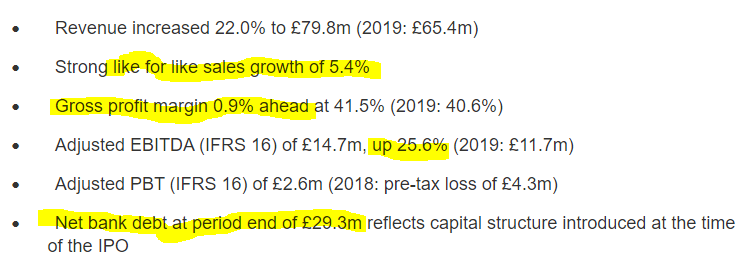
In particular, generating LFL sales growth (of 5.4% here) is the key number. Since many costs are rising, especially staffing related, then hospitality sector companies have to be eking out at least some LFL sales growth. In this case, 5.4% is good, and similar to what some of the pubcos are achieving.
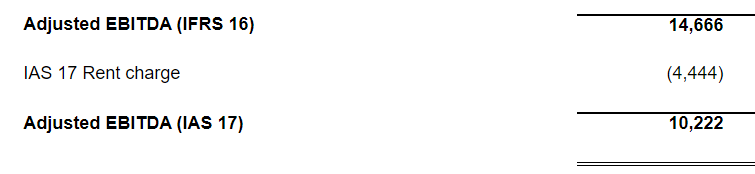
The 25.6% rise in adjusted EBITDA is also good, and reflects the expansion capex on new sites. Although the recent changes in how leases are accounted for has distorted the figures, and made analysis more difficult (with no benefit whatsoever from the changes). Hence we’re given 2 different EBITDA figures. It seems to me that the lower figure is the only one that makes sense, since EBITDA really should be stated after all rental costs.
For my purposes, IFRS16 has completely messed up accounts for multi-site companies, rendering them largely useless, unless I adjust out all the spurious numbers inserted under IFRS16;
Net debt doesn’t look a problem.
Current trading & outlook also sound OK, although no figures are given, and there is no mention of full year expectations;
- Continued to trade well and to outperform the market
- Five new sites opened in H2 to date and on plan to deliver 25 new site openings in the financial year with Lounges in locations such as Sutton, Watford, Sittingbourne and Chorley and Cosy Clubs in Nottingham and Brindley Place, Birmingham
Statutory profit is not so good. There are lots of adjustments, and £3.7m in exceptional costs, which takes statutory profit to a minus £2.5m loss for the 6 months – not good. Looking at note 3, the exceptional costs all relate to the IPO, which is justified in treating as a one-off. So that’s actually OK.
Balance sheet – is strikingly thin. Only £10.4m in NTAV. The lease liabilities & right of use assets can be safely crossed out, as they’re meaningless numbers. Once that is done (reducing current liabilities), the current ratio comes out at just 0.3 – which is one of the lowest I’ve ever seen.
Admittedly, hospitality groups don’t need much working capital (they sell for cash, so don’t have anything much in receivables, and inventories can be kept quite low and turn quickly). Even allowing for that, I’m surprised that LGRS can operate using so little working capital. It looks a bit stretched to me (especially trade creditors).
Why does this matter? It increases risk, were the company to go into a period of weak performance. Also it means that divis are not on the cards – although in future, once it has stopped expanding, there should be scope for divis. This is a sensible policy. Once of the things RBG got wrong, was to expand (heavy expansion capex), plus paying generous divis, which proved too much, and in the end both expansion & divis had to be put on hold.
Valuation – based on consensus forecast of just under 10p EPS, that puts LGRS on a fairly toppy PER of 20 times. It’s a roll-out, which normally attracts a higher rating of 20-ish, so in that respect, it’s probably priced about right, assuming nothing goes wrong.
My opinion – roll-outs are a lot harder to manage than many investors realise. The danger is that opening new sites takes up so much management time, that the existing sites become neglected, staff morale drops, and before you know it, the business is in crisis. That is precisely what happened with Revolution Bars. That also had the distraction of 2 takeover bid approaches, which dragged on for a long time.
I’ve had a 2 meetings this year with management of Revolution Bars, and gone through all the detail of what went wrong, and how they’re fixing it. That brought home to me just how delicate multi-site bars are. If a few key people leave (especially Area Managers) then it can do serious damage to the business. This is because when Area Managers leave, they often take their best site managers with them, to please their new employer, doing serious damage to their old employer.
For this reason, I’ve learned how fragile a roll-out can be, with a lot of risk attached. Hence I’m not particularly interested in investing in a fully-priced roll-out (PER of 20, weak balance sheet) that LGRS appears to be. Having said that, based on today’s interim results, LGRS seems to be performing well, and no cracks have appeared as yet.
This section also by Paul Scott.
QUIZ (LON:QUIZ)
- Share price: 14.85p (-11%)
- No. of shares: 124 million
- Market cap: £18 million
QUIZ, the omni-channel fast fashion brand, announces its unaudited interim results for the six months ended 30 September 2019 ("H1 2020").
Given how bombed out the share price has been, the highlights are not as bad as I was expecting. In particular, note that EBITDA is still positive (a reasonable proxy for cashflow) in the seasonally slower half year that excludes Xmas;
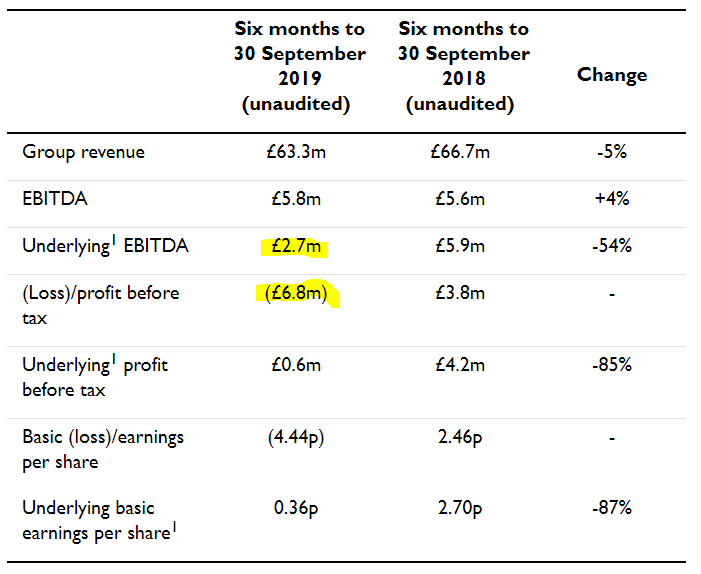
The main reason for the large difference between positive EBITDA and the negative -£6.8m loss before tax, is £7.0m exceptional charges, as follows;
The exceptional administrative costs in the current year relates to store impairments, onerous lease provisions and other associated costs. The total charge amounts to £7.0m; being £4.6m in relation to store impairments, £1.9m for onerous lease provisions and £0.5m for other associated costs.
Balance sheet – is still OK. I don’t see any immediate risk of insolvency here.
The cashflow statement is also quite interesting, in that the business operated around cashflow breakeven in H1. With the peak A/W season now underway, it could be that cashflow for the full year might be positive.
New store expansion has stopped, very sensibly, as it’s the physical stores which are creating the problems, with lower footfall.
Half the problem stores have leases up for expiry in the next 2 years. Hence, QUIZ should be able to exit from a lot of its loss-making stores, in 2020 and 2021, thus hopefully leaving a smaller, but more profitable remaining business.
Outlook – more of the same – i.e. struggling with physical stores, but online somewhat better;
Since the end of H1 2020 we have continued to achieve growth through QUIZ's websites with sales up by 16%. However, consistent with the six months to 30 September, the performance of our stores and concessions has remained challenging. Given this, total Group sales for the nine weeks to 30 November 2019 reduced by 6% year on year (excluding international franchise sales which are wholesale in nature and therefore, can fluctuate from month to month).
My opinion – this business looks down, but not out.
Providing trading from the physical stores doesn’t get any worse, then Quiz should be able to gradually close the loss-making sites as the leases expire or come up for a break clause. Although with fewer stores in future, the business will also need to downsize its central costs.
The online side of things is interesting. It seems to be the case that some brands can grow fast in the early stages, but then hit a brick wall of market saturation. Maybe Quiz is suffering from that? Although the latest online growth of +16% isn’t too shabby.
As we saw recently with Sosandar (in which I hold a long position), sales growth is mainly driven by marketing spending. What matters after that is how sticky customers are. Sosandar has high customer loyalty, hence its high marketing spend makes sense. I’m not sure whether the same applies to Quiz or not? I suspect it probably doesn’t apply to the same extent.
The other problem for Quiz is that it’s trying to compete with the fash fashion online behemoth Boohoo (LON:BOO) – with its multi-brands, and highly aggressive pricing policy. BOO has made no secret of the fact that it wants to dominate the younger, fast fashion space, and squeeze the competition out. It’s an over-crowded space, and Quiz could struggle to make much more progress, against such intense competition, and without any brand strength to speak of.
Although note that Quiz’s 61.7% gross margin is exceptionally high, so they’re doing something right to achieve that level of gross margin.
Overall, at just £18.6m market cap, I think Quiz could possibly be worth a speculative punt.
This section and the rest of this report is by Graham.
PCF (LON:PCF)
- Share price: 35.2p (-2%)
- No. of shares: 250 million
- Market cap: £88 million
Please note that I have a long position in PCF.
PCF Group plc, the AIM-listed specialist bank, today announces its preliminary results for the year ended 30 September 2019.
These results are in line with expectations.
The market had priced this in, as the share price recovered from its low at 25p back up to 35p over the last 3-4 months.
Most pleasingly of all, the company has hit its strategic targets (loan book and ROE) a year ahead of schedule.
Quick recap: this is the lender which got a bank license a few years ago. This cleared the way for a rapid increase in size and a greatly reduced cost of funds.
I've been invested in it since December 2017. The core investment thesis is that with increased scale, there will be a big profit opportunity as the overhead costs from running a bank are spread out over a much larger portfolio, i.e. operational gearing.
Results
- new loans for PCF's own portfolio up by 50%, with brokerage income on top of that.
- total portfolio up 50% to £339 million
- retail deposits up 40% to £267 million. These haven't grown as quickly as the loan portfolio, but they still cover a majority of the portfolio value.
PCF is skewing new loans to better-rated borrowers, making it a safer business that has a better chance of surviving a downturn.
The disadvantages of this are a) it's more competitive among lenders in this space, i.e. you have to face off competition from larger and more prestigious financial institutions to get the business; b) interest rates charged to customers must fall, to reflect their lower risk of default.
As such, PCF's net interest margin has declined by 40bps to 7.8%.
It's also important to mention the small matter of impairments. These more than doubled to £2.2 million, although £600k was due to the new accounting standard (IFRS 9).
As a percentage of the portfolio, the impairment charge increases from 0.5% to 0.8%. Without the new accounting standard, it would have increased only to 0.7%.
It's unfortunate that this has occurred despite an improvement in customer credit ratings. But as followers of Begbies Traynor (LON:BEG) will know, the economy has more than its fair share of financial distress at present.
In PCF's own words:
The part of the portfolio reported as 'up to date' deteriorated slightly in the period to 95% (2018: 96%). The less benign environment has been most noticeable in our Business Finance Division where the UK is experiencing an increased incidence of business failure across most industry sectors.
The company itself is cautious (one might say bearish) on the economy:
Over the course of the year our views on the political and credit environment have changed and as a result we have amended our risk weightings to reflect a less benign credit environment and a more uncertain outcome for Brexit.
As a shareholder, I'm happy that the company is taking a cautious view. I want them to be paranoid about a recession, so that when it eventually comes, they will be prepared for it!
Profits - aren't hugely important to me this year, because it's all about what the company can grow into. But for what it's worth, PCF has returned statutory net income of £6.4 million, or EPS of 2.7p. This is slightly below the forecast on Stocko for EPS of 2.8p.
This is a fine result when you consider that average equity during the year was just £50.6 million, for a highly satisfactory ROE of 12.6%.
The underlying performance is even better than that, when you consider that the company raised £11 million during the year. It will have taken some time to deploy the additional funds.
Outlook
There are some very interesting statements in the outlook section.
Firstly, PCF continues to target a portfolio of £750 million and ROE of 15% by September 2022. But the CEO is already thinking about getting to a size of £1 billion in "the medium term".
Secondly, the CEO highlights the company's cautious approach to the economic environment. In addition to the possible miss on EPS, this might help to explain why the shares initially sold off this morning.
While still positive about PCF's business model, he says they are "not sanguine" about the economy:
Economic uncertainty arising from the current political situation does remain a risk. This could manifest itself as decreased demand in our market places, a fall in our growth rate or rising impairments due to a downturn.
My view
I'm a content shareholder with this one. Ultimately, I just want them to keep their feet on the ground, keep doing the basic things well, keep moving up the credit spectrum, and see where it takes them.
If costs can be controlled, then I don't see why ROE of 15% can't be achieved. I would be perfectly satisfied with that level of return and I imagine that most other shareholders would be, too.
At some point, the growth will have to level off, or the returns will have to fall. There are limits to growth in banking: at some point, if you pursue endless growth, the larger banks will start to notice you and your returns will fall to their levels. But I think there is still quite a long runway (several years) before that happens to PCF.
On the other hand, PCF benefits from the lack of any legacy business. It's a new set-up, purely online, and can make a clean run at the opportunities afforded by its banking license.
The existing forecast for FY September 2020 is EPS of 3.6p, followed by 4.6p in 2021 and significantly higher again in 2022.
I'm still a bit nervous about future fundraising activity, and hope that the company won't do it unless the price is right, i.e. at a significant premium to book value.
Book value now is £58.8 million or 23.5p per share. The current share price (32.5p) therefore produces a P/BV of 1.5x.
For a company earning ROE of 12.6% and with the potential to earn 15% and higher, I think this might possibly undervalue its prospects. I would say that the upper end of fair value is probably around 2x book balue, i.e. 47p per share.
M&C Saatchi (LON:SAA)
- Share price: 79.1p (-46%)
- No. of shares: 93.1 million
- Market cap: £74 million
Accounting Review and Trading Update
Hot on the heels of the inventory review at Ted Baker, we have another accounting scandal to look at.
Do you remember what I said (courtesy of Warren Buffett) about cockroaches in the kitchen? There's usually more than one.
In August, Saatchi said that it needed to take an exceptional £6.4 million charge:
We believe we have discovered the full extent of the issues, but to be doubly sure, the Board is appointing independent advisors to undertake a review of all the Group's accounts and accounting systems, as well as setting aside an extra £1.5m as a conservative measure to provide for any potential further items arising.
Making "doubly sure" has resulted in the discovery of more cockroaches, which now add up to £11.6 million.
This bit is shocking:
Separately and in relation to 2018, PwC has identified that the 2018 half year reported profit was adjusted by approximately £6.4m. Such adjustments may have occurred in half year reports since 2014.
What does "adjusted by" mean, if not "inflated by" or "falsified by"?
For the record, PBT in H1 2018 was given as £16.7 million.
The new FD now has the job of bringing in completely new financial controls and reporting systems.
2019 trading update - this goes back to another point raised in relation to Ted Baker. After an accounting scandal, when they start telling the truth, companies might not be able to generate the profits which investors had come to expect.
Saatchi's 2019 result will be "significantly lower" than expected, and that's before taking heavy exceptional costs into account.
Additionally, minority shareholders get to keep around 20% of Saatchi's profits, and the company warns that their share will increase.
My view
Checking the interim results, I see that it reported net cash of £9.5 million. So it might be able to survive from a balance sheet point of view. Though I note that it reported £40 million of borrowings, offset by £50 million of cash. Why borrow £40 million, if it has £50 million in cash?
Checking the annual report, it sounds like the cash is sitting at its subsidiaries while the PLC holds the debt:
During 2019 we will perform a strategic review of our banking facility and other banking requirements and will determine how we can better utilise positive working capital balances in some subsidiaries and currencies against negative working capital balances elsewhere.
Either way, it would take an awful lot of convincing for me to want to get involved in a situation like this. This now deserves to be on a dirt-cheap earnings multiple.
LoopUp (LON:LOOP)
- Share price: 67.5p (unch.)
- No. of shares: 55 million
- Market cap: £37 million
Measures relating to 2018 and 2019 options grants
This reads like the latest edition of "heads we win, tails you lose" from a listed company.
In August 2018, LOOP awarded 2.3 million share options to staff at 440p, which was approximately the share price at time.
In June 2019, it awarded another 1.1 million options at 317.5p, which again approximates to the share price at that time.
Since then, the share price has collapsed after a nasty profit warning in July followed by another one in September. The share price was bashed and for good reason: revenue was millions of pounds lower than expected as customers started using the product less.
But the Remcom thinks that the staff who failed to hit the company's targets must be retained at all costs, so it's repricing the option scheme:
The Group's Remuneration Committee and the Board consider that these grants have become ineffective in their primary purpose: the future retention of business-critical staff...
All current employees not under notice who were granted options in August 2018 and June 2019 will be given the choice whether to keep those grant contracts as is, or whether to cancel those grant contracts and enter simultaneously into new contracts with different terms.
New options will have an exercise price of 75p. How would that make you feel, if you were a minority shareholder who bought in at 400p two years ago?
At least the new scheme will not apply to the co-CEOs.
My view
If Loopup feels the need to do this, because the staff receiving the options are necessary for the continued functioning of the company, then I reckon that these staff should not be on an option scheme in the first place.
They should instead receive variable pay, in cash, depending on the attainment of their individual and team objectives. Because if their work is truly vital, then retaining them should not depend on the vagaries of the stock market. Pay them the necessary amounts in cash, and stop diluting your shareholders. Simples.
Numis (LON:NUM)
- Share price: 244p (+3%)
- No. of shares: 105 million
- Market cap: £256 million
Investment banking is a feast-and-famine industry and the famine is currently underway.
Revenues are down 18% but administrative expenses are only down 8%.
On top of this, Numis has suffered writedowns in its investment portfolio of early-stage private companies (total value of this portfolio is now £15 million).
The result is an operating profit of just £12 million, versus £31 million last year. Operating margin almost halves.
It's less extreme if we exclude the results in the investment portfolio. Through that lens, operating profit was £14 million this year (versus £30 million last year).
Comment from the co-CEOs:
"It has without doubt been a challenging year for everyone in the industry and our results have inevitably been impacted by the persistent political uncertainty, macro-economic factors and subdued, yet volatile markets...
We continue to be actively focused on our clients and believe we are better positioned than ever to continue winning market share...
There just isnt enough activity at the moment to keep bankers cheerful. Numis says that equity trading volumes have declined and there was "a far smaller group of deals" compared to better years. Big transactions are few and far between (which ironically might be a good thing for the economy, if you take the view that most M&A destroys value).
And Numis gives us an insight into the view of big money:
The persistent uncertainty facing the UK also impacted institutional investors as they typically adopted a more cautious approach toward investing in UK equities. Many overseas institutions maintained underweight positions limiting their exposure to the UK market, whilst many domestic long-only institutions suffered outflows in UK equity strategies.
Let's be clear: this is a good thing for anyone buying UK equities right now. Many shares look too cheap in comparison to interest rates and their prospects, and this can be partly explained by the absence of foreign investors and the general disdain towards the UK stock market.
As a rough measure of this, the FTSE is currently stuck around 7200, having made no progress in the past three years. And small-caps are particularly unpopular.
This won't be much comfort to anyone cashing in their portfolio, but it's a nice environment in which to be a buyer.
If half of the FTSE-100 is nationalised after the next election and we get the long-awaited recession, then macro bears will doubtless feel vindicated. But if you can find stocks which won't be wrecked by macro factors (this bit isn't easy), I think that now is a perfectly reasonable time in which to be a buyer.
Let's get back to Numis. It further notes that private markets remain buoyant, attracting more funds and higher valuations. Though it is a public market specialist, its revenues from private market deals meaningfully increased.
It's an interesting contrast. I do think that private markets are currently the venue for much of the speculative froth which undoubtedly exists in certain sectors (fintech, bitcoin, SAAS). But sooner or later, I do expect that successful private companies will want to benefit from the unparalleled liquidity that public markets can offer. This could take a while, but should eventually lead to a rebound in popularity for the public markets.
Outlook is upbeat, in the circumstances. Revenue for the first two months of the financial year is up, compared to last year:
Market conditions and the upcoming general election will likely impact the pipeline of deals in the short-term but we remain well positioned to progress our strategy.
My view
I admire this company and I do expect it to recover to a much more profitable level, although the timing of this is impossible to predict.
It doesn't pass the filters that I currently apply to my personal portfolio, so I won't be buying it, but I do think that shareholders could do well.
Another factor is the much smaller Cenkos Securities (LON:CNKS), which trades at a discount to book value and a yield of c. 10%.
With Numis trading at a substantial premium to book value (1.85x) and a much lower yield, its profitability absolutely must return to prior levels, to justify the value differential. In other words, It seems to me that relative value is already pricing in a recovery at Numis.
Either that, or it sees no hope for Cenkos. I would be interested to understand why.
Impax Asset Management (LON:IPX)
- Share price: 290p (-3%)
- No. of shares: 130 million
- Market cap: £378 million
Impax Asset Management Group plc ("Impax" or the "Company"), the specialist investor focused on the transition to a more sustainable global economy, today announces final audited results for the year ending 30 September 2019 (the "Period").
This company's assets under management just keeps on growing. Impax is at the forefront of "ethical" or "environmental" investing, a popular niche at the present time.
AUM is now £15.7 billion, up from £12.5 billion fourteen months ago.
The balance sheet is very healthy, showing cash and equivalents of £32 million and no debt, after Impax paid off the loan it used to buy a similar US-based fund manager (Pax).
In hindsight, it was a brilliant move to structure this deal using debt, instead of issuing more shares. The Impax share price has doubled in the last two years, and has done even better on a longer timeframe. The gently rising share count must get some of the credit for this.
Outlook is measured:
In 2019 markets have become harder for investors to navigate. With the US-China trade war leading to the implementation of tariffs, widespread concerns about prospects for global growth, and unprecedented levels of political turmoil in several countries, including the UK, there are many reasons for investors to be cautious.
Nevertheless, the commitment of policy makers, the business community and wider civil society to combatting climate change, reducing pollution and forging a path towards a more sustainable economy has never been stronger. Against this backdrop, Impax's committed teams, well-established investment philosophy, broad range of investment solutions and acknowledged leadership position across many markets should stand the Company in good stead to deliver further growth over the coming years.
Results are good, but revenue growth is a little constrained at 12%, for a total of £73.7 million.
The entity in the US has seen some outflows, and profits have not matched the expectations at the time of the transaction. This results in the defcon due to the sellers being written down to the zero.
Costs ran faster than revenues, up 22% on an adjusted basis to £55.7 million.
Fortunately, revenue run-rate finished the period at £78.3 million, and it will be even higher after the AUM gains seen since then.
My view - these results could have been better, but I think that the outlook is still positive for patient shareholders. The rating is currently quite high, reflecting the strong revenue run-rate and the secular trend for more environmentally-focused investing.
I expect dividends to rise considerably, in line with its new payout policy (55% - 80% of adjusted PBT). This is likely to support the share price.
Character (LON:CCT)
- Share price: 380p (-8%)
- No. of shares: 21 million
- Market cap: £81 million
I'm running out of time, so my comments on this toy company will need to be brief.
CCT continues to exhibit good margins, a high ROE and plenty of cash on the balance sheet.
Formatting issues struck here and destroyed this section. Sorry about that. See you tomorrow!
Disclaimer
This is not financial advice. Our content is intended to be used and must be used for information and education purposes only. Please read our disclaimer and terms and conditions to understand our obligations.

23 comments
I had a wry smile about the M&C Saatchi (LON:SAA) "revelations" today.
When they first(?) announced the issues back in August - I got quite exercised about their inaccurate disclosure. (From a PR company - surely not?.)
What had got me riled was the statement : "That was in late May 2019, and was published in the Annual report on 29th May."
In fact I could find no reference to this in AR, so it seemed to me that they were trying to brush this under the carpet - "old news" , "nothing to see here, please move along".
They got a bit "rattled" by the market reaction (25% fall) to their new so issued a "Further Trading Update" which in particular said :
With hindsight "they protested too much". (lies upon lies?)
Back in August I was minded to write an "exposé" on their misleading statements, but decided I did not really have enough to go on. If I had followed my gut on this one I would be looking quite clever.
If I had followed through with a short I would probably also be looking quite tanned by Christmas.
I won't disclose on whether I would have spent the proceeds on a brief trip to the sun or a full course of Skinny Tan [DISC : I own shares in Innovaderma (LON:IDP) ]
I cannot claim kudos for reading this one, because (i) I hardly told anyone and (ii) I did not act on it.
However, perhaps the lesson is : if you find reports lacking honesty then run for the hills (or go short).
Meanwhile, I could not invest here while the current directors are in place.
re: Character (LON:CCT), thanks for the super comments which put my own to shame! G
Superb updates yet again today from both Graham and Paul. I don’t know how they mange to absorb and then pass on so much invaluable information day after day. It’s a brilliant service and more than worth the current Stockopedia subscription. Yet there is so much else on this site too effectively in for free.
I was particularly interested in the Numis update and comparisons with Cenkos as I hold both (Cenkos at 40% loss, and average down at break even). .
Can’t really fathom the 11p Numis share price rise today. Consolidating sector so maybe on bid hopes? Otherwise and bearing in mind Graham’s detailed analysis and Numis eps now only 8.8p with PE approaching 30, recovery does already looks priced in.
Cenkos otoh looks cheap by comparison including share price to book value. A recent Edington note said it is just x1 for Cenkos and possibly at all time low, whereas, as Graham pointed out, Numis trades at substantial premiun to book value. Also if held Cenkos yields 10%. Cenkos have been winning and losing business so jury out until next results, but could also be a bid candidate? And Cenkos share price is down over 80% since peaking around 240p in April 2015, whereas Numis share price now is similar to where it was in 2015. It peaked around 440p in June last year, so again compared with Cenkos that 45% fall since then is much smaller. So a lot of bad news priced in already for Cenkos, and unlike with Numis recovery isn’t.
Accsys Technologies (LON:AXS) - some time since you have commented on this company - there is a share placing on currently and seems strange to me - but the shares can be purchased in the Mkk for less than the placing price - (98ish v 105p) - Any thoughts / comments please ?
Accsys Technologies (LON:AXS) What's the bull case for investing in this indebted, loss-making company?
Impax Asset Management (LON:IPX)
I am very encouraged to see that the large and prestigious investment mandates that Impax have been targeting are now flowing through. They already manage money for CALSTERS (California Teachers - one of the world's largest pension funds) and are getting the seal of approval from influential investment consultants (eg. Mercers).
The year-end AUM of GBP 15.1bn is old news but they were up to GBP15.7bn by end-Nov with some GBP0.5bn of net inflows. What is more, there are material mandates in the pipeline (awarded but not yet funded). I would assume this would include the Formuepleje (Danish fund manager) and Mercers. These are around £100m each. This size of mandate is no longer unusual for Impax.
I haven't yet crunched all the numbers but its pretty clear that with this business momentum the forecasts for next year (certainly the Stocko 2020E revenue) are far too low. Indeed, the run rate will already be above the 2020 full year forecast. Of course, there could be a sharp fall in the market but I don't think this was the basis of those predictions!
Loungers (LON:LGRS) my only interest in this would be on the short side (but I don't short shares).
The new openings are benefiting from interest associated with them being new (shall we try that new bar?) but I've spoken to many people with far better social lives than me and they were all very neutral on the places - certainly nothing that makes them stand out. A few commented that some weren't in great physical locations, not that easy to get into etc.
Balance sheet is paper thin, operating in a very crowded market with lots of competition, a roll out strategy which is inherently risky and high valuation metrics. I don't think there is a management team in the world that I'd trust to be able to pull this off.
Good luck to them, but I see the risk/reward on this very skewed towards the risk side of things.
Hi JDW,
Re: Loungers Loungers (LON:LGRS) - Interesting thoughts that chime with my experience, which I thought I'd briefly share.
I recently visited my local one and although the food was ok, and the staff were good, the venue itself was quite disappointing and underwhelming and both my other half and I decided it was not a venue we would be rushing back to given the choice available at comparable prices.
So, based upon my own experience, I think your take on the new sites generating some initial interest may have some weight to it.
Richard
Another Mello presentation, just published. Internet Mobile Communications who are unlisted looking to raise funds.
Described as a FinTech and international telecommunications business. IMC has three divisions comprising International Carrier Services and settlements, Retail and Mobile Marketing, with presence in the UK, Moldova, Chile, India and Malta.
They've doubled revenue and EBITDA every year for 5 years. The raise is being done at a 10.5x multiple on this year's EBITDA, but 4.5x next year's forecast. They pay a dividend, which should double each year.
https://www.piworld.co.uk/2019/12/04/internet-mobile-communications-ltd-presentation-at-mello-london-may-2019/
It was interesting presentation. However, as one party commented they don't file full accounts at Companies House, only exempt accounts, with a balance sheet only. And on that basis its difficult to match their quoted figures with published figures. For example EBITDA is quoted in the presentation, but as we know EBITDA is adjustment city for some companies, and maybe so in a software trading platform, as they appear to offer.
There could be a variety of reasons for filing very limited accounts that, but frankly their response seemed muted in the presentation.
It would be interesting to see the cashflow analysis to see how they fund the dividends they offer, and how close to their quoted EBITDA the cash generation is.
Could be a cracking opportunity, but without more analysis of the accounts, I wouldn't be inclined to invest. But it looks like they fully funded this round of investment anyway.
Whereas this sort of business in prospect would have been a slam dunk for a public quotation at one time, the cost of and uncertainty of getting a public quotation in current markets would not be feasible, as my City friends say the public markets are dead at the moment for IPO's.
Private Equity are short of deals also, with the pause button being pressed because of the General Election, and uncertainty hovering of who might get in.
Quiz (LON:QUIZ) H1 results show it making slow progress towards a modest recovery over time ....but needs a change in strategy to really take off.
Product is mostly generic apart from cheap glamour wear - think sequins, heavy make up and a lot of flesh revealed. But headline model is still Sam Faiers (TOWIE since 2010). She is now nearly 30. So who is Quiz targetting? Lower income young Mums who still like to party?
Business still has potential if it doubles down on its niche (glamourware) but updates its appeal and pricing position with fresh celebs. This strategy also needs few (any?) stores and can do away with several categories, allowing major cost reductions.
The CEO/controlling shareholder is a long time rag trader who made millions in the IPO. Now need to see if he wants to be a modern, public company businessmen......or if he wants to buy it back and go private again (as I would if I had his squillions).
Opportunity is there as business is still generating £4.9Mn op cash and claims £7.2 net cash at what should be a low point in annual cash cycle.
%GM is back to 62% as worst of the poor/excess stock driven discounts have passed through - although back to selling 75% off in Cyber week ! Tells you brand strength despite spending a reasonable £1.7Mn on Marketing!
Online sales are flat at £20mn overall but +12% on higher margin Quiz website (ie 3rd party sites must be down). Lots more active customers reported (+31%) but ave. order value only around £30; v low vs fixed distribution costs. Must also be vulnerable to rising environmental concerns on 1 use wear and packaging - although I suspect target market are not liberal tree-huggers.
Stores were a disaster at £20mn. Down 11% on flat total sq footage - despite 2 new stores in presumably higher traffic Arndale and Eastbourne and Concessions opened/closed. £7Mn asset & lease impairment hit taken. However, down to 25months ave lease left and (allegedly) on leases renewed all profitable. Still committed to omni-channel model, in part I think to retain achieved scale in part because it is what the boss knows.
International ticks over at £12Mn but this really means Eire + bits in Spain/UAE etc where TOWIE folk go to party!
I still hold after catching a falling knife at its bottom but no longer expect a fast turnaround.
Paul, Just read your summary on Quiz (LON:QUIZ) (better - should've waited!). Marketing issue for Quiz is that their strength/USP is glamourware. Even if you party hard and change dresses each time, you only need so many. Harder to get you to spend more without moving you up in price/item; which is hard for QUIZ since it gets customers in via cheap pricing. Its proven in a specific space but will struggle to grow but it is cheap.
In contrast, Sosandar (LON:SOS) (which I also hold) starts higher priced/item and the brand feels like it can stretch quite far - from original arm-covering fashionable dresses to office and evening party wear to shoes, smart casual (denim) and accessories as well as target a wider age range. Long term much more potential but as yet sub scale and vulnerable.
Interesting to see what happens on both.
Thanks Graham.
Not sure what the thumbs down was for. Maybe the comment about a Tory majority? If it was, I nearly added that it’s market reaction that matters from an investment perspective and not what we might prefer.
Andy, Ken, David- thanks for the suggestions! ~Yes, we'll be looking at all of them.
Graham
So Character (LON:CCT) produced interesting results this morning.
As I argued here previously, one key takeaway for me was that the imminent removal of Peppa Pig from its ranges is proving not to be the binary event that was priced. A new range which has a 3 year licence has been agreed. Since Hasbro will have inevitably been consulted this bodes well for some level of continuation after the next 2 years.
Trading was broadly as expected but against reduced forecasts, at 43p eps. Balance sheet is strong with net cash at £6.5m, almost 10% of market cap. Dividend is now 7% and a fairly miserly PE of 9 given the last 5 years the company has traded consistently.
Cash generation is very good. Despite spending £11m on acquisitions and £7m on shareholder distribution they still only took £10m out of the cash pile and increased inventories. Given the in-line update it suggests cash will be back up towards £14m next year! Great return on Capital and Equity in excess of 30%.
As we know it's a difficult market in the UK at present and this is also flagged as expected. What I liked within these results though is the international expansion and growth. This is important if the company is to keep growing.
Looks like a decent recovery play theme for me.
"A new range which has a 3 year licence has been agreed. Since Hasbro will have inevitably been consulted this bodes well for some level of continuation after the next 2 years."
How sure are you of this, David?
Firstly Hasbro are not an owner of Entertainment One so why would they have any right to influence the companys' strategy?
Moreover, are there any 'change of ownership' clauses in the contracts signed between Character & Entertainment One?
Howard
Character (LON:CCT) have an existing relationship with Hasbro. They already licence toys right at the top of the "desired" list such as Stretch from them, irrespective of £ETO. Ask yourself why......the reason is that Character (LON:CCT) are bl**dy good at it.
So, never at all obvious to me that immediately Hasbro take over Entertainment One (LON:ETO) that they get rid of Character (LON:CCT) for Peppa. At least not in the medium term.
Re the new contract for wooden Peppa toys. Would you sign a new contract where you developed a range of toys and associated IP knowing that the company in question was shortly being taken over if there was a 'change of ownership' clause in it? I definitely wouldn't and Character (LON:CCT) management are far from stupid. So whilst I can't say for certain one doesn't exist I'd be absolutely staggered if there was anything that allowed Hasbro an immediate out post takeover.
Having been on the other side of a takeover I know only too well that the company acquiring wants influence over decisions that are not short term in nature. I'd say a 3 year contract is likely to constitute something Entertainment One (LON:ETO) agree to run past Hasbro management. In fact I'd go as far as saying it is likely that the extension to the original licence was also agreed with Hasbro as they will be keen to avoid disruption to the brand merchandise during the integration.
Irrespective of Peppa my other previous comments on Character (LON:CCT) replacing any potentially lost revenues with new brands / geographies is also showing signs of life. The Goo Jit Zu, 2 in-house brands and international expansion is all focused on by mgmt and where the future growth is.
Hi David - i agree that the contract announced today and the prior 6mth extension were likely agreed to by Hasbro management and given prior Hasbro/CCT co-operation that the market was likely being too negative. however - and please note i am quite long here - i have yet to see much positive re: Goo Jit Zu.. happy to be wrong here since they own the IP too..
Hi Jim, I don't hold CCT (although it has been on my watch list for a long time and today's results are pushing me closer to the buy button) but my 6 year old son recently asked for a Goo Jit Zu for his birthday, it was at the top of his list and according to him a number of his friends at school are after one for Christmas (admittedly he does talk a lot of rubbish so the source isn't 100% reliable). Personally I don't see the appeal of it, but he is very happy and I guess I'm not the target market.
Thanks Luke - that's really useful feedback to hear. A sample of one may not be statistically representative of course but it does back up the Character (LON:CCT) boards assertion that it's a top Christmas list seller in the target market. I have to say I have followed Character (LON:CCT) for a few years and I have always been impressed with managements ability to distribute toys that consistently make the desired list. I think they are very much misunderstood as a company.
Keen for an update on Numis please Graham. Difficult UK markets along with Brexit uncertainty and General Election are continuing big headwinds.
e.g “Once the political uncertainty dissipates and investor confidence returns, we would expect execution revenues to recover.”
And in the Outlook statement, “market conditions and upcoming General Election will likely impact the pipeline of deals in the short term, but we remain well positioned to progress our strategy.”
Note the “short term.” If a Tory majority, good chance markets will react positively and new issues drought and other currency headwinds will ease? If so maybe good recovery in Numis (and also Cenkos) share prices after the Election.
Would be great if you could have a gander at Numis (LON:NUM) Graham at some point this should be a decent buy ideally after Brexit sorted still making a profit and cash on the balance sheet there also a couple of large holders just below the line from where they would have to make a bid from memory.
Thanks Andy
My morning smallcap tweet: More nasties at Saatchis
M&C Saatchi (LON:SAA) TruFin (LON:TRU) Ilika (LON:IKA) £SO4 QUIZ (LON:QUIZ) Big Sofa Technologies (LON:BST) LoopUp (LON:LOOP), SDCL Energy Efficiency Income Trust (LON:SEIT), i-nexus Global (LON:INX)
M&C Saatchi (SAA) nasty - guides FY adj pretax significantly below that expected at H1 RNS. Increases a/c 'adjustments' (for FY18, 19) of Sept by £3.8m to £11.6m. Also restructuring its UK office to save £6m PA at a cost of £2.5m.
TruFin (TRU) tender of 12% of shares at 45p, a 9% discount. Guess that's aimed at Arrowgrass, a 74.4% holder which wants to sell down. Conducting review which "may include proposals to dispose of and/or reduce the operations of certain subsidiaries in order to accelerate further returns of value to shareholders." Trading in line.
Ilika (IKA) trading in line - FY rev £1.5m and EBITDA -£1m despite all the grants they get. How long can they keep cashing in hope for funds?
Salt Lake Potash (SO4) plans fundraise so halts trading on ASX but not AIM!
Quiz (QUIZ) H1 poor as trailed in Oct. Rev down 5%, U/L pretax £0.6m (£4.2m). Recent 9 weeks rev down 6%, "we have seen a positive response to recent product ranges. " blah blah. I hold.
June, at 1030h (BST). The details are:
LoopUp (LOOP) offer new options at 75p to replace those granted at 440p (Aug '18) and 317p (June '19). The co-CEOs graciously waive their option option. SP is 67.5.
In line: SDCL Energy Efficiency Income Trust (LON:SEIT) i-nexus Global (LON:INX)