Small Cap Value Report (Wed 9 Oct 2019) - RCN, TCN, VTU, FAN, CDM

Good morning,
A few bits to cover today.
- Redcentric (LON:RCN)
- Alpha Financial Markets Consulting (LON:AFM) - dropped this one, as not interesting enough!
- Tricorn (LON:TCN)
- Vertu Motors (LON:VTU)
- Volution (LON:FAN)
- Codemasters Group (LON:CDM)
Redcentric (LON:RCN)
- Share price: 85.9p (-0.1%)
- No. of shares: 149 million
- Market cap: £128 million
This is a simple one: trading in line with expectations.
Redcentric is a managed IT services provider that offers the IT/Cloud services you'd expect from a mid-sized group.
Net debt is light, at £16.5 million - no major surprise, then, to see that RCN is paying out dividends and also buying back £2 million of its own shares.
Net debt has declined over the past year despite dividend payments and "an acceleration of network and infrastructure capital expenditure in the period."
While reported net income has been nothing to write home about in recent years, if this company hits its forecasts from now on then it will offer decent value at current levels.
Tricorn (LON:TCN)
- Share price: 11.2p (-38%)
- No. of shares: 34 million
- Market cap: £4 million
I'm not going to bother covering Alpha Financial Markets Consulting (LON:AFM), which was in the original list.
Let's move on and see if this announcement from Tricorn is worth looking at.
Paul covered the company in April. His summary opinion was:
It's difficult to get excited about this - a small engineering group, with a bit too much debt, is not going to attract a high rating.
Deary me.
Today's announcement is a nasty one. Let me put the problems in bullet form:
- USA demand "broadly in line with expectations"
- USA margins are down, due to tariffs on Chinese imports. Tricorn phrases this elegantly, saying there is a "lag" between the imposition of these tariffs and its negotiation of higher prices with its own customers.
- UK demand "slowed significantly", with H1 revenues down 12%.
The upshot is that revenue will be "slightly lower than expectations" and 7% lower than H1 last year. PBT will take the hit of lower revenues and lower margins. Full-year results will be materially lower than expectations:
There is a strong pipeline of opportunities and the Board continues to evaluate the impact of new business inload and the extent to which this can offset the impact of weaker underlying market conditions. However, the Board now anticipates that full year results will be materially lower than market expectations.
My view
Stocko shows a net income forecast for the current year of £1.03 million, off revenues of £23 million. With lower revenues and margins, is it safe to assume that the company will publish a loss?
Like Paul, I see few attractions to this share. But then, I tend to steer clear of nano-caps and companies in this sector.
When I reviewed it in June last year, I thought it was worth looking into, despite the debt load (£3.3 million at year-end) and patchy track record. But this update suggests not.
I'm struggling to find anything of interest, but let's plough on and see if there is anything more interesting in the next set of announcements.
Vertu Motors (LON:VTU)
- Share price: 33.2p (+2%)
- No. of shares: 369 million
- Market cap: £122.5 million
A (trailing) EV/EBITDA multiple of less than 3x would normally be of interest to a value investor.
And financial results at Vertu remain excellent, with free cash flow of £14.6 million from PBT of £16.1 million. That's in just six months!
The profit number is a slight deterioration compared to the prior year, but VTU's valuation is evidently pricing in a collapse, and these results are far from a collapse.
The risk is that the valuation is correct and this turns into another Pendragon (LON:PDG), seeing its profitability disappear in the face of a terrible new car market.
Vertu's new vehicle sales to the retail market were down by just over 10% in H1, on a like-for-like basis.
Let's check the outlook section. The company is on track to meet expectations.
Key points from the outlook:
- September like-for-like new vehicle unit sales to retail are down 1.6%
- used car sales and service revenues still growing on a like-for-like basis
- overall profitability in September is up compared to the prior year.
The company also mentions the impact of Sterling with respect to manufacturer margins and price changes to consumers.
While I do think that Sterling weakness should only be a short-term issue for Vertu (in the sense that price changes will be passed on to consumers and Vertu should retain its small margin), it's hard to be optimistic about overall prospects for the new car market.
And this general weakness in sales means that the company's prospects are dull, at least in the short-term.
However, is this more than fully priced in? Quite possibly.
If it were possible to buy a car dealership ETF, which included a basket of stocks like this, I'd be tempted to pick up a few. Those which survive the potentially imminent recession could prove to be great investments over a 5-year holding period.
I also note that this company bought back 2% of its shares during H1.
The trigger for me to actually go ahead and take a stake in one of these dealerships might be something like a material share buyback. If we wake up one morning and see that 20%+ of the shares in one of these companies are being retired, that could be the signal for me me to get involved.
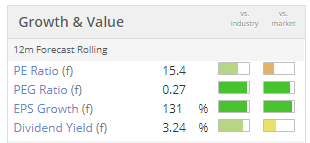
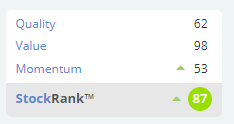
StockRanks love it. Quantitatively, its story checks out:
Volution (LON:FAN)
- Share price: 171p (+1%)
- No. of shares: 198 million
- Market cap: £339 million
This is "a leading supplier of ventilation products to the residential and commercial construction markets", i.e. another stock which is unlikely to light up the bulletin boards any time soon.
It reports organic revenue growth of 3.5% at constant currency - not bad.
Combine that with growth via acquisition and currency movements, and you get total revenue growth of 14.6%.
On an adjusted basis, this feeds through to growth in operating profit of 13.3%.
Remarkably, this feeds through to growth in statutory PBT of 38%.
The reason is that the accounts have cleaned up a bit, with much fewer adjustments for 2019.
Last year, the company included £5 million of factory relocation costs within the adjustments. This year, only £1.5 million of such costs were included.
Net debt is significant at £74.6 million. The company reckons this is 1.6x EBITDA, which is not a very scary multiple.
Net cash from operations during the year was £32 million. If acquisition activity was dialled down for a while, it looks like the company would be able repay significant chunks of the debt.
Working on margins
I appreciate management's focus on margins:
Whilst there is an inevitable margin dilution as we acquire companies with a lower margin, we are also conscious that there has been a reduction in our underlying margin over the last two years.... We have taken action to ensure that operating margin improvement is the key focus for management and employees of the business over the coming years and we have also updated our strategy to now include a sharp focus on Operational Excellence. We believe that the Group has the potential to increase adjusted operating margins back to a level of 20% over the medium term.
But if we check the "official" metrics, ew see that the company's quality scores are distinctly average at present:
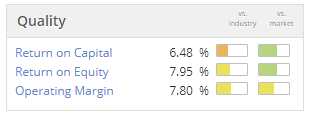
It's true that the "underlying" operating margin is much better than this, but we should be cautious about accepting that at face value.
By far the largest adjustment relatess to the amortisation of acquired intangibles: £15.4 million this year, and £14.7 million last year.
If we ignore this charge, we risk treating the company as if its acquisitions were free - which of course they weren't! So it's important to be careful about that.
My view - I don't have a strong opinion on this one. It's cheap on a PE basis, but it looks to be average as far as quality is concerned. The balance sheet has negative tangible equity, another reason for caution.
Codemasters Group (LON:CDM)
- Share price: 213p (+0.2%)
- No. of shares: 140 million
- Market cap: £298 million
This trading update is in line with expectations.
Newsreaders and broadcasters are supposed to make the news sound "sensational". Unfortunately, I can't patch up the fact that today's company news was terribly dull, at least from my perspective. Let's hope for a better day tomorrow.
Cheers,
Graham
Disclaimer
This is not financial advice. Our content is intended to be used and must be used for information and education purposes only. Please read our disclaimer and terms and conditions to understand our obligations.

50 comments
Stockopedia, can I report a problem with your software.
I've just logged into the Small-cap-value-report but instead have arrived at some political discussion group
Can you look into this please?
Thanks in advance.
There's a time & a place:
Howard Marx - you are looking at the wrong day. Discussion on shares has moved on!!
Here in the UK I listened to a programme about where a houseful of East Europeans died in a House fire in the Norfolk area of a Town in which there has been a large influx of East European people causing some disjunction of the locals. Lots of Polish shops.
Polish shops are being used to sell illegally available cigarettes, avoiding UK duties etc. Turns out the shops aren't owned by Polish people, but behind the scenes are owned by foreign third parties.
The illegal cigarettes do not have the mandatory slow burn additive, so represent a fire risk, and are obviously cheaper. Hence the sad deaths of homeless and people with drinking problems from East Europe.
So there's a lovely little knot of problems that has arisen just from being in the EU. Its hard to predict what are the unforeseen consequences of top down policies.
Hi timarr - Goods manufactured in NI would be accompanied by a vat invoice. Goods from Eire would not although they may in some cases be accompanied by a fraudulent invoice. I would have thought some computerised checks could be put in place to help catch these. It is little different to goods currently coming into the UK duty free from the EU and other goods from the rest of the world being subject to duties. If the DUP object to this then it is they who are causing the difficulty. After all HMRC can currently visit their premises to inspect vat records so having some paperwork checked when their goods cross into the mainland seems a trivial issue to me.
doublelutz
All those ideas work fine where everyone is law abiding, keeps and shares good records and has no interest in fiddling the sytem, either in terms of duties, tariffs or H&S standards. The real world doesn't work like that - which is why countries have checks at borders.
It is little different to goods currently coming into the UK duty free from the EU and other goods from the rest of the world being subject to duties.
It's completley different. Currently all non EU goods arriving in the EU from outside have to pass border checks as they enter the EU - if they are coming to the UK via Ireland they would pass checks in Ireland. Post Brexit the EU border is the NI border. While in the EU we have coordinated regulations, tariffs and customs arrangements - so once in the EU goods can flow freely, and it doesn't matter which country of entry the checks are made at. If we are outside that no longer applies, and checks need to be made at the EU/UK border, like any other.
peterg
I am aware of what happens in real life. I have had clients receive lengthy prison sentences for vat fraud without import or exports even being involved. I alluded to fraud when I mentioned that there could be fraudulent vat invoices. Because some people are dishonest it doesn't mean we don't try to enforce tax, vat and duties laws. We set up systems to try to identify frauds which as you say is why there are border checks.
It is already accepted by all parties that there will be no border check at the actual border between Eire and NI. NI could be treated as a special case for receiving imports from Eire which I think has already been proposed in relation to agricultural products but goods need to be checked before arriving in mainland UK. I don't think it is impossible to find an answer if Eire/EU and NI and the rest of the UK really wanted to.
Vertu Motors (LON:VTU) - In 2014 we bought our new Mazda from them (under their Bristol Street Motors brand - a name I remembered from 50 years ago). The individuals we dealt with were good and the car has been a successful purchase for us but then they cancelled our service agreement unilaterally, dumped the Mazda dealership, and basically told us to PO (they have a USA style of management). The overall impression I got is that they are quite good at squeezing profit out of their trade with a very hard-nosed attitude and when I think the timing is right I am a buyer of the shares. I don't think there is an ounce of customer loyalty or goodwill left in the car trade so the fact they treated us badly doesn't influence me as an investor. I think that in the car trade all one should look for as an investor is the right moment in the cycle to buy businesses which have the knack of squeezing the juice out of every opportunity they get. If you want warm and cuddly investments, or long-term buy-and-hold, don't even think about car traders.
Come to think of it, I suspect that in the world we now inhabit customer goodwill is pretty much a thing of the past in most trades. I blame the price comparison websites which force all suppliers to pare their offer to the bone, grab business by being the cheapest, and survive by using every trick in the book to keep costs low and stuff existing customers who can't find the time to switch.
timarr - without responding to all of your points you say "The same applies in reverse - the EU has to charge the UK the same tariffs as any other country trading with it on WTO rules. So somehow there needs to be some form of border check (physical or virtual) to prevent the NI border becoming a backdoor for tariff free imports into the UK/EU. The alternative is to have checks at the point of entry into the mainland, but that creates a de-facto border in the Irish Sea, which the DUP are opposed to, or with the Republic, which breaks the Treaty of Rome (and won't happen)".
Obviously you are well aware but if the Republic are importing goods from the UK they would not charge the UK but would add duties to the cost of the goods which the importer pays and which their government retains and which makes our goods more expensive. So good news for the Republic as far as their revenues are concerned. Whatever controls it needs to collect such duties does not seem to be something they should be worried about since this would be entirely in their favour.
If goods enter the Republic in Dublin and they come from, say, China then the importer will already have paid duties which would be the same as we would charge if they came directly into the UK. There could possibly be rules to allow the Republic to ensure that the duties paid cannot be reclaimed by their importers on re-export to the UK so again no loss to them.
If goods are imported into Dublin tax free from the EU and those goods along with goods originating in the Republic are sent to the UK they would be very happy to know that we were not intending to impose duties if that were the case. Obviously, we would want the ability to charge duties but I am at a bit of a loss as to why the DUP should object to our charging such duties on arrival on the mainland provided they are not charged on goods originating in Northern Ireland and there are provisions to protect tax free trade between the Republic and NI.
I am not suggesting that this is what the UK should want but I feel that the problems are being made deliberately intractable.
Hi doublelutz
The point I was making was in response to the idea that both the EU and the UK could choose not to levy tariffs on goods being legally transferred across the NI border. They can't, it would all be governed by WTO rules outside of a free trade agreement.
However, you're making a different point, I think, about when tariffs are paid - but the problem is not that, but where the customs checks are performed to ensure that they are paid.
The DUP's objection would be to goods manufactured in NI being checked on arrival in mainland UK - but if they're not checked how do we distinguish between goods legally imported from NI and those illegally imported via Eire? Unless, of course, there are checks on the NI border - also ruled unacceptable because of the Good Friday Agreement.
Of course, customs checks are not purely about tariffs - they're also about regulatory compliance. Post-Brexit the UK and the EU will diverge, so regulatory checks at the borders will also be necessary.
Given that the UK wants to close its borders with the EU and retain an open border in Ireland the only way of resolving this is via a gigantic act of political fudge. However, both sides appear to have backed themselves into corners that it's going to be difficult to extricate themselves from.
timarr
I went to Eire for a lovely holiday with my wife (a foreign national with residency in the UK), and a relative of the wife who was a tourist visiting the UK.
Myself and the tourist relative didn't have to obtain an Eire visa, but my wife did?
We reached crossed a Motorway which went into NI, and I did wonder whether we should have a day trip there, but being worried in case some obscure visa breach came to light, and might harm my tourist relative or wife's status somewhere down the line, so we didn't do it. Obviously there was no visible restriction on us doing it.
It all seemed a bit topsy turvy, and as the taxi driver said the policy decisions made in Eire were often ridiculous (usual taxi banter!:-).
Dublin seemed at that time to have quite a reasonable eat European homeless/Romany begging problem, and again the Dublin Taxi driver said open European access wasn't all that! But then he didn't have a cushy job with Tax havening Apple/Google etc.
anyone following Liontrust. Quarterly AUM out today. Has had inflows of LTM run rate of 21% over the last 8 quarters. trading at 16x calendar 2019 EPS
Here's £CMD FY19 results presentation, to help put today's trading update in context.
Also, we've just published DX (Group) (LON:DX.) H119 results webcast. (Results were published about 2 weeks ago.) . The new management team who arrived in 2017 are turning things around. Here's all three of them talking through what they've achieved, their strategy and the outlook.
I note that AdEPT Technology (LON:ADT) shares are down c. 10% today on no news that I can see. The drop actually happened from 10:30am. I was going to say that this was on quite low volume (c. 25,000 shares traded) but I hadn't realised how thinly traded these shares are, the volume is already well above a normal day.
Anyone know anything? Is this just the response to a single investor selling or is there other news reading across to this?
AdEPT Technology (LON:ADT)
Doesn't look like a "single investor" - 3 trades Thursday, 2 Friday, 5 yesterday and 22 so far today. ?Tipsheet.
I might be adding 2 & 2 and getting 5, but I note Water Intelligence (LON:WATR) are down by a similar percentage as AdEPT Technology (LON:ADT) with the "action" also starting around 10:30
Curiouser & curiouser
With volume now up to over 80,000 this is a big day for AdEPT Technology (LON:ADT) shares. The free float is only 43% and almost 23% was held by Charles Kingsman, who between November 2017 and May 2019 was also a non- exec director. If he is starting to sell it would put a lot of weight on the price
"I'd like to ask what people's views are on the winners and losers among small cap shares from a no-deal Brexit"
Many moving parts. Day-one the Pound will drop and yo-yo around looking for equilibrium. Bond market will go crazy, with yields dropping expecting an emergency response from BOE. But, if Sterling drops too much, BOE would actually increases rates to defend the Pound.
Assuming not, i.e. base case is Sterling drops to around 1.10 to the USD then the FTSE100 large caps will move around, miners like RIO up with the FX gain. Domestic firms like Lloyds down. Property companies and builders down.
Small caps, I'm not sure. They should mirror large caps, i.e. firms with USD income gaining. For example, I bought a few Vitec (LON:VTC) recently, with their international earnings part of my value consideration.
But what I'm not sure about is the uncertainty and investors initially selling off everything and hiding in bonds, gold, cash. Bargains would arise in small caps in that case. Could be some great buying opportunities with a sell off.
I'm sure the government will then announce a huge borrow and spend programme to prop up the economy, which will whip the markets. Who will buy all those Gilts? Potential to actually raise rates here through too much supply. Government contractors could be winners here.
Following this, a hard Brexit means the UK actually have to go back to the EU to negotiate a trade deal, so expect another couple of years of back and forth.
The other dimension, is an upcoming general election. Tories will lead on no-deal to fend off Farage. But a Corbyn win raises the spectre of all sorts of issues for the share market, such as the 10% reallocation of shares, dividend taxes, nationalisations.
Not sure H&T and Ramsdens do well within a recession, as loss rates increase. Usually sub-prime lenders crash first, then gain just after a recession when a wave of new customers arrive and loss rates stabilise. Actually, in a recession most shares just sell off, with the exception of utilities.
I think individual companies with strong balance sheets and good international earnings will push through regardless. I would like to buy dips and have a shopping list. But need to see a good margin for error given the issues.
I've also noted, fairly extreme policy outcomes previously unthinkable are now politically on the table from both parties, thus, overseas diversification as well.
I was originally a marginal Remainer, but have switched to Leave. Its clear we have to rebuild a relationship with the EU, rather than reform from within. This is obviously a very complex situation, but its odd really that the EU has become a money washing operation of funds donated by the UK and others to feed it back to UK countries such as Scotland and Wales in the form of grants etc, so that they can feel better about themselves that somehow the money doesn't smell as if it originally came from us!
Perhaps we should leave it in an anonymous Swiss bank account in future, and say help yourselves!?
The one share I hold definitively as a Brexit winner is Begbies Traynor (LON:BEG) , a recessionary shock from a hard Brexit should obviously benefit their insolvency arm.
I agree that H & T (LON:HAT) and Ramsdens Holdings (LON:RFX) are potential winners, but I'm always a bit wary of the FX reliance of the latter. Part of the reason for holding the pawnbrokers is that they are partial gold plays but I've also upped my holdings in gold miners including (since this is a small cap report) Anglo Asian Mining (LON:AAZ) .
Phil
"IMF data show that growth has already slowed in almost 90% of the world."
quoted from the BBC this morning
its starting to look like Japan is the only big economy showing any positive signs
No Deal BREXIT?
How about Morses Club (LON:MCL) and Shoe Zone (LON:SHOE).
Are they a shoe in (ouch)
Steve
I really shouldnt make a political comment and I apologise but I just cant help myself.
how did we come to a point where the German government cares more about the good friday agreement that our own government. I grew up in Plymouth, big navy town, and I remember armed police emptying my primary school because of a bomb scare, it was terrifying. In those days bomb scares in our town centre were quite frequent.
The amount of violence from our recent history than the good friday agreement brought to an end makes it truly valuable, yet politicians from other countries care more than ours do, our politicians give a dam whilst shouting slogans like lets get our country back
I'm not so sure that the Germans care about the Good Friday agreement...........i think it's more a case of what can we do to make leaving the EU as difficult as possible.
I assume you have read it.
And actually they don't.
The GFA attempts to reconcile two fairly contradictory positions. The principle is that the Nationalists can act as if they are Irish, and that the Unionists can act act as if they are British. And they constructed a system of government which required the participation of both communities. And should a majority ever indicate a preference to become part of the Republic then there would be a referendum.
It never managed to achieve that - Stormont has been suspended for a long time because Sinn Fein won't participate.
The Germans are upholding one part of the agreement (that the Nationalists can act as if they are Irish), by rejecting the other part. This is why the DUP are so adamant about rejecting the original Irish backstop.
The most recent British proposal (consent from Stormont) works in theory by achieving consent from both communities, though possibly not in practice because Sinn Fein have collapsed Stormont.
The Germans are upholding one part of the agreement (that the Nationalists can act as if they are Irish), by rejecting the other part. This is why the DUP are so adamant about rejecting the original Irish backstop.
With regards to the latest UK proposal, this isn't the case at all.
The Germans and EU rejected the UK proposal which was to give the NI Assembly (not sitting at the moment) a veto every X years.
The fact is, the DUP (and SF) have a veto on anything the Assembly enacts.
Thus the DUP could have scuppered any interim customs arrangement even before the first X year revision date.
It was totally unworkable.
It seems UK Govt put this proposal forward without even checking this... or did the DUP suggest it in full knowledge that if the EU accepted it, it would fall straight into their lap and make them political and statesmanship genii.
I live in NI. The arguments regarding the agreement are a total red herring. There is no real peace here. Dissidents will however use the departure from the EU as a means for legitimising an increase in violence. The various Govt of Ireland Acts from the 1920s onwards guarantee freedom of movement and reciprocity of services. The UK will not impose border checks. Will Ireland? Probably only if instructed to do so by the more influential EU players.
Useful investments may be those companies which pay dividends in Euros ( £PTEC ); or those with substantial US interests ( £WG or £BP ).
Isn't it the case that the EU cannot allow the NI border to bevome a route for goods to flow into the EU that they wouldn't allow in across other borders (maybe also services and people)?
In which case, the choice for the EU is either a border in Ireland or one between Ireland and the rest of the EU, just as (for goods flowing into the UK from the EU), the choice for the UK is either a border in NI or one between NI and the rest of the UK. The UK's problem is somewhat easier because (as an EU member) all EU goods are currently acceptable in the UK, though that will change as the regulations inevitably change on either side.
Surely this has been obvious since 2016 and that's why the hard decision was kicked down the road by inventing the "backstop" until a solution could be found.
Hello FR. You have an excellent and very clear understanding of the situation. Few do! Pre-EU legislation guarantees Irish and British citizens equal rights in both countries: this includes rights to reside, claim benefits and receive medical treatment. The EU can insist that measures are taken to ensure goods, people and services entering the RoI (and therefore the EU) are monitored and taxed. This will destroy the Irish economy (as well as a very good chunk of the Northern Irish). For example my local creamery supplies all 'Irish butter' to Asda. 80% of the milk used comes from the RoI (and most of the tankers are driven by Bulgarians!!) Waitrose source their 'British chicken' in large part from NI. The birds are grown and processed in NI (largely by Slovaks), but half the chicks are hatched and raised in the RoI.
The border is not capable of being monitored, and the UK has said it is happy not to do so. A tariff war was engaged in in the 1930s, largely for political reasons. It was instrumental in establishing three decades of Irish economic stagnation. This time around though, EU money will immeliorate the problem, at least in the short term.
The current offer from the UK actually solves most of these problems, but the EU clearly see it as too generous to the UK. We are at another impasse.
What to own in the current market? Perhaps all the things we don't want to buy, but have to: insurance, tobacco, oil, gas and electricity.
Beginner - I thought there were proposals relating to agricultural products that would cover the businesses you mention. Or is your concern that there will be no labour to run them? If a company requires foreign workers I cannot imagine they will not be allowed to recruit. I believe that a persons residency should be dependent on them retaining suitable employment. I know someone who employs a large number of overseas workers. He has no concerns as to their continued availability.
Apologies for late response. The current deal offered by the UK solves all these problems, at least for four years, but the EU seems reluctant to take this up. Who knows!
Agree with your comment Beginner. Also, good to see a fellow NI resident on here. I always thought I was alone!
There are a few of us! ;-)
I have often toyed with the idea of trying to organise a gathering or a meet up, probably over dinner, but not sure how much interest there would be.
That would be great if something like that could be organised, and I would certainly be interested. I read on Twitter about certain share discussion meet-ups in England, but haven’t seen anything based in NI.
Yeah, not much in NI for us PI's, probably a reflection of the smaller numbers. There needs to be a certain level of attendance to make it worthwhile. The dinner thing would be more a group of people getting together for an informal chat about shares and to bounce ideas off each other.
I'll post something and see what interest we get.
I have next to no knowledge of the Irish situation but had we dropped out of the EU last night without a deal what border checks would now be in place. The UK has no need to have border checks provided that we have no intention of applying duties to goods originating in the Republic. Maybe the Republic would want to apply duties to UK goods entering their country but that would be their decision or that of the EU.
In all honesty, I don't think there would be any visible border checks, on the Northern Irish side. The UK government has already stated as such, and I think with the political situation being the worst it has been since the mid 90's, they would be afraid of providing further propaganda to republicans.
On the other hand, I think we would see more of a visible presence on the ROI side. they will need to be seen to be "protecting" the EU frontier. Also, the current Irish administration- especially Varadkar and Coveney- have been rather provocative on the border issue, and have made no secret of their desire for a UI. I can actually see them taking some pleasure in being as visible, and making life as difficult for NI as possible. ie. "Make them suffer, so that their only way out is unity".
Personally I voted remain because I foresaw that the NI border would be a problem. Now that it's inevitable, I'm very much a hardline Brexiteer, after seeing the behaviour of both the EU and Irish government.
Back to the original question, listed beneficiaries of Brexit I see as those with USD denominated revenue, and zero impact from any tariffs. Anglo Asian Mining (LON:AAZ), RockRose Energy (LON:RRE) and Bioventix (LON:BVXP).
The UK has no need to have border checks provided that we have no intention of applying duties to goods originating in the Republic. Maybe the Republic would want to apply duties to UK goods entering their country but that would be their decision or that of the EU.
As we're after hours ... it wouldn't be an EU, Irish or a UK decision, it's governed by WTO rules.
The UK does wants to apply tariffs to some goods from the EU, as under WTO rules we have to charge everyone the same unless we have free trade agreements in place. The latest proposed tariff schedule is here: https://www.gov.uk/trade-tarif...
The same applies in reverse - the EU has to charge the UK the same tariffs as any other country trading with it on WTO rules. So somehow there needs to be some form of border check (physical or virtual) to prevent the NI border becoming a backdoor for tariff free imports into the UK/EU. The alternative is to have checks at the point of entry into the mainland, but that creates a de-facto border in the Irish Sea, which the DUP are opposed to, or with the Republic, which breaks the Treaty of Rome (and won't happen).
Secondly the UK wants to stop free movement of people - somehow there need to be checks on people coming over the border, otherwise this becomes the easy route for illegal immigrants -- and a target for criminal gangs, probably connected to dissident Irish groups. That seems to me to be the most likely flashpoint for violence.
Thirdly the UK wants to diverge from EU standards, so in time there will need to be border checks to make sure that our new standards are being met. All of these issues apply in reverse. To take one particularly unlikely example, if the UK ever did a trade deal with the US and allowed the import of chlorinated chicken then the EU would want to stop this flowing across the Irish border and potentially into the rest of the EU. I doubt that will ever happen, but it makes the point quite well.
I have some sympathy with politicians on both sides of the border - I think this is an intractable problem. None of the governments want a hard border but the logic of the UK reclaiming control of its borders makes it difficult to see how to avoid one. Personally I think both the EU and UK should agree to a temporary backstop and to simultaneously fund a border technology project to the tune of a few billion, with the resulting technology deployed to avoid hard border controls. It wouldn't be perfect, but it'd be better than another war.
timarr
I’ve learnt the hard way that technology “fixes” for complicated issues where people can’t agree on the specs don’t help. If you want an IT system to work then simplify the issues first.
Anything else just postpones the necessary decisions and wastes lot of money on the likes of IBM consultancy.
The current benefits system comes to mind as an example.
I’ve learnt the hard way that technology “fixes” for complicated issues where people can’t agree on the specs don’t help. If you want an IT system to work then simplify the issues first.
I've spent the last 35 years designing some of the most complex IT systems on the planet, I know this won't really work, especially if governments are involved and they keep changing the requirements. But the whole thing's a compromise - it needs a face saving solution all round to move on.
Of course, that assumes everyone wants to move on ...
timarr
The idea that the UK will not impose border checks is pure fantasy. They may claim all sorts things now, but faced with the reality that will unravel, just as promises of cake and eat it and easy deals did after the referendum. No checks will mean large scale smuggling (and it's quite likely that would-be paramilitary groups would benefit from that, as they have in the past). Plus the Ireland/UK border would be wide open for people to enter the UK without full rights. The papers and politicans who are promising no checks now would be the first to be demanding them within a few months of a No Deal - one of Johnson's few recent honest statements has acknowledge they would have to exist. And of course the EU would require them too, for exactly the similar reasons - to protect the integrity of the single market.
peterg - "No checks will mean large scale smuggling"
From where to where? Surely there will be no less checks than there are at present for Irish goods entering the UK.
so I'd like to ask what people's views are on the winners and losers among small cap shares from a no-deal Brexit.
Winners with be a happy Tim Martin from J D Wetherspoon (LON:JDW) as that seems to be his number one xmas wish, losers i guess may be just about listed company short term :)
Being serious though it's a very decent question - i guess there must be the odd listed company that will have income boosted by brexit - i am struggling to think of any that i hold shares in though (and that includes £JDW). Let's see if we can cobble together a list of 5 who see brexit as boosting profits.
It looks like a quiet morning, so I'd like to ask what people's views are on the winners and losers among small cap shares from a no-deal Brexit. I feel HAT and Ramsdens should benefit, if the hit to the economy is as bad as the forecasts. Is there a way to screen for the shares that did best in 2008/9?
Is there a way to screen for the shares that did best in 2008/9?
Don't you mean the shares that went down the least? :) If you think we're heading for a repeat of 08/09 then it would be best not to hold any shares at all, particularly small caps that will get totally trashed. I still remember it too well. FWIW I can't remember the last time I bought a share and didn't look at the long term (10 years plus) chart. It can be a sobering experience...
All the best, Si
I see Kainos (LON:KNOS) as a Brexit beneficiary deal or no deal;
- If we get a deal then a wave of pent up government IT investment is released which has hitherto been delayed pending the outcome of the Brexit process
- If we get a no deal then an even bigger wave of investment is released as the government starts to replicate much of the bureaucracy currently undertaken by the EU on our behalf
And if we get an extension/election then I think knos could suffer short term as these investment decisions remain on hold.......
On the subject of Brexit beneficiaries, what about Costain (LON:COST) (and some other contractors currently looking cheap)? On the same rationale, namely release of infrastructure projects currently held up by political deadlock, but a lot cheaper than Kainos (LON:KNOS) which I think the market rates as continuing to prosper whatever the politics.
If we think the £ would go a lot lower, then we should be stocking up on export heavy businesses - but that faces the difficulty that the whole world is looking more recessionary, nothing to do with our politics.
If we think the £ would go a lot lower, then we should be stocking up on export heavy businesses - but that faces the difficulty that the whole world is looking more recessionary, nothing to do with our politics.
Since the referendum the fall in sterling has dropped through to exporters' bottom lines. However, if we leave the EU without an agreement then any further fall will be balanced by an automatic increase in tariffs to exports to the EU and the countries the EU has free-trade agreements with. So I don't think you can assume exporters will benefit from a further drop in the pound, you have to analyse on a case by case basis to see where they're exporting from - and whether they import components from EU, which may be affected by border controls.
More broadly I don't think it's possible to predict the outcome of a no-deal exit: some of that must already be priced in, some it is in the realm of unknown unknowns. More generally, you'd expect good companies to manage the transition better than poor ones, but no doubt unintended consequences will lead to surprises where we would least prefer them.
timarr
Xpediator (LON:XPD) in their half-year report say "... custom clearance activity is potentially a significant opportunity for the division." Hmm.
Re Brexit and share ideas.
Key fact rarely covered is that really there is no such thing as no deal. If Brexit happens there will then be years of negotiations ahead, deal or no deal. Arguably those negotiations will go better for both sides if not after rancorous UK exit.
As for share winners once this first stage of Brexit is history, arguably it is the bombed out larger Company shares currently on very low PE ratios and sometimes extraordinarily large dividends that could benefit the most. Short term perhaps further 20%ish downside if imminent no deal. If out with an agreement likely immediate bounce. If (favourite?) another extension then those shares likely to continue to drift with best tactic to buy on dips and close to 12 month lows.
I posted examples of shares that could do well in this post (21) a couple of months ago. Most are a bit higher now. There are many others that maybe are even more worth checking out?
https://www.stockopedia.com/content/small-cap-value-report-mon-19-aug-2019-ixi-gnk-rbg-bvc-mti-505711/?page=2#comments
Others worth a look include these 2 mining sector shares, though China/US trade war and slowing world economy rather than Brexit, is behind their share price falls,
EVRAZ. £4. In freefall at present and down from £7 but PE 5 and astonishing 14% dividend if held. Their last update did show significantl profit fall but outlook comment was positive. Stocko Q92 and V92.
CENTRAL ASIA METALS. £2. Recent low £1.80. PE7 and 7% dividend with increase quite likely.
AND 2 non miners worth a look?
IUKD. IsharesUKdividend. 720p and 7% dividend. I know little about this one but it was suggested by a poster on a thriving BARGAIN thread on Mike Walters subscription website. The investments are in big dividend paying UK shares and these are often in FTSE100. Buying could solve the problem of which ones to choose. Share has been over £10 and low in 2008 extreme bear market was £5. So perhaps 50% upside in time with dividends on top, and worth an average down if buying half stake now. Most of my dividend buys are half stakes for now.
HAMMERSON. 769p. £2.68. PE10 and dividend 9%.
They still have a progressive dividend policy though for how much longer? I bought at £7.10 which is close to recent low. That price or lower again on no deal crash out?
By all means have a go at any of the big dividend paying shares worth looking at in this post and in the previous one. And better still, I’m also keen to know of smaller companies paying good dividends that have fallen heavily and look well worth considering.
I
My morning smallcap tweet: Tricorn forlorn.
Tricorn (LON:TCN), Pressure Technologies (LON:PRES), Good Energy (LON:GOOD)
Tricorn Group (TCN) H1 trading. Rev down 7%. Guides FY results materially lower than market expectations. Blames weak UK and USA margin squeeze.
Pressure Technologies (PRES) significant contract worth £3m from EDF.
Good Energy Group (GOOD) admits error in H1 a month ago. Misclassification of £4.9m within cash and cash equivalents and other current assets and liabilities on the balance sheet. "No impact on either the total net asset position, nor on earnings, and management's view of the current financial performance of the business and financial outlook is unchanged."