Stock in Focus: Can Bloomsbury Publishing print a digital future?

The catastrophic collapse in DX Group shares following a profit warning last week has been blamed on heavy-handed institutional selling. However, a 70% fall in one day is exceptional for a profitable company with no apparent financial problems.
I suspect that the underlying cause of the sell-off may have been investors’ sudden fear of being trapped by a business in structural decline. Sellers were determined to get out at any price.
The result arguably leaves some value on the table at DX, but that’s a topic for another day. In this post, I’m going to look at another firm with a high StockRank which could also be in a structural decline. Could shareholders of publisher Bloomsbury one day find themselves on the sharp end of a 50% loss?
The pace of change
Microsoft founder Bill Gates made a good case for suggesting books will become obsolete and that investors shouldn’t allow themselves to be lulled into a false sense of security:
“We always overestimate the change that will occur in the next two years and underestimate the change that will occur in the next ten. Don't let yourself be lulled into inaction.”
Yet it’s not black and white. Bloomsbury may still be cashing in on paper copies of the latest Harry Potter special editions, but there’s more to the firm than that.
As a commenter explained in response to Paul Scott’s comments on the firm in July, Bloomsbury also has a thriving and well-regarded professional and academic publishing service. Much of this is digital. Such activities generated a third of revenue and 42% of operating profit last year, up from 32% the previous year:

Bloomsbury seems to be doing a reasonable job of developing electronic products and services to replace its paper editions, in both its fiction and reference divisions. The key thing, from my perspective, is that the firm recognises the need to change. Complacency is lethal, as Bill Gates understood:
“In this business, by the time you realize you’re in trouble, it’s too late to save yourself. Unless you’re running scared all the time, you’re gone.”
Is it good value?
Let’s start with the basics. Is Bloomsbury cheap? A StockRank of 96 and a ValueRank of 76 are encouraging.
Bloomsbury also qualifies for six Guru Screens. These include three value investing screens (Dreman Low P/B, Dreman Low P/E and John Templeton Bargain) and two income screens. All five of these have beaten the FTSE 100 by at least 11% over the last two years. The Dreman Low P/E screen has managed a 35% gain over this period, versus an 8.3% loss for the FTSE 100.
Focusing on the numbers, Bloomsbury looks quite reasonably valued, if not cheap:
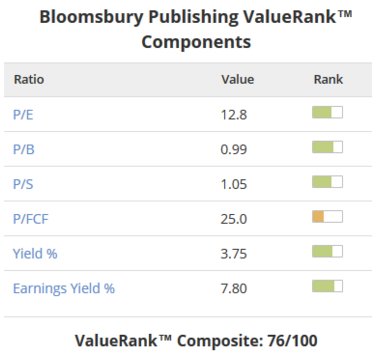
A trailing yield of 3.75% and price/book of 0.99 seem attractive. On the other hand, a price/free cash flow ratio of 25 is a little pricey. Bloomsbury’s earnings yield (Op. profit/EV) of 7.8% isn’t amazing either.
However, looking back at the Stockopedia figures for the last 6.5 years, Bloomsbury’s free cash flow does seem pretty consistent. In aggregate, it has covered 97% of the firm’s dividend payments since 2010.
What’s less clear is how robust Bloomsbury’s book value would be if it was forced to sell some or all of its assets. The value of intellectual property with a tapering commercial shelf life can be hard to judge. A long run of consistent valuations reassures me somewhat, but there is room for uncertainty, in my view.
Falling Quality?
The helpful arrowhead indicators by Bloomsbury’s StockRank tell me that its QualityRank has been falling recently.
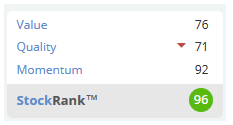
Hovering over the red arrow shows that the QualityRank has fallen by 10 over the last 30 days, to its current value of 71.
The trigger for this fall was presumably Bloomsbury’s latest interim results, which were published on 27 October. Why might this be?
A useful feature in Stockopedia is the ability to view historical StockReports. To do this, click on the arrowhead by the print button at the top of each StockReport and choose the date you’d like to view.
Looking back at the snapshot for 7 October shows me that Bloomsbury’s Piotroski F-Score has fallen from 7 to 6 following the publication of the recent results. The F-Score is heavily weighted in the QualityRank algorithm. It includes nine important measures of financial strength and profitability. A good score here covers a lot of important investing criteria, in my view.
It’s not possible to see which element of the F-Score has changed since October 7, but it’s worth noting that the three red flags in the current F-Score are all pretty marginal. They represent tiny declines in cash generation, the current ratio and gross margin on the prior period. In my view these differences are too small to be concerned about. For example, a current ratio of 2.66 instead of 2.74. Both are very healthy figures, so I’m not worried.
While I’d accept Bloomsbury’s 8% operating margin as being reasonable for a publisher, the firm’s return on capital employed has averaged 6.8% since 2010. That’s probably less than the Bloomsbury’s cost of capital, at a guess.
Similarly, while Bloomsbury has had a net cash balance since at least 2010, it has declined steadily. In 2010, net cash was £35m. Today, it’s less than £1m. Cash has been used for acquisitions, but any fresh use of debt might be worth watching. Returns aren’t high enough to justify getting geared up, in my view.
Is there momentum?
Bloomsbury shares hit a 52-week high of 185p in June. They’ve languished since then and are only worth 3% more than they were at the start of the year.
However, Bloomsbury does have a MomentumRank of 92. What’s driving this?
One factor is that the shares have only pulled back by 11% from their 52-week high. The 50-day moving average (dMA) is more than double the 200 dMA.
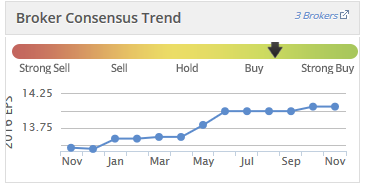
On the earnings front, EPS forecasts for next year have edged higher recently. Even better was that the recent interim results came in 12% above expectations, according to Stockopedia figures.
In fact, earnings forecasts have been edging higher all year:
Where now for Bloomsbury?
I agree with Paul Scott’s view that Bloomsbury isn’t cheap enough to be an obvious buy. Yet the firm’s performance over the last six years has been more than acceptable. Sales have grown at an average of 5% per year. Operating profit has risen by an average of 9.4% each year, while dividend growth has averaged 6.6%.
Bloomsbury’s sales are always weighted to the second half, thanks to the start of the academic year and then Christmas. I like the fact that this firm serves a mixture of markets, in both digital and paper formats.
In my opinion, this boring stock may yet be able to make further progress. Please DYOR as always, and share your views below.
Disclaimer
This is not financial advice. Our content is intended to be used and must be used for information and education purposes only. Please read our disclaimer and terms and conditions to understand our obligations.

6 comments
Just a comment on book value in your commentary Roland, Quercus was an example of a mismanaged book business that got into trouble, ( overpaying on books and overreaching on infrastructure ) but even then, they were bought out at what I thought was a reasonable price when they got themselves into severe difficulties. For us as external investors it can be hard to discern value in the books themselves with unrecouped balances held on the ledgers, however company value is much better "read" by the rival publishers themselves so this business could and should be seen as having an annuity style ability to protect itself through thick and thin IMO. I'm satisfied that value is being built here through diversification, digital and acquisition and all these elements would come out to protect us on the downside and hopefully even more so on the upside of an eventual trade sale ( which hopefully won't be for a very long time ). I believe there will be further consolidation in the market and the values of key copyrights will only ever go up in the evolving marketplace, so whilst the share price might fluctuate the "value" is baked into the business by their competitors who all crave consolidation. Harry Potter alone goes a very long way to protect the investor here..
Roland,
The latest trade figures show an increase in the sales of Harry Potter books of 126% (yes, more than doubled) in 2015, compared with 2014:
http://www.booktrade.info/index.php/showarticle/63138
"Harry Potter sales for publisher Bloomsbury were up 126% in 2015 on the prior year (TCM Nielsen Bookscan UK) following a programme of major initiatives, including relaunched children's editions of J.K. Rowling's bestselling series in 2014; the first ever Harry Potter Book Night; and publication of a stunning new illustrated edition of Harry Potter and the Philosopher's Stone, with extraordinary colour artwork from Jim Kay, which has sold over 94,000 (UK Nielsen TCM) copies. The Illustrated Edition of Harry Potter and the Chamber of Secrets will be released in October 2016 and is part of a major publishing programme of over ten Harry Potter projects to be published by Bloomsbury.
The opening of the play Harry Potter and the Cursed Child Parts I & II is expected to further boost sales of the original books. Bloomsbury has a rolling plan of publishing and marketing initiatives throughout the year and into 2017 when the first book in the Harry Potter series will celebrate its 20th anniversary.
Following on from news of the release of the film Fantastic Beasts and Where to Find Them, Bloomsbury announces it is publishing a brand new edition of Fantastic Beasts and Where to Find Them, to include new content from J.K. Rowling, in early 2017.
In addition, Bloomsbury will commission three new illustrators to create lavish, full-colour illustrated editions of J.K. Rowling's three Hogwarts Library books, starting with Fantastic Beasts and Where to Find Them in autumn 2017, The Tales of Beedle the Bard in 2018 and Quidditch Through the Ages in 2019. Illustrator announcements will follow in due course.
To tie in with the 20th anniversary of the publication of Harry Potter and the Philosopher's Stone in June 2017 Bloomsbury will be publishing four special editions of the first book in the series, their liveries representing each of the four Hogwarts houses. Bloomsbury will also be running a programme of activities and celebrations throughout the year to mark the landmark anniversary. "
I'd expect that Harry Potter books make up a large part of the "Children's & Educational" category so by itself this performance ought to boost results for the current year, besides the likely benefit from the rising US dollar, in which I'd expect a substantial part of their sales to be made.
All IMHO, DYOR.
(I am a holder)
Best wishes,
Jane.
Thanks Roland-- I didn't know about the back test report feature, I can now do my own research and no longer be dependant upon others!
Regards
Ken
Hi Roland
What's your view of Trade receivables on the balance sheet. For example from the interims nearly half of trade receivables were made up of prepayments and accrued income. I'm not sure what this relates to as the note doesn't provide a lot of information and was wondering whether you'd picked up on this and whether you had any views about this.
Best wishes,
Imran.
Hi Imran,
Interesting question. I wasn't completely sure of the answer, and as you say detail is minimal in the interim report.
However, the full annual report (here) for last year provides more information. It seems that 'Prepayments and accrued income' includes advances paid to authors in advance of publication. These sums are then reclaimed from the authors' royalty payments once the book goes on sale. Advances totalled £21.3m at the end of last year (p.84), so presumably account for most of the prepayments and accrued income. I'm not sure what else might be included.
The risk of booking advances as accrued income is obvious -- a book may not sell enough to recover its advance. Bloomsbury Publishing (LON:BMY) makes provisions to recognise this. I suspect this is quite a subjective process, but the firm says it uses historical statistics to help with this. Presumably it's a fairly routine operation for all publishers so shouldn't be a big risk.
There's a bit more information spread throughout the annual report if you'd like more detail!
Regards,
Roland
Thanks Roland - much appreciated.