5 UK shares at 52-week lows to consider buying

I think there’s a good chance that the bear market that has seen the AIM index fall by 40% over the last couple of years may now be easing to a close.
If I’m right, then now could be an excellent time to revisit the screen I wrote earlier this year to search for shares trading close to their 52-week lows.

I can’t be sure that we’re close to the bottom, of course.
But interest rates appear to have topped out for now, which could ease one of the pressures on asset valuations. In addition, I feel that many UK equities offer enough value at the moment to justify investing, despite the near-term economic uncertainty.
Although I expect to see some degree of softness in earnings next year, I don’t expect a serious collapse in corporate profits. Based on this assumption, I think there’s already plenty of bad news priced into UK equities.
Of course, anyone expecting a serious 2008-style collapse is likely to be taking a more cautious view than me, especially with cyclical businesses.
My 52-week low screen revisited: multibagger opportunities?
I am naturally inclined to take a fairly conservative approach to investing. I prefer companies with strong balance sheets, a track record of solid profitability, and good cash generation. I also want them to be reasonably priced.
Given this, you can imagine how pleased I was to see Ed talking about these characteristics in his fascinating multibagger webinar last week (follow the link for the replay and extended slide deck).
It turns out that statistically, multibaggers often start out as profitable, reasonably priced companies with established sensible business models and room to scale.
To me, that sounds like a fair description of some of the companies that are appearing in my 52-week low screening results at the moment. There are too many to cover here, so I’ve selected five shares that I think look particularly interesting right now.
Click here for my 52-week-lows screen
5 stocks I’d consider
I’ll start with a bonus share – last week I published an in-depth Stock Pitch on Serica Energy (LON:SQZ). Although the long-term future of this business may be uncertain, I’m fairly sure there’s some value on offer at the moment. You can read the article here.
Michelmersh Brick Holdings (LON:MBH)
Michelmersh owns and manufactures a range of premium brick brands in the UK and Belgium. The shares have halved from 2021 highs and there are obviously some cyclical concerns about the outlook for demand.

However, half-year results were in line with expectations. I think this group’s premium positioning and exposure to the UK import market (which mostly involves products not available domestically) provides some differentiation from market heavyweights Ibstock (LON:IBST) and Forterra (LON:FORT).
Michelmersh’s accounts also look very strong to me, and I like the continued founder ownership:

Michelmersh shares currently trade just below book value and offer a 5% yield. I think they look good value.
Two other stocks from this sector in my screening results that I’d also consider are James Latham (LON:LTHM) and Epwin (LON:EPWN).
Fonix Mobile (LON:FNX)
Despite technically trading close to a 52-week low, mobile payments specialist Fonix is still classed as a High Flyer by Stocko’s algorithms and is trading on 20 times forecast earnings.
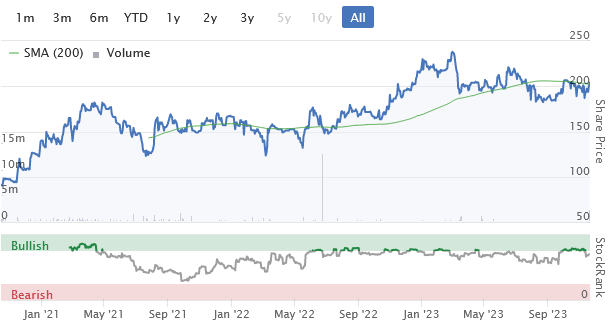
Does that rule it out as a potential purchase? I don’t think so. I’ve had a very favourable impression of this fast-growing business since its 2020 IPO. It’s highly profitable, capital light and generates plenty of cash.

Paul and Graham have also commented favourably on this business, most recently here.
As with any fast-growing business, there’s a risk that the growth rate will slow and the stock will de-rate sharply. But I don’t see any evidence of this at the moment. Net cash and a 4% dividend yield provide further reassurance. I think this could have multibagger potential.
British American Tobacco (LON:BATS)
I know that not all investors are comfortable with tobacco investments. There’s also the fact that smoking rates in developed markets, at least, are falling and a growing number of governments are aiming to make smoking illegal for future generations.
However, for the moment, the reality remains that British American Tobacco is robustly profitable and trades on very low valuation multiples.
BAT shares currently offer a 9.5% dividend yield. Stockopedia data suggest this is backed by a trailing earnings yield (EBIT/EV) of 13% and free cash flow yield of 17%.
The group’s strategy is to maintain high levels of cash returns to shareholders and invest little internally. If the current dividend policy is maintained, an investment at today’s prices could repay itself completely through dividends over the next 10 years.

Looking ahead, BATS is making good progress with smoking alternatives. These now generate more than 15% of revenue, although this business is only just approaching breakeven.
One other attraction is the group’s 23% (£10bn) shareholding in India’s ITC (NSI:ITC), which contributed £319m to BAT’s profits during the first half of 2023 alone. Emerging markets have growing populations and it’s possible that smoking rates will not decline as quickly as in the west.
It’s not an investment for everyone, but I believe there’s good value and income on offer here.
Capital (LON:CAPD)
This mining services business has long-term owner management and has delivered strong growth in recent years – operating profits have risen fivefold since 2017, although there has been some dilution in this time.
One complication in terms of analysis and valuation is that there are quite a few moving parts here.
In addition to the core mining services (contracting) business, Capital also has an assaying business (MSALABS) and holds significant equity investments, often in client companies.
At the end of the third quarter, these investments were valued at $47.8m, or around 40% of the group’s market cap. However, their reported value fluctuates regularly and I’d suggest these equity stakes in other mining businesses are hard for outsiders to evaluate.
Holding such investments rather than operating a pure contracting model may also mean that the group’s exposure to commodity price movements is amplified.
Even so, Capital doesn’t look expensive to me. The shares have fallen by nearly a quarter this year and trade below book value, on just five times forecast earnings. Quality metrics look decent and the outlook appears to remain relatively stable:


For investors with an understanding of this sector, I think Capital could be worth a closer look.
Hargreaves Lansdown (LON:HL.)
The UK’s leading investment platform for private investors has a market share of around 40%. Hargreaves generates a 50% operating margin and plenty of free cash flow, but its shares have fallen by almost 70% from the all-time high reached in May 2019.

Hargreaves now trades on just 11 times forecast earnings with a prospective dividend yield of more than 6%.
I admit this business faces some challenges around its growth strategy and growing competitive pressure. There’s also the risk that the FCA’s new Customer Duty regulations could lead to a reduction in interest income or fee margins.
Even so, I think this business is just too cheap. Customers tend to be sticky and Hargreaves’ market-leading scale should provide a durable advantage, in my view, assuming the company doesn’t make too many self-inflicted errors.
I would also expect an uplift in trading activity when market sentiment starts to improve – which it will, at some point.
With founder Peter Hargreaves still controlling almost 20% of the stock, I’d be happy to put my cash to work alongside his.
Disclaimer
This is not financial advice. Our content is intended to be used and must be used for information and education purposes only. Please read our disclaimer and terms and conditions to understand our obligations.

13 comments
Hi Roland,
Thanks for another great post.
I hold Fonix Mobile (LON:FNX) and Serica Energy (LON:SQZ) from your list coincidently.
I also think Fonix Mobile (LON:FNX) Has great potential, even though it trades at 20x. There is plenty of scope for increasing services dealing with mobile phone based payments of all sorts of things. We know they are big on TV voting on shows and payments to charities, as is with 'Children in need'. But they also work with YouGov and their services and then there's all the other services like car parking fees paid by mobile texts and other similar things that can all be paid for by their technology. We just need to hope that they are keen to expand and are aggressive at finding new markets, including more abroad. We can only hope!
Graham.
Thanks for the write up Roland - Would be great to see meaningful Director buying in these to add some weight to their "cheapness" and recovery potential - It seems mainly lacking in all 5
Hi Roland - Regarding MBH, what do you mean when you say that exposure to the UK import market gives them differentiation over their competitors?
I've built 5 houses with Michelmersh bricks from their Timsbury factory near Romsey - very high quality products with a premium price but worth it for the lasting kerb appeal.
Hi Gung Ho,
It's great to hear from someone with first-hand experience of Michelmersh Brick Holdings (LON:MBH) products - thanks for sharing.
My comments about imports came from a results webinar I attended with the company earlier this year.
I had assumed that imported bricks were basically the same as the bricks produced in the UK. This might mean that in a construction slump, imports could fall almost to nothing, because it would be cheaper to buy UK-made products (lower transport costs).
However, according to Michelmersh this is not necessarily true. Management said that imported bricks are generally soft mud (stock) bricks that are in demand in the UK, but not widely produced here.
Apparently, most newer UK brickmaking capacity is for wire cut bricks.
For this reason, even in a construction slump, Michelmersh's management do not expect imports to drop as much as might otherwise be expected.
I don't have any inside knowledge of this industry, so I'm just reporting what the company said, but it seems reasonable to me.
The only possible caveat is that MBH may have been talking their book a little - the group owns the Florens brick business in Belgium, which was acquired in 2019. MBH says that about 45% of Florens production is imported into the UK.
However, my overall impression from the webinar was that management were very experienced in the industry and on top of all the details.
Roland
Hi Roland - thanks for your insight. MBH incorporated several small brick companies from Hampshire up through the Chilterns, starting with Michelmersh Brick and Tile Co which is the site in Michelmersh - a small village next to Timsbury just outside Romsey.
Their product brochure used to list all the various products from each of these original companies so there was a lot of overlap. Looking at their online product brochure now, it seems greatly simplified and makes it much more obvious which of their brands will suit your development project, eg: Michelmersh sandfaced Hampshire Stock bricks for premium houses, Blockleys for the wirecut bricks used in large commercial projects, schools and hospitals etc.
They have deleted products as well - the Michelmersh site used to do roof tiles and a range of Handmade bricks which are not listed now. I suspect they didn't sell enough of these to make it worth carrying on with. The roof tiles were too expensive compared with competition providing equally good quality products (can get very nice handmade clay tiles from Poland now). Their handmade bricks were too expensive given that their Hampshire Stock bricks look handmade anyway so the premium wasn't worth paying.
So they've obviously rationalised the business to concentrate on their most profitable lines which must be a good thing for shareholders!
To cut a long story short - I bought into MBH yesterday with an initial holding.
Let's hope there's some good news in the budget today to help housebuilders....
Thanks, Roland. Thought provoking. My question for each is: where is the catalyst? I can see them rated higher by the market, especially the cyclical ones, but can't see them as multi-baggers. But who know?
Just be careful with Hargreaves Lansdown (LON:HL.) I have a feeling it might be about 80% of current profits come from interest skimming on cash holdings some of the other main competitors give 100% of the interest back to clients.
RE HL
MSN reported that from profits of 403million, interest from customer's accounts contributed 268.7 million.
Not sure how accurate these figures are but its a significant amount.
Hargreaves Lansdown (LON:HL.) following up The Phoenix's comments about interest.
The Annual Report for the FY June 2023 is bruddy difficult to access, you have to download a zip file and save it on your device, not just read it online, antedeluvian format, lots of it can't be copied and pasted, Anyway, I found these relevant comments on interest income:
Page 10, Revenue for the full year was £735.1 million, up 26% on the prior year... we have seen continued base rate increases throughout the year and have passed over 85% of the benefit through to our clients over the last 12 months. Net interest margin has also increased as a result and it is encouraging to see growth across all our key revenue lines in the second half of the year.
Page 28, [garbled cut and paste, what a carp AR this is] period of historic low interest rates, and the level of cash held by clients in both their Investment and Savings accounts more than offsetting the impact of lower average asset values and lower stockbroking volumes resulting from negative market movements and low levels of investor confidence.
Page 29, our guidance for net interest margin for the next financial year is 180bps to 200bps
Page 146, The largest source of revenue for the Group encompasses ongoing revenue, which includes platform fees, fund management fees, net interest income on client money and ongoing advice charges and renewal commission.... Active Savings revenue is earned on fees from partner banks.... Net interest income on client money is the revenue earned on money held within Group products by clients. It represents amounts retained and received from clients for the administration of cash on the platform, after interest is received by clients. It is linked to the underlying interest rates and is recognised over time, based on the balances held in investment accounts under administration
And here's the data:
So net interest income was 36% of Total Revenue.
Suppose in a worst case the FCA were to force platforms to distribute 100% of interest to clients. Presumably all the platforms which currently skim interest earned on client deposits would raise their fees for services to try and compensate for the loss of net interest income, so HL wouldn't lose a third of its profits, and certainly not overnight. But it is still a huge cloud hanging over HL and makes the shares difficult to value - it's no surprise to me that HL is trading at 52 week lows.
Note: HL operate a scheme called Active Savings which is identified above and I think propbably would be allowed to continue by the FCA.
Active savings is not that different to any other comparison platform (other than it is viewable on your broker account). The fee is charged to the bank.
FWIW, if there was a company I'd be willing to put a 100% of my net worth, it would be HL. Not that I am going to do anything that brave/stupid.
As for net interest income, brokers have to maintain that as an easy access account & easy access accounts usually are higher NII.
Also, biased as I likely am, I think HL is a beneficiary - I think a lot of the lowest cost operators are far more reliant on NII to subsidise the offer. And if I was with a platform that sells itself as lower cost, I think I'm more likely to be annoyed by the increase & given I shopped for lowest cost also be more inclined to move.
Being the biggest in the sector, they will have a larger absolute impact from any changes. Also, there is a great deal of short interest & they're probably smarter/better researched/better resourced than I am & of course more correct (so far!)
And a rant if I may - HL & anyone offering OEICs you can hold cash OEICs (one day liquidity). If no OEICS, ETFs Tbills with less than 3 month maturity (ccy risk but you can buy £ denomination so no ccy charge) & govt gilts (max 5 yr maturities is shortest duration I found).
If you are self managing & holding a lot of cash that's really on you (and if that is a permanent feature, perhaps your equity investments are greater than your risk tolerance (and you should perhaps meet an advisor).
And coming back to my HL ramp, guess who can easily suggest you meet an advisor if your asset allocation is out of kilter. They all can - but HL is more equal than others
Thanks for all the comments on Hargreaves Lansdown (LON:HL.)
I agree that interest income is an important issue to consider. Certainly, I think it's fair to say this has been an incredible tailwind to profits over the last year or so.
During the y/e 30 June 2023, the company earned an extra £219m in net interest income. This more than offset the £75m drop in revenue from investment-related items:
I suspect that interest income is already falling, though. Rates seem to have levelled out and I think the amount of interest paid to clients has already increased. Cash balances in investment accounts may fall too, as investors either reinvest or withdraw cash.
However, given the new interest rate environment, I suspect interest income will remain above the levels seen prior to 2022. In addition to this, I'd hope to see investment-related charges start to rise again soon, when investors start to become more active again.
For context, I think it's fair to say that prior to the zero interest rate era, interest earned on client cash was often part of the business model for wealth managers/platforms.
Looking ahead, I would guess that if platform providers were forced to pass all interest to clients, they would find a way of recovering some of the lost margin through fees.
A while ago, I took a good look at Integrafin Holdings (LON:IHP), which is a platform IFAs can use to manage their clients' money. IHP passes all interest income onto clients, but the business still generates an underlying operating margin of around 40%.
There's no certainty that Hargreaves Lansdown will remain the market leader and the company certainly still faces some challenges. But I think the company holds most of the cards it needs to succeed. In my view, if HL loses its market lead, it will probably be self-inflicted.
Roland
Hi Roland
Thanks for the write up on HL, a stock that's on and off my radar - not least because I use their platform and jolly good it is too.
Does the increasing short interest (see Research Tree - one of the top 10 most shorted stocks in the UK) cause you any concerns or do you think this is related to any potential regulatory interference?