Daily Stock Market Report (Thur 27th November 2025) - SQZ, BOO, MACF, HFD, LTHM, REVB, MCG, ADF

Good morning!
The dust is settling on the Budget news, and there is consensus that this is a high-tax, high-spending set of measures.
Sticking to the narrow question of how it will affect most of the companies we cover in this report, my view is: probably not that much.
Last year's Budget included higher National Insurance contributions, from a lower threshold, that were a direct cost to every business, and a very significantly increased cost for labour-intensive businesses.
This Budget represents a more generalised set of tax increases, with much of the burden falling on individuals (especially through the long-term freezing of personal tax thresholds).
While this will of course have long-term economic effects, the direct impact on businesses in the short- and medium-term is perhaps not that high.
The removal of stamp duty for newly-listed companies, and the shrinking of cash ISAs for under-65s, are measures that I do think will directly impact (in a small but positive way) stock market activity.
So that's my initial take: a very important Budget for the economy, but not one that is likely to make a very great difference to the majority of companies we cover here. The major exception to that is the gambling industry.
We've run out of time for today, tomorrow I'll make an attempt at the backlog! Cheers.
Companies Reporting
| Name (Mkt Cap) | RNS | Summary | Our View (Author) |
|---|---|---|---|
Flutter Entertainment (LON:FLTR) (£26.5bn | SR28) | Adjusted EBITDA impact before mitigation is expected to be approximately $320m in FY26 and $540m in FY27. 37% of this could be mitigated in FY27. Flutter may see market share gains. | ||
Pennon (LON:PNN) (£2.49bn | SR41) | “Robust start”. Statutory PBT £65.9m (H1 last year: £38.8m loss). Targeting 7% return on regulated equity during the 2025-2030 regulatory period. | ||
Pan African Resources (LON:PAF) (£2.06bn | SR73) | Completion of Feasibility Study on Soweto Cluster Tailings Storage Facilities | Completed a feasibility study to process the Group’s Soweto tailings storage facilities. An integrated 600ktpm Soweto Tailings Retreatment circuit at the Mogale Tailings Retreatment Complex was identified as the preferred option. | |
Safestore Holdings (LON:SAFE) (£1.56bn | SR90) | Like-for-like revenue at CER up 3.3%. “We… continue to expect to deliver in line with EPS consensus expectations for FY 2025.” | ||
Sirius Real Estate (LON:SRE) (£1.47bn | SR85) | Acquiring multi-tenant business park in Hamburg for €31.9 million. EPRA Net Initial Yield of 6.1%. | ||
Serica Energy (LON:SQZ) (£702m | SR86) | Production rebounded in November to once again average above 50,000 boepd. Expects production for FY 2025 to average 27,000 to 28,000 boepd. Capex around $250m, in line with guidance. | AMBER/GREEN = (Mark) Specific production guidance wasn’t given at the last update, just that it would be below 29kboepd. Today’s update looks in line with what I’d expect from that statement. This has been a poor year for Serica’s production, as ongoing issues at both Bruce and Triton have cost them. They say production reached 50kboepd in November. However, there are further planned works before the end of the year. While 2026 is certainly looking better, and will benefit from acquired assets too, I think it would be naive to assume that there won’t be some further issues with production. However, the company still looks cheap, clearly has ambition to grow production and pays a 9% dividend yield. The Budget may not change the short-term outlook but does provide clarity over the long-term fiscal regime. It makes sense to keep our mostly positive view. | |
Marshalls (LON:MSLH) (£448m | SR53) | CEO steps down with immediate effect. He is thanked. Chief Commercial Officer appointed interim CEO. Full year expectations remain unchanged. | ||
Capita (LON:CPI) (£377m | SR76) | Three-year contract extension worth £33 million with a leading UK financial services provider to continue delivering critical contact centre services. | ||
Halfords (LON:HFD) (£314m | SR90) | On track to deliver FY26 expectations following a strong first half. H1 like-for-like revenue +4.1%. Underlying PBT +1% (£21.2m). | AMBER/GREEN = (Graham) It’s a close call, but I prefer to prudently leave this on AMBER/GREEN rather than taking a more optimistic stance. At the end of the day, a P/E multiple of 10x might be reasonable for this sector, and that’s where Halfords is trading currently. Thie current financial year is looking good, with the upper limit of of company-compiled range of analyst expectations rising since the last update. | |
Pensana (LON:PRE) (£278m | SR24) | Company has identified the scope to increase the content of heavy rare earths within its high-value Mixed Rare Earth Carbonate product by more than five times. | ||
B.P. Marsh & Partners (LON:BPM) (£235m | SR90) | Invested £5.3m for Cumulative Preferred Shares representing approximately 26.67% of the equity in Sodalis, a newly formed insurance intermediary. | ||
Anglo Asian Mining (LON:AAZ) (£228m | SR50) | ACG Metals Limited is in the early stages of considering making an offer for Anglo Asian. Trading in the company’s shares to be restored today. | ||
VP (LON:VP.). (£221m | SR86) | “Solid” H1. H2 continues to be impacted by challenging market conditions and economic uncertainty, but FY26 is currently expected to be in line with market expectations. | ||
James Latham (LON:LTHM) (£207m | SR70) | The second half of 2025/26 has started with similar volumes to the previous six month period, with similar margins. | AMBER/GREEN = (Mark) These results look consistent with achieving (recently-trimmed) market expectations for the full year. Volumes are up, revenues a bit less so, but increases in costs and lower interest earned means EPS is down. The valuation doesn’t look particularly compelling at 11x earnings and the bulk of the cash will be spent on a new National Distribution Centre, meaning investors can no longer rely on it looking cheaper on a EV basis. The new NDC may be the right thing to do, but I would have liked to see a much clearer business case as to why this is necessary and how it will benefit earnings. Despite these concerns I think where we are in the cycle for building products means that demand will be higher in the future, and with consistent pricing this will drop through to the bottom line. As such, I’m happy to keep our mostly positive view. | |
Activeops (LON:AOM) (£169m | SR64) | Well positioned for a strong second half, with continued momentum expected to deliver full-year results in line with the recently upgraded market expectations. | ||
Boohoo (LON:DEBS) (£162m | SR7) | Group Turnaround Scheme & Results for the six months ended 31 August 2025 | GTS is an incentive scheme, gives management 6% of the growth in the market cap of the company for share price growth between 35p and £3. (Current SP 11.6p.) Full year EBITDA to be c. £45m. Net debt £111m. | RED = (Graham) This still looks very high-risk to me, for a number of reasons. And one problem that it never seems to shake off is an unusual corporate governance setup, which continues to this day. At least the new operating model is more promising than the old one, and I am open to upgrading my view on this eventually. But while it remains overly leveraged, loss-making and with a major shareholder that it accuses of attempting to disrupt its operations, this is not a share that I'd be willing to touch. |
Camellia (LON:CAM) (£129m | SR75) | Historical land claims call for the surrender of c. 3,200 acres of agricultural land holdings. Kakuzi (of which CAM owns 50.7%) has been advised by legal counsel that it holds clear and valid title to the subject lands. Camellia considers that this matter will not affect delivery or outcome of its Value Enhancement Plan or have a material impact on its financial performance. | ||
Macfarlane (LON:MACF) (£104m | SR64) | Performance for the year ending 31 December 2025 will be in line with full year expectations as set out in its trading update dated 22 October 2025. Operations at Pitreavie are gradually recovering following the death of an employee. Committed £1.2m in new equipment to aid recovery. Looking to get pension scheme buy-in costing £2-3m. | AMBER/RED = (Mark) | |
DP Poland (LON:DPP) (£70.8m | SR18) | The new Facilities comprise: • a five-year non-revolving loan facility of up to PLN 5 million • a one-year overdraft facility of up to PLN 7 million • a one-year revolving framework agreement of PLN 3 million. | ||
Andrada Mining (LON:ATM) (£65.5m | SR26) | H1 Revenue +12% to £12.2m, Op. Loss £0.9m (25H1: Op loss £1.5m). Net debt £19.1m (25H1: £13.3m net debt). | ||
Gelion (LON:GELN) (£44.2m | SR11) | FY Revenue +36% to £2.7m, Operating Loss $6.0m. Cash 30 Jun £2.7m (FY24: £3.8m) after raising £4.4m in FY25. Raised £10.5m of equity in Nov 25. “As we enter FY26, we do so with focus and determination, acknowledging both the potential and the challenges ahead.” | ||
Palace Capital (LON:PCA) (£40.4m | SR71) | Adj. PBT -48% to £1.1m. EPRA NTA/share -3% to 244p. Assuming that the properties currently under offer are sold, it is anticipated that the Company will return further cash to shareholders through another tender offer in the first quarter of 2026. | ||
hVIVO (LON:HVO) (£39.8m | SR44) | Merck will acquire Cidara, a hVIVO client. The Company continues to support Cidara through Phase III development, acting as a major clinical site for the ongoing multi-site trial. | ||
Jersey Oil and Gas (LON:JOG) (£37.4m | SR35) | “With clarity on the longer-term tax regime now provided, the Company will be working with the Buchan joint venture partners, NEO Next Energy and Serica Energy, to assess the impact of these changes on the Buchan project.” | ||
EnSilica (LON:ENSI) (£35.3m | SR21) | Overall revenues for the year declined, driven by customer-induced delays on two contracted projects, which impacted the timing of NRE revenues. With recent new business momentum, has contracted visibility of more than 95% of FY 2026 consensus revenue forecasts and remains well placed to achieve FY 2026 guidance. | ||
Blencowe Resources (LON:BRES) (£34.3m | SR19) | ·Proven Reserve: 1.29 Mt @ 5.13% TGC ·Probable Reserve: 21.78 Mt @ 5.18% TGC ·Total Ore Reserves: 23.08 Mt @ 5.18% TGC Represents the final key technical input into the Company's Definitive Feasibility Study, to be published shortly. | ||
Ariana Resources (LON:AAU) (£33.9m | SR33) | 2,769 metres across 31 holes drilled. Best result: 4.90m @ 4.53g/t Au + 118.3g/t Ag from 24m. Extensions of the known vein systems remain prospective and have the potential to add to the resource opportunity at this deposit. | ||
Arrow Exploration (LON:AXL) (£33.1m | SR50) | Q3 Production +2% to 4,214 boe/d, Net YTD income of $4.8 million, Cash 30 Sep $6.3m. “The focus for the remainder of 2025 will be to drill low risk wells at the Mateguafa Attic pad in the Tapir block and to get all preliminary works in place to drill our first exploratory well at the Icaco prospect.” | ||
Cardiff Property (LON:CDFF) (£26.1m | SR27) | Net Assets/Share +4% to £30.53. EPS 29% to 132.9. Total dividend +17% to 27.5p. Unsure outlook due to budget and interest rate outlook. | ||
Cirata (LON:CRTA) (£25.2m | SR3) | Investigation into the Company has been closed and no action will be taken against the Company. | ||
Aptamer (LON:APTA) (£22.9m | SR34) | Order book of signed contracts for FY26 of £1.95 million with seven months of the year remaining. Confident that revenue will materially exceed the prior year's £1.2m sales. | ||
First Property (LON:FPO) (£22.9m | SR63) | 6m PBT +28% to £1.48m, EPS -13% to 0.79p due to higher number of shares. Adjusted net assets per share (EPRA basis) +6.6% to 38.07p.Markets and economy continue to be challenging. | ||
Revolution Beauty (LON:REVB) (£21.2m | SR28) | Revenue -32% to £49.4m, Ad. LBITDA £12.5m (25H1: LBITDA £6.3m). Net Debt £30.2m (25H1: 25.5m). Moved back to generating positive EBITDA in Sep/Oct. £16.5m of new equity raised in September, £4.0m used to reduce RCF from £32.0m to £28.0m. £2.1m transaction costs. Full year sales and Adjusted EBITDA will not match the guidance given on 22nd August. Will reach Adj. EBITDA guidance of £8-10m on a run-rate basis by the end of FY26 (28 Feb 26). | BLACK (RED =)(Graham) [no section below] The market cap has risen here thanks to a more-than-doubling of the share count, after a fundraise. As we said in August, the new money being raised was only planned to repay £4m of the debt load, with the other £11m being used to cover losses, make investments and restructure. Today’s interim results are for the period to the end of August, i.e. they include the effects of the August fundraise, and they show net debt remaining high at £30.2m. So I’m not surprised to see that there is another going concern warning. The company’s founders have returned to effect a turnaround, and I wish them well, but I view this stock as totally uninvestable given the current state of its finances. Adjusted EBITDA was negative £12.5m in H1. Also, in a separate announcement it is disclosed that one of the founders (who still owns 5.6% of the company) is going to be paid £160k annually for 2 days of work per week, as a consultant. There is an ongoing FCA investigation into potential breaches of market abuse regulations that might have occurred during this individual’s tenure as CEO. I’ve previously raised corporate governance concerns at REVB, and I think these concerns are equally valid reasons to consider the stock totally uninvestable. | |
Nanoco (LON:NANO) (£18.4m | SR17) | Shoei (who acquired substantially all of the assets from Nanosys, another manufacturer of quantum dots) issued proceedings in the US District Court in order to establish whether Shoei has or has not been infringing a number of Nanoco's patents. | ||
Facilities by ADF (LON:ADF) (£16.2m | SR38) | …expects to report FY25 results broadly in line with market expectations. Revenue and gross margin increased in the second half. Actions have also been put in place to reduce the cost base. £1.7m exceptional costs. 31 Oct net debt £13.8m (30 Jun: £13.2m). FY26 results will be slightly ahead of FY25. | BLACK (broker forecasts reveal a huge profits warning) (AMBER/RED) = (Mark) [nsb] Broadly in line, of course, means slightly below, and Cavendish take 3% out of their FY25 revenue forecasts. However, the impact increases as we go down the income statement. Adj. EBITDA (which is a poor measure for a company that rents out equipment as depreciation is a real cost if they want to stay in business) is reduced by 6% to £9.4m, Adj. PBT, PAT and EPS are all slashed by a whopping 39%. This isn’t just an accounting foible either. While these figures exclude £1.7m of exceptional costs (which turn FY25 loss-making on a statutory basis), with the cash flow impact of these, net debt is now going to be £3.5m higher than previously forecast. There is no doubt that this "broadly in line" is actually a huge profits warning. The market seems to be sanguine about it today with the share price barely moving. Presumably it was already known that the results would be bad, and 61% of bad is still bad! Or perhaps shareholders just read the headlines and missed the broker’s take on it. Cavendish have also introduced FY26 forecasts based on the company’s “slightly ahead” guidance. While these forecasts show EPS up 23% on FY25, these are still below what was forecast for this year before today’s warning. Net debt is also higher at the end of FY26 than it was planned to be at teh end of 2025. At the time of the HY Results in September, I concluded that this company looked materially overvalued on near-to-medium-term earnings. It looks even more overvalued today. | |
Altitude (LON:ALT) (£15.2m | SR56) | 6m Revenue +18% to $21.6m, Adj. Op Profit +8% to $1.6m, LPS 0.75c (25H1: EPS 0.11c). Net debt $2.3m (25H1: $0.8m). | ||
Kazera Global (LON:KZG) (£15.1m | SR14) | Engaging with three independent parties exploring the potential development or commercialisation of the Aftan mine. |
Backlog
Mobico (LON:MCG)
Unch. yesterday at 21.7p (£130m) - Q3 Trading Update - Graham - RED =
Quickly catching up on yesterday’s update in response to a reader request.
The company formerly known as National Express is a shadow of its former self:
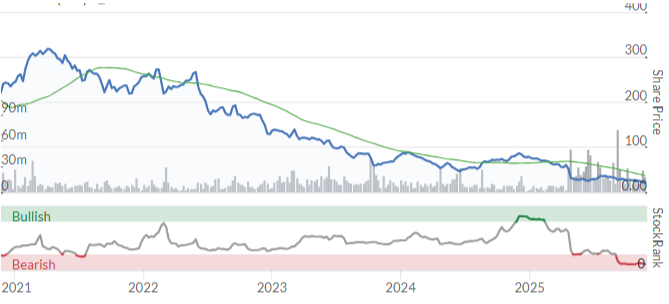
Its US school business was sold, but that hasn’t appeased the credit rating agencies.
Earlier this week Fitch downgraded the company from BB+ to BB, with a negative outlook.
In layman’s terms: they already had a “junk” rating, but now they have a worse one, and Fitch considers it more likely to receive another downgrade next, rather than an upgrade (emphasis added by me below).
Here’s the view of Fitch (emphasis added by me). Only the Spanish bus and coach business ALSA seems to be carrying its weight:
The downgrade mainly reflects a change to Mobico's debt capacity, driven by the weakening business profile and poor performance in recent years. Mobico's businesses outside Automóviles Luarca, S.A. (ALSA) have continued to underperform, resulting in overdependence on ALSA profits.
The Negative Outlook reflects heightened execution risks across divisions. Most of ALSA's Spanish contracts face concession renewal in the next two to three years (although the company has a strong renewal record), negotiations with German public transport authorities on German Rail are ongoing, and profitability at WeDriveU and UK Coach needs to recover.
That’s the backdrop for yesterday’s trading update:
Revenue +5.4%
Adjusted operating profit for 2025 towards the lower end of the £180-195m range.
They will not redeem their £500m perpetual bond (but how could they?)
CEO comment excerpt:
"We continue to focus on simplifying and strengthening the Group, taking decisive actions to improve operational and financial performance. These actions include a comprehensive cost savings programme, further leveraging ALSA's best practice across the business and exploring options to monetise the assets of the UK Bus business ahead of franchising. Discussions with German PTAs are continuing and we will provide an update in due course…
The regions have produced a mixed bag of quarterly results: Spanish ALSA up 4.1%, UK down 3.2%, Germany up 14.3%, WeDriveU down 0.9%.
Graham’s view
This competitive, capital-intensive sector is difficult at the best of times. Throw in poor trading and an expected net debt multiple of 2.5x by year-end (according to the interim results) and you have an unsustainable situation.
With the market cap being so low now, I do see it as potentially having option value to the upside, if it remains solvent - adjusted operating profit was £60m in H1. But net debt was £1.3 billion (June 2025), with about £300m coming in from the sale of US school bus to deleverage. So let’s call the net debt £1.0 billion currently. This means that the value of the existing equity becomes the difference between two large numbers (enterprise value and debt): due to what I perceive as ongoing high risk, especially considering Fitch’s view, I’m going to stay RED.
Graham's Section
Boohoo (LON:DEBS)
Up 42% to 16.45p (£145m) - H1 Results & Group Turnaround Scheme - Graham - RED =
It’s a rare day of positivity for this share:
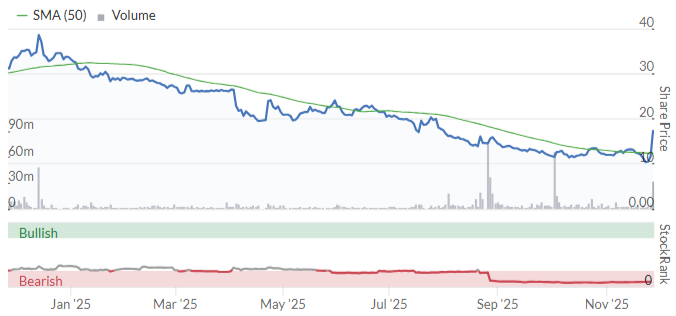
We last covered this in August, when Mark was RED at a market cap of £195m.
Even after today’s very large gains, the market cap is only £145m.
Let’s explore the interim results before checking out their “Group Turnaround Scheme” (actually a bonus scheme for management).
Interim results
Key bullet points I’ve picked out:
H1 GMV (gross merchandise value) minus 19%
H1 adj. EBITDA +5%.
The company focuses on its Debenhams brand at the top of the report, downplaying the importance of its “Youth Brands” and Karen Millen.
Debenhams GMV is up 20% while the GMV of Youth Brands is down 41%. The collapse in Youth Brands is understandable in the context of a big change in their operating model.
Continuing:
32% of GMV was generated through their “marketplace”, enabling a large inventory reduction.
15% EBITDA margin achieved, with a 20% target within the next three years
“Decisive cost elimination programme is nearing completion”.
The new strategy sounds more promising than the old one:
Our marketplace model is at the heart of our go forward business. It is stock lite, capital lite, margin rich and highly cash generative. This will improve further as we continue to grow our take rate and realise the potential of our recent AI investments across the business.
Bottom line profitability: the company is still loss-making, with a statutory loss of £14.7m or £3.4m if we focus on continuing operations only.
The company is profitable at the adjusted EBIT level. However, that’s before interest costs, which are substantial.
Net debt has thankfully reduced year-on-year to £111m (a year ago: £143m). This has been achieved with the help of a large equity raise and disposals.
They are targeting a leverage multiple of <2x by February 2027. It looks to me as if the current leverage multiple is in the region of 2.5x (using the latest net debt figure and the EBITDA target for the current financial year, £45m). For an unprofitable business, that’s going to be uncomfortable.
The finance expense in H1 alone was £12m: far too high for a business that only generated a heavily adjusted EBITDA during the period of £20m.
I also note that there were £7m of share-based payments in H1, up from £6m of share-based payments last year. My understanding is that these entirely relate to employee bonuses. Again, this is far too high given the company’s level of profitability. And I'll have more to say on share-based bonuses in a moment.
Name change: they are still trying to get this over the line.
We operate as Debenhams Group. We will formally change the name of Boohoo Group Plc to Debenhams Plc, as we previously tried, as soon as all major shareholders agree, as we believe that is in the best interest of all shareholders.
CEO comment:
Our turnaround is gathering real pace. We are making progress, we are moving fast, and we are transforming the business. We have returned all our brands to profitability and grown adjusted EBITDA. These results show that our strategy is working.
Group turnaround scheme: in a separate RNS, the company announces a new incentive scheme, because apparently the existing schemes don’t include the CEO and CFO. Current CEO Dan Finlay was appointed to his position a year ago.
Some interesting corporate governance considerations:
Debenhams notes that its Board has previously stated publicly that… seeking shareholder support for management incentive schemes of this nature is consistent with its corporate governance aims…
However, they are not going to seek shareholder approval for this scheme. They give various reasons for this, but the main reason seems to be Frasers/Mike Ashley:
…a major competitor who is a significant shareholder of Debenhams continues to seek to disrupt the Debenhams Group's growth strategy and operations rather than maximise its future success; at the Debenhams general meeting on the 28 March 2025, it voted against a simple resolution to change the Company's corporate name and at the annual general meeting on 19 September 2025 it voted against customary resolutions regarding dis-application of pre-emption rights, which are regularly recommended by boards as being in the best interest of all shareholders.
Looking at the details of the scheme, it sounds like the type of scheme that shareholders should definitely have a say on: it will give management 6% of the market cap increase that occurs between 35p and £3 per share.
Granted that the current share price is still far below 35p, but the amount of wealth that could potentially be transferred to management is extraordinary!
At a 60p share price (£838m market cap), the bonus would be worth £21m.
At a £3 share price (£4.2bn market cap), it would be worth £222m.
These aren’t Elon Musk numbers- the principles are similar!
Graham’s view
The share price gain here today is impressive but I still view this as a slam-dunk RED for a variety of reasons:
Turnaround in progress but it remains unprofitable for now
The leverage multiple is uncomfortable, with the interest burden itself being a big reason for the company’s unprofitability.
Some strange corporate governance features. If DEBS are correct and Frasers - their largest shareholder - are seeking to disrupt their operations, what does this say about DEBS’ ability to succeed?
Along similar lines, I think awards that hand out percentages of market cap gains do need to be voted on. It’s not ideal for a company to say that they aren’t going to put a bonus scheme like this to a vote, with the reason being that they suspect it would be voted down.
So in summary: the chances of the turnaround succeeding may have increased, but this remains too high-risk for me to get off RED.
Halfords (LON:HFD)
Down 3% to 139.5p (£301m) - Interim Results - Graham - AMBER/GREEN =
The key outlook statement seems fine here:
We are confident in delivering FY26 underlying PBT in-line with consensus and continue to expect capital expenditure for the full-year to be within the guided £60m to £70m range.
The company-compiled consensus figure is an underlying PBT of £36.0 - 40.7m.
And I note that’s a slight increase compared to the range that was given in October, at the trading update (£36 - 39.8m).
Other key points:
LfL revenue +4.1% (already known)
Underlying PBT +1% (£21.2m)
Net cash £18.6m, and no change to the dividend.
Free cash flow has been flowing into the balance sheet, which I think is always welcome for a company with lots of lease liabilities. (Even if lease liabilities aren’t considered “real debt”, they do create a less flexible structure, and so I always like to see some net cash on the balance sheet.)
The latest H1 period saw the net repayment of about £9m of borrowings, and £12.6m of dividend payments. So there has been a buildup-up in net cash excluding leases (from £10m to £18.6m), that has accompanied the dividend. A nice situation!
And the yield here is considerable:
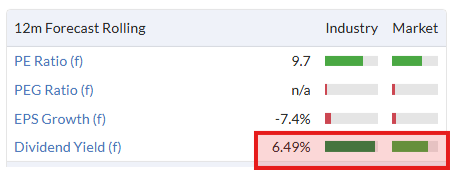
Indeed, this share offers a ValueRank of 96.
CEO comment:
“I am very pleased to be announcing a strong set of HY26 results that show good financial, strategic and operational progress. Cycling was the stand-out performer, with LFL sales up 9%. Our consumer garages also performed particularly well, up around 8%, driven in part by the ongoing roll-out of our new format Fusion garages.
Looking ahead, there are significant opportunities for us to create further value through improvements in our technology and data capability, which are key areas of focus for us as we plan for the future. While the operating environment remains unpredictable, our combination of needs-based products and services, as well as market leading positions in both motoring and cycling, give us the confidence that we will continue to grow our business in line with our plans.”
Of course the overall profit margins are very thin:
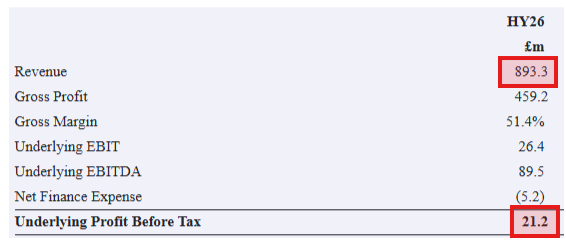
And these margins aren’t improving, with a 4% increase in revenue only producing a 1% increase in underlying PBT.
However, I personally think this is an excellent result. The company has had to offset a large (£23m annualised) increase in direct labour costs in the current financial year. I was concerned that net profit margins might significantly deteriorate, but the company’s very tight cost control has prevented this from happening yet.
“Non-underlying items” - there are some adjustments, which are worth mentioning given the thin profit margins. £4m was classified as non-underlying in H1 this year, relating to problems at the Coventry distribution centre. Not a big deal perhaps, but it’s still 20% of underlying PBT that is lost.
Graham’s view
I like Halfords as a value share and as a retailer with a high proportion of service-based elements - I agree that this protects it from online competition.
However, it also drags on quality, as it’s difficult to earn high profit margins on this type of work.
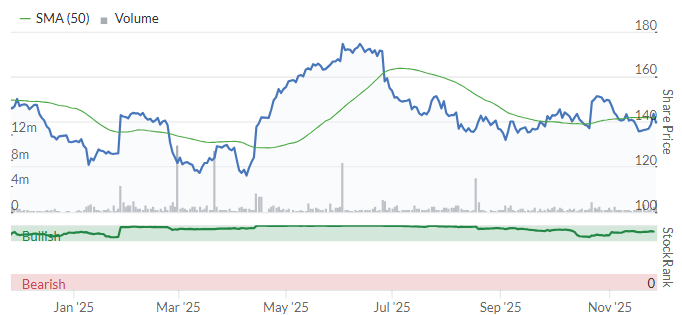
It’s a close call, but I prefer to prudently leave this on AMBER/GREEN rather than taking a more optimistic stance. At the end of the day, a P/E multiple of 10x might be reasonable for this sector, and that’s where Halfords is trading currently.
Mark's Section
Serica Energy (LON:SQZ)
Down 2% at x177p - Trading and operations update - Mark - AMBER/GREEN
It’s not proving to be a great year for Serica production-wise:
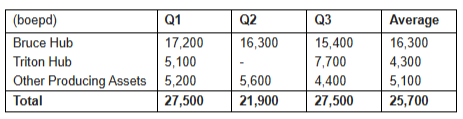
And as regular readers of the DSMR know, this has been going on for over a year now. Here is the 2024 quarterly production:
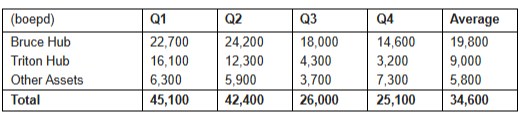
The reasons are well known with problems with the Triton FPSO. However, it is worth noting that Bruce has suffered problems too:
Production from the Bruce Hub averaged 22,000 boepd in the period prior to planned annual maintenance, which began on 15 August. Following the completion of maintenance, bull-heading operations (in which gas is pumped into a well to reduce back pressure and enhance production) were only able to resume in November, resulting in curtailed production of 16,100 boepd in October. With the resumption of bull-heading, production has returned to over 20,000 boepd from the Bruce Hub.
The market is forward looking, though, and Triton is now back up to full production:
Production rebounded strongly in November, averaging 25,300 boepd net to Serica prior to the planned subsea work starting on 23 November. This work on the Bittern export pipeline requires production to be shut in from the Bittern, Gannet, and Evelyn fields, and is set to complete in mid-December.
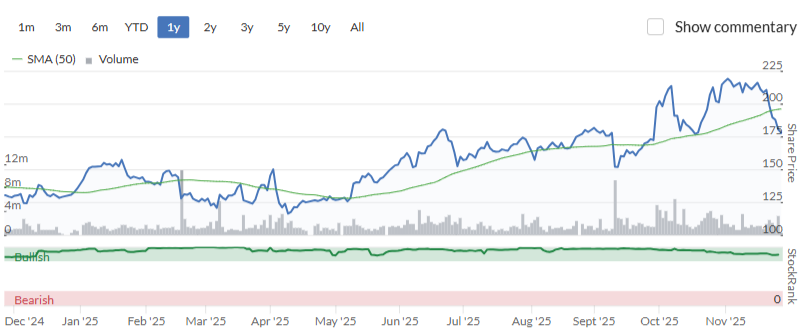
It is this willingness to forgive short-term issues in the pursuit of longer-term gains, that explains why the share price has been strong over the last year, despite ongoing problems and a weaker oil price:
They say that “Production rebounded in November to once again average above 50,000 boepd, a level that more accurately reflects the potential of our portfolio.” but with further work on Triton over the next month, this isn’t enough to save them from a poor year of 27-28kboebp. In September, the guidance was 29-32kboebp (then reduced from 33-35kboepd). In October, they said they would be below this range, without providing specific guidance. Today’s range looks consistent with that previous statement, though.
Finances:
The reduced production and continued capex/dividend payments means that they are now in a net debt position:
- Borrowings of $231 million as at 30 September 2025 (30 June 2025: $231 million), resulting in a net debt position of $190 million as of 30 September 2025
- Total liquidity of $300 million as of 30 September 2025, comprising cash and undrawn committed RBL facility availability of $259 million
Partly this is timing, as no payments from Triton liftings were received in Q3. They also have plenty of liquidity. However, it shows that they have to get a handle on these production issues if they want to maintain their 9% dividend yield.
Production Growth:
As well as returning to planned production at their core assets there are a couple of opportunities for production growth:
The Belinda field being brought on stream. However, this requires Triton operator Dana starting two-compressor operations on the FPSO, which they have not been willing to commit a start date to.
The acquisition of the Lancaster field from the administrator of Prax should add around 5,900 boepd when it completes in December. The associated deals involving TotalEnergies and ONE-Dyas anticipated to finalize in Q1 2026
As I pointed out when Serica announced a possible deal to acquire BP's 32% non-operated stake in the Culzean gas condensate field, if this completes, pre-emption rights would mean that existing owners didn’t want to increase their stake at the same price. As it happens , NEO NEXT exercised its rights, meaning Serica's acquisition of the Culzean stake did not go through.
Budget Impact:
As well as confirmation that the government will actually allow license extensions, and limited extensions into adjacent areas. Serica give us a nice summary of what specific changes are being made to the fiscal regime:
· As announced in the Budget yesterday, the Energy Profits Levy ('EPL') will be retained in its current form until 2030
· After EPL ends, or ceases due to average oil and gas prices falling below triggers set under the Energy Security Investment Mechanism ('ESIM'), currently Brent $76.12/barrel and 0.59p/therm, the government yesterday confirmed that it will be replaced by a new permanent mechanism, the Oil and Gas Price Mechanism ('OGPM'). Unlike EPL, the OGPM will be applied separately to oil and to gas and will tax only the proportion of revenue earned above new OGPM trigger levels, those being $90/barrel and 90p/therm (for 2026 to 2027, then rising with the Consumer Price Index), at a tax rate of 35% (as opposed to 38% for the EPL)
This seems like a sensible move. Especially given that the EPL was brought in as a “windfall” tax during a period of high prices and these conditions are gone. Like almost everything in the Budget, it seems to have very long implementation timeframe, and may not have a material impact on Serica on a NPV-basis.
Mark’s view
While I like the ability that serica has to acquire non-core NS assets from larger companies, I don’t think they always get as good a deal as some of the headline numbers would suggest. While there may not always be huge competition for assets, if deals complete, it means they wil have outbid others. Plus what they are buying is usually short-life fields with aging infrastructure. If these are non-core for existing owners, they may well have been under-invested in over a number of years. As both Bruce and Triton have shown, once issues are found they are often more extensive (and expensive) than first thought.
With weaker than expected production the StockRank has been declining slightly here:
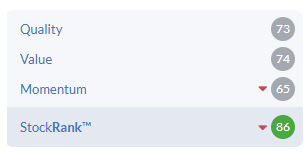
However, it is still a high-ranked stock and with a 9% yield and greater clarity on the fiscal regime in the North Sea, it makes sense to be mostly positive and keep the AMBER/GREEN rating.
Macfarlane (LON:MACF)
Up 5% at 69p - Trading Update - Mark - AMBER/RED
Given the recent halving of EPS forecasts since the summer, the market seems to have taken heart that trading is in line with expectations:
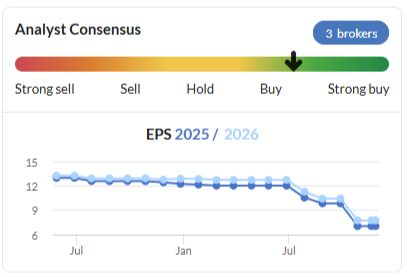
Helpfully, they give us these these revised expectations of £19.1m for FY adj. Operating profit. Most worryingly, the brokers didn’t see this as a one off affecting just the current year, but a multi-year deterioration of prospects and took around 30% out of all forecast years from 2025 through to 2027. As a corollary of this the forecast debt stays higher for longer.
Roland downgraded this to AMBER/RED on the last warning, and I felt that the initial market move here under-reacted to the scale of this miss. However, the shares have drifted down since the warning and the last big downgrade was at least partially due to them temporarily closing of one of their sites recently:
Following the tragic incident at the Pitreavie business, operations are gradually recovering. We have committed £1.2m of investment in new equipment to restore the business to full operational capability by the end of Q1 2026, helping to accelerate the process of recovery and creating capacity for growth.
Given that the tragedy was the death of an employee, I’d assume that this equipment is in order to improve safety. This will presumably be capex not operational costs, and this gives scope for a recovery in this business. I don’t think we can judge Macfarlane too harshly here as this was a recent acquisition. However, they will be on the hook for any HSE fine. The scale of any fine is hard to judge without details of the incident. Pressure Technologies (now Chesterfield Special Cylinders) had a similar case that cost around £1m when all costs and a £700k fine were applied. Offsetting this, you would hope that Macfarlane will not have to pay the full earnout on this business. Overall, this should not be material to a business of Macfarlane’s size, though.
The other thing the company choose to report on today is seeking a possible buy-in for their pension scheme. They say:
As part of this process a non-recurring accounting charge, currently estimated at between £2m and £3m, will be accrued to recognise an increase in the expected cost of historic equalisation of pensions.
While this may be a non-cash charge as part of this process, this will be reflected in the cost of any buy-in. The reasons for this move are to avoid any future cash contributions. However, looking at the last Annual report, they weren’t required to make any in the last triennial valuation:
The triennial actuarial valuation at 1 May 2023 was completed in February 2024. Due to the positive funding position of the scheme, there is no requirement for the Group to make further deficit repair contributions.
So this is a positive as a risk-reduction exercise, but the risk looked low anyway, and a buy-in won’t remove costs or free any surplus back to the company.
Mark’s view
While it’s good that is no further warning here. There is no sign of any immediate recovery in prospects. Pitreavie operations are gradually recovering, but are likely to face an increase in capex or costs and a possible HSE fine. Overall, this isn’t expensive for a company with a history of compounding EPS:
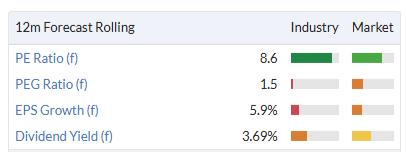
However, much of the growth has come from acquisitions and the recent warnings mean that they are not paying debt down as quickly as planned, limiting their scope for any significant additions. As Pitreavie has shown, acquisitions can also come with hidden risks. I wouldn’t be surprised if management are also more focussed on managing these risks at the moment than looking at expansion prospects. In light of this, I feel it is too soon to change our previous AMBER/RED rating.
James Latham (LON:LTHM)
Down 2% at 999p - Half-year Financial Report - Mark - AMBER/GREEN =
Revenue was up 5.5% here on Volumes that were up 6.8%. Gross margins were pretty much flat at 16.2% (25H1: 16.3%) but costs were up so Operating Profit was down about 2% to £11.1m.
The also had lower finance income due to higher capex and a pretty standard tax charge, which means that EPS fell by 5% to 47.9p. FY EPS forecasts have been reduced recently, and currently stand at 93p, which looks achievable with a similar H2 to H1:
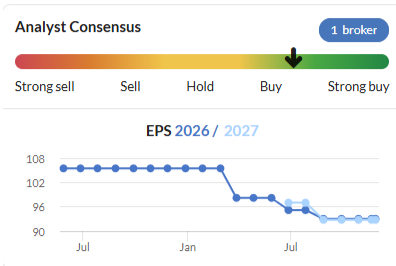
This is what they say about this:
The second half of 2025/26 has started with similar volumes to the previous six month period to 30 September 2025, with similar margins. We expect that the stability in product prices will continue.
Our customers still have reasonable order books but there is a degree of nervousness about the economic outlook. The merchant sector is still finding growth difficult, in part due to the weakness of the DIY and House Building and Construction sectors.
The P/E of around 11 that this implies isn’t crazy but doesn’t stand out as particularly cheap amongst UK small caps:
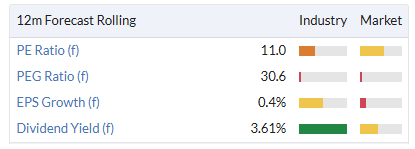
Many consider this a high quality business that deserves a premium rating. However, this is only really true if it leads to a higher than market growth rate on lower capital requirements.
In the past, I would also have taken into account the significant cash balance in any rating. While it has reduced in this half due to capex requirements, it remains around a quarter of the current market cap:
Cash and cash equivalents have decreased to £59.8m (2024: £67.5m) due to capital expenditure of £8m in the first half of the year, most of which relates to the National Distribution Centre. We continue to take advantage of additional early settlement discount opportunities with our suppliers as well as generating improved interest receipts.
The bulk of this cash balance is earmarked for spending on the National Distribution Centre, which they give us an update today:
Construction has now started on the National Distribution Centre, located in Chatteris, and we are pleased with the progress so far which is all going according to plan. Construction is anticipated to be complete by the end of 2026 with the aim of fully trading from the site by the end of 2027. During this period we have strengthened the senior management team by employing an Operations Director and a Business Development Director who will drive the development of the National Distribution Centre and the business opportunities that this will bring.
This is what they said about this in a recent announcement:
The Company's initial investment will be £6m for the land and then a further £39m over the next two years to construct and fit out the warehouse. This investment will create a purpose built 300,000ft2 warehouse in East Anglia, with good transport links, room to expand the Company's product offering and fitted with Warehouse Management System technology to provide operational efficiency. These costs will be funded from the Company's existing cash resources.
This means that (excluding any retained profits) after completion, their cash balance will be down to £20m, not enough to move the valuation needle. Indeed it sounds like there may be further inventory build needed to be funded beyond the construction cost for the NDC. All things being equal, their EPS will also decline due to lower interest income. It may be a low bar for a £45m+ investment to generate a higher return than cash, but I am a little worried that they haven’t spelled out the benefits of this strategy more clearly than this, from their previous announcement:
The NDC will provide more control and security over the storage of imported products, help support development of value-added products and allow the Company to increase its product ranges and improve stock throughput. The NDC will also improve the internal distribution service within the UK allowing depot locations to hold a wider balanced range of products and improve service and product availability for customers and the business to continue to grow through the existing depot footprint.
Balancing this, it is clearly a business subject to the construction market cycle and they may well be increasing range and throughput at exactly the right time at the start of a cyclical upswing.
Mark’s view
I struggle to get excited by the company at current rating, and with the bulk of their cash committed to building their NDC, I don’t think we can conclude this looks better on a cash-adjusetd basis. I’m not sure this is a business that tries to excite shareholders and the NDC is probably the right thing for the business in the very long term. However, there seems to be very little presented to shareholders in the way of a concrete business case that makes it clear that this is a strategy that will generate materially higher earnings when it is operational. For example, it could be necessary to protect their existing market share. It would still be the right thing to do, but not something that justifies the current rating.
Despite these concerns, I am of the opinion that demand for building products will be higher in a couple of years’ time than now and any company exposed to these trends will benefit. Like our view of almost all the well-run companies in the building products sector right now, my view remains mostly positive at this point in the cycle. AMBER/GREEN
Disclaimer
This is not financial advice. Our content is intended to be used and must be used for information and education purposes only. Please read our disclaimer and terms and conditions to understand our obligations.

89 comments
Interesting developments at Anglo Asian Mining (LON:AAZ) - which has been my largest holding for most of the last 8 or 9 years. Given that the board hold around 38% of the shares it seems highly unlikely that a bid will succeed without their agreement, and given the prospects for a step-change in scale that the company has over the next few years, I doubt they'll be easily convinced. So my hunch is that this bid will be treated as an unwelcome distraction by management, and ultimately won't succeed. But it will no doubt raise the company's profile somewhat.
I retired with a defined contribution pot but no corporate pension. With some luck ( and some help from sites such as this) and the generally positive market of the last 13 years I am just about keeping my drawdown in step with my income/gains so that barring a longer life than I expect I should be able to keep going without the State having to support me. Like BnB I do appreciate that I live in and contribute to a society which is prepared to support those not as fortunate, but like Neal Hattersley I do feel that the government takes it for granted that I do go on providing for their plans. I, like many others , exist near the edge of where incremental changes drive a fundamental change in my standard of living.
There seems almost no understanding in the elected government or the Civil Service how their plans cut off our chances of growing the economy, making plain how few (if any) are in touch with the world of business and commerce, which (directly or indirectly) drives 100% of the country’s income. There also seems to be no alarm at the casual increase in costs of the management of the country.
The SEC in the USA is operated by a staff of 4700 for a company total thousands of times larger than ours. The FCA in the UK is moving to a projected 5435 staff this year, having increased from 4268 since November 2022. While accepting that the FCA scope of work may be slightly wider than the SEC any sensitive government should be deeply embarrassed about disclosing this growth in a stunningly ineffective department with a £783million budget. But they do not seem to be.
Defence Equipment and Support takes 12,500 staff, but this does not include the scientific and technical research advice from DSTL (another 5,000 employees). At this point the fact that none of this covers the Submarine Delivery Agency will,hardly surprise you. It is extremely hard to believe that this does not result in slowing and vastly complicating our defence procurement.
A government that expects to go on taking needs to get serious about really showing that they are embarrassed by these things and are going to commit to doing something about them.
By the government you mean us the public…
James Latham (LON:LTHM) - Hi Graham - Thanks for the analysis of their figs today - Agree the cost of the NDC is heavy on such a relatively small company and add to this - their report today states the build will take until end 2026 but only expecting it to be fully operational end 27.
Thats a long time to wait. Is this, to use a technical term - 'fiscal drag'
Games Workshop (LON:GAW)
I have held for a few years - as this successful Nottingham based company almost became an income stock at one point. I thought I’d mention that it’s just popped up on Phil Hoffers “Grow your dough” screen which is so tough that almost nothing makes the grade.
Re Games Workshop (LON:GAW) High praise indeed, Nothingventured! Would be good if more UK stocks made it through the Phil Hoffer GYD screening criteria.
"Phil Hoffers “Grow your dough” screen which is so tough that almost nothing makes the grade."
Nothing much in the UK that is - which was behind Phil's comment years ago when he suggested that his screen needed a much wider catchment area than the UK to get an investable universe.
This is the paradox of the UK market which is supposed to be full of investment bargains, yet cannot muster hardly any stocks for a selective growth and momentum strategy.
Intrigued by your comment that Games Workshop has made his screen. The only two I currently see are Fresnillo and Halma? Have I missed a revision of the screen?
Think Games Workshop (LON:GAW) fails on 1 parameter of the screen, so doesn't show up for me. However, the price action certainly fits. Personally, I wouldn't be too concerned if it only fails on 1 parameter. You should think of Phil's screen as a starting point, and tweak it to suit your style.
Yes I've only got Fresnillo & Halma on Phil's screen also.
Just for info, if you add Europe you only get 2 more, Arteche Lantegi Elkartea SA (MCE:ART) and Safilo SpA (BIT:SFL) .
.....and if you include dual listings you also get Barrick Mining (ETR:ABR0)
I’ve probably programmed it wrong
Where can i access Phil Hoffer's screen. Is it in the guru screens?
the webinar replay here.
Or if you do not want to go through the whole webinar - try this
https://www.stockopedia.com/sc...
For some reason I didnt quite understand, Fresnillo makes the screen but isn't considered for investment.
Whilst it is a rules based system, there is a degree of subjectivity.
Thank you. I got the impression from the webinar that the main reason the performance was high is that he uses a very tight stop loss.
I watched the video and kept stopping it. Setting up the screen was challenging ! I’ve since subscribed to Europe and Asia and plan on including the US at some point. I also set up a weakened screen which produces more stock but of course there’s greater scope for disappointment.
Another day, another flexible use of the phrase "broadly in line with market expectations". I refer to the trading update from Facilities by ADF (LON:ADF) which makes this suggestion. Well it might be true at the revenue level (only 3% shy of forecasts), but once we get down to the nitty gritty of pre-tax profits and net debt it rather stretches the point. Turns out that Cavendish have 'trimmed' their profit numbers from £2.1m to £1.3m, or the small matter of 39%. At the same time the new net debt forecast is £13.5m from an expected £9.9m - just an extra 35% then!
I share this view, and was hovering over the buy button earlier but resisted. Current SP is below the last 24 month 150p-ish average and yet Stocko shows improvements in EPS current and future years. It seems there's some doubt over top line growth, and I guess there needs to be faith in the new CEO to drive the turnaround. So, I'm too interested in community views and coverage here
I'm surprised that the Budget didn't remove the IHT rule that says that any amount of excess income can be given away and be free of IHT immediately. That must save wealthy older people's families very significant amounts of IHT.
Sshhh!!
Sshhhhhh
Rachel might be a beneficiary, so, she's keeping stumm.
stumm or mum.. ?
The benefit of keeping this in place is immediate incremental income tax as large pension pots are depleted to reduce IHT liability. Thus more powerful to keep it in place, as most budget measures don’t feed through so quickly.!
The big issue with gifts out of income is you never know if they have worked until the point of death as the revenue will decide at that point if the evidence presented is acceptable.
There's an awful lot of hoops to jump through with only one needed to trip you up and potentially 10-20 years of gifting has failed.
Start early and keep good financial records and issue a gift letter when handing over cash. I maintain a spreadsheet of all of my spending, ( I know, I know, I find it interesting and I don't get out much, which helps ) which is shared with the most financially literate of my beneficiaries.
My understanding is that the tax office has to prove you cannot afford to gift away income.
No - not quite - there's also the 7 year rule. But another important factor of the 'income' rule is that you must be able to show that it was taxed income. If its for example tax free income from your ISA it won't count.
Bohenie, are you sure? I can't find any reference to not allowing ISA income on HMRC website. Remember ISA income is after tax, it's just the tax rate is zero.
This from a firm of solicitors on the web:
"The exemption only applies where the gifts are made from surplus income after tax. Examples of income will include pension income, interest from savings, dividend income, rental income or income payments received from a trust. If you prepare income tax returns, your tax return will help you identify the sources of your income but you should remember to also take into account any income from ISAs, which will not show up on your income tax return, but which will still be considered income, for the purposes of the gifts out of surplus income IHT exemption."
Well - that just shows the complexity of it all - I certainly understood it had to be taxed income - being income showing up on your tax return. So thanks for pointing this out - That said - personally, I hope to live another 7 years - but okay future planning starts to play......and more paperwork follows
Best of luck living another 7 years!!!!!
I think ISA income can be included. Be aware that HMRC concede that although there are no hard and fast rules, in the absence of evidence to the contrary, they rather arbitrarily state that in general, unspent income becomes capital after two years
I think you're referring to 'gifts from regular income' that don't materially reduce the gifter's standard of living. My assumption is that very few people who could make use of this IHT-free gifting do so because of: poor awareness of its existence; perceived complexity and it requiring good record-keeping to demonstrate no impact on the gifter's standard of living. Sadly, I never did manage to persuade my mother to take advantage of this IHT allowance.
I think the full detail on various penalties on business owners in the budget will creep out on further analysis
100% agree Trident. I've already found a nasty sting for one of my clients with a small leisure business. The chancellor announced a "cut" in business rates for small businesses yesterday but the abolition of the RHL (retail, hospitality, leisure) 40% discount from next March, together with business rates revaluations, will mean an increase of 40% in business rates for my client from next April. Not a political point but so much smoke and mirrors.
B.P. Marsh & Partners (LON:BPM) - Another investment announced today following several over the past months yet they still seem to be suffering following the sale by the Australian Inst holder (cannot remember the name) in the summer. Beginning to wonder if its worth holding on.
B.P. Marsh & Partners (LON:BPM)
yet they still seem to be suffering following the sale by the Australian Inst holder
When you say they are suffering - do you mean - "you are suffering with regard to the share price not being as high as you would like it to be. I dont see how they suffer from low share price paticulalry - note they are prone to buy back shares rather than issue them so low share price isnt all bad for them and might be good.. So it it you or them suffering ?
Beginning to wonder if its worth holding on.
To me the fundamentals seem better than ever - the invetsment flow is fine and the all important discounts to diluted NTAV is as good as its been for a while if not better - so to me it looks great - whats your logic for potentially selling when the shareprice has bigger than normal discount to NTAV.
must admit i was kinda expecting it to toodle on up to 750p after share sale - buit i have seen didly squat to make me think i want to sell with chomping disopcunt to NTAV - perhaps the opposite.
Note i would say this is niche share - if you buy in here you may need to play the really long game to get good exit price - that might be in terms of years. also i ma preuming they will still churn out decent above inflation NTAV increases - there isnt 100% certainty there - albeit they have nowt to provdie to me. If you are looking for exit route now perhaps your logic is flawed in that perhaps you should haev exited when price was up with events eg at 740p - that might not have been an option if you are newer holder.
that perhaps leaves then posibility you follow the charts - if you feel the trend is lower then perhaps selling up is right for you.
Hi rmillaree - thanks for your comments. Sorry but I don't agree your logic. The share price has come down from over 700p 12 months ago - hovered around there till mid summer but has fallen to 650 today - and this despite the share buyback programme - so Yes |I am suffering. As for the discount to NTAV - the valuation of their portfolio will always be up for debate (as its unquoted) but whilst you argue its a good reason to buy in - I would say if the share price discount is increasing all the time its a reason to avoid.
B.P. Marsh & Partners (LON:BPM)
I think you have misunderstood my point
In your original post you said they were struggling - that suggested the company not you and you gaive the imrpession you thought they were struggling - i fully understand you may struggling if you are underwater - thats a given - thats different from the company the company are not struggling - and that was my point.
As for the discount to NTAV - the valuation of their portfolio will always be up for debate (as its unquoted) but whilst you argue its a good reason to buy in - I would say if the share price discount is increasing all the time its a reason to avoid.
we will have to agree to disagree - imho if the news is the same and the discount to real value widens - then to me its obvious the share is becoming better value. It can take time for value to out here though ref shareprice - many holders had to be uber patient before quick rise from 300p ish to closed to 650p ish - doubling of price in short order is pretty good
Drilling down to the detail that matters
looking at the update oct this year compared to last year NAV at 31/7/2024 was 691p per share - that has risen to 956p per share at 31/7/2025 - note those wont be fulled diluted numbers but show the progress made - i simply dont understand how you can take any negative sout of that uplift - other than the shareprice has laged - that happens sometimes
i dont know what to say if you are not happy that TNAV has increased from 691 to 956p - if you think thats dud well thats up to you - but you cant surely argue they are not providing real tangible uplifts in value. Yes its illiquid and yes its not all easily converted - i am pretty sure that most of the uplift is of the real cashed in chips kind.
here is the update from october 2024 - up to 31/7/2024
Net Asset Value has increased by £23.7m over the Period to £252.9m, a 10.3% increase (31 January 2024: £229.2m; 31 July 2023: £203.5m)
· Net Asset Value per share 690.8p*, a 9.8% increase (31 January 2024: 629.0p; 31 July 2023: 567.3p)
here is the update from october 2025 - up to 31/7/2025
· Total Shareholder return of 9.5% for the Period, comprising the growth in Net Asset Value ("NAV") and the aggregate dividends paid in February, May and July 2025
· NAV increased by £23.1m over the Period to £349.5m, a 7.1% increase (31 January 2025: £326.4m; 31 July 2024: £252.9m)
· NAV per share of 956.1p*, a 7.4% increase over the Period (31 January 2025: 890.0p; 31 July 2024: 690.8p)
Its good to debate these things - I get where you are coming from and in time - hopefully - the share price will indeed catch up with the net asset value. Of course the Mkt goes up and down and in recent months has been especially harsh - but to my mind a falling share price against a rising NTAV (and I'm not questioning the veracity of these figs) is frustrating, especially after a major shareholder has sold out.
B.P. Marsh & Partners (LON:BPM)
but to my mind a falling share price against a rising NTAV (and I'm not questioning the veracity of these figs) is frustrating, especially after a major shareholder has sold out.
i understand your frustration - you simply need to know if you are investing in niche stuff like this the value might not out for a long period of time.
Note there is also risk holding - the future might not be as bright as the past - so my plan of holding on doesnt really work if they dont keep the ntav increasing (or at least steady) - in that regard though their track record has been rock solid - if we go back 31/1/2022 nav per share was 462p - so in under 4 years they have doubled the value of their assets (per share) -plus paid out divis of possibly 40p per share!!! - thats a solid record of deliverance (that allows for their uber generous payout to directors to be tolerated!)
especially after a major shareholder has sold out.
Who knows how long overhangs last - if they exited around 650p and that was a discount - the buyers might ver well be happy to only sell out at say 700p plus - so any overhang could easily stay around for months if the price doesntb reach their quick buck profit level - must admit i am surprised the excellent news on 28/10 ref the nice sale with profit didnt help move price up - neither did their mello appearance - i was expecting this to be over 700p an closer to 750p - we are where we are though.
Pan African Resources (LON:PAF) debt gone by feb 2026 hidden in announcement
The VCT relief cut from 30% to 20% is a nasty sting in the tail yesterday for investors. This will probably at least half the c£1bn / year investment in London listed venture capital trusts despite some widening of their growth investment remit. Anyone else impacted by this? https://citywire.com/investmen... The 2% penal tax rate on savings was also total stupidity. We now have a sugar/alcohol/gambling style tax on saving which is seen by the UK government as bad. You couldn't make it up! Otherwise, I agree with Graham that the budget was less bad than feared, but will undoubtedly hinder UK growth as we gradually become a world leading welfare state attached to a smaller low growth economy.
Thanks for highlighting this topvest. G
Hi Topvest - I usually find your posts on macro somewhat, dare I say excessively, pessimistic. But you absolutely hit the nail on the head here with your “tax on saving”. I love it! The phrase, not the tax.
Yes. Let’s discourage savings and pensions . . . Let’s punish thrift.
"a world leading welfare state attached to a smaller low growth economy". Love it and I'm going to borrow it.
World-leading only in cost and waste, sadly
I recently read that Europe has two thirds of the world's social spending and one third of the world's GDP. Food for thought.
I’ve heard similar statistics but as a share of global population (c.9%) and was discussing this with some Americans whilst on holiday. Their response -“what do you guys spend it all on?”
Don’t forget that welfare costs includes state pensions and we potentially all benefit from welfare support.
It does seem to have morphed into equality of outcome rather than the intended safety net.
I think the important point is to question how affordable this spending is in the long term. When the pension age of 65 was introduced after the second world war the average UK male life expectancy was, I think, 66.
The problem is that yes people now tend to live longer, but there are many lower paid jobs or physical jobs that people struggle to even work in to the current pension age. If they can even keep that job until they retire. Then what are these people supposed to live on? We should encourage the young and able to work so we can provide the safety net of state pension, which is very low in any case compared to other countries. What should be looked at are the goldplated public sector pensions which are unaffordable.
Gold plated civil service possibly , most others are not like they were.
Still better than private but makes up from lower earnings during their career.
Police and NHS pay in 14% min I believe. So they are paying in more then ever for less then previous schemes. A lot carry on working and in some cases like NHS do the 'retire and return' route.
Fun fact:
When Count Bismark introduced the idea of retirement with a pension (in the 1880s) the retirement age was 70 and that was about the average age on death of people who survived to adulthood.
On life expectancy:
The uk life expectancy _at_birth_ was about 65 in the last century.
If you were a man (*) and made it to late adulthood in good health you often lived to 70 if you were born in the last 400 years or so.
(*) childbirth was v. risky until we discovered cleanliness
On retirement:
this has been an ongoing topic of discussion for the last 20+ years (I went to lectures from time to time) I may be out of date, but in bullet point form:
people who do intensive physical / unhealthy / safety critical work are done by the time they are 55/60 (army/divers/farmers/binmen/airline pilots)
there is no reason for non-manual workers to stop working at any particular age
the increase in life expectancy has outpaced experts predictions for the last 30 years
there seems to be a hard stop about 120
On affordability:
I think that is the wrong question.
There are three questions:
1. As a nation, what are we willing to pay
2, As a nation what is the minimum standard of living for a pensioner
3. how to reconcile (1) and (2)
The problem is that as a result of (expensive) as advances in medicine and the fact that fewer people smoke people are living longer than they used to. The medical care is increasingly expensive and their pensions need paying. I don't decry these developments but the money has to come from somewhere.
I do not know any farmers retiring at 55/60 most do not retire
Don't foget production workers in factories, some 12-hr shift-working and on contracted performance when you mention work-worn aging, Andrew.
I gave a talk recently and asked those present how many were over 75. Many put up their hands! I told them that had this meeting been held 50 years ago they, and me, would not have been there! And my topic..."My life of failure and how I survived"
I recently read that Europe has two thirds of the world's social spending and one third of the world's GDP
Europe has around 30% of the world's over 65's who consume over 75% of the continent's social spending budgets, mainly on pensions and healthcare.
timarr
At least the 20% IHT relief on qualifying AIM shares remains. I doubt the ISA tinkering will make a jot of difference - Anyone not inclined to invest in shares will simply cut back to £12000 if indeed they would have saved more than this anyway.
Or you could just put the stocks and shares element into 4-5 money market funds if your uber cautious as a way round things.
A budget for the lazy
Good grief..
However, for people like me, retired but dragged into higher rate IC band and substantial investments outside tax wrappers buying VCT,s seems essential, or leave UK. HMRC must know how many of us they are.
Everything in proportion for sure, but I don't get why you're so reluctant to pay any tax on your investment profits that you would consider leaving the country before investing in an S&P500 tracker and enjoying 76% of the gain after tax. Wealth taxes on previously taxed gains, yes, there's a breaking point for most HNWIs. But threatening to leave the country because capital gains are taxed is plain silly if you don't mind me saying.
Nothing to do with Capital Gains!. I paid those yesterday. It's divi income compared to yesterday and interest. That is my source on non pension income.
But paying tax on "unearned" dividend income at a rate broadly comparable to tax on employment income is reason enough to leave the country?
You, I and many here are extremely fortunate to be in one of the higher marginal tax brackets. Surely the way to get the most out of retirement is to enjoy the money you are keeping hold of instead of grumbling about paying similar taxes to the employed, who don't benefit from your abundance of time!
You need to read handybrownone. The original prompt for my comment was that VCT,s had been harmed. In fact they will be essential to a much bigger catchment. I am NOT in a higher tax band, fiscal drag will put me there, VCT,s will assist. My private pension is capped at 3% inflation. So this budget, without VCT, is a material reduction in disposable income over time. I'm not commentating on fairness.
Hi Neal, apologies if you are already aware of the below, but trust you are taking full advantage of the following? I'd assume yes, but thought I'd write it down anyway...
Shoving the max in to tax wrappers every year (eg 20k ISA/10k JISA for you/partner/dependants/grandchildren, as well as their SIPPs if thinking longer term; you can still contribute up to MPAA to your own SIPP if in drawdown)
Storing non tax wrapper cash in low coupon gilt ladder, and taking income from there as they mature (tax free)
Managing your CGT and divi tax exposure by selling down your non tax wrapper divi holdings and re-buying inside the ISA/SIPP. Appreciate this is difficult to do in a meaningful way within the paltry 3k CGT limit! But if you have a large divi payer that hasn't appreciated much then you sell without a CGT hit and can shelter the future divis from tax at least.
Many thanks. The low coupon gilt ladder is entirely new to me! The others I have fully covered. I have 30% of my assets outside wraps. The budget does tend to favour spending it abroad.
Excellent, I have done something useful today!! Take a look at the gilt ladder builder link below - plug in your variables (annual withdrawal, marginal tax rate etc), and it will calculate a tax efficient ladder to build.
The basic idea is that a low coupon gilt gives you tiny coupons (that are taxable, but small), with the return loaded to a capital gain when the gilt matures (gilt capital gains are tax free).
So for income purposes, as each rung matures you take your income requirements from the gain (and can re-invest the remainder in a future rung if you want it to keep on rolling).
For cash interest sheltering purposes (and this is the default option for reducing tax on any non-sheltered cash in my view), you could load it all in to the nearest rung, and roll forward to the next rung once it matures (ie a much shorter ladder).
Note a longer ladder increases your exposure to inflation/interest rate moves etc, but provided you hold to maturity you will get a guaranteed 100p redemption price.
https://lategenxer.streamlit.a...
Certain gold coins are also exempt from CGT. Probably wise to have around 5-10% of portfolio in gold in any case. If you also have say around 20% in low coupon, short dated gilts, that's more than a quarter of your portfolio sheltered from CGT.
Gold coins in Sterling denomination are legal-tender and therefore CGT-free. NB That is not a recommendation to buy a non-income-producing and highly-cyclical asset while that asset price is near record high prices.
Oh the agony and angst of first world problems! Just spend it. It makes the world go round.
Doesn't the HMRC add your dividends to your income and make the adjustment to the Tax Code? It does that to me and I'm doing my best not to get tipped into the higher rate of income tax.
Doesn't the HMRC add your dividends to your income and make the adjustment to the Tax Code?
Below the upper rate limit dividends are taxed at 8.75% (soon to be 10.75%) and above at 33.75% (35.75%). Normally taxable income comes first, so if you earn over the upper limit in normally taxable income then dividends fall into the upper bracket.
This is one of the ways people use personal service companies to minimise their taxes - pay a negligible salary and then lots of dividends. The argument here is about fairness - a tenant would pay more tax than a landlord for the same income. I don't think that's unreasonable, but I think she could have done far more to encourage people to invest in stocks in other ways.
Staggeringly Brits have over a trillion pounds sitting in interest bearing accounts, losing money every day in real terms.
timarr
Doesn't the HMRC add your dividends to your income and make the adjustment to the Tax Code?
its 100% optional whether you have current year potential property income or dividend income coded out at an estimated level.(note i am not talkinbg about tax owed from earlier years here thats something else )
when you are within sa there is a box tiock to say "dont do it"
note even if you arent in sa all you need to do is ring up after ye and say add 9999 dividend income to my p800/simple assessment calc and its job done - over 10k its via sa
the problem with having potential dividend income or property income in tax code in year is that the figure aint going to be right anyway and needs amending - so why not keep money in your savings account then pay em correct exact amount after year end.
hmrc love it though if you are happyu to hand over wads of tax early !!
what hmrc need to do though is limit peoples ability to receive benefits whilst not paying tax at same rate as others. those who choose to not pay the tax of others by moving abroad - should not be bale to get the benefits of our generous welfare sytem later on - oh and perhaps tax em on the way out on accrued gains to date not yet taxed.
there is no need for you to leave the uk - sounds like you just dont want to pay 40% - the company doesnt function if we offer people choice to not pay higher rate tax. the fact many have been able to box clever up to now is probbaly lucky for them.
I agree on a practical sense. I should have maxed isa and sipp contributions but I didn't account for fiscal drag. Those that inherited wealth knew that already and have not been as much harmed by yesterday.
Dont you think the threshold for higher rate tax now is a joke? It was meant to be for a small segment of the population not the broad segment that is being dragged into it now due to the common trick of not increasing the thresholds, including for stamp duty, in line with inflation. Who benefits from inflation? I think the government as they are reducing the amount of their debt.
Dont you think the threshold for higher rate tax now is a joke?
yes - as is the lack of increase in the personal allowance
the reality is now that those previously on what i would class as fair skilled wage are now dragged into higher rate tax.
I agree that the 10% drop is not good, That was not the only news on VCTs in the budget so why fail to mention all of it? It would be good to also say, at the same time, that VCTs investment rules have been relaxed again. The investment rules were so strict after 2015 Finance act that a range of investment types that were pro-growth, and had great returns, were no longer allowed - so this led to the demise and consolidation of the "generalist VCTs" like Matrix/Mobeus/Elderstreet . The narrow constraints meant that VCTs could only invest in "stupid" start-ups and it favoured a focus on IT businesses only. Also, if the only way you can make a VCT work for you is to have tax relief on entry AND IHT exemption then it's an exotic tax mitigation vehicle and not really helping UK businesses to grow whilst providing a return on risk capital for the investor. Look at the sorry state of Amati AIM VCTs - absolute blowout investments.......
Now the VCT industry is talking its whole book down so badly on the 10% cut that no one is going to invest in the future. When people look at performance since 2015 they will also not invest. IF the new rules boost better investments to play out and performance to dramatically improve over time then the loss of 10% at entry is immaterial. IF yes I get IF
VCTs could play an important part in investing start-ups. So much of this crowing I see is, let's be honest, from a narrow political lense and dare I say it a bit of misogyny? Can we stop beating up the UK and just get a little bit more optimistic?
The government has loosened several of the investment eligibility rules for VCTs. This means:
broader sectors are investable again
capital-efficient, proven-growth companies are eligible
older and slightly larger businesses are allowed
VCTs can back scale-ups, not just “two people and a laptop” startups
more robust revenue-generating companies can qualify
This is potentially huge as it reverses some of the damage since 2015.
All VCT dividends are still tax-free (income), all growth is CGT tax free and IHT rules still apply. Income tax relief, upon investment, has been reduced by 10%,
It is ridiculous that she said that it was a budget for growth. If she said it was to help people on benefits that would have been honest.
The cut in VCT tax relief is quite major. It is likely to kill this area of venture capital. But the Treasury estimate this change will raise just £65 million next year, falling to £45 in future years.
You now get 20% tax relief in exchange for tying up money in a high risk investment for 5 years. In other words 4% each year as compensation for a major risk to capital, as well as not being able to access the money.
I have invested in past years but i can't really see the point in the future with these changes.
BTW
I just looked at the government website on this. Where they boast that it will not impact a 'protected group'. But they are pleased to say that it will affect males and those in the 45-64 age group disproportionately.
So thats ok then.....
Venture Capital Trusts, Enterprise Investment Scheme investment limit increase and restructure - GOV.UK
Previously, VCTs growth were constrained by the 2015 rules. Now that the rules are relaxed there is a whiff of better +ve returns. There is a remote chance you may actually be able to utilise the CGT exemption on sale. A capital gain on VCT SP was in most parts a pipe dream.
The rules changed again in 2018 where it was mandated that the investment MUST HAVE a significant loss to capital risk! Madness. That precludes MBOs, and existing growing businesses require fresh capital.
If you are "investing" for 30% saving up front on next year's self-assessment, then it was never really an investment, was it? That is the tail wagging the dog. If you have ever bought a VCT you'd realise immediately that most of that income tax "gain" is immediately lost in the "buy/sell" spread on VCTs sp. On day 1 your £1 is worth 80-90p anyway. I'd rather forsake 10% up-front for a higher return on exit.
Could be a renaissance or a false dawn!!!
Fair points on the wider remit and better chance of capital gains handybrownone if investors actually invest. The incentive for VCTs is to mitigate higher rate tax and earn tax free income, unfortunately with little capital growth over the last decade. Its a useful tool for reducing your higher rate tax bill (at the margin) once you have no pension relief left and no ISA capacity left. It will undoutedly be more beneficial if there are capital gains tax free through investing in non-start-up's - agreed! The AiC doesn't appear impressed though https://www.theaic.co.uk/aic/n... I suppose they are hoping that the Treasury might back down, but that won't happen. As with most other things announced by this government, it is not "pro-growth" or "pro-investment"!
Which goes to my original point that if the fund industry always presents the bad news and none of the good it is essentially turning people away. Already as a % the UK population does not invest properly and ther just put it into a savings account for a rainy day. I'm not advocating that average Joe buys VCTs but we all know the issues here.
Not only do you often have to face a large discount to NAV on day 1, the VCT shares can be difficult to sell unless the VCT operates a buyback. Furthermore, the AIM VCT's tend to invest in small risky loss making companies which themselves are also difficult to sell. 18 years ago, I invested in Oberon AIM VCT (LON:OVCT) at 100p. I found them very difficult to sell but recently managed to do so at just 22p, albeit I did get initial tax relief and some dividends. The dividends were generally paid out of reserves rather than the income generated by the VCT so in effect, the dividends were being paid out of my own capital. The moral of this is that a 20% tax relief does not cover the high risk. CGT exemption is not useful if you make a loss and losses on VCT's cannot offset gains elsewhere for CGT purposes. As the VCT is fully listed it has no IHT advantage unlike EIS's or most AIM shares.
It does not say "pleased" nor does it "boast" . It deals with the Equality Act based on the available facts. It also states that the changes will have a positive effect on UK businesses which you don't mention. It estimates that 24,000 individuals invest in VCTs - not a lot really. It is no surprise to me that they are mostly male and over 45.