Daily Stock Market Report (Thur 5th March 2026) - BMY, AV., TW, RGG, HTG, SMWH

Good morning!
Today's Agenda is complete. Spreadsheet accompanying this report: link.
Companies Reporting
| Name (Mkt Cap) | RNS | Summary | Our view (Author) |
|---|---|---|---|
Reckitt Benckiser (LON:RKT) (£39bn | SR70) | Sales ahead of expectations. Revenue up 5% LFL with adj operating profit up 2% to £3,543m. Growth driven by Core Reckitt including Dettol, now the largest brand by revenue. Outlook: expect Core Reckitt LFL revenue growth of 4% to 5%. Q1 revenue affected by weaker cold and flu season. | ||
Aviva (LON:AV.) (£20bn | SR64) | Operating profit up 25% to £2,203m, including £174m contribution from Direct Line. Operating earnings per share rose by 17% to 56p, with the dividend up 10% to 39.3p. £350m buyback. New three-year targets of 11% CAGR EPS growth, Return on Equity >20% and cash remittances of >£7bn. | AMBER/GREEN = (Roland - I hold) I don’t see too much to dislike in these results, with solid growth from the core insurance business and good cash generation. If return on equity can be sustained at last year’s high-teens level, then I think the current 6% dividend yield could still represent an attractive valuation. I’m leaving our previous broadly positive view unchanged today. | |
Associated British Foods (LON:ABF) (£13.7bn | SR81) | Appointment of Primark Chief Executive & ABF Chief Financial Officer | Joanna Edwards appointed as Group CFO, she has served as Interim CFO since March 2025 and was previously Group Financial Controller. Eoin Tonge appointed as Primark CEO having been interim CEO since March 2025. He was previously ABF Group CFO. | |
Rentokil Initial (LON:RTO) (£10.8bn | SR67) | Revenue up 4.4% to $6,908m, adj pre-tax profit up 4% to $876m. Adj EPS up 2.4% to 25.91c, leverage reduced to 2.6x EBITDA. On track to deliver NAm 2027 targets for $100m of cost savings and 20% margin. 2026 outlook: expect to deliver full-year results in line with market expectations. | ||
Admiral (LON:ADM) (£8.8bn | SR41) | “2025 was an exceptional year for Admiral”. Turnover -1% to £5.9bn, adj pre-tax profit up 16% to £957.9m, with adj EPS up 16% to 247.4p. Dividend per share up 7% to 205p. Return on equity -3% to 53%. | ||
Harbour Energy (LON:HBR) (£4.1bn | SR82) | “We delivered excellent operational performance while maintaining capital discipline and integrating new assets.” Production up 84% to 474kboepd, operating cost -22% to $12.8/boe. 2P reserves and 2C resources of 3.0bn boe (2024: 3.2bn boe). Adj pre-tax profit up 50% to $0.6bn, free cash flow of $1.1bn. Dividend of 8.05c in line with new policy (2024: 26.2c). Outlook: production to be 475-500kboepd w/ unit op costs of $14.5/boe and free cash flow of c.$0.6bn at $65/bbl Brent. | ||
Entain (LON:ENT) (£3.7bn | SR42) | NGR +7% inc BetMGM, with Entain +3% and BetMGM +33%. Adj pre-tax profit down 2% to £507.2m, with net loss of £(680.5)m. Outlook: “remain comfortable with market expectations for FY26 Group Underlying EBITDA”. Expect to mitigate about 25% of UK gaming tax increases, rising to 50% in FY27. | ||
Taylor Wimpey (LON:TW.) (£3.6bn | SR73) | Revenue up 13% to £3.8bn, adj operating profit up 1.1% to £420.6m. Completions up 6% to 11,229 units. Adj EPS down 4.8% to 8.0p, dividend down 20% to 7.62p per share. Net cash of £342.6m (2024: £564.8m). £53m share buyback. 2026 Outlook: “Spring selling season has started well”, but affordability remains challenging. Expect completions of 10,600-11,00 with lower profit margins resulting in adj op profit “around” £400m. | BLACK? (AMBER=) (Roland) [no section below] I discuss housebuilders in more detail in a new article published today. These results from Taylor Wimpey appear to be broadly in line with expectations, but as I speculated could happen, the dividend has been cut to restore earnings cover in the face of a dwindling net cash balance. Looking ahead, I’d also note that management expects margins to remain under pressure this year, with a small decline in completions. There will also be a heavier H2 weighting than usual, with around 60% of completions expected in the second half. Arguably, this increases the risk of a cut to guidance later this year if conditions don’t improve. Today’s 2026 profit guidance is for adjusted operating profit to fall by c.5% to around £400m. I don’t have access to any broker forecasts, but my impression is that this might be slightly below previous consensus. Overall, I’m happy retaining my previous neutral view here given the c.15% discount to book value. However, as I discuss in today’s article, I think there could be better choices elsewhere in this sector currently. | |
3i Infrastructure (LON:3IN) (£3.2bn | SR91) | Selling 71% stake in TCR for c.€1,140m, a 22% uplift from 30 Sept 25 valuation. Buyer not specified. TCR is the largest independent lessor of airport ground support equipment. | ||
Serco (LON:SRP) (£3.0bn | SR87) | Revenue up 3% cc (+1% organic) to £4.9bn. Adj operating profit up 1% to £272m, adj EPS up 2% to 16.93p. 2025 order intake £5.5bn, with book-to-bill of 114%. Around two-thirds of new business in defence. Total order book up 9% to £14.5bn. Outlook: FY26 guidance unchanged for 3% organic revenue growth and adj op profit of c.£300m. | ||
ITV (LON:ITV) (£3.0bn | SR89) | “We remain in discussions with Sky regarding a possible sale of the M&E business”. Revenue up 1% to £3,511m, adj pre-tax profit down 5% to £448m. Adj EPS down 11% to 8.5p, total dividend held at 5p per share. 2026 Outlook: expect “good growth” in total revenue with EBITA margin at lower end of range. Expect H2 weighting to revenue and profit due to timing effects. | PINK | |
Drax (LON:DRX) (£2.9bn | SR97) | CFO Frank Lemmink is taking a six-month leave of absence to support his recovery from a health issue. Deputy CFO Daniel Peacock has been appointed interim CFO in his absence. | ||
| Osb (LON:OSB) (£2.0bn | SR84) | Preliminary Results | Net loan book up 3.2% to £24.9bn, with net interest income down slightly to £679.4m (NIM:2.28%). Pre-tax profit down 9% to £382.5m with TNAV per share up to 579p due to reduced share count. Total dividend of 35.3p (+5%) as per guidance. | |
Grafton (LON:GFTU) (£1.77bn | SR93) | FY adj op profit “ahead of expectations”, up 7.1% to £190.2m. This was driven by an acquisition in Spain. Improved gross margins supported an operating margin of 7.3% (FY24: 7.6%), reflecting cost pressures. 2026 outlook: Ireland and Spain are positive, but the exit rate of trading in the UK was weaker than expected. | ||
Coats (LON:COA) (£1.68bn | SR68) | Revenue up 2% to $1,465m, adj EBIT up 7% to $290m with EPS down 5% to 9.3c. Net debt up to $815m (2024: $449m). Gained market share in weak markets and exited non-core US Yarns business. Ortholite acquisition delivered FY profit in line with exps. Outlook: expect organic growth despite weak external conditions. Warn of potential impact of events in the Middle East. | ||
Lancashire Holdings (LON:LRE) (£1.56bn | SR86) | GWP up 5% to $2,259.3m with insurance revenue up 5.4% to $1,860.4m. Net profit down 9% to $293.4m, with return on equity of 20.9%. Additional special dividend of $0.50 per share, total dividend for year of $1.23 per share (c.91p). | ||
Senior (LON:SNR) (£1.26bn | SR63) | Senior confirms that, on 21 February 2026, it received a preliminary, non-binding all-cash offer from Arcline Investment Management. Discussions with Arcline and other potential offerors remain ongoing. | PINK | |
Elementis (LON:ELM) (£917m | SR63) | Revenue down 1%, adj pre-tax profit up 11.2% to $107.5m. Personal care revenue up 2.4%, with coatings down 4.3%. Operational improvements delivered $18m cost savings and improved capacity utilisation. Outlook: expect “another year of progress”. | ||
Hunting (LON:HTG) (£788m | SR83) | Results for the year ended 31 December 2025 & Cost Reduction Plan & Update to Capital Allocation | Revenue down 3%, EBITDA up 7% to $135.7m. Adj EPS up 9% to 34.1 cents, with total dividend up 13% to 13.0 cents per share. 2026 guidance for EBITDA of $145-155m unchanged, with EBITDA-FCF conversion of at least 50%. Targeting additional c.$15m cost savings and new $40m buyback to be executed up to March 2028. | AMBER = (Roland) Today’s results appear to be in line and there’s some evidence of improved profitability this year. However, the order book is 30% smaller than at the end of 2024 and management comments on refilling the order pipeline leave me to think there could be some risk of a shortfall. I also get the impression there could be some revenue slippage if current events in the Middle East continue. On balance, the valuation looks up with events to me given the rather average profitability of the business. I’m going to retain our neutral view today. |
Spire Healthcare (LON:SPI) (£785m | SR34) | Revenue +4.5%. Adjusted operating profit £150.5m (2024: £149.4m). Statutory PBT £18.6m (2024: £38.3m). “We are targeting FY26 EBITDA broadly in line with FY25 EBITDA within our NHS planning scenarios… during FY26 Spire will focus on cash generation, private patient opportunities, delivering more efficiency and disciplined capital investment.” | PINK | |
WH Smith (LON:SMWH) (£766m | SR36) | Group revenue +5%, or +2% like-for-like. “The Group has delivered a solid first half performance and is on track to deliver Group guidance for the year.” | RED = (Graham) This is an old favourite of mine but I turned fully negative on it in December at the full-year results (see the main section below for the full list of reasons). Given that not much has changed since then, I'm going to stay fully negative on this for the time being. | |
Pagegroup (LON:PAGE) (£587m | SR43) | Revenue -7.4% (cc). PBT £16.2m (down 67%). Cost reduction programme to save c. £15m from 2026. ”Whilst the market outlook remains uncertain due to the unpredictable economic environment, we will continue to control the controllables.” | ||
Ibstock (LON:IBST) (£474m | SR37) | Revenue +2% (£372m), adjusted EBITDA £71m (2024: £79m), in line with revised guidance. After a weather impacted start to 2026, residential construction and RMI markets expected to remain challenging in H1. Events in the Middle East to introduce new uncertainty. Actively managing production volumes and inventory which will create a margin headwind for 2026 but benefit cash generation. | BLACK? | |
Funding Circle Holdings (LON:FCH) (£439m | SR36) | Credit extended £2,453m (2024: £1,899m). Revenue £204.3m (2024: £160.1m). Adjusted PBT £20.3m (2024: £3.4m). Upgrades guidance for FY26, including PBT of at least £35m, and sets new medium-term targets through to FY29. | ||
Bloomsbury Publishing (LON:BMY) (£388m | SR55) | Sarah J. Maas has announced the publication dates of the next two novels in her A Court of Thorns and Roses series which will be published on 27 October 2026 and 12 January 2027. FY 2025/26 in line, FY 2026/27 expected to be materially ahead of previous expectations for adjusted pre-tax profit of £44.5m. | AMBER/GREEN = (Roland) [no section below] Bloomsbury is in the hit business and the market is expecting – probably with good reason – that these long-awaited new books from best-selling fantasy author Sarah J Maas will deliver the goods. Maas hasn’t published anything since 2024, but was the highest-selling author in the US that year. She has been responsible for a growing proportion of Bloomsbury’s profits in recent years and is now ready to release two new books within three months, something the company describes as “almost unprecedented”. Guidance for FY27 to be “materially ahead” of consensus suggests to me that forecasts could rise by 15%-20% – a view reflected by this morning’s share price movement. Prior to today, profit forecasts for FY27 were flat on FY26 so this represents a welcome return to growth. I estimate a pro forma FY27E P/E of 12 following this morning’s news – at this level I’m happy to retain our broadly positive view and would guess that the eventual FY27 results could be ahead of these expectations. I’m not going completely positive today because Bloomsbury’s recent performance has highlighted the company’s dependence on a handful of hit authors – and there’s no guarantee Maas won’t take another long break after these have been published. | |
Foresight Solar Fund (LON:FSFL) (£350m | SR54) | NAV was £545.9m at 31 December 2025. NAV per share 99.2p. | ||
Seraphim Space Investment Trust (LON:SSIT) (£339m | SR95) | NAV per share +20.1% (142.3p), due to private portfolio fair value gain (portfolio valuation +27.6%) less performance fee provision and costs. Measured according to fair value, 70% of portfolio companies are fully funded. 7% are funded for 12 months or more. | ||
FW Thorpe (LON:TFW) (£311m | SR73) | Revenue -2.4%. Adjusted operating profit -0.8% (£12.5m). PBT +3.1% (£11.6m). Special dividend due to absence of M&A. “...the outlook for growth for the second half remains a challenge, especially considering the strong second half achieved in 2024/25.” | ||
Hargreaves Services (LON:HSP) (£248m | SR98) | HSP has been appointed by Balfour Beatty and awarded an enabling earthworks subcontract at Lower Thames Crossing representing aggregate gross revenues of £10m. Thanks to contract awards and increased revenue visibility, they upgrade market expectations for Revenue and Profit before Tax for FY May 2027 by 4% each. | ||
Cab Payments Holdings (LON:CABP) (£223m | SR51) | Further response to firm offer announcement & Full Year 2025 Results | Offer from Helios Consortium “highly opportunistic and fundamentally undervalues CAB Payments”. 2025 total income +12%, adjusted EBITDA +14% to £35m. Reported profit after tax down 4% to £13.6m due to restructuring costs and higher tax. Expecting to face interest rate headwinds going into next year, as global interest rates fall. | PINK |
Vertu Motors (LON:VTU) (£187m | SR84) | The new car market remains challenging due to the Zero Emission Vehicle mandate impacting manufacturers and retailers alike. Full year FY26 adjusted profit before tax expected to be in line with market expectations. | ||
LBG Media (LON:LBG) (£138m | SR79) | The new CFO will take up his role on 9th March. His most recent role was as CFO at Inspired Thinking Group, a technology-enabled marketing services and software business. | ||
Foxtons (LON:FOXT) (£136m | SR57) | Revenue +5%, adjusted operating profit £22.2m (2024: £22.1m). 2026: letting to remain resilient, Renters’ Rights Act to create medium-term growth opportunities. The London sales market remains challenging with weak consumer confidence. | ||
RM (LON:RM.) (£101m | SR39) | Revenue -2.5%, PBT from continuing operations £3.2m (previous year: £12.1m loss). Adjusted net debt £50.6m. Trading in the first months of the year has been consistent with the Board’s expectations, with the full-year outlook remaining in line with expectations. | ||
Strategic Minerals (LON:SML) (£91m | SR33) | Assay results from drillhole CRD039, including ultra-high-grade intersections and long intersections of high-grade mineralisation from the Redmoor Tungsten-Tin-Copper Project in southeast Cornwall. | ||
Hansard Global (LON:HSD) (£70m | SR62) | Present value of new business premiums £49.2m (H1 2025: £49.1m). PBT £2.6m (H1 2025: £0.5m). Interim dividend unchanged at 1.8p. | ||
Rentguarantor Holdings (LON:RGG) (£42m | SR25) | Revenue +87% to £2.4m. Operating loss £1.38m. Year-end cash reserves £2.05m. The first two months of 2026 are showing further growth in revenues. | RED = (Graham) I’m staying RED on this due to the heavy cash burn in 2025, which I look into in greater detail in the section below. However, I am open to changing my mind on this stock if it becomes clear that it’s on track to break even, and if I can be convinced that it is fully funded through to profitability. It has the potential to be a really high-quality investment, in my view. But as it currently trades on 10x forecast sales, and the actual historic financials are poor, I think it’s right to stay sceptical. | |
Predator Oil & Gas Holdings (LON:PRD) (£26m | SR13) | Independent Technical Report by Scorpion Geoscience for the proposed Snowcap-3 well. 2P resources of 8.73 MM bls. Project economics based on US$60/bo. | ||
Inspiration Healthcare (LON:IHC) (£21m | SR46) | Has been re-appointed by the NHS supply chain as an approved supplier for its respiratory care units for newborns under a new four-year framework agreement covering England and Wales. | ||
Zenith Energy (LON:ZEN) (£20m | SR42) | Acquisition of an additional photovoltaic development project in the Puglia region of Italy. Expected to reach Ready-to-Build status by February 2027. Total consideration €1.05m. | ||
Robinson (LON:RBN) (£20m | SR63) | Revenue down 0.4%. Underlying operating profit £3.6m (2024: £3.2m). Operating profit for the 2026 financial year to be in line with current market expectations, and PBT to benefit materially from property disposals. | ||
Vulcan Two (LON:VUL) (£15m | SR20) | Long-term lease agreement for a new 22,000 sq ft distribution centre in Leeds. | ||
Xeros Technology (LON:XSG) (£12m | SR11) | XSG’s manufacturing partner Donlim has received a Purchase Order from MediaMarkt, Europe's largest consumer electronics retailer for an initial production run of XF3 units. | ||
Cordel (LON:CRDL) (£11m | SR18) | The contract moves to a new Strategic LiDAR Program under a fixed monthly fee, Software as a Service (SaaS) model, moving away from a per-order approach. Delivering Cordel in excess of US$600k in 2026. |
Graham's Section
Rentguarantor Holdings (LON:RGG)
Unch. at 28.9p (£42m) - Full Year Results - Graham - RED =
RentGuarantor (AIM: RGG), a provider of rent guarantee services to prospective tenants across the socio-economic spectrum wishing to rent property in the UK private rental sector, is pleased to announce its audited financial results for the year ended 31 December 2025 ("FY2025").
This stock moved onto AIM last August, and I’ve been a keen follower since then. Despite its strong growth rates, I have struggled to understand the valuation it has achieved. I’ve also found the frequency at which it publishes RNS announcements rather offputting (there were five in February!).
But let’s try to keep an open mind as we review these full-year results.
Highlights:
Revenue +87% to £2.39m
Operating loss £1.38m (“or £817k excluding AIM Admission costs and accelerated marketing spend”)
Year-end cash reserves £2.05m
I can understand leaving out AIM admission costs from adjusted profit measures, but I’d have some difficulty when it comes to accepting the exclusion of marketing spend.
Additionally, the £2.05m cash balance should be considered in the context of the company raising £4m during the year. There has clearly been a significant cash drain, over and above the £1.38m operating loss, given that the company entered 2025 with a small net cash position.
Outlook
While there have been plenty of operational updates in the new year, the only financial guidance is that “the first two months of 2026 are showing further growth in revenues.”
We do also get an interesting note on the impact of the economy:
The current economic climate in the UK, combined with the Renters' Reform Act, presents a significant growth opportunity for RentGuarantor to scale its operations and establish itself as the leading provider in its sector. There has never been a more critical time for both landlords and tenants to protect their positions with a reliable rent guarantee solution. Landlords cannot afford sustained rental losses, and tenants benefit from avoiding the added stress and risk of potential possession proceedings…
With rental property likely to remain in limited supply, upward pressure on rents is expected to continue. At the same time, the private rental sector is undergoing substantial legal and digital transformation. RentGuarantor is well resourced, strategically positioned, and equipped with the expertise to capitalise on this shift and secure a valuable first-mover advantage.
CEO comment is pleased with the spending that was enabled by the fundraising efforts:
"FY2025 marked a pivotal year for RentGuarantor, with strong revenue growth, a strengthened balance sheet and meaningful strategic progress across the business. Revenues rose 87% to £2.39 million, and our improved cash position, underpinned by the total of c. £4 million raised in 2025, has enabled us to invest confidently in marketing, technology, product advancement and team expansion.
Cash flow analysis
As I try to get a greater understand of where the money has gone, here is the cash flow statement:
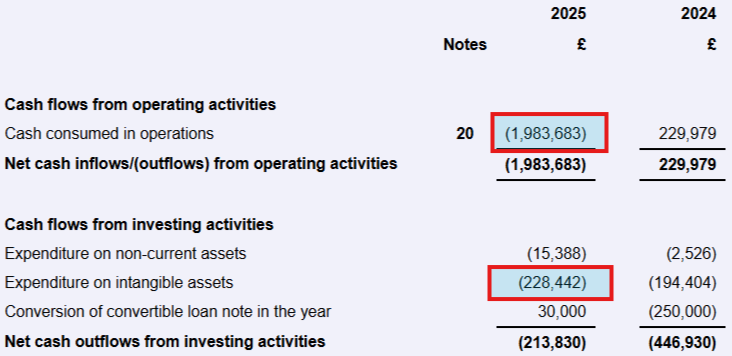
Checking footnote 20 (cash flow from operating activities), I see that over £700k left the company as it reduced outstanding payables.
Another footnote reveals that most of this (over £400k) was due to a reduction in “amounts due to related parties”. There is a long footnote explaining the related party transactions between the CEO and company itself.
To be clear, I’m not saying this to raise any suspicions - this is all fairly normal when studying smaller companies. I just think it’s worth understanding how the company managed to burn through over £2m when the operating loss was only £1.4m.
Graham’s view
You may wonder why I continue to study this company when I am so consistently negative about it.
The reasons are:
1. Very fast top-line growth. We don’t regularly get to study companies whose revenues are almost doubling year-on year.
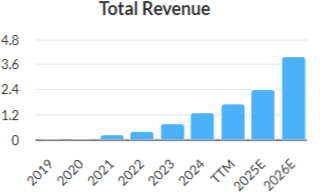
The mission statement as expressed by RGG’s CEO is:
Unlike other property portals who have a subscription-based model with estate agents, Paul has a vision for RentGuarantor as being the premier online place to go for landlords and tenants.
It’s not easy, but I’m interested in finding quality businesses at an early stage in their development, before their quality is widely understood. RGG strikes me as something that has the potential to achieve this.
But I’m clearly not the only person who thinks this, as the shares apparently offer very little value. The ValueRank is only 13.
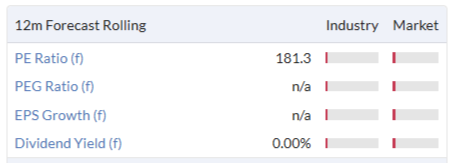
Given the lack of profitability, I think price to sales is the multiple we should be looking at: based on 2026 forecast sales of £4m, this is trading at 10x sales.
Even for a thriving, profitable SaaS business, that would be a demanding valuation.
Therefore, I am going to stay RED on this for the time being.
But I’ll be watching it closely. Forecasts suggest that it can turn a profit this year.

If RGG looks like it is on track to break even in 2026, and if I’m convinced that it’s fully funded through to profitability, my stance on this is likely to change very quickly. I could go straight to neutral at that point.
So I’m staying negative for now, but am very open to changing my mind - perhaps at the interim results this year.
WH Smith (LON:SMWH)
Up 1% to 613.5p (£775m) - Trading Update - Graham - RED =
This stock is now a shadow of its former self, after selling off its High Street business at a cheap valuation and then finding accounting errors in its North American division last year:

Today’s trading update does at least offer stability in terms of revenue generation. Group like-for-likes are up 2%:

This is achieved despite temporary airport store closures in the UK.:
As expected, total growth has been impacted by temporary store closures across all Heathrow Airport terminals as we continue to invest in the quality of our UK store portfolio. Our refurbished flagship stores are expected to open in April.
Looking at the areas not impacted by store closures, it’s a mixed bag: Hospital LfL revenue up 4% while Rail LfL revenue is down 2%, “against the backdrop of continuing consumer headwinds”.
In North America, where the accounting black hole was discovered last year, it’s again very mixed: positive trends in Airport Travel, but negative trends for Inmotion (electronics retailing) and in Resorts, “largely driven by a continued reduction in Las Vegas visitor numbers”.
Outlook is in line.
The Group has delivered a solid first half performance and is on track to deliver Group guidance for the year.
Looking ahead, we are mindful of the geopolitical uncertainty in the Middle East and the impact that this is having on passenger numbers across our key markets. We will continue to monitor the situation and focus on what we can control, including executing against our clear strategic priorities and strengthening our focus on cost and cash discipline.
Graham’s view
This is an old favourite of mine but I turned fully negative on it in December at the full-year results. I had plenty of reasons:
FY25 results missing expectations
FY26 guidance looking light against existing forecasts at the time
An FCA investigation into compliance with listing rules, in the context of the large accounting error.
Net debt of £390m excluding leases, or £874m including leases.
Very unclean results with enormous “non-underlying items” including £138m of impairments.
Deeply negative tangible balance sheet equity.
The company has since appointed an Executive Chairman, which does at least remove one of the concerns I had.
Overall, however, given that my downgrade was three months ago, and not all that much has changed since then, I think it makes sense for me to stay fully negative on this one
Roland's Section
Aviva (LON:AV.)
Down 2% at 653p (£20.0bn) - 2025 Results - Roland - AMBER/GREEN =
(At the time of publication, Roland had a long position in AV.)
Today’s results from this FTSE 100 insurer have received an indifferent reception from the market, but look pretty healthy to me. As far as I can see, they suggest investors can remain confident in the medium-term outlook for the business (and the dividend).
2025 results summary
Headline numbers show a big rise in profit and improved profitability, with CEO Amanda Blanc reporting that the business has achieved its “2026 financial targets one year early”.
Operating profit up 25% to £2,203m, including £174m contribution from Direct Line
Operating profit rose by 15% excluding Direct Line
Cash remittances up 4% to £2,077m
Return on equity up 1.8% to 17.5%
Operating earnings per share up 17% to 56.0p
Full-year dividend up 10% to 39.3p per share
£350m share buyback
In a nutshell these figures show us that the group’s profits generated an attractive return on equity, reflecting the company’s capital-light strategy. Aviva says 68% of its profit is now from capital-light businesses.
Cash generation is another strength – broadly, the cash remittances figure above of £2,077m represents post-tax surplus cash returned to Aviva from its operating subsidiaries. This means that it’s a good proxy for the amount of cash available to support dividends and buybacks (as long as regulatory capital coverage ratios remain adequate, as they are here).
In this case, last year’s cash remittances comfortably cover the 2025 dividend of 39.3p (£1.2bn) and new £350m buyback.
Divisional trading: Growth was positive across all four of Aviva’s operating segments, as this slide from today’s presentation illustrates:
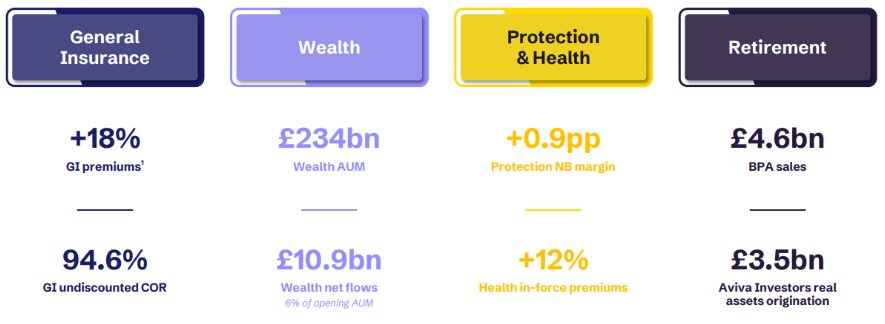
General Insurance (UK & Ireland): volume and profitability improved, with gross written premium up 27% to £9,787m and operating profit up 52% to £708m. The discounted combined operating ratio for the year was 89.7% (2024: 90.9%). A figure under 100% represents profitable underwriting.
Canada General Insurance: Aviva is Canada’s second largest Property and Casualty insurer, with a c.9% market share and 2.6m customers.
In 2025, gross written premiums rose by 2% to £4,358m, while operating profit climbed 49% to £408m. Combined operating ratio improved by 2.9% to 95.6%.
Insurance, Wealth & Retirement: this business offers individual retirement products such as annuities,, wealth management and bulk annuities. Aviva has a c.25% share of the UK life insurance market and a large share of the personal annuity market, which has really strengthened since interest rates returned to more normal levels, improving annuity rates.
Last year saw bulk annuity sales fall by 41% to £4.6bn, “reflecting a more typical year”. I think this has also become quite a crowded market, perhaps explaining the slowdown.
However, overall IW&R results were boosted by strong demand for products such as Health Insurance (especially from corporate customers) and wealth management. Operating profit from these two segments rose by 53% to £204m and by +36% to £175m, respectively.
Net inflows into the Wealth business rose by 6% to £10.9bn, representing 6% of opening AUM.
Aviva Investors: this is the group’s conventional asset management business. It’s relatively small and largely serves the group’s own requirements – year-end AUM was £262bn, of which £221bn was being managed for Aviva Group businesses.
Net inflows were £1.4bn last year, but AUM rose by 10% to £262bn over the year. This suggests market performance/investment gains of perhaps 9% for the full year.
Learning more: there’s a lot more detail in the results about each division and the detailed financial mechanics of the insurance business. For anyone wanting to get an accessible overview I’d suggest starting with today’s results presentation before drilling down further if desired. While company results presentations inevitably put a positive spin on results, for complex businesses like Aviva they are also a good way to get an overall understanding of the business.
Outlook & updated financial targets
Aviva updated its three-year targets for the business in November. These are:
Operating EPS growth of 11% CAGR from 2025-2028;
Return on Equity of >20% by 2028;
Cash remittances of >£7bn cumulatively from 2026 to 2028.
Management says the group is “comfortably on track” to achieve its previous cash remittance target for >£5.8bn from 2024-26. Based on £4.1bn achieved to date, this suggests a 2026 figure of at least £1.7bn. That should provide continued support for the dividend, as a minimum.
Consensus forecasts have moved higher over the last year overall, despite recent dip:
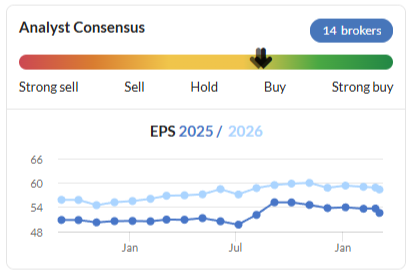
Based on these FY26 estimates, Aviva shares are trading on a forecast P/E of 11, with a potential 6% dividend yield.
Roland’s view
I admire what CEO Amanda Blanc has achieved since taking charge at Aviva and today’s results don’t change that. If the company can maintain return on equity at the high-teens level achieved last year, then I think the current 6% dividend yield could still be a reasonably attractive valuation, despite the stock’s strong performance over the last few years:
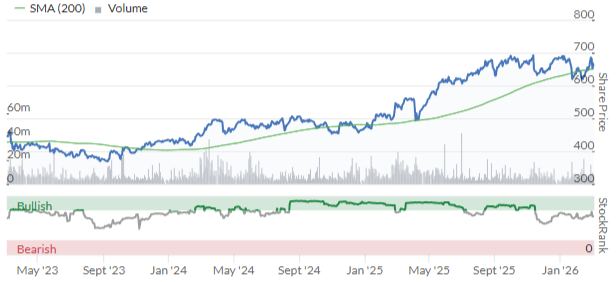
I think Aviva remains an attractive choice for income at current levels and don’t see any reason to change our previous broadly positive view today.
Hunting (LON:HTG)
Up 4.5% at 535p (£823m) - Results for the year ended 31 December 2025 - Roland - AMBER =
LONDON, England. Hunting PLC (LSE: HTG), the precision engineering group, today announces its results for the year ended 31 December 2025.
2025 results summary
This engineering group is predominantly focused on providing parts and equipment for the oil and gas sector. Today’s headline numbers appear to be largely in line with consensus expectations:
Revenue down 3% to $1,018.8m
Adjusted EBITDA up 7% to $135.7m
Adj pre-tax profit up 5% to $79.7m
Adjusted earnings up 9% to 34.1 cents per share
Final dividend up 13% to 6.8 cents per share
However, this comment from management made me wonder about visibility on future work, after the completion of major contracts for Kuwait Oil Company and ExxonMobil last year:
.. management is actively converting its high-value tender pipeline to backfill capacity and scale the order book.
Sure enough, Hunting’s year-end order book fell by 30% to $358m last year (Dec 2024: $508.6m).
On the assumption that all of these orders will be fulfilled in the current year, this means that revenue visibility is only around 35%, compared to c.50% at the start of 2025.
The outlook for the group’s OCTG product group (pipe connection products) appears particularly uncertain. This division generated 46% ($468m) of group revenue and 65% ($87.7m) of group EBITDA last year, but the order book has collapsed dramatically following the completion of last year’s big orders from KOC:

While I recognise that some of Hunting’s work is fairly short-cycle and will be both ordered and completed during the year, this doesn’t seem an ideal way to start the year. It may also help to explain the narrative about cost savings. In a separate RNS today, management have confirmed plans for a further $15m of cost savings by the end of 2027.
Profitability/balance sheet: profitability in this business has been fairly weak over the last couple of years, at least at a statutory level.

Today’s figures do show some improvement in this regard:
Operating margin: 7% (2024: n/a)
Return on capital employed: 8% (2024: n/a)
Free cash flow: c.$103m (2024: $138m)
Net cash: $28.1m (2024: $70.7m)
Profitability was acceptable but not especially impressive last year, in my view. With the stock trading on a FY26E P/E of 16, I think continued growth is already priced in unless there are further improvements in profitability.
Thankfully, adjusting items in these results were relatively modest, at $14.2m (2024: $109m). This means the statutory profits are within a reasonable distance of the company’s adjusted measures.
Outlook
Hunting made two acquisitions last year and appears to have some interesting technology.
Management says that events in the Middle East could cause “some tender and order slippage” but are not expected to have a material impact on “long-term growth trajectory”. The potential impact on near-term revenue isn’t clear to me – in addition to client projects, Hunting also has some of its own facilities in Dubai.
Guidance is vague but positive:
Overall, Hunting is anticipating further earnings growth in the year ahead and, having demonstrated that the Group can deliver growth and returns against a challenged macroeconomic backdrop, the Directors remain confident that our skilled workforce will rise to these challenges as we continue to deliver our Hunting 2030 Strategy.
Fortunately, broker Canaccord Genuity has provided an update today that’s available on Research Tree – many thanks.
Canaccord’s forecasts for the year are largely unchanged.
FY26E adj EPS $0.46 (prev. $0.45)
FY27E adj EPS $0.60 (unch)
Interestingly, the broker’s analysts characterise Hunting’s order book as having “normalised” after an exceptional period. So perhaps I don’t need to be too concerned about revenue visibility.
These forecasts leave Hunting trading on what seems a fairly strong valuation to me, given the modest profitability:

However, it’s possible that US peers are more highly rated, as is often the case.
It’s also fair to say that double-digit earnings growth expectations for the current year mean the PEG ratio of 1.0x is reasonably attractive and could indicate an attractive valuation.
Roland’s view
In February, Mark commented that Hunting’s only strong factor score was its MomentumRank. This remains true, at least prior to today’s full-year results being digested by the algorithms:

Given that the company’s broker has left its 2026 and 2027 forecasts unchanged today, I have to assume that analysts are reasonably convinced that Hunting can refill its order pipeline and deliver on current forecasts.
Even so, I can’t help feeling that much of the good news is already reflected in the share price here, especially as earnings estimates have been trending lower over the last year:

To reflect unchanged forecasts and the company’s rather average profitability, I’m going to leave our neutral view unchanged today. This is also reflective of the StockRank Style at the time of publication:

Disclaimer
This is not financial advice. Our content is intended to be used and must be used for information and education purposes only. Please read our disclaimer and terms and conditions to understand our obligations.

35 comments
I own Bloomsbury Publishing (LON:BMY) so I am biased but imho it is worth investigating the potential leap in earnings that these new book can bring. These will be books 6 and 7 in the A Court of Thorns and Roses (ACOTAR) series. Sarah J Maas has become a lot more popular over the past 2 years and that she has one other book series that she's still writing and that's Crescent City. She released the last Crescent City book in early Feb 2024. Prior to c October 2023, estimates for FY 2024 (Feb 29th Year End) were c. 30mm PBT. All told it ended up being 48.8mm. Not only that but 2025 was materially higher too than those late 2023 estimates with much of that coming in the first half of the year. We can guesstimate the bump in earnings from that book alone to be c. 33mm. ACOTAR is many times more popular than Crescent City as evidenced by TikTok hashtag count or Goodread ratings count. There will be 2 books released in this FY and the excitement in that community is enormous. I don't think it's impossible we see a c. 50+mm bump in earnings which would be c 2x current estimates... again please DYOR.
An important sequence of RNS events in 2 months, with significant combined importance.
Sulnox (SNOX) is quoted on Aquis. Aquis has many plus features I’m sure, but a readership commentary section is not one of them, so I resort to occasional reviews on Stockopedia, Paul Scott etc. Respectfully, I try to keep away from the busy times of the day when readers are naturally more concerned with the rest of the LSE market. Briefly, Sulnox is an important aid in this difficult period when many companies and individuals are (or are not!) trying to decarbonise and going through what will inevitably be a very difficult and prolonged period of B, between where we are now (A) and where the majority would like to be (C). Sulnox Eco is a patented unique fuel conditioner suitable for all ICEs and works with all types of liquid hydrocarbons, and it’s a British company. The product is patented in over 100 countries and used in over 40 so far. By helping engines work more efficiently, it reduces fuel usage saving money, reduces harmful emissions, reduces maintenance costs and with no capex – just simply pour in when filling up. It is 100% organic and 100% biodegradable. It is super concentrated and for diesel, a 5 litre container say is sufficient for 10,000 litres of fuel. Incredible? Well, go to sulnoxgroup.com and follow the instructions to see more.
Sorry the intro is a bit long, but Sulnox Eco isn’t a household name in the UK – yet, because of its focus as a low-cap operation on the global sector where it can make most impact – shipping. The biggest consumer, the greatest polluter, the area where greatest improvements and highest sales can be made. Not surprisingly, potential users want to test…and test… Towards the end of last year, there were several breakthroughs with whole fleets of smaller companies or important sections of bigger fleets saying – ‘yessss!’ and converting to regular use. Demand for shares on Aquis goes up (and on an equivalent US market too), the SP too, and then comes down, until the next important announcement. As a shareholder, I look forward to reduced volatility but that will take time…. but you know that.
So why a report from me today? Well, today there has been a significant RNS about the addition of a distributor, but with a difference. It is the third in the space of a few weeks. You can read the others on the company page on Aquis. The difference is that this distributor covers the area around the Suez Canal, AND it is adopting Sulnox Eco in its fleet, WITHOUT further testing, by reputation alone. That is an important difference, ad we look forward to many more this year. The other two RNSs by the way were for a key distributor covering the area around the Panama Canal…and the intervening one, a Finnish company with broad coverage of the Nordics but also wider influence in the EU and expanding into the GCC (Gulf Cooperation Council) – 6 key Arab oil producing nations including Bahrain, Kuwait, Oman, Qatar, Saudi Arabia and the U.A.E.
So that’s it for today. A small company with unbelievable potential and big ambitions with a low capital organization base, working with a model of combined shareholders/distributors/users. Keep an eye out for more.
Re: Taylor Wimpey and Ibstock - and construction in general.
The © 2026 S&P GlobalS&P Global UK Construction PMI for February has been released today - link below.
The headline "Faster decline in housing activity" basically describes the current situation and a reason why some housebuilders are clearly struggling.
Also reported are higher input costs leading to reduced margins...
https://www.pmi.spglobal.com/P...
if one wants to have some better news planning applications seem to be at 10 year high - ok planning application is worth didly squat if it isnt approved - but if we say the green shoots should show here first "all other things beig equal" then at least the application numbers are positive - we also know the gov came in with ambitious plans with ragard to number of homes they would ensure are built - its looking like they may "fail" - however what is clear is that they will be under the spotlight in that regard - imho the number of new homes they ensure are built at "affordable as possible prices" may be one of the key metrics they are judged on when people come to vote at the next election. in that regard stuff all the nimybs and similar and please just get as many "affordable as possible" new home built - my optimism the powers that be care are perhaps not over high - its just sad that people who have lived in this country their whole life and need something "cheap" are really not looked after whatsoever - bit of a disgrace really.
https://www.stockopedia.com/co...
Planning applications are not an accurate indicator of construction activty nor are they guaranteed to convert to housing starts.
Affordable housing usually means subsidised housing. Either the property is sold at a discount to open market value or the property has some form of subsidised finance. The question is , who picks up the tab for the subsidy.?Housebuilders and their shareholders seem unwilling to be part of the subsidisng and there are examples of where Housebuilders are now lobbying for a reduced percentage of affordable homes in developments.
A big problem is input inflation and I would guess that due to the combined efforts of Mr Milliband and President Trump, we shall see a spike in energy costs - which is unlikely to help the construction industry in the near future.
Some while ago on Stockopedia when the Government picked the term figure of 1.5 million new houses from thin air, I queried the figure and suggested a figure of 800,000. I still think that I will be closer to the actual figure.
I could be wrong of course. I am long term investor that is currently following the construction market for a turnaround. Nothing here to tempt me at this stage.
I did see Roland's piece on another thread. It has not however changed my opinion that the sector is rather weak.
That seems a fair target Intuitive. Personally I'd make it mandatory for all schemes of 100 plus homes to include 10% of units as Social Housing not Affordable. And give Councils both the right to build and the obligation to hit Social targets in their area every year. Don't blame housebuilders for not wanting to subsidise but if they want to build at all they have to come to the party.
In the meantime I'd double the Stamp Duty thresholds permanently. Not in favour of any form of support for First Time Buyers as that just continues the misallocation of resources and looks after those a little further up the ladder IMO. We do need something though to get the market moving and enjoy the multiplier effect that the housing market can bring.
Nonsense socialist drivel....
Planning applications are not an accurate indicator of construction activty nor are they guaranteed to convert to housing starts.
obviously current planning applications says little about current construction activity - i am looking forward.
would you not agree that all other things being equal its likely that more applications being made is a sign that - more applications might be approved - yes no certainties - and it may be false dawn - but imho more applications is deffo better than less for obvious reasons.
Affordable housing usually means subsidised housing. Either the property is sold at a discount to open market value or the property has some form of subsidised finance. The question is , who picks up the tab for the subsidy.?Housebuilders and their shareholders seem unwilling to be part of the subsidisng and there are examples of where Housebuilders are now lobbying for a reduced percentage of affordable homes in developments.
I said as affordable as possible - in that regard i would muih rather be forcing housebuilders to build more volume cheaper stuff than high value less volume - affordable doesnt have to be subsidised so i wasnt talking about subsidies here necessarily . simply that rather than building ten 500k detached houses - we could do with row of 250k terraced houses.
Housebuilders and their shareholders seem unwilling to be part of the subsidisng and there are examples of where Housebuilders are now lobbying for a reduced percentage of affordable homes in developments.
well they would say that wouldnt they - they are trying to maximise their proifits - them bitching does mean curent quotas are unfair.
- if i were the gov i would just have changed rules so gov can get greenbelt and unsued sites - then smash through planning - minorly compensate prior owners - and sell of plots to the highest builder who promises to build to fair specs as laid out - quickly. Thats a moot point as the gov will likely bumble along not doing much. If market price paid by housebuilders is low - thats a decent subsidy to ensure the volume is done.
I could be wrong of course. I am long term investor that is currently following the construction market for a turnaround. Nothing here to tempt me at this stage.
I would agree that whilst i am semi hopeful that voilumes would pick up - as things stand pricing is an issue - the pricing problem is best sorted by simply building volume - if that takes pressure of pricing in existing stock thats job done.
"- if i were the gov i would just have changed rules so gov can get greenbelt and unsued sites - then smash through planning"
Oh dear, green belt exists for a number of reasons.It's not something we should simply decide isn't needed because once it's gone , it will never return. Fortunately there are established principles laid down by the Supreme Court in a landmark judgement known as Hopkins Homes.
It says the need for more houses is not a sufficient reason to destroy green belt. You have to prove that green belt land doesn't satisfy the original reasons for classifying it as green belt.
Oh dear, green belt exists for a number of reasons.It's not something we should simply decide isn't needed because once it's gone , it will never return. Fortunately there are established principles laid down by the Supreme Court in a landmark judgement known as Hopkins Homes.
I am not against green belt at all - you are ignoring the fact the population of this country will be increaing by nearly 10 million people in a period of 20 years. perhaps we should limit population as then solution - buty other than that what are you going to do to the bottom edges of society who cant afford a home due to over competition for houses due to population growth.
You just have to take the train from london to scotland to see how much green belts and farming land is left - facts are we could easy take from that. yes its gone when its gone but we either need more homes or we need less people - thats just basic maths. yes we should use brown field sites - and building more modest homes can fit more homes into the same space - but the reality is we have shed loads of greenbelt and getting rid of a chunk of will leaave us with plenty.
Not sure what you plan is for the not so will off make them stay in their parents house for their entire lives - thats just plain selfish. ref green policies we have done a great job in this country reducing co2 and leading the way ref pulloting less - the fact is taking a chunk of the green belt away aint going to change much and will give teh youth of today hoepfully similat options to waht we had growing up - imho its etremly selfish anyone who owns their own home not wanting others to have that samr opportunity.
perhaps it can be done without taking away too much grenbelt i am happy to look at all options but to suggests taking a bit of the greenbelt away is a biggie is kinda dumb - not nice if its the green belt next to your house - thats life unfortunately.
You have to prove that green belt land doesn't satisfy the original reasons for classifying it as green belt. No you dont have to do anything like that we could simply say 10% of the grenbelt will be gone and get it done - its ridiculous that we can waste 200 million looking after a selection of 50 bats and 46 newts when its no biggie.
I'm not going to get into an argument with you on this. Your views conflict with numerous established laws and policies so I suggest you read the Governments own word on protecting the green belt, here
https://www.gov.uk/guidance/na...
Incidentally, getting rid of farms isn't exactly a brilliant idea, unless you are happy to be dependant on other countries to grow the food you eat. I'm not.
no worries its fine to agree to differ - my point here is rules and laws can be changed.
Incidentally, getting rid of farms isn't exactly a brilliant idea, unless you are happy to be dependant on other countries to grow the food you eat. I'm not.
we arent short of food in this country thankfully and the supply chain manages just fine. All we ever seem to here from farmers is that they cant make a living from being farmers in this country.
facts are if we are going to add an extra 20 million peope living here - your inistance thatb you get what you want and that nothing should change - well things change over time.
facts are in life compromises often have to be made in life - and you seem to be completely sideswiping completely the real issue that needs to be addresses - a growing ppulation demands an ever increasing number of homes - unless you want to force people to not be able to have ahome of their own - just so you dont have to have imported cheese - or some of teh countryside may be no longer.
In reply to rmillaree
I prefer to rely on facts rather than assumptions.
Fact - the uk population is projected to increase from 67.6m in 2022 to 72.5m in 2032. This is entirely attributable to net migration, not increased birth rate. According the Office For National Statistics.
https://www.ons.gov.uk/peoplepopulationandcommunity/populationandmigration/populationprojections?utm_source=copilot.com
It’s a far cry from your assertion that the population is going to grow by 20m.
Net migration is capable of being controlled if we choose to. We could make it more attractive for our existing population to remain here and less attractive for migrants from elsewhere to come here.
“we arent short of food in this country thankfully and the supply chain manages just fine”
Again, you oversimplify. In fact this country imports much of its food from abroad, which maybe is why we aren’t short of food. According to DEFRA, we only produced 58% of the food we consumed in 2023.
https://www.newsbreak.com/the-independent-517119/3711016566060-key-statistics-in-government-report-on-uk-food-security?utm_source=copilot.com
Fact is we are already heavily dependent upon foreign producers for much of the food we eat. Losing more farm land will only make it worse.
You seem to have a great deal of sympathy for people who cannot afford a home but none for farmers who struggle to make a living.
There are according to DEFRA, roughly 150,000 small family farms in the UK. They have been battling weather, government taxes and generous subsidies for rewinding which make farming less viable.
Recently I heard that:
“The Government has blocked the temporary concessionary visas, which allow highly-skilled shearers from Australia and New Zealand to come to Britain in the spring and help with the process of removing the fleeces of 1.5-2 million sheep. … the Home Office has refused to permit the exception this year, saying the farming industry should have trained enough Britons to do the work. And while British Wool are training shearers every year, it’s only a tiny number of them who will go on to do professional shearing. It’s a very seasonal operation, so you have only got that three-month period that you can shear.
“So to be a professional, it’s very difficult. You either have to have a different job the rest of the year or you also need to be travelling overseas, like the guys who we want to come in who are doing it the other way around.”
Think about it - it’s a seasonal job, how many people in the uk are likely to want to become a sheep shearer, a highly skilled job? How are they supposed to gain the experience unless they spend a lot of time shearing sheep abroad.
Yet another example of our Government not having clue about how farming works.
Why do you believe people have to own their own home? In Germany, less than 50% of the population owns their own home. Successive Government have made it much less attractive, and more expensive, to own rental property. But for this, perhaps we could have thriving rental sector at prices people could afford as they have in Germany.
Here the fundamental problem is that we don’t have enough productive work which pays people well. We have far too many public services employees who create nothing that makes the rest of us better off. We have far too many people who are not working and being paid from the taxes of those who do have work. We have a Government that talks about wanting growth in the economy, yet almost all of its actions so far have suppressed growth and reduced the availability of work opportunities.
I’m fully in support of using unproductive land, land that is built on but which can be repurposed. I support building where land adjoins established towns or cities which have all the infrastructure required for additional populations, or housing which is unused and has been vacant beyond a reasonable time. What I don’t believe is that we should carpet the countryside with bricks and mortar. People need somewhere other than built up areas to enjoy nature, flowers, trees, birds, fresh air and exercise. Green belt preserves the gaps between towns and cities so this can happen.
It is entirely possible that both the government number (1.5m NEW homes) and your number of 800,000 is correct if your number is NET NEW homes
POT
Thanks. Yes my figure was for NEW homes. I am not an industry expert, but follow the sector and .think that the Goverment's figures are somewhat optimistic. We are now 20 months into the term of office and time is short.
I could easily be wrong, but it will be interesting to see how close I was to the actual figure.
Osb is in the list now, I'm not sure why it's hidden from my news feed! thanks. G
Osb (LON:OSB) Because it is listed under "other" and Reuters.
Osb (LON:OSB) preliminary results released today
Missing from today's list, Graham.
Bloomsbury Publishing (LON:BMY) I hold
Trading update says "Bloomsbury now expects its full-year 2026/27 profit to be materially ahead of market consensus..."
Seraphim Space Investment Trust (LON:SSIT) I hold
Would appreciate coverage of today's interim results which look good to me with NAV up over 20%
Great results from the insurers this morning Aviva (LON:AV.) Admiral (LON:ADM) and Lancashire Holdings (LON:LRE) . Real profits and chunky dividends!
Bloomsbury Publishing (LON:BMY) may as well rename the company Sarah J Maas Publishing PLC
As a Bloomsbury author (and shareholder) I would object to that (as might JKR)!
well its all management seem to care about. see the first 3 paragraphs of the RNS.
I actually took the opportunity to sell into this morning's rise. Always good to see a materially ahead statement, but this feels like it could be a bit of a one-off due to two SJM novels being planned in close succession, I'm also getting a little uncomfortable that they now seem so dependent on a single author.
Could say that but they are the publishing house which found JKR and SJM. They have a good track record of finding these authors which are hard to find. I wouldn’t necessarily bet against them finding the next author of the future.
Don't get me wrong I think Bloomsbury are very good and clearly able to identify popular writers. But they've really only found 2 huge best sellers in 25 years - so could easily be another 10-15 years before they find another.
Holding BMY is a bet that SJM stays with them and continues to churn out best sellers. That might not happen for lots of reasons.
I don't think its quite as simple as that. Look at the golden goose that is Harry Potter. Everyone (myself included) predicted a big drop off in 'wizard' sales would happen long ago, but each time there is a new mini series on tv etc the back catalogue gets a further boost. JK Rowling has not been with Bloomsbury Publishing (LON:BMY) for years now but they keep earning strong returns from her books. The same would likely be true for SJ Maas if she ever leaves.
More intriguing is the Academic Publishing side. A serial disappointer up till now but if that ever gains real traction then it should be a more valuable business than consumer publishing (and they have just flagged that the year to Feb 2026 was strong in this division).
Really not sure SMJ will have the same staying power as Harry Potter. Children's books tend to be more timeless and HP is clearly established as a children's classic that will probably be around for decades. Children who like it will read it to their kids when they grow up. Far too early to say that SMJ will still be in the bestsellers list in 20 years time - I'd personally be doubtful but you never know.
Good point about the academic side. I understood that this is a hidden gem in terms of licensing deals.
Bloomsbury Publishing (LON:BMY)
Has the company ever disclosed the contract terms with JKR and SJM. I assume these will have expiration dates / clauses etc. I am not sure I have ever seen any reference to terms of contract etc. This makes it pretty difficult to invest as these are the main 'assets' of the business. If it was a miner you would want to know the 'life of mine'. If anyone knows the terms of the deals that would be great, personally I don't remember them ever mentioning them (which if that's the case makes it a pretty risky investment imo).
My wife has worked in publishing for forty years specialising in trade fiction. According to her, so long as Bloomsbury Publishing (LON:BMY) don't make any terrible mistakes in terms of marketing SJM there is almost zero chance that she would leave for a competitor and even less chance that one could afford to make it financially lucrative for her to do so.
Authors who leave publishers tend to be the much less successful ones where the departure is often mutual. Publishing is as far removed from the Premier League as it could possibly be!
Bloomsbury Publishing (LON:BMY)
This makes it pretty difficult to invest as these are the main 'assets' of the business.
Sometimes in life it is what it is - ref JK - just look at the amount of time she has been with bloomsbury - do you think she is materially likely to want the hassle of change ? - i think its matter of fact many publishing houses turned her down before Bloomsbury took here on - its pretty comendable that they are still together all these years later.
SJM - well thats a different kettle of fish - but i think she has been with bloomsbury for 13 years since novel number 1 - and copliot thinks she has to deliver 6 more books under her current contract - so that seems pretty decent if correct.
one needs to dyor - but i would have no qualms buying at present - i have had it on my watchlist and had simply not got around to prioritsing purchase even though sub 500p it looked good value with new books being released from sjm.
as you say though it is concentrated risk ref these 2 - so i fully understand anyone who sideswipes .
Note we do know that Bloomsbury will not want to upset these authors - so its clearly in their interests to be seen to fully support tham - why would they leave if they are supported and stuff is selling at acceptable levels?- as both have bern around for so long it seems like up to now all a ok in that regard ref keeping them sweet.