Daily Stock Market Report (Wed 25th March 2026) - JNEO, PZC, VLX, PINE, QTX, RS1

Good morning and welcome to Wednesday.
The mood in markets seems to be one of cautious optimism this morning, with most major indices expected to open higher on reports of Iran talks. One major exception to this at the time of writing is the FTSE 100. Of course, things could change as the day unfolds:
- S&P 500: up 0.6%
- DAX: up 1.0%
- FTSE 100: down 0.1%
- Euro Stoxx 50: up 0.9%
Today's agenda is complete.
To start things off today, Graham has prepared backlog sections on Journeo and PZ Cussons, both of which issued updates yesterday.
Spreadsheet accompanying this report: link.
Companies Reporting
| Name (Mkt Cap) | RNS | Summary | Our view (Author) |
|---|---|---|---|
Rio Tinto (LON:RIO) (£105bn | SR67) | The Queensland and Commonwealth Governments will invest AU$2bn over 10 years to 2040 to support “the transition to long-term competitive power for the smelter”. This will combine with large solar and wind developments that have been underwritten by Rio Tinto. | ||
Diageo (LON:DGE) (£30bn | SR55) | United Spirits Limited has agreed the sale of its 100% equity stake in the Royal Challengers Bengalaru cricket teams for INR 166.6bn (approx £1.3bn) to a consortium including Blackstone. | ||
United Utilities (LON:UU.). (£8.5bn | SR40) | 2025/26 underlying EPS is expected to be in line with guidance “at around 100 pence”, with opex guidance unchanged. However, a change in the estimation technique used to value index-linked debt will lead to lower net finance costs and an increase in underlying EPS of c.5p. Electricity costs are fully hedged for Summer 26 and over 90% hedged for Winter 26/27. | ||
RS (LON:RS1) (£2.8bn | SR87) | FY26 like-for-like revenue is now expected to fall by 0.6% due to “difficult markets”. Adjusted pre-tax profit is still expected to be “marginally ahead of expectations” (consensus £241m/range: £230-247m). | AMBER (Roland) I am taking a neutral view today out of respect for the difficult geopolitical environment and recent challenging trading conditions. However, I think value could be emerging here and am intrigued by the track record of the CEO, who has invested nearly £1m since taking charge in 2023. | |
HICL Infrastructure (LON:HICL) (£2.17bn | SR84) | Sale of 24% stake in France’s A63 motorway for gross proceeds of c.£311m, a 21% premium to the most recent valuation. The sale will add 2.2p of NAV per share and is accretive to the portfolio’s expected return metrics. Intention to deploy proceeds into new investments exceeding the return hurdle set by share buybacks. The A63 was HICL’s second-largest asset and accounted for 8.4% of the portfolio in Sept 25. | ||
Volex (LON:VLX) (£803m | SR89) | Full-year results are now expected to be significantly ahead of current market expectations. Revenue is expected to be at least $1,220m, with underlying operating margins “slightly above the top end” of the 9-10% target range. Outperformance has primarily been driven by data centre demand, with full-year data centre revenue expected to be “approximately double” the $118m achieved in the prior year. Volex also announces that it is considering a move from AIM to the Main Market. | AMBER/GREEN = (Roland) A strong update showing Volex has continued to benefit from accelerated demand for the high-spec data transmission cabling that’s needed to fit out new AI data centres. Sales in this part of the group doubled last year. The company does warn that some 2026 sales were pulled forward from 2027, so at this early stage there’s a risk this demand might not be repeated this year. Even so, I am happy to maintain a broadly positive view here, reflecting the company’s strong growth and diversification in recent years. | |
WAG Payment Solutions (LON:EWG) (£684m | SR63) | Net revenue up by 12.9%, adj EBITDA up 8.5% to €132.1m. Adj EPS up 3.9% to 4.83c. Launched a new integrated platform for core services and saw total active trucks rise by 6.4% to 321,500. | ||
Enquest (LON:ENQ) (£346m | SR88) | Pro forma production of 45,606 boepd (guidance: 40-45 kboepd). 2P reserves down 3.6% to 162.5 MMboe. Adj EBITDA down 25% to $503.8m reflecting lower oil prices. Net debt up 12.5% to $433.9m. 2026 Outlook: production expected to be 41-45 kboepd. | ||
| Pinewood Technologies (LON:PINE) (£270m | SR13) | Business Update | A five-year contract with dealer group Marshalls is running behind schedule. The rollout is not now expected to start until H2 2026 (previously Q1 2026). As a result FY26 underlying EBITDA will be lower than current market expectations. Guidance for underlying EBITDA of £58-62m by FY28 is unchanged. | BLACK (AMBER/RED ↓) (Roland) Following February’s takeover bid failure, Pinewood has announced delays to a major customer project. My reading also suggests possible slippage in its own internal North American rollout. While I think there should be a decent business here, the shares don’t look particularly cheap to me and I’m concerned by the weak outlook. I’m inclined to be cautious and have downgraded my previous neutral view today ahead of April’s full-year results. |
Luceco (LON:LUCE) (£257m | SR86) | Revenue up 11.9% (LFL +4.6%), adj pre-tax profit up 11.6% to £27.8m. Adj EPS up 20% to 15.0p. Growth driven by energy transition – EV charging sales rose by 85% last year. 2026 Outlook: good early momentum. Expects adj op profit “to exceed £37m”. | ||
Asos (LON:ASC) (£254m | SR39) | H1 Gross Merchandise Value down 9%, with sequential quarterly improvement. UK performed better with GMV -5%. FY26 guidance reiterated for FY26 adj EBITDA of £150-180m. | ||
Franchise Brands (LON:FRAN) (£217m | SR56) | System sales up 2%, revenue up 2% with adj pre-tax profit up 12% to £23.9m. Leverage reduced to 1.6x EBITDA. Outlook: early 2026 trading “varied” with strong performance at Filta International. FY results to be “within the range” of current forecasts, planning £10m buyback. | ||
Literacy Capital (LON:BOOK) (£202m | SR N/A) | Diluted NAV per share up 0.3% to 484.3p (share price: 335p). Diluted NAV £291.4m. “Literacy's investee companies remain prudently valued and modestly leveraged.” Weighted average EV/EBITDA multiple for ten largest investments was 9.4x (Dec 2024: 8.8x). Average net debt/EBITDA 2.8x. | ||
| James Latham (LON:LTHM) | Trading Statement | Revenue for the y/e 31 March 26 was in line with expectations, with volumes expected to be slightly up on the prior year despite challenging trading conditions. Cost prices remained stable during the year but freight rates and shipment times are currently increasing as a result of the conflict in the Middle East. | |
TT electronics (LON:TTG) (£186m | SR49) | Organic revenue down 2.7%. Adjusted PBT +5.5% (£28.7m). Actual revenue is down 7.6% and actual PBT is a loss of £36.7m (2024: loss of £33.4m). “The Board expects 2026 revenue and adjusted operating profit to be in line with Company compiled consensus.” | ||
Kore Potash (LON:KP2) (£183m | SR26) | “We look forward to an exciting year ahead in which we expect to achieve Financial Close under the EPC as well as start construction at Kola with a view to delivering production in the first half of 2030." (Kola is in the Republic of Congo). | ||
Fonix (LON:FNX) (£147m | SR66) | The company has authority to buy back up to 230,000 shares, which is 0.23% of its share capital (the presence of a Concert Party prevents it from buying more). | ||
Mobico (LON:MCG) (£122m | SR53) | The COO is promoted to CEO. He is also CEO of the Alsa division and will continue to oversee Alsa. | ||
Pharos Energy (LON:PHAR) (£111m | SR96) | Working interest 2025 production totalled 5,398 boepd net, in line with guidance of 5,200 - 6,000 boepd. 2026 outlook: working interest production guidance increased from 2025 to 5,200 - 6,400 boepd net. | ||
Quartix Technologies (LON:QTX) (£103m | SR64) | Revenue +12%, adjusted EBIT +38% (£8.8m), PBT +34% (£8.7m). “...outstanding progress in 2025 on all key measures.... The outlook for 2026 is very encouraging.” | GREEN = (Roland) A strong set of results showcasing excellent profitability and improved operational metrics. 2026 forecasts are unchanged today but already imply double-digit EPS growth for this year. Given the company’s track record of upgrades over the last 18 months, I wonder if there’s the potential for this positive trend to continue. I think the valuation remains reasonable relative to growth and profitability, so am leaving my previous positive view on this founder-led business unchanged today. | |
Avation (LON:AVAP) (£79m | SR37) | Commencement of a new lease and delivery of an ATR 72-600 aircraft (MSN 1387) to a new client, ETF Airways, a Croatian airline. | ||
Braemar (LON:BMS) (£74m | SR49) | FY26 performance in line. Underlying operating profit c. £13.2m (FY25: £16.7m). Forward order book remains strong. “...the board remains confident in the Group's prospects and delivering on its FY30 objectives…” | ||
Centaur Media (LON:CAU) (£61m | SR55) | The max number of shares were validly tendered at 48p. New share count 18.1m. | ||
IG Design (LON:IGR) (£51m | SR58) | Completed the sale of a surplus warehouse to the Welsh government for £3.1m. Carrying value was £0.1m. | ||
Headlam (LON:HEAD) (£6m | SR36) | Revenue down 4.6%, negative EBITDA £12.5m (2024: negative £5m). Statutory operating loss £63.5m (2024: loss £31.3m). Net debt £31.4m. Trading conditions remain challenging in the near term. “The new core customer strategy will see a material planned reduction in revenue over 2026 and 2027… continues to have confidence in a return to profitability in 2027 as previously guided.” | ||
Aptamer (LON:APTA) (£18m | SR21) | Fundraise for at least £3.75m. Placing for £3.75m, retail offer for up to £0.5m. Issue price: 0.6p (last night’s close: 0.65p). Also includes one warrant for every three shares issued. Net proceeds to be used for working capital, extending the cash runway through to 2028, and to fund various development projects. | ||
Cadence Minerals (LON:KDNC) (£17m | SR47) | Funding Confirmation Notice has been issued; Cadence and REM Mexico intend to commence international arbitration against Mexico under the agreement between the UK and Mexico for the Promotion and Reciprocal Protection of Investments. | ||
Nexus Infrastructure (LON:NEXS) (£10m | SR50) | “While market conditions remain mixed in the near term, the fundamentals of our end markets are supportive. With a growing pipeline, a strengthened platform and continued operational momentum, we are well positioned to deliver sustainable long-term growth.” The Chair and a NED are stepping down. An Interim Chair has been selected. |
Graham's Section
Journeo (LON:JNEO) (Backlog)
Down 3% to 367.1p (£65m) - Final Results - Graham - AMBER/GREEN =
Journeo plc (AIM: JNEO), a leading provider of intelligent systems for transport networks and critical national infrastructure, is pleased to announce its final results for the year ended 31 December 2025.
We cover this one regularly, as it’s a frequent issuer of announcements and is a popular share, although Roland is usually the one who looks at it. Guess it’s my turn today!
Financial headlines:
Revenue +11% (£55m), which includes around £4m from an acquired business.
Adjusted PBT +13% (£5.7m)
Cash reduces to £12m (2024: £14.3m) after making an acquisition.
According to Cavendish, these results are in line with expectations.
Some operational headlines:
Won their largest ever Framework Award, with an anticipated value of £10m over three years from First Bus UK.
£4.2m purchase order from Alstom.
Development into overseas markets with new orders from Outfront Media (for platform-based displays).
CEO comment:
"Journeo has delivered another record year, driven by our customer-centric approach, the deployment of our proven technologies and a strategic, value-enhancing acquisition. With a strong order book, disciplined capital management and a talented team of nearly 300 people, we are well positioned to convert market opportunities into further sustainable growth."
And the outlook from the Chairman concludes as follows:
Across the operating businesses, we have strong orderbooks and a growing pipeline of sales opportunities which gives the Board confidence that Journeo will continue to deliver growth and increasing value for all stakeholders.
Estimates from Cavendish for 2026 are similar to what they published at the full-year trading update, with the differences probably not worth making a fuss over.
Revenue forecast £72m unchanged.
Adj. PBT £7.4m (previous estimate £7.2m).
Adj. EPS 32.2p (previous estimate 33.2p).
Graham’s view
I don’t have a very strong opinion on Journeo but the results are clean, with only modest share-based payments and acquisition-related expenses. The actual PBT result for 2025 is £5.6m (vs. adjusted PBT £5.7m).
The balance sheet is fine, too: there’s no tangible asset backing that is worth speaking of, but at the same time there’s a healthy cash position and working capital surplus, with minimal borrowings.
The major long-term liability is £4.4m of deferred revenue: this is “good debt” as it represents customers paying upfront for Journeo’s products.
The six operating companies cover a broad range of activities and a few different geographies:
Fleet Systems: CCTV, telematics, communications and passenger counting
Passenger Systems: hardware and software for public transport information systems, smart-ticketing and wayfinding
Infotec: information displays hardware for rail applications
Crime and Fire Defence Systems (new from 2025): protection of critical national infrastructure
Journeo A/S based in Denmark, serving Denmark, Sweden and Iceland
Journeo AB based in Stockholm, providing technical services to public transport customers in Sweden.
My overall impressions of the business are pretty positive, and I concur with the AMBER/GREEN most recently given by Roland.
At the end of the day, it is an order-driven B2B type of company, and this limits the sort of rating I’d be willing to pay for it. At the moment it’s trading at 11x earnings, with a low PEG ratio based on the EPS growth that is anticipated. There are no 2027 forecasts yet.
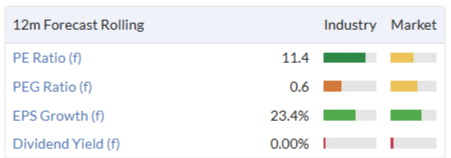
I’m personally of the view that this valuation is fair enough. At Fleet Systems for example, which is Journeo’s largest division and was responsible for over 40% of revenues in 2025, there was 3% revenue growth.
Passenger Systems grew revenue by 33%, while Infotec declined by 35%.
The point I’m getting at is that the underlying growth rates here are something of a mixed bag. A big chunk of the expected revenue growth in 2026 will be from the addition of Crime and Fire Defence Systems Limited (CFDS), which will add an additional £13m of revenue (as it only added £4m in the late stages 2025, and will add c. £17m in 2026).
I calculate that the expected organic growth rate in revenues for 2026, excluding the impact of CFDS, is about 7%-8%.
Hopefully this helps to underscore the role played by acquisitions in the growth story here: without them, the actual growth achieved would be much less interesting. But this doesn’t take away from my overall impression that Journeo is a decent business that is not particularly expensive.
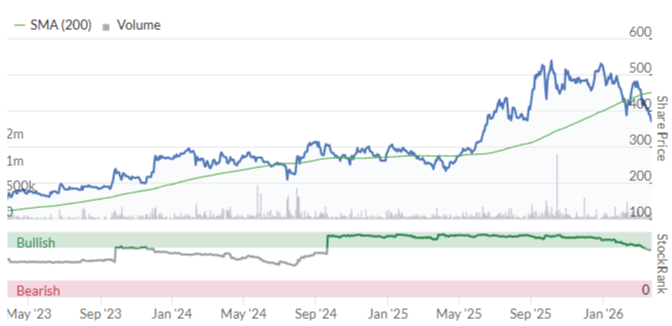
3-year chart:
PZ Cussons (LON:PZC) (Backlog)
Up 11% at 81.6p (£350m) - Q3 Trading Update - Graham - AMBER/GREEN ↑
We had a brief but very pleasant update from PZC yesterday. It was just a few sentences long. Here are the first two of those sentences (emphasis added):
The positive trading momentum in the first half of the year has continued, with 6.3% Group LFL revenue growth in Q3 (H1 FY26: 9.5%). On a reported basis, revenue growth was 5.0% (H1 FY26: 8.0%).
Reflecting the performance to date, with further stability in the Nigerian Naira and careful cost management, the Group now expects to report adjusted operating profit towards the upper end of the previously updated £53-57 million guidance range.
The share price reacted very strongly (+11%) to this message that profits would be “towards the upper end” of the range.
Graham’s view
It seems to me that this was an outsized reaction to moderately positive news: even a result at the very top end of the range (£57m) would only be <4% higher than a result at the midpoint of the range.
Therefore, I’m going to interpret this movement in the same way that I interpret a share price rise in response to an “in line” update: I assume that investors were braced for negativity.
The PZC share price has been fairly uninspiring over the past year, going almost nowhere in that time while the FTSE is up 15%.
And for a branded consumer goods business (owning the likes of Imperial Leather, Carex, Original Source and St. Tropez), the rating is fairly weak:
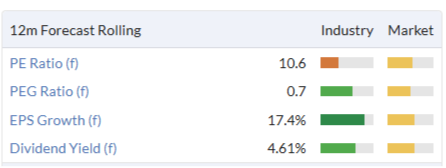
Of course, the company is not without its challenges.
There are significant currency risks in its African business - it recently abandoned efforts to sell this, having already failed to sell its fake tan business.
But helping to boost the positivity yesterday, there were also some calming words on the currency question:
While this guidance remains subject to movements in the Nigerian Naira in the remaining weeks of the financial year, the actions management have taken to mitigate against future volatility have continued to reduce the Group's sensitivity to such fluctuations.
I don’t take much convincing to get bullish on a cheap stock for a branded consumer goods business, so I’m inclined to upgrade our stance here to AMBER/GREEN (my co-writers have been fully neutral).
The interim results to November 2025 showed the company having net debt of £84m, which appears manageable (the leverage multiple being only 1.1x). LfL revenue growth was strong at 9.5%, and H1 PBT was solid both on an adjusted (£29.8m) and unadjusted (£34.3m) basis.
This old share has been in the doldrums for years now - maybe it’s time to look at it with fresh eyes?
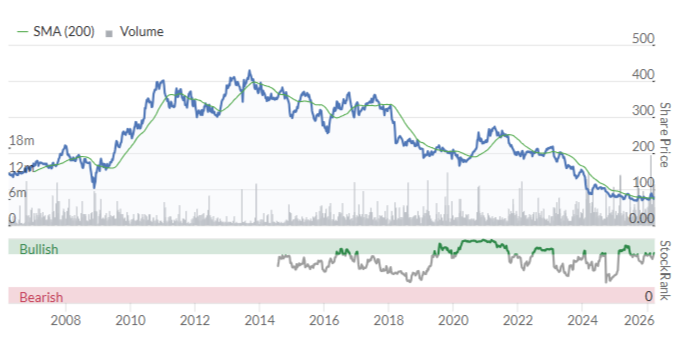
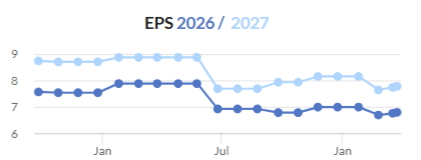
EPS forecasts have actually held up quite well here over the past year:
Perhaps it’s a nice time to start taking this one a bit more seriously?
Roland's Section
Volex (LON:VLX)
Up 9% at 475p (£873m) - Trading Update - Roland - AMBER/GREEN =
Today’s trading update from cabling specialist Volex is a relatively rare beast – a company guiding for full-year results to be “significantly ahead of current market expectations”. I don’t think we’ve had many of those recently.
Volex is benefiting from booming demand for the sophisticated high-speed data transmission products that are required to fit out new AI data centres. The company says that sales in its Complex Industrial Technology division are now expected to be around double the $118m achieved in the FY25 financial year (y/e 31 March) – or nearly 20% of total FY26 revenue.
Interestingly, the company says it’s benefited from being able to pull forward supply to meet “accelerate customer requirements”, where “other suppliers have not been able to meet these needs”. There is a potential downside to this of course in terms of next year’s demand, which the company acknowledges:
The Board is encouraged by the strength of the Group's positioning in this market, although this particular dynamic may not recur at the same level in FY2027.
Trading elsewhere in the business is said to have remained “broadly in line with the first half of the year”. Checking back to the H1 results shows a fairly mixed picture, suggesting to me that Data Centres and EV-related products were the main bright spots during the year:
H1 EV - organic revenue up 13.1%
H1 Consumer Electricals - organic revenue down 6.3%
H1 Medical - organic revenue down 9.9%
H1 Complex Industrial Technology (inc. data centre products) - organic revenue up 48.2%
H1 Off-Highway - organic revenue up 20% due to a one-off project completed in H1 – so perhaps a flat performance otherwise?
Updated profit guidance
The company has provided the following guidance today for FY26, which ended on 31 March:
Revenue to be at least $1,220m (previous consensus $1,173m)
Underlying operating margins to be “slightly above” the top end of the group’s 9-10% target range, thanks to both operating leverage and cost savings.
Previous consensus for underlying operating profit was $114.8m (in a range of $111.5m - $117m). Assuming a full-year margin of 10.3% gives me an underlying operating profit estimate of at least $125m, c.9% above current consensus.
Happily, Volex is one of a growing number of companies that has adopted the more democratic approach of including consensus forecast information in its RNS releases – this makes the estimates above much easier for investors without access to broker notes.
Main Market move?
Volex has also announced today that it’s considering moving its listing from AIM to London’s Main Market, where it would be likely to join the FTSE 250.
In conjunction with the expectation of being eligible for inclusion in the FTSE250 Index, the Board of Directors of Volex (the "Board") believes that a move to the Main Market would facilitate access to deeper pools of capital and a broader range of investors, supporting increased liquidity in trading of the Group's shares.
The Board also believes that a Main Market listing would increase the corporate profile of the Company and enhance its reputation with a larger and more global customer base.
An update will be provided following consultation with the Company's largest shareholders.
While specialist AIM investors (e.g. IHT funds) will no doubt feel sad at the prospect of losing such a strong performer, it does seem logical to me for a business of this size and quality to be listed on the Main Market.
Roland’s view
Volex was one of the stocks I profiled at the Stockopedia panel event at Mello in November. I’d been struck by the rapid growth in demand for data centre products and thought this might continue for some time yet.
Today’s update appears to support this view, with the caveat of course that the AI spending boom is likely to come to a halt at some point. How predictable that slowdown might be remains to be seen. With the US tech giants planning to spend $650bn on AI collectively this year, the current rate of growth can’t continue indefinitely.
Volex’s FY26 performance has clearly been driven by data centre demand, with revenue in the Complex Industrial Technology product group accounting for nearly 20% of the group total. Although Volex doesn’t report margins for each product group, I would guess these high-spec data centre products are likely to carry higher margins than some of the group’s more commoditised products. In the event of a slowdown in AI demand, this could result in a larger hit to profit than might otherwise be the case.
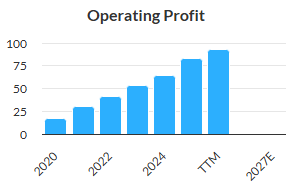
Despite this concern, I can’t ignore Volex’s strong track record in recent years:
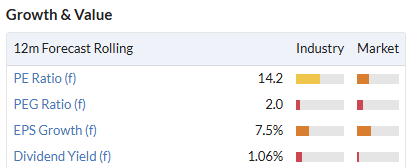
I think the valuation also remains reasonable, albeit not cheap for an industrial manufacturer:
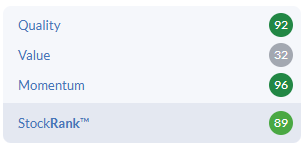
The StockRanks concur with my view, with High Flyer styling reflecting strong Quality and Momentum, with weaker Value:
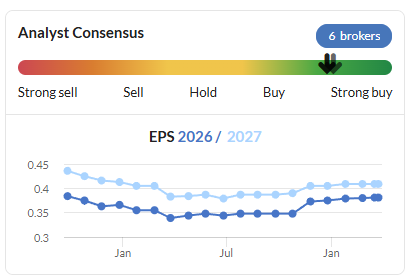
Broker forecasts prior to today suggested further earnings growth in FY27, albeit we don’t know if today’s upgrade to FY26 expectations will be carried forward to FY27 – unfortunately I don’t have access to any updated broker notes today:
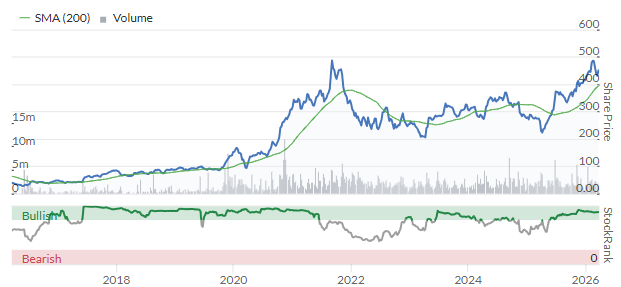
Following this morning’s gains, shares have almost doubled over the last year and have now returned to the previous record highs seen in 2021:
On balance, I don’t see any reason to change my broadly positive view today – AMBER/GREEN.
Pinewood Technologies (LON:PINE)
Down 7% at 219p (£252m) - Business Update - Roland - BLACK (AMBER/RED ↓)
After a promising start to listed life as a standalone software company, things seem to be going downhill at automotive group Pinewood Technologies. The company failed to agree a takeover in February and has today issued a profit warning due to delays with a major client project.
Let’s take a look at the key points from today’s update.
Marshalls Implementation: this is the bad news. Pinewood signed a five-year contract with Marshalls Motor Group in October 2024 to rollout its Pinewood.AI system across Marshalls dealerships.
To me (as a former IT engineer) it sounds like a nasty dose of scope creep has taken place, pushing back delivery:
Since then, Pinewood.AI and Marshalls have been working collaboratively across a number of key areas, including aligning with many other complementary technology projects that Marshalls is implementing to modernise its systems for the future. This integrated approach is designed to maximise the long-term benefits to Marshalls, once the Pinewood.AI system is launched.
Both parties have been focused on optimising the sequencing and efficiency of these key technology projects. This process has taken longer than originally anticipated, compared with the expectations set out in the 24 September 2025 announcement, but is expected to deliver a more effective outcome for Marshalls once completed.
The rollout to Marshalls’ dealerships was originally expected to start in Q1 2026 but is now expected to begin during the second half of 2026.
Based on the description above, I’d argue that Pinewood’s agreement with Marshalls wasn’t adequately defined – or that Pinewood has allowed itself to be drawn into unplanned work in an effort to keep a large client happy (Marshalls is owned by US firm Constellation Automotive Group).
I wonder if there will be any extra payment relating to compensate for the extra work? There’s no mention of this today. I wouldn’t bet against further delays, either.
North American System rollout: Pinewood is rolling out its system to Lithia dealers in North America (see here for the backstory on this).
Today’s update says the pilot is “performing as planned” but I think the main rollout may be running slightly late. Guidance today is for a full rollout “in the second half of 2026”. In September, the company said the wider rollout would start “in mid-FY26”.
Other news: a system implementation across Lookers dealerships is said to be “progressing to schedule” and “is scheduled to complete on time”, in Q4 2026.
Pinewood has also acquired its last remaining reseller, in The Netherlands, for £3.3m. This is expected to add around £0.7-0.8m in annual EBITDA. This sounds like a sensible transaction.
Updated Guidance
As a result of the change in timing of the Marshalls implementation, FY26 underlying EBITDA will be lower than current market expectations. The Board of Pinewood.AI also reaffirms its expectation that the Group will achieve underlying EBITDA of £58-62m by FY28. This is underpinned by good visibility from existing signed contracts and a strong pipeline of opportunities.
I don’t have access to any updated broker notes today and Pinewood’s management has not included details of previous consensus forecasts in today’s RNS. The analyst consensus link on the company’s website also goes to a 404 (not found) page!
However, a forecast from broker Zeus in September 2025 suggested FY26E adjusted EBITDA of £25.9m. As far as I can see, consensus hasn’t really changed since then:
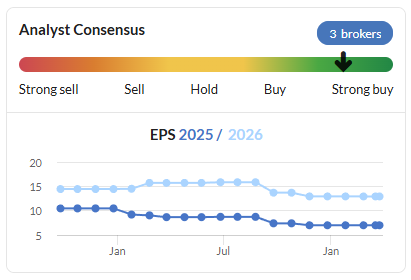
In the absence of further guidance I think it’s prudent to reduce FY26 estimates by at least 10%. That gives me a FY26E adj EPS estimate of 11.6p.
At a price of 222p, that still leaves Pinewood shares trading on a forward P/E of 19.
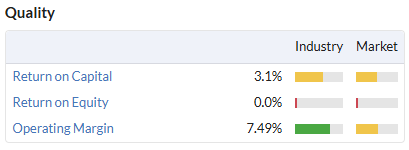
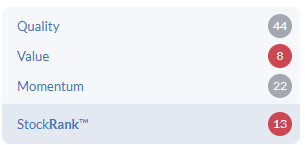
That seems quite a full valuation to me, given the stock’s low quality metrics:
Roland’s view
I’m struck by how far Pinewood’s share price and StockRank have deteriorated.
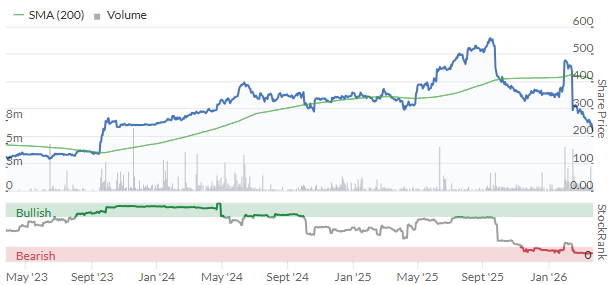
I think there could be an attractive business here, in principle.
But given the current valuation and uncertain outlook, I am not inclined to bet against the algorithms at this time. My feeling is that there could be a risk of further slippage on project timings this year. I’m cutting my view to AMBER/RED today ahead of April’s FY25 results.
Quartix Technologies (LON:QTX)
Up 15% at 245p (£118m) - Final Results - Roland - GREEN =
This AIM-listed vehicle telematics business has been fighting its way back to health since the return of founder Andy Walters in late 2023.
Accounting restatement: today’s results are complicated by a restatement of past accounts due to a change in the accounting treatment of telematics equipment supplied to customers. In short, Quartix now treats equipment supplied to customers as a fixed asset over which it retains control for its entire economic life.
Previously, such costs were depreciated over the average initial contract term for the asset (a shorter period). There’s nothing sinister here as far as I can see, but while cash flow is unaffected, the impact on certain aspects of the accounts is quite significant. Readers who are interested should scroll down to Note 9 in the footnotes of today’s 2025 results.
2025 results summary
Today’s results cover the year ended 31 December 2025. Quartix has provided restated figures for 2024 so we can see the relative effect of last year’s performance:
Revenue up 12% to £35.7m
Pre-tax profit up 34% to £8.7m
Earnings up 25% to 13.17p per share
Free cash flow up 102% to £5.2m
Total dividend of 10p (2024: 4.5p)
This performance was driven by a fairly strong operational performance, with improvements on all key metrics. I’ve pasted in the table from today’s results to save retyping:
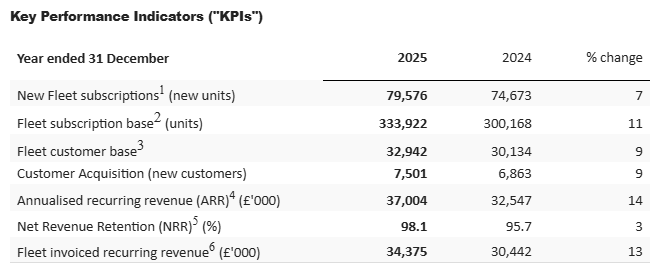
Some of the points I think are worth noting here include:
Customer acquisition and retention: net revenue retention rose to 98%, continuing a positive trend seen since 2023. New customer acquisition also improved.
Average fleet size remains small, at 10.1 units (2024: 10.0) - I've always hoped to see this grow a little faster, to move the needle on scale.
Customer churn improved to 22.8% (2024: 25.2%), measured by comparing new customers with the prior year-end fleet customer base. This suggests the average customer life is rising from c.4 years towards five years.
ARR per unit rose by 2.2% to £110.82, from £108.43 in 2024, although the company says that “price indexation, when averaged across the base, amounted to approximately 4.2% in 2025”. It’s good to see continued evidence Quartix can push through price increases in a business that’s quite competitive.
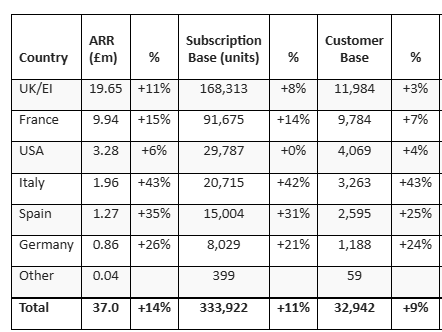
International growth: pleasingly from a longer-term growth perspective, Quartix continued to deliver growth in its European markets that was ahead of the growth seen in the UK, where it has a larger market share already:
Balance sheet and free cash flow: Quartix helpfully reports free cash flow of £5.2m today. I am happy to report that my own calculations show a very similar result of £5.0m (I also exclude lease costs).
The balance sheet remains in good shape, with net cash of £5.6m and no debt (excluding lease liabilities).
Profitability: today’s results show improved profitability metrics relative to the restated 2024 accounts – be aware that comparisons with the original 2023 accounts (and earlier) may no longer be entirely valid:
2025 operating margin: 24.3% (2024: 20.4%)
2025 return on capital employed: 25.3% (2024: 21.9%)
2025 return on equity: 19.4% (2024: 17.7%)
Outlook
Executive Chairman Andy Walters is positive but not specific in his outlook statement today:
We will continue to invest in developing and exploiting the many opportunities we have for growth through our channels to market in each of our current six target markets and we look forward to reporting on further substantial progress in 2026.
Fortunately, house broker Cavendish has published an updated note on Research Tree today making its forecasts more widely available – many thanks.
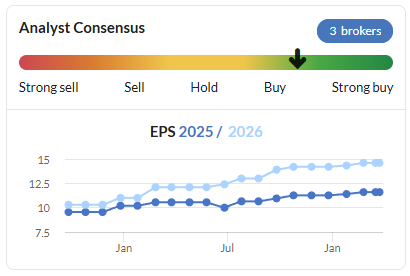
The broker has left FY26 forecasts unchanged today, albeit they already suggest a healthy level of growth relative to FY25:
FY26E revenue: £40.3m (+12.6% vs FY25)
FY26E adj EPS: 16.3p (+22.6% vs FY25)
It may also be worth remembering that expectations have been upgraded a number of times over the last year – perhaps this positive momentum can continue?
Roland’s view
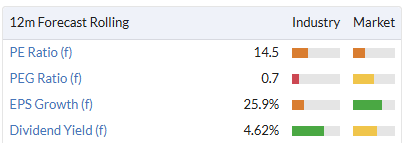
Today’s forecasts put Quartix on a forward P/E of 15. The stock’s High Flyer styling reflects the view that it’s not cheap, but on balance I think the valuation is still reasonable for the recent rate of growth. A PEG ratio of less than 1.0x provides some support for this view too, plus there’s a useful dividend supported by the group’s strong cash generation and net cash:
I have some longer-term concerns about whether the technology supplied by companies such as Quartix will be made obsolete by in-built tech in future vehicles, especially EVs.
However, on a medium-term basis I remain a fan of this founder-led business. I was GREEN in October – when the share price was higher – so I am comfortable leaving this view unchanged today, given the strong quality metrics and continued momentum.
RS (LON:RS1)
Down 4% at 561p (£2.7bn) - Pre-Close Trading Update - Roland - AMBER
Since taking charge of RS Group in Spring 2023, CEO Simon Pryce has spent almost £1m buying stock at an average price of 729p. Today, the share price is 560p. Should investors back Pryce – who has a record of engineering takeovers – after a difficult period for this business?
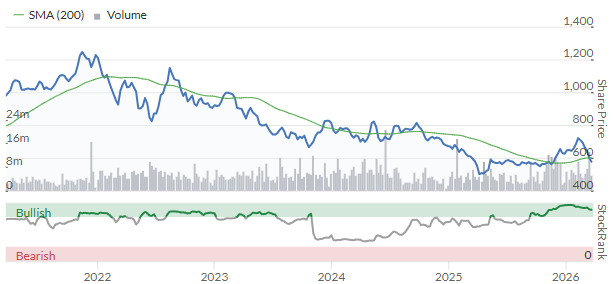
I’ve had an eye on this FTSE 250 industrial component distributor (formerly known as Electrocomponents) for the last couple of years, but have been unsure about its ability to return to growth in a macro environment that’s become less favourable.
Today’s full-year trading update seems to support the case for caution.
“Difficult markets”
RS now expects revenue for the year ending 31 March 2026 to fall by 0.6% on a like-for-like basis, warning that it has faced “difficult markets”. This is actually an improvement from the -1% LFL reported for H1, but hardly compelling evidence of a return to growth.
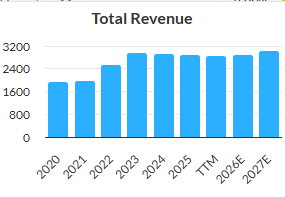
The good news is that adjusted pre-tax profit is expected to be marginally ahead of market expectations, which are given as being £241m (range of £230-247m). This has been achieved through “a solid gross margin performance” and some cost efficiencies.
According to the company, the main area of weakness is Mexico, with other regions performing more strongly or at least improving:
EMEA: quarter-on-quarter improvement through the year, expected “to return to marginal growth in H2 2026”. One contributor to the weakness in this region has been the automotive sector.
APAC: “continued momentum”, expect “increased revenue growth in H2 2026 when compared to H1 2026”. Unfortunately this stronger region is the company’s smallest contributor, generating less than 10% of H1 revenue.
Americas: this region is said to be particularly exposed to manufacturing output, due to its product mix. LFL revenue rose by 1% in H1 2026 but is now expected “to decline in H2 2026 as a result of the continuing challenging trading environment in Mexico”. In H1, RS said uncertain economic and political conditions in Mexico (including US tariffs) had caused several larger customers to defer expenditure.
CEO Pryce: takeover man? Simon Pryce may be familiar to former shareholders of Ultra Electronics and BBA Aviation. He was CEO of both firms prior to them receiving takeover offers.
I am not suggesting he will do the same at RS, but he does have form in this area. Having invested almost £1m of his own money in the stock, I would guess he is hoping for a profitable exit at some point.
What do the StockRanks say?
RS’s StockRank has made something of a recovery in recent months and is currently reasonable, if not outstanding:
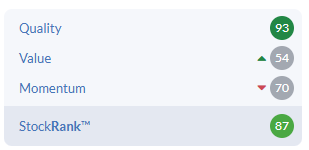
Valuation and quality metrics also look reasonable, if not outstanding:
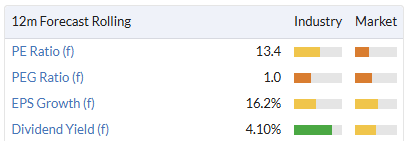
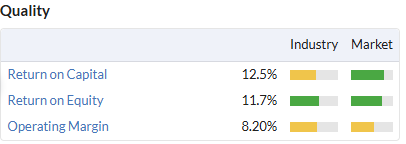
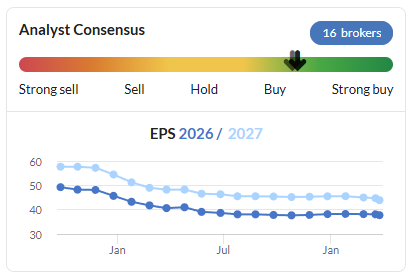
However, the broker forecast trend has been negative over the last year and I am not sure today’s announcement will be enough to reverse this:
More broadly, I might argue that profits are cyclically depressed at the moment, but I am not bold enough to feel confident that we’re at the bottom.
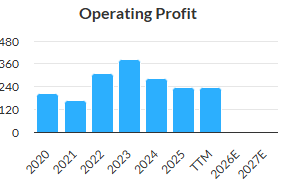
Given the geopolitical climate, I think there’s definitely a risk market conditions could worsen with a corresponding decline in earnings – this is a business that relies on high volumes to drive improved profitability.
Roland’s view
My research suggests RS1’s valuation is somewhere below its long-run average. In my view, the stock is approaching a level at which the value on offer is quite attractive.
One metric I like to use for this is the EBIT/EV yield, which strips out tax and interest costs to provide a whole business view on valuation. As a rule of thumb for most businesses, I tend to view 8% as a useful indicator of value, so RS is in the right ballpark.
Following our QVM methodology, I think the sensible move might be to wait for signs of positive momentum (especially improving sales) before committing to a long position here.
RS Group’s neutral styling probably reflects this:
Even so, I remain interested in this business (and a little bit tempted). RS remains on my watch list.
To reflect this I’m going to take an initial view of AMBER today, in the hope that I’ll be able to turn more positive in the coming months.
Disclaimer
This is not financial advice. Our content is intended to be used and must be used for information and education purposes only. Please read our disclaimer and terms and conditions to understand our obligations.

47 comments
Hi guys, are you catching up on Asos (LON:ASC) and Headlam (LON:HEAD) in the morning??
Many thanks
After all the to-ins and fro-ins, £QTX goes from strength to strength. How many companies do we know where the key part of the service, the little black box, is generating better and more customer-friendly productive information at a significantly lower cost. Not a lot. £QTX has fought its way back from a board without the founder investing in an ill-founded German purchase to the well balanced operation with plenty of scope for profitable growth in exciting markets. In particular, they have found a great opportunity in Italy and Spain, with progressive fight back organically in Germany and huge opportunity in the North America. The Chairman and founder puts great store on Customer Service and they have great scores on Trustpilot which will continue to be a major attraction to their target market - SMEs, based on tradespeople operations. In more normal times, I look forward to returns to the 300p+ SP which £QTX justifies.
Hi Graham. I firstly want to thank you, Roland et al for the continuing breadth and depth of your coverage - very impressive. Can I just revisit Journeo (LON:JNEO) one last time. Yesterday I was writing that the revenue 'growth' of 11% turned to c-4% organically if you strip out the CFDS acquisition. However, your piece above talks of only £4m of acquisition revenue and hence suggesting a modicum of organic growth. I am puzzled by this because I took my number directly from the results RNS under 'Operating company performance' where they say CFDS generated £7.4m revenue and £3m gross profit. Can you confirm which number is right?
Your overall assessment of the business looks reasonable enough, although personally I am a little put off by the three things that I have already touched upon, namely; 1. Too many small RNS and Reach contract announcements 2. Lack of clarity in reporting the underlying progress of the Group and 3. An acquisition outside their area of focus.
re: JNEO, sparkler, that is an interesting point you make. In the acquisition announcement, they said "With 4 months of FY25 remaining, it is expected that the Acquisition will add £4m revenue and £0.4m PBT to current FY25 market expectations which were Group revenue of £52m and adjusted PBT of £5.2m." So I am indeed puzzled that CFDS generated £7.4m of revenue in four months. Well spotted. This would push my estimate of their overall organic growth rate in FY25 lower, and their forecast organic growth rate in FY26 higher. I agree with you that they should be making this crystal clear for us. G
Geiger Counter (LON:GCL) (I own) story on Citywire suggesting the funds at CQS may follow exiting fund managers to Tufton ...which I would take positively for Geiger Counter (LON:GCL) that reacted negatively when this story broke. Let's hope for positive news.
Oil expensive will push into nuclear stuff.
US Bonds to my surprise give some room for optimism ... although MOVE has shot up to 105..... still much lower than recent levels a year ago where it reached 150 but was hovering around 125. So some volatility but nothing extreme.
Looking at the curve is quite interesting ...it has steepened ...but again nothing extreme. So short bonds.... <2yr 2 yr rates are below 4% at 3.7% and 3.88% which are lower than 10yr which is behaving at 4.33%. 30 year yields are the least well behaved at 4.9% and importantly spreads between inflation linked bonds and conventional are static suggesting inflation continues to average out between 2 and 3%. So the bond market has not moved to anticipate a much worse inflation backdrop but suggests less rate cuts at the margin. A deflationist would buy the 30 year bond.....but my equity conclusion from US bonds would be the current scare blows over and inflation is transitory. Ouch don't shoot the messenger. (The data will deteriorate in Q4 due to weak back data falling out).
However if the bond market is right and we see a ceasefire established - my conclusion would be the $weakness trend will reassert and this would be positive for emerging markets... so Fidelity China Special Situations (LON:FCSS) for example - trading at a discount and off its peak looks interesting. So do some commodity stocks - copper. So my current thinking are financials and EM for the exit trouble trade.
Just random thoughts but encouraging non-the-less.
Kenmare Resources (LON:KMR) results also came out today https://www.manilatimes.net/20... but no mention in table and missing on stocko?
Yes - another one missed = but no need to go to Manila too find the news - Its an RNS - on the Kenmare website and indeed on Stocko
Not linked to from the Kenmare page and missing from the table above, so I found it elsewhere...
Should of sold when the takeover rumours were circulating
Just a little note for those interested, I updated my 2024 "ISA ideas" portfolio. It aimed to buy good quality companies at reasonable valuations. I've set it up as a "permanent" portfolio, so I'll keep it running, making changes only where absolutely necessary.
How did it do? Abysmally! You can read more here: https://www.stockopedia.com/co...
Thanks for the link and it makes for interesting reading. Will do you a follow up in the spring of 2026.
Yes. It would be easy enough just to abandon it, but that's too easy. :)
I can't imagine many people rushing to the portfolio considering how badly it has done, mind.
Alas, the Smithson Investment Trust has disappeared and turned itself into an OEIC. A comparison is therefore difficult, although it probably outperformed my portfolio. The share price was around 1412p at the same time I started my own quality portfolio, and it delisted on March of this year, seemingly around 1426p, It restarted as OIEC at £10,000 at the end of Feb and now stands at 9321p. So there would have been a further decline.
For comparison, Lindsell Train Investment Trust (LON:LTI) went from £8.10 to £5.90 over approx the same period. That's a decline of 27%, which is pretty shocking. This is, coincidentally, the same loss as my own suggestions. Just goes to show.
Just copied this from another BB (hope this is ok) as I know a number of people here are invested in MS International (MSI:LN). This company doesn't appear to have benefited from the recent rise in the defence sector however, I am convinced there will be a lot of jam tomorrow! The company generally aren't the best communicators so it's sit and wait.
News in for MSI watchers. The Royal Canadian Navy has confirmed its River-class Destroyer, based on the RN's Type 26 frigate, will feature the MSI-DS Mk 38 Mod 4 30mm cannon rather than Leonardo’s Lionfish 30mm mounts. Canada will build 15 of these ships.
It’s a mystery to me that MSI has not issued an RNS as this must translate into revenues in the tens of millions? I believe this publication is preparing a piece specifically on MSI shortly, perhaps that will shed light: www.navylookout.com
MSI now serves four NATO navies and seems well placed to win a fifth: https://ukdefencejournal.org.uk/starmer-pushes-at-high-level-for-danish-type-31-frigate-deal/
Back on dry land, my hunch is that MSI’s self-contained, gun-based C-UAS platform will emerge as a preferred kinetic effector solution for BAE System’s Anti Threat System (BATS). This is BAE’s flagship ‘integrator/orchestrator’ counter drone solution designed to protect a city, an airport or an entire border from drones (https://defence-industry.eu/bae-systems-rapidly-develops-bats-counter-drone-system-to-protect-military-bases-and-critical-infrastructure/). BAE is developing this at pace “in response to strong demand”. I’d be interested in views from anyone with more industry/technical insight: could this be the game changer for MSI to participate in large scale C-UAS projects on a scale akin to the multi-billion dollar SAN project?
Trump Always Chickens Out. TACO.
Wish the UK, EU and Japan would stand up to him and levy reciprocal tariffs on the USA. China did this and he backed off.
The Chinese Goverment had the foresight to build a monopoly in the production of rare earths. They then used that as leverage to make Trump back down. The UK, EU and Japan took the easy option of assuming that Uncle Sam would always be nice to them.
Just for a laugh: the latest TACO change is being called a Trump de l'oil
Because they hold the rare earth minerals - China played the long game. Please don't let TDS take over the huge brain. There is some reason that Trump went full Iran. Their survival is due to many years of planning and being 'supported' - how the hell put a ballistic missile onto Diego Garcia - not Iran working alone. Maybe a country with the the capital letter C in front of its name - satellites, tech to confront the US of A.
What I find annoying is that after many many years of wind farm, global warming, solar power, net zero, no nuclear, Thunberg etc etc - oil suddenly becomes a thing to go to war over.
Anyway I'm looking at oil and not hand soap. Volex (LON:VLX) some light in the darkness, maybe.
James Latham (LON:LTHM) another company cannot get sorted early morning - TU just posted at 09.00 - but at least it's simply confirmation of existing estimates. Just seen - rwh3ue - beaten me to it!
James Latham (LON:LTHM) I hold
In line trading update this morning. PBT expected to be inline with market expectations. The new national distribution centre construction is on time and budget and expected to be fully operational by end of 2027. FY results to be announced on 2nd July.
Thanks for flagging this up rwh3ue and others.
I've now added James Latham (LON:LTHM) to the table - and also this morning's profit warning from Pinewood Technologies (LON:PINE).
Roland
ECB update includes several scenarios but an extended shock, ie straight remains closed - then GDP 2027 -1% hit and inflation 2027 will be too high ...c3%. It goes without saying the longer the worse....and more justification to raise rates to hold back inflation. So the ECB remains concerned about cost push inflation and continue to think a forceful monetary response is needed. Ie they are more concerned with inflation. Quite strong words that policy response will be swift...my take is this is positive bonds not equities at the margin. Obviously how things pan out is all important. The ECB obviously do not share Neil Woodfords view that a monetary policy response to high oil prices will just make the economy weaker than it needs to be. I don't think anyone would be surprised by the ECB stance.... they have plenty of form. The message was pretty clear. Bond yields are falling anyway today so it's hard to gauge a market reaction.
Perhaps a dumb/obvious question but can anyone explain how the Relative Strength figure is calculated?
Is it simply measured vs the actual index the stock is part of? e.g. if it's in the FTSE250 it's vs that, if it's in the AIM100 it's vs that etc?
Thanks!
The 1 Year Relative Strength measures a stock's price change over the last year relative to the price change of a market index. It shows the relative outperformance or underperformance of the stock in that timeframe.
Go to the screens page and then click on the various rules to get a definition. I believe RS is compared to the index the share is in.
Thanks.. but which index is it relative to? That's what I'm missing.
Roland, I am looking at the Cavendish note of 21 January 26. It gives expected adj eps for 2025 of 26.9p. Then yesterday's note claims that adj eps declined slightly as expected to 24.3 p. Did I miss a note or RNS in between these two notes?
qvg - it helps if you tell us which company you are referring to. I am guessing it is Journeo (LON:JNEO) as I was looking at the 21/1 Cavendish note yesterday. If that is the case then address your comment to Graham who wrote it, not Roland.
Hi qvg,
Re. the Journeo (LON:JNEO) results from Tuesday, I think Cavendish has actually made the situation slightly more confusing than it needs to be!
On 21 January, Cavendish updated its forecasts to show FY25E adj EPS of 26.9p.
Yesterday, Cavendish said FY25 adj EPS had come in at 26.1p (i.e. slightly below its previous forecasts).
However, Journeo didn't report adjusted EPS figures at all!
Journeo reported basic and diluted EPS, both of which are based on statutory earnings (i.e. not adjusted).
The company says the fall in EPS last year reflects new shares issued during the year and a higher corporation tax rate. The combined impact of these factors appears to have cancelled out a 13% rise in reported pre-tax profit to £5.6m.
Cavendish appears to have adjusted out restructuring costs, share-based payments and "other" to reach its adjusted profit figures (page 8 of yesterday's note).
I'm not sure why the broker would use adjusted EPS when the company doesn't itself, but personally I would be inclined to view the reported EPS figures as a more objective measure of after-tax earnings last year.
I hope this helps clarify the situation"
Roland
Roland, thanks for that. when I get a few minutes I will contact Cavendish and point out the confusion they are causing
@Roland Head/Graham
Hi Roland/Graham, re Journeo I can see from a fundamental point of view the attraction, and its had a great run. Personally though looking at the chart it looks potentially more like a stage 4 stock to me having had some topping between Sept and Jan resembling a stage 3 ( before the war started). Its trading now below its 200MA ( probably due to the war) but was exhibiting weakness before it.
A thank you to Graham, Roland, Mark and colleagues for their excellent coverage of the market during turbulent times.
Stating the obvious but most of weakness thus far YTD is FTSE 250 and Small cap plus US indices.... which are all down 5-6% compared to the FTSE 100 that has held in there - falling 0.23% when I looked yesterday. Despite my high cash I find myself in line with the weaker indices but not weaker. Never the less I would have expected slightly better but you have to be careful with small exposure that you aren't just capturing the low of a wide spread...that you recapture later as markets recover. I don't watch these numbers daily anymore because I have a decent feel for how things are going and obviously if you take a hit then this has its impact. I prefer to concentrate on thinking hard about whether I am committed to my positioning ...particularly if the conflict drags on and starts to meaningfully hold back the economy. Of course it's easy to get gloomy with red on the screen so during reprieve these are good times to reassess. Im pretty relaxed to be honest but where appropriate I am reducing large positions that are maturing and favour broader exposure given the volatility will accentuate negative news. Cyclical bias I was interested in can wait for the time being as I think news flow until after the summer could be unpredictable. The overall message here is that overall falls at the index level have not been that severe yet, all is not lost and a lot of weakness has been concentrated in areas like travel that are immediately affected. I top sliced a few BT (LON:BT.A) at 220 to finance a purchase and am amazed they were 10% lower 2 days later. I only mention it because in this market if there is a half decent sell order the stock will fall but unless something has happened it should recover....such is the nature of volatility. Bad days are -1--2% at the moment but were 5x this in GFC so it can get much worse but I am not expecting it to. Let's hope a solution to the straight arrives quickly and prevents real shortages emerging in Europe.... good luck all.
Despite my high cash I find myself in line with the weaker indices but not weaker. Never the less I would have expected slightly better but you have to be careful with small exposure that you aren't just capturing the low of a wide spread...that you recapture later as markets recover
Index bias is a problem for benchmarking portfolios, you'll struggle to beat the index in both bull and bear markets due to issues of survivorship bias, market cap weighting, costs and lack of reinvested dividends. Constructing useful benchmarks turns out to be quite tricky and time consuming.
We all like to mark our homework, but it's not always useful to do so.
More broadly there are significant pockets of value appearing in the market - particularly around housing, software companies and some financials. Obviousy, it's a tricky decision about when to go back in - if there's a ceasefire there will be a huge re-rating, but it's difficult to believe anything that comes out of Trump's mouth, even on the occasions when it actually turns into an understandable English statement.
timarr
My approach is to assess whether my portfolio is behaving as I expected.... the "homework" as you say, marks itself. We can chose how often to look at this and it makes no sense to spend all day marking it to market but I value taking a step back and thinking about how its going. Obviously with a decent cash balance you would expect that to make it easier to beat a falling index.....but it's not a guarantee. My main point was these indices haven't been as weak as you might think.
Obviously with a decent cash balance you would expect that to make it easier to beat a falling index.....but it's not a guarantee
I find exactly the same, and have in every downturn I've ever experienced. Possibly I just invest in terrible shares that aren't very resilient or perhaps it's something structural about how indexes are constructed. Probably a bit of both ...
timarr
A conversation for another time no doubt but in my world portfolios are constructed in the same was as an index but the weightings are different. That's active management.
Interesting discussion guys. I have also found it surprising at times that cash doesn't tilt performance favourably in a falling market. To be precise RD its weightings and volatility that deliver active management, but being a bit pedantic there.
Straight and narrow, RDH or Straits and narrow, because they certainly are that. They could almost throw hand granades, never mind drones and missiles.
Further to yesterday's comments, another reason why I'm mainly cash at the moment:
https://x.com/calvinfroedge/st...
The sooner this current US administration is gone, the better for ordinary investors in my opinion. There are enough headwinds in investing without the added complication of an overtly corrupt President.
Volex (LON:VLX) Super results and plans most likely to transfer from AIM to FTSE250. And Young & Cos Brewery (LON:YNGA) confirms transfer goes live end of April.
Luceco (LON:LUCE) A good set of results from this electrical manufacturer in a subdued construction market. EV chargers sales are strong.
I hold both, hopefully the Stockopedia team will find time to comment.
All the best
Brent down $4 as well, so hopefully a better day for the markets.
IG is showing FTSE 0.6% up and above 10,000 again
Roland, it's Wednesday 25th here in sunny Devon!
Apologies - thank you for pointing this out. Now corrected!
Roland