Daily Stock Market Report (Wed 27 Nov 2024) - HFD, ABDP, TEP, KETL, PETS, TUNE, EZJ, ATG

Good morning!
Today's report is now finished (12.30). Please feel free to leave any additional requests in the comments if there's something you'd like us to look at, and we'll try to cover some of them later this week if time permits. Have a good afternoon.
Explanatory notes
A quick reminder that we don’t recommend any shares. We aim to review trading updates & results of the day and offer our opinions on them as possible candidates for further research if they interest you. Our opinions will sometimes turn out to be right, and sometimes wrong, because it's anybody's guess what direction market sentiment will take & nobody can predict the future with certainty. We are analysing the company fundamentals, not trying to predict market sentiment.
We stick to companies that have issued news on the day. We usually avoid the smallest, and most speculative companies, although if something is newsworthy and interesting, we'll try to comment on it. Please bear in mind the "list of companies reporting" is precisely that - it's not a to do list. We have a particular emphasis on under/over expectations updates, and we follow the "most viewed" list of readers, so if you're collectively interested in a company, we'll try to cover it. Add your own comments if you see something interesting, and feel free to discuss anything shares-related in the comments.
A key assumption is that readers DYOR (do your own research), and make your own investment decisions. Reader comments are welcomed - please be civil, rational, and include the company name/ticker, otherwise people won't necessarily know what company you are referring to, if they are using unthreaded viewing of comments.
What does our colour-coding mean? Will it guarantee instant, easy riches? Sadly not! Share prices move up or down for many reasons, and can often detach from the company fundamentals. So we're not making any predictions about what share prices will do.
Green (thumbs up) - means in our opinion, a company is well-financed (so low risk of dilution/insolvency), is trading well, and has a reasonably good outlook, with the shares reasonably priced. And/or it's such deep value that we see a good chance of a turnaround, and think that the share price might have overshot on the downside.
Amber - means we don't have a strong view either way, and can see some positives, and some negatives. Often companies like this are good, but expensive.
Red (thumbs down) - means we see significant, or serious problems, so anyone looking at the share needs to be aware of the high risk. Sometimes risky shares can produce high returns, if they survive/recover. So again, we're not saying the share price will necessarily under-perform, we're just flagging the high risk.
Others: PINK = takeover approach, BLACK = profit warning, GREY = possible de-listing. Links:
Daily Stock Market Report: records from 5/11/2024 (format: Google Sheet).
Companies reporting
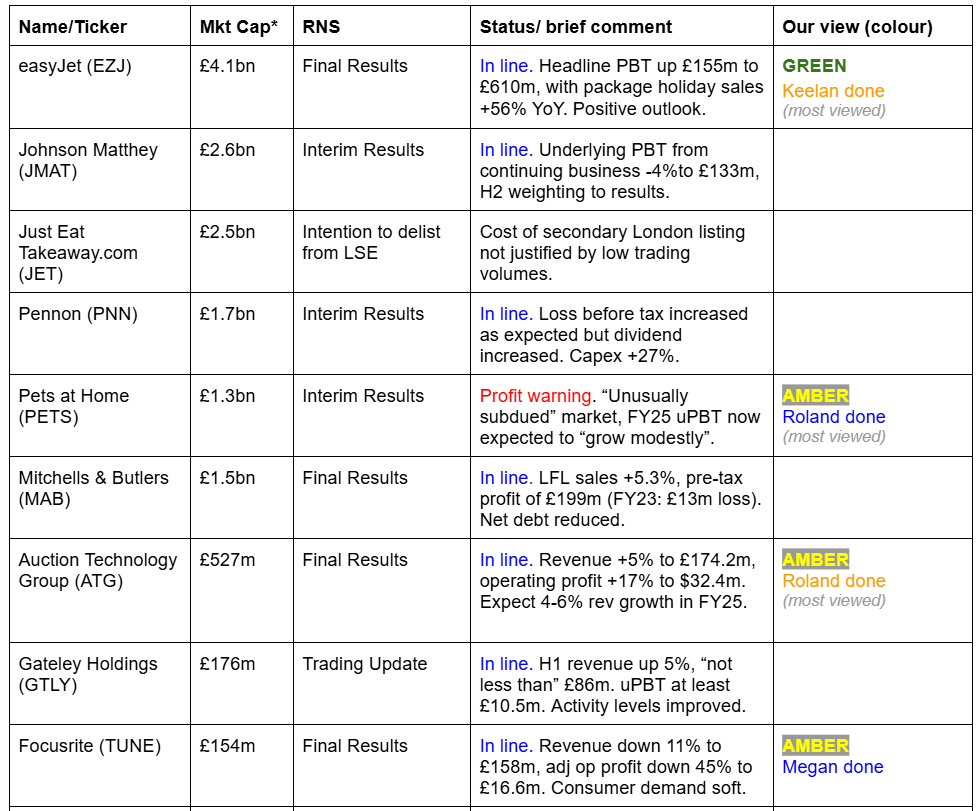
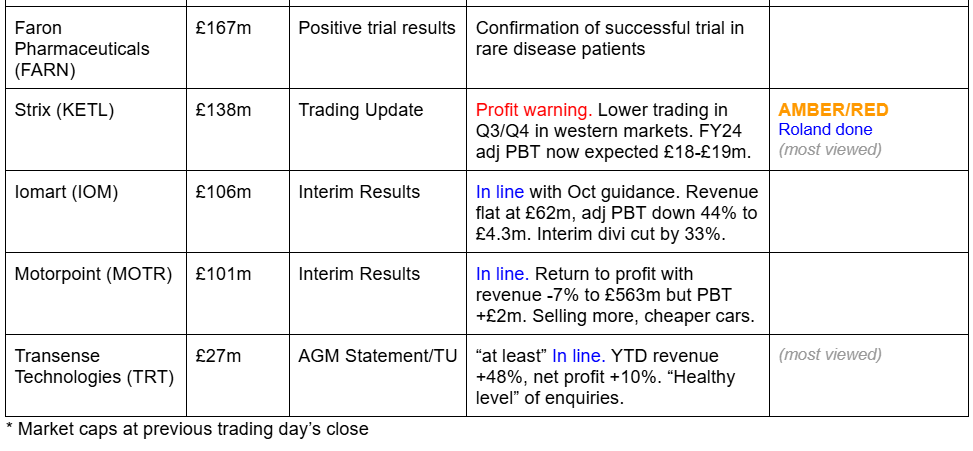
Summaries
Strix (LON:KETL) - down 9% to 55p (£128m) - Trading update - Roland - AMBER/RED
Another profit warning from the kettle controls manufacturer translates to a near-30% cut to 2024 earnings forecasts. While I can see potential in some elements of this business, I’m wary about the indebted balance sheet and unsure about the broader outlook.
Pets at Home (LON:PETS) - down 10% to 248p (£1.1bn) - Interim Results - Roland - AMBER
The pet and vet group has cut profit guidance for FY25, saying that subdued market conditions are continuing for longer than expected. However, underlying pre-tax profit is still expected to increase “modestly”. I can see some value here, but also several possible headwinds, so remain neutral.
easyJet (LON:EZJ) - up 1% to 545p (£4.1bn) - Final results - Keelan - GREEN
easyJet delivered robust FY2024 results this morning, with headline profit before tax rising 34% to £610 million, driven by a 56% profit surge in its Holidays division. The company is capitalising on fleet efficiencies and growth in package holidays. The company's dividend hike, growing cash pile and optimistic outlook put it in strong standing for 2025.
Auction Technology (LON:ATG) - up 17% to 515p (£627m) - Final Results - Roland - AMBER
Today’s results suggest trading could be strengthening into the new financial year. However, shares in this online auction software group don’t look obviously cheap to me and the balance sheet is not especially strong. At least one broker has trimmed FY25 forecasts following today’s numbers. I remain neutral.
Short sections
Halfords (LON:HFD)
Up 15% yesterday to 147p (£283m) - Interim Results - Megan - No colour
Flat sales and slight decline in underlying pre-tax profits were enough to send shares in beleaguered motoring and cycling retail group Halfords (LON:HFD) up 15% yesterday. Expectations are low for the company, which has had to warn of the fallout from weakening market conditions twice this year. Prior to this interim results announcement, shares had fallen to record lows. Consensus earnings forecasts for the year to March 2025 are now just over 9p, down from 19p at the start of the year.
Let’s be clear, these interim results are not good. The company reported a loss of market share in both its autocentre tyres and retail motoring divisions and only a miniscule gain in a severely weakening cycling market. Pre-tax profits from continuing operations were down 17% and it takes some heavy and rather confusing adjusting to help the company report only a 2% decline in what management calls ‘underlying’ pre-tax profits.
And H1 is the profitable half of the year. In the coming months the company will have to stomach additional freight charges, while the rollout of new ‘Fusion’ stores will force the temporary closure of some Autocentres, at an estimated £1m cost to revenue.
The company has also confirmed that the national insurance and minimum wage hikes announced in the budget will add £23m of additional labour costs in FY26 alone. That’s equivalent to about 40% of net profits. A spokesperson for the company confirmed the rather large figure for a company that employs about 12.5k staff and noted that unlike some other retailers, Halfords’ financial year aligns with the tax year so staff cost increases will have a full year impact.
Megan’s view
I can offer a consumer perspective on Halfords because as an investor this is not one for me. I am a very keen cyclist and I like to spend money on cycling gear or gadgets or trinkets for my bike. My bikes also need quite a lot of care and get taken into a shop about once a year for a general service - which normally ends up costing more than I would like (and often more than I spend on servicing my car). But I have only ever bought one thing from Halfords bike shop - my Boardman bike.
The problem Halfords has is that even consumers like me are not loyal. Both bike and car maintenance are hugely fragmented markets and customers are more likely to take their vehicles into shops that are convenient for them. In the retail space, they’re also competing with companies that have fantastic online offerings - Wiggle, for example, which is owned by Frasers.
As a consumer, I can’t see how management can halt the downward trajectory at Halfords without a major overhaul of the strategy.
A contrarian’s view
From an investment perspective, Halfords is certainly a contrarian pick and it’s marked as such by our StockRank Styles.
Both its forecast earnings and dividend yield around 6%, which is tempting if those forecasts are achieved. Margins are wafer thin, but there has been a little improvement at the gross level in these numbers. The opportunity presented by the ‘fusion store’ concept could provide further support to the margins. The balance sheet is nothing to write home about, but it’s fine, with net gearing at a modest 57%.
If the company can continue the pattern of delivering against its expectations without another warning, its shares might have been oversold. But with market conditions still very weak and big staff costs coming down the line, the current forecasts could still be a bit too optimistic.
Ab Dynamics (LON:ABDP)
Up 2% yesterday to 2069p (£466m) - Final Results - Megan - GREEN
Since its searing pre-pandemic highs, Ab Dynamics (LON:ABDP) has paid the price of its US tech stock-like valuation. Its price to earnings multiple rarely falls below 30x, which means the car testing company must deliver phenomenally impressive numbers consistently to prevent punishment. And because it is somewhat at the mercy of the automobile industry, it has been punished a number of times in the last few years.
There hasn’t been much to complain about in the year to August 2024. Revenues rose 10% to £111m and adjusted operating margins were almost 2 percentage points higher than the previous year at 18.2%. Like many companies, AB Dynamics does insist on stripping out amortisation of acquired intangibles from its underlying profit figures. When they’re included, operating profits were flat and margins slightly down at 11.5%.
But adjustments in the income statement can be forgiven when the cash flow statement is so impressive. Cash inflows from operating activities rose 39% to £26.9m, equivalent to 109% of operating profits. The company’s net cash position is now £28.3m, even after £17m of acquisitions completed in the year.
Acquisitions have proved both a blessing and a curse for AB Dynamics which, under the tenure of its founder Antony Best, grew largely organically with whopping margins. Acquisitions made in the last few years have supported sales growth (revenues have risen at a compound annual rate of 22% over the last five years), but come at a cost to the company’s quality metrics. Operating margins have fallen from an average of more than 20% prior to the pandemic, to 12% in the last five years. Return on capital employed, which also always used to average 20%, now hovers closer to 10%. That puts the mega-valuation ratios harder to justify.
Still, it’s hard to deny that the acquisition strategy has been the right one. AB Dynamics now has a global presence in the vehicle testing and simulation market, which puts it far better positioned to benefit from the rollout of electric vehicles and autonomous cars. It also could make it a takeover target itself.
Megan’s view
I have struggled with AB Dynamics’ diminishing quality metrics, which haven’t been justified by growth while the global car industry remains challenged by supply chain disruption. But this year, the company might have turned a corner. As acquisitions become more embedded into the company and costs can come out, margins could recover.
Earnings forecasts have also been ticking up this year, which could be a positive precursor to a change in momentum.
With a valuation like this, AB Dynamics is a risk - we know what happens when it fails to deliver and it has to deliver big to achieve any material share price rise. But I have belief in renewed growth at this former high flyer and am going with green.
Telecom Plus (LON:TEP)
Up 2% yesterday to 1800p (£1.4bn) - Interim Results - Megan - GREEN
Every time I look at financial results from Telecom Plus (LON:TEP), I think that I really should become a customer. This is a business which delivers fantastic service to its customers, making it easy for them to pay utility bills and delivering them long term cost savings.
Retaining customers for as long as possible is a good business strategy. It’s cheaper to upsell new services to existing customers than it is to win new ones and so when revenue per customer rises, margins also benefit.
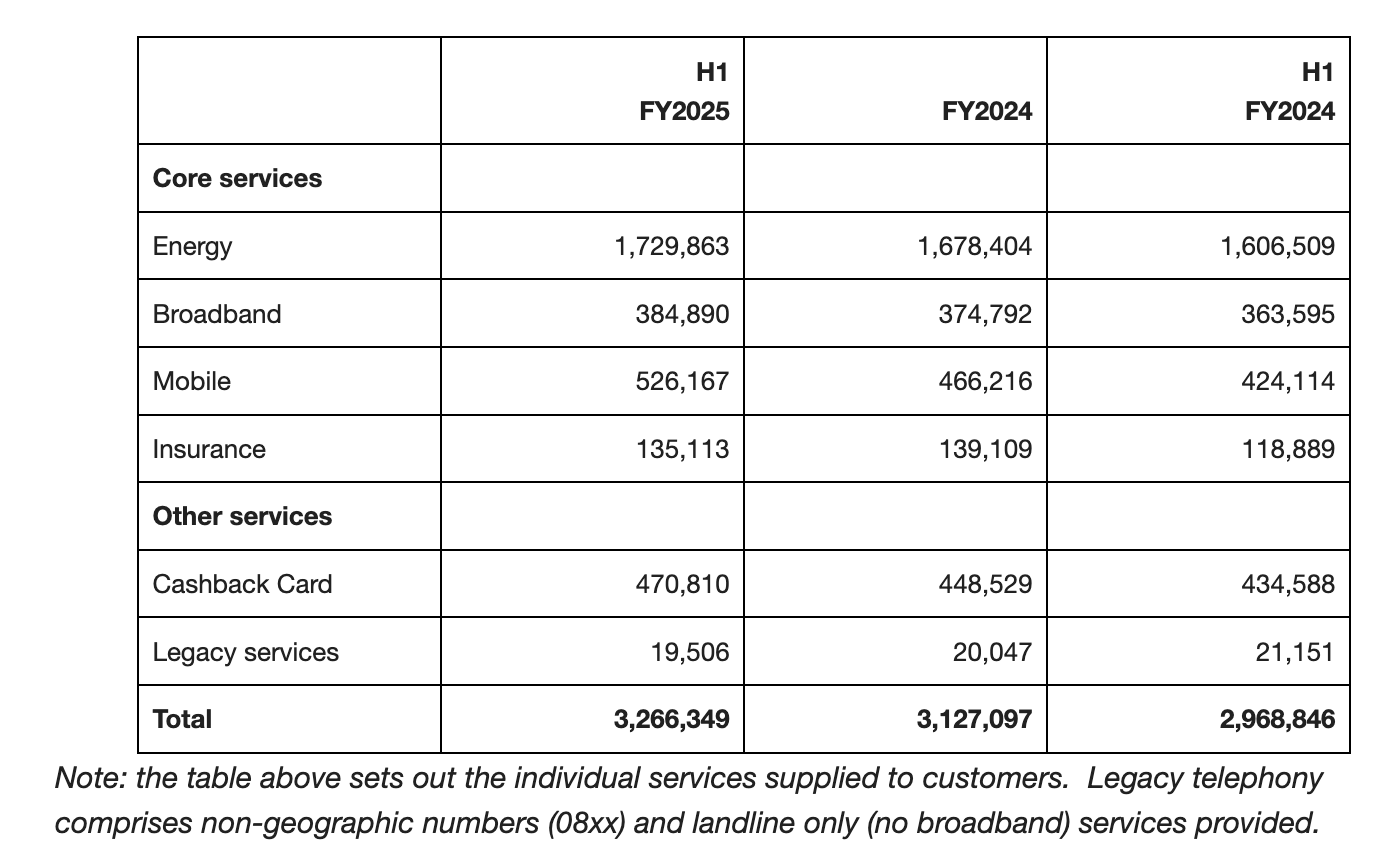
In the first six months of the 2025 financial year, Telecom Plus welcomed almost 66,000 new customers, sending total customer numbers up 13% to 1.08m. The table below shows the breakdown of customers across all of the company’s services. Note the rise in three of the four core services. Insurance services numbers were temporarily down while the company made a decision to renew its licences on four insurance products.
Revenues declined in the first half of the year owing to falling energy prices, but as this resulted in a greater proportion from higher margin non-energy businesses, gross profits were slightly up on the previous year. Operating and administrative costs were largely in check, despite the material inflows of new customers. The company has pencilled in £3m of additional staff costs from the national insurance changes due to come into effect next year.
After completing a £10m buyback scheme in the second half of FY2024, management has decided to revert its material cash generation back to the payment of dividends. The interim dividend was confirmed at 37p, but shareholders will receive an annual dividend of 94p, which is a 13% improvement on last year. At their current price, the shares are yielding 5.2%.
Megan’s view
Telecom Plus is an under-the-radar company which rarely causes controversy, but delivers pretty consistently for its shareholders. It’s unspectacular and not especially good value. A comment from a reader yesterday said that they had bought the stock at just 103p in 2003 - I can’t see the company replicating that kind of performance over the next 20 years. But I can see it continuing to pay reliable dividends and return its material cash profits to its shareholders. For long term income investors, I think this is green.
Focusrite (LON:TUNE)
Up 2% to 265p (£153m) - Final Results - Megan - AMBER
As forecast back in the summer, profits at audio products company Focusrite (LON:TUNE) fell materially in the year to August 2024.
Adjusted EBITDA (the company’s preferred figure of profitability) was 34% lower than the previous financial year at £25.2m. That’s in line with the guidance delivered during the summer’s profit warning, but below the £27m-£30m forecasts set out at the start of the year.
Adding back in the £8.6m of ongoing amortisation and depreciation, underlying operating profits were 45% lower at £16.6m.
A further £5.5m was booked as non-underlying amortisation and the company took a £5.3m impairment charge on the goodwill value of its Sequential acquisition. Focusrite bought the US-based synthesiser specialist in 2021, but with demand for higher priced products now lower than it was when the acquisition completed, the company’s growth trajectory is less than expected.
Reported operating profits were just £5.7m and the company reported earnings of just 4.5p, down from 38.4p last year and a 2021 high of more than 50p.
So what’s gone wrong at Focusrite - a former gem of London’s junior market?
The main issue is that market conditions have altered dramatically since the wonderful highs of the pandemic - when amateur musicians clamoured for music making equipment during the tedious lows of lockdown. This was reflected by the 19% decline in sales from the content creation business in FY2024. Acquisitions and investments made during that period are also not delivering against the expectations set out at the time.
The smaller business division - Audio Reproduction, which delivers sound systems for venues - remains in growth mode everywhere other than America. Acquisitions made in this division in recent years have bolstered its overall contribution so that it now makes up just under a third of overall revenue. This has also improved the company’s diversity of end markets.
Megan’s view
Looking at the numbers alone, it’s hard to get excited by Focusrite. Sales have fallen, margins narrowed, earnings missed, debt widened and return on capital declined.
The company is still cash generative, but as profits have fallen so sharply those cash inflows aren’t as impressive as they once were.
I am happy to stick with the numbers on this one and not get tempted by the price to earnings ratio of 14x, which is materially lower than the company’s history.
But for those who like a story stock, it is worth taking note of the company’s continued investment in new products which should help stimulate some better growth in the coming years. There is also the fact that the company’s founder Phil Dudderidge (who was the drummer in Led Zeppelin) remains the company’s chairman and its major shareholder, with just under a third of the business.
Amber for me, because I am trying to be disciplined (and story stocks don’t tend to deliver for shareholders). But there are things to like.
Roland's section
Strix (LON:KETL)
Down 8% to 55p (£128m) - Trading update - Roland - AMBER/RED
Bad news for holders of this leading manufacturer of kettle controls – it’s another profit warning. According to today’s update, the improvement in sales seen during the first half of the year (see our comments here) was a false dawn, driven by Strix’s customers restocking their pipelines.
Underlying consumer demand has remained weak and the company says that it experienced “relatively lower trading” in Q3 and (so far) in Q4. Demand has been especially weak in regulated markets such as western Europe and the US, where the company sells its highest-margin kettle controls.
Updated guidance: as a result of this weaker performance in H2, Strix now expected to report 2024 adjusted pre-tax profit between £18m and £19m.
Sadly, Strix’s management did not include previous expectations for comparison in today’s RNS. Fortunately, two updated notes are available on Research Tree today. With thanks to both Zeus and Equity Development, we can see that today’s update corresponds to a big drop in expectations:
Zeus: pre-tax profit cut from £23.6m to £17.5m (-25.7%)
Equity Development: pre-tax profit cut from £23.7m to £17.6m (-25.7%)
These new estimates drop out to give 2024 eps forecasts of 6.5p and 6.2p per share respectively. That’s a cut of around 28% from previous estimates of c.8.8p.
Both brokers are now forecasting broadly flat performances for 2025.
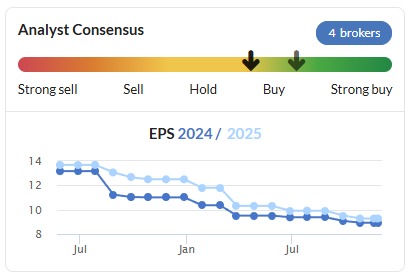
This extends a run of downgrades this year and means earnings forecasts for Strix have now halved over the last 12 months:
Dividend & Net debt: in its half-year results management said net debt/EBITDA leverage was expected to fall to 1.5x before the end of 2025. Today’s update doesn’t mention this target but confirms that “latest reported net debt leverage” is 2x EBITDA.
Significant cost cutting efforts are said to be underway to protect the balance sheet against a backdrop of weaker trading.
This level of leverage is said to be within covenant limits and does not appear an immediate cause for concern. But I think it’s still a bit too high, for a small cap that appears to be struggling to recapture past levels of profitability.
As a result, I do not understand management’s decision (reiterated today) to press ahead with the reinstatement of the final dividend for 2024, which I estimate will cost c.£3.2m.
Given that Strix's cash interest costs appear to be running at c.£8m annualised, I would have thought it far more prudent to use any surplus cash to reduce debt until trading stabilises.
Roland’s view
I was struck by a statistic in this morning’s ED note saying that Strix’s core kettle controls market is still trading 20% below peak 2019 sales levels.
I’m not sure what lies behind such a big drop in sales. While kettle controls are obviously a mature market (we all have one already), periodic replacements are necessary. One possibility perhaps is that consumers are delaying discretionary replacements (i.e. they are no longer replacing kettles that aren’t faulty) or else switching to hot water taps.
If the latter is true, then hopefully Strix’s higher-margin Billi divisions, which sells “hot water dispensing” products, should continue to do well. The half-year results already suggest that Billi is becoming as important as kettle controls in terms of profit contribution:
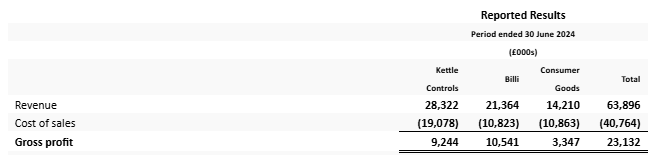
I think this is worth watching. But for now, I’m inclined to remain cautious on the investment prospects here. It’s not clear to me when (or if) the kettle controls market will start to recover.
In the meantime, I think the group’s elevated level of debt increases the risk of holding the shares.
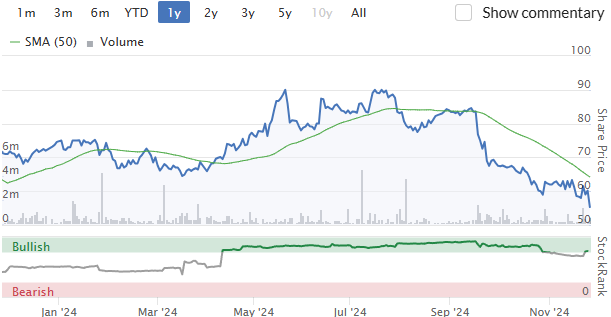
Strix shares have been weak since the interim results, perhaps pricing in a further downgrade. However, with the stock trading on 10x earnings and a flat outlook for next year, I’m not convinced the shares are obviously cheap right now. I’m going to maintain our AMBER/RED stance on this one.
Pets at Home (LON:PETS)
Down 10% to 248p (£1.1bn) - Interim Results - Roland - AMBER
Oh dear. Even Brits’ spending on pet care appears to have come under pressure this year. This has prompted a profit warning from Pets at Home, which has a 24% share of the £7bn UK pet care market.
we are operating in an unusually subdued pet retail market which we now expect to continue through H2.
As a result, the company now only expects modest growth in underlying pre-tax profit in FY25. Previous consensus cited by the company in May was for a figure of £144m. That would have been a 9% increase from the FY24 uPBT result of £132m.
Still, modest growth in this environment is not necessarily a disaster.
Today’s profit warning has left PETS stock trading at levels last seen during the 2020 market crash. Is value emerging here, or are there too many risks? Let’s take a look.
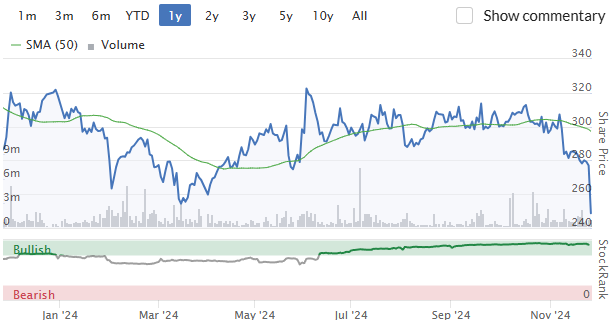
Interim results summary: today’s figures cover the 28 weeks to 10 October 2024. The financial highlights for the half year are actually okay, showing a decent recovery in profits from last year’s depressed levels:
Revenue up 1.9% to £789m, with LFL +1.6%
Vet group revenue +18.6%
Retail revenue +0.1% - “resilient against a declining retail market”
Underlying pre-tax profit up 14.1% to £54.5m
Net debt exc leases of £8.3m (FY24: net cash £8.8m)
The company says the rollout of its new digital platform has seen app sales almost double, vindicating a period of investment in IT. Similarly, a new distribution is also said to be working well, supporting “near record” availability in stores and greater automation of ecommerce.
Pets at Home’s business model is built around offering a full vertical range of pet services to owners, with benefits for loyalty and a seamless in-store/online offer. The company’s loyalty club offer seems to resonate with many customers and membership rose by 3% to 8.1m consumers in H1.
New pet registrations with the company’s Vet Group remained “robust” at 18k signups a week.
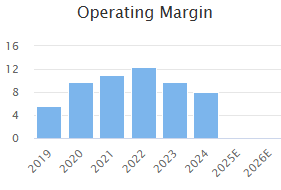
Pets’ hybrid vet/retail model supports much higher operating margins than a pure retailer would be likely to command. The half-year results show an operating margin of 7.6%, up from 5.4% for the same period last year. This is still below past highs, but is at least trending in the right direction again:
Cash generation is generally reasonably good, too, in my view. These half-year results show free cash flow of £33.8m. The company says this represents 61% of underlying pre-tax profit. Personally, I think a more useful metric is that this free cash flow gives 90% conversion from reported after-tax profit of £37.6m.
In general, I often find that reported profits are a closer match to free cash flow than adjusted figures, hence my general preference for reported profits.
Updated FY26 guidance: Pets at Home’s H1 performance was clearly an improvement on last year. Unfortunately this rate of improvement isn’t expected to continue in H2.
The company says “pet retail market growth has been subdued for longer than we anticipated” and believes this situation will persist through the remainder of the current financial year (y/e March 25).
However, capex plans have been cut by £5m to £55m and management expects free cash flow performance to be relatively stronger for the full year.
The company says it continues to expect that pet market growth will return to its long-term rate over time, supporting a return to profit growth:
we are confident that market growth will improve in future, supported by long established and unchanged structural growth trends and a stable but higher pet population. As growth returns to historical long-term averages of c4% (c3% Retail and c5% Vets) in future we would expect to deliver revenue and profit growth in line with our medium-term ambition
Outlook: the consensus trend chart shows us that analysts’ estimates have been trending lower for most of the year:
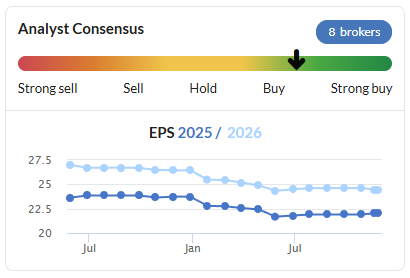
I don’t have access to any updated forecasts today, so we’ll have to wait for new consensus estimates to trickle through to the StockReport.
However, based on uPBT guidance, I think it’s reasonable to expect underlying earnings to be similar to last year’s figure of 20.7p per share.
Assuming a figure of 21p per share leaves PETS shares trading on a P/E under 12. Dividend forecasts also suggest a possible 5.5% dividend yield, still covered by earnings.
Roland’s view
At face value, I think Pets at Home could be decent value at current levels. The balance sheet seems fine to me and the company’s whopping 24% market share ought to mean that it remains a strong competitor in the future.
However, there are a few factors that concern me.
Growth timing: the post-pandemic decline in profits may still be ongoing. Certainly, the market has not yet returned to growth.
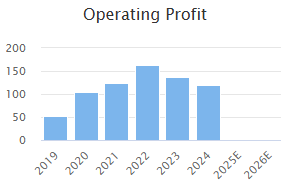
Regulatory risk: the Competition and Markets Authority’s investigation into the big pet care chains is ongoing. We don’t know what the outcome might be, or if it will have any impact on the profitability of PETS vet business.
The Vet segment generated two-thirds of H1 profit. In my view, it’s really the engine that drives PETS superior profitability and potential attraction as an investment.
Budget impact: planned increases to National Insurance and the minimum wage are expected to cost PETS £18m in FY26.
The timing of PETS’ financial year means that like Halfords (see above), the FY26 results will include a full year’s impact from these changes, rather than a partial year as for some other retailers.
Conclusion: on balance, I’m going to stay neutral on Pets at Home for now. While there are several aspects of this business I like, I can also see the potential for further headwinds. AMBER.
Auction Technology (LON:ATG)
Up 17% to 515p (£627m) - Final Results - Roland - AMBER
This online auction software group owns a range of online marketplace websites and also provides a white label service used by many auctioneers. We’ve covered ATG a number of times over the last year, most recently in October when Graham took a neutral stance following the group’s full-year trading update.
Today’s full-year accounts should not theoretically have contained too many surprises, given the recent update. But Auction Technology’s share price is up strongly this morning, suggesting the market has found something to like.
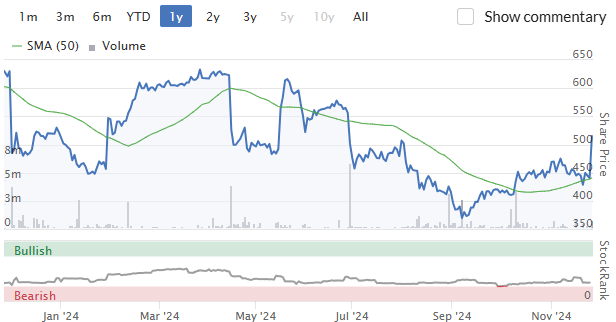
Final results summary: today’s results cover the year to 30 September 2024. Looking at the numbers, my feeling is that the rally we’ve seen today may be more of a relief rally than an upgrade.
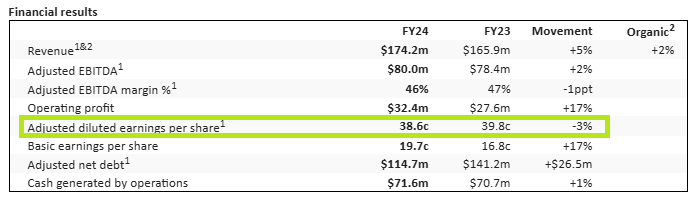
Full-year revenue rose by 5% (2% organic) to $174.2m, while operating profit was 17% higher at $32.4m.
This dropped through to a 3% fall in adjusted earnings, to 38.6 cents per share (FY23: 39.8c). However, this FY24 result appears to be slightly ahead of Stockopedia’s consensus figure of 35.9 cents, perhaps giving some investors confidence that momentum is returning.
Reassuringly, net debt fell by $26.5m to $114.7m last year, reflecting flat overheads and free cash flow of $23.9m. This demonstrates an excellent near-100% conversion from reported net profit of $24.2m.
No dividend has been proposed for FY24.
Profitability: Today’s results give an operating margin of 18.5%, up from 16.7% in FY23. That’s a respectable margin, but my sums suggest these profits only give a sub-par return on capital employed of 4%. This is due to the presence of $589m of goodwill and £244m of other intangibles on the balance sheet – I assume these are largely a legacy of past acquisitions.
As we’ve been discussing in the comments today, I don’t believe in ignoring these items. In general, they represent past capital allocation decisions by management. This is a personal choice, but it makes sense to me that we should judge profits relative to these past investments.
Operating performance: moving on, I find that it’s often useful to look at key operating metrics for businesses of this kind, as well as financials.
ATG listed 23.8m lots last year (+7%) and facilitated more than 88,000 auctions (+2%) and 390m web sessions (+16%).
The company says it has improved its differentiation and growth potential with the launch of a white label solution auctioneers can use, while still being able to list their items on ATG’s own marketplace websites.
A key metric for this business is gross merchandise value (GMV), on which most auctioneers levy a percentage fee.
ATG says that GMV fell by 11% last year, but improved as the year progressed with H2 GMV down by only 4%.
GMV is said to have turned positive in the first eight weeks of the current year, driven by a recovery in revenue from Industrial & Commercial sales.
However, the fall in GMV last year relative to the increase in lot numbers tells me that there was a fall in the average value of items sold, which isn’t ideal.
More positively, ATG’s take rate (% of GMV) improved last year, rising from 3.6% to 4.2% last year. This improvement was driven by improved take-up of value-added services such as shipping, payments and digital marketing. Such services now represent 24% of group revenue.
However, without further research I’m not sure how the company’s core auction lot fees have changed. Providing these add-on services carries costs too, after all.
Outlook: the words from the company sound positive. Trading in the first eight weeks of FY25 is said to have shown positive momentum.
For the FY25 full year, the company expects revenue growth of 4%-6% and adjusted EBITDA margin of 45%-46% (FY24: 46%).
However, these estimates do not appear sufficient to support previous broker forecasts in the market.
In a new note today, broker Cavendish has cut its FY25 earnings estimate by 8%, from 43.2 cents to 39.6 cents per share.
If this estimate proves accurate, then it would leave ATG’s earnings effectively flat for the third consecutive year:
This revised estimate prices the shares on a FY25 P/E of 16.4 after this morning’s gains. That doesn’t seem obviously cheap to me, given the slow growth.
Roland’s view
I have some familiarity with this kind of business through having used such services in a past life. Many (most?) bricks-and-mortar auctioneers now depend heavily on online auction tools to drive a significant proportion of their sales.
Instinctively, I would say that this ought to be a decent business to own, cash generative and able to deliver incremental growth.
However, I can’t ignore some of my concerns. I’m not familiar with the competitive landscape here and I don’t know how many serious rivals ATG has, who might threaten either margins or market share.
Past acquisitions have laden the balance sheet with intangibles and a reasonable amount of debt. While debt leverage of 1.4x EBITDA doesn’t seem excessive, interest costs totalled $12.5m last year. That’s more than a third of operating profit.
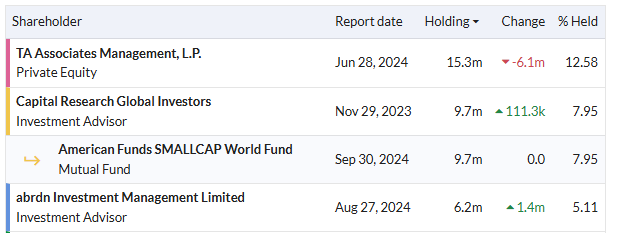
The company’s former private equity owner also seems intent on selling, having disposed of a 5% stake earlier this year. However, TA Associates remains the largest shareholder with 12%, so there could still be an overhang here that will drag on the share price:
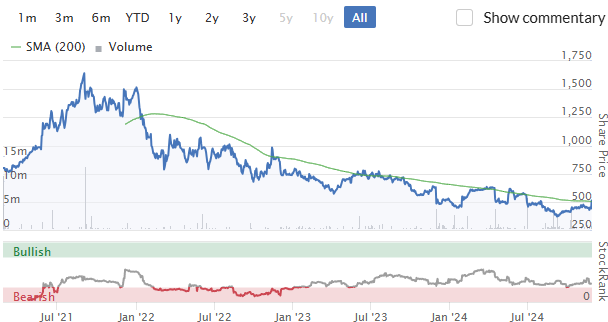
The shares themselves have been in a long-running decline that might not be easily overcome. Stockopedia styles the stock as a Falling Star in an additional warning, although I note the StockRank has improved (slightly) this year:
I think there could be a decent business here, but based on the evidence of these results the shares are not cheap enough to tempt me in. I’m going to maintain our view at AMBER.
Keelan's section
easyJet (LON:EZJ)
Up 1% to 545p (£4.1bn) - Final results - Keelan - GREEN
(Disclosure: Keelan has a long position in easyJet)
It was easyJet’s turn to publish some excellent full-year 2024 results this morning after IAG and Jet2 led the way with their respective updates earlier this month. Headline profit before tax rose 34% from 2023, reaching £610 million, a level slightly above the company’s prior guidance range of £590-£595 million for the year.
A large factor driving this growth in profitability is easyJet’s Holiday’s division. The division has seen a dramatic 56% increase in profit before tax, contributing £190 million in profits overall. The holidays division now covers more than 80 destinations across Europe and North Africa, with a collection of more than 5,000 hotels to choose from. Its rapid expansion has surpassed most expectations, with easyJet now forecasting a further 25% growth in its customer base next year.
The Holidays division is a key differentiator from its struggling low-cost peers, Ryanair and Wizz Air. Selling holiday packages is a far more profitable activity than simply selling plane seats. Incoming CEO, Kenton Jarvis, commented the following on the Holiday’s division strength:
"The outlook for easyJet is positive and travel remains a firm priority with consumers who value our low fares, unrivalled network and friendly service. The airline will continue to grow, particularly on popular longer leisure routes like North Africa and the Canaries and we plan to take 25% more customers away on package holidays, as easyJet holidays continues to thrive. I am looking forward to taking over the controls of this fantastic business in the new year and we still have a lot to go for as we progress towards our ambitious targets."
The fact that easyJet’s fleet is entirely Airbus has also benefited the business. Companies relying on Boeing aircraft orders are experiencing notable delays, a problem easyJet is not struggling with.
Whilst its peers are scrambling for additional seats and more fuel-efficient planes, easyJet has reliably secured its growth plans. A further 9 aircraft deliveries are expected next year, reaching a total fleet size of 356. The delivery of the new Airbus A320 neo aircraft this year helped save the company £25 million from cost efficiencies. easyJet is clearly becoming a leaner business.
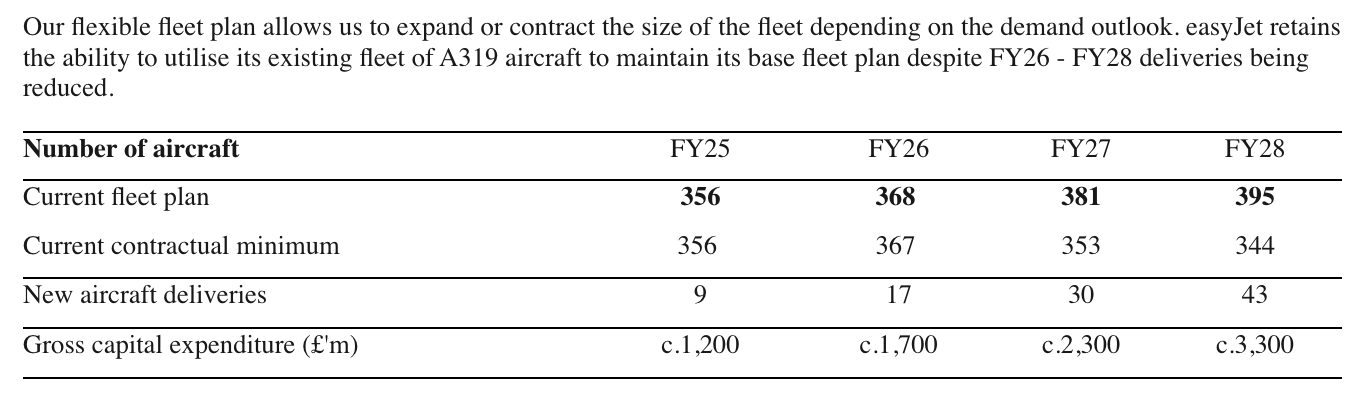
Source: easyJet FY2024 annual report
However, it appears that overall costs did increase by 14% last year, though, it appears most of this can be explained by the higher capacity and the expansion of easyJet holidays. Indeed, the headline Cost Per Seat (CPS, excluding fuel) experienced a marginal increase of 1% on 2023.
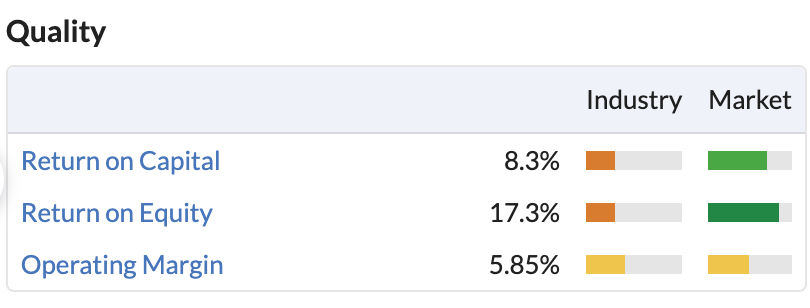
For FY2024, the company has produced a commendable return on capital employed of 16%. Provided there aren’t any significant operational disruptions next year, profitability could yet improve further, especially as fuel prices are expected to fall. You’ll see the profitability metrics and Quality Rank improve as the results feed through to the StockReport page tomorrow.
Moving to the balance sheet, the company is steadily building its cash resources now. easyJet’s cash pile grew from £41 million in 2023 to £181 million this year. This opens up the possibility of improved shareholder returns in the future. Broker Jefferies certainly thinks so, with a price target of 680p:
“We see a re-rating opportunity as easyJet benefits from a growing package holiday business, fleet renewal and self help opportunities through optimising winter trading and ancillary revenues.
The strong balance sheet and net cash position leaves room for upside to dividends in the next two years.”
Keelan’s view
There’s a lot to like from the results today, despite the muted response from the market. easyJet’s outlook for 2025 is optimistic, it’s firmly on track to achieve its medium-term target of £1 billion in annual profits and its Holidays division is defying all expectations.
Travel demand remains resilient, and as long as we don’t see any deterioration in the geopolitical environment or another global pandemic, easyJet is now in a good place to take advantage after fixing up its post-Covid balance sheet.
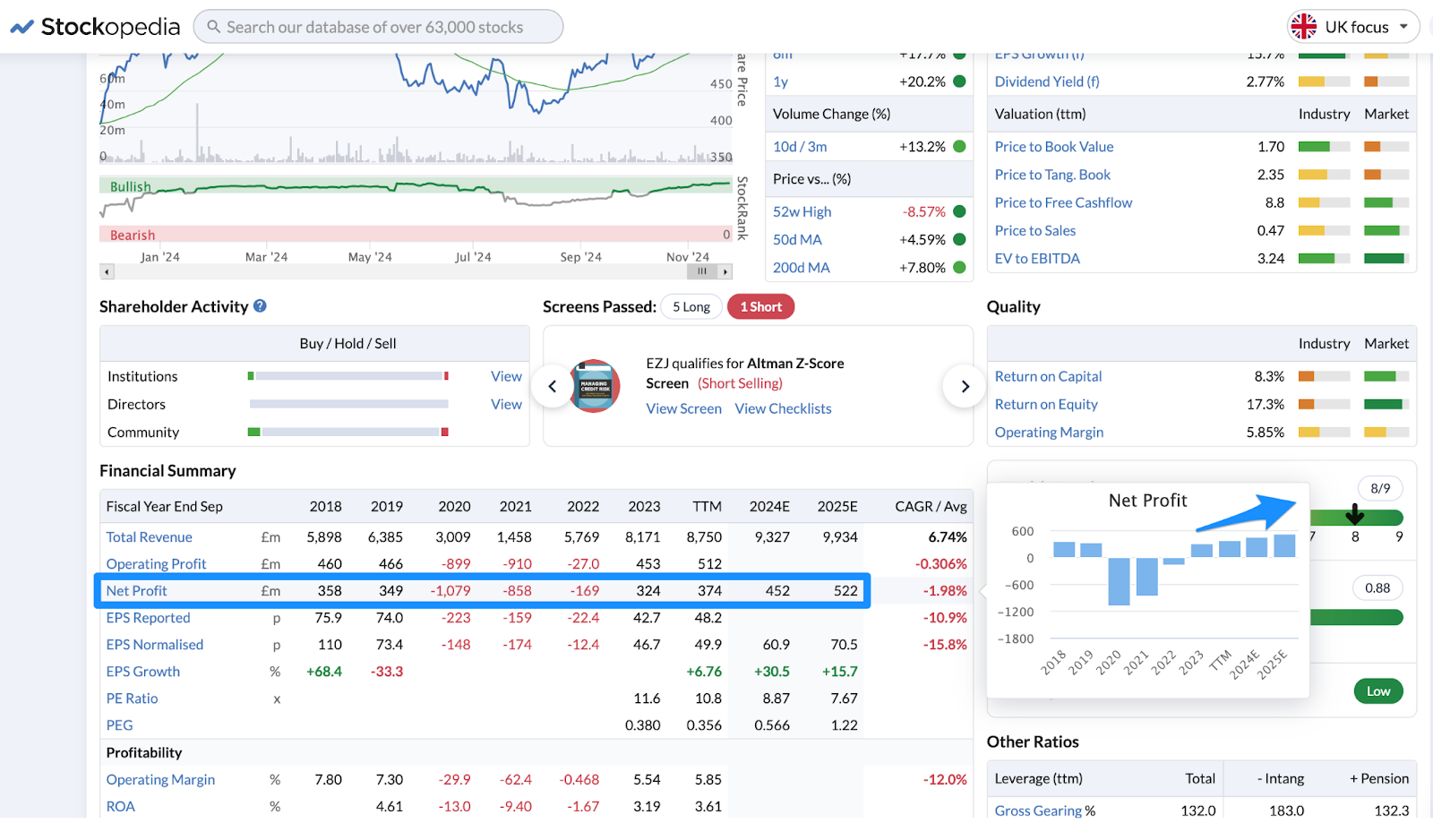
Whilst the share price momentum hasn’t really picked up compared to IAG or Jet2, the broker revisions in the coming days may offer some hope. Most notes have been positive so far this morning, and whilst the company didn’t provide clear visibility for FY2025, it’s likely to come in well above the £522 million currently forecast
A promising snippet I picked up on was that the winter losses are expected to fall. The company is adding more winter destinations to its Holidays offering, thereby reducing the impacts of its winter seasonality. This is especially important as this period erodes a significant chunk of the group’s profits each year. In H2 2024, the company achieved a record £960 million in profits, but the winter losses meant the total for the year fell to £610 million.
Any meaningful progress in reducing winter losses is likely to be well-received by the markets next year. In the meantime, investors can take solace in the fact that the dividend has been hiked from 4.5p to 12.1p.
Disclaimer
This is not financial advice. Our content is intended to be used and must be used for information and education purposes only. Please read our disclaimer and terms and conditions to understand our obligations.

88 comments
Norcros (LON:NXR) - Investor Presentation video recording now available (Interim Results)
Thomas Willcocks (CEO) and James Eyre (CFO) of Norcros plc hosted an Investor Presentation covering highlights of their Interim Results for the six months to 29th September 2024. The company posted resilient trading and market share gains in what was a challenging demand environment. The team discussed the strong momentum on their strategic initiatives across Portfolio Development, organic growth, operational excellence and ESG. Management provided a detailed financial review, including the strong balance sheet (leverage 1.0x underlying EBITDA), and answered a wide range of questions submitted by viewers.
Great new blog and chart features just released here.
Thank you to everyone for your feedback on market cap coverage today. We're always keen to hear from you to make sure we can provide the most useful content.
For clarity, here is a breakdown of the market cap coverage in the last three weeks compared to the first three weeks of October:
We have also just released a survey which we hope to help ensure we are creating the right content for you. Please follow this link to fill it in: https://www.surveymonkey.com/r...
With the greatest of respect Megan those tables mean nothing. So if you and the team “covered “ an RNS from Rolls Royce for example what would it entail ? Probably nothing more than a re jig of the headline numbers and Outlook statement and a personal opinion which would probably be dependent on your view of the Macro events affecting their markets. It would not include anything meaningful on their balance sheet or business valuation because that would be impossible to do without an awful lot of work.Which is nothing more than a subscriber could do for themselves. However “ coverage” of a small cap company like Creightons for example would be much more insightful and useful to a subscriber and could include a pretty good stab at an informed view on their balance sheet and business valuation.
I know which I would prefer.!
i came to exactly the same conclusion. Perhaps the contributors need to do an intensive course on forensic accounting or at least get invited to the sellside analysts’ briefings to add some value. Publishing summaries of the information in the RNS, a day late in several cases , and trying to say something meaningful about a large cap like Rolls Royce, ITV or BT, where they clearly have no real insight, is not worth £200 a year, IMHO. Investors Chronicle, for all its faults, does this already and covers many more companies, not that im suggesting we subscribe to IC! Your focus should be narrow and analytical, not broad and superficial.
Completely agree.
Your focus should be narrow and analytical, not broad and superficial.
I would also add, for me, whilst separate articles on US companies, mining stocks, and large caps can be interesting, particularly when they highlight an opportunity, the focus of the daily reports should be on small and mid caps.
I really like the metrics based approaches articles too.
David
Have filled in the survey monkey. There are places for feedback on what we want (all different) and not boring up personal opinions. There is a place for small, large, US, macro etc.
What do we want - make money.
When do we want it - now.
And what do we want to do with it (if lucky to have any) - our choice not govt, whilst paying 'fair' dues. It's not very hard.
It's very disappointing that the BBC have dropped market indices coverage, not so much because I used them, but because it's another sign of how divorced the stock market has become from the mainstream in this country (well UK plc at least, obv there's a growth in trading in crpyto, mag 7, the latest gamestop etc) . The excuse that the information is available elsewhere is true of virtually everything else the BBC outputs, I wouldn't expect them to drop football results or weather forecasts so why market indices.
I'm not surprised though because the BBC has, in my opinion, wound down it's business coverage over the years both online and on air. I used to listen to BBC 5 breakfast show back in the day, when it was a mixture of current affairs including a large dollop of business, and sport. They used to interview CEOs of FTSE100 companies on results day etc. Then about 15 years ago it went through what felt like a sharp pivot away from business and more towards human interest and societal stories. The business output dropped to hardly anything, unless it was bad news stories about layoffs or environmental issues etc. To be fair I haven't listened for about 10 years now so can't say first hand if that's still true. They still have "wake up to money" but given that airs from 5-6am it's hardly bringing finance to the mainstream and cannot respond to any of the days RNSs etc.
If you steadily reduce your output on a subject, give that subject less prominent links on your website, move what coverage you do have to less mainstream times of day, then surprise surprise fewer of your users and viewers appear to be accessing what you produce. And we end up where we are today.
Martinji, you have just described wokeness.
There's good coverage of world business news and comment in Business Matters every weekday at 1am GMT on BBC World Service. Indices have been covered before Farming Today on R4 at 05.40, but numeri changes make comparing indices unnecessarily hard - percentage changes would be more useful. BBC R4 Today covers business commentary from market participants around 0645 and major result news around 0715.
thanks, might try listening to some of those on catch up.
If you've got Microsoft, you can click on the Money box (if you click on Start) & get a ton of indices from all over the world, including Brent Crude pricing, and Sterling vs other currencies. Plus business news. I'm sure Apple has the same, or similar.
Just like to say that I am enjoying the commentary coverage.
I wonder if on the folios chart mapping whether a portfolio could be also pictured on the basis of its mixture of small caps/US exposure/ etc, as well as its other characteristics, as this seems to have some importance for weighting/risk profile arguably?
A couple of observations:
I welcome the wider coverage of stocks on this daily board. I have many large and mid-caps and I value the coverage.
It seems grossly unfair that criticism is heaped daily on Graham, Megan, etc. when it is Paul who has suddenly, without warning, done a runner.
My sub was and remains good value.
How do you know the reason Paul left?
I think most posters who miss Paul's insightful, sometimes quirky, analysis have been careful to say that this is NOT criticism of the rest of the team. Nor does requesting a focus on small caps imply such criticism.
To be clear the the reports from Graham, Megan and Ronald are excellent in my view. I think it's more a case of people giving feedback on the areas they prefer to be covered. I'm personally more interested in small and mid caps, with perhaps the occasional large cap if there's something particularly interesting.
John hi
that isn’t my experience ‘that criticism is heaped daily on the writers’, in fact lots of posters who have questioned the change in format, have made a point of praising the output and in my mind rightly so as the content is still great as are the data tools and the community.
in this new world a lot of users have lost their place of focus with the removal of pure small cap coverage, as that discussion board was the hub for nearly all subscribers (rightly or wrongly)
Holding anyone responsible for Paul’s sudden departure without knowing the details ? That really does seem unfair. (Although many have speculated). Am I annoyed yes, does it matter in the big scheme of things no. I’m happy to continue with my subscription.
What I would like is for the stocko team to communicate the ‘plan’. What’s the road map?Tools? Central hub needed? stock specific discussion trail, etc etc. I.e can they share their development road map?
I think that was the purpose of the survey. But like so often happens acting on the results of a survey doesn’t always capture what needed to change as opposed to what might be changed.
Whatever one’s perception of the situation this change hasn’t been managed well. Reading the temperature of comments, I think that that’s one thing everyone CAN agree on. That does fall squarely on Stocko’s shoulders. I also appreciate that the change ‘curve’ does dip before improving… so patience is needed.
So… other than what has been communicated already about the recent change, can we have a forum to discuss future changes for our platform? Can someone internally ‘champion’ feedback with subscribers and find tools/coding to achieve this? A list of potential improvements and a way to prioritise them.
Perhaps also a calendar of past improvements to help highlight progress for those considering their subscription? It could be an interesting exercise to repost that survey and compare the results?
My biggest worry would be that a reduced engagement with the daily discussion boards, will remove some of the magic of stockopedia, hence posting this highly subjective (and demanding!) :-) comment
This is meant to be constructive thou. I love the webinar’s about how to use the tools, or data driven investment strategies (Ty Ed, Megan, Mark et al.) if the team nail the social interaction for the different sub groups (e.g. small cap, investment trusts, resource stocks etc ) and provide great tools to achieve this. I think that could help with change in future and keep happy the myriad of different investor types that subscribe.
what do others feel would improve our community for investing interactions?
I'm in the same camp as this who don't want coverage of larger caps. I feel these stocks are very well covered elsewhere and has been pointed out, there are teams of full time analysts who do the same job as Stocko's talented and hard working team. Where's the advantage in trying to compete?
Small caps overall may not be enjoying their place in the sun right now but there are individual stocks that remain overlooked until they reveal their worth. If that is left to Paul, I guess I know where to find the information I'm no longer getting here.
I know there's more to this site than this daily report and yes, I do look at other threads, but is that enough to retain those who want small cap analysis?
Probably much easier said than done, but I would agree with the earlier comment re profit warnings.... ignoring short selling, we are all here to find stocks to own, so I would love to see the team's very considerable efforts focused on ' Greens ' where possible... I imagine that you already do that with picking those appear interesting / highly viewed, but a short section on Reds would compare favourably with longer depth on Greens ... I personally don't tend to read the Amber sections... as we're all very pressed for time...
Many thanks indeed once again for all your excellent, hard work...
Mid Caps, Large Caps, how far down the well can we go in what can be no more than an hour or two of study each day? Add America? oh dear.
Apologies, this company, Card Factory (LON:CARD), hasn't updated the markets today, but I had expected the company to have announced their US wholesale partnership, first mentioned in their September update by now. They had said they would be rolling this out for Christmas and announcing the partnership deal by a couple of weeks ago now. This led me to think there must be some issue with the deal, so I thought I would Google their US holding companies (announced in September): Cardfactory US LLC and Cardfactory US Holdings Inc., to see if I could find anything out, perhaps through US news. I found a link from a website called "ImportGenius" which listed the following shipments to Cardfactory US LLC (see below):
When I dug a bit deeper into the individual orders from each of the suppliers, it listed tissue papers arriving from Sri Lanka last week, gift bags arriving in July and October from China, and paper bags arriving from China in October from two different suppliers. It looks like the October shipment was quite large, but I don't know how much supply that many kilograms actually relates to in terms of revenue. Perhaps someone with wholesale buying experience can help us out with how much gift bag/paper bag product that looks like? It wants me to pay $199 for full access, which I don't want to do (sorry!) so there could be more as well. When I googled import genius's reliability google told me about Import Genius that all it's data is obtained through the US Freedom of Information Act and is considered public record. My initial thoughts are therefore that this data is probably accurate. I'm not too sure about what this will mean for profit but feel confident there must be some significantly sized initial US order/partnership even if we've been kept in the dark about it. Given the first shipment was in July then a large-looking shipment in October, and another shipment following on from that last week, it looks reassuring from my perspective regarding top line growth at least. (I hold).
Thank you for this forensic analysis of Card Factory - really interesting insights here, it's much appreciated.
Here is another list that is available without paying going to Card Factory USA LLC from Importgenius, although the weights don't seem to match and I'm not entirely sure why. Perhaps I'd have to pay to get the full data picture but I'm comfortable enough that they are shipping a significant amount of product to the US and I expect they will update us with the details in the Jan trading update at the very latest.
:
Very interesting data.
Greetings Cards, the final entry. Using an average card weight of 30g - 50g that’s between 290k - 480k cards shipped to the states from their factory, assuming the weight is container contents (it may not as column is ‘gross weight’).
Lack of small caps coverage contrarian thoughts .
- could someone from stickopedia take the time to reoly please , to my post just want to hear what the stockopedia position is ..
Graham / roland ?
Manage and set expectations so I can understand what the plan is
Hi planetx,
Thanks for your feedback. In terms of coverage, we're certainly aiming to maintain a balanced mix of coverage including small caps and larger companies.
The precise mix will vary sometimes depending on news flow and subscriber interest, but our intention is to maintain coverage of many popular small caps, as I believe we have been doing.
Regards,
Roland
Megan's comment "Like many companies, AB Dynamics does insist on stripping out amortisation of acquired intangibles from its underlying profit figures." - I have long believed that if a company is prepared to pay extra, goodwill, for an acquisition, then the reason has to be that the purchaser believes that it will get a return for its money, and therefore amortisation of the goodwill etc is a cost of making that profit and should not be added back.
Hi acdoug,
Speaking personally, I agree with you completely!
Fortunately, the StockReports show statutory operating profit, which is also used for our ROCE calculations. So these figures do include amortisation as you describe.
Roland
It seems logical to me that the amortisation of intangible assets should NOT be considered a valid adjustment to profits , in the same way that depreciation of physical assets should not be considered as a valid adjustment to profits. When either the physical assets or the intangible assets were acquired, then the company had to pay cash or shares for them, and the resulting depreciation or amortisation charges are a valid way of spreading this cost over a period of multiple years. If the adjustment to add back amortisation of intangible assets is considered reasonable, then it is like pretending that the intangible assets never had to be paid for. This is often a good way for directors to claim that their adjusted EPS targets have been met and that the directors large bonuses should therefore be paid.
The link below is what Simon Wolfson of Next (LON:NXT) has to say about excluding amortization of acquired intangibles from statutory profit measures in order to capture the underlying operating margins and returns of the company, which I concur with. Trading Statement
QARPY. Thank you for your reply about amortisation. I was hoping that someone would disagree with me, so as to test the validity, or lack of validity, of my view. I have read the Next statement that you linked to, and it has not changed my opinion. This is because the purpose of amortisation is to deal with the cost of acquiring intangible assets. It is not supposed to be a way of calculating the future value of the intangible asset.
I'll have a go - depreciation is a mechanism to avoid a company's assets being overstated as capitalised assets decline in value through wear and tear. That doesn't apply to a lot of intangible assets. As Wolfson says, many intangible assets actually increase in value. So by amortising you get two potential issues:
1. Assets are UNDERstated on the balance sheet
2. Profits are reduced by 'losses' that in any normal meaning are not losses at all.
I think I favour adopting a similar approach to that used in Goodwill and other purchase accounting intangibles - hold at cost and test for impairment
RupertEvans12. Thank you for your reply about amortisation. I was not really considering the effect on the balance sheet, and it looks like I should have thought about that. I was more thinking about the effect on profits. So let's imagine that we are dealing with a serial acquirer and the goodwill is amortised in the reported profits, but in the adjusted profits the amortisation is adjusted away. So, in my opinion, the adjusted profits are being overstated because the cost of making the acquisitions is being ignored. I think that it is unreasonable to ignore a real cost of running the business when calculating the profits.
I guess that we should also think about what happens to the cash. If the acquisition is paid for in cash, then that has been spent and that cannot be adjusted away in the cash accounts.
There are two considerations that are being conflated in some of these arguments - the value of the company, and the real profitability.
The VALUE of the COMPANY should reflect the true value of the assets, whether they are tangible or intangible. The problem comes with the subjectivity of valuing intangible assets, but if the brand, for example, is increasing in value shouldn't that be reflected in increased profits/equity, and cash, from the brand to justify an Increase rather than an Impairment of its balance sheet value. The same applies to Intellectual Property. Wolfson's issue about an acquiring company illustrates the inconsistency of accounting standards.
I maintain that the PROFIT should reflect the cost of achieving it, and I don't think Wolfson's argument that it should be written of if/when the brand is sold gives a realistic assessment of the ongoing profitability. It seems that a lot of financial directors like this approach because it boosts their adjusted profits
Acdoug. Thank you for your reply. I agree with most of your comment, especially "I maintain that the PROFIT should reflect the cost of achieving it." And when the amortisation is adjusted away, then the profit does not reflect the true cost of achieving it.
For many investors (such as myself) the the intrinsic value of the company would be calculated as profits x PE ratio. In this calculation, both the profits and the PE ratio would be increased as a result of owning the brand. So ownership of the brand has a big effect on the value of the company. The value to the company of owning a successful brand can often be far more than might be estimated by looking at the balance sheet.
I think both ways have value - would that assessing companies were as simple as looking at one metric!
Looking at EBITA (operating profit before deducting amortisation of goodwill) relative to net assets employed (on a debt free, cash free basis and excluding goodwill arising on consolidation) gives a guide to how much additional capital might be required to fund future organic growth. Including goodwill on both sides of the calculation obscures this, particularly if acquisitions are only an occasional, incidental feature of the group's strategy.
Looking at statutory profit (after goodwill amortisation) relative to net assets including goodwill gives an indication of whether past acquisition activity has earned a decent return on investment. It is particularly relevant when acquisitions are frequent and a core element of the growth strategy.
Surprised Ab Dynamics (LON:ABDP) gets a green rating with the risks involved. There have been big falls in the past. Note one director sold over £4m of shares recently. Note big fall after large directors sales in 2019.
Thanks Megan for covering Ab Dynamics (LON:ABDP). I have held since IPO at 86p (current price 2080p) but have topsliced many times over the years as they always seemed overvalued. I have just listened to their results presentation on the Investor Meet Company platform. I recommend the recording (when available) to anyone interested in the company. It contains a detailed and well argued case for their new medium term (3 to 5 year) plan to double revenue and triple profits with regulatory tailwinds supporting organic growth and strong cash generation funding bolt on acquisitions. This could be another Diploma (LON:DPLM) (whence, not coincidentally, their CEO was recruited several years ago).
Rusty2 is right to highlight the risks as there is a significant capital goods element in sales (although much less than at IPO, with recurring revenue now 45% of sales). I think the comment on director sales is less fair because these were by the now octogenarian founder and his wife who are no longer involved in management and who waited many years after the 2013 IPO to reduce their holdings.
The company has a long track record of profitable, cash generative growth. Its margins and return on capital went through a dip because covid related disruption to its customer base coincided with a transition from founder led to professional management which involved the addition of overhead to support the next stage of growth. At c30 times earnings, it's certainly not cheap. I now have a difficult decision between sell, hold or even buy more!
Hi both,
Thanks for your comments on AB Dynamics. I agree, it certainly is a risk and I'm with you SheriffJEB with not quite knowing what the right course of action is here.
The new CEO is not of the same calibre as the company's founder and he takes a big salary which I don't especially like. It's frustrating that it has become a higher risk company, when it was previously a solid, high quality deliverer of impressive profits.
But on balance I do believe that the challenges that have been posed by the wider car manufacturing industry are those that are the biggest threat. And that means the company should benefit from the upside in that industry too. There is no denying we're going to need plenty of good safety testers with more EVs coming through development and maybe even some driverless cars.
Thanks Megan for taking the time to reply about Ab Dynamics (LON:ABDP) .
I was lucky enough to attend a Charles Stanley organised factory visit and management presentation pre IPO in 2013. Tony Best was indeed impressive but already 76 years old then, so management succession was a key risk in my investment assessment at the time. Like many small, very profitable, owner managed businesses, Ab Dynamics (LON:ABDP) at that time was run on a shoestring as regards overheads, structure and process so the operating margins were not, in my view, sustainable for a PLC with substantial growth ambitions. I was encouraged when Dr Routh was appointed in 2018 with a Diploma (LON:DPLM) pedigree. There is always a worry that this process overburdens a small company with excessive, big company style overheads. My impression is that he has got the balance right - although I confess that I had not picked up on the excessive remuneration you mention. Would that a similarly sound transition had happened at Gooch & Housego (LON:GHH) when the even more aged Archie Gooch went. I think there's a similar issue at Cake Box Holdings (LON:CBOX) where post IPO accounting difficulties probably reflected the tricky transition from successful founder managed private company to PLC: margins going forward at Cake Box Holdings (LON:CBOX) will be more like those of the last couple of years than those immediately before and after IPO
Regarding automotive industry related risks, this morning's presentation pointed out that Ab Dynamics (LON:ABDP) is not directly exposed to the slow down in car sales and production. Their products and services are linked to the development and testing of new models which continue at pace. However, there is an indirect exposure because if sales continue to disappoint, eventually expenditure on new models will be scaled back or deferred.
Morning all - just a reminder that we are hosting Investor Presentations with live Q&A later today with Norcros (LON:NXR) at 10am, and Speedy Hire (LON:SDY) at 2pm - the links to register are below.
Norcros: https://www.equitydevelopment....
Speedy Hire: https://www.equitydevelopment....
Greggs (LON:GRG) have 32,000 staff, if budget changes will cost around £2k per person, that is £64m, how can Greggs cover that by a few pence increase in prices? That is around 45% of their net profits.
I believe 1k per employee is a more accurate estimate of NI changes so a 32m hit to profits, which would be just a 1.5% increase in prices on their 2.2 billion of revenues
It is not just NI, it is wages as well. NI seems to be around £650. So increasing the prices by 1.5% will increase their profits by 15%? But then everyone else will be increasing their prices, so costs will go up even more.
Yes - that is exactly what the bond market is telling you Rusty2 - the increases in NI and min wage are inflationary so rates will be higher for (even) longer!!
As I tried to point out here when it was first announced big direct to consumer retailers/hospitality will seem to be hit hardest given the number of employees but because they are all in the same boat at the same time expect price rises to compensate. D2C has the benefit of being able to do this immediately with no lag and a number of large retailers/hospitality have already indicated they will do so. However, prices don’t need to rise anywhere near the %age of the NI/wage effect. In most cases it will be circa 2% - it drops straight to the bottom line and offsets the increase all other things being equal.
Conversely businesses with locked in contracts, or those that supply to other businesses may struggle to offset the impact immediately so this will take time to filter through. They will see reduced profits until they can pass on costs at which point the retailers etc will be forced to raise prices again.
So, in my view there will be a persistent drag on inflation for the next couple of years as this plays out but it may impact the businesses you think should be most impacted less and those you think would have less exposure more.
Lack of small caps coverage contrarian thoughts .
I do seem to be very much in the minority on here in readers who all seem to lapping up the coverage of mid caps. Large caps and even US stocks .
Have to say Im not a fan .
Before taking my bat and ball a way maybe stocko can clatify if this is now the general direction of travel and they have moved away from the small cap market (and left up to paul)
No problem if they have but may as well ask for clarity .
I find the mid and large cap coverage immeasurably tedious as these companies are pretty much well covered i so dont feel im finding out anything under the bonnet
Still love stockopedia but I want to be zapped not sapped and I petsonally just dont want to Learn about mi caos , large caps or US stocks because I can never have any as antage over the hiuge coverage already out there .
I like the small cap market if its off the radar / getting much reduced visibility here be nice to get clarity
Well said plantex . I observe from today’s report Telecom Plus (LON:TEP) a perfectly admiral company but it’s the same price as it was 10 years ago. I look to reports for companies which have greater potential and these usually come from small caps.
The value of Stockopedia however lies in the screens which one can set up to find and analyse companies off the radar of most discussions.
I have to say that I agree with planetx. Where this team can add value is by giving in depth comment on the small caps, which is likely to yield insights that are not already out there in the market. Having three analysts cover the whole market is spreading their output far too thinly and will add very little to what we can find out elsewhere in the market about the likes of M&S, Glaxo, Unilever etc.
So far I'm impressed by the diligence of Graham, Roland and Megan but please focus on small cap and lower end mid cap please.
I agree with all three comments above from Planetx, Richardho and sparkler, for the reasons stated. I admire Graham, Roland, Megan etc as talented analysts and for their diligence and hard work under time pressures but firmly believe that they can add most value by sticking to UK small caps.
I agree l'm not interested in uk large cap coverage on here, even if l do hold shares in them. I don't mind some interesting midcaps.
l also think there is too much coverage of profits warnings, seems nearly everyone is covered.
"l also think there is too much coverage of profits warnings, seems nearly everyone is covered."
I would agree and think it would suffice if the profit warnings were more selective or just covered in short sections at the head of the article. In the past this thread had in my view become too cluttered with very average shares and subsequent discussion on their decline.
I personally don't mind the discussion including some mid cap and larger shares if the overall move is towards a focus on better quality shares
I agree on the large cap point - I always think of something like Glaxo as essentially a portfolio of hundreds of different pharma companies. How would you even start to do a detailed analysis? The big brokers will have teams of people who are all over the company, so very unlikely that a retail investor can uncover something not already priced in.
Totally agree. I came to Stockopedia from Sharepad precisely because of the small cap coverage. It was different from everything else out there and has totally changed how I invest. The new coverage is very impressive in it's output but is adding very little value to my investing day. This means I have slowly started to reduce the amount of times I am coming onto Stockopedia.
The big issue is not what is or isn’t covered by the key writers on this thread. It’s the fact that far too many Stockopedia subscribers are one track minded in only looking at this thread, There are a wide range of superb threads on Stockopedia that see far fewer readers and replies in total than this thread gets in a single day.
Do readers of this thread realise these threads exist??
Use this link to see all the other threads and so wide range of topics covered on Stockopedia.
https://www.stockopedia.com/di...
Use this link to excellent threads including by Stockopedia’s own writers, including Ed Croft himself. Even those from Ed see fewer readers in total than this thread gets in a single day.
Occasionally I’ve done long posts on other threads that got few replies or none at all and no recommendations, so then reposted it on this thread to get over 100 recommendations and lots of replies. That surely is more evidence of the over popularity of this thread, and far too little interest in other threads, including not realising they exist.
e.g I’m a great fan of Investment Trusts. My namesake Charles Mitchell has set up excellent Investment Trust threads that he updates with a new thread every new month. Those threads too see fewer readers in a full month than this one gets in a day.
That’s the problem. It’s not what the likes of Graham or Megan or Roland or whoever post here. Writers on all the threads here should feel free to write whatever they like on investments. It’s up to subscribers to search out the threads we want to read here, and not to expect just one of them to cater for what they want to see.
I have been a successful fund manager for many years. I follow both small and large companies on the UK market. The large companies are certainly well researched but not everyone has access to that research. Generally the perfomance of larger companies has been much better than smaller companies. The AIM market has been a disaster largely due to the poor quality of many of the constituents. Many issue profit warnings and if you hold shares in such a company you want to hear Stockopedia's views on it. I am personally delighted at the larger coverage on Stockopedia. Don't ignore larger companies. The way you value them does not really differ from the way you value smaller companies. You don't need to know about every division of the business. Most of what you need to know is in the outlook statement. What Stockopedia is good at is condensing all the information available and drawing a conclusion. You then make up your own mind. On larger companies, you will have far less disasters and you will generally find their shares far easier to sell than shares of smaller companies
This seems a sensible and - temperate approach. It resonates well with me.
Paul - for all he is a brilliant analyst and exceptionally able to engage and connect with subscribers - is also a dyed in the wool risk-taker. The opportunity is there in small caps to strike lucky (or wise?) and get rich quickly in a way that is not possible with larger companies. The opportunity is similarly available to lose your shirt. Perhaps Stocko's apparently excessive focus in the SCVR on profit warnings is partly due to its past tendency to focus too much on risky businesses where profit warnings just 'go with the territory'.
I can understand that many subscribers who came to Stocko for its small cap coverage and, especially, Paul's daily commentary are unhappy with the direction that the site is now taking. I am far happier with the new direction than with the old, however. I believe many others will feel the same.
Well stated. Thanks. Even with two glasses of red would struggle to construct an intelligent response.
MBarnard.
Thanks for that reply. Interesting comment that “most of what we need to know is in the Outlook statement.” I agree but obviously it’s also a must to check further. e.g in my case as a keen fan of big dividend paying shares and Investment Trusts I always look for comment on likely future dividends as well as checking the figures for hints too.
As a fund manager I’m sure posts from you would be very well received on the Investment Trust threads here. The threads were set up and run by an ex fund manager, my namesake Charles Mitchell. There’s a new one every month. Here’s the link for the about to expire November thread:-
https://www.stockopedia.com/co...
Disagree; a balanced portfolio should have a selection of small, mid and large caps, and getting analysis on each of these from known and trusted analysts is exactly what I want.
Disappointing that the BBC has withdrawn its market data service yesterday, more so that to the best of my knowledge it gave no notice it was going to do this. Does anyone know of an alternative resource which summarises the movements in the major exchanges on one page, even if the data is delayed?
Google Finance is a good place to start and it is also free....live share prices as well.
To be fair, the beeb has had a message displayed for several weeks announcing the demise of the service.
You could try https://www.cnbc.com/markets/
The Peoples Republic of China aka PRC.
Oops - sorry may not be posting much longer.
Hi all, it’s correct that to be fair the BBC displayed a message for quite some time that the service would come to an end. It is a shame. I found it very useful. One click and an instant overview of all worldwide indices performance.
Re Greggs (LON:GRG) and Megan B comments on automation. FT Lex yesterday pointed out that Starbucks is being beaten in China by local chains that have pioneered automation. From low cost labour to beating the West on productivity in 15 years! China is winning.
Strix (LON:KETL) - Recent trading proves challenging (new research note: https://www.equitydevelopment....)
At the time of the interim results in September it was clear that Q3 trading had proven volatile. Unfortunately, this has continued into Q4, with the greatest weakness witnessed in the highest margin areas, compounding the impact of operational gearing. Should the share price decline further as this trading update is digested and test new lows, we feel this presents a strong medium-term opportunity. One should bear in mind that the Group owns one global brand and two premium regional brands (with a desire to distribute globally). The Group’s largest market (kettle controls) is now 20%+ below its previous sales peak in 2019.
Our new estimates (see adjustment to prior expectations on page 2) do not factor in much recovery in FY25. Notwithstanding the downgrades, the Group continues to operate comfortably within its core net debt banking covenant.
We still see material underlying worth in the global (Strix) and regional /premium (Billi/LAICA) brands but lower our current fair value in line with estimate changes to 102p / share.
I also welcome the expansion into UK mid- and large caps but please stay out of the US. You’ll simply be duplicating coverage that is widely available, much of it for free, and which will dilute your appeal. You cannot hope to compete with Seeking Alpha’s paid service and those wanting US exposure should head there. Subscribers hoping to find a service that will cover both markets for £300 a year are seeking a false economy. Insight and depth are what investors need.
You're paying only £300? Count yourself lucky (unless you have a bill coming up for over £400)| :-\
I think BnB is just talking about the UK subscription, which is what I have. This renewed for me in the last few days at just short of £300. Currently I don't subscribe to the US or other markets.
Point taken. Thanks
I think BnB is just talking about the UK subscription
That’s correct. I’m only here for the discussion boards. I have Sharepad for data and charts.
I should probably drop the US data coverage next year. The discussion boards (discussing the data) are clearly valuable. Looking at Sharepad the data seems 'good for the money' but I have been impressed with the presentation of the data here on Stockopedia; I am happy with the charts on FT/Investor's Chronicle but I guess I would have to look further for screening tools? I'm guessing your main worry about the direction of the discussion boards here on Stockopedia is loss of focus?
I'm guessing your main worry about the direction of the discussion boards here on Stockopedia is loss of focus?
That. But also the risk of meandering onto territory where there exist plenty of alternatives that are widely available and cheaply accessed. Preserve the uniqueness please!
Good morning BnB can I ask please what services do you find useful on Sharepad which are not available to you on Stockopedia?
Better presentation and flexibility of data tables, superior charting, portfolio functions. Plus I’m not interested in stock ranks so Stocko’s USP doesn’t compensate.
Would be very interested to hear your opinion on Pets at Home (LON:PETS) , if you have the time today.
Profit warning notes bad sentiment in terms of 'cost concious customers avoiding expensive items', but like for like up slightly with a high div yield which looks sustainable. And is sitting on a decent long term history of growth, potentially a good stock to pick up when sentiments not so good and sit on.
Hi PocketMoneyInvestor, we'll be covering Pets at Home (LON:PETS) today!
Roland
The results appear a bit ruff!
Pets at Home (LON:PETS) :
In the October Budget, the government announced planned changes to the National Living Wage and employers National Insurance Contributions. Combined these changes represent a £18m cost increase for our business in FY26. We will continue to proactively mitigate these cost increases where possible, including through our ongoing productivity programmes and investments in automation.
Doesn't bodes well for smaller companies as NLW & NI costs ratchet up. Very likely lead to job losses and lack of investment imo.
Thank you for your comments on Halfords Megan, we are very recent holders and I thought I might have caught the bottom rather than yet another falling knife, you have made me think again.
Hi all,
I know a few others have already commented on this but think it’s worth saying again. To Graham, Megan & Roland et al - I think you all deserve incredible recognition in how you’ve taken this Daily Stock Market Report to the next level especially after the chaos / uncertainty that came with Paul’s sudden departure. I would welcome more coverage of mid caps and USA stocks as well - mid caps like MKS & RR. Have done fantastically well and should be covered more rather than small caps which continuously flatter to deceive. Keep up the excellent work!
Completely agree. Its next level indeed. Well done
Totally agree guys , well done indeed... I would particularly emphasise the USA piece... to upsell the USA add on component to a relative Newbie like myself, I would love to see some ideas for further personal research ... the departure of Yiannos1 has left a gap in coverage sadly...
10
9