Falling Stars: searching for signs of a turnaround at Diageo

In last week’s article I took a look at the temptation offered by the UK’s Falling Stars – former high flyers that have fallen out of favour.
Many of these stocks have quality reputations and long-lived business models that seem to offer the promise of value and future growth.
While some may never recapture their former glory, I think it’s fair to assume that some of these will recover.
Investing in these turnarounds at an early stage can be lucrative. As a follow up to last week’s piece, I’ve decided to spend some time taking a closer look at how I’d approach this kind of analysis using FTSE 100 drinks giant Diageo (LON:DGE) as a case study.

Wealth warning! What follows is very much a discussion of a subjective stock-picking approach that requires careful research.
I would not suggest buying Falling Stars as a systematic investing strategy. Indeed, I think we should be very cautious about buying such stocks.
There’s always a very real risk that weak earnings and share price de-ratings can lead to longer periods of underperformance than anyone expects. In addition, there are some Falling Stars that simply won’t make a full recovery.
Famed UK investor Jim Slater had some pithy words on this subject in his book The Zulu Principle:
If someone throws a safe out of a window from the penthouse of a skyscraper, you will be severely damaged if you lean out of a window on the third floor and try to catch it.
It’s often far safer and potentially more profitable to wait for concrete evidence of a turnaround before considering an investment. For Slater, this was an inviolable rule:
It is absolutely essential that the forecast for the year ahead shows rising profits or a return to profits.
You are looking for the first glimmer of a change – the first hint of good news after the gloom. You will pay a little more this way but look upon the extra cost as an insurance premium.
Case study: Diageo
The highest profile and perhaps most tempting candidate on the current list of Falling Stars is Diageo.
This £46bn company owns brands such as Guinness and Johnnie Walker. It featured heavily in the comments to last week’s piece and is on my own watch list as a potential long-term buy.
For investors who like to follow top fund managers (a technique discussed in our new Smart Money Playbook), Diageo is also topical.
Fundsmith boss Terry Smith sold his fund’s holding last year, in part due to concerns about the potential impact of weight-loss drugs on alcohol consumption.
However, Nick Train of Lindsell Train remains committed, with holdings across his funds totalling c.£700m. At the end of 2024, this included a near-10% weighting in Lindsell Train’s UK Equity Fund.
Why now? Alcoholic drinks have historically been a fairly defensive consumer good. People don’t stop buying them in recessions.
When we consider Diageo’s share price chart, it’s not hard to see why a turnaround might be due:

The shares are trading at levels first seen in 2016, but Diageo’s operating profits are 35% higher than they were in 2016.

By my reckoning, Diageo shares are cheaper than they’ve been for around a decade. But the market clearly sees reasons for caution, both within the business and externally. I’ll discuss some of these later.
I’ve divided the remainder of this piece into four sections, highlighting different areas I’d focus on when researching Diageo (or another Falling Star) as a potential buy. While some of these are generic, some are naturally specific to this company.
StockReport: start here!
The StockReport provides a wealth of information allowing me to form an initial impression of the company’s financial health and any high-level trends that may be of interest.
The StockRanks confirm the classic Falling Star factor profile for Diageo – high quality, low value and momentum. However, the green arrow by the MomentumRank score tells me this rank has risen recently – potentially a positive sign:

Momentum: there may be some early evidence of improving momentum. This could come from two possible areas, earnings estimates or share price action.
Earnings estimates: recent increases to consensus estimates are marginal, as are growth forecasts for the year ahead. But perhaps they are an early sign that analyst sentiment is improving, after the continuous decline seen over the last 18 months.


Price action: share price momentum remains weak, with negative relative strength across all timeframes. But investors do appear to have been buying Diageo shares in greater volumes over the last couple of weeks:

I think this could be an early sign interest is recovering. But it could equally just reflect market volatility and external factors such as tariff risks.
Overall, I think early evidence of positive momentum is still very tentative. But it’s definitely worth watching.
Quality: Diageo’s QualityRank of 87 remains reassuringly high. What interests me here is the direction of travel. Are key factors such as profitability, cash generation and leverage improving or worsening?
Operating margins and return on capital employed are only marginally lower than before the pandemic. Broadly, I think profitability is unchanged:


Indeed, a small amount of Excel work using the 10-year data from the Income and Balance sheet tabs shows us that Diageo’s profitability has been pretty stable at these levels for the last decade. I don't think there's any sign of a serious collapse in pricing power:

The StockReport also allows us to take a broader view on quality using the F-Score. Usefully, this also has a momentum element – nine measures covering profitability, leverage and cash conversion are compared to the equivalent values 12 months ago.
Diageo scores well at 7/9. The two failed tests were only missed by a narrow margin – hardly significant:

Checking back six months in the historical StockReports (click on the arrow on the Print button) shows us that the F-Score was 6/9 in September 2024. Diageo’s interim results have been published in the intervening period, so this suggests some modest improvement in fundamental health in its latest accounts. Potentially a positive sign.
Overall, I would say the quality trends here are stable or mildly positive.
Valuation & Balance sheet
When I see a multi-year share price decline in a large, liquid stock, I tend to expect one of two possible explanations:
Profits have collapsed;
Growth expectations have changed, leading to a de-rating.
In this case, we’ve already seen that profits have trended higher over the last decade and have not collapsed:

The cause of Diageo’s share price decline must be a significant valuation de-rating.
Here’s a chart showing Diageo’s P/E ratio over the last 10 years. I’ve used the company’s adjusted earnings and the share price just after each year’s results to calculate this:
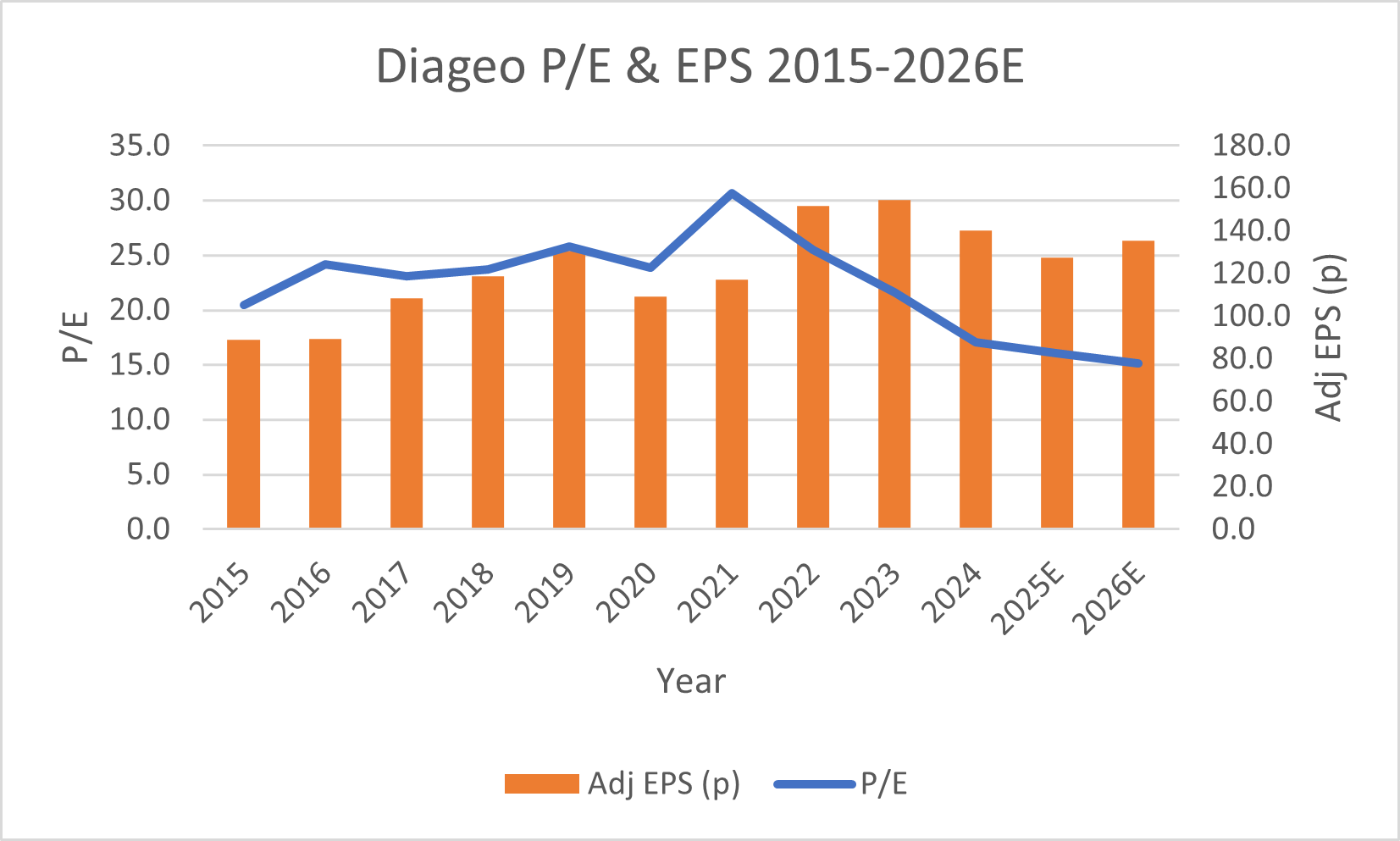
Forecast data from 24/03/25. Earnings adjusted for change in reporting currency from GBP to USD.
Diageo’s P/E ratio has halved, from a high of more than 30 in August 2021 to around 16 today. This de-rating has had a more significant impact on the share price than the relatively modest fall in earnings.
Why have the shares got cheaper? Quality defensive stocks such as Diageo maintained high valuations during the low interest rate era that followed the 2008 financial crisis. Some investors considered them as bond proxies for their reliable earnings and steady dividends.
This phenomenon reached fever pitch during the Covid era. In Diageo’s case, the phenomenon was exaggerated by the temporary boost to profits provided by locked-down drinkers. I would argue the shares became overvalued during this period.
Now that interest rates have normalised and growth has slowed, the maths behind these valuations no longer adds up. Government bonds provide higher and genuine risk-free yields, so it seems logical to pay less for more risky equity.
Another pressure is that the group’s leverage no longer looks as attractive or easily manageable as it once did.
Net debt has risen from $16.3bn in FY21 to $20.7bn at the end of December 2024. Over the same period, the group’s effective interest rate has risen from 2.7% to 4.3%.
Net interest charges in FY24 were $906m, nearly double the $470m reported for FY21 (restated in USD).
While I don’t think Diageo is likely to have any serious problems managing its debt, the increase in finance costs is material for a business of this size and has put some pressure on free cash flow.
All of these factors have combined with a slowdown in earnings momentum we saw earlier to drive the shares lower. The question is – are we now at the bottom?
Recent news: signs of stability?
Headline commentary in Diageo’s latest half-year results seemed to suggested a mixed picture, albeit with some signs of stability:
Organic net sales +1%, with volumes down just 0.2% (FY24: -3.5%)
Organic operating profit down by 1.2%, margin -0.7%
Diageo held or increased its market share across 65% of its sales value
However, the company also removed its longstanding medium-term guidance for organic net sales growth of 5%-7%, citing an uncertain pace of recovery in its markets.
This target already looked unrealistic and discredited. But CEO Debra Crew’s decision to provide “more regular near term guidance” instead suggests she is genuinely uncertain about the outlook. Not entirely reassuring for a £46bn business.
Turning back to the StockReport, one potential positive from the half-year results is that it looks like inventories may have peaked:

A more substantial decline in inventories in H2 would be good news, in my view. It could be an early sign that in-home and distributor stocks are clearing, paving the way for a potential return to volume growth.
From a purely financial perspective, I could probably make an argument that Diageo shares are reasonably priced at current levels:

Unfortunately, the market isn’t only looking at the financials.
Diageo’s peers have also fallen from grace over the last couple of years. The reason for this is that many investors are worried about the possibility that these businesses are facing larger, external risks:

I’m going to wrap up this piece with a look at some of the external uncertainties weighing on this sector at the moment.
Is alcohol the new tobacco?
One near-term and (arguably) temporary issue facing Diageo is the possibility that President Trump will impose tariffs on Mexico and Canada, affecting alcohol sales.
I’m not going to try and predict what might happen, but nearly half Diageo’s US sales come from products imported from Canada or Mexico. There would likely be some impact on profits, although I suspect this would be modest when mitigation and substitutions were taken into account.
Tariffs are a possible concern. But I think the real issue that’s worrying investors at the moment is the possibility that alcohol consumption could go the way of tobacco usage – into structural decline.
The perception that even moderate alcohol consumption is harmful to health seems to be gaining hold in western populations, especially among younger adults.
Tobacco-style product labelling highlighting links between alcohol and cancer has recently been recommended by the World Health Organisation and the former US Surgeon General.
This 2024 data from Gallup suggests a change in perception among Americans of all age groups about the health risks of moderate drinking:

Source: Gallup August 2024
The question for me is whether this awareness will affect drinking habits. Unlike tobacco, alcohol consumption has been a cultural norm in many regions of the world since ancient times.
The same Gallup survey found that 58% of US adults consider themselves drinkers, only slightly below the 63% long-run average. The average number of drinks reported in the last week was four, “which matches the trend since 1996”.
However, Gallup also found that the number of Americans reporting that they drink to excess fell to just 16% in 2024, the lowest ever reading. From 1978 to 2010, this figure was above 20% – peaking at 35% in 1989.
Of course, all of this data relies on self-reporting. Who knows how accurate it is?
Spirits have gained market share at the expense of wine and beer in recent years. And even if there’s a fall in overall consumption, a shift to drinking less but better could fit well with Diageo’s enviable brand portfolio.
Final thoughts
I had hoped that when I got to the end of this piece I would have a strong conviction to share with you. But I really don’t.
I think that both the financial fundamentals and the broader macro picture can be interpreted to suit several possible narratives.
In simple terms, I’d suggest the following bull and bear cases – but there’s probably a middle ground, too. Even if demand does enter structural decline, I suspect drinks groups will be able to continue generating attractive profits, as tobacco firms have done.
Bull case: volume growth recovers in line with population trends and big spirits groups regain their premium ratings. In this scenario, Diageo shares could be attractively priced right now.
Bear case: a decline in alcohol consumption becomes more clearly defined. Drinks companies suffer the same kind of de-rating as big tobacco stocks have previously. In this scenario, Diageo shares could have further to fall.
I suspect the situation will become clearer over the next 12-18 months. But this is a good example of why investing in Falling Stars is so hard. Investors have to make a decision that involves predicting the future. Not easy.
Even if we guess right, our timing might still be wrong. That can be costly, too.
This difficulty is the reason why we believe it makes sense to focus on stocks where at least two QVM factors are favourable, rather than just one.
Please let me know what you think in the comments below.
I’ll finish by returning to the Warren Buffett quote I used last week:
I don’t look to jump over seven-foot bars; I look around for one-foot bars that I can step over - Warren Buffett
Disclaimer
This is not financial advice. Our content is intended to be used and must be used for information and education purposes only. Please read our disclaimer and terms and conditions to understand our obligations.

15 comments
Over 5 years or more, flat revenue growth, flat reported EPS, flat book value growth, puny dividend growth and the only thing growing at Diageo (LON:DGE) is the debt and management compensation. Things to like : reasonably high ROCE and ROE, good brands which clearly desperately need new leadership. Possibly a PE of 8-12 would be a value opportunity with these half-filled measures? A dividend yield of 6- 8% might indicate income value . Otherwise, unless there are clear signs of a persistently improving business, avoid. Price target £12.99 (with Clubcard).
Sorry the below is the latest episode(today’s) of “In Good Company” , Nicolas Tangen interviewing. Debra Crew CEO of Diageo.
https://podcasts.apple.com/gb/...
https://www.youtube.com/watch?...
Obviously a very experienced corporate executive judging by the endless extensive word salad gobbledygook business speak on show here….she would put me off investing in #DGE for sure.
I agree. I wasn't very impressed!
Indeed. In addition to the arguments in the article which are all valid, Sir Ivan Menezes death was a major blow and I worry his successor is another "diversity hire", I know this sounds sexist but please point me to the FTSE 100 firm with a female CEO that has done well.
Amanda Blanc at the insurer Aviva, Dame Emma Walmsley at GSK and Milena Mondini de Focatiis at Admiral. Carolyn McCall is also doing a good job at ITV in my opinion.
Your comment doesn't sound sexist, it is sexist!
It doesn’t sound sexist, it is. You cannot judge someone’s intellectual ability and commercial skill on there gender, only their record in business.
Excellent analysis Roland, thank you.
A very balanced and thoughtful analysis. I thought it was interesting when attention to ESG was at its peak that Tobacco got pummelled and DGE seemed to be impervious. Of course that was because the former was being hammered by the regulator leading to downgrades, whereas DGE was experiencing strong trading momentum. Now investors have remembered that premium alcohol also has a cycle and as you point out DGE has subsequently experienced a de-rating as previously ignored structural issues have come to the fore. I've always been a fan of the brown spirits business but white spirits less so since it is more commoditised. The key question for me is whether ultimately tequila, which is now a much bigger part of DGE, behaves like a brown or white spirits business in a US consumer slowdown. Couple that with the uncertainty around tariffs and it still feels a bit early.
P.S. This excellent article prompted me to look at Lindsell Train.
This below is the link to their website and the latest (February) monthly which also focusses on Diageo.
The Global IT offer price is currently on a roughly 15% discount to NAV and offers a 5% plus dividend return, despite the fact that they don't seem to like higher dividend payers in their fund holdings. This is not, of course, a recommendation either for Diageo nor for Lindsell Train or its funds.
https://www.ltit.co.uk/
I sold Diageo very recently at 20.6 having bought last May 2024 at 28. I was quite confident that the growth in Guinness and especially Guinness Zero - both of which I drink myself - was so good that earnings would improve. Plus I listened to the presentation of the new CEO and had been impressed. The principal negative news was that US consumption of spirits was declining and the company's distributors in the 'growth' S American market had overstocked and the Chinese were reducing the use of high quality spirits as presents for customers.
I only took a half position on the basis of try it and see. In the event I found it very hard to isolate the excellent Guinness business from the more heavily weighted spirits element. Search as I did these figures are not available in the annual report. They should be. Liquor started to be publicised as an unpopular element in Gen Z, the recovery in earnings was not obvious and I decided to cut. We shall have to see whether or not that was a mistake but I do not fret about the decline in the share price any more.
The lessons are that - usually - setting actual stop loss limits can help. I think, roughly, a 10% decline in a large cap is a sensible warning level. That a change in senior management can be significant for shareholders - my view was that Ms Crew sounded highly able and I had not been really aware of her famous predecessor. He was probably fortunate in his timing but he oversaw the fairly dramatic rise in share price and valuation which may have been partly fortuitous.
Finally I will add the apparently unpopular view that the ghastly Jim Slater should have been gaoled for his dishonesty but was saved by his friends in the Tory party of the time. He personally wrecked a series of businesses needing good managers, not asset strippers. The nasty side of the City.
Another excellent article and interesting that you don't have a strong conviction either way as I find that for the majority of companies I'm looking at, including those with two or more QVM factors.
Of the six I've committed to so far five were absolutely solid with few concerns on the downside. The other was one with risks that I made excuses for. I liked the story around the strategy, it had a good Quality factor and I thought I was being over cautious after a string of "no strong conviction" decisions. I even paused on the buy asking myself if I was rushing into buying and whether I should be less forgiving of the concerns. One month in and two of the six are well ahead, three slightly behind and one, yes that one, heading towards a 20% decline.
I'm very new to this investing game but I've already learned that being patient and not moving on a purchase until it's compelling is probably the right answer. It's just hard to do nothing, really hard.
It honest to say that you're not sure.
In reality most shares are fairly priced with the bull and bear case finely balanced.