SIF Portfolio: Updates from Go-Ahead Group and Norcros, plus my defensive problem

I’m writing this on Tuesday afternoon, after an action-packed morning for the SIF portfolio.
In this column I’ll take a look at the latest results from Norcros and at Go-Ahead’s costly year-end trading update. I’ll also follow up on the comments I made last week about the shortage of true defensive stocks in the portfolio. What kind of company are we missing, and why?
Norcros edges higher on solid results
Tuesday was a down day for the markets. Bad news generated a much stronger reaction than good news. Recent portfolio addition Norcros headed into the close just 2% higher on Tuesday evening, despite reporting a 29% increase in underlying pre-tax profit, which rose to £20.4m.
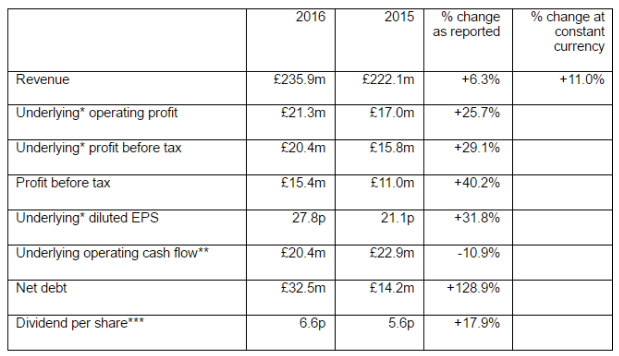
Shareholder and small cap editor Paul Scott took a detailed look at yesterday’s results from Norcros. You can read Paul’s comments here.
I share Paul’s view that with a strong balance sheet and a P/E ratio of about 7, it’s hard not to see value in Norcros. The only thing I’d add to Paul’s commentary is to emphasise that free cash flow remains strong at Norcros. This is important, in my view.
When companies are growing by acquisition, management often gloss over poor cash flow. They may argue it isn’t representative of underlying or pro forma performance. It’s easy for investors to take a lax attitude in these situations, even though this can be a warning of problems to come.
The good news is that Norcros doesn’t appear to have any problems with cash flow. In my view, the group’s cash flow is very healthy. Stripping out acquisitions, free cash flow was £10m last year. That puts the stock on an underlying P/FCF of 10.8, pretty much unchanged from 2014/15. This sort of quality provides a real margin of safety and reinforces the buy case for Norcros, in my opinion.
Go-Ahead plunges, should I be worried?
Shares in SIF portfolio member Go-Ahead Group fell by about 15% on Tuesday, after the group warned that the profit margin over the life of its combined Thameslink, Southern and Great Northern rail franchise is now expected to be half the level originally forecast.
The collapse in the price of Go-Ahead’s shares would normally be associated with a profit warning. Effectively that’s what it was. While full-year adjusted profit guidance remains unchanged for 2015/16, the statement made clear that profits in future years would be lower than expected.
The group had previously said that the profit shortfall experienced in the early part of the franchise would be made up at a later point in the contract. This isn’t going to happen (my bolding):
“As previously reported, the additional resources being invested in GTR to support service delivery are depressing margins on that contract in the current year and will also impact on next year's margins. While we do expect margins to improve in the longer term; given the very challenging performance and industrial relations environments, we no longer expect to recover the profit shortfalls and as a result margins, on an adjusted basis, over the life of the contract are now more likely to be nearer to 1.5% than the 3% previously expected."
House broker Jefferies has reportedly cut its 2016/17 earnings per share forecasts by 9.4% following Tuesday’s announcement. Based on consensus figures at the time of writing, this suggests earnings per share of about 192p for the current year, putting Go-Ahead on a forecast P/E of about 11.
Although I’m concerned by this, it’s worth noting that Go-Ahead’s bus operations provide the lion’s shares of the group’s profits. The group’s adjusted operating margin for bus operations was 11.3% during the first half of the year, compared to 2.6% for rail.
During the first half of last year, bus operations accounted for £42.8m of the group’s £60m operating profit:
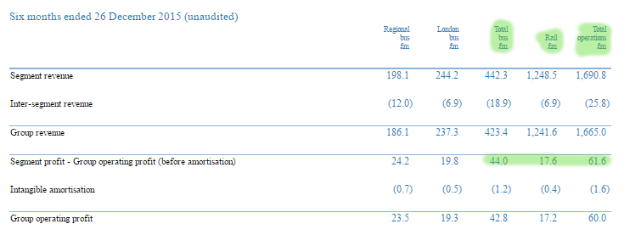
Today’s update confirmed that bus operations are on track to deliver an adjusted profit of £100m for 2015/16, as previously guided.
I’m tempted to sell, as I’m a strong believer in the adage that profit warnings come in threes. However, I’m not sure today’s news is bad enough for me to ignore my own rules and sell Go-Ahead before my minimum six-month holding period is up.
I’m also still attracted to Go-Ahead’s strong cash generation and 4.7% forecast yield. Unless more bad news emerges, I’m going to reserve judgement until the group’s full-year results are published in September.
The missing defensive link
One other reason I’m keen to hold on to Go-Ahead is that I believe public transport is essentially a defensive business, which should perform reasonably well even in mixed economic conditions.
As I noted last week, the SIF portfolio is rather short of defensive stocks. The screening criteria I’ve chosen to help build this portfolio are making it very difficult for me to hit my soft target of a 50:50 mix of defensive and cyclical stocks.
Rather than adding a new company this week, I thought it would be interesting to look at what kind of stocks the portfolio is missing out on owning. Are they attractive at current prices? Would they be likely to deliver the balance of growth and income I’m looking for?
According to the Capita Dividend Monitor report, the main defensive sectors are:
- Healthcare and pharmaceuticals
- Telecoms
- Utilities
- Food, drink and tobacco
- Non-life insurance
I don’t have space in this week’s column to analyse these sectors in detail, but my immediate impression is that many of the better quality companies in these sectors look quite expensive at the moment. In a number of cases, the growth outlook is also quite uncertain.
A quick random sample of possible candidates using Stockopedia’s excellent Run a Checklist function suggests that valuation may indeed be the problem. A number of the stocks I tested failed for two common reasons: their earnings yields were lower than my 8% threshold, and their PEG ratios were above my permitted maximum of 1.2.
Both of these factors point to valuation. A high PEG ratio suggests that investors may be paying too much for growth. A low earnings yield suggests investors may be paying too much for profits.
I think that this reflects the defensive premium that’s been applied to high quality defensive stocks since the financial crisis. Investors are willing to pay more for dividends from companies like Tate & Lyle, Diageo and Unilever because of the defensive safety they are seen to offer.
The problem is that historical evidence suggests that buying at such high valuations is likely to lead to below-average future returns.
The market is unsteady at the moment, due to the increasing uncertainty surrounding next week’s EU referendum. The outcome seems genuinely uncertain, in a way that’s quite unusual in the UK.
I’m going to hang fire this week, but I’m hoping that the current market volatility will create some bargain buying opportunities for the SIF portfolio next week.
Roland owns shares of Unilever and Diageo.
Disclaimer
This is not financial advice. Our content is intended to be used and must be used for information and education purposes only. Please read our disclaimer and terms and conditions to understand our obligations.

6 comments
Roland, I'm sure you looked at it, but in case not, I was attracted to Total Produce (LON:TOT) as it might prove to be quite good for a long position (I hold this). I realise that it might not fit all your screening tests though.
Thanks for the article, I'm enjoying seeing your portfolio evolve and I value your analyses.
Regards
Howard
Howard,
Total Produce (LON:TOT) is a company I've looked at for my personal portfolio in the past. I've always been put off by the low margins, low yield and the potential for being permanently squeezed on price by big customers (supermarkets).
But the performance over the last few years suggests I may have been wrong to ignore it! Total Produce has been a much better investment than the supermarkets...
Regards,
Roland
Howard,
Following on from my other comments, I should have said that Total Produce does pass all of my screen criteria bar one -- its primary listing is overseas.
This criteria was intended to filter out dubious overseas stocks (e.g. China), not reputable Irish businesses. I may consider relaxing this test to allow companies whose primary listing is in Ireland/USA to qualify for the screen.
Thanks for bringing this to my attention!
Cheers,
Roland
Roland, my pleasure.
Like you I was concerned with £TOTs low margins etc ....
Turning from the quants however, I looked at some qualitative factors in the business. In particular I was surprised to find that several of the key actors in the business (board and operating team) are ex Fyffes (LON:FFY). This prompted me to look quite closely at Fyffes (LON:FFY) and I noted they they also run on very low margins but have made reasonable growth for several years. They were doing well then clearly got hammered in 2008, but they have made sustained progress since. I therefore felt that if the Total Produce (LON:TOT) team have cut their teeth in the Fyffes (LON:FFY) business, culture and operating environments, then I think they will have the experience to develop Total Produce (LON:TOT) (possibly as a global business).
I appreciate that this perspective might be classed as a 'story' factor, but it added sufficient attraction for me to take a small position, on a long-term view.
Thanks for your added comments, I am pleased to hear that Total Produce (LON:TOT) passed all your other tests, that adds to my confidence with the holding.
Regards
Howard
Roland, another interesting article. On defensives, I like Beximco Pharmaceuticals (LON:BXP), Treatt (LON:TET), Hilton Food (LON:HFG), National Grid (LON:NG.) and more cautiously Produce Investments (LON:PIL), all of which I have an interest in. Apart from National Grid (LON:NG.), all score fairly high on stock ranks.
James,
I agree National Grid (LON:NG.) has been an outstanding investment over a long period. It's remarkable to think that anyone who bought in the late 90s and then held will have received their original investment back via dividends several times over, in addition to a 400% capital gain. All from a utility stock.
Hilton Food (LON:HFG) and Treatt (LON:TET) have also been good performers and still look attractive. Interestingly, Hilton is another stock that only fails my screen because of valuation -- the earnings yield is below my threshold of 8% and the PEG is > 1.2. But both could be good buys on a dip.
Regards,
Roland