Stock in Focus Portfolio: I add Go-Ahead Group and revisit an old friend

This week, I’m starting to populate the Stock in Focus portfolio. To get the ball rolling I am going to add two stocks this week, one cyclical and one defensive.
One of these will be a company I’ve recently reviewed, while the other is a new choice. These will be selected from my screen results using their StockRank. I’m not using StockRanks to populate my screen because this would end up with me creating a duplicate of the NAPs portfolio. Instead, I am going use StockRanks to sort the screen results and select the next stock to be purchased.
So far, my screening criteria have produced a set of stocks with ranks varying from 64 to 99. All but three of the stocks which currently qualify have a StockRank of more than 80. I’m pleased about this, given the StockRanks’ strong performance to date.
Will cyclical momentum continue?
At the time of writing on Tuesday, two stocks are tied for top place in my screen. Although they are obviously different, Persimmon and Alumasc are both cyclical construction stocks with a StockRank of 99. I looked at Persimmon on 6 April and Alumasc on 13 January.
I’ve opted for Persimmon and not Alumasc because of the latter’s £19.5m pension deficit. This is more than four times last year’s net profit of £4.4m. Alumasc is currently paying £2.5m per year (more than half its profits) into its pension scheme, but this has not yet done much to reduce the deficit. These payments were also due to be reassessed following the pension scheme’s triennial valuation in March. Although I quite like Alumasc, I’m not keen on the risks involved here.

Persimmon has no pension deficit and is planning to return £9 per share to shareholders by 2022. Net cash currently accounts for more than 10% of the market cap, providing solid backing for the 5.9% forecast yield.
Although I am generally cautious about the housing market, Persimmon’s appeal is hard to ignore. It remains one of the most-screened stocks on Stockopedia, qualifying for nine screens.
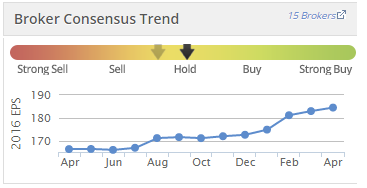
The only news since my original article is a trading update from 14 April. Although this suggested that growth rates might be moderating, the outlook for the year remains unchanged and broker forecasts have edged slightly higher over the last month:
An all-weather defensive cash cow?
The top-ranked defensive stock in my screen is bus and train operator Go-Ahead Group, with a StockRank of 93. Although this belongs in the Industrials sector and is technically a cyclical stock, I’m going to disagree with this classification.
While an airline may be cyclical, I think a bus and train operator is a fairly defensive business and am including Go-Ahead on this basis.
I can imagine that some small-cap readers may be disappointed to find that both of this week’s choices are big caps. This is purely by chance. I don’t expect it to be typical and plan to make up for this next week with at least one small-cap choice. Going forwards, I expect the portfolio to contain a mixture of market caps, from £50m upwards.
Mixed signals for value investors
Go-Ahead has a ValueRank of 75, which is reasonably encouraging. However the metrics behind this score are a little more mixed.
The big highlights are Go-Ahead’s strong free cash flow and earnings yield (EBIT/EV), which suggest it is a very profitable business at an operating level:
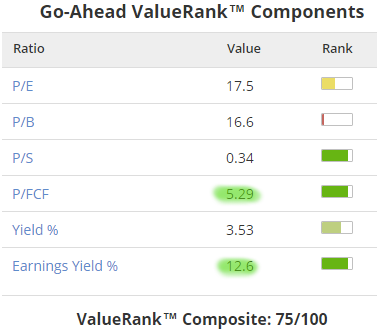
There seem to be two reasons why this isn’t reflected in a low P/E rating. Firstly, Go-Ahead has a fairly high depreciation charge, as you’d expect for a fleet operator. More interestingly, the firm’s balance of trade and other payables have risen substantially over the last few years. For example, last year this total rose from £557.7m to £772.9m. This seems to be the result of an increase in deferred income from season tickets and other accrued income:
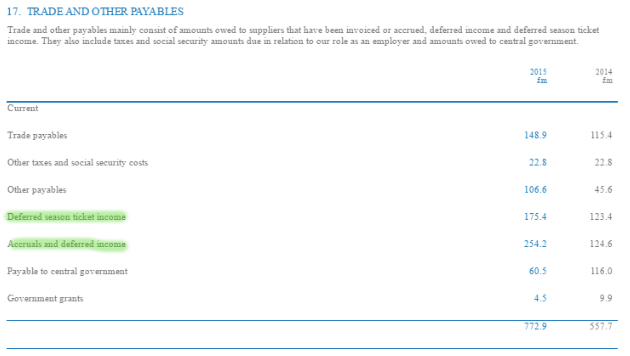
Much of this cash is restricted and must be held in short-term deposits until the service has been delivered. However, it does still represent an improvement on -- say -- a transport company whose invoices are all paid 30-60 days in arrears.
Overall, I can live with these figures. Go-Ahead’s dividend has been consistently covered by free cash flow. The firm’s strong cash generation is a definite attraction, as is its partially-regulated business.
Cash flow boosts quality
I’d be more suspicious about a low margin business like Go-Ahead if it didn’t have a reasonably high QualityRank -- 79, in this case. As you can see from the usual graphic, there’s plenty of green:
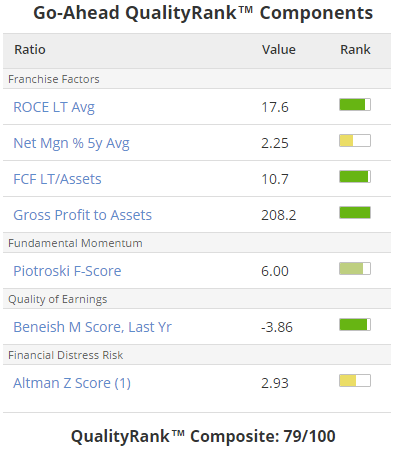
Stockopedia’s QualityRank score is quite heavily weighted to the Piotroski F-Score, which is 6/9 here. In my view, it’s always worth drilling down by clicking on the F-Score link on the StockReport page to find out which items a company has failed on. Fails are often so marginal they aren’t a serious concern.
To some extent that’s the case here. Go-Ahead doesn’t report a gross profit, so the gross margin calculation is irrelevant. A lower level of asset turnover and return on assets aren’t necessarily a big concern either. Go-Ahead’s mix of business and its asset base change periodically. These changes can be a bit lumpy.
Go-Ahead’s long-term average free cash flow is more than 10 times its average asset value, which suggests to me that the firm employs its assets productively. It’s worth noting that while Go-Ahead’s operating margin is low, at 3%, this doesn’t seem to be an obstacle to free cash generation.
As with value, these figures aren’t perfect but they don’t cause me any major concerns.
Is Go-Ahead losing momentum?
Go-Ahead’s MomentumRank has fallen 16 places to 76 over the last 30 days. While 76 isn’t a bad score, 92 was much better! So what’s changed?
The only material news over the last month was the firm’s third-quarter trading statement. This didn’t seem too bad to me, but didn’t get a particularly warm reception from the market. I’m not sure why. Go-Ahead reported above-inflation increases in revenue across the board, and rising passenger numbers in all divisions except regional buses, where passenger journeys fell by 0.5%.
Looking at the stock’s MomentumRank numbers, Go-Ahead’s interim results came in significantly ahead of expectations. The shares are within 5% of their 52-week high and the 50-day moving average is double the 200-day moving average. That’s a good sign of price momentum.
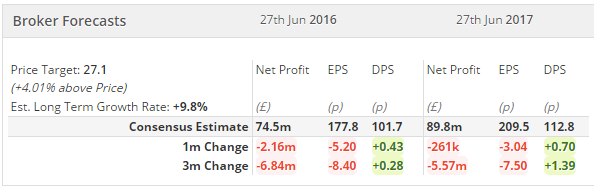
The only fly in the ointment is that full-year earnings forecasts have been edging lower. They’ve fallen by 4.5% over the last three months, according to Stockopedia:
My view
Go-Ahead isn’t a perfect stock, but it’s strongly ranked by Stockopedia and I suspect its performance will be surprisingly resilient. Earnings per share are expected to rise by 18% in 2016/17 and there seems to be plenty of cash flow backing to fund double-digit percentage dividend growth.
I’m comfortable adding this to the Stock in Focus model portfolio alongside Persimmon, but please remember that these are just my views and are NOT tips. Please let me know what you think about these choices in the comments below.
Disclaimer
This is not financial advice. Our content is intended to be used and must be used for information and education purposes only. Please read our disclaimer and terms and conditions to understand our obligations.

4 comments
Good piece on Persimmon - I am bullish on house builders - I run a property sales company and the agents are desperately low on stock - house builders are the only ones with decent stock levels!! We would be selling heaps more homes if we had more to sell - customers are also buying off plan new homes as they cant find 'second hand' homes to buy. The referendum is keeping sellers out of the market as they sit on their hands.... I fully expect house builders results to be all positive - the recent trading update from Taylor Wimpey is a good example. I am long on Persimmon and Crest Nicholson.
In regards to Go Ahead loosing momentum that's because the overall industry rate of revenue growth has slowed in recent months and looking ahead, transport in particular can see further deterioration over the medium term. It expects weakening consumer confidence, terrorism concerns, sustained lower fuel prices, the related effects of car and air competition as well as slower UK GDP growth to have a negative impact on the overall industry.
Clearly, this paints a downbeat picture of the company's outlook. However, Go Ahead continues to offer a fairly wide margin of safety so its risk/reward ratio remains kind of appealing.
Re. Go-Ahead (LON:GOG) , while I agree the demand side is pretty resilient to any downturn in economic activity (if anything, it's a classic Giffen good in that you might expect demand to rise in a recession as people seek cheaper forms of transport) do you have a view on their exposure to a rising oil price? Lower oil prices over the last three years may have flattered their figures but as this potentially unwinds will this impact margins, especially as fares tend to be regulated and RPI linked. Do you know whether and how effectively they hedge this exposure?
Gus.
Hi Gus,
Thanks for your comment. I'm not sure of all the details but my understanding is that Go-Ahead (LON:GOG) uses swap contracts to fix future fuel prices for all of its bus services.
To take advantage of low fuel prices Go-Ahead has fully hedged bus fuel costs through to 2018, much further out than usual. This looks pretty smart to me. Fuel costs will actually fall over the next couple of years, according to the 2015 results:
If oil prices really do recover, then there may be some impact post-2018, but the outlook is pretty good for the next couple of years.
I couldn't find any mention of fuel hedging for rail in the 2015 results, though. I'm not sure how fuel for trains works -- is it outside the scope of the franchise deal perhaps? If anyone knows I'd be very interested to find out more.
Regards,
Roland