Stock in Focus: Will Alumasc surprise investors in 2016?

Building engineering firm Alumasc has triple-bagged since hitting a low of 62p in 2012. A tighter focus on sustainable and high-spec products appears to have served the group well.
As with housebuilders, this gives rise to an obvious question. Is it too late to buy into such a cyclical stock?
No -- or at least not according to Stockopedia’s computers, which currently rank the firm very highly. Alumasc is one of only a dozen UK firms with a StockRank of 99. The stock also qualifies for five Stockopedia’s Guru Screens and was one of the qualifying stocks for Stockopedia founder Ed Croft’s 2016 NAPS portfolio.
In this article I’ll explain why Alumasc scores so highly. I’ll also offer my opinion on whether the shares have further upside potential, and highlight some of my concerns.
What does Alumasc do?
Alumasc has a number of operating businesses in two main areas: energy management and water management.

Energy management really means solar shading, roofing and walling, while water management means drainage, guttering and related products. One of the group’s flagship businesses is Levolux. This firm builds solar shading and screening for large commercial and industrial buildings. A recent £3m contract win for Levolux in the USA will see Alumasc design and install a “custom screening solution” for a new gas-fired power plant.
These products may not be that sexy, but they do seem increasingly relevant to modern construction, and likely to remain so.
(Alumasc does also have a die-casting business, but this accounted for less than 10% of revenue last year and is something of a legacy operation, so I’ll ignore it.)
What about the value?
According to Stockopedia, value is Alumasc’s weakest point. The stock’s ValueRank is just 75.
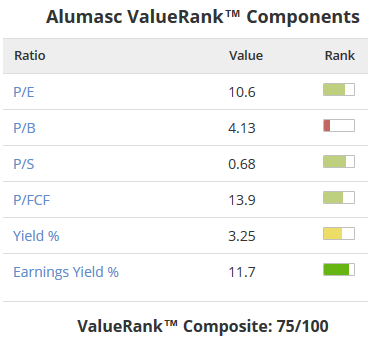
One reason for this is Alumasc’s P/B of 4.1, which seems very high for a manufacturing firm. On closer inspection, this appears to me to be a warning flag. The reason the P/B is so high is because Alumasc’s book value per share has fallen from 88.5p in 2011 to 44.1p last year, despite the share count remaining unchanged.
Although some of this decline is the due to Alumasc selling various non-core business, there is a second reason. The group’s pension deficit has risen from £2.8m to £20.9m since 2011, reducing net asset value.
Alumasc’s large final salary pension scheme appears to be a legacy of the group’s industrial past, but is very much a current risk. Paul Scott has flagged this up previously but I think it is worth repeating. After all, last year’s £2.5m deficit reduction payment swallowed up 57% of the group’s reported post-tax profit of £4.4m.
This risk also gives rise to a second concern. Alumasc’s current and recent board members own 8.6m (24%) of the firm’s shares. Perhaps for this reason, the stock offers a relatively generous 3%+ dividend yield. However, I wonder if the board is giving too much priority to dividend growth, and not enough to pension deficit reduction.
A Quality builder?
Alumasc scores highly on quality, with a QualityRank of 90. It’s easy enough to see why. The firm’s operating margin has recovered steadily from a low of 1.3% in 2012 to 7.7% last year.
Alumasc also has a strong Piotroski F-Score of 7/9. I believe this geeky-sounding metric is a good way to gain a snapshot of a company’s financial health and profitability. Alumasc’s only two misses are that the current ratio and gross margin both fell last year. One reason for this may have been the loss-making Alumasc Precision Components business, which has now been sold. On that basis, I’m not too concerned.
However, it’s worth mentioning that one risk that isn’t captured by the F-Score is the pension deficit. The only way to see this is to look at the balance sheet for yourself.
Financial performance aside, the other factor that governs a firm’s quality is its franchise quality, or moat. Does Alumasc have a competitive advantage over its peers?
I’m not sure. The firm’s focus on sustainability and the upper end of the market appears to be working well. However, while I’m not an expert on the building materials market, it’s doesn’t seem to me that Alumasc meets any of these five tests for an economic moat. I’d expect the stock to be vulnerable in the next construction downturn.
Momentum -- flying high
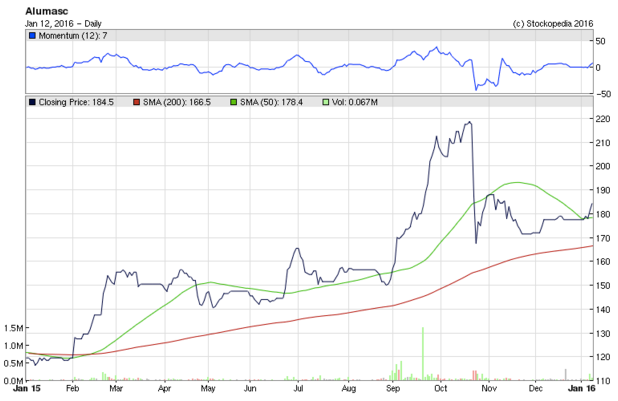
One area in which Alumasc does not lack is momentum. A MomentumRank of 98 signifies a strong price and earnings upgrade momentum. A look at the Stockopedia charts provides a textbook display of how an investment like this can work.
Over the last year, Alumasc’s share price has risen by 59% to about 190p.
During the same period, forecast earnings for 2015/16 have risen from 16.8p per share to 19.2p:
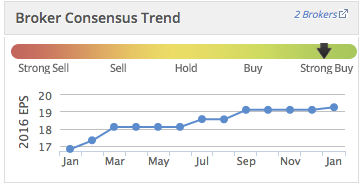
Earnings forecasts for 2016/17 have also risen and currently stand at 21.1p per share. This gives the firm an apparently modest forecast P/E of 9.0. Dividend growth of about 7% is expected this year and next year. This means at 190p, a yield of 3.5% is expected for the current year, rising to 3.7% in in 2017.
Don’t get carried away
Alumasc’s recovery since 2012 has relied on eliminating loss-making business and increasing margins. Total sales during this period have actually fallen from £110m to £98m, although sales are expected to rise in the current year. In my view, shareholders need to monitor this. Without sales growth, the upside for earnings could be limited.
A second risk is simply that Alumasc is currently riding a cyclical wave of rising profits and cash generation. The reality is that the construction sector is almost certainly much closer to the top than the bottom of the cycle. Recent comments from management seem to confirm this:
“We have seen some evidence that capacity constraints within the construction industry generally have caused delay to some projects. While this may have an impact on timing, we continue to believe that management's expectations for the group's full year financial performance will be achieved.”
Alumasc shares fell by 20% after this comment was made at the AGM in October, suggesting that investors saw it as a veiled profit warning. The share price has since recovered somewhat, but remains below last year’s 221p peak.
Overall, my view is that Alumasc could offer further upside as a quality-momentum play. It fits the profile of a high flyer. For value investors, I’m less convinced. Alumasc may be too close to the top of the cycle to offer an acceptable margin of safety.
Ultimately it’s a personal choice. We’ll learn more on 2 February when Alumasc’s interim results are due.
In the meantime, please DYOR -- this article is only intended as a starting point for further research.
Disclaimer
This is not financial advice. Our content is intended to be used and must be used for information and education purposes only. Please read our disclaimer and terms and conditions to understand our obligations.

3 comments
Alumasc's shares are pretty thin on the ground. A few hundred perhaps, but not thousands unless you keep shopping over a period of time.
mothy9,
Thanks for pointing this out. I mentioned in the article that the board hold c.25% of stock but should also have pointed out that the free float is only 54%. This is quite a tightly held company so anyone planning to buy in size will probably need to buy in stages.
Regards,
Roland
The balance sheet often does not reveal the whole truth about pension deficit. For the usually larger actuarial figure you need to look at the notes.