SIF Portfolio: What would happen if I changed the rules for 2017?

The criteria I’ve used for my Stock in Focus screen fall into two categories. A small number are essential characteristics which characterise the majority of stocks in the portfolio. The remainder are safeguards to avoid ‘outliers’ carrying specific risks.
This week I’m going to highlight some of these key criteria and explain how they work against each other to restrict my choice of stock. Would it make sense to target a broader range of stocks?
Am I too focused on one type of stock?
The SIF portfolio was designed to target affordable growth stocks. The screening criteria include a number of rules whose purpose is specifically to reduce downside risk. This approach reflects my belief in the Warren Buffett rule that avoiding losses is as important as identifying winners.
This conservative approach has often resulted in a restricted choice of stocks. At the time of writing, just four stocks qualify for the screen. I’ve still had some big winners, such as IG Design (+49.5%), Avesco (+132%) and Beximco Pharmaceuticals (currently +60%). But serious growth picks such as Paul Scott success story Boohoo.com (up 255% in one year) have never qualified.
Nor have highly-ranked big cap income stocks such as housebuilders and insurance stocks, even though they’ve performed well since the referendum.
The portfolio will be one year old in April. This will give me a chance to tweak the rules if I want to. Would it make sense to relax certain criteria to capture a broader range of stocks? Or will any gains be offset by an increase in the number of losers?
The key screening criteria
There are four rules which have a huge impact on the number of stocks which qualify for the screen:
- Earnings yield >8%
- Piotroski F-Score >6
- PEG rolling <1.2
- RS 1y >0
That’s only four out of 14 rules. You may wonder what the purpose the other 10 rules serve. I’ll come back to this in a moment, but first I want to explain how the four rules above combine to set a fairly high bar for potential buys.
Value, Quality, Growth & Momentum
You may already have spotted that the four rules I’ve listed above are each classic characteristics of a style of investing:
- Earnings yield (EBIT/EV) = Value
- Piotroski F-Score = Quality
- Low PEG ratio = Affordable growth
- 1-year relative strength = Momentum
Finding a stock that combines all of these attractions is naturally going to be difficult. Value stocks often have poor momentum. Growth stocks often look expensive. And so on.
Removing any one of these four criteria from the screen typically results in a massive increase in the number of qualifying stocks. At the time of writing, reducing the minimum earnings yield from 8% to 4% causes the number of qualifying stocks to rise from four to 15. Attractive growth stocks such as Revolution Bars (Paul Scott comments) now appear in the screen results.
In fact, the revised selection contains a number of stocks which seem suitable for the portfolio at first glance:
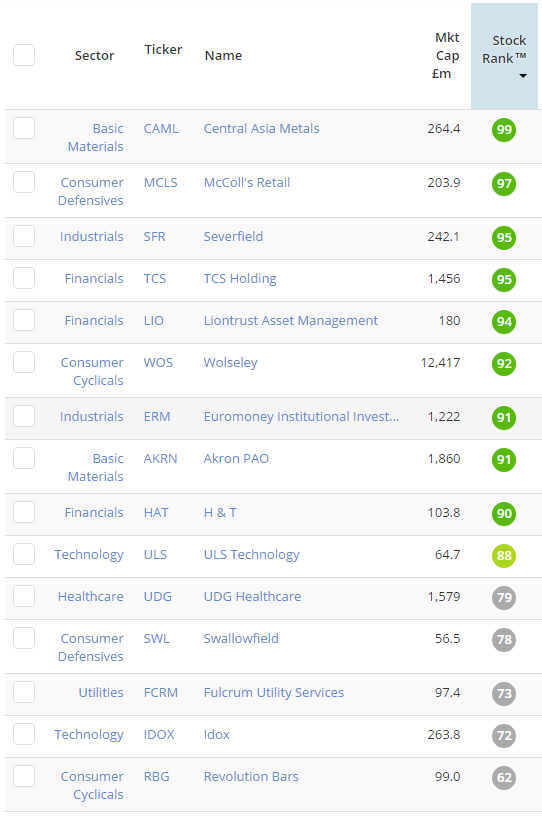
Perhaps my 8% earnings yield requirement is weighted too much in favour of value and mature businesses? I may give this some thought when I review the portfolio rules in April, after one year of operation.
Changing the relative strength rule so that RS 1y >-20 has a similar effect, increasing the number of stocks from four to 14:
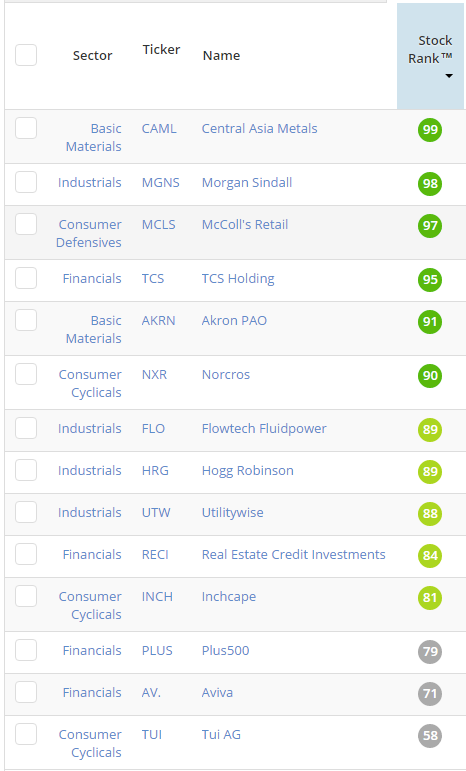
There’s more of a bias towards value here, I think. A number of stocks are included which were hit hard by the referendum result but have since performed well. Examples include Morgan Sindall and Aviva.
Abandoning this key momentum indicator is a big step. I’m not sure I will. But I might consider adding a small amount of leeway to improve stock choice.
Refining the selection
My core rules are quite tough, as we’ve seen. But my ‘safeguard’ rules then make stock selection even more difficult. The screen contains a number of rules designed to filter out outliers which may meet the core criteria, but still carry specific risks. For example:
- The rolling P/E ratio must be between 5 and 30
- The dividend yield must be greater than 1.5%
- Net debt must be less than 5x net profit
- EPS growth must be greater than 5%
- Forecast dividend growth must be positive
- Sales growth must be positive
Some of these criteria may seem irrelevant at first glance. But most of them are recognised indicators of risk.
For example, a company with a flat dividend and falling sales may be able to deliver rising earnings per share through cost cutting or share buybacks. But the outlook is likely to be uncertain.
These rules don’t usually have a dramatic effect on the screen results. But they do definitely have an impact on the overall appearance of the portfolio. Here are a couple of examples.
Numis
Stockbroker Numis has a StockRank of 92 and passes 13/14 of the SIF screening rules. The only rule on which it fails is that sales growth is expected to be negative over the next twelve months, even though earnings per share are expected to rise:
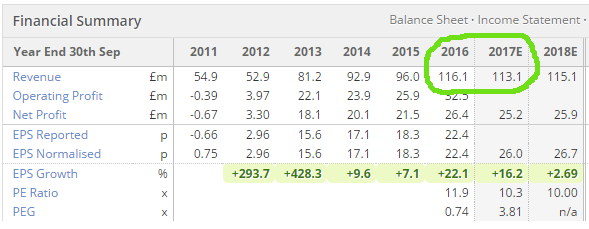
This is an excellent example of a company which meets all of my core criteria but does not qualify as a result of its unusual valuation and poor earnings visibility.
In his small cap value report on 7 December, Graham Neary commented that while Numis is heavily cyclical, its recent track record suggests a higher rating might be justified.
Pan African Resources
I sold Pan African Resources from the portfolio in January. But a quick check today shows that the only reason why Pan African no longer qualifies is that the dividend is expected to fall this year.
A dividend cut is always a concern. Worryingly, this appears to be a symptom of a spectacular collapse in momentum. Pan African’s StockRank has fallen from 93 to 68 since the start of December. This is solely because the stock’s MomentumRank has fallen from 75 to 14 in less than two months.
Consensus net profit forecasts have fallen from £52m in December to £38.2m today. A 17.7% reduction in share count means that earnings per share are still expected to rise, but this is a major downgrade:
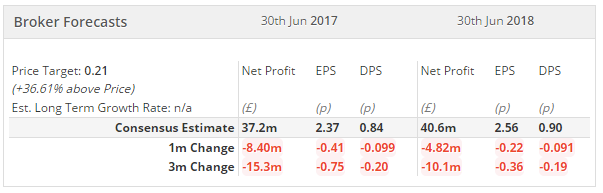
Pan African fits the profile of a contrarian play, with high Quality and Value ranks. But there appears to be a new risk here. The stock no longer fits the well-rounded profile I’m seeking for the portfolio.
Should I change?
There’s much food for thought for me here as the portfolio’s first anniversary approaches. I won’t be making huge changes to the rules, but I may consider some small tweaks to improve stock choice and the diversification of the portfolio.
As always, I’d love to know what you think. Am I simply too impatient, or does it make sense to target a broader range of stocks?
Disclaimer
This is not financial advice. Our content is intended to be used and must be used for information and education purposes only. Please read our disclaimer and terms and conditions to understand our obligations.

8 comments
Your SIF portfolio has done very well so far and I think it would be interesting to see if it maintains that over a longer period. Who knows, it may even out-perform its rivals over the next 12 months.
I'd also be interested in seeing how a bare-bones SIF might do, with minimal or nil subjective decision-making. If a share fits your key criteria just bung it in. I have banged on about that before, but this is the last time I'll mention it!
Having said that using a new regime with relaxed criteria as the basis for SIF 2.0 would be worthwhile, too, if only to see how it performs against the original.
I suppose if you were to conduct your research as a pure scientific experiment then there would be a hundred portfolios running alongside each other, each having just one variable. Might be a bit time consuming, though!
Very interesting to read absorb and learn from others more experienced than I!
Thank you all for your positive information flows and debate.
Roland
I great read as always.
My experiences for what its worth is that a tight rule-set as you have had, run for a period offers good base to build a good portfolio. As I did.
What I found however, was that I was not achieving quite the returns other Stockopedia people were reporting. In reaction I have made a conscious step to run twp portfolios side by side (methodology the sames, screens are different).
One screen is very like yours (we share several of the same stocks). The second however, is much more akin to a Paul Scott portfolio. This second still employs the disciples about screening, testing, and so on, but I accept it is picking very different stocks for a very different reason.
Reading Ben Graham recently, encouraged me to understand that he in fact encourages the 'enterprising investor' to mix types of stocks. Thus have sub-portfolios within the overall portfolio. This approach is really beginning to show positive results.
In short, I am suggesting not necessarily relaxing your rules (they are serving you well). Rather replicate your methodology with a different screen for different types of stocks.
Regards
Howard
Your screen at the moment means that you will either be mainly in cash, or, have a highly concentrated portfolio foregoing the benefits of diversification. As your article outlines, the opportunity cost of having so many rules is that potentially good stocks don't qualify. On the other hand, the behavioural instinct to change the rules is what often makes it hard for investors to match the returns they could achieve if they stuck to their rules. How much backtesting did you do on your set of rules? If you did quite a lot and there were positive returns then maybe it is best to be patient. However, I'm not sure what everyone else thinks but it seems to me like 14 is quite a lot of rules. Most of the Guru screens don't have nearly that many. Clearly a lot of thought has gone into your rules so it would be a shame to ditch some of them altogether. Sticking to the 4 key rules seems to be important for the integrity of this screen with a possible slight adjustment of the thresholds, as you suggest, to get a few more stocks to qualify. The other rules are each there for a reason but in aggregate they do seem to be pretty restrictive. The case of Numis is a good example. Why not consider an approach where the 4 key rules are met then perhaps as long as a certain number of the other rules are met, e.g. 7 of the 10, then a stock could be considered to have qualified? Using the RUN A CHECKLIST feature Gus mentioned would be one way to check this on an initial list of stocks that meet the top 4 rules. There was an article that Ed wrote a while ago talking about looking not for the perfect stock but instead aiming for a portfolio that would have the characteristics of a perfect stock. Perhaps your rules as they currently stand are aiming a bit too much for a set of perfect stocks?
I saw a comment from the late Jim Slater when his Zulu screens were not showing many candidates that he would be prepared to relax his criteria on the price he was willing to pay but never on the quality of the business.
Hi John,
Re. Jim Slater -- that makes sense. Focusing on quality should limit the downside risk, even if you have paid slightly too much. And the returns from investing could still exceed those from sitting on the sidelines.
Regards,
Roland
Morning Roland.
Thanks for the write up - good to get "under the bonnet" and have an insight as to how you formulated the original rules and how they fit together to form the whole investment strategy.
I guess the temptation to relax the rules to allow more stocks through the filter is always there, especially when you see stocks that have missed the cut doing really well. If you have a very short, short-list from your filter, do you change the rules and move to the market or wait for the market to come to you? Most private investors (me included) are rarely that patient.
In effect there is a trade off between having a long list of objectively filtered stocks to then screen subjectively or a short list of stocks that have to clear higher hurdles perhaps requiring less subjective input. Which of the two approaches to take is presumably a function of how much time you have available to do the subjective analysis as well as your own self confidence in the ability to assess a stock. I probably err on the side of starting with a long list and whittling it down - too much of the "monkey brain" for my own good most of the time.
One Stocko feature I regularly use is the [RUN A CHECKLIST] under the [TOOLS] feature which allows me to assess a stock against my primary screening tool. This allows me to see which, if any, of my particular rules is being broken and provides the information to allow me to dig down into the specific reasons for failure and then make a call on whether to buy/hold a stock or not. I'll often use this if I see a "hot stock" being discussed on the board to see whether it is worth following up on and have made a few decent purchases (and avoided a couple of with hindsight howlers) along the way.
Best,
Gus.
Hi Gus,
Thanks for your feedback.
You're right about the temptation to trade, but what I don't want to do is to introduce too much additional subjective judgement. As I've discussed in recent weeks, the evidence so far suggests that this isn't enhancing the portfolio's returns.
If I do loosen the rules, it will only be slightly. And I'm not yet convinced I will.
I use the Checklist tool a lot as well -- it's a great feature IMO.
Regards,
Roland