Small Cap Value Report (Fri 10 Jan 2020) - JOUL, SDRY, De-listings, CBUY, TED, JD., BME

Good morning, it's Paul here with Friday's SCVR.
It looks as if there's going to be more pain today for shareholders in retailers, as evidence gathers that only the best had an acceptable period of trading over Xmas.
Estimated timings today - I've done most of the report now, but have to pop out for a meeting. I'll be back after lunch to do some more, so final finish time today is c.4 pm.
Edit at 15:31 - today's report is now finished.
Early snippets - before 8am
I'm not sure whether it's a good idea to be doing this, as my initial reaction to MKS yesterday was not how the market saw things. But let's do it anyway.
Joules (LON:JOUL) - profit warning. 7 weeks to 5 Jan 2020 saw retail sales (stores + ecommerce) down -4.5% vs last year. That's a big step backwards from H1, which saw +3.1% retail sales.
It blames website problems. Stores & concessions are said to have traded in line with expectations. It will be interesting to see how the market reacts to this, but the only question is how big the sell-off today is going to be.
Cost headwinds - due to China-US tariffs, and logistics changes (although that should deliver longer term savings).
In conclusion -
Taking the above into account, the Board anticipates that FY20 Underlying PBT² will be significantly below market expectations³.
Brace for a nasty day, my commiserations to shareholders.
Superdry (LON:SDRY) - this looks pretty grim too, I'll elaborate once the market has opened (it's 07:58 at the time of writing this).
Joules (LON:JOUL)
Share price: 179p (down 21% today, at 09:27)
No. shares: 89.4m
Market cap: £160.0m
Trading update (profit warning)
Background - Joules is a nicely differentiated brand, with distinctive fashion products. To get up to speed, there are some useful articles in our archive, here;
Graham covered the last trading update here on 5 Dec 2019
I covered the last full year results FY 05/2019 in quite a bit of detail here.
Reading through both those articles to refresh my memory, a key point to note is that online is about half of Joules's sales - similar in proportion to Next (LON:NXT) and a very important factor in my view. Fashion retailers that also have a strong online offering, are usually more likely to be winners - since the growth from online can offset declining physical store sales. There are exceptions though, like Primark, which doesn't sell online (not comparable with Joules of course, in terms of product or price).
Profit warning -
There has been a sharp deterioration in retail (stores and ecommerce combined) sales trend from +3.1% in H1, down to -4.5% in the 7 weeks to 5 Jan 2020.
This has obviously hit profits;
... the Board anticipates that FY20 Underlying PBT² will be significantly below market expectations³.
²Underlying PBT before share-based payments, exceptional items and impact of IFRS 16
³Company compiled consensus of £16.7 million
It's great that the (now defunct) consensus forecast profit figure is provided as a footnote, well done to whoever wrote the RNS. But why can't they give us a figure, or a range, for the actual shortfall in profit? Instead of all this daft coded wording that companies use in trading updates, I would much prefer specifics. E.g. something like this - we expect profit to be approximately 10-15% below expectations (with a footnote giving expectations). That would save investors & commentators so much time. Other companies do it - plenty of companies give specific profit guidance, so why can't everyone else? It doesn't have to be a precise figure, a range of possible outcomes is perfectly acceptable.
I think maybe that people who write RNSs forget that many of us have to read hundreds of them, from many companies, so we really need clarity, not fudge! Over the years I must have wasted thousands of hours trying to unpick what trading updates really mean, when companies could have said so clearly in the first place.
This is actually not at all fair, because it means that private investors are put at a disadvantage. The big name brokers get preferential access to profit warnings, the night before, so they can put out precise figures to their clients at 7am. It takes the rest of us until maybe lunchtime to properly understand what's going on. In the meantime, big investors with privileged information through their relationships with brokers, might have been dumping their stock in the market.
This system is highly questionable actually - you could argue that it amounts to insider dealing and hence could be illegal, when privileged data is provided to some brokers, who then restrict their research notes to preferred clients only - clearly giving those clients an unfair advantage when making buy/sell decisions.
Reasons behind profit warning -
The cause is blamed entirely on some (unspecified) problem with online stock availability;
This was a result of disappointing online sales performance due to an internally generated stock availability issue through the important end of season sale event, the cause of which has now been addressed.
Whilst this sounds like a one-off factor, it actually worries me a lot. A business that generates half its sales online simply cannot mess up something as basic as stock availability. I think the company needs to explain this in much more detail, specifically;
- What went wrong?
- Who was responsible? Are management changes needed?
- How could management allow such a basic thing as stock availability, at peak trading, to go so wrong that it causes a profit warning?
- Has the business grown too fast & become operationally inefficient?
- Are logistics & computer systems up to scratch, or was this human error (or both)?
- Could this (unspecified) problem happen again?
Reading between the lines, it sounds to me as if the warehousing side of things might have collapsed under the volume of Xmas trading. Because the company goes on to say this about its logistics;
To support further growth of the brand, the Group has taken strategic decisions in relation to its supply chain operations: establishing an outsourcing partnership with a leading logistics provider to operate and enhance the Group's UK logistics operation and also transitioning our US distribution centre to a new partner. These initiatives will incur incremental non-recurring costs during the transition phase but are expected to deliver significant cost benefits from the end of FY21 onwards.
That's good news I think. Outsourcing logistics makes complete sense - get the experts to handle this tricky area, which frees up a lot of management time to do what they're good at.
Rant about trading updates - Joules doesn't give enough information in its trading updates - i.e. it obscures performance by not revealing its LFL sales figures. This is poor reporting. New store openings boost sales, but also boost costs, hence the total sales figure doesn't give us the true picture. Why is the company so coy about revealing its LFL sales performance? Investors need full information, not curated highlights which cover up potential problems.
This is an ongoing theme, as Card Factory (LON:CARD) did something similar yesterday, by obscuring its LFL performance in Q4, providing only YTD figures instead. This is probably due to PR people trying to be clever. It doesn't work - investors see through it, and it's actually harmful, in undermining trust.
I think the best PR people understand that it's best to get bad news out immediately, truthfully, and in full. Then the share price gaps down, and everyone can move on. When bad news is obscured in announcements, it just undermines investor trust in future announcements (and management).
Forecast changes - Research Tree has an update note today, thus leveling the playing field for us, which is great. I should have read this note first, as it explains what went wrong - basically human error on product planning & allocation, so that the warehouse didn't have the stock they thought it had, for online orders. Poor management in other words.
However, the changes to forecasts are much larger than I was expecting.
FY 05/2020 - EPS reduces from 14.2p to 8.9p - a reduction of 37%. Ouch.
FY 05/2021 - also comes down from 15.9p to 12.7p, a 20% drop. Why? If the problems are a one-off, then I don't see why it should have a knock-on impact on the following year.
There's also a 17% drop in forecast for the year after that - again, why?
Maybe analysts are being prudent. Also, I get the point that spreadsheet models are built using incremental revenues & costs on the prior year. Therefore if you reduce the base year, then all future years automatically reduce too.
The small divis are also expected to be reduced.
My opinion - I was warming to this share, on the basis that this looks like a one-off problem.
However, the extent of the forecast reductions has taken me by (negative) surprise.
In the time I've been writing this section, the share price has bounced from its initial 30% fall, to about 20% now (at 09:39). I'm struggling to see why the share price should be any higher than this, as at 178p per share, the current year PER is now 20, dropping to 14.1 next year. That's probably about the right price.
Overall then, I can't see any reason to get involved here. It was on my watchlist as a possible purchase, but the only reason to buy now, would be if you're happy to take a long-term view, and see today's warning as growing pains.
Or, if you think the company can recover quickly from this setback, and beat the new, lowered forecasts.
I do like this company though. Its previous track record before today was excellent. I'll watch from the sidelines and see how things develop. As Graham, and others, have said - why get involved in retailers, since the sector is fraught with risk?
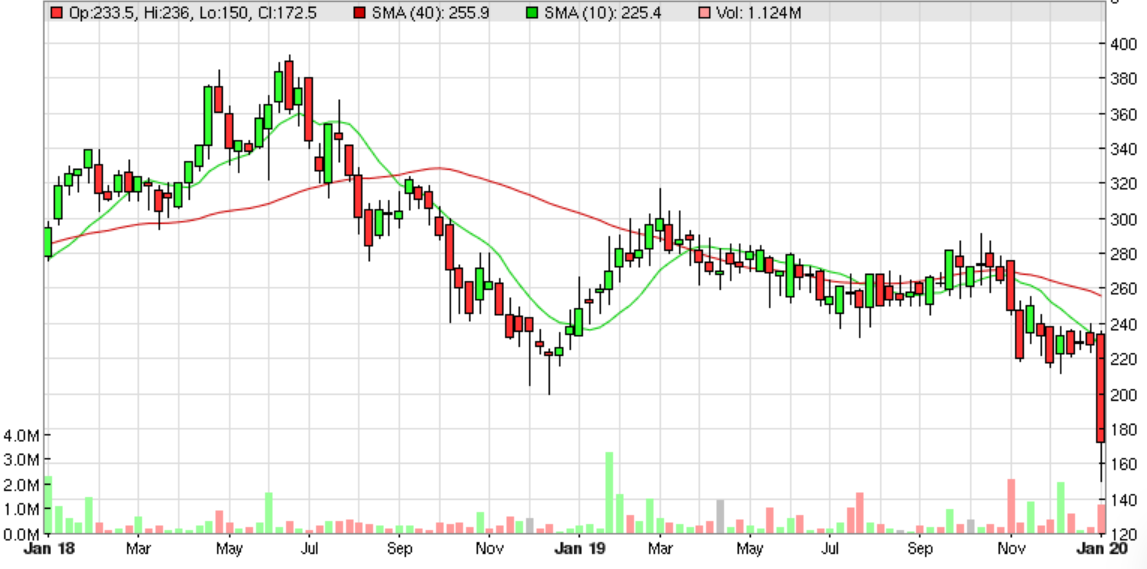
Superdry (LON:SDRY)
Share price: 404p (down 14% today, at 10:21)
No. shares: 82.0m
Market cap: £331.3m
Trading update (profit warning)
Here we have another struggling fashion brand.
Superdry announces today a trading update covering the 10 week period from 27 October 2019 to 4 January 2020 ("peak trading period").
This is an unusual situation, where the founder Julian Dunkerton took back control, and is now trying to re-position SuperDry as a mainly full price fashion retailer, rather than permanently discounting. That's a nice aspiration, but it can only be done if the product is perfect, and customers are prepared to cough up for it. It's customers who ultimately decide whether discounts are needed, by refusing to buy at full price. Hence my worry here is that by resisting the need to discount, Dunkerton may just be deferring the hit to profits, perhaps?
My review of the interim results, published here on 12 Dec 2019, is worth a quick recap, as it reminds me of the key issues. I had significant concerns (especially the going concern note), and decided this share was too risky, and the turnaround too protracted, to want to buy any shares at 479p at the time. Good thing too, as the price is now down to 404p.
Profit warning today - poor sales;
Despite a strong Black Friday event, peak trading performance has been lower than expected as we continue our strategic transition to a full price stance.
Reasons given - I've converted the text into bullet points;
- Unprecedented levels of promotional activity [Paul - from competitors}
- Subdued consumer demand immediately after Christmas
- Shortages of some better-selling product
- The need to reduce our inherited inventory position [Paul - presumably by putting it into clearance sale at reduced prices]
Delay in turnaround - this comment concerns me, as it suggests poor performance and struggles to clear poorly designed product is likely to continue until c.Sept 2020 - so we should be braced for more profit warnings in 2020, I reckon - hence this share is best avoided in my view;
Whilst we are encouraged by response to the limited ranges that we have introduced, this challenge will remain until the new design philosophy and product can be fully implemented across the entire range, with full impact expected by the launch of Autumn/Winter 2020.
Revised guidance - JOUL should take note! SuperDry has at least given clear guidance;
The benefit of strong gross margins and cost initiatives will not fully offset the profit impact of the aggregate shortfall in sales.
Taking into account our revised sales expectations for the balance of the financial year, and the challenging trading environment in which we are operating, we now expect Underlying PBT(1) to be in the range of £nil - 10m.
This is grim, because H2 is meant to be the seasonally stronger half. H1 was a small u/l loss of -£2.3m. Therefore, H2 looks likely to be a profit of only £2.3m to £12.3m.
As I outlined last time I reported on SDRY, profitability is collapsing. With the current year FY 04/2020 only likely to be at, or just above breakeven, then the likelihood seems to be that FY 04/2021 may be significantly loss-making. Probably the only thing that might preserve profits, is if the new A/W 2020 season stock (due in Aug/Sep 2020) turns out to be a blockbuster range.
My opinion - this strikes me as high risk.
It's worth revisiting the going concern note contained within the interim results.
If SuperDry has another bad year, and moves into heavy losses in 2020, then it could be facing potential insolvency risk in 2021.
A key question is how much net worth does Mr Dunkerton have? The reason I ask, is whether he has the financial clout to take the company private? That could provide an exit route for existing shareholders. But with the business in an increasingly poor situation, why would he be generous with any potential offer?
It will be interesting to see if the turnaround plan works at SDRY. However at this stage, based on the information available, it's not working so far. Therefore I'll be giving this share a wide berth unless there is some evidence that performance is improving.
It's a horrible sector, with well-known upward cost pressures, but downward footfall in the High Street. Therefore turnarounds are generally not working. SuperDry certainly has an uphill struggle in current conditions.
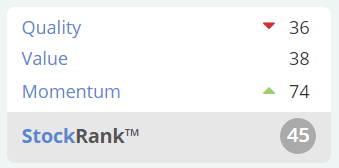
Stockopedia isn't impressed, calling it a "Momentum Trap", and the StockRank is lowish;
EDIT: Incidentally, I think there are some similarities between Superdry (LON:SDRY) and Ted Baker (LON:TED) at the moment, although TED looks to be in a much worse financial position. Therefore, I've opened a small short position in TED this week, since I cannot imagine it traded well over Xmas either. Thanks to the reader who posted a link from Sky News, suggesting that TED's banks had called in restructuring experts. That's usually a very bad sign. I rarely short anything, and only ever very small position size, as it's too risky. End of edit.
De-listing Risk
As mentioned many times in the past here, we have to be alert to the risk of usually the smallest companies de-listing.
The latest nano-cap to announce it intends to de-list (i.e. become a private company) is CloudBuy - Cloudbuy (LON:CBUY)
CloudBuy has been a complete basket case for years. I remember meeting management a few years back, and coming away from the meeting completely perplexed. They couldn't even explain what the company did, let alone what its prospects were. It just burned through cash every year, and achieved nothing of any significance.
So it's not really a great surprise that Cloudbuy is going to disappear from AIM. However, this triggered a c.60% drop in share price yesterday, and another 20% today.
Therefore, every time something de-lists, it's worth checking out our own portfolios for the smallest companies we hold, and ask whether the same thing could happen to them?
If something is a complete basket case, I think it's best to just chuck it out, even if you have to accept peanuts. It's much better to clear our worst mistakes off our portfolios, so we don't have to see a daily reminder of something awful, and cling on to some distant hope that it might recover.
Liquidity is such a problem with nano caps, that I reckon we'll see plenty more of the tiniest companies leave AIM. Good riddance too, I'd much rather have a smaller market, with more decent companies, than one clogged up with dross. AIM seems to have been badly managed, and brokers have generally done a lousy job in recent years - failing to find enough decent companies to float, and all too often instead floating speculative junk on AIM.
EDIT: I added the following in the comments section, then thought it would be useful to copy it here;
Re de-listings, off the top of my head, the companies most at risk are;
- Tiny mkt cap - I would say sub-£10m are most at risk, rather than your sub-£50m
- Run out, or about to run out of cash
- Struggling, or impossible to raise fresh funding from equity market, due to track record of failure, and investor fatigue
- Busted flush in terms of the story - i.e. a failed business model
- Almost no liquidity/trades in the shares - so why bother with the costs & hassle of a listing?
- By far the most important risk factor: shares concentrated heavily in one, or a few, large shareholders.
This would be an interesting project for an intern actually - to look at all UK market de-listings in last few years, and pick out the key risk factors. That could then produce a "risk of delisting" rating for each share. One for the Stockopedia tech boffins, possibly?
End of edit.
JD Sports Fashion (LON:JD.)
Share price: 826p (unchanged, at 14:02)
No. shares: 973.2m
Market cap: £8,039m
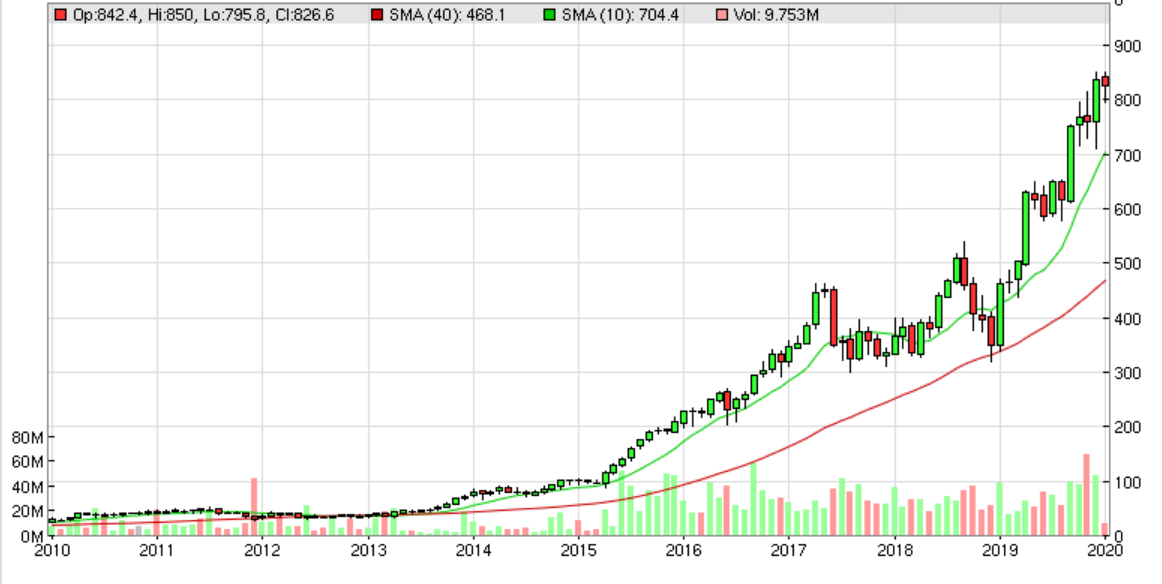
What an amazing success JD Sports has been in the last 10 years or so. Its shares have roughly 40-bagged, benefiting from that lovely combination of greatly increased earnings, and PE multiple expansion. The secret of its success seems to have been on focusing on the fashion element of sportswear, and snazzy shopfits rather than the pile it high & sell it cheap approach of others. Also its international growth has been stunning. So well done to everyone who spotted the potential & stuck with it.
Sales - sounds positive overseas. Implies that UK growth was modest, perhaps? Although the wording strikes me as ambiguous;
Against a backdrop of widely reported retail challenges in the Group's core UK market, it is encouraging to report positive like for like trends in the Group's global Sports Fashion fascias, particularly overseas.
It doesn't want to give any figures at the moment, for this reason;
Given the increasing significance of our international businesses in the overall Group result, and the fact that there is a differentiated timing of the post-Christmas sale period in a number of our key overseas markets, the ultimate outturn will reflect trading in these markets through the remainder of January.
Hmmm, that sounds a little concerning.
However, this bit reassures, and gets a thumbs up from me, for being clear in the guidance given (rather than ambiguous wording);
We remain confident that the full year Group headline profit before tax will be in the upper quartile of current market expectations which, after adjusting for the impact of the transition to IFRS 16, range from £403 million to £433 million.
That's quite a wide range of analyst forecasts, but upper quartile means the company is telling us that the correct range is now £425.5m to £433m.
Valuation - I can't find any broker research on this, which is surprising, given its large market cap.
The share price not moving today, indicates that the market is happy with this outcome, and buyers/sellers are in balance, so nothing much more to say about it.
The PER is 25 based on consensus forecasts. Given its track record of beating forecasts, that's not necessarily outrageous.
My opinion - it's done fantastically well, but with the market cap now up at £8bn, and as I understand it, mainly selling other people's product (big brands), as opposed to designing its own unique product, I think this business model could ultimately prove risky - if the big brands decide to concentrate on selling direct to customers through their own websites (at much higher margins).
Clearly my misgivings have proven horribly wrong in the past, and I overlooked a pot of gold sitting in front of me, so probably best to ignore everything I say!
In the context of looking at the retail sector generally, JD. seems to have done well mainly thanks to its overseas operations, not its UK operations.
Look at this for a remarkable chart! How much further can it go?
B&M European Value Retail SA (LON:BME)
Share price: 376p (down 5% today, at 15:09)
No. shares: 1,000.6m
Market cap: £3,762.3m
I thought it would be interesting to look at some of the mid and larger cap retailers too, so that we get a broader view of how retailing has performed over Xmas. One of my jobs for the weekend, is that I'm hoping to put retailers trading updates into a table, and see how they compare.
B&M European Value Retail S.A. ("the Group"), the UK's leading variety goods value retailer, today provides a trading update for the third quarter of its current financial year, relating to the 13 week period from 29 September 2019 to 28 December 2019.
I'm not familiar with this group, having never visited its stores. It has several fascias, in the UK and abroad. UK performance is what I'm interested in. It says;
B&M UK stores revenue growth of +8.8% including like-for-like ("LFL") growth of +0.3% for the quarter, against the backdrop of a challenging broader retail market and our decision not to engage in any early discounting activity
That's a similar ballpark level of LFL to the UK supermarkets. The +8.8% total growth shows that there must be a store expansion programme underway.
Heron Foods is the other UK brand, and it just says, "solid LFL sales growth", with no figure given.
This bit probably explains why the share price is down 5% today - a slowing of growth in Q3 (Oct-Dec 2019);
Cumulatively, B&M UK has achieved +2.3% LFL sales growth during the financial year to date, albeit with a slower performance than anticipated during the run up to Christmas.
Overall - unless I've missed it, I can't see any reference to full year profitability expectations, which is the main point of putting out trading updates! I'll see if there are any broker notes available, and what they say.
I've not looked at this business before, but quite like what I see. It makes a much higher profit margin than the big supermarket groups, and is rolling out new stores. I must visit one, to get a better handle on the main business unit of B&M UK.
I'm out of time now for today, thanks for reading & commenting, and have a smashing weekend!
Best wishes, Paul.
Disclaimer
This is not financial advice. Our content is intended to be used and must be used for information and education purposes only. Please read our disclaimer and terms and conditions to understand our obligations.

43 comments
B&m European Value Retail Sa (LON:BME) Hi Paul, one of my holdings so would appreciate your further investigation. From everything I know the market over-reacted to the trading update. They are a bit of a Primark for Homewares if that makes sense and from everything I read pretty well managed.
I do visit one or 2 B&M European Value Retail SA (LON:BME) shops as close to me, some items are pretty cheap compared to some supermarkets, I don't buy very much there at all, just the odd item. They improved the stores near me, about 4 years ago, mind you they need it but since then hardly anything has changed. For homewares it's definitely at the cheap end of the market, I think they have quite a bit of competition from Dunelm (LON:DNLM) and Range which both have shops close by. I was impressed with Range some interesting items at reasonable prices. At the tills in B&M seems most people are just buying a few items. I think there is plenty of room for improvement. The shops are like a shed, ie a DIY type store, they tend to be out of town.
Much appreciated purpleski.
I could not listen to today's Webinar due to a prior engagement even though I registered. Does anyone know if a recording is available?
Tony
available at
https://events.genndi.com/replay/169105139238459639/b8409147e4/0/0
Top Picks at https://www.stockopedia.com/challenge/top-picks/
Slides at http://assets.stockopedia.com/webinars/2020-stock-picks-webinar-slides.pdf
Full report at https://assets.stockopedia.com/webinars/topstocks2020.pdf
Re Delisters.
I did cover a bit on delisting in the IPO articles I wrote lat year
https://www.stockopedia.com/co...
There is also another study from 2019 which suggests that delisitings are on the decrease (see plot below)
That said I am just finishing an article looking at performance in 2019: nearly 40% of AIM Stocks made 10 year or all-time-lows in 2019 . That is hopefully indicative of a turning point from a capitulation low and not the prelude to a slew of delistings
I'll post a separate article on Stocko on the above though it will be available with the 60 odd page interactive data report on runprofits.com from later today
I am curious about the mechanics when a company delists. If you do sell who buys the stock? Presumably there are very few buyers so most of it would end up being held by the market makers. I am sure they have no desire to take a position in an unlisted company, but they are obliged to "make a market". Do they have some kind of back-door to offload this stock or do they write it off?
Nick,
My experience is that the shareholders get left with shares in an unlisted company, with no chance to sell them. They are pretty worthless when this happens.
Regards,
Ricardo
De-listed shares can always be sold on a "matched bargain" basis. Market makers are not involved. In practice this only works if either there is a large block that is actively marketed, or if some party instigates a scheme to buy them. As I said in the comment above, this can be used by the company itself to buy back shares on the cheap, so providing an incentive to de-list.
Ref delisting i have held a couple of "proper" delisting stocks that were companies making profits (blips aside) when they delisted (i have had a couple of rank cowboys too but that's another matter)
Both these companies offered a third party matching solution whereby one could advise that you wanted to sell (or buy) and then if a match was found in theory the shares could be sold. Practicably speaking i don't think there was much action going on there.
Both the companies after to de-listing subsequently did tender offers to try and buy back the shares from shareholders at a price well above the price when they dislisted. One of the companies was subsequently acquired for over 5 times the delisting price (Just car clinics) which was a nice outcome - other than the fact i had tendered a wad of my shares at a lower price. The other company touchstone group plc is paying decent dividends 10 years later - i think the de-listing price was 28p ish and the dividend in the latest year was 11p - so the dividends in the last 10 years have been a great return compared to the price at time of delisting.
To be fair to those companies it was reasonably evident the reasons for delisting were genuine and there was no specific indication that i though the main shareholders were trying to do this to screw anyone over. I probably would be less likely to hold after de-listing if i thought the main shareholders had dubious morals.
I think the other answers are to a slightly different question.
What I am pretty sure you are asking Nick is about transactions that happen whilst the company is still listed - ie between the announcement of the intent to de-list and the event itself actually happening.
Even after the 50%+ price collapse that often ensues most just want to sell at any price rather than be faced with a minority position in an unlisted company.
But as mentioned by others, holding shares in an unlisted company is not necessarily a disaster and some investors have an appetite for such investments (especially at such a large discount) - I'm guessing mostly institutions and funds.
If I remember correctly, you can ask a company (listed or not) to examine their shareholder register and I think the legal presumption is that they should comply unless they have very good reason not to. So if anyone was particularly interested, it might be instructive to ask to see the shareholder register of a recently de-listed company. (if my recollection that unlisted companies are covered is correct).
Yes - I meant the trading that happens between announcement and delisting. The market makers are obliged to quote a price but they are facing a point in time when the shares are no longer publically traded.
It looks though that even for private companies there are ways to trade and presumably the MMs can use these routes to slowly get rid of the shares. I guess there are worse situations where everyone is heading for the exit and the company looks to be unlikely to survive (but not yet confirmed) and the MM is bravely still offering a price (even though it will be minuscule!)
Hi Paul
"This is an ongoing theme, as Card Factory (LON:CARD) did something similar yesterday, by obscuring its LFL performance in Q4, providing only YTD figures instead. This is probably due to PR people trying to be clever. It doesn't work - investors see through it, and it's actually harmful, in undermining trust.
I think the best PR people understand that it's best to get bad news out immediately, truthfully, and in full. Then the share price gaps down, and everyone can move on. When bad news is obscured in announcements, it just undermines investor trust in future announcements (and management)."
Except in tru;y exceptional cicumsyances, as soon as I conclude I cannot trust a management team, I sell the company's shares as it seems deluded to me to do anything else. If JOUL and CARD aren't prepared to be honest and open with us, its a complete bargepole from me.
SDRY may turn out to be a bust but at least their management team has shown a bit of decency to investors.
Best wishes, Martin
Much to my surprise, given the well-known problems with bricks-and-mortar stores, Superdry (LON:SDRY) has opened an new store in Telford. Since my wife still holds Superdry shares we've been into the store and had a look round. I see little difference between the new store and my last visit to one of their stores which was long before Mr, Dunkerton took over.
Yesterday, when I walked past, they were discounting stock by up to 50%. Again, I thought the strategy was to confine discounting to their online shops and sell only full-priced items through the stores.
I am really struggling to see the difference Mr. Dunkerton is making - or maybe I'm just not looking closely enough.
My wife went shopping to John Lewis earlier this week and spotted a lovely coat by JOULE in size 12. Hesitant about buying it as it was quite expensive she held back. She went back yesterday it had gone together with the smaller size 10. JL said there were none of that size in any of their stores (plenty of other larger sizes) rang Joules who told her they were completely out of stock. Came home, went on line and lo and behold on Joule's website she found one and ordered it. Obviously some stock control issues internally.
Or maybe Joules (LON:JOUL) 's website isn't accurate about the stock position, which seems likely in a company with an "internally generated stock availability problem".
re Joules (LON:JOUL), I would have thought, naively, running out of stock was a better problem to have than having too much stock because no one will buy it, which is the Superdry (LON:SDRY) problem. Joules (LON:JOUL) is a fashion brand, isn't it? I thought the business model was all about holding as little stock as you can get away with. If they were running out on some items over the Christmas selling season, maybe it is a straw in the wind that the sector could be turning. I don't hold, but Joules (LON:JOUL) looks a plausible recovery bet to me.
re de-listing one possible safeguard against this is holding a share via a spreadbet with a guaranteed stop loss if you are particularly worried about it.
I spoke with IG about this and they said the guaranteed stop would be honoured in this event but there might be a short delay in the payout.'
The caution regarding de-listing is a point well made, but I struggle to identify those at risk, or identify clear criteria for those at risk.
Maybe it would be wise to avoid anything under £50m, but does that mean that Sosandar, Intercede and Best of The Best are uninvestable (to quote 3 examples that are favourites of this blog)?
To de-list you need 75% to vote in favour, so you could argue that if the % of shares in public hands is greater than 50%, you are ok, as de-listing hurts all of these people and they will vote against. But this doesn't seem to apply in reality. Looking at Cloudbuy, the free float is 40%. That is less than ideal but still means, in theory, that you need a lot of people to vote against their own interest in order to de-list. However, I guess the reality is that most people simply don't vote, so the vote is carried by those who are active. So no level of free float is any guarantee.
Maybe having large institutions on the share register is some form of protection. But maybe institutions don't care as much because they could trade blocks of shares privately.
Maybe companies that need capital for growth are less likely to de-list than those who are generating free cashflow. But the ones generating free cashflow are arguably the ones you want to invest in, not the ones sucking up your cash.
The whole issue seems rather imponderable to me and I would welcome the thoughts of anyone who thinks they have a handle on this.
Hi cmpeckham,
Re de-listings, off the top of my head, the companies most at risk are;
This would be an interesting project for an intern actually - to look at all UK market de-listings in last few years, and pick out the key risk factors. That could then produce a "risk of delisting" rating for each share. One for the Stockopedia tech boffins, possibly?
This is a big risk, as unexpected notification of intention to de-list quite routinely triggers a 50%+ drop in share price, as people rush to exit. There again, the companies concerned are usually such junk, that nobody should be holding their stock anyway!
Regards, Paul.
Paul, thanks for the list. Looking at it that way, it's a non issue, because you would have to be insane to hold such a share anyway. If you are right, I have no need to worry. But I'm not sure it's that simple. I read recently that the costs of a public listing are not worth it unless you have a market cap > £100m (of course I can't find the article now).
In general, I suspect we will see more de-listing of viable, cash generating businesses, due to a rational preference to avoid the burdens of being public. Although it would be unethical, such a company can then either:
- load the company up with debt and make money on the interest, private equitiy style while avoiding dividends, or
- hoover up all the de-listed shares that people want to dump at any price.
Either way, they would make out like bandits.
Hi cmpeckham,
I read recently that the costs of a public listing are not worth it unless you have a market cap > £100m (of course I can't find the article now).
Yes, I read that article recently, and also cannot remember where it was published, lol!
I think what that article got wrong, is that shareholders won't agree to companies de-listing on a whim, unless there's a very good reason to do so. A profitable, dividend-paying company can't just de-list because the Directors fancy doing it. Providing there's no overwhelmingly dominant shareholder or concert party, then institutional shareholders would surely block any attempt to take a company private.
In terms of liquidity, the problem is fundamentally caused by brokers being lazy when they IPO smaller companies - placing all the stock in lumps with institutions, thus creating a situation with negligible after-market liquidity in the shares. It's crazy. Companies are very naive, in paying huge fees to brokers to float them, whilst not doing anything to create an after-market!
Reversing into a cash shell is a much better way of doing it. Take Sosandar (LON:SOS) for example - it inherited a PI shareholder base, which was bolted on to the new institutions who funded it. Liquidity has been fairly good ever since if floated, because of this.
In my portfolio, I have 2 companies with very dominant (over 50%) management shareholdings - namely £BOTB and Beeks Financial Cloud (LON:BKS) . In both cases, I've carefully assessed (and asked tough questions, repeatedly) the risk of management de-listing, and concluded that it's very unlikely. William Hindmarch at BOTB is emphatic that he won't de-list, and his track record is such that minority investors are treated very well. It's ultimately down to trust in that type of situation.
Whereas, many years ago, FDM (Holdings) (LON:FDM) shafted its small shareholders by de-listing at a low price. That's why I won't touch the company since it re-listed at a much higher valuation - because I don't trust management.
Regards, Paul.
£Dis has been discussed a lot here but at a market cap of £.3.5 million it seems to me to be a delisting risk. However it has just 30% ownership amongst larger shareholders with some very recent institutional buying. Largest holder is a private investor at almost 11%.
(No personal position)
Paul,
Thanks for an interesting list of risk factors in respect of delisting. However, delisting need not necessarily be a disaster if the management are both effective and ethical.
I failed to sell up on the delisting of Norman Hay plc. I could have sold subsequently in the matched bargain market where the price was quoted at 68p a share last year. However, I was never tempted to do so as the business was clearly well run and they continued to churn out reliable dividends.
This year the various businesses were sold on the retirement of the founding director and the initial return of capital dividend I received just before Christmas was £3.71 per share with further payments to follow in the liquidation of the company. I shall have to trawl back in my records to discover the amount I paid for the shares but I doubt it was much more than about £1 per share - so a decent return on my investment.
Of course this is not typical of delisted shares, but if you buy decent companies with decent management and are patient delisting is not necessarily a disaster.
Jeremy - caselaw
I bought Norman Hay in 2010 for 80p and sold pre delisting 6 months later for 57p, which if I remember was quite a discount to the price pre announcement.
I've always kicked myself as I thought it was a good company and often wished I'd just held onto them. I now have my answer....at 371p 9 years later I should have held.
I'm guessing that on the "new" site comments are normally threaded so following a narative is simpler but for those of us clinging on to the old site or who like to read comments in the order they were submitted a plea to please try to remember to use the £ followed by ticker so we have an idea what is being discussed.
Re: Subject line / £ticker
Hi Laughton
I strongly agree. I mostly use the new site but found it annoying having to scroll up & down to find new posts in when in threaded mode, and sometimes missed updates. Therefore even on the new site I use the unthreaded setting so all new posts appear in one place at the end.
I feel it would help to have a subject line formatted in the comment subscription form, but the suggestion was not taken up when I made it.
Re Superdry (LON:SDRY) - the clothes they produce just aren't that popular anymore with younger people. There was a time 6-7 years ago when they were the 'in' fashion brand with teenagers and they expanded massively to accompany this but are now just not that popular, especially at the prices they charge!
DJB
You are spot on. The same applies to Ted Baker. These are fashion trends and when your day is done you either do not survive or need to reinvent your offering. As a highly speculative punt I think Superdry may come back if Dunkerton has the commitment and he seems to be making the right noises. Retail is very hard now and you are punished where it goes wrong. E.g. Joules. You may have the best offering but when you cannot manage your supply chain!
If a clothing brand becomes the clothes you wear after you become a dad, then they are no longer 'cool'. That's the kind of market they're in.
Re Sopheon (LON:SPE) - another factor is that it's incredibly illiquid.
Coincidentally, I was trying to buy a small opening stake in SPE earlier this week, as it's been on my watchlist for a while, and it seemed to have stopped falling. Despite trying all day, my broker only managed to get 1,000 shares, at 630p. I was too tight to pay up 650p for more!
My broker commented that Sopheon is so illiquid that you can only usually buy when it's falling in price. At other times, lots of PIs tend to compete for scarce stock, apparently.
For this reason, I've decided to diversify my portfolio more in 2020. I'm looking to open maybe 10 smallish new positions, rather than 1 or 2 new big ones.
Regards, Paul.
Paul
Sadly this is an inherent issue with many small companies whose free flat is small and undermined by large holders on the register who are not sellers.
Liquidity issues are undermined in a lot of AIM stocks when a number of Inheritance Tax services operate on a modular basis so will hoover up stock, forcing the price up. We are all at the behest of Market Makers
who will widen spreads at the drop of any bad news. As invesco and Woodford liquidators have found out it is a lot easier to get in than out when you have a substantial stake and the discount they have to take is large. Were the IT exemption to be removed most of these services would be closed and liquidation cause huge issues. Let’s just not be that negative.........
Paul, diversification is troubling to me. I have just finished the art of execution (again) which lists 5 dos and one of them is best ideas only and another don't buy illiquid stocks. I find repeat reading reinforces the rules (i still manage to break too regularly!!) Years ago I used to use the BARRA multi factor model which would analyse the volatility and weights relative to an index. It was clear if you bought stocks not in the index it increased your risk relative to the index obviously. Or if you didn't buy stocks in the index it increased your risk (rel to index)(depending on volatility of said stock of course). But I recall Anthony Bolton at Fidelity used to invest in well over 100 stocks in his special situation fund and delivered 17% a year for 20 years outperformance. So plenty of diversification but presumably no respect for the index. Don't recall his benchmark. I suspect his risk was quite low because he knew what he was doing and his army of analysts knew their stocks. Evidence his attempt to start the China Special Situation fund. As i said undecided about diversification as I don't want a return a benchmark, I want a total return, so I will take Jim Rogers advice "if you want to make money you have to risk it". Then we are in the discussion about what is risk and sizing urgh!
We've just published another piworld interview: How to .... EIS investing.
A tremendous overview of tax efficient EIS investing, by private investor Tim Grattan, who outlines what an EIS is, why the government offers this tax incentive, the EIS benefits, the EIS risks. A really helpful overview, giving examples from his own experience, including the overall performance he's experienced.
Not really connected to any RNS but Sopheon £spe has jumped 25% in the last 24 hours despite no news that I can see and after 2 profit warnings recently. Smells fishy....anyone have any insights?
SPE: Naked Trader tipped in his newsletter, yesterday.
I just read his latest entry and didn’t see any mention of Sopheon?
Just went to paid subscribers to his emails but I'm surprised if it was just that it caused a jump so big
pretty annoying I agree, I'm interested in Sopheon (LON:SPE) too but felt there might be one more profit warning in it yet, may have missed the boat. I didn't know that Robbie Burns did more than his blog as it wasn't mentioned in there at all yesterday
Robbie adds a "higher risk ideas" extra bit on his email to email subscribers - you wont have seen it unless you have subscribed. SPE featured in that extra bit yesterday. He covers a few stocks each time that can be riskier then the steadier shares he otherwise buys. If you attend one of his events you can sign up - for a fee. He may sign up people if emailed.
Also worth noting that in each e-mail as he begins this higher risk (exclusive) section he consistently asks for them not to be shared online/bulletin boards/forums etc so it shouldn't really be flagged here as his actions driving a share price.
I wasn't aware you could "buy" into his subscriber list. I'm subscribed through signing up as one of his Utility Warehouse customers.
Out of interest and as it's a retailer which is your specialist subject and interest, what do you make of B&M results. On the face of it they look okay but shares marked down.
My morning smallcap tweet: Superdry sucks
Superdry (LON:SDRY) £TM17 Abcam (LON:ABC) MTI Wireless Edge (LON:MWE) Joules (LON:JOUL), Surface Transforms (LON:SCE)
Superdry (SDRY) warns of ower than anticipated retail sales of £23m plus £5m wholesale, since Black Friday. Guides FY U/L prerax £0-10m. Blames rivals discounting, weak post Xmas demand and product shortages. CEO says co working to "return to full price sales and reduce promotional activity, and we halved the proportion of discounted sales over our peak trading" and this hit sales more than expected.
Team17 (TM17) guides FY adj EBITDA and revenue ahead of market expectations.
ABCAM (ABC) guides H1 rev up 11%, 8.3% at const FX. Tightens const FX growth target for the full year to 9-10% but from what? F/C is for 13% growth. Guides adj op profit margin towards the lower end of guidance of 25-28%.
MTI Wireless Edge (MWE) wins $0.6m order.
Joules Group (JOUL) Xmas retail sales down 4.5% due to "internally generated stock availability issue through the important end of season sale event, the cause of which has now been addressed." Other retail channels were in line. Expects H2 cost headwinds as a result of US-China tariffs. Guides FY U/L pretax significantly below market expectations. Will outsource logistics. One off cost but are expected to deliver significant cost benefits from the end of FY21.
In line: Surface Transforms (LON:SCE)