Stock in Focus: Can highly-ranked John Wood Group deliver?

When choosing a company for this week’s Stock in Focus article, I ended up with a short list of two: John Wood Group and Alumasc. So I was interested to see a few hours later that both stocks appeared in Ed Croft’s NAPS portfolio for 2016.
Alumasc is a building engineering stock I’ve followed for several years and may cover next week, but this week I’m going to take a look at Wood Group. I rate this Aberdeen-based firm as the class of the field in the UK-listed oil services sector, and believe it could offer good value.
Is this wise?
After my disastrous foray into commodity-related stocks for this column last year, it may seem rash of me to choose an oil business for my first stock of 2016. But I’m not so sure that’s true. I believe that crunch time is approaching for the oil sector and that casualties -- and perhaps production cuts -- are likely this year.

Macro views aside, I think that Wood Group has now had a chance to show investors how it will cope with lower oil prices. So far I’ve been impressed, as have the Stockopedia computers.
Wood Group currently has a StockRank of 95, with value and quality ranks of 80 or more, suggesting a possible contrarian buy. Crucially, momentum is also improving rapidly. This suggests that now could be a good time to take a fresh look.
The case for value
Oil sceptics will point out that the historic performance of companies operating in the oil sector isn’t necessarily relevant. After all, profits linked to the price of oil are going to take a big hit over the next few years.
That’s certainly true up to a point, but there are limits. Wood Group’s role in the oil sector means that it has two big advantages. Firstly, it doesn’t sell oil. Wood Group provides engineering and operational services which many oil companies need to maintain production. Wood Group also has an asset-light business model and a flexible workforce.
A final consideration is that Wood Group’s forecast P/E valuation is almost identical to its historic P/E. The implies that the market is expecting stable earnings from this firm.
Let's start by looking at why Wood Group has a ValueRank of 88:
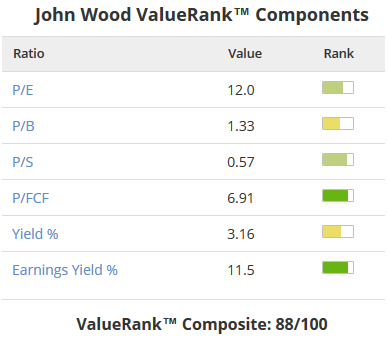
(You can see these breakdowns by clicking on the StockRank numbers for the company on its sector page)
Two particular highlights are the price to free cash flow ratio of 6.9 and the earnings yield of 11.5%. Both demonstrate Wood Group’s cash-generative profitability.
There’s also a dividend yield of about 3.2%, which is expected to rise to about 3.4% this year. To me, this looks like a decent reward for patience without being imprudent -- last year’s payout was covered 2.8 times by earnings.
Simple quality
The ability to generate consistent profits and free cash flow is a sign of quality. Another important clue is balance sheet strength. Investors can get a snapshot of how a company scores on all three measures using the Piotroski F-Score.
If you’re not familiar with the F-Score, it’s worth taking a look. This isn’t an obscure technical indicator that’s open to interpretation. Instead, the F-Score is simply a checklist of useful metrics. Together, these test for improving balance sheet strength, cash generation and profitability.
Although it’s not failsafe, the F-Score is a very useful way to get a quick overview of a company’s financial health. Wood Group scores a reassuring 7 out of a possible 9:
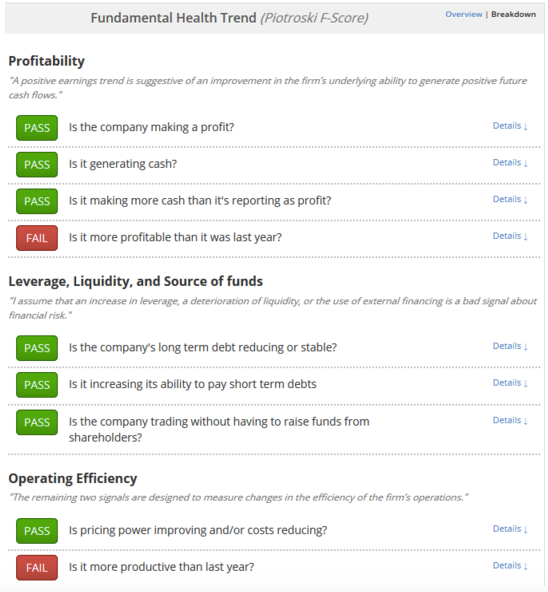
It’s no surprise to see that Wood Group is less profitable than it was last year. The F-Score uses return on assets to measure profitability. If you click on the Details link you can see the numbers behind the pass/fail result. In this case Wood Group’s return on assets for the trailing twelve month period appears to have fallen from 8.0% to 6.7% over the last year. I don’t see that as a big concern given the scale of the oil market downturn.

Two other quality indicators I’d like to point out are net debt and operating margin.
Wood Group’s operating margin rose from 6.3% to 7.6% in 2014 and was 6.4% during the first half of 2015. Current forecasts suggest to me that the firm should deliver a similar margin for the full year.
Debt levels also seem quite safe. Interest payments were covered 7.6 times by free cash flow last year. At the end of June, net debt was only $277m, which equates to net gearing of just 10.8%.
Improving momentum
Economist and investor John Maynard Keynes famously said that “the market can remain irrational much longer than you can remain solvent”.
In my view, this is another way of highlighting the importance of momentum to investing returns. Many investors who placed bets on a housing crash in 2005/6 were right, but were still forced into painful losses because their timing was wrong.
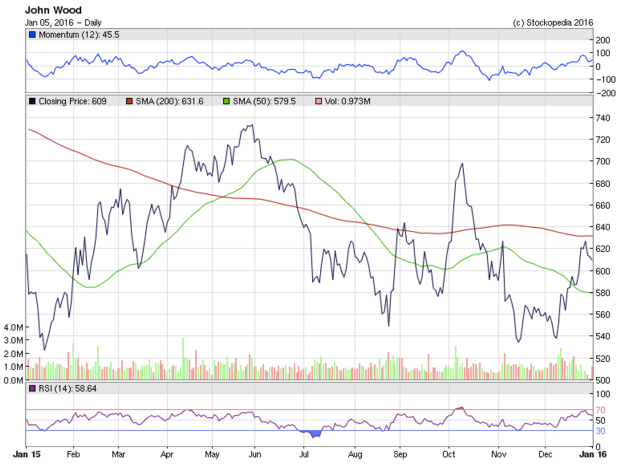
Luckily, Wood Group’s momentum appears to be improving. The stock’s MomentumRank has risen from 40 to 65 over the last month and Wood Group shares have rebounded strongly from their November low of 534p.
Price momentum still looks solid at the moment, with encouraging momentum and RSI readings:
City analysts are also turning slightly more positive. Earnings per share forecasts for the current year edged slightly higher last month, to $0.79. That puts Wood Group on a 2015 forecast P/E of about 11.5 -- almost exactly the same as the firm’s trailing P/E of 12.
Too good to be true?
I may have put my head in the lion’s mouth by taking a positive view on an oil stock. Yet I think it’s worth remembering that Wood Group’s services are a mission critical element of the operations of many large oil and gas firms. Big Oil no longer has enough of this expertise in house. Firms such as Wood Group are indispensable.
However, oil prices may yet slump further, and I expect that this year will see a shakeout of heavily indebted firms with poor cash flow. Aside from short-term volatility, I don’t expect either of these risks to affect Wood Group very much -- but what if they do?
The big risk, in my view, is not so much that Wood Group will lose work but that it will be subject to renewed pressure on pricing. The firm’s management were quick to confront this risk and have cut headcount by 17% since June 2014, while also cutting pay rates for many remaining contractors.
I suspect further cuts would be possible if needed, as staff and contractors would be unlikely to find better offers elsewhere in such a poor market. This should help protect Wood Group’s earning power, as should the firm’s broad range of skills.
In my view an investment in Wood Group could provide an attractive medium-term profit, in return for a moderate level of risk.
As always, this is only my opinion, not advice. Please do your own research and share your views in the comments below.
Disclaimer
This is not financial advice. Our content is intended to be used and must be used for information and education purposes only. Please read our disclaimer and terms and conditions to understand our obligations.

13 comments
Any reference to Wood Group drives me to apoplexy. This company has not increased pensions for pre 1997 DB pensioners for the last 20 years resulting in a cut by 50% over the period. They say they can’t afford a rise as they are discretionary but they can for 96% of pensioners who are legally entitled to a inflationary rises.
Thought I'd come back and comment on WG performance that finally ended up well north of 850 in December. I guess my opinions were firnly wrong. I finally bought in and enjoyed some fruits of the debate.
It has now drifted down to just over 800 with a report coming out on 21 Feb and Brent roughly $55. Any views on further improvement or leave well (get it) alone?
a lot of big contract wins this year for JW including one today in Iraq.
Takeover rumours:
http://www.ft.com/cms/s/0/1c4a4262-ba21-11e5-b151-8e15c9a029fb.html#axzz3xCTHf46X
I can't read that link as I'm not a FT subscriber. The share price has not gone up today. I think after the KBC bid I think John Wood (LON:WG.) does look quite attractive.
I bought a few John Wood shares today, so they are bound to plummet now, lol. I have a tight stop loss just in case.
agreed
Thanks Roland, no I'm not suggesting WG earnings linked in that way but I have worked in the industry and when the clients are out of cash they just stop spending on capital equipment and repair budgets fall apart. In this industry the plans move slowly but the cash moves fast... In fact the ability of contracts to slow down cash payments at a whim is a major facet of the business. If a pump does not work at top efficiency, no one cares, if a piece of kit is delivered late no one cares, if a bribe arrives late, everyone cares. I'm sure WG do not operate in a Bribe environment but a lot of the oil industry is like that.
I'm long (in a very small may as part of diversified approach on this share) but i'm also realistic. I can see £20 for 6 months BTW.
My point on aquisitions is who would buy it? I know there are weaker companies but are there stronger ones who can see an advantage in buying it. If not, then I see it bouncing along hopefully making a little cash.
Thanks bobo. I take your point about what happens when cash is tight. I've seen similar things in other industries in the past, too.
Having said that, I would be surprised if WG's business reached the point where it had so few worthwhile contracts that no-one would buy it at any price, but I suppose it's not impossible.
Ultimately I think we (mostly) agree! WG should be able to bump along at the bottom for a while and then hopefully deliver strong results when prices start to rise. I don't see this as an existential risk to the firm thanks to its strong balance sheet and good cash generation.
The companies that will go by the board are those with too much debt and negative cash flow. The big question is how long it will take for this flushing out process to complete.
Cheers,
Roland
Just how low and for how long does Brent need to go before WG runs out of cash. $20 and 6 months? Cutting costs is all very well, but once the contractors are gone, then you need to cut the old/weak/poor performing in the core business then you just end up with a rump.
To put it another way, which company that you can select will buy WG if the share price drops by half, because I can't think of one
bobo,
Your comment seems to suggest that £WG earnings are linked in real time to the price of oil. This isn't the case.
Although the collapse in oil has caused WG's customers to negotiate prices down on new and existing contracts, the firm's business generally operates on multi-year timescales and involves agreed fees for certain work. As a random example, WG announced a new 3-year, $90m contract in Iraq as recently as November.
I'm don't think Wood Group will run out of cash in any reasonably foreseeable scenario. The group has generated plenty of free cash flow over the last eighteen months and has very little debt.
On the subject of acquisitions, who knows? Wood Group has made at least one small acquisition itself recently and I wouldn't be surprised if more followed. There are many companies in a much weaker position than WG.
For what my opinion is worth (not much!) I'd be very surprised if oil reached $20 and stayed there for six months. But even if it does, global oil consumption will remain much the same, and most WG customers will continue to pump and refine most of the oil they are currently pumping and refining.
Regards,
Roland
It has fallen about 10% in last few days so I think I will watch from the sidelines for now.
I fully agree with you. I have written about Wood Group and in my opinion the company is strong enough to survive even a very harsh times on the oil market. I am happy to see someone, who support my point of view.