Stock in Focus: Indivior revisited, still a Super Stock?

In June last year, I wrote about Indivior in this column.
At the time, the Reckitt Benckiser spinoff was nearing its peak share price of 271p.
The stock enjoyed a perfect StockRank score of 100, despite only having been listed for six months. The market appeared unconcerned about the future, despite the likelihood of serious challenges to the firm’s profits.
How things change. Indivior shares have fallen by 27% since then. The changes I feared in Indivior’s business are starting to materialise. February’s results revealed that sales fell by 9% in 2015, and net profits fell by 43%.
Despite this, a sharp improvement in momentum since the firm’s 2015 results has helped lift Indivior’s StockRank back up to a stellar 99.
A couple of readers have asked me to take a fresh look at the stock, which is also a member of Stockopedia founder Ed Croft’s 2016 NAPS portfolio. With the shares down by 38% from last year’s all-time high, is Indivior a contrarian opportunity, or a value trap?
The big risk?
Before I delve more deeply into Indivior’s valuation and outlook, it’s worth summarising the key risks faced by the business.
Indivior’s only real commercial product is Suboxone, a medicine used to treat patients with opioid (mainly heroin) addiction. Historically, Suboxone has been sold in two forms, a tablet and a film.
The film is seen as having a number of advantages over tablets. As it’s administered by dissolving a piece of medicated film on the tongue, the dispensing pharmacist can be sure the treatment has been taken by the correct person. Tablets can be more easily secreted and sold or swapped for drugs. There is apparently a black market for Suboxone.
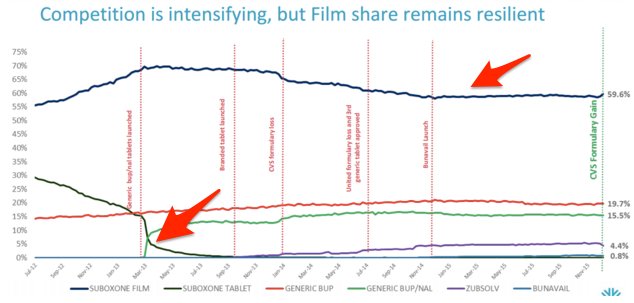
However, market share for Suboxone Tablet has now fallen to less than 1%, thanks to generic competition. This slide from the 2015 results presentation shows how Indivior’s market share has changed since July 2012 (Suboxone Film is the top line, Suboxone Tablet is the green line that drops to the bottom):
(Taken from Indivior 2015 results presentation)
In just one year, Suboxone Tablet went from a c.30% market share to sub-1%. The other coloured lines represent generic tablet competitors. It’s obvious why Indivior is putting a lot of effort into legal challenges to all six of the new drug applications for a competing film products.
An approval could be disastrous. As far as I can tell from the legal update in the firm’s 2015 results presentation, there are two competitors who could, theoretically, get the green light this year. Others may follow in 2017/8.
Indivior’s guidance for 2016 is based on the assumption that there will be no generic competitors in 2016. That seems reasonably likely, but from 2017 onwards, uncertainty levels are much higher.
To combat the likely eventual loss of Suboxone Film exclusivity in the US, Indivior is targeting EU and Asian markets with Suboxone. The group also has a number of other products progressing through its pipeline. However, it will be some time -- if ever -- before they reach the $1bn scale of Suboxone.
This is why Indivior’s board has decided to pay no dividend for the “foreseeable future”. Preserving cash and managing debt is vital.
What about the accounts?
Indivior shares now trade slightly above their IPO price. This gives them a trailing P/E of 6.1 and a dividend yield of 8.1%. The other factors behind Indivior’s ValueRank of 95 are a price/free cash flow ratio of 5.8 and an earnings yield of 19.2%.
Traditional value investing relies on past performance as being a more accurate guide to the future than forecasts. Yet as Indivior is in transition, are these figures of any use? Doesn’t a forecast-based valuation make more sense?
I reckon there’s still some value in these numbers, especially when combined with a high QualityRank. Together they demonstrate that this is a well-financed business that is not in crisis.
Quality remains intact
When I last looked at Indivior, the stock had a QualityRank of 91. Today, it’s 86. That’s not really a big decline, given what’s changed.
This is because Indivior’s franchise factors, which give it a profitable edge, remain strong:
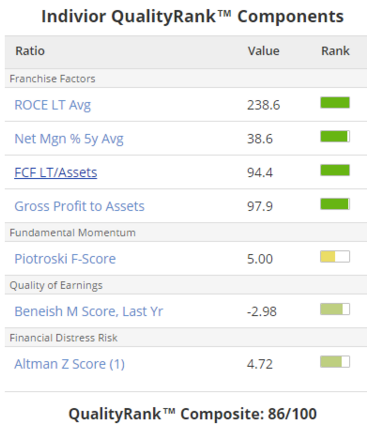
The only obvious casualty compared to the start of July last year is Indivior’s Piotroski F-Score. This has fallen from seven to five, out of a possible nine.
Falling profits accounted for one of these F-Score fails, but elsewhere the deterioration is negligible. For example, the current ratio has fallen from 1.22 in 2014/15 to 1.2 in FY2015. That’s not statistically significant, in my view. Factors such as this are why it’s sometimes worth reviewing the data with a critical eye, despite the quality of Stockopedia’s algorithms.
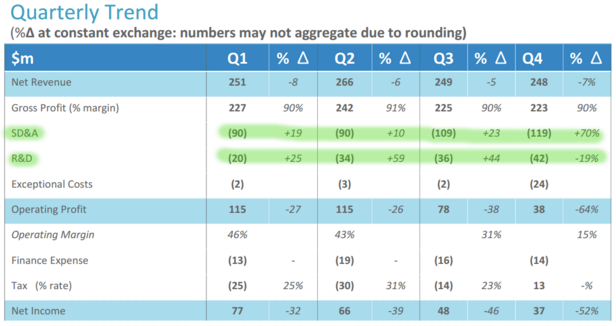
It’s also worth taking a closer look at why profits fell last year. Contrary to my expectations, it wasn’t because prices fell. The firm’s quarterly breakdown shows that gross margin remained almost flat at 90%. Operating profit fell because of the costs of scaling up to a standalone FTSE 250 PLC and because of an increase R&D spend, as this slide shows:
(Taken from Indivior 2015 results presentation/my highlights)
Despite these rising costs, Indivior’s debt situation did improve last year. Indivior ended 2015 with net debt of $174m (2014: $428m) and plenty of cash on hand. The balance sheet looks safe enough to me.
Rising momentum
When I first saw Indivior’s results in February, I was quite bearish about the outlook. I am still concerned about the threat to Suboxone Film from potential competitors.
However, I suspect that the relentless activities of Indivior’s legal department may postpone the day when this risk becomes a real threat. In the meantime, Indivior has a decent balance sheet and is in a position to consider potential acquisitions or a merger deal.
Earnings are expected to fall by 41% to $0.23 per share in 2016, putting Indivior on a forecast P/E of 10.5.
For some unknown reason, a number of analysts are still forecasting dividends, which is why a forecast yield of 3.6% is shown in the Stockopedia figures.
I’d ignore these forecast payouts and focus on the earnings upgrades we’ve seen since the 2015 results:
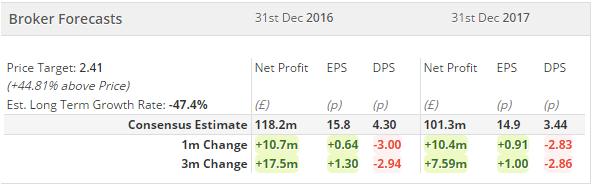
These continue a pleasing upward trend in consensus forecasts over the last year:
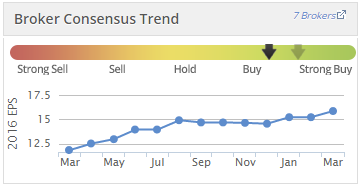
These upward revisions plus last year’s earnings beat have helped push Indivior’s MomentumRank up by 37 points to 70 over the last month. The stock is within touching distance of having the profile of a Super Stock.
Although this requires considerable faith in Indivior’s management, I don’t think it’s impossible.
Having said that, this is a situation which involves a lot of specialist pharmaceutical law. This means that most investors will be forced to rely blindly on Indivior’s guidance.
Indivior remains something of a special situation, in my view. It’s very much a case of DYOR and form your own conclusions.
Disclaimer
This is not financial advice. Our content is intended to be used and must be used for information and education purposes only. Please read our disclaimer and terms and conditions to understand our obligations.

21 comments
Another legal setback overnight with an adverse ruling in the US courts on alleged patent infringements of £INVD IP rights for its Suboxone Film.
https://www.investegate.co.uk/indivior-plc--indv-/rns/indivior-responds-to-court-ruling-anda-litigation/201803230700057188I/
Going to appeal but given wider market mood (and the sense that the US is collectively pulling down the portcullis) may be another steep drop on the share price rollercoaster. No position, but sympathetic to holders ....
Gus.
Gus.
Interesting large new study showing a newer rival Vivitrol to suboxone is as effective. Advantage of Vivitrol seems to be that it is administered once a month (vs daily for suboxone). Advantage to suboxone is that patients need to be completely off opioids before they can take Vivitrol.
Could lead to a decrease in prescriptions of suboxone.
https://www.statnews.com/2017/11/14/vivitrol-suboxone-study-nida/
The actual low on Friday was 246.5p
Picking up on the write up from Gus above, the company stated in the second from last paragraph, "We remain confident in Indivor's long term outlook and vision". The share price drop was the largest drop in the whole of the UK market from 416p to 267p at close of business on Friday. This must have triggered massive automatic sell orders driving the price further and further down with I think over 14M shares traded.
So has it been over sold as Hayashi22 is thinking.
The company was valued by Vector Vest on Thursday at 550p and Friday it had a valuation of 516p, that is only a drop of 34p compared with a 149p drop in the share price thus making the company even more undervalued.
So going by these figures I am expecting the share price to rise and agreeing with Hayashi22 that it has been oversold. Certainly one for the watch list and wait for a reversal to come. Another bottom fishing oppertunity perhaps. Please DYOR. Stoco still has a stock Rank of 99 too. In fact the low was around 255p at about 9:30 am so it has already started to reverse the huge drop. See what happens over the next few days.
So is INDV a buy or sell at these levels? I don't have a strong view but inclining to it being oversold.
Not a stock I follow closely or hold but RNS this morning from the company saying they are appealing an adverse court ruling about validity of their patents on Suboxone Films in the US.
------------
INDIVIOR RESPONDS TO COURT RULINGS IN ANDA LITIGATION AND ANNOUNCES INTENTION TO APPEAL
CONFERENCE CALL TODAY AT 2:00 P.M. UK Time (9:00 A.M. US EDT);
DIAL-IN +44(0)20-3427-1900 (UK); +877-280-2296 (US); CONFIRMATION CODE: 1978790
This announcement contains inside information.
Slough, UK, 1 September 2017 - Indivior PLC (LON: INDV) ("Indivior" or the "Company") today announced that the US District Court for the District of Delaware has found the asserted claims of U.S. Patent Nos. 8,017,150; 8,603,514; 8,900,497 valid, but that Dr. Reddy's does not infringe any asserted claims of those patents, and that Watson (Actavis) and Par do not infringe the asserted claim of the '497 Patent.
The Court has also issued a separate ruling denying Watson's and Par's motions to reopen the Court's June 2016 judgment finding that their respective proposed generic products infringe valid claims of the '514 Patent; therefore, the Court's ruling enjoining marketing approval and sale of Watson's and Par's proposed generic products until the expiration of the '514 Patent in 2024 remains in place.
The Company intends to continue vigorously defending its intellectual property and believes that it has grounds to appeal the ruling by the District Court of Delaware. Unless and until the Court's ruling is reversed on appeal, and in the absence of other judicial relief, the Company will not be able to rely on the '514, '150, and '497 Patents to prevent Dr. Reddy's from manufacturing and marketing a generic film alternative in the US. Further, the Company may have increased difficulty successfully defending its intellectual property against future ANDA filers. As noted above, Watson and Par remain enjoined from manufacturing and marketing a generic film alternative in the US by the Court's June 2016 ruling. However, Watson and Par are now able to pursue their respective appeals at the US Court of Appeals for the Federal Circuit.
As of 29 August 2017, FDA has not announced that it has granted tentative or final marketing authorization to any generic Suboxone® Film (buprenorphine and naloxone) alternative. If FDA grants approval to Dr. Reddy's, it would be able to market a generic alternative to Suboxone® Film in the US. Any market launch would be on an "at risk" basis, as the Company would have a claim for damages against Dr. Reddy's if the Company prevails on appeal.
Although it is not possible to quantify precisely the financial impact that the launch of generic alternatives to Suboxone® Film would have on the Company's revenues generated from Suboxone® Film in the US, or how quickly such an impact would take effect, the Company believes that it could potentially result in a rapid and material loss of market share for Suboxone® Film in the US, an effect that could occur within months of a successful launch of a generic film alternative into the US market.
In 2016, the average market share in the US for Suboxone® Film was 61% (2015: 60%), and was 59% in H1 2017 (H1 2016: 61%) and sales of Suboxone® Film in the US represented approximately 80% of Indivior's revenue for the year ended 31 December 2016. Industry analogs[1] suggest that a launch in the US of a generic product that can be directly substituted by a pharmacist for the branded product without consultation with the patient would result in the branded incumbent (in this case, Suboxone® Film) losing up to 80% of its market share within a matter of months. A material loss in market share in the US would have a significant adverse impact on the Company's revenues, profitability and cash flows.
The Company recognizes the significant challenges that an "at risk" generic film launch would present to its Suboxone® Film business in the US based on industry analogs in the near-term. As such, the Company has prepared contingency plans based on various potential generic film launch scenarios.
The Company remains confident in its long-term prospects in view of the progress it continues to make with its innovative product pipeline, in particular buprenorphine monthly depot ("RBP-6000"). On July 31, 2017, the U.S. Food and Drug Administration (FDA) accepted with a Priority Review designation the New Drug Application (NDA) for RBP-6000. The FDA has set a PDUFA target action date of November 30, 2017. The Company continues to believe that RBP-6000 has the potential to generate at least $1 billion in annual net revenue at peak sales levels.
The financial guidance for FY 2017, updated by Indivior on July 27, 2017 in its H1 2017 results, assumed no generic film launch. Clearly, as a result of the Court ruling, the risk to the guidance related to the launch of a generic Suboxone® Film has significantly increased. The Company will continue to monitor market conditions and will update its financial guidance if appropriate.
Commenting today, Shaun Thaxter, CEO, said:
"Today's news is disappointing to Indivior, given the belief that the Company has in its intellectual property for Suboxone® Film. We will appeal the ruling and defend our intellectual property.
We remain confident in Indivior's long-term outlook and vision. Our confidence is based on our market leading position in the addiction disease space forged over the past 20 years that has created unrivalled relationships with healthcare professionals, medical societies, regulators, payors and policymakers to expand access to opioid dependence treatment. Our focus and dedication continue to drive our innovative pipeline, particularly RBP-6000, which we expect will be a potentially transformational new option for the treatment of opioid use disorder.
As always, our unwavering focus is on addressing the unmet needs of opioid dependent patients. On behalf of the millions of patients who struggle to overcome opioid addiction, the majority of whom need help but go untreated, we remain relentless in our pursuit to transform addiction from a global human crisis to a recognized and treated disease."
Fascinating change of fortune for INDV in the NAPS2016 portfolio. It's gone from being one of the worst performers to being one of the best.
Good news - Indivior up 36% on a suboxone ruling against generics in the US.
http://www.reuters.com/article/indivior-ruling-idU...
It may be a case of a misreading company PR: from this it seems suboxone is still available as a generic in pill form, only the film delivery method, providing minimal or imaginary benefits, is still under patents. Payers with a clue should only reimburse the non-film generics. At least it's reassuring that they're now focussing on scamming investors and not solely heroin addicts and healthcare providers.
1) no one mentioned the competition eg Vivitrol from alkermes - see p14 on
http://phx.corporate-ir.net/External.File?item=UGFyZW50SUQ9NjA4NzczfENoaWxkSUQ9MzI2NTczfFR5cGU9MQ==&t=1
how does film compare with LAIs?
2) will current revenues see them through to 2017/18? - see p35
http://indivior.com/wp-content/uploads/2016/02/Indivior-FY-2015-Results-Presentation.pdf
3) what is sector sentiment like?
http://bigcharts.marketwatch.com/kaavio.Webhost/charts/big.chart?nosettings=1&symb=ibb&uf=0&type=64&size=2&sid=465828&style=320&freq=1&entitlementtoken=0c33378313484ba9b46b8e24ded87dd6&time=8&rand=2074904077&compidx=aaaaa%3a0&comp=uk%3aindv&ma=0&maval=9&lf=1&lf2=0&lf3=0&height=335&width=579&mocktick=1
4 imho, with this sort of stock you need to look through the windscreen ...................
It seems to me that RB took a leaf from the Private Equity playbook and dumped this on the stock market while it still had some life left in it.
JohnEustace,
It certainly looks that way. In the IPO prospectus, Indivior (LON:INDV) committed to paying a certain level of dividend after the listing, presumably in order to sweeten the attraction of the shares. However, it's scrapped the dividend as soon as it was able to. Here's the comment from this year's results:
The Board announces a second interim dividend of 9.5 cents a share completing its prospectus indication at the time of the demerger. Following its review of future dividend policy, Indivior PLC does not propose to pay further dividends in the foreseeable future.
As brucepackard commented, it all comes down to Suboxone Film and the various legal cases now, unless Indivior can make a canny acquisition (or be acquired).
Regards,
Roland
I would say that Indivior shareholders should sell up and use the money to buy RB. At least that way they will be investing in a business run by people who are smarter than they are.
Agree, discussion of INDV numbers and stockrank makes sense only when you refer to the uncertainties of suboxone and court case. I have no view, but interesting post.
The dividend cut to zero going forward for the indefinite future makes it an easy call for me to avoid it, in addition to all the uncertainty surrounding their main product. Seems that by suspending the dividend payments the board are signalling that they are not too confident about the potential outcomes.
Also Roland if you have some free time would be interested in your thoughts on Ceres Power Holdings (LON:CWR) given your energy sector knowledge.
Hi bobster123,
To be honest, Ceres Power Holdings (LON:CWR) is a bit blue sky and speculative for me. Without specialist knowledge and direct access to the company, I don't see anyway of judging whether the firm's technology is likely to be a hit or a miss. While fuel cells sound exciting, no one knows quite how, when or if the market will take off. At least I certainly don't!
There's also the niggling risk that a company like this will run out of cash. According to the recent interim results, Ceres has burned through £10m over the last 12 months and now only has £12.7m left.
However, these are only my first impressions after a quick look, definitely not advice! I don't follow this company, so please DYOR.
Regards,
Roland
Great piece. I'm not really sure how anybody game be comfortable holding this company given the inherent generic competition risk/
Worth remembering that Stockranks are basically a numbers game. Being in the top decile gives a stock about a 70% probability of outperforming the index in a year according to Ed's charts. But even then, occasionally stockranks can temporarily lose their discriminating abilities completely (50:50 chance of out-performance) as happened in 2014 for example.
There are two schools of thought you can follow. You can look for other factors not included by stockranks, and based on research on a company to add an additional screening layer. Or you can simply get the statistics to do the work for you by having a diverse but high-ranking portfolio and expect about 30% of stocks to under-perform.
perhaps the title of this piece could be .. again a Super Stock? the rating went below 90 recently, if I recall correctly, and now is back again. Similar situation was with Plus 500 - to mention another 'hot' stock. What I think would be useful on Stockopedia would be a historical graph of SR to see how it changes over time per each stock.
I never understood the Stockopedia rating for this stock when it was around 230p, now the share price has fallen about 40% and the forecast EPS are better although still about -40% for this year it does look more attractive.
One thing I have noticed with quite a few highly rated Stockopedia shares is the negative forecasts for the next year, does Stockopedia not take this into account? A few examples: Inland Homes (LON:INL), Wizz Air Holdings (LON:WIZZ), H & T (LON:HAT),