Using Guru screens to find growth stocks with momentum

Stockopedia’s screening system is a powerful tool for finding stocks that fit certain profiles. I use it extensively. For example, I have run the Stock in Focus (SIF) model portfolio for the last eight years using one of my own screens.
We don’t have to build our own screens to use this system though. The Guru Screens available to Stockopedia subscribers contain a wide range of interesting approaches based on the methods of noted investors.
Some of the most popular and successful screens sit in the growth investing category.
By far the best-performing screen since Stocko’s launch is the Jim Slater ZULU Principle screen. This is a growth plus value approach named after the excellent book by noted growth investor Jim Slater. I would recommend The Zulu Principle to any investor, regardless of one’s preferred style.
At the time of writing, the ZULU screen has delivered an impressive 1,254% return since its inception in 2012. That’s equivalent to 23% annualised over 12 years.
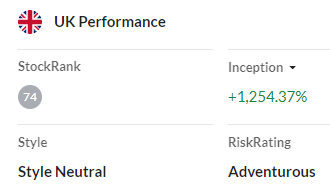
It’s a strong result, but one problem with this screen is that quite often it only provides a small number of stocks – just three at the time of writing, for example:

I think it could take quite a while to build a reasonably diversified portfolio using only the ZULU screen, so I’m also going to take a look at some of the stocks featured in the Growth at a Reasonable Price screen.

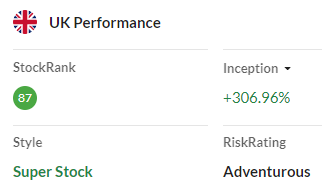
The GARP screen is based on the approach made popular by well-known UK investor and journalist David Stevenson. It has returned 307% since inception in 2012, equivalent to a market-beating annualised return of 12%.
In my view, the GARP screen has some overlap with the ZULU approach, and could be a useful source of additional ideas.
Screen: Jim Slater ZULU Principle Screen
Jim Slater says he titled his book The Zulu Principle to reflect the benefits of becoming an expert in a relatively narrow area. With a manageable amount of effort, he realised one could become more expert than most people on the culture of the Zulus of South Africa.
One of the main investment recommendations in this book is to concentrate your investment efforts in a narrow area.
Slater believed this logic also applied to small-cap growth stocks. By focusing on this relatively small segment of the market, he thought that private investors could potentially outperform institutional fund managers.
The outperformance of the ZULU screen over the last 12 years seems to suggest this is an approach that can work (very) well:

The rules
The rules in the screen are derived from Jim Slater’s comments on selecting growth stocks.
In essence, he’s looking for reasonably-priced shares in small companies where there’s evidence of solid earnings growth and good profitability.
The most distinctive measure used in this screen is the Jim Slater PEG (price-to-earnings growth ratio.
This is a modified version of the standard rolling PEG used in StockReports. In short, Slater deviated from the standard PEG by using the forecast P/E ratio as well as forecast eps growth.
As a result, a Slater PEG is likely to be lower than the standard PEG for any given stock.
The remainder of the rules we use to create the ZULU screen are fairly conventional and self explanatory (a full glossary is available here):

Let’s take a look at the stocks that currently qualify for this screen.
ZULU stocks
Here are the shares that qualify for this screen at the time of writing:

Gaming Realms (LON:GMR)
This is a software business that produces online casino games. The core product is a suite of Slingo-branded games.
At first glance, this looks to me like it could be a classic Jim Slater growth stock. Revenue has risen from £6m to £23m since 2018 and profits are rising strongly. The trailing P/E of 20 falls to a forecast P/E of 15 for the current year:

There’s also an appealing low (regular) PEG of 0.6. A PEG ratio of under 1.0 is generally considered to be good value.
Gaming Realms also appear to be benefiting from operating leverage and becoming more profitable as it scales:

Paul covered Gaming Realms latest trading update in the SCVR recently and sounded positive – you can read his thoughts here.
Cairn Homes (LON:CRN)
Irish housebuilder Cairn appears to have been benefiting from more positive domestic market conditions than most UK housebuilders. As with all companies in this sector, I think understanding the current state of the housing cycle is important when investing.

Despite recent gains, these shares still look quite affordable on the measures used by the ZULU screen:

However, Cairn shares look a little less cheap to me relative to their book value, which is a measure I tend to use with housebuilders:

In this case I think it’s useful to compare the stock’s price-to-book value with its return on equity. Dividing ROE by the P/B ratio gives us an idea of the return on cost shareholders might expect in a steady-state situation, if they bought the shares today.

Cairn’s ROE of 11.3% and P/B of 1.5 suggest annual earnings could equate to a return on equity cost of 7.5% for new buyers. That’s in line with the long-term UK market average and might be acceptable.
However, to consider opening a new position at this level, I would personally want to feel confident that Cairn’s profitability can continue to improve:

In a strong housing market, I think further improvements may be possible. But I’d want to understand more about the Irish housing market before making this call.
Graham has covered Cairn Homes in the SCVR, most recently in February.
XPS Pensions (LON:XPS)
This pension consultancy business has delivered strong growth in recent years. The shares have doubled in two years, but profit growth has reflected this and XPS has grown into its rising market cap.

We can see the impressive profit growth of this business in the tables on the StockReport. But it’s worth noting that the operating profit and margins shown for 2024 included a one-off gain from the disposal of the company’s National Pension Trust business unit:

In my view, stripping out the £32m disposal gain provides a more useful idea of underlying performance. I estimate the following figures:
2024 operating profit: £34.4m
2024 operating margin:17.2%
Both metrics still show a very credible increase from 2023 levels.
Looking ahead, XPS’s valuation still doesn’t seem too demanding to me. It also sits comfortably within the ZULU criteria, assuming the company can hit forecasts:

Broker forecasts have been upgraded regularly over the last year, so perhaps further upgrades are possible?

XPS appears to be thriving in the current corporate pension environment, although it might be worth understanding the drivers of growth in more depth.
Paul and Graham have covered XPS regularly in the SCVR, most recently here in June.
Screen: Growth at a Reasonable Price
The GARP approach to investment has become very popular during my time as an investor. This screen is based on the approach discussed by journalist and investor David Stevenson in his book, Smarter Stock Picking. It’s distinct to the ZULU screen, but it shares some common criteria and in my view, is quite similar in intent:

One key difference is the size of business being targeted. We’ve interpreted David Stevenson’s suggestions by adopting a minimum market cap of £200m, with no upper limit.
In contrast, the ZULU screen limits the search to companies with a market cap between £20m and £1bn.
The performance of the GARP screen has been strong, but less consistent than the ZULU screen, with bigger, longer periods of drawdown:

However, as I mentioned earlier, one benefit of this screen is that it tends to provide a broader range of stocks to select from for further research.
GARP stocks
At the time of writing, 10 stocks qualify. I’ve sorted them by StockRank here, as due to space constraints, I’m only going to look at a selection of the highest-ranked stocks:

Morgan Sindall (LON:MGNS)
I’ve written about this construction group many times before in these pages. I’ve held it more than once in the SIF folio and I view this business and its management as a rare example of long-term excellence in this accident-prone sector.

My sums suggest the stock has delivered a total return (share price + dividends) of 11% annualised over the last 20 years.
The shares qualify for the GARP screen by virtue of their multi-year earnings growth record, decent returns on capital and positive momentum (relative strength). At face value the stock’s trailing P/E of 11 does not look expensive either.
However, this is still a cyclically-exposed, low-margin business, for which I’d be reluctant to pay a premium. Earnings are expected to fall this year before returning to 2023 levels in 2025.

The elevated PEG ratio here also suggests that the near-term earnings outlook may already be priced in.
Given its strong track record, I think it’s certainly reasonable to suggest that Morgan Sindall could continue to outperform. The stock certainly scores well with Stocko’s algorithms, with a StockRank of 99 and Super Stock styling.
However, the valuation is starting to look relatively full to me, despite my positive view. Personally, I’d want to see some evidence of a strengthening outlook before I would consider buying at current levels.
This week’s half-year results should provide an update on recent performance and the outlook.
B.P. Marsh & Partners (LON:BPM)
This specialist investment firm takes stakes in early stage financial businesses, mostly related to insurance. It’s controlled by 38% shareholder, founder and chairman Brian Marsh.
Perhaps the best indicator of its long-term success is the growth in net asset value, which has more than tripled over the last decade:

Last year was strong with pre-tax profit rising by 57% to £43.6m. Net asset value rose by 20.9% to £229.2 (629p per share). This means that although the shares have risen by 37% to 550p over the last year, they continue to trade at a (reduced) discount to book value.

The shares aren’t quite as obviously cheap as they were. But BP Marsh’s valuation metrics still seem fairly modest to me, especially as the £205m market cap is underpinned by a £40m net cash position – around 20% of the share price.
I can imagine there’s still scope for growth here.
Graham covers BP Marsh regularly in the SCVR – his most recent comments are here.
Supreme (LON:SUP)
Manufacturing and distribution group Supreme generates the majority of its profits from vaping products, alongside a mix of other distribution and manufacturing operations.
This business features impressive quality metrics:

Earnings growth has also been strong, but the shares continue to look reasonably priced:

The shares sold off sharply in 2022 when the (previous) government started talking about tougher regulation on vaping, especially relating to disposables. Supreme sells its own vaping range and imports the leading disposable brands, ElfBar and Lost Mary.
However, investors appear to have gradually regained confidence since 2022, helped by a string of solid results:

I don’t know what the future holds for vaping regulation. But in an apparent effort to diversify, Supreme has recently acquired the assets of a protein powder producer and a soft drinks business.
The firm’s financial and technical performance explains its inclusion in the GARP screen. If progress continues then I can see this business could be worth much more in the future.
However, given the regulatory risk (and the market’s adverse view on vaping), it may make sense to apply a discount to any valuation estimates.
I think it may also be worth noting the forecast for slowing earnings growth:

This is a good example of why screen results are best viewed as a starting point for further research, rather than a list of stocks to buy. Investors need to make their own decisions about the balance of opportunity and risk at Supreme.
Paul and Graham have covered Supreme regularly in the SCVR since its 2021 IPO, most recently here.
Imperial Brands (LON:IMB)
If vaping is controversial, tobacco is toxic! At least for some investors.
An alternative viewpoint is that it’s a legal and heavily regulated business, where valuations (in the UK, at least) already reflect the well-documented risks for investors.
Individuals must form their own views on issues like this. But in financial terms, I think Imperial looks like a much-improved business from a few years ago.
Chief executive Stefan Bomhard has chosen to increase focus on the core cigarette business and tightly control expenditure on alternative products. There have been some disposals too, helping to reduce debt.
Imperial now appears to belong to the category of business known as cannibal stocks. Prodigious free cash flow is not needed for capex, so is being diverted into share buybacks and generous dividends.

This strategy is providing upfront shareholder returns:

It’s also helping to support stronger earnings per share performance and a share price recovery:

Despite recent gains, the shares still look cheap on headline valuation metrics, including the PEG ratio:

Quality metrics are excellent, too:

What’s a fair valuation for a business operating in a declining market with high levels of regulatory risk? The stock’s 7% dividend yield plus forecast dividend growth of 4% implies an expected return of 11%. That could be attractive, I think.
What we don’t know is how long the current rate of dividend growth will be sustainable – and whether external factors may result in a more rapid decline in tobacco sales than is currently expected.
Brokers have an average price target of 2,318p at the time of writing, suggesting around 8% upside from current levels. My sums suggest a similar target, perhaps slightly higher.

On balance, I think the shares could still be attractively valued, especially if interest rates have further to fall.
Disclosure: Roland owned shares in XPS Pensions and Imperial Brands at the time of publication.
Disclaimer
This is not financial advice. Our content is intended to be used and must be used for information and education purposes only. Please read our disclaimer and terms and conditions to understand our obligations.

11 comments
Problem with the Zulu screen is so few stocks are on it. At the moment only one which is Ashtead Technology Holdings (LON:AT.)
Not sure how accurate Stockopedia performance figures are on these screens, l have reported major errors in the past, a while ago this screen was around 0%.
With the Zulu screen, what do you do when a share slips off the screen and comes back on?
I dont understand how the return is calculated, is it "Only whilst its listed on the zulu screen" OR is "every share listed held in perpetuity?" OR something else?
I'd like to know that too. Apparently the screen is re-run each quarter but I can't see anywhere what's in the current selection.
Thanks for another great article Roland, just picking up one comment about Imperial Brands (LON:IMB), I'm wondering how I would go about creating a screen for 'Cannibal' stocks.
a screen with a single rule will show you this!
screens > new screen > add rule > quality > dilution category > share dilution
add rule > share dilution last year less than: -2%.
although for a proper cannibal, i would say buying back at least 5% of their shares a year, so -5% is your input
preferably closer to 10% (like the famous U.S cannibals e.g NVR (NYQ:NVR), AutoNation (NYQ:AN) Jack In The Box (NSQ:JACK) etc.)
regardless, any rule input less than 0 ie. a negative % = share reduction over time as you are inverting the share dilution ruleset. you can also select for average over 3yrs or 5yrs vs simply last year
hope this helps!
It does indeed, thank you very much. I'll give it a whirl
Roland
I think the Slater approach definitely works. This week's Investors' Chronicle indicates that its Slater screen is the most successful of their screens in the last 11 years, which tends to underline the excellent results of the Stockopedia Zulu Principle screen.
The Slater approach seems to be very resilient and has worked over a volatile period which included Brexit, the Ukraine war and severe inflation.
In the current Zulu Principle screen the share which resonates with me is Cairn Homes (LON:CRN) which I bought nine months ago, before it qualified for the Zulu screen but in the belief that it would subsequently do so. There has been a good deal of focus on housebuilders given the attention the new government is giving to housebuilding targets and simplification of the planning rules.
Cairn off course is an Irish housebuilder, however I feel that Ireland is ahead of the UK in housebuilding terms. For instance the ECB Bank Rate is currently 3.75% compared to 5.0% in the UK this helps to make Irish mortgages cheaper. There is also a help to buy scheme operating in Ireland, their immigration in percentage terms is higher than the UK's and the ECB may be considering a further rate cut given the economic problems in their largest economy Germany.
Great article Roland - it has prompted me to dedicate a bit more time to both using the screens and also getting some new reading literature.
For the Zulu Screen, at what point would you sell?
The guru screens are reselected quarterly. Note the stocks selected now, may not be contributing, to the performance. I think Stocko, should show which stocks are actually selected each quarter.
Thanks Roland a great article.
The very first books I read on investing were Jim Slater’s Zulu Principle and the follow up, Beyond the ZP.
I created my own screen applying some of the metrics behind the ZP with some of the Naked Trader’s ones as well.
I hold GMR after the last TU. I normally go for shares which match my criteria and pay a decent dividend of 3%+ like MEGP, ALU, CBOX, so if the shares are drifting and aren’t doing much, a dividend is worth my trouble.
WM