SIF Folio: T Clarke and Ashmore compete for my cash

In my recent piece looking at the SIF portfolio’s biggest losers, I found that three out of the nine businesses I looked at were contracting or construction-type businesses.
That seems more than a coincidence to me, and many of you suggested that I should simply avoid this sector altogether, in order to avoid future losses.
I’ve decided not to impose an complete ban on such stocks, but I’m already facing the temptation to buy one again. This time my screen has picked out a small firm I rate as a quality operator in its sector -- building services group T Clarke (LON:CTO).
The other choice provided by my screening system is emerging markets asset manager Ashmore (LON:ASHM).
Shares in both firms have performed strongly this year. In the remainder of this piece I’ll explain what I’m going to do and why.
Mello London
I’ll be at Mello in Chiswick this week, where I hope to be able to meet up with many of you.
I see that T Clarke’s CEO Mark Lawrence and FD Trevor Mitchell will be manning a stand on Thursday and also giving a presentation on the day. I’ll be attending this session to find out more about this business.
Character Group, another SIF stock, will also be presenting (on Friday), so I’ll be attending that one too.
You can see a full list of of exhibitors and presenters here.
T Clarke: right stock, wrong time?
Building services contractor T Clarke has a 130-year history of installing wiring and related infrastructure in buildings. These days, its work focuses on commercial projects such as office blocks, hospitals, rail projects and schools.
I share Paul’s view that the combination of complex projects, low margins and cyclical risk is a potential concern. Having said that, my impression is that this is a fairly high quality business. One metric that’s caught my eye is that more than 80% of custom is repeat.
Recent trading commentary was upbeat and the group’s order book and margins are continuing to expand. However, I added brickmaker Michelmersh to the SIF folio last week and already have broader cyclical exposure through Bilby, Staffline and Lookers.
While none of these firms are directly comparable to T Clarke, I’m keen to find a way to achieve more meaningful diversification. So I won’t be adding Clarke to the SIF folio this week, although I may circle back to it in the future.
Can Ashmore help rebalance SIF?
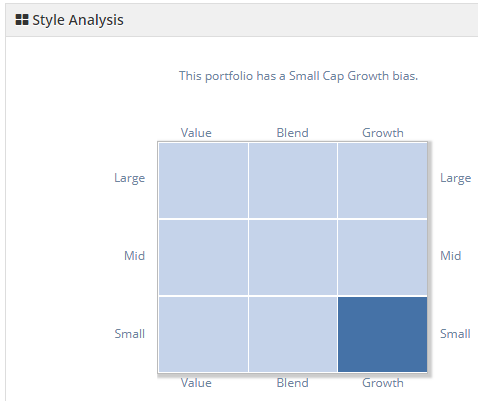
For a long time, the SIF portfolio’s style was classified as “Mid Cap Blend” by Stockopedia’s algorithms. This refers to company size and the mix of value and growth stocks.
Recently this has shifted to “Small Cap Growth”, as you can see from this screenshot taken from the portfolio’s Allocation tab:
I know many subscribers are dedicated small-cap investors. But personally I like to have some larger stocks in the SIF portfolio. In my view, they tend to reduce volatility, help with diversification and provide useful income (although this isn’t recognised by the Fantasy Fund system).
Diversification is certainly one of the reasons why I’m keen to consider FTSE 250 asset manager Ashmore (LON:ASHM) for the fund.
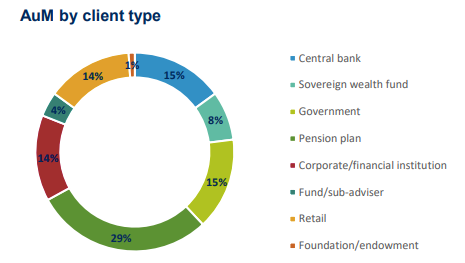
This £3.1bn firm specialises in emerging market assets of all types and reported $85bn of assets under management at the end of March. The majority of client cash is invested in sovereign and corporate debt. But the firm also invests in equity, infrastructure and distressed assets. It also provides services to allow investors to manage currency exposure.
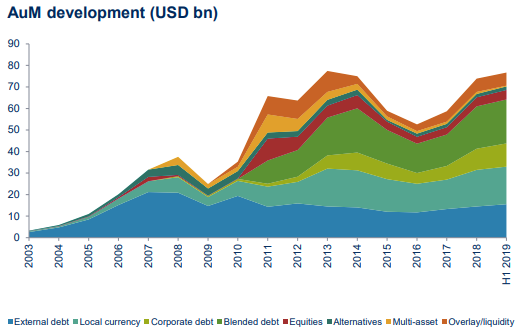
Source: Ashmore investor presentation March 2019
Ashmore is still run by founder Mark Coombs, who has a 39% stake in the business. Mr Coombs spooked investors earlier this year by announcing plans to start selling 4% of this stake each year, but I don’t think this is a concern.
Mr Coombs has reiterated his commitment to the CEO role and says that the decision to sell has been made to “reduce his shareholding to a more appropriate level”. This appears to relate to a risk that was flagged up last year by institutional shareholders (FT paywall), who were concerned that buybacks might result in Mr Coombs gaining a controlling stake.
In my view, Mr Coombs selling could indirectly benefit shareholders by allowing the company to use some of its c.£500m surplus capital to buyback shares.
A structural growth story
Although Ashmore is exposed to cyclical and currency risks, the real story here is of structural growth in emerging markets. The firm points out that emerging markets account for 85% of the world’s population, 66% of its foreign exchange reserves and 59% of GDP.
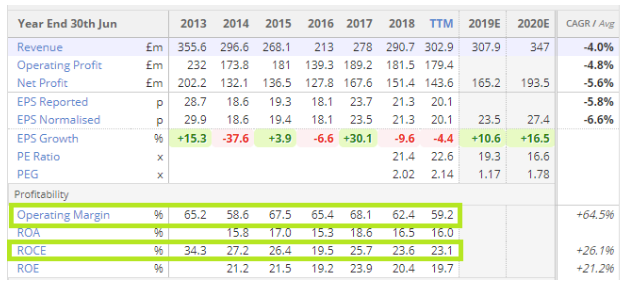
The firm claims to have a “deep understanding of EM” combined with an “active value-based investment philosophy”. It’s certainly highly profitable. Operating margins of about 60% suggest to me that clients value Ashmore’s services.
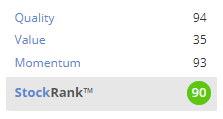
Stockopedia classifies this stock as a Balanced High Flyer, suggesting low volatility but a valuation that’s priced for continued growth. The StockRanks reflect this view, with high scores for quality and momentum, but a relatively low value score:
High margins boost value
Let’s start with the lowest rank, Value. A score of 35 suggests this high flyer is quite fully valued, based on historical performance:
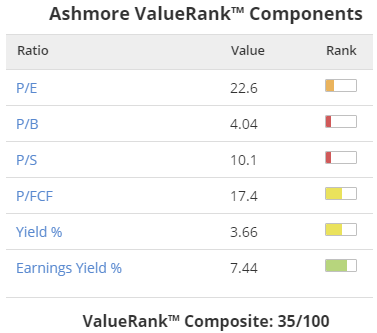
You may notice that the earnings yield (EBIT/EV) is below my usual minimum of 8%. That’s because this stock has come from my relaxed screen, which I use when my main screen has dried up. (I explained this in more detail last week).
However, 7.4% is still attractive and the earnings yield is probably the main attraction here. The only other figure I’d highlight is the price/free cash flow ratio of 17.4, versus a P/E of 22.6. As the free cash flow ratio is lower, this indicates that cash generation was greater than reported earning last year.
Ashmore tracks cash conversion from operating profits as a performance indicator. Although this isn’t an exact match to statutory free cash flow, I’m confident that cash generation is strong, however you measure it.
A quality premium?
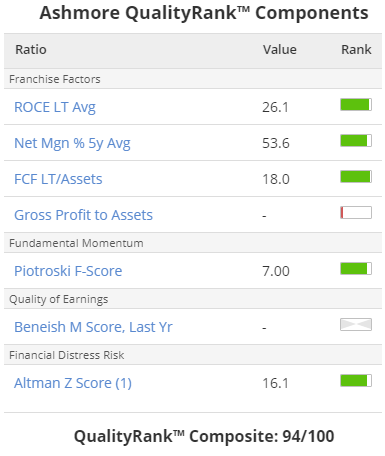
Earnings growth is one driver of valuation, and I’ll come back to that in a moment. But the other driver of valuation is earnings quality, and here Ashmore scores highly:
There’s nothing to dislike here, in my view.
Starting at the top, we see that Ashmore is very profitable. An average net margin of 53.6% tells us that more than half the fees and other revenue collected by the firm fall through to the bottom line as after-tax profits.
The average return on capital employed of 26% is also impressive. A look at the year-by-year figures shows us that margins and ROCE have been fairly consistent since at least 2013:
Conventional UK active fund managers are suffering pricing pressure from passive funds? Will this affect Ashmore? I suspect that the company’s specialist skills and largely institutional client base means that fee margins should be much more robust.
Source: Ashmore investor presentation March 2019
I don’t see too many immediate risks to the firm’s financial quality. Any new areas of activity appear to be cautiously seeded and tested. Acquisitions have been rare and Mr Coombs’ strategy has been consistent and focused. I’m comfortable with this situation.
Improving momentum?
Ashmore’s rating as a Stockopedia High Flyer implies that the company could suffer a sharp fall if growth falters. How likely is this?
We can never be sure, but the stock’s price momentum and earnings estimates seem to suggest a positive outlook:
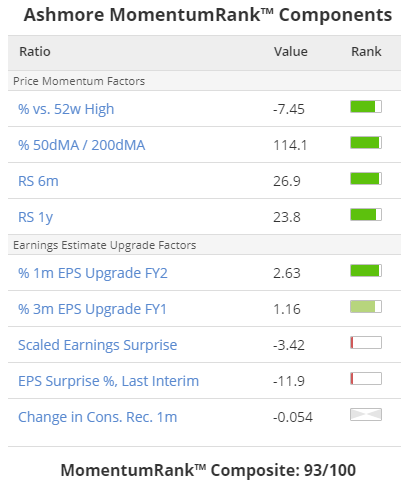
The shares have performed strongly this year and consensus earnings forecasts have been upgraded recently for both 2019 and 2020:
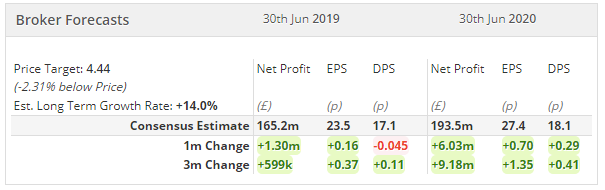
Although earnings upgrades have been fairly modest, these figures imply earnings per share growth of 10% for FY19 and of 16% for FY20. There’s also a forecast dividend yield of 3.8%, rising to 4.0% for FY20.
My verdict: Ashmore’s share chart suggests to me that a cheap entry point would probably be under 400p. At c.450p, the stock isn’t a bargain. However, I don’t think the rolling forecast P/E of 16.9 is unreasonable, based on expected earnings growth and the firm’s high profit margins.
I will add Ashmore to the SIF folio and my own personal holdings this week, after this article has been published.
Disclosure: Roland owns shares of Michelmersh Brick Holdings, Bilby, Staffline and Lookers.
Disclaimer
This is not financial advice. Our content is intended to be used and must be used for information and education purposes only. Please read our disclaimer and terms and conditions to understand our obligations.

1 comment
I recently bought a holding in T Clarke (LON:CTO) as they seem to be making significant improvements in performance, especially in the margin; the rating still seems incredibly low.
I don't share a positive view in Ashmore (LON:ASHM) with interim EBITDA only up 8%. Q3 AUM results were more positive (though without any mention of profit), but I am rather put off by the recent, significant sale by the wife of the CFO.