Small Cap Value Report - (Tue 25 June 2019) - CER, G4M, LWB, CPR, OPM, FA., D4T4, LOOK

Good morning, it's Paul here.
Graham was meant to be writing today's SCVR, but he's been overtaken by unforeseen international travel delays, so at this late stage, has asked me to cover for him.
I had been gently winding down for a lazy day, and lunch with Mum, but that's all gone out of the window now! Instead I'll have to try to think of something sensible to say about small caps, at short notice. Will do my best!
To get you started today, I wrote big expanded sections late yesterday, in the evening, on both Porvair (LON:PRV) and Cake Box Holdings (LON:CBOX) , both of which I think look potentially interesting (with some reservations). The completed version went live at almost 1am, after a lot of work.
(7-8 am section - I can only do these with prior notice & an early night, so not applicable today, I'm afraid)
Cerillion (LON:CER)
Share price: 170.5p (up 4.3% today, at 10:26)
No. shares: 29.5m
Market cap: £50.3m
Cerillion, the billing, charging and customer relationship management software solutions provider...
Not to be confused with Carillion, of course!
I don't normally mention contract win type announcements here, as they're often spurious. However, Cerillion has been on my radar (thanks originally to Graham flagging it here) as a reasonably-priced growth company. It supplies what looks like mission-critical billing software to telecoms companies. That suggests to me sticky revenues, always a good thing.
I reviewed its most recent interim results here on 20 May 2019, and flagged that it might be a buying opportunity, if the company is able to hit full year targets (which at the time looked a tall order, but it looks like the company should now achieve targets). Although interim results were not good, management flagged that 2 high value contracts were imminent.
Sure enough, they've announced winning two major contracts, one here on 14 June 2019, and the second today. That's impressive - as it means we can rely on management commentary & outlook statements. Previous commentary was not just baseless optimism, they told it how it is - a big thumbs up for that.
It would be a great idea if someone were to start a website which collated outlook comments from every company on the market, and then reported what actually happened afterwards, and gave a score to show us which companies repeatedly fail to deliver, and which ones are more reliable.
Contract win today -
... is pleased to announce a major new contract win worth an initial £4.8m with LINK Mobility, Europe's leading provider of SMS and message delivery solutions.
This win supports existing market forecasts and continues the Company's trend towards securing larger deals, following the £5.1m contract win announced on 14 June.
These deals look very significant, given that forecast revenues for this year (ending 09/2019) are £18.7m. Although I imagine the contracts will be spread over several years, it's not stated how much is recognised initially.
Large lumpy contracts are risky, as if anticipated contracts are not won, then it can cause a big profit warning. In this case though, the contracts have been won, so that de-risks this year's forecasts. Although as mentioned above, these contract wins were already baked into existing forecasts, so are reassuring rather than significantly share price-sensitive.
Valuation - this is based on last night's share price;
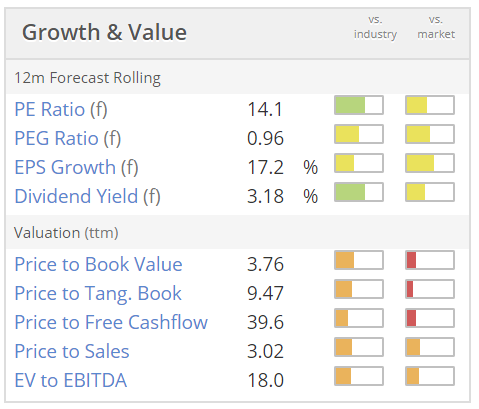
That strikes me as a good value PER, and the divi yield isn't bad either.
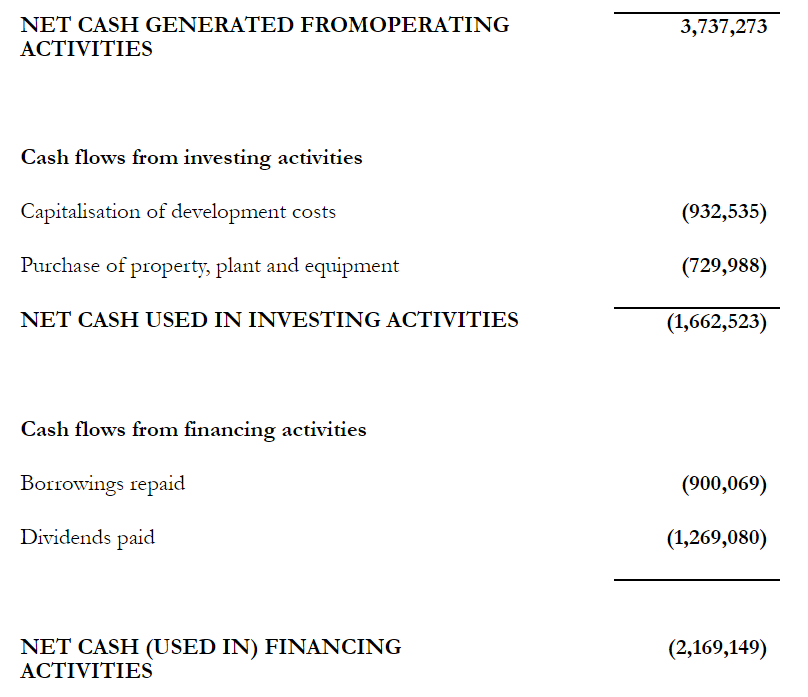
Cashflow - the price to free cashflow figure above looks weak, so I've checked out the last 2 years' cashflow statements, which actually look OK to me. There was a jump in capex from £198k to £730k from 2017 to 2018, and £933k of development spend was capitalised in 2018 - which isn't a particular problem, as it's around one quarter of operating cashflow, which i can live with.
As you can see from this excerpt below, operating cashflow was spent on capex, development spend, paying divis, and reducing debt. A very nice mix, being able to fund all those things from internal cashflow;
My opinion - this company is looking increasingly interesting, so it goes on my list of things to research in more depth.
The big problem is that the shares are so illiquid, so it can be very difficult to buy or sell, other than in small amounts - so it's really only suitable for small investors. Management owns about 41% of the company (good to have skin in the game, but maybe that's a bit too much?), so outside shareholders are completely in their hands. I imagine that eventually they're likely to sell the company - as it must have strategic value, being embedded in various telecoms companies.
In the meantime shareholders are receiving reasonably good, and growing, divis. Plus the company seems to be on a roll, re contract wins.
Overall then, it looks rather good.
Gear4Music
Share price: 212.5p (down 7.6% today, at 11:32)
No. shares: 20.9m
Market cap: £44.4m
(at the time of writing, I hold a long position in this share)
Gear4music (Holdings) plc, ("Gear4music" or "the Group") (LSE: G4M), the largest UK based online retailer of musical instruments and music equipment, today announces its financial results for the 13 months ended 31 March 2019. Comparative information is on a 12 months basis unless stated, and as such may not be directly comparable.
Important to note that this is a one-off 13-month period, which makes it harder to analyse.
Positives
- Very strong revenue growth, both in UK and RoW - up 37% on a comparable 12 month basis, year on year
- Taking market share from physical retailers, and probably also from online competitors (can smaller competitors survive in the long run, with price competition so intense?)
Negatives
- Margin pressure - this is the main problem - gross margin of 22.8% is down 260bps. That's a very low margin now, making it extremely difficult to turn a profit - although note that the average order value of £117 means that there's a decent cash profit on each sale, even though it's low on a percentage basis
- EBITDA down 34% to £2.3m
- Moved from £1.4m profit last year, to £163k loss this period - going the wrong way, although during the rapid growth phase some investors don't care about profitability - arguably it's more important to grab market share at this stage
Outlook - this is the most important part for me. We already knew about the above issues, from previous trading updates, so there's nothing new in today's update.
All that matters is what are management doing to fix things? I find the following comments encouraging, as in my experience (from having met them several times), management tell it like it is.
We have taken quick and decisive action to address the operational and commercial issues that impacted profitability in FY19. Whilst early in the current year, we are beginning to see positive trends establishing themselves which give us confidence in our refocused growth strategy.
Alongside this, we will continue to develop our excellent e-commerce platform, expand our customer base in the UK and internationally, extend and refine our product ranges, and deliver the market leading service and value that has made us a leading European retailer of musical instruments and equipment in such a short space of time.
Whilst the on-going Brexit uncertainty and its impact on consumer confidence is unhelpful, we remain well positioned to benefit from further consolidation within our market.
We believe we are well placed to deliver on our strategic objectives with a solid financial base and a better organised and refocused operational structure, giving us confidence in our trading outlook for the new financial year.
Another outlook section says;
The Board has taken decisive action to address the underlying causes of the profitability challenges in FY19.
Pleasingly, many of the issues faced are within our grasp to resolve and we are already starting to see the benefits of a more rigorous focus on margin.
In parallel with these initiatives, we continue to see a significant opportunity to continue to win market share in the UK and across Europe.
With over £5m cash on hand at 31 March 2019, the Directors remain confident that the Group has the financial resources required to achieve its business objectives during the next financial period.
I believe the Group will emerge from this period as a stronger and leaner business, well prepared and better placed for the next phase of our exciting growth journey.
I would have prepared fewer words, and more specifics!
Still, it shows that clearly management is focused on improving margin.
Margin improvement - Revenue is forecast at £138m for the new year FY 03/2020, so if the company is able to recoup just half of the gross margin loss this year, then that would add £1.8m to profitability. Hence there looks to be a good chance of profitability recovering this year, and that should improve the share price too.
Remember also that marketing spend is a very high element of costs, and can be dialled up or down at will - a key advantage for online businesses if times get hard. Physical retailers cannot do that, as their costs are mostly fixed.
Balance sheet - includes £7.2m in freehold property. There are mortgage loans of £4.6m outstanding against these properties.
Above that, there is £7.8m of bank debt, largely offset by £5.3m in cash. So net debt is only £2.5m, excluding the mortgages (which are well covered by freeholds).
I imagine net debt will flex around quite a lot, especially when stocking-up for Christmas.
I've been told by another company that banks like lending to online businesses, as they know that in an emergency, marketing spend can be switched off, to generate enough cash to repay the bank quite quickly. That would obviously leave a husk of a business with declining sales, but banks don't care about that - all they want to know is that their loans will be repaid.
NTAV is OK, at £10.9m
Cashflow statement - even though profit was down, operating cashflow rose from £155k last year, to £2.6m this year.
Note that capitalised development spend rose from £1.7m last year, to £2.7m this year.
At this stage, capex & development spend (combined £4.5m) exceed operating cashflow of £2.6. So clearly the business needs to improve its cash generation, which should flow through from the improved gross margin that is anticipated in FT 03/2020.
Nobody is buying this share for its cashflow or divis (there aren't any), because the investment case is all about the rapid organic growth, and international sales. We'll find out in a few years' time if the business does become more cash generative once it's matured, or not.
My opinion - I'll properly go through the whole RNS later today, so might add more points below.
Overall though, I think this share is attractively priced now, for a strong organic growth company.
Previously the company was focused on a dash for growth, and that seems to have let the focus on margin slip. Management is aware of the problem, and are fixing it. So I'm cautiously optimistic about this share on a 12 month view.
It should be a much bigger business in say 5 years' time, which will mean increased buying power, greater efficiency in marketing spend, and a higher net margin. Therefore, I feel with patience, this share could multi-bag again. Or it might not, time will tell!
Low & Bonar (LON:LWB)
Share price: 6.1p (unchanged today, at market close)
No. shares: 689.8m
Market cap: £42.1m
Low & Bonar PLC (the "Group"), the international performance materials group, confirms that it will announce results for the six months ended 31 May 2019 (the "period") on 30 July 2019.
This update confirms the update on 20 May 2019, saying that interim results will be in line with the Board's expectations.
Some more detail is given today;
- H1 2019 sales down 8% on LY H1
- Small underlying profit before tax (no figures given, so I'm assuming it will be just above breakeven)
- Net debt at 31 May 2019: £99m (the group is over-leveraged, that's why the share price has collapsed)
- Average net debt in H1 was £135m - this is a much more meaningful measure, and I think companies should be required to declare average net debt, as well as year/half year end snapshot on balance sheet dates
- Selling off 3 businesses - work-in-progress
- Bank covenants - within, but not much headroom, so this is a potential problem, if trading deteriorates further (figures are given - see RNS for more)
My opinion - this is a lot of business for the money, however I'm steering clear because of the high risk caused by too much debt.
Carpetright (LON:CPR)
Share price: 18.4p (up c.4% today, at market close)
No. shares: 303.8m
Market cap: £55.9m
Results for 52 weeks to 27 Apr 2019
This is an interesting RNS, from the UK's largest carpet retailer. It has undergone a CVA, to reduce its rents & dispose of loss-making stores. The total number of stores fell from 410 to 334. It also has operations in Europe. The text gives some interesting perspectives on how that process has gone.
Carpetright has done well to survive this upheaval, and that was only possible from generous shareholder support in fresh equity & loans. Without that, it would have gone bust.
LFL sales - were clobbered by the CVA process, but have gradually been improving. LFL sales have now turned positive in the last 8 weeks (+8.5% in the UK), but that's against very weak comparatives of -14.6% prior year. I think it's best to not get too excited about the recent sales growth, as it's only partially recouping previous declines.
Underlying EBITDA for FY 04/2019 was £2.9m (prior year £7.1m). Since that performance was adversely affected by the CVA process (disruption to sales, supplies, adverse publicity, withdrawal of trade credit insurance, etc), it's difficult to know how much performance is likely to improve this year. I can't find any recent broker research, so that takes me to a dead end on being able to analyse it.
Balance sheet - this is problematic. Net debt is too high, at £27.4m, and note that bank facilities expire at end Dec 2019. Plus a large £25.7m shareholder loan is due for repayment in July 2020. Whilst the company says it should be able to refinance these facilities, it's still a lot of debt.
On the upside, it owns a substantial property portfolio, of £52.3m in freeholds & long leases. I was very surprised that landlords agreed to the CVA, and did not require the sale of its freeholds.
So if you match up the freeholds with the borrowings, it doesn't look too bad.
My opinion - I seem to recall there was an aggressive competitor, set up by Carpetright's founder's son? Investors would need to carefully consider the competitive landscape before buying into Carpetright's survival/recovery story.
With its CVA successfully completed, Carpetright is in a much better position to compete, having ditched its loss-making stores. Although we've seen in the past, that the companies which needed to do CVAs, are the weakest, and often go on to fail again a few years later.
There might be some upside here, if Carpetright reports stronger trading later in 2019, against very soft comparatives. It doesn't really interest me though - recent experience has been that investing in struggling retailers is usually a mistake.
Quick comments to finish off with;
Fireangel Safety Technology (LON:FA.)
Trading update for its AGM today.
Encouraged by growth in H1 sales.
First half trading to be slightly ahead of budget.
Thanks shareholders for supporting recent fundraising.
My opinion - terrible track record in recent years, of burning through tons of cash, and multiple operational mistakes. That rules it out for me.
1pm (LON:OPM)
A sub-prime lender. I'm only commenting because a reader has asked me about it.
Clearly the update today has upset shareholders, as the share price is down 23% to 32p.
I've never been sure how to value this company. A PER basis is not meaningful, since profits depend so much on what defaults are on the loan book. I cannot see how its bad debt provisions of 1.9% (increased from 1.5% last year) can be anywhere near enough over the full economic cycle. Although OPM seems to broker some loans, as well as taking others onto its own balance sheet.
Today's RNS talks about additional costs, together with macro uncertainty, making FY 05/2020 a year of investment & consolidation (i.e. not very good!)
Experience shows that sub-prime lenders suffer huge bad debts when recessions strike, which is what puts me off investing here.
£D4T4
Flagged up by readers, I've taken a quick look at its results today, for FY 03/2019.
Very impressive is the short version!
- Beat forecast, with adj diluted EPS of 13.89p, up an impressive 57% on LY
- Share price of 260p gives a PER of 18.7 - not cheap, but with profit growth this strong, and a positive outlook, that's probably a reasonable price
- Adj PBT up 48% to £6.0m
- Revenue up 37% to £25.2m
- Very strong cashflow - net cash has risen from £3.85m LY, to £11m this year - giving scope for potential acquisitions, they say
- Positive outlook comments
- Significant contracts won
- Strong balance sheet
- Has done share buybacks
My opinion - this is a company I like, and have previously owned (but not currently).
In more normal markets, I would consider buying back, but given the political uncertainty, am playing it safe right now, in not opening new positions unless they're stunningly cheap.
Lookers (LON:LOOK)
I've only just spotted that this car dealership's shares plunged 24% to 53.5p late in the day today. Why? An RNS at 3:14pm today, saying that the FCA is to investigate its regulated sales practices;
The Company has now been informed by the FCA that it intends to carry out an investigation into the Company's sales processes between the period of 1 January 2016 to 13 June 2019.
The FCA investigation is newly commenced and no findings have been made. The FCA will reach its conclusions in due course and, at this stage, the Company cannot estimate what effect, if any, the outcome of this investigation may have. The Company is co-operating fully with the FCA in relation to this and will update the market further when appropriate.
The drop in market cap today is c.£66m, which seems a rather extreme reaction. Will costs & fines really amount to that much? I don't know, as I'm not familiar with how FCA investigations work.
I'm wondering if this might have read across to other car dealers?
Following some recent poor trading updates, this sector no longer interests me.
Thanks for reading, and for posting some superb comments today - star of the show today is Zipmanpeter, with several excellent comments!
Regards, Paul.
Disclaimer
This is not financial advice. Our content is intended to be used and must be used for information and education purposes only. Please read our disclaimer and terms and conditions to understand our obligations.

41 comments
In a quiet afternoon has anyone done any work on Accrol Group (LON:ACRL) as I think this is turning into a very nice potential recovery play?
First off I admit to buying at 20p so although I am 50% up on my investment in hindsight I think I was in reality a little premature. Whilst I backed new management to turn it around I suspect the risk/reward trade off wasn't the best at the time (ie maybe a flawed investment process from me to work on!).
However, that has also given me skin in the game to pay attention. Recent results were decent, moving back to b/e. Turnaround to put the company back on a sound footing through simplification, price increases and sales has been tremendous but that's all in the past and now we look forward for a view on valuation.
What got my interest was an anomaly between a video interview the CEO did versus broker expectations I have seen. Gareth Jenkins is the ex UK CEO of DS Smith so has a pretty good track record in a not dissimilar space (cardboard packaging versus toilet roll). In the interview he discussed the market dynamics. ie we all need toilet roll, it is a consistent growing market etc. He discussed the fact that no one customer makes up more than 20% of their revenue and that they are supplying all but 2 of the major retailers but are in talks with both of those, so good revenue diversification. But really he talked about the fact that they were already at £140m of revenue p/a and are planning to get to £250m p/a. That's interesting as brokers have pencilled in only £126m for this year and £132m for next and a PE of just 7. So, it feels to me as though there will need to be significant broker upgrades.
Net debt is also coming down rapidly, so a tick there. Biggest risks appear to be FX and raw material cost inflation.Though I believe the latter has been somewhat mitigated through raw material inflation pass through type contracts. Also, given these factors have both been highly negative for the company over last couple of years and moved towards extremes one wonders if we are close to the top of the cost curve now.
All in all I am impressed with the new management. If they can get to £250m over next few years then EPS could hit 12-15p and shares should be several times the current share price.
Anyone else looked at this in detail?
Paul,
If/when you write further on G4M, can you comment on the following having met mgt
1. "We include our costs of delivery within our cost of sales figure which is a different accounting treatment to some other e-commerce retailers. Delivery costs increased to £9.1m in the period represented 7.7% of total revenue (FY18: 7.3%)."
Thus %GM at other ecommerce retailers, % GM would have been 22.8+7.3% = 30.1% - still not great but sounds much better. So why not do this?
Actually, I think it right especially in an ONLINE business to include Carriage as part of Gross margin since it is directly related to the cost of selling that specific item vs a shared cost of carrying stock to a store.
Kudos BTW to £G4M for their transparency to show it at all broken out as also show their % Marketing spend. I wish others (eg £SOS) would do the same. Ultimately this is variable in a way that SG&A overhead is not. (In FMCG, I always measured my Sales&Marketing team on their contribution margin ie Net Sales after price discounts - COGS-Marketing as any fool can cut price or advertise to get sales)
2. In contrast, for an online business they are coy about returns
For my education how are MOST online companies handling costs associated with returns. I assume direct cost attributable to a specif order are returned to the product cost ie are handled in % GM but that the overhead cost of an area and people to sort them is in a below gross margin line?
Do you know the level of returns £G4M face for music related items now I understand women's fast fashion can be as high as 50% ! Must be lower - does anyone try out 2 guitars by post? but equally, cost of returns must be significant. I note in their presentation today (slide 12 Challenges/Actions)
Returns costs increased as international sales increased --> Review Returns policies, and charge for some collections
This infers the cost was significant and underlies why switching as much fulfilment to Euro distribution centres makes sense
3. Best metric (not cited in results) was slide 15, No of repeat customers which was down in % terms but up in absolute terms from (by eye) about 105K to 150K customers. If you have 150K repeat customers in a year at ave. £117/order, you have some sort of a sustainable business.
Note I bought £G4M after their big fall and hope to hold a few years
PS Note of appreciation to you/Graham/other contributors for my continuing education about how to analyse results. I worked in a big multi-national and was an MD of several SME's overseas but reckon my financial analysis skills have been more improved here than they were at work!
Zipmanpeter,
G4m are right to point out the difference is CoS treatment. Along with investing I own an e-commerce co and in addition to distribution costs directly attributable sales fees should be applied into CoS. G4m also operate on amazon with typical fees circ 15% of sales and postage, so when comparing bricks and mortar top line margin this needs to be added back. In our co we operate a margin at 35% but if you added back postage and attributable sales fees margins would be into 50%. In terms of returns, well managed e-commerce cos would manage this at product/catagory level to ensure margins at product level take into account returns costs. Personally I like to see fulfillment (out) and returns (in) accounted for in CoS as well but can see the debate either way. Agree with your perspective on music returns particularly as customers review technical details online often after recommendations, so fit/size less of a factor than woman's clothing.
Good Investing
Thanks again Paul for your ongoing and highly valuable insights.
1pm (LON:OPM)
I've spent the some time today considering my position with OPM (a relatively low conviction holding for me). I'm thinking about if this a good (fixable) profit warning or a bad one (structural)? Here is my (possibly flawed) thinking, being aware that I suspect I've several biases spinning round in my head.
Firstly, this is not a type of business in which I have any deep or unique knowledge, as it is at the fringes of my supposed areas of competence (such as they are).
When I bought, one area of research was evaluating the business model. I made the naive assumption the on-balance-sheet/off-balance-sheet lending model was great because it meant OPM could bag all the on-balance-sheet lending they wanted, and broker the remainder off for extra income. My mistake in hind-sight was to assume customers were queueing to borrow money. Clearly they are not, at least not in high enough numbers to build both short term cash flows from the broking side of the business and the longer term repeatable income streams from their own lending book.
Looking at the cash flows (as at November 2018) and the need to meet their dividend paying aspirations, I suspect they are currently focusing on the broking business in order to support the short term cash needed to fund the cash-flow & dividends. This at the expense of the longer term sticky income. My concern is that they'll end up chasing their own tail, never building a long term repeatable income stream.
Therefore I've sold. The flaws I've identified in my original purchase case include the lack of deep sector knowledge & assumption about how the business model would work out and the weak cash flows. Good luck to those buying or holding.
Hi Lion Tamer
I must also put my hands up to a lack of knowledge of the sector regarding 1pm (LON:OPM), which has come at a cost. I had assumed somewhat naively as it appears, that there was sufficient demand to allow the company to off the load less attractive business by broking whilst retaining the 'safer' and more lucrative business, thus de-risking the process and earning fees from the former as the icing on the cake.
Lesson for the learning, sold this morning. Fortunately it was a small part of the portfolio. Nonetheless a loss that could have been avoided if I had been more insightful and knowledgeable.
Hello Lion Tamer
I hold building in last 8 months or whenever price got close to 40p...obvs should have waited.
Cash to fund growth is a problem and broking on is definitely to improve short term cash at expense of higher earnings. I think the dividend was introduced to seduce shareholders and its backfired. They'd be better not paying it out and focusing on growth...but was strategy to seek to pull out of lowly valuation.
Equity raises have fecked investors off and sunk the multiple. That said they have grown eps well:
This is post dilution from new equity. Current CEO been at company since Jan 2014 (year end is May) as Chairman and then CEO since Jan 2016. 2011/12-14 the company was run by person with legal and risk background (Maria Hampton). 1pm had expanded fast before and thro the 2008 crisis pivoting along the way post listing in 2006/7 ish from being a subprime lender. Previous mgt didn't seem to realise that demand for credit would go up when cos faced stress and they lent like mad thro the crisis. This came home to roost in 2010 and they were punted and replaced by risk/legal manager who did great job stabilising business and getting back as much as the dodgy loans as possible. She massively improved prospective risk lending rules. Can't find out what she went on to do but seems like she came from a non-exec role in time of need and then disappeared afterwards not pursuing exec role....so, guessing, I think she was never on or wanting the exec path (never director even though called CEO) and that means that current CEO Ian Smith was probably quite active as Chairman from 2014 onwards.
Revenue growth has continued. For the last year they have drastically turned down unsecured lending on book and that has slow revenue and earnings growth too.
FY19 looks bit like kitchen sinking. They know they aren't going to please the market so they've put out a RNS dump that was inevitably going to be negative and fast forwarded inevitable integration and tidy up plans and stalled growth to free the cash flow for it. My hunch is that they will seek to surprise to the positive as early as HY20 (end of Nov 2019) and defo FY20 by a mixture of top line and earnings growth due to greater own book lending.
2018 AGM approved an equity plan for this management for the first time. They earn proportionately from 60-110p. That's now the focus of the business and nothing sort term will be done to jeopardise hitting that. At 110p the pay out is 7,900,000 shares. Vesting from 5/7/20 and expire 5/7/21. So a hefty near 8% of the company worth +£8m at 110p. You can be sure that mgt attention is on that and aware of doing what is needed to hit decently into the 60-110 strike range....
That makes me think that mgt is engineering a surprise for FY20 to shift this share price. My guess is a much more upbeat interim trading update come December.
That speculation aside 1pm (LON:OPM) seems a decent business and network. Bit old fashioned but knows how to relate to customer and make money. At 5x earnings and op margin that inhabits 20-30% range this seems too cheap. I believe the downside is quite limited as they earn their corn through lending spread rather than leverage of their balance sheet and in last year they have been even more conservative in their lending.
Many thanks for your comments mojomogoz & jonno. I's great to hear two differing views on 1pm (LON:OPM)
Whilst not yet convinced either way, I might revisit this in November or December (via a note in the diary). If I can find evidence of a strong demand for borrowing, if the economic outlook at the time is positive (bearing in mind the spectre of what 31st October may bring upon us), and if any other research supports it, I might take a small position ahead of any trading updates that might come out a few months ahead of the interims.
VG Lion Tamer
I tend to invest a bit contrary and that can get messy so not seeking to persuade but just air my case/views for feedback.
I'd say that demand for loans is not the issue really. They could sell more of them if they wished. The issue suppressing revenue growth is their choice not to fulfil more demand. That's driven by a cyclical credit cycle view and a step off of the gas to allow cash to come through from current book for investment purposes (rather than more equity issuance).
I've just realised that Paul Scott wrote a small snippet on them. I missed that. I believe his POV is flawed:
1) Subprime lender is misnomer and doesn't capture the lending environment for them very well. They lend to small businesses that find it tough to access funds elsewhere more due to size and connections. Big banks ain't interested and don't want personal contact. Bigger businesses will by default have a lower credit risk rating simply as they are bigger....its irrespective of the quality and predictability of the earnings.
2) They make money on spread rather than leverage. Whereas a trad bank with its balance sheet will typically make money on more leverage and less spread. Important to note that this spread is not driven by a genuine credit risk differential but by lack of access to funds for small businesses. I've looked at PCF (LON:PCF) in the past and spoken to CEO....he says they have similar quality client as 1pm (LON:OPM) and get similar spread in response to me saying he used more leverage for less spread FYI...my suspicion is that they get less spread and apply more leverage.
2.1) There is a great parallel to 2 with payday and non standard finance for consumers. A lot of that lending at very high prices is driven by a the fact the customer lacks access to 'middle class' banking. There is some more credit risk too but its way less than priced. Its a different environment for a lot of reasons so not a perfect read across. I'm relatively expert on credit rating and risk rating stuff as a started a subprime consumer lending business from scratch and did all the credit, reg and consumer interface work to develop the systems (seeking to make 30-80% APR loans rather than 1500% driven by experience of seeing what they do in emerging markets)
3) As a cyclical precaution they have drastically reduced unsecured lending that their balance sheet is exposed to (they'll broke that on). They have also reduced duration
4) 2% provisioning on total loan book is quite reasonable given asset backing for most...unless you believe its a book for crap as they do not have lending discipline. This is what happened to them in 2008 when they were a subprime business...but they survived it as they still made good margin on what they got back
5) They tend to write off anything that has a whiff of bad early and then have a record of making good on some recoveries such that this becomes an earnings/cash positive with write back. This is conservative approach with good recovery aided by asset backing and relationships
6) Note, any lending business that wants to grow a lot tends to need financing. So 1pm have issued a lot of equity but their eps growth has been good.
7) Through cycle I expect the earnings trajectory to be smoother from 1pm than a bank lender in the same space...so downside to those that can grow faster through leverage they create themselves.
I believe that 1pm is quite a safe play if cycle turns down and would have nice growth other side of it. But I stick to my hunch that they are designing a surprise for interims at end of year
Mojomogoz
Thanks for note on £1PM and the read across to sub prime/ non-standard (consumer) lenders. I also am interested in such lenders from my time working in emerging consumer markets where a lack of access to cash, low savings and unexpected economic shocks are common
I hold Non-Standard Finance (LON:NSF) which has been decimated recently dropping from >60p in Feb to 35p today.
I believe this is short term blow back from i) its failed takeover offer for PFG ii) FCA comments on Guarantor lending (where I think they are well placed in terms of regulatory compliance, forbearance procedures and affordability checks - their guarantor call rate is well below Amigo for instance iii) concerns over cash disappearing (Libra on Home Credit) but most of all fears of turbulent times following politically induced. The other 2 legs (branch based and guarantor backed) mid-sized mid term lending where they are clear no and no 2 with limited current competition look great, growing rapidly with impairment well controlled.
Non-Standard Finance (LON:NSF) try to argue that "non-standard" specialists are actually counter-cyclical in a recession because although their impairment rates go up so to does the price (ie interest rate)they can charge and so does the volume: as more people become sub-prime and blocked from normal lending routes.
DO you buy this argument for both SME's and does it read across for consumers?
In terms of Non-Standard Finance (LON:NSF) the real players (Provident, NSF, S&U, Morses...) are typically recession proof as their customers, processes and default rates are well equipped to deal with income deeps. It is usually the new to market or dabblers which get pulverized during recession and regulatory reviews (Wonga...) as their core business models are about as customer centric as chilli flavoured toothpaste. NSF seems a very well balanced operation which can leverage credit skills/loans platforms across a growing product suite and customer life-cycle.
Miane,
Thanks for response. Re Non-Standard Finance (LON:NSF) I intend to hold on as I agree - this is a segment that rewards experienced specialists and NSF's mgt team are that.
I did however undersell another short term depressing factor - the £10Mn costs associated with the failed takeover. The risk here is that may cause lending to be constrained (to free cash to pay advisers - I hope they were success based!) or worse, some king of rights issue or placing.
Hello Zipmanpeter
Some points in response. I don't know the answer as I don't know Non-Standard Finance (LON:NSF) well. I did watch them present at Mello South November-ish last year. Can't remember the position of presenter (FD, IR?) but I instinctively didn't trust him when answering questions. That put me off more work...plus, having experience in related field I knew the hurdles and felt a little like I might get too distracted trying to dig into NSF as well. I note that their pedigree in the area is great plus being newbies but with prior experience is a nice position as no legacy stuff to come up and bite you.
The risk will revolve around client base and how they have been sold. When a debt goes bad or delayed whether you can get it back depends on client relationship stuff particularly in new regulatory world that curtails debt recovery processes. If you sold at a distance with a high impulsive marketing angle to the sell then when it goes you might struggle to get it back....but that still depends on customers.
In the old days when Wonga was making loads of wonga a significant part of their clients base was what you would call moderately affluent but profligate. These people were targeted customers. This could reach all the way to city professionals who had significant variable remuneration and a tendency to make personal commitments above their basic income level. They's arrive at Wonga after they had taped out their other sources of credit. Basically, these guys might default or rollover and earn lots of fees for Wonga etc but would have a high prob of paying off once flush again.
I think that NSF's business is targeted more clearly to the less affluent by comparison
I haven't kept up with regulatory stuff or controversies but my opinion is that guarantor loans are quite an abusive things all round and that as regulators dig its going to get worse and worse for providers. I think they will so regulated they are hard and expensive to do.
More generally, the FCA are behind the curve on so much that there is a danger to everyone as they catch up. For example, they do not understand how credit reference services that everyone buys (not mandated by regulator but if you didn't they would eat you alive...so in effect FCA underwrites business for Experian etc). They do not understand how the data forms an effective trap for the less affluent and effectively justifies putting them in a high cost credit trap...once you're in the data feeds back saying you use high cost (so high risk credit) and there's overlays with other 'incriminating' data such as postcode.
What's going to be quite untested in next recession is what the new forbearance culture means for repayment profiles. Before they could go after you...but now they need to tread carefully and not impossible that FCA issues statement saying they are really watching forbearance as consumers struggle.
The above is a long way of saying I don't know where the equilibrium on regulation will stop. If you know then you can see who wins. NSF is in a relatively good position I'm sure....but whether that is absolutely good hard to say....it probably is but I'd only buy bombed out after a bit of a panic profile event.
I don't think that SME lending is necessarily counter cyclical. I think 1pm (LON:OPM) have taken steps to make themselves reasonably cycle proof. They'll get some payments problems but with provisions at 2% of lending (so near £3m off top of head) and broking on of most stuff that us unsecured they seem in robust position. They'll get payment problems no doubt but high ongoing margins should also buffer. So they don't make more money in a downturn but they do outperform dire expectations
Thanks for the kind messages about yesterday's report - it's always good to hear about it, when people find my work useful, and helps motivate me! We're all human!
Regards, Paul.
I would add a small point to your balance sheet comments with regards to stock. From the figures presented one can see that the stock turnover (based on the product cost of sales, as well as adjusting for 13 months) at the end of the year was 4.04x, but at the end of Feb 2018 it was 3.15x. The implication of this is that the company has already started to trim the lower margin stock items from its range.
Paul,
Usually find myself nodding along with your analysis and I am a relative retail bull (ie I think the doom is overdone & mis-stated; High St is suffering but retail consumption is not). However, I am much less positive about Cake Box Holdings (LON:CBOX) than you and see a lot of red/amber flags.
What is the long term ultimate consumer benefit of eggless cakes (outside of lacto-vegetarians & egg allergy sufferers - a narrow demographic still outside of the Indian community that the founder Sukh Chamdal comes from)? Cakebox has no significant brand heritage and branding is a bit suspect IMHO. Mass footfall sites are falling. Personalised cakes are available through my local Asda and from ever more independent, often Vegan/Veggie friendly, independent cafes - even as, in my observation, cakes themselves are in a secular declining trend as a celebratory tool (not healthy, fewer works & kiddies parties).
Given the above I was astonished to learn that people are willing to £125K for a franchise (albeit only £35K upfront) .....and then have to pay for fit out. Even high (69%) gross margins and no mgt fee must make that a very risky proposition except perhaps if run as a family business.
Director salaries pre-admission were very low; after listing, this will add £500K to cost base and there are other small print concerns eg value was tiny but Directors disagree with market valuation of property in IPO.
So while numbers even in 2019 look good I am suspicious. Patisserie Valerie has thrown the spotlight on cash....and there was £3Mn on the Cakebox balance sheet on a £16Mn revenue business, with borrowings up to fund 2 new warehouses.
So well done to the founder for building it up and cashing out - I note from IPO document owners took out £15Mn but will still retain >50% of voting shares! Lock up period for first 12M expires only in June 19.
This has the look of other well dressed recent IPO's. I will not be buying for a least a couple more years - unless there is a QUIZ (LON:QUIZ) like collapse!
Hi Zipmanpeter,
Excellent post, thanks for your thoughts on Cake Box Holdings (LON:CBOX) , very interesting!
Regards, Paul.
French Connection (LON:FCCN) looks like bad news may be leaking out
I'd also be interested if anyone knows anything about what is happening to French Connection (LON:FCCN) at the moment. Is it a tree shake or something more notable with a pending announcement. I don't know what current trading volumes are so unable to see if it is a big sell off or not.
Wildshot,
Re: French Connection Published trades are here: London Stock Exchange.
Bonitabeach
Many thanks Bonitabeach. With the recovery this afternoon I was wondering if it was just a tree shake. Looking at those volumes (For FCCN at least) it looks like the MMs were trying to get some trades away.
£D4T4 very nice set of results. Slightly ahead of expectations based on a strong H2. Strong cash generation with rock solid balance sheet of £11m net cash, more than 10% of market cap and cash pile expected to grow again this year.
Trading on around 13-14* fwd earnings looks too cheap. Brokers seem to think a peer / fair value closer to 310p. Given their market is growing at 12% p/a and they seem to have a top class product that is selling strongly I'd tend to agree.
Morning Paul,
I'd really appreciate your thoughts on 1pm (LON:OPM), bit of a surprise today.
Thanks
Altitude (LON:ALT) interesting to see the management incentive structure : options issued half of which are structured to vest at 200p, 250p and 300p. Seems to correspond quite closely to broker estimates of target valuations, so clearly a heavy signal that management are comfortable with those forecasts and are currently on track year to date.
The other half vest linearly over 3 years but all are exercisable at 105p so key directors only make money if shareholders do from here. Looks like some positive signals coming out of the company
Altitude (LON:ALT)
Another way to look at it is that the options they issued to Torch partners exactly one year ago will vest at 300p, 400p and 500p. So are they now less bullish than they were 12 months ago?
Altitude (LON:ALT) Not really comparable bestace.
One is an external adviser where they want the option price to be as high as possible to get best deal. Torch obviously felt that these were reasonable stretch targets for the long term so that is bullish.
The other is to internal management, including the CEO, who you want to be incentivised to stick around long term and get well remunerated but only if shareholders also do well. Therefore you'd expect these to be a little lower.
My point is that this current trading year is quite an inflection point if you read the broker revenue forecasts. I have heard scepticism around these numbers. I find it unlikely that management would take an option incentive struck at 105p where targets are clearly dependent on achieving those numbers if the CEO wasn't convinced that this was on track. Given we are a reasonable way into the year I look at this as a bullish signal.
I would be concerned and might agree with your comment had they reduced Torch partners option prices at the same time. That wouldn't sit well for me and would be a red flag.
Your distinction between internal and external option beneficiaries feels a bit artificial to me. From the company's perspective they should always want the vesting price to be as high as they can get away with whilst preserving the incentives they are intended to create. That applies regardless of who the option holders are so issuing options at lower target prices for insiders feels to me like an agency problem, i.e. directors looking after themselves.
Furthermore, only one of today's beneficiaries can be considered "internal management", the other is a non-executive director. I really don't get the rationale for giving away half a million options to a non-executive director. It's not like he has a strong track record of creating shareholder value at the other listed companies of which he has been a director.
I don't disagree with you by the way, that this year should see an inflection point for Altitude (LON:ALT).
Paul,
As a topic, I'd welcome your thoughts on £G4M who make an effective First Half profit/revenue warning as they seek to make margin recovery not share growth the primary objective in 2020. (Margins including Carriage dropped to 22.8% vs 25.4% for a combination of one-off (slow moving inventory sell off, peak season planning cock-ups (!) and ongoing structural pricing pressure from Amazon etc. This seems like the right focus but leads to:
" The combined effect of the actions that we have taken will likely lead to a lower rate of H1 sales growth than recent years, particularly against FY19 H1 when gaining market share was prioritised over profitability. This will ensure that our margins are realigned ahead of the H2 peak trading period."
Actions include focus on higher margin skus incl Own label (up to 26.5% of sales) and re-jigging/re-negotiating Carriage costs.
Marketing is 8.3% of revenue currently to drive growth and at £8Mn pa is effectively creating scale and a moat for a go-to specialised website for emotionally engaged-but-not-wholly-professional musicians (ie between price driven Amazon and specialist/local music shops, a bit like £PETS). I think that is a sustainable niche that can be grown as physical music shops are squeezed out of business.
I also expect operational leverage to rapidly emerge as under-utilised Euro distribution centres are more fully utilised (and UK's York Distribution centre is managed smarter) given their fixed costs. Euro warehouses also should help lower the ave. courier costs for European sales. This is important as non-UK sales are likely to be greater than UK in less than 2 years, even though UK sales can still grow sharply.
FWIW, I hold and remain very optimistic on a 2-3 year basis, my usual investment horizon.
Paul I know you don't comment on price movement but for anyone else holding CALL have been gradually moving higher with a 5p rise today. A US business declared a 12.2% holding up from around 8% a week or so ago. Valuations on this type of business are different over the pond so might be something of interest to you.
Hi Camtab
Re: Cloudcall (LON:CALL)
I see Kinderhook who recently upped their holding have been a longterm investor in CareerArc an HR Tech company described as
Perhaps they see synergies between the two?
cheers
Francis
Interesting cheers Francis.
Hi camtab,
Thanks - I monitor all my positions very closely, so I'd already spotted that a US fund (Kinderhook Partners LLC) has been building a stake in Cloudcall (LON:CALL) - currently at 12.1%. Their website is quite interesting: https://www.kinderhookpartners.com/about They seem to be passive, long-term holders in carefully researched companies. How on earth they found CALL, I have no idea! But as you say, the Americans value growth tech companies very much more highly than we do. CALL's operations in the US are growing well. I'm hoping that a US tech co might bid for CALL at a substantial premium.
Cannacord (probably Hargreave Hale) are selling down, and now only hold 3.49%. So hopefully the overhang may soon be cleared?
Regards, Paul.
Morning Paul,
I'd really appreciate your thoughts and comments on 1pm (LON:OPM), who seem to be a big disappointment and frustration today.
ATB!
Any views on Wincanton???
Thanks also Paul for your thoughts on Cake Box Holdings (LON:CBOX)
I've no position, but really useful to see how you delved into a franchise business model.
Really impressive forensics on Cake Box Holdings (LON:CBOX) yesterday Paul. This sort of informed and educational analysis is extremely useful and worth the subscription alone .
1pm (LON:OPM)
Disappointing update today
Revenue up 6%
EPS flat due to share issuance
Lending book 134m down from 142m as shifted to greater proportion of brokered deals (this is bad as they prefer to give the loans away and collect a quick fee than keep it on their balance sheet and earn interest revenues)
Increase in senior mgt costs
Outlook "....expects the financial year ending 31 May 2020 to be one of investment and consolidation with future benefits being derived from these actions in ensuing years"
Read - no growth prospects
Share price 35p down from 42p closing yesterday. A lot of volume changing hands this morning.
I held a few of these shares in the past but sold out a while back. I always thought they should do well, this lending sector is not well served by banks and should be profitable.
I had asked for a distribution of their funding profile but they never gave it to me. I always found it odd they never published this in their reports, as it's standard for lending firms to list their debt maturity, so you know how secure their balance sheet funding is. I didn't read too much into this, other than their reporting was a bit complacent or mgt naive.
Gear4Music might interest you, Paul. I can't remember if you are long.
The market seems to dislike the results, and the share price was under 200p at one stage. They are not like for like, and cover 13 months.
Overall I am bullish regarding their chances, I think they have enough differentiating features about them to ensure they don't become a musical version of AO (massive turnover for no profit). Although looking at the forecasts it could well be that the good days are a few years off.
Torn between thinking this is going to be the best entry point or whether there may be another blow. They have cited a 'highly competitive market', but in truth I think this market is heavily fragmented with specialists doing narrow ranges. But it could be the case that many buyers are happy with that.
Just to add to the mix, a brief TA from Ashley House (LON:ASH), which seems to be developing a following. News today however is that it is struggling to close some current deals and thus may be falling short for this year. Confident going forward though.
Fantastic reports on Porvair (LON:PRV) and Cake Box Holdings (LON:CBOX) by Paul yesterday evening. The time this took him is the precise reason why even after a lifetime in accountancy and with substantial funds invested I have never been able to raise the enthusiasm to look at my own shareholdings in such detail relying instead on comments by people like Paul and then looking at directors buys, dividends and how the chart looks. Well done Paul!
My morning smallcap tweet: FireAngel starting to warm up
1pm (LON:OPM), Fireangel Safety Technology (LON:FA.), £D4T4, £G4M
1pm (OPM) guides FY EPS up only 2%. Extra investment in FY20 to deliver growth plan means FY20 will be "one of investment and consolidation with future benefits being derived from these actions in ensuing years." Smells like a fancy sauce to make needed spending more palatable.
FireAngel (FA.) guides H1 slightly ahead of budget.
D4T4 Solutions (D4T4) FY lightly ahead of market expectations with rev up 37%, adj EPS up 57%.
Gear4music (G4M) FY slight beat with rev up 48%, pretax -£0.2m. Outlook: "starting to see the benefits of a more rigorous focus on margin". I hold.
Figures from D4T4 look interesting, £6M profit from £25M revenue. I need to read the results more thoroughly though.