5 new stocks to consider from my Compounding Quality screen

In my last article, I looked at the performance of my compounding quality screen over the last two years. I concluded that a more active approach to management might have improved performance.
On revisiting the screen results, I found that 12 stocks were still the same, but that eight new companies had also appeared. This week I’m going to take a closer look at five of these to try and understand whether they have the potential to become true compounders.
To start with, here’s the full list of eight new stocks:
Company | Recent DSMR commentary |
Integrated Diagnostics Holdings (LON:IDHC) | 20 Jun 25 (AMBER/RED) |
Central Asia Metals (LON:CAML) | 21 Jul 25 (AMBER/GREEN) |
Wise (LON:WISE) | 17 Jul 25 (AMBER) |
Foresight group (LON:FSG) | |
Spectra Systems (LON:SPSY) | 31 Mar 25 (AMBER/GREEN) |
Experian (LON:EXPN) | 14 Nov 24 (GREEN) |
Frp Advisory (LON:FRP) | 8 May 25 (AMBER/GREEN) |
Sage (LON:SGE) | 15 May 25 (GREEN) |
Briefly, I want to explain why I’ve ruled out three of these from consideration in this piece:
Integrated Diagnostics: as Graham commented in June, this may well be an excellent business with enviable quality characteristics. But it operates in the Middle East and Africa and reports in the Egyptian pound. High inflation, a volatile currency and geopolitics add a layer of risk that make this hard to analyse.
Central Asia Metals: this mining business is popular with private investors and doesn’t have a bad record. But like all commodity producers it’s inherently cyclical and thus unlikely to ever be a true high-quality compounder.
Foresight Group: I have a broadly favourable view of this specialist asset manager, which is focused on infrastructure and private equity and benefits founder management. However, the company’s exposure to cyclical forces and external asset values mean that I’d probably choose to analyse it through a value and growth lens.
These exclusions leave me with five stocks I am going to consider:
Wise
Spectra Systems
Experian
FRP Advisory
Sage
Wise (LON:WISE)
Unlike many of the stocks in this screen, currency transfer specialist Wise’s QualityRank is not the currency transfer specialist’s strongest suit:

Instead, this is a momentum situation, with a strong trending share price…

… a track record of rising profits since its 2021 IPO…

… and a fairly positive track record of earnings upgrades:

Strong momentum can be a great asset for a quality compounder, as long as the relevant quality metrics are also strong. That’s certainly the case here, judging from the StockReport data:

Why isn’t Wise’s QualityRank higher? I think there are a couple of reasons, both of which may ease with time:
1.) F-Score: the Piotroski fundamental health score is heavily weighted in the QualityRank algorithm, but Wise only scores a fairly average 6/9. However, a closer look reveals two marginal fails that could easily become passes when the next accounts drop. I don’t see any concerns here.

2.) The QualityRank uses five-year average scores for measures such as ROCE and operating margin. Wise’s profitability metrics have been improving steadily, but started out a little lower:

Is Wise a potential quality compounder?
I’ve been very impressed by the profitability and growth rate of this business since its listing. The value of currency transferred by Wise has risen by 40% to £145.2bn over the last two financial years, while the number of active customers is up 56% to 15.6m. As we've seen already, profitability is excellent.
Despite this growth, the company still only has a small share of the lucrative cross-border transfer market. I think Wise has the potential to become a true platform business that could be an order of magnitude bigger than it is today.
The main risks I can see are that competition is likely to increase, while FX businesses can sometimes come unstuck due to risk management or regulatory changes.
In my view, Wise is definitely a potential quality compounder.
Read more: we covered Wise’s latest results and trading updates in the DSMR on 5 June 2025 and again on 17 July 2025.
Spectra Systems (LON:SPSY)
This quirky and somewhat niche small cap specialises in security technology used in banknotes and certain other markets. Its StockRank is buoyed by a strong QualityRank, with somewhat average scores for other factors:

Looking at these factor scores in order, Spectra Systems’ quality metrics seem pretty impeccable:

These metrics relate to 2024 but are fairly representative of performance over the last five years too.
Cash generation is good, too. Spectra tends to report a net cash position each year and the StockReport suggests cash conversion from earnings is excellent.
We can check this by comparing the EPS line on the StockReport with the Free Cashflow per share line of the Financial Summary table. But a quicker shortcut is to compare the TTM P/E ratio with the TTM Price to Free Cashflow ratio. If they’re the same, then free cash conversion is 100%:

Spectra’s low ValueRank suggests the shares could be pricey. However, I think this ranking is being skewed by the weighting to historic metrics and the inclusion of metrics such as book value and price to sales.
In my view, a trailing P/E of 16 and 4% dividend yield are not expensive for a business with such strong quality metrics, proprietary intellectual property and a sound balance sheet.
Looking ahead also suggests reasonable value to me – Spectra’s rolling forecast valuation looks modest, reflecting expected earnings growth this year:

Turning to momentum, at first glance the falling MomentumRank is a possible concern. The StockReport metrics show weak price momentum…

… and highlight the risk of falling earnings could fall in 2026:

However, Mark addressed this issue in his review of the company’s 2024 results, noting that some revenue was pulled forward to 2024 from 2025 and 2026. As a result, the company’s broker held 2025 EPS estimates but cut those for 2026 by 5%.
I share Mark’s view that there’s still plenty of scope for Spectra to win new business for 2026, so am not too concerned by this. But it’s worth considering – there’s no guarantee of an upgrade to FY26 and earnings could fall next year.
Is Spectra Systems a potential quality compounder?
This business is prone to lumpy growth and its banknote speciality arguably means that it’s focused on a legacy market, or at least a very mature market. However, there’s money to be made in mature markets that may not attract many new competitors. A business of this size doesn’t need to win huge contracts to be able to move the needle on earnings.

Spectra’s share price has eight-bagged over the last 10 years and its quality metrics are impressive. CEO Nabil Lawandy also owns an 8% stake, aligning his interests with those of shareholders.
I’d want to dig deeper into the company’s product range and market segments before making a move. But I’m broadly positive on this business and think it has the potential to continue compounding.
Read more: DSMR 2024 results review on 31 March 2025.
Experian (LON:EXPN)
This FTSE 100 group is known for its credit scoring but is actually a much larger data business than this description suggests. Experian’s High Flyer status is reflected in its StockRank makeup, with high quality and momentum ranks but a very low ValueRank.

Growth has been steady over the last decade, with operating profit rising by 70%, or just over 5% per year compounded. While that may not seem exciting, Experian has maintained a similar average growth rate for 20 years, since its listing in 2005. How many other companies can say the same?

The group’s quality metrics are very strong although not absolutely exceptional – Experian’s return on capital employed is below the 20% threshold I’d look for to denote the highest quality businesses.
This may be because Experian does have a handful of similarly powerful competitors. A long history of acquisitions may also have depressed ROCE – the balance sheet carries $6.6bn in goodwill, up from $4.2bn in 2016.

Such a long track record of success has left this rating business looking quite highly rated itself. A ValueRank of just 8 reflects the stock’s trailing P/E of 36 and some pretty challenging valuation metrics:

A dividend yield of just 1.3% provides little appeal to income hunters like me, either.
The real case for investment here is the possibility – or even likelihood – that Experian will be able to maintain this level of performance for the foreseeable future. This potential is reflected in a MomentumRank of 92 and double-digit forecast EPS growth in each of the next three years (as far as current consensus reaches).

Note how steady these forecasts have been over the last 18 months, despite the various upsets that have hit the financial markets and real-world global economy over this time.
Is Experian a potential quality compounder?
I think I can say categorically that Experian has already proved itself to be a quality compounder. In my opinion, there’s a high probability this will remain true in the future.
As always, though, it’s worth asking what could upset the apple cart.
Usage of credit is baked deeply into western economies at all levels, from individual households to mega cap corporate borrowers. I can’t imagine this changing, which means that services such as Experian are likely to remain essential to help companies manage risk and optimise lending profitability.
Possible risks might include botched management execution of a major change or a disruptive new technology that eats into Experian’s pricing power or market share. Blockchain and tokenisation, for example.
Personally, what really concerns me as a potential investor is the valuation. I’ve ruled out investing in Experian for many years, because the shares have seemed expensive. However, the long-term price chart would suggest that I’ve been wrong to do so:

For me, the stock is just too pricey on any metric. But I’ve been consistently wrong about this for years, while true quality investors have climbed on board and enjoyed market-beating returns. I’m afraid this is a DYOR situation – everyone’s circumstances and time horizons are different.
Read more: Megan was GREEN on Experian in November 2024. Read her thoughts here.
Frp Advisory (LON:FRP)
This specialist insolvency advisory group floated on AIM in 2020 and has performed much more strongly than most pandemic-era IPOs.

The StockRanks have cooled on FRP recently, though, awarding a very middling score and a StockRank Style of Neutral:

For a true quality compounder, this isn’t necessarily a problem. Such companies can go through periods of slower growth or more demanding valuation without losing their ability to compound; that is, to generate returns above their cost of capital and reinvest these at similar rates of return.
In FRP’s case, the company’s quality metrics seem reassuringly strong:

Valuation relative to earnings doesn’t look too demanding, either – FRP trades on a 2025 historic P/E of 14, with a 4.2% dividend yield.
Other value metrics score more poorly, however, reflecting the company’s asset-light, professional services business model:

A green-rated price to free cash flow ratio highlights the appeal here – cash generation has been good since the IPO.
However, this profile does highlight my main concern with FRP – it’s a people business and the main assets a) walk out the door each night and b) require generous remuneration. Acquisition spending totalled over £10m last year, while the accounts showed £5.6m of share-based payments and “equity based deemed remuneration”.
According to the accounting footnotes, trade payables of £40.8m (which would normally mainly be money due to suppliers) also includes “liabilities to Partners go forward” of £18.8m.
My impression is that this represents future profit share accrued to the company’s partners. I assume this will be paid out of work billed as the cash is received – however, this typically takes more than five months (which FRP says is normal in the insolvency sector):

FRP’s momentum since listing has been strong, but aided by regular acquisitions:

Broker forecasts remain positive but suggest earnings growth could slow over the next 18 months:

Is FRP Advisory a potential quality compounder?
FRP has displayed some of the growth and quality attributes of a compounder since its IPO. However, this is a people business and people don’t scale. To continue expanding, the company will have to continue making acquisitions and adding fee earners and support workers to its payroll.
As the business scales, it may become harder to maintain the culture of ownership and flexibility that has taken the business this far. I have never been a huge fan of professional services businesses incorporating from partnerships – it seems a reliable way to enrich partners, while weakening the direct relationship between service quality and remuneration.
That may seem overly sceptical. But I am not convinced FRP truly has the kind of scalability and durable quality I would look for in a quality compounder.
Read more: we reviewed FRP’s latest trading update in the DSMR on 8 May 25.
Sage (LON:SGE)
Accounting software group Sage is a rare example of a UK tech business that’s achieved global scale. I hold the shares myself and I don’t mind admitting that Sage is by far the most expensively-rated stock in my portfolio.
Recent trading has been strong, with third-quarter revenue up by 9%. However, this isn’t reflected in the StockRank or Sage’s recent downgrade to Falling Star status:

Indeed, Sage’s share price chart highlights a potentially worrying trend, with a sharp fall in StockRank seemingly triggered by the stock’s third-quarter update on 15 May 25:
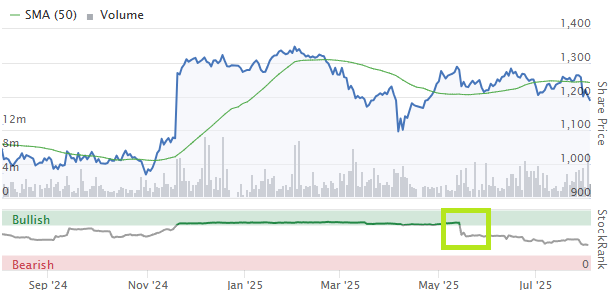
The share price hasn’t yet reflected this drop in StockRank, but I am a little concerned that a slowdown could be in the pipeline. In an article earlier this year, I explored the idea that changes in MomentumRank (and thus StockRank) could be leading indicators of share price performance.
As things stand, Sage’s only strong factor score is its QualityRank. Here at least, the numbers look good:

A low ValueRank reflects an expensive share price rating, with the stock trading on a trailing P/E of 31 and on a price to free cash flow ratio of 25.
An expensive price tag isn’t necessarily a problem for a quality compounder. Sage shares are no more expensive than other high quality UK big caps, such as Relx and Experian.
The group’s balance sheet also looks fine to me, with net debt of 1.5x EBITDA and good cash conversion. I would prefer management to use surplus cash to repay debt rather than buy back expensive shares, but I don’t think this level of leverage poses any meaningful risk.
I am convinced the answer to Sage’s low StockRank lies in its MomentumRank, but I’m struggling to identify a smoking gun.
Consensus earnings estimates have been broadly stable since November’s upgrade, with EPS growth of 13% pencilled in for FY26:

While price momentum looks mixed, it does score green on key metrics such as the 1y relative strength and 10d/3m volume change:

Is Sage a potential quality compounder?
As with Experian, I believe Sage is already a proven quality compounder. The share price has risen at a compound average growth rate of 8.5% per year for the last 20 years.
However, profit growth has been slower – my sums suggest operating profit has risen at a CAGR of only 3.5% since 2006. One weakness of the company is that it was slow to adapt to the shift online and spent several years playing catch up.
However, that difficult period is over and both profitability and growth have strengthened over the last 18 months.
I intend to hold my Sage shares indefinitely, as long as I continue to believe in the quality story. But one risk that does concern me at the moment is the group’s heavy exposure to small and medium-sized businesses in its core markets of North America, UK and Europe. A broad-based slowdown in the real economy could make it hard for Sage to maintain its current rate of growth.
I remain onboard with Sage. But I can’t say that I’d buy more shares at this time. The combination of a near-record valuation and the stock’s Falling Star rating mean I’m feeling very cautious – I can’t help feeling that a more attractive mix of risk and reward may be available in the future.
Read more: we covered Sage’s recent Q3 update in the DSMR on 15 May 25.
Disclosure: at the time of publication, Roland owned shares in Sage.
Disclaimer
This is not financial advice. Our content is intended to be used and must be used for information and education purposes only. Please read our disclaimer and terms and conditions to understand our obligations.

9 comments
Wise (LON:WISE) is the one I'm riding for the long term. Excellent analysis thanks Roland.
https://wise.com/us/blog/googl...
Thanks Roland. Educational on Stocko algos with your personal 'Buffetesque' insights - where is the 'smoking gun' etc.
My only comment is how will AI disrupt what are 'weak' moats. Sage (LON:SGE) presumably has the cash to buy out competitors.
Loser strategy investing in potential 'takeovers' can sit years on a loser.
Private equity now putting out tentacles - agree some of the best future ideas are not in the public market. But beware Will Robinson.
Hi Roland. Many thanks for this piece of work. I’ve really enjoyed reading your analysis and conclusions. I probably hold too many stock positions at present but I am in the process of trimming my laggers so I’m certainly on the lookout for (some) replacements; one of the things Stockopedia is great for finding. I was an avid subscriber to Company Refs a long time ago so discovering its ‘reincarnation’ many years later was a welcome surprise. Most of my share purchases are longer term holds so i favour steady plodders/compounders. Thanks again, Chris
Wise (LON:WISE) is the only one of these I hold but confidence has been dented somewhat by recent performance. The move of the main listing to the US, and subsequent spat between directors hasn’t helped. Nevertheless, new customers flock to their cash-transfer system - most on recommendation from present ones, and they seem to be able to reduce prices year on year whilst growing profits. Disruptive? Indeed imo.
Taavet Hinrikus is not a Director of Wise; he stepped down in 2021.
I agree that the continuation of ‘B shares ’for another decade was opaque, but suspect Kristo wished to have control as there was a significant risk they’d have been bought out which may have eventually destroyed the business model they both/Kristo designed. I understand this share structure excludes it from inclusion into the S+P 500.
The reason for a transfer to the NASDAQ is deeper pools of liquidity, improved access to other markets and hopefully a rerating by being included in tech/global trackers.
With a forward PE <30 it is trading at a much lower valuation than its rivals (PayPal, Ayden).
SGE: Excellent analysis Roland.
What I'd add is that looking underneath SGE's top-line revenue growth of +9% is the Sage Business Cloud products (comprising 82.5% of total revenue is growing at +12% and within this the Cloud Native products (34.6% of total revenue) are growing at 22%. The strong growth of SGE's Cloud Native products is being masked by their established (now Cloud enabled) products.
So, we should see the top-line growth accelerating as these Cloud Native products become an increasing proportion of the overall revenue.
Key to this is the roll-out of Sage Intacct, their mid-sector product, that has been an excellent performer in the US and again delivered 21% growth (1H25). In the UK Intacct grew 60%, albeit off a smaller base, and is starting to impact the numbers. Intacct is being rolled out in Australia, South Africa and more recently Europe. The reception in other territories has also been reported to be positive – so we appear to have a strong medium-term growth story developing nicely. This geographic expansion should (I hope) off-set any potential weakness due to the Trump affect in North America.
Roland - Fair to say each company has its attractions and detractions. I'm interested in IDHC but have never come across it before - and looking at list of major shareholders would certainly want to know just who they are. I can see the CEO has the largest holding but what about others. The Chair seems to collect directorships like I used to collect stamps - or am I being unkind? Can you provide any more info on the company and its shareholders
Fascinating input here Roland. Thanks for this thought provoking post.