New Year 'Naps' - Top 10 Stocks for 2015

When I first started subscribing to stock market tip sheets in the 1990's, the concept of “New Year Naps" popped onto my radar. Many tip sheets would choose a handful of favoured stocks (naps) for the year in a special section of their January edition. I thought the phrase and practice was an odd idiosyncrasy until I started to spot racing tipsters and bookies refer to naps when considering racing certainties.
It seems that the origin of the phrase 'a nap hand' comes from the traditional English card game called “Napoleon". In the game each player is dealt five cards and declares how many tricks they think they can make. A “Nap Hand" is a declaration that you can take all 5 tricks - so it's only ever used when you've got very strong odds. I've never played or heard of the game Napoleon but apparently it used to be quite popular. The phrase 'nap hand' seems to have been adopted first into horse racing and from there eventually into the tip sheet tradition.
But we don't do tips…
Now, before we publish some Naps, we need to make some disclaimers. As most readers will know, the entire philosophy behind Stockopedia.com is not to 'tip' stocks. Why don't we tip? Firstly and most simply - we don't believe we need to. The history of stock market returns shows that simple rule-based stock picking models have been far more consistent and effective than human forecasts.
The history of human forecasting is riddled with failure. Left to our own biases, we tend to project what's just happened, so our forecasts often lag reality rather than predict the future. Those that want to read up on the appalling accuracy of human forecasting should read Sin 1 (the folly of forecasting) in James Montier's excellent Seven Sins of Fund Management.
In contrast, for the last 80 years or so since Ben Graham began his work on classic bargain investing strategies, simple checklist based approaches have been shown to be far more consistent at beating the market. Put simply, statistics trump stories in stock market strategies, and that's where we put our bets at Stockopedia.
More importantly, we believe everyone is capable of making their own investing decisions. Rather than mirroring the 'broadcast' approach that most financial publications take, our philosophy is to put the best possible tools at your disposal and provide the education to use them wisely so that you can select your own stocks.
A method for our New Year Naps
So it's within this framework that we thought we'd try out an angle to create our own set of New Year Naps - not as a set of 'tips' - but as the outcome of a checklist of rules as follows:
Rule 1. High StockRank - Order the UK stock market by descending StockRank
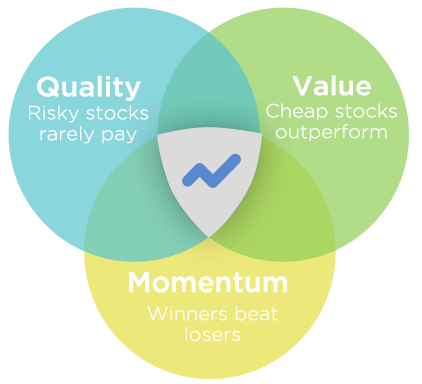 Where better to start than by leaning heavily on our StockRanks. The StockRanks are designed to find good, cheap, moving shares - known as quality, value, momentum stocks to the geeks. Value and Momentum are powerful drivers of stock returns and they've worked as strategies for the last hundred years - while past performance isn't a predictor of future returns history does tend to rhyme.
We've researched the StockRank in detail and believe it's a robust methodology. Portfolios selected with the ranks have performed well in backtests and in 'the wild' - strongly outperforming the FTSE All Share since launch in 2013. There's no reason why good, cheap, improving shares should not continue to outperform their opposite - expensive, deteriorating junk - so it's the basis for generating our Naps list.

Rule 2: Not hard to trade - Remove all stocks which are highly illiquid
We've removed hard to trade stocks from the list as they can be risky, most investors don't want to own them and they can be expensive to trade. So no stocks with less than a £20m Market Capitalisation and no stocks with a bid-ask spread > 5%.
Rule 3: Diversify - Select the single highest ranked stock from each sector
The very top 10 stocks by StockRank include 4 Consumer Cyclicals, 4 Industrials, 1 Financial and 1 Basic Materials stock. Only 4 sectors are represented out of 10 possible. Building a portfolio with such heavy weighting in single sectors can be highly risky - what if the economy tanks when you are loaded with cyclicals? There are 6 other Economic Sectors - Energy, Telecoms, Technology, Healthcare, Utilities and Consumer Defensives - and we thought it more interesting and prudent to cover the highest ranking share from each with an honourable mention for the second best ranked.
A unique set of New Year Naps
Each of the following shares has been selected by the purely rules-based strategy above. These are not share tips - DYOR !
Consumer Defensives
Cranswick - Back in 2000, with dotcom excitement reaching fever pitch, few backed Cranswick as a potential ten-bagger - but ten-bag it has. With an 18% compound annual growth rate in earnings per share over the last six years, this has been a stealth growth winner. Persistently high returns on capital have often highlighted this as a hidden champion on the UK stock market. But it goes on being ignored perhaps because investors prefer quantum dots to pork pies. Shame… the way to a man's heart has always been through his belly. Mkt Cap £675m - StockRank 98.
Honourable mention: Imperial Tobacco - the £27bn capitalised stalwart - StockRank 94.
Consumer Cyclical
Berkeley Group - Shares in this housebuilder have been on a remarkable run since the end of the economic crisis. Improving economic prosperity, rising consumer confidence and low interest rates have proved to be a boon for cyclicals like Berkeley. Its focus on developments in London and south-east England add an extra degree of attraction for investors, as does its 7.2% yield. Mkt Cap £3.3bn - StockRank 99
Honourable mention: Character Group - the £57.6m designer and distributor of toys and games for dozens of well known brands including the tot's favourite Peppa Pig - StockRank 99.
Industrial
Dart Group - This airline and logistics business proved to be a major coup for value investors who calculated back in early 2012 that it was simply too cheap. Since then it has risen in value by 360%, defying concerns about its business model. Dart has long been one of the highest ranking stocks in the Stockopedia ranking system for its quality, value and momentum. A profit warning in June may have hammered the shares, but the company has since shown that it may have been a one off. Mkt Cap £425m - StockRank 99.
Honourable mention: Costain Group - the engineering and construction consultancy - Mkt Cap £283m, StockRank 99.
Financial
Town Centre Securities - This Leeds based property developer and car park operator prides itself on intensive management of its assets and a conservative management style. Shares in the company rose by 12% during 2014, helped by positive earnings surprises. Plus the stock offers a useful yield of 3.9%. Mkt Cap £110m, StockRank 98.
Honourable mention: Catlin - a £2.4bn specialist insurance group - StockRank 97.
Basic Materials
James Latham - Like Cranswick, this importer and distributor of timber and panel based products is another AIM tenbagger since 2000 that remains moderately valued. It falls into the category of predominantly family owned niche businesses that investors have ignored to their detriment. 30% EPS CAGR versus 7% sales growth shows strong management, while brokers have been consistently hiking their estimates to the benefit of the share price. Mkt Cap £113m - StockRank 99.
Honourable mention: International Greetings - the £43.4m gift packaging and stationery retailer - StockRank 96.
Technology
Idox - This company supplies software to public sector organisations and has grown earnings at a compound average rate of 11% over the past six years. Efforts to reduce debt have improved a previously vulnerable balance sheet (as noted by Paul Scott), and those improvements are reflected in a QualityRank of 97. After a year of falling earnings forecasts, brokers have recently upped their expectations for Idox. Could 2015 be the year when Idox completes its balance sheet rehabilitation? Mkt Cap £141.7m - StockRank 95.
Honourable mention: Cohort - a consultancy working in defence and related markets - StockRank 94.
Energy
Lamprell - Shares in this oil & gas engineering group slumped by 30% in the final four months of 2014 as the world price of oil halved. Even so, analysts have been ratcheting up their earnings forecasts on the stock as a result of promising contract news and a strong order book. Overall, the shares look moderately priced, although it's unclear how Lamprell will be impacted by in the near term by lower oil prices. It remains to be seen whether fortune favours the brave. Mkt Cap £413m, StockRank 98.
Honourable mention: NWF - a warehousing and distribution business specialising in groceries and fuel oil - StockRank 87.
Telecoms
AdEPT Telecom - An acquisitive telecoms business that serves both residential and commercial customers across the UK. Adept has recently seen some sharp upward revisions to earnings forecasts for next year - indeed, earnings have been on an improving trend for the past six years. It boasts some good headline financial characteristics, including 10% operating margins and a return on capital of over 14% although Paul Scott has raised some concerns. Mkt Cap £32.2m - StockRank 96.
Honourable mention: BT - the £32.7bn telecoms giant - StockRank 92.
Healthcare
Animalcare - Shares in this pet health and veterinary supplies business rose 27% in the final two months of 2014, helped by some hefty upgrades to earnings forecasts. While the valuation looks reasonable at present, Animalcare's exceptional 20% operating margins and 13% return on capital suggest this could be a small-cap worth watching. Richard Beddard, Share Sleuth at Interactive Investor, recently added Animalcare to the Share Sleuth Portfolio - you can read his research here. Mkt Cap £35.1m - StockRank 96.
Honourable Mention: Alliance Pharma - the speciality medicines developer - StockRank 92.
Utility
Dee Valley Who in their right mind would want to own a utility? Well lots of sensible people do including those who enjoy 5% yields at moderate valuations. Dee Valley, is a £55m niche business serving water to over a hundred thousand households. It won't be on anyone else's New Year Naps list, but on a StockRank of 91 it makes the list as the highest ranked utility in the UK.
Honourable mention: Jersey Electricity - the sole supplier of electricity on Jersey - StockRank 90.
Isn't this a really boring and unsexy list?
Yes quite possibly, but as I've written before stocks that have the best fundamental and technical qualities are often strikingly hard to imagine buying. Value stocks often have 'problems', Quality stocks are often 'boring', and Momentum stocks often have 'scary' charts. Who really wants to buy boring, problem stocks with scary price charts? Therein may lie the secret to the StockRanks alpha.
The saddest fact in investment is that most investors overpay to buy the most glamorous names in the market. If you do the same, you may end up with the same returns as them - average returns are very uninspiring. What investors ought to do is invest at the margins, where others aren't paying attention. As Peter Lynch, one of the greatest fund managers of all time, wrote in the classic One Up on Wall Street - "A company that does boring things is almost as good as a company that has a boring name, and both together is terrific."
Creating your own list of Naps
While the list above was created using the overall StockRank, it's worth noting that some of the StockRank Crossovers have done even better. Notably Value & Momentum (VM), and Quality & Momentum (QM). You can screen for these ranks using the Stockopedia screener by searching for VM Rank or QM Rank. The QM list tends to highlight more expensive shares, but has had very impressive performance since launch. If you are the kind of investor who can't bear to purchase dowdy value shares it may be a good place to start your own hunt.
Remember that finding a strategy that fits your own psychology is vital, and please learn the rules of diversification - 10 stocks is never enough - so we'll be tracking the performance of all 20 stocks as a portfolio across the year.
Bonaparte...
Napoleon I'm sure would have loved his own Nap hand to play at Waterloo. While our man Wellington got the better of him, he was a most quotable fellow. In his own words…
“All great events hang by a hair. The man of ability takes advantage of everything and neglects nothing that can give him a chance of success; whilst the less able man sometimes loses everything by neglecting a single one of those chances."
All we can do in investing is try to put the odds in our favour by exposing ourselves to many return drivers and managing our risks. If markets play fair, we can hope for a fair chance of success. If it's our Waterloo, then so be it but we won't have gone down without a fight.
Best of luck in your own strategy for 2015 and of course…. Safe Investing.
Disclaimer
This is not financial advice. Our content is intended to be used and must be used for information and education purposes only. Please read our disclaimer and terms and conditions to understand our obligations.

47 comments
-
A quick update on the Euro NAPS selections I outlined in this post last January ... http://www.stockopedia.com/content/new-year-naps-t...
Average return: 47.61%
Best of luck
Phil
P.S. Edited to correct links to stocks
vik
David Schwartz was a stock market historian whose work was focussed on questions such as the one you ask and who write books about the subject. He used to write a column for the FT. He died in 2013 but you can still find his books second hand. See www.amazon.co.uk/Schwartz-Stock-Market-Handbook-Shares/dp/0952396122
He would ask/answer questions such as "is January a good time to buy stocks?" - "after a year which ends down is January a good time to buy stocks" - "when interest rates have risen is it a good time to buy stocks?" etc etc etc.
I recommend his books.
Won't make you rich but will scratch your itch.
T
thanks for the reply gus. yes my question was when is the best time to pick the Naps. So January would be a good time?
be interesting to see some data if selecting stocks at certains times of the year will affect the Naps portfolio.
thanks for this ed. I have set up a virtual nap and its already up by £900 in the last 7 weeks following your rules. im going to setup a real life portfolio using real cash soon. what I wanted to know is there a better time to devise the Stock Ranks naps? ie waiting till after xmas/new years - perhaps even in February once the stocks have settled down. So my question is can the timing of the NAPs selection affection the performance of ones portfolio?
Morning Vik - sounds like a good start for your Nap portfolio.
Is your question about the best time to pick the naps or when is the best time to buy into the market generally? If the former, Ed may have some data on whether there is some kind of seasonal pattern to Stock Rankings/share price performance patterns. His strategy of buying last January seems to have been very successful compared to some of the other portfolios devised later in the year. If the latter, my experience is that although the market in general shows some seasonality, buying (or selling) based on a previous year's pattern is tricky. As soon as a trend is identified it repetition seems to break down.
There are a few general adages that may be broadly helpful but are by no means infallible. There has been a bit of a year end Santa rally so far (fund managers acquiescing to higher prices on thin/nil volumes to window dress year end fund performance). We often see a further rise in the first quarter peaking late March as retail investors fill up their ISA allowances and II's place their capital allocations for the new year. There is then a bit of a sell off as activity tails off - leading to another established saw of "sell in May, come back on St Ledger day" (early September as I recall).
Of course, laid over all this are event driven market moves that can break up these patterns. Last year we had marked sell offs due to concerns over Greece, China, oil price etc.. Many of these factors are still latent going into 2016. Short answer is that calling market timing correctly is difficult - probably even harder than for a specific stock since there are so many more variables for the market as a whole.
My personal approach is to phase my investment over time - hopefully missing the peaks albeit at the risk of missing the troughs - and once invested staying in the market rather than trying to trade in and out due to the expenses involved and the view that time (ie compounding) is more important than timing.
Good luck with your investing.
All the best,
Gus.
New joiner but hope Ed or the rest of the good folks can share your rebalancing experience with NAPS portfolio.
I was thinking of rebalancing quarterly the bottom quartile of stocks with the best equilvalent stock in the same sectors. If any stock in the bottom quartile is still >80 in the overall stock rank, keep it and let it run for a quarter longer.
Anyone tried that before. It makes perfect sense to me on paper.
If you have not seen it you should read this: http://www.stockopedia.com/content/semi-year-snaps-more-top-stocks-for-2015-103099/
This was after 6 months. Your theory seems to make sense but a lot will depend on timing. 3 months maybe to often? Some sectors its difficult to find 2 stocks with high enough ranking, such as Ultilities, Telecoms, Health.
Thanks Herbie. Will give it more thought before I push the button for naps 2016.
It's in the gold and lending business and got a double sucker punch a couple of years ago by the payday lending review and the collapse in the gold price.
Not sure about that, Ed. 2014 Final Results (announced March 5th: http://www.investegate.co.uk/h--38-t-group-plc--ha... )
High cost short term credit interest rate cap
On 11 November 2014 the FCA published its rules relating to a cap on the interest rate and charges that apply to High Cost Short Term Credit ("HCSTC"). The rules took effect from 2 January 2015 and provide for:
· a maximum charge of 0.8% per day on the amount borrowed
· a maximum of £15 fees on default
· a cap on the total costs incurred over the life of the loan of 100% of the amount borrowed
The definition of HCSTC is broad but provides a specific exemption for pawnbroking and certain other credit products at present; we do not expect the cap to apply to pawnbroking in the near term.
The Group's personal loan product must conform to the cap although our relatively low rates of interest compared with the wider alternative credit market mean that the cap has almost no impact on our earnings.
David O'Hara
Editor, AIM Prospector
The 20 stock NAPS portfolio detailed in this piece is now up 19% year to date which has been a stellar return and well beyond the FTSE Small Cap index which is up 8.6% in the same time frame.
Catlin has been acquired by XL Group for cash and shares - but XL has a StockRank of 47 which isn't a good substitute. Catlin returned an annualised 24% till its delisting, so it wasn't a bad hold for the time period.
Given the UK focus of this portfolio we're rotating the 5% position into the next top ranked UK Financial - which is H & T (LON:HAT).
H&T is certainly one of those stocks that very few investors like the look of right now - it's one of those ugly frogs that's hard to swallow. It's in the gold and lending business and got a double sucker punch a couple of years ago by the payday lending review and the collapse in the gold price.
But it's now cash generative, paying down debt, and in the midst of rejigging its business model. It's cheap and out of favour but sentiment is just starting to improve with brokers upping numbers. There's little technical overhead supply of shares and it could be poised to perform. It's been added to the NAPS folio to make use of the Catlin cash.
I have an idea for a "Semi-Year SNAPs" follow up to this NAPS piece - but not due for at least a month.
Thats sounds like a good idea, must admit I'm gutted having missed out on most of the naps in January. Not keen on H&T myself. I would consider Novae, which is similar company to Catlin, SR 96.
This approach completely fascinates me and it is interesting to see how this develops over the years if you decide to keep this going. Your Rule 2: below is one important rule to which I added into my screeners to further my comfort zone.
I really look forward to further updates on this post.
There does seem to be a low number of high ranked (90+) consumer defensive stocks? Is this because they are the belle de jour?
As we're nearly a third of the year through I thought I'd post up some performance figures for the New Year NAPS portfolio to date.
It's too early to draw broad conclusions, but the whole list of 20 stocks is up 13.5% year to date, well ahead of the FTSE All Share's 8.6%. The top 10 stocks are up 11.6%, a tad less than the top 20 - as discussed in the article, the importance of portfolio breadth in harvesting factor based returns can't be stressed enough.
Standout performers have been Dart Group, Character Group and International Greetings which are all up between 20 and 40% YTD. The list of shares remains at a 20% P/E discount to the overall market and is benefiting from valuation mean reversion and strong momentum.
I'm hoping to be able to publish the portfolio alongside this piece at some stage in future, but here's some graphics from the portfolio analytics page. A nice spread across sectors...
But personally I don't like the underweighting of the consumer sectors. Consumer defensive stocks can often generate strong economic moats - so this underweight concerns me. A more intelligent weighting system than the 1/N sector weighting we applied would be to either match the market, or overweight sectors with a stronger likelihood of outperformance.
Still strongly exposed to good, cheap stocks:
And still strongly exposed to Value & Momentum:
I see Cranswick trading was out yesterday, did not look bad but sp is down, is this to do with supermarket price cutting in the future?
I see. Yes I own quite a few housebuilders, they have done well this year but Im looking to reduce my holdings soon. Although some (Barratt) maybe worth holding for the dividend. And Inland I think is worth holding.
Hi David, I understand about sectors, just find it odd that housebuilders are in different sectors.
Re Catlin this is a bid situation, think its been agreed so you may want to reconsider.
Yes I agree its a good starting point and I think most of them are pretty sound.
Yes I saw Boohoo this morning thanks to Paul's review, actually bought some at 22p. I notice IC tipped them as a buy at 48p now a sell at 22p. Really rather disappointed with IC's advise, don't think I will be renewing my subscription.
I agree value stocks are a better investment.
Super article and nice to see AdEPT Telecom on the list. I originally picked this stock up after it appeared on my Stockopedia screen. I visited the company down in Tunbridge Wells and was impressed by their discipline in terms of capital allocation and commitment to cash generation and creating shareholder value. They have increased the dividend substantially over the last two years and have now commenced a share buyback.
It is the seventh largest shareholding in the JIC Portfoio at 4.2% and having had to be a little patient since first buying stock in September 2013, (subsequently I added in November '13 and March '14), it is now up 20% on my purchase price and I for one will not be selling them back any of my shares!
My last posting on AdEPT in November last year
Did you have a Naps for 2013 that I can look at and see how it all panned out ?
I do a regular review of my top ten and they are certainly not tips but always interesting to see how they continue to perform over a long period compared to benchmarks and indeed just by comparison with the very long tail of stocks I have in the remainder of the portfolio. It can be found here....
http://boards.fool.co.uk/a-not-too-scary-end-to-2014--13143308.aspx
My five to watch this year as entered in various competitions for stock picks in 2015 are RTC, SPRP, UNG, SPL and HMLH. Two of those will definitely do well through 2015 and the other three will be exciting and potentially double or even triple and one is based overseas so there is added risk ! DYOR naturally.
David
Ed, Re-reading my last post, I think it might come across as a bit grudging, which wasn't my intention. Many thanks for your very interesting and useful discussion of methods of diversifying a portfolio in your response to my original post.
Ed, Thanks very much for your long response to my questions. You only indirectly answered my questions, but I think your response is interesting and useful nevertheless.
My conclusion from what you wrote is that my current rule of not selecting more than one stock from each 'Industry Group' (as defined by Stockopedia) for my 20-stock portfolio (which uses the Stockopedia StockRank as one of its selection criteria) is probably a reasonable compromise between diversifying my portfolio (and thereby reducing its risk and volatitlity to some extent) whilst retaining stocks that have a good chance of out-performing the All Share Index. The rule also has the advantage of being easy to implement, so I will probably continue using it unchanged.
Excellent article, regarding sectors.
In the US nearly all the airline stocks have done extremely well in the last 2 or 3 months due to the oil price falling, LUV being one of them. However balancing that the rate of the $ to the £ has to be taken into account. From about $ 1.7 to now just over $1.5, which is about 8% in just a few short months.
I notice IDOX, which is right in my doorstep, so I will be keeping an eye on it.
The Stock Ranks do save a lot of time, & generally you do get a better chance with investing with them.
Dart Group was one of the first shares I bought with Stockopedia and has proven that very point. AHT is another which still looks good.
Joel Greenblatt's magic formula really loves Quindell :-]
Hi,
Interesting article, thanks Ed.
As regards momentum, if you look at the US indices (which drive everything in the UK too), then it's been a continuous rising market, with occasional small corrections, since 2009. So that would greatly flatter momentum investing strategies in the last 5-6 years.
However, that's not going to last forever. Sooner or later there's going to be a change of trend, and momentum strategies will stop working. That will leave people who ignored valuation and instead bet on momentum, high & dry in a load of considerably over-valued stocks, which would be prime candidates to crash in price in a violent market correction.
My understanding is that the Stockopedia "momentum" calculation includes rising earnings estimates, which in my view is far more important than a rising share price. It would be interesting to know how the momentum score is calculated.
I have to say that in smaller caps, a lot of the highest scoring StockRank stocks are ones which fit nicely with my approach, so I do like this system.
On the other hand, the figures and screening systems only tell you so much. After all, Quindell (LON:QPP) scores very highly on the numbers alone, but it's been a disaster, as there were serious problems with management & the business model, which statistical systems wouldn't necessarily pick up.
Similarly, Cenkos Securities (LON:CNKS) had a one-off good year due to huge fees earned on the IPO of the AA.
So it's still vital to properly check out every company, but I find that starting with a decent quality/value/momentum shortlist of stocks saves a lot of time.
Regards, Paul.
Hi Paul,
It's interesting that you've included Cenkos Securities (LON:CNKS) and Quindell (LON:QPP) in the same paragraph as they seem like their fortunes are rather tied at the moment with Cenkos being the last advisor standing for Quindell.
When I did my research on Cenkos I stripped out the profit from the AA so I could get a feel for what a normal year would look like - clearly, I didn't do enough research as I could have spotted that they advised Quindell - an expensive mistake!
Regards,
Sully.
Hi Paul,
Firstly StockRank isn't a momentum based approach, it's a hybrid - Quality, Value & Momentum based approach.
Of course stop losses will be triggered and portfolios will turn over to cash. It doesn't have to be the case that this occurs as a dramatic crash, but it could be. It could be that a momentum approach keeps you out of a bear market as opposed to a value investor who sees opportunities coming out of the woodwork.
Also a loss in momentum in stocks with a high StockRank doesn't necessarily mean you'll end up with overvalued stocks. In fact if you're selecting stock with 97+ StockRanks on the whole you'll be selecting high ValueRank stocks too.
Well that only flatters momentum approaches if you think it will stop any time soon ... 5 years+ and counting.
If I'd told you in 2009 that the markets would go on a bull run for 6 years+ would you have used a momentum based approach? If the answer is No, then surely you've missed out on some major gains as you waited for stocks to correct and fall into traditional value territory. My own portfolio closely mirrors (in terms of holdings as opposed to value) my fantasy fund and has gone up by 56% in 23 months. Very early on in the establishment of this portfolio I switched to a QVM/QGM approach (heavily influenced by the Stockopedia research and The Naked Trader approach)
Who's to say that this market won't go on for another 5 - 6 years? Patience is the watch word of the value investor. The value investor knows best, has done the research, spotted the opportunity that the market has missed and is sure they have it right. They are so sure they even buy more stock when the price drops. Maybe my watch word is 'adapt'.
If the market conditions change, I'll look to adapt my strategy. Even if a catastrophic market event happens and wipes 30% off my portfolio I'd still be significantly ahead of most other private investors. Personally speaking even the growth shares I buy are cheap in terms of growth so I'd be very surprised to see 30% wiped off my portfolio.
With respect to Quindell, it's never popped up on my screens but I did take a 13% gain on a punt in the recent upetty/downy ride. However I did buy Let's Gowex SA (MCE:GOW) when it appeared on my screens and it did run into serious problems. That however was only after I bought and sold it again (when it lost price momentum) for a 166% profit. My point is in a diversified portfolio whilst attempting to avoid total losses with screening parameters:
1) a share that may well go under can still be bought and sold before the disaster strikes (of course I'm not looking to buy into companies that are headed this way but it happens)
2) even if the share did pan with a portfolio of 25 shares it isn't disastrous
Ultimately, you are a hunter whereas I'm a farmer and this plays into this statement too
The definition of "properly check out" is subjective. For me my screening rules help me to weed out the duffers as best I can and I read recent releases. I evaluate risk/reward by generating price targets and considering points of technical support. I know that this will be quite different to your definition of "properly check out", e.g. I rarely if ever look at the accounts (sacrilege to some I know) but rather I 'rely' on the Stockopedia metrics that drive my screens, e.g. P/S, Altman, Montier, EPS estimates, PEGR, etc.
I recognise that not all of my choices will work out and so I sell them at a loss, knowing that my other selections will (so far) in general do well. The exception to this selling strategy has been when there has been a market wide sell off. In this situation I tend to sit tight for a while, let the dust settle and give the winners a chance to recover.The ones that falter I sell and move on until they pop back up on my screens at some stage in the future. On average I hold for a year to 18m but this can be skewed by the relatively quick selling off stocks that falter.
I guess in this post I'm trying to offer an alternative to the Value only approach that requires detailed company research. I try to not get an emotional attachment to my stocks and I expect to get some wrong. I think in the Value approach there is a lot riding on one's evaluation of a company and as such the ego can become wedded to a selection. Each to their own I suppose.
Disclaimer, this is very much my own approach that I have developed it over time and it could be fluke, good fortune, market conditions, etc. etc. I'm no means an investing expert so there's my wealth warning. What I do say though is that I'm completely transparent in my selections which you can see in my fantasy portfolio. I'm passionate about providing a way for the every day Joe/Jo to manage their own financial future without needing to know the ins and outs of accounting principles and as such to me that doesn't sit well with a value based/hunter based approach whereas a farmer approach does.
Enough rambling.
Happy New Year and I hope you all enjoy a prosperous 2015
Phil
Hi Ed
An interesting article and an interesting choice of shares.
Using Stockopedia metrics, I have developed a more complicated mechanistic method of suggesting shares for investment, which reflects my statistical background. My method has served me well to date,, although I do further research before investment..
I start from roughly the same base as you, giving a share a score according to its Stockopedia stockrank (although, as an aside, I become more and more convinced I should be using the value/momentum rank rather than the stockrank).
I then include a score for each share, according to its current dividend. I know share buybacks add complications, but I believe the research of David Dreman and others, plus the investment experience of people like John Lee, suggest this is a useful addition.
I then add a score for qualification of some Stockopedia screens. However, this is not a linear score. High performing screens since inception have the largest scores. Screens which have underperformed the FTSE All Share since inception have a zero score, unless they have a negative return or are short screens, when they have a negative score..
Finally, I add a score according to which index a share belongs, and given the diversity of shares qualifying for AIM, I subdivide the AIM score into three parts
Obviously, my method is more complicated than yours,,so either I am overcomplicating matters, since your method works just as well, or I should be adding extra performance. Possibly, you should be hoping my method works better, or why include the stock screens in Stockopedia?
My choice of shares, using my mechanistic method, produces three top ten shares which also feature in your top ten shares, and ten shares which also feature in your top twenty shares.
For completeness, my system produces the following "naps":
Consumer Defensive.
1. Imperial Tobacco
2. Cranswick
Consumer Cyclical
1. Berkeley Group
2. Bellway
Industrial
1. Reed Elsevier
2. Galliford Try
Financials
1. Catlin
2. Cenkos Securities
Basic Materials
1. James Latham
2. Mondi
Technology
1. Indigovision
2. Newmark Security
Energy
1. Royal Dutch Shell B
2. Lamprell
Telecom
1. BT Telecom
2. Adept Telecom
Healthcare:
1. UDG Healthcare
2. Animalcare
Utility
1. Dee Valley
2. United Utilities.
Best wishes
David Talbot
Interesting selection, David. Not sure I would class Reed and Galliford Try as Industrial. Cenkos depends on Quindell investigation which of course screens will not pick up on. Yes Dee looks good, just bought some myself. Energy depends on oil price. Looking at a few others on your list, hope the sp will fall back a bit. Looking at ZYT in technology.
Hi herbie47
Thank you for your comments. With regard to whether Reed Elsevier and Galliford Try are industrials, what I was doing was producing an alternative mechanistic portfolio to Ed's, using Stockopedia metrics and classifications. Since Stockopedia classes both Reed Elsevier and Galliford Try as industrials, then for the purposes of my exercise they were classified as such. The only time I differed from this strategy was when Ed did. Therefore, I classified the Berkeley Group as a consumer cyclical, since Ed did, whilst according the Stockopedia this share falls (surprisingly) in to the financials sector.
Any mechanistic system only produces a shortlist of shares for further consideration. I agree with the concerns about Cenkos Securities, not only with regard to being Quindell's NOMAD but also because of the fall in turnover expected in 2015 (which, incidentally, the Stockopedia Cenkos page clearly shows). Personally, if I had been making a judgement call, I would have replaced Cenkos by Lombard Risk Management, but I wanted to show what my mechanistic system produced, without any amendment.
Best wishes
David Talbot
Thomson Reuters are going to be reclassifying some of these housebuilders under cyclicals - notably Berkelely - so I figured I'd pre-empt them in this article. Given the reclassification it wasn't a really discretionary decision, though it was a conscious one.
I actually own Persimmon, Barratt and Telford Homes myself - but Berkeley was ranking higher so I brought it into the article.
Ed, Thanks for this interesting article, in which you wrote:
"Rule 3: Diversify - Select the single highest ranked stock from each sector
The very top 10 stocks by StockRank include 4 Consumer Cyclicals, 4 Industrials, 1 Financial and 1 Basic Materials stock. Only 4 sectors are represented out of 10 possible. Building a portfolio with such heavy weighting in single sectors can be highly risky - what if the economy tanks when you are loaded with cyclicals? There are 6 other Economic Sectors - Energy, Telecoms, Technology, Healthcare, Utilities and Consumer Defensives - and we thought it more interesting and prudent to cover the highest ranking share from each."
I constructed a 20-stock portfolio using the StockRanks three months ago. In order to diversify the portfolio, I used a rule that I would not select more than one stock from each 'Industry Group' (as defined by Stockopedia), because I did not notice the 'Sector' class in Stockopedia. There are a lot more possible Industry Groups (I estimated about 35) than the 10 possible Sectors. However, examining my portfolio now, I see that just 8 out of 10 Sectors are represented in the portfolio, and the number of stocks in each Sector range from 0 (for Telecoms and Uitlities) and 1 (for Energy and Healthcare), to 4 in Consumer Cylicals (in Industry Groups: Hotels & Entertainment Services, Speciality Retailers, Homebuilding & Construction Supplies, Media & Publishing) and 5 in Financials (in Industry Groups: Real Estate Operations, Insurance, Collective Investments, Investment Banking & Investment Services, Residential & Commercial REITs).
Do you think my portfolio is therefore less diversified than it could be?
If so, would it be better, for example, to use a rule (to construct a well-diversified 20-stock portfolio) that each stock must be from a different Industry Group but no more than 3 stocks can be selected from any one Sector?
On the subject of diversification...
I think it's important to say that this article isn't designed as an investment system. I've selected the top ranked stock from each sector to write about as it's a broader set of stocks and makes for a more interesting discussion. I could have selected a set of stocks that I personally believe have a higher probability for outperformance in 2015 - which would have been more concentrated in fewer sectors - but that would have skipped over some of the subjects we are now discussing - like diversification and risk. Important topics and I'm glad they've been brought them up.
We have been writing a lot of articles in recent months on the subject of risk, diversification and portfolio management which you can catch at this link. It is a complex topic and one that depends on one's personal portfolio size, time horizon and tax status. As a result there's really not a one shoe fits all approach here.
Equities obviously are only a single asset class among many. We love equities here but as a result this post can only cover the subject of diversifying within equities. The first thing anyone should do is ensure they are diversified away from equities too - but that's beyond the scope of our site at present. There's bags of literature on this subject though which Google can help on.
There are though several schools of thought on the subject of diversification within the equity asset class. These include breadth, sector diversification, geographic diversification, factor diversification and correlation. All these ideas try to reduce risk, volatility and drawdowns in portfolios... but often the more one diversifies, the more one sacrifices returns in the process. The extreme of diversification can be thought of as an index fund - which gives you the market or index return - so one doesn't want to take it too far. All of us here invest directly in equities because we want to improve on the index return - so all that follows in the next few paragraphs needs to be taken in moderation. The goal is to maximise the 'risk adjusted return' - i.e. to reduce risk, but not sacrifice all the possibility to beat the market. We don't want to completely cage the bird.
So here goes... firstly on portfolio breadth - I've written an article on the subject here which I won't duplicate, but essentially there's a lot of evidence that one should diversify across 20-30 stocks as soon as it's economically feasible rather than the 5-10 that most naive investors favour. There's a far lower risk of ruin investing in broader portfolios, and the upside is just as strong with lower risk.
By factor diversification I mean diversifying across stocks that have exposures to Value, Momentum and other return drivers. This is a more modern approach to diversification - it ensures you won't be only exposed to e.g. value stocks when value investing goes out of vogue. Nobody wants to be stuck in value stocks when there's a bull market in other parts of the market (e.g. late 1990s) - so diversifying across other 'factors' like momentum stocks helps returns and lowers the risk of underperformance. I've written on this subject many times, and the StockRanks system to some extent helps ensure exposure to these ideas. Some believe you should take half a portfolio of Value stocks, half a portfolio of Momentum stocks.. others believe you should just buy Value & Momentum stocks (like our ranking system) - how one skins the cat is again a personal decision.
I appreciate I may be going off topic as the question I was asked predominantly relates to sector diversification. But my take on sectors is quite simple - try to focus on high probability shares while avoiding concentrated sector exposures. One doesn't need to mirror the sector weightings of the index or get too neurotic about ensuring exposure to all parts of the economy. What we should be trying to do is ensuring that we don't get caught out investing in purely e.g. energy stocks when the bottom falls out of the energy market. We sometimes never know when an issue will hit a part of the economy, so it's prudent to diversify sector wise. How much is a personal decision - utilities may never make you rich, but they sure can provide a defensive base in rough waters.
We use the Thomson Reuters Business Classification Schema for sector categorisation which includes 10 economic sectors. I think it's a good system. Though there are others like the GICS classification or the FTSE sector classification which we don't publish. You can read up on TRBC here. I also personally further segment the market into 3 super-sectors - cyclicals, sensitives and defensives - which I'd like the site to reflect over time.
And of course one shouldn't forget that most UK portfolios are exceedingly biased towards the home UK market. Home bias is a well researched blight on portfolio returns as it ignores the returns to foreign stock markets and economies- never ignore geographic diversification. There's a lot on this subject in our ebook Getting Started in US Shares. The UK is a mature market with an ageing demographic - should we really be ignoring the big opportunities abroad? You don't need to go and buy foreign listed stocks -one can gain exposure to foreign markets through UK listed stocks, but it does need some conscious effort to ensure stocks selected have foreign sales exposure. This isn't something we can do yet at Stockopedia but I'm hoping we'll be able to in the not too distant future. (Of course you can research US and European listed shares here.)
I'm sure with all the above I've lost a few readers. Investing should be simple, but it shouldn't be made hard. There's often too much to think about when diversifying and fulfilling the above checklist may seem impossible. The software will help on the above in future - but it doesn't quite yet - so it needs to be a personal, conscious thought process.
I will leave this extended comment with one last thought... volatility is designed to separate fools from their money. We diversify to reduce short term volatility - creating safer short term returns often at the expense of long term returns. Reducing volatility is a balm that makes us feel safe, but it can ultimately ruin our long term returns if taken to extremes. I believe everyone investing in equities should try and feel comfortable with risk, and comfortable with occasional short term pain for long term gain as long as they are exposed to real return drivers.The best book for understanding this ideais here.
So my own personal take is to diversify just enough, but not too much... I call it Goldilocks diversification... and it's very hard if not impossible to know when you've got it right - so don't sweat the small stuff !
Hi Ed,
Yes it would be very good to get the Euro and US versions.
It would also be good to filter on min and max mkt cap not just min.
Playing around with the existing back tester it's interesting to notice the performance of the QVGM composite which has been outperforming the StockRank since September in 3/4 of the cutoffs (i.e. 90%, 95%, 97.5% & 99%)
I personally prefer the 97.5% options (see here) as it generates enough results to model a 25 stock portfolio,
With the 97.5% option StockRank has generated 38% since May 2013 and QVGM 47%.
If I further filter this with > £50m mk cap (which is my preference) it shows a StockRank 40% and QVGM 46%
Any thoughts on this? Why did QVM gain favour over QVGM at Stocko?
Thanks in advance
Phil
Ed,
Will look forward to the backtesting facility. Think you are correct that there are to many, "budding Buffets" after QV type stocks and that momentum is not sufficiently considered. An interesting Autumn 2014 paper called, "Fact, Fiction and Momentum Investing" by Asness strongly suggests that Value should be combined with Momentum (VM) for best results. http://papers.ssrn.com/sol3/papers.cfm?abstract_id=2435323
Ian
Hi Phil,
QVM is preferable to QVGM because the academic research shows positive returns to Quality, Value and Momentum but negative to Growth. Any outperformance in the short term is probably just noise and a reflection of the market overpaying for some big name growth shares Ocado (LON:OCDO) etc. The returns to these factors need long term commitment - probably why they keep working. In all markets, shares, countries and time periods the market simply overpays for growth, on average, over the long term and leads to negative relative returns to growth.
Re: your choice of 97.5% cut-off i think this may be too tight - it implies a level of refinement that really doesnt exist. You may be better off widening your stock rank criteria and filtering out the likes of Quindell (LON:QPP) and Lets Gowex via Earnings quality or financial distress metrics e.g. Beneish M-Score and Altman Z-score to reduce your choices to the right level of shares. Since you like the purer quantive strategy the book 'Quantitive Value' would show the benefit of following this approach.
HTH,
Mark
Thanks Mark I appreciate your detailed response.
I'd like to add a few comments on why QVM gained favour over QVGM. Initially (for a few months) we favoured a QVGM StockRank, but dropped the 'G' (Growth) for a number of reasons. It wasn't because QVGM as a model was underperforming (it wasn't at the time), but because there were strong reasons to ditch growth as a factor which we became convinced would make it underperform over time. This was a very tricky decision, partly because Growth is such a popular factor for stock picking, but I think it was the right one. It really boiled down to the following 4 key reasons.
1. Little Academic backing - As dangersimpson has mentioned, there's little academic research that backs up using "Growth" as a core factor in a long term stock selection model. Stocks that have high exposure to Sales and Earnings growth actually have a tendency to mean revert - i.e. past & forecast high growers don't continue to outperform - and often they underperform slower growers. This has been backed up by the raw returns to the GrowthRanks as evidenced in the chart below. The top 5 Growth deciles have all returned similar amounts => there's been little alpha for Growth stocks !
On the other hand the literature has long shownthat stocks exposed toValue and Momentum as factors tend to outperform, while a lot of the more recent literature is backing up the idea that Quality factors have some impact (especially low volatility / high profitability or blend approaches ) - indeed the top 10% of ranked stocks for each of Q, V and M have outperformed all other deciles to a far greater extent - none more so than Momentum stocks as shown below.
2. Correlation - In our analysis we found that the stocks exposed to Growth were highly correlated (similar) to those exposed to both Momentum and Quality. i.e. Growth wasn't adding any new information. What you really want is a set of uncorrelated factors as there should be higher risk adjusted returns. We found Quality and Momentum were somewhat correlated, but Value and Momentum were inversely correlated. Q, V & M were the best set of the 4.
3. Arithmetic - If the Value factor was 1 of 4 factors in our model, stocks would only have a 25% exposure to value. Value has long been one of the most powerful stock selection factors - portfolios of cheap stocks tend to outperform those of expensive stocks in almost every 5 year cycle. What was happening in the QVGM model was that much more expensive stocks were qualifying in the top ranked sets. In QVM, there's a 33% exposure to the Value effect. Many academic models seek higher exposure to Value, so we were more comfortable with a higher exposure to value.
4. Simplicity - I'd be lying if there weren't some other lesser, but still important motives for favouring QVM. A lot of our goals with the site (and ranks) are educational as well as alpha generating. QVM is simpler and more understandable, and a stronger educational framework. Also Quality in the academic literature often contains growth factors so there is scope for its extension.
There may be some portfolios of QVGM which have outperformed over the last couple of years - but there are many ways to skin a cat. From a top decile perspective the QVM portfolio has strongly outperformed QVGM. I'll publish those results in due course.
I'll answer the sector question a little later !
Hi Ed,
Many thanks for your very detailed response.
I'd be interested to see the latest comparison between Stockrank and QVGM as the old back tester is showing little difference between the performance of the top decile.
Are there any plans to give us access to this facility so that we can back test our own scenarios, e.g. forks of the QVM strategy.
Thanks in advance
Phil
Happy New Year and thanks for a great article and your earlier book suggestion which I am just reading. On the QVM / QVGM debate I would like to add my tuppence worth.
When I worked in the city I worked for a house that followed a Simple Quant / BF model not dissimilar to the one you have developed except it was generally described as VGM (although there were also some quality / financial metrics in the black box too). As at that time, despite growth being an underperforming factor, it was found to improve the model overall.
Value was just the simple earnings yield although I would accept that your combo approach works just as well.
Growth focussed on earnings growth ONLY, which tends to drive ratings and works well when combined with estimate revisions, but I'll come back to that.
Momentum had Estimate revisions and 12 month Price momentum plus a one month reversion factor.
Quality / Financials were represented by ROE and Interest Cover to give a 6 factor model.
As a value / yield investor I sometimes struggled with the momentum aspects, but did find that they were useful in keeping us in and out of stocks.
For growth / momentum plays it is the interplay between the rating and the estimate revisions that needed watching. Positive revisions made it more likely the numbers would be hit and further serial upgrades may follow hence helping to support or expand ratings. But you knew if you were running a stock like that you had to head for the exits at the first sign of trouble.
Conversely for value plays the Momentum factors helped to keep you out of "Value traps" by avoiding the under performers with downgrades. While cheap unloved stocks getting upgraded would be interesting turn around candidates.
I certainly found that drilling down into the underlying factors (which I think you are planning to offer) was instructive in terms of the support or otherwise that estimate revisions could give to other metrics. I think there has been research to show that momentum factors can improve results in value (I think your Ben Hobson provided a link to a Quant house showing this).
So the ideal stock / portfolio in aggregate would have been cheaper than the market, with faster forecast earnings growth, supported by above average earnings revisions and positive price momentum. The ROE and interest cover metrics would then also steer you towards the better "quality" names in terms of operational and financial metrics. This all played to the value and momentum performing at different times. Some funds even stitched a value portfolio and a growth / momentum folio together to achieve a purer version of this. So overall quite close to what you have come up with except for the earnings growth element, but then arguably your is more sophisticated or complicated, but then some argue for simple being better.
Finally in terms of the whole momentum debate we certainly found that it worked most of the time when the market was trending in either direction, but struggled somewhat in a sideways trading market that we have seen in 2014. Where it really stopped working and blew up was at an inflection points in the market i.e. when it tops or bottoms out. Thus all the highly rated winners would suddenly get caned and defensive stocks would take over for a time and it would take about 3 to 6 months for the price momentum indicator to pick this up. Equally at the bottom the defensive stocks would suddenly get trounced as all the terrible looking trash suddenly bounced back unexpectedly and again it would take 3 to 6 months for the momentum compass to re set itself.
The only defence to this was either to accept it if you are running a pure quantitative approach which is what I think you lean towards. OK for PI's but clients tended to get very upset around those periods. Or you can employ a manual over ride at turning points which is easier said than done but may be more obvious not long after the fact. Will be intersting to see how QVM goes when / if we reach a turning point in the market.
Cheers
jjis
Website: Compoundincome.org
Twitter: @CompoundIncome
JJS - there's plenty that can be done to improve Price Momentum as a factor. It's a project for 2015 for us, but I'm hoping we can switch to using Residual momentum rather than plain Vanilla momentum. Plain Vanilla Momentum does have a tendency to 'crash' from the long short perspective at market turns - I've written about it here - http://www.stockopedia.com/content/how-momentum-tr...
Price Mo is only 1/6th of the overall StockRank which I'm comfortable with. There's certainly plenty of scope to up the exposure in future once we've made the adjustments.
re. Growth as a factor. In my experience, some growth metrics work v. well, but not as overall market ranking factors... just for the top decile. One of the key goals of the StockRanks are to rank all stocks in the market, rather than to create a single super stock portfolio of 20 stocks - I'm struggling to find a growth metric or composite that creates a classic decile spread across the market - the deciles tend to remain flat. For our GrowthRank the top performing set has been the 30th-40th percentiles - which I think says a lot about the tendency of growth stocks to mean revert !
On that note - take a look at Boohoo.Com (LON:BOO) today which is what out and out growth investors are up against on a regular basis -45% in a single day! Growth investing is sexy, but I think it's a crowded trade - everybody is going for growth as they 'know' that eps growth is what drives stocks. What they don't seem to know is that eps surprises have way more upside in value stocks than in growth stocks as growth stocks tend to be overpriced.
Good to debate this stuff.
Hi Ed thanks for your reply, would be interested to hear more about residual momentum.
Certainly agree on growth stocks like BOO, that's the risks that investors run holding these highly rated growth stocks and I see they have missed big time numbers which were being downgraded for the last 6 months or so.
Personally I'm much more in the value / yield / income camp so no way I'd have held or be buying into BOO even though its in Mr. Markets January sale at less than half price, but best of luck to any one who holds it or buys it down here if they want to play that game, maybe it will bounce back.
Ed,
Great article and I am going to set the 10 NAPs up as a dummy Stocko portfolio to monitor their 2015 performance. Also agree with the generalized tip comments: IC just published their "Tips of the week 2014 Results", which to me look no better than Monkeys throwing darts results.
You mention that, "While the list above was created using the overall StockRank, it's worth noting that some of the StockRank Crossovers have done even better. Notably Value & Momentum (VM), and Quality & Momentum (QM)." What are the VM and QM gains vs. QVM since their inception please?
Ian
Hi Ian, Yes I will be tracking the above portfolio similarly - and I'll post a link once I have.
I favour broader portfolios when using ranking systems as you are more likely to end up with a similar return to the top decile return. Concentrated five or 10 stock portfolios tend to have a huge variability of return - and it's quite possible a portfolio can under perform substantially in a single year even when constructed carefully.
So I'll be just as interested in how the 20 stock portfolio (including all the 'honourable mentions') performs. Often only 1 or 2 stocks in a 20 stock portfolio drive a large proportion of the gains, and it's incredibly hard to know which stock will pull it off beforehand - the fewer stocks listed, the more likely you will miss out on one of them. I have definitely moved me away from the 'put all your eggs in one basket and watch that basket' camp. Check out this article for more detail.
Regarding the VM & QM ranks. We will be launching the StockRanks 'back-tester' within a month or so which will allow you to view their results in a lot more detail. What we've found is that the Momentum Rank has outperformed the Value Rank over the last couple of years, which has outperformed the Quality Rank. Taken together the VM and QM have done much better than the QV portfolio.
I think there are several reasons for this - but my gut tells me that QV (or the strategy of buying 'good', 'cheap' stocks) is underperforming because it's the most well followed. There are still too few investors that trust 'momentum' which may be the reason it's often underpriced.
I'll try and post up some QM, VM results from the backtester in due course - we're doing a lot of optimisation work to get it ready for production on the website. Good news is we've got the speed down to just a few seconds for printing the performance charts - so @PhilH it's getting there. We will launch the UK backtester first and hope to follow up with the EU and US ones shortly afterwards.
Here's my list with a more European/US focus:
Consumer DefensivesI've done well (+60%) with Salmar ASA (OSL:SALM) a Norway based Salmon farmer, but I feel there is more to come (SR 98)
Consumer CyclicalHornbach Baumarkt AG (ETR:HBM) a German DIY Chain (SR 99)
IndustrialI'm overweight in Industrials. Sprue Aegis (LON:SPRP) has been fantastic for me (+380%) and it holds a fantastic market position (SR 71) however looking forward I think I'd choose Southwest Airlines Co (NYQ:LUV) the US airline even though it's on a SR of 83. It's a growth play and has a low PEG and PEGR with increasing forecasts. Low oil prices will surely improve margins too.
FinancialsI've chosen UK house builder Barratt Developments (LON:BDEV) (SR 98)
Basic MaterialsCorticeira Amorim SGPS SA(ELI:COR) - Portuguese holding company engaged in cork related products (SR 99)
TechnologyAnother sector where I'm overweight. I've already done well (+85%) with GFT Technologies AG(ETR:GFT) a German based supplier of IT solutions and I think there is more to come (SR 92). I also like Data Modul AG Produktion und Vertrieb von Elektronischen Systemen (ETR:DAM) a small German supplier of flatbed displays. It's cheap, has low a risk adjusted PEG with increasing broker forecasts. (SR 99)
EnergyI have no holdings in this sector
TelecomsI have no holdings in this sector
HealthcareAnother sector where I have more selections. I've done well (+188)% with CellaVision AB (STO:CEVI) a Swedish medical technology company and again I think there is more to come here (SR 85). My choice going forward would be Health Net Inc(NYQ:HNT) a US provider of managed care (SR 99)
UtilityI have no holdings in this sector
Of course not recommendations just selections from my portfolio which is constructed using screens heavily focused on QVM, also known as StockRank and QGM. Please do your own research and best of luck for 2015.
Warm regards
Phil
Puts into good practice the wonderful book
Millennial Money: How Young Investors Can Build a Fortune. Easy read in a few hours and excellent http://t.co/DrHE5BArPU