What to do on a takeover bid

A takeover bid has come in for a share you own. The offer may be significantly above the share price before you knew - maybe 30% or more. Quite soon, you may have to decide what to do with your shares. Firm offers usually go through: of the 64 the Takeover Panel saw resolved in the 12 months to March 2026, 52 completed. A possible offer is less certain. When we analysed UK takeover bids, the shares made most of their gain on the day the bid became public. Where it began with a firm or recommended offer, they typically added only about 2% more before the deal completed. When a bid failed, most of the bid premium went, and nearly half the shares ended up below where they were priced six months later. What's left is a small price discount below the offer, months of waiting, a chance of a higher bid but a risk of failure. The share price has jumped, so you could bank a gain by selling. If you hold, that premium is at risk. So you’ve got to decide what to do… stick or twist?
Read the bid announcement as the deal comes in stages
A takeover bid is an offer to buy the whole company, usually for cash. Most approaches are made in private, and some never become public. When one does, it is often because word has got out: the board may have been approached or a rumour or unusual move in the share price obliges the company to say it is in talks. That is why so many bids surface the way Deliveroo's did in April 2025: "Following recent press speculation, the Board of Deliveroo confirms that on 5 April 2025 it received an indicative proposal".
The rulebook is the Takeover Code, run by the Takeover Panel. It covers most AIM companies as well as the Main Market, and the Panel's free Disclosure Table lists every company in a takeover situation, with the deal deadlines.
From there, a bid moves through up to three stages:
A possible offer. There are talks, perhaps at a named price, but no commitment. The announcement prints a deadline 28 days out, by which the bidder must "put up or shut up": make a firm offer or walk away. Only the target's board can ask for more time, and extensions are routine. Graham Neary, who writes our daily report, said "typically, these extensions grant an additional month." In the Panel's latest year, 41 of 84 bid situations began this way.
A firm offer. The bidder is committed, subject to its conditions, and a bank or adviser confirms whether the cash is there. Most are recommended by the target's board. Hostile bids, which the board opposes, are rare: 3 of the 64 the Panel saw resolved. The deal can still fail at the shareholder vote, due to regulatory blocks, or by running out of time.
A walk-away. The bidder says it won't bid, and is then barred from trying again for six months. Even a possible offer ties up the target's board and unsettles its share price, and the bar stops a bidder from doing that again and again.
The announcement doesn’t always name the stage clearly. A possible offer tends to arrive as a "Response to press speculation" or a "Statement regarding possible offer", while a firm offer reads as a "Recommended offer" or a "Recommended cash acquisition". The test is usually in the text: a possible offer carries the warning that "there can be no certainty that an offer will be made".
The premium is the bidder's maths, so check its measurement
The premium is how far the offer price sits above the share price. But which share price? The Takeover Code doesn't say, so the bidder picks the date, and it often picks one that flatters the offer.
Deliveroo's firm offer of 6 May 2025 was a 44% premium to the 125p close before DoorDash's first letter, but a 29% premium to the 140p close before the bid became public: one offer, two true numbers.
Our analysts will recalculate the sums. Bodycote's 940p offer in September 2026 was billed as a 36.5% premium to a three-month average. Graham measured it from the last price before anyone knew:
"940p is a 24.3% premium to the price at which Bodycote shares were trading just before the interest from private equity firms was revealed. That's typical for the sort of premium that UK shareholders tend to be open to accepting."
Graham Neary, Daily Stock Market Report, 1 September 2026
Three checks tell you what an offer is really worth:
Was the "undisturbed" price already disturbed? The FCA, the City regulator, found unusual price rises before 41.1% of UK takeover announcements in 2025, though it says some of those moves will be good guesses, rather than information leaks.
Is it cash or shares? A share offer is worth whatever the bidder's shares are worth today. SEGRO said Prologis's proposal had lost 5% of its value since the bid became public.
Is a dividend inside the headline? Hargreaves Lansdown's "1140p in cash" was 1110p of cash plus a 30p dividend.
Is it enough? Graham's yardstick is that premiums of "c. 25%" have been common, and he thought Bodycote's holders could reasonably "hold out for a premium of 30%+".
A big premium can still be a low price, if the shares had fallen hard first. Compare the offer with the price before whatever knocked the shares. Roland Head, who also writes our daily report, found Ember's possible offer for Ashtead Technology "well below the stock's historic highs".
Most of the gain comes on the bid, and only a little afterwards
We tracked the 35 UK bids in our data that became public from January 2025 and had completed by October 2026. Typically, the shares rose about 2% in the month before anyone knew, then jumped 20% on the day the bid became public. Our earlier study of 116 takeovers from 2022 to 2025 found the same jump, as did an academic study of 514 UK targets from 1986 to 1991.
What came next depended on how the bid began. Where it began with a firm offer, the shares typically added only about 2% more before holders were paid. Where it began as a possible offer or a sale process, the price on day one still carried doubt, and they typically added another 13% by the payout. Three of those, including Spectris, also had their offer raised.
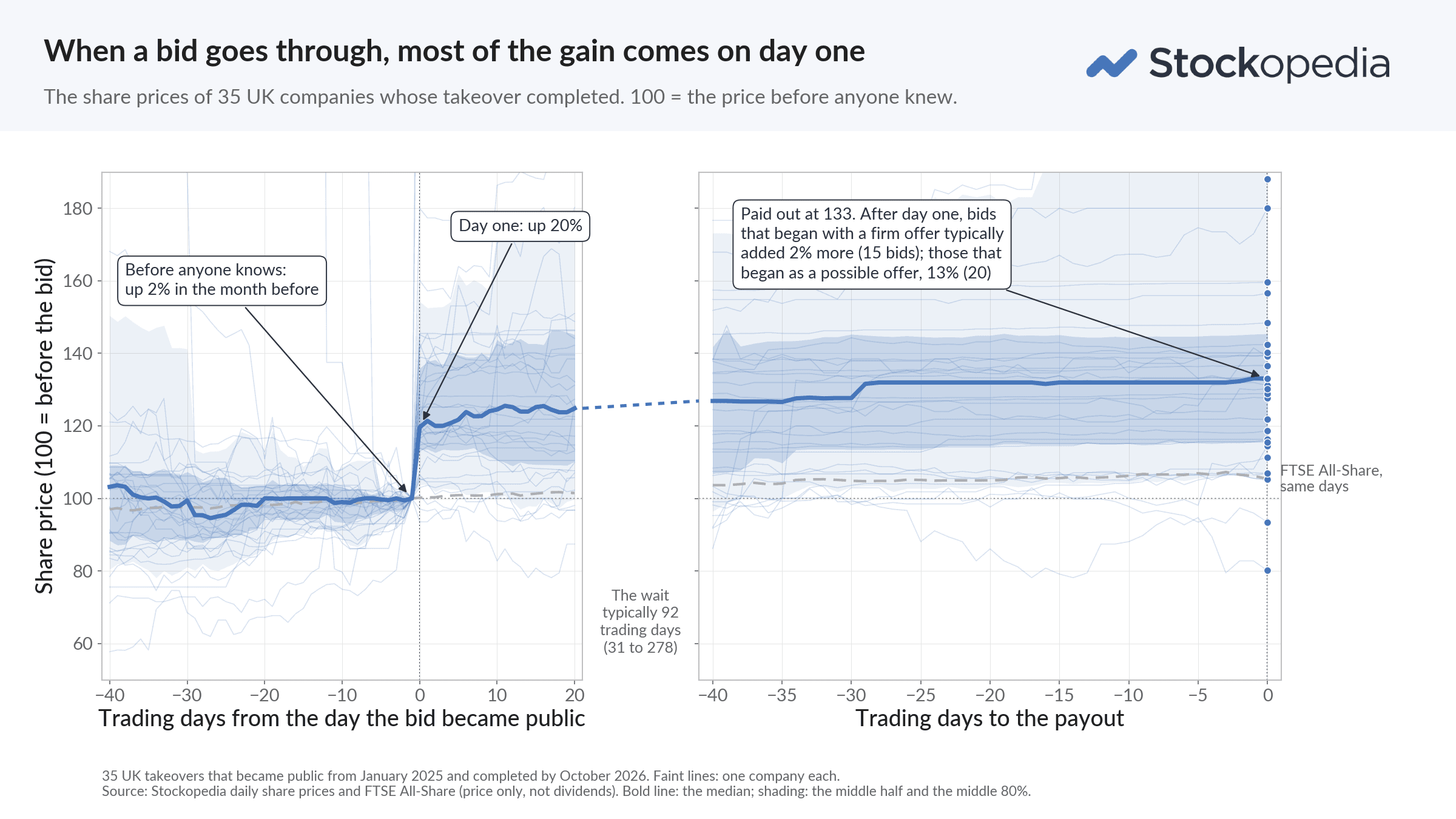
Once a firm offer is on the table, the shares are worth roughly what the bidder will pay, less something for the wait (like an interest rate) and the chance the deal fails. So they trade a little below the offer, and the gap is the market's view of the deal.
A wide gap means doubt. easyJet traded about 10% below Castlelake's proposed £6.90 in July 2026, which Graham read as "some level of uncertainty as to when and if the takeover might proceed".
A price above the offer means hope of more. Bodycote traded at 950p against the 940p offer, and Graham saw "every chance of a slightly higher bid".
Deliveroo shows the typical shape. The shares rose 22% when it confirmed DoorDash's approach in April 2025, and sat about 5% below the 180p proposed. Once the offer went firm, the gap roughly halved, and the shares crept up towards 180p over the five months it took regulators to approve the deal.
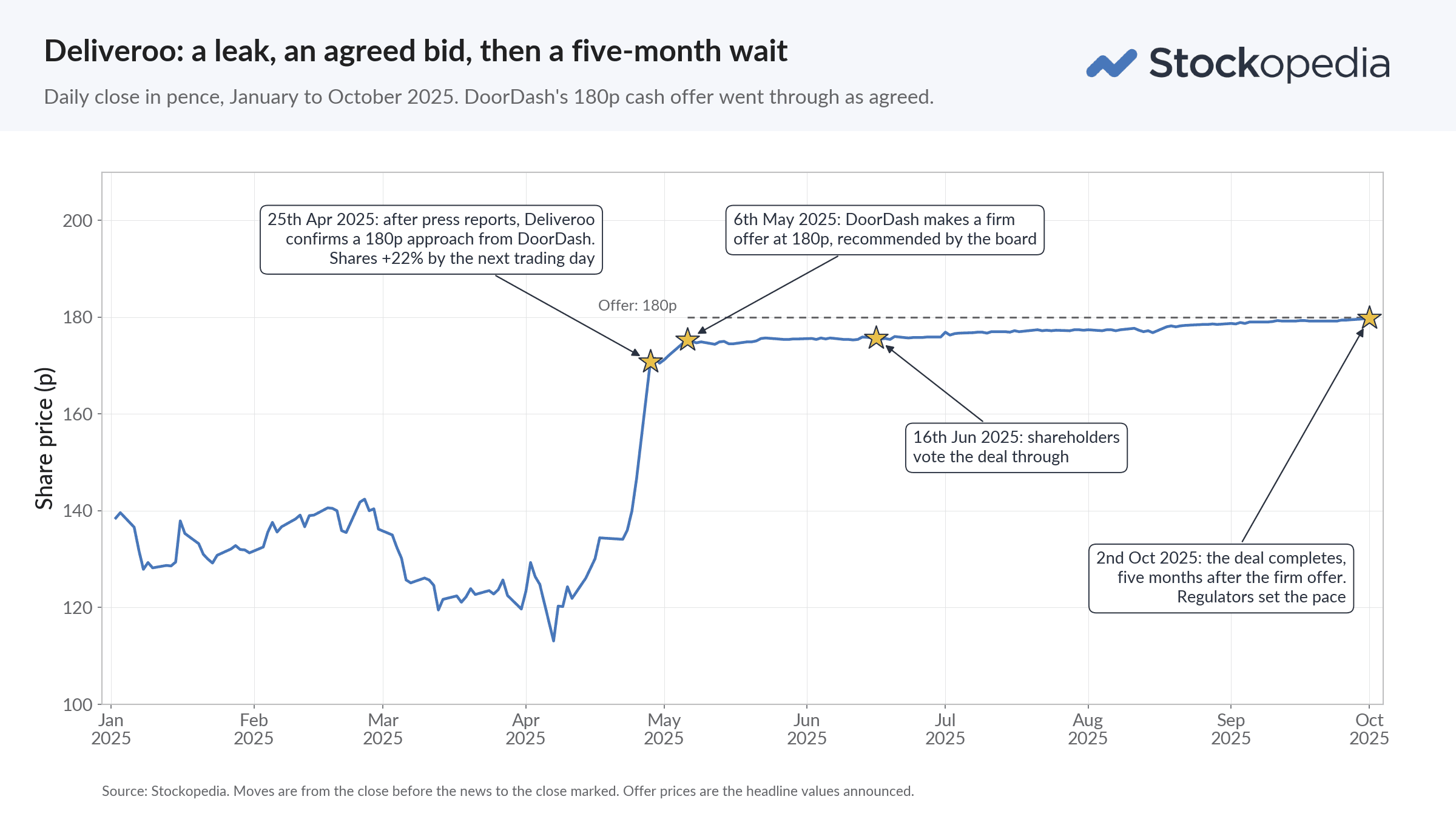
The wait can be longer than most holders expect. In our data, a completed bid typically paid out about four months after it became public, and the slowest took more than a year. Regulators, not shareholders, usually set the pace, and every firm offer names a long-stop date by which it lapses if the approvals haven't come.
Once a firm offer is in, the upside on a bid that completes is usually small. The question is whether the gap pays you for the wait and the risk. If you are selling your shares in this window, it’s usually M&A arbitrageurs (often hedge funds) that are buying from you. They use leverage to gear up the available return and use their research to minimise failures.
Whether a bid completes shows up in the small print
Start with who has signed up. Big holders often sign irrevocable undertakings, promises made in advance to accept or vote in favour, and every directors' undertaking we read held even against a higher rival bid. The more of the shareholder register locked in, the likelier the deal and the smaller the chance of a rival bidder. At Schroders in February 2026, undertakings of over 42% of the shares meant, in Graham's words, "the deal should be a shoe-in".
Then look for rivals. Spectris had four recommended offers from two private-equity firms in 2025, and the price climbed with each one. Advent opened at £37.63, and KKR won with £41.47 in cash plus a 28p dividend. In the last days of the contest, the shares traded above KKR's final cash offer, on hope of more. Once Advent dropped out, they fell back to about 3% below it.
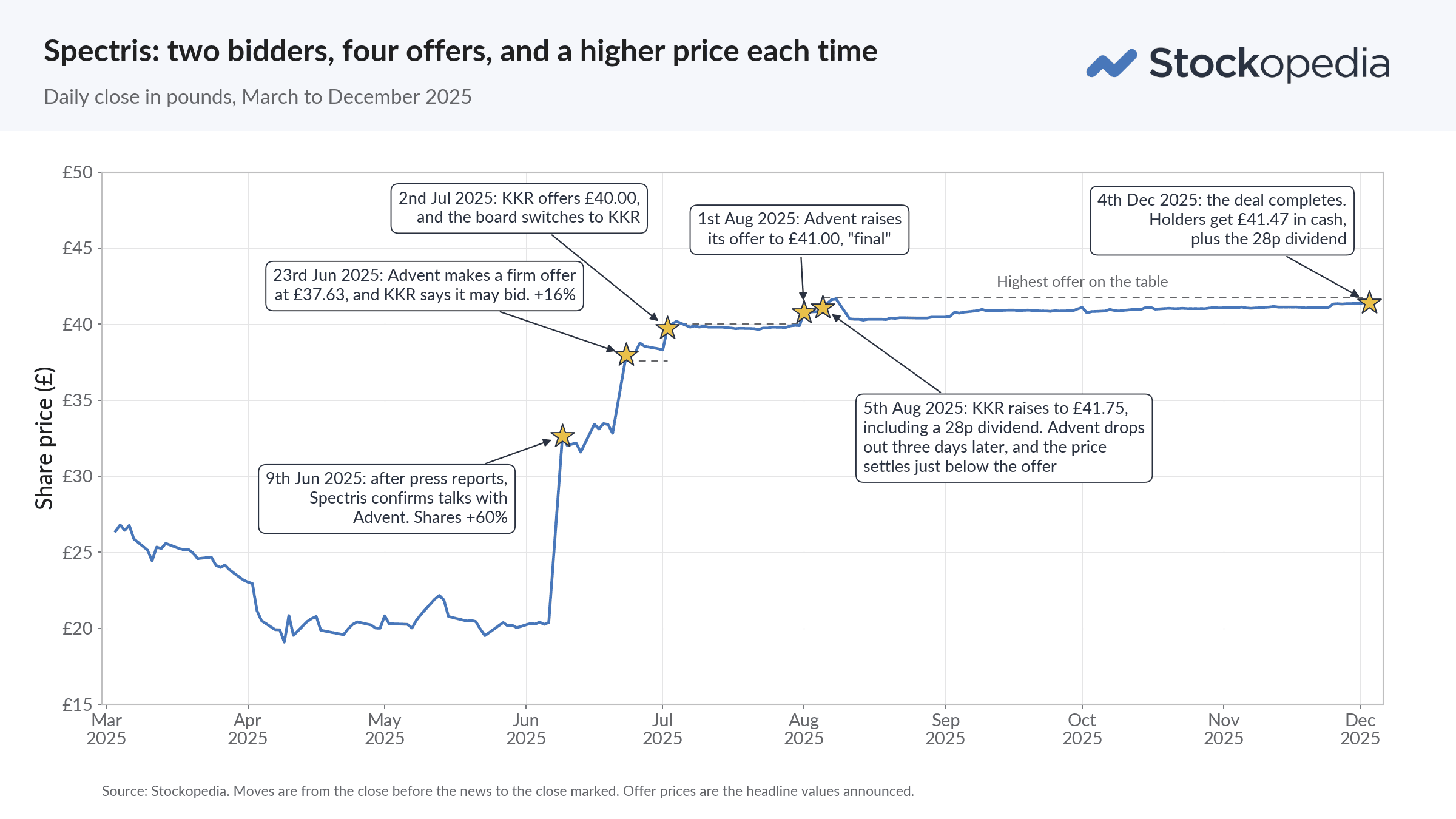
A bidder that calls its offer "final" can't raise it, but every "final" offer we read kept the right to go higher if a rival bid came in. Shareholders can push back too - Alliance Pharma's meetings were adjourned in 2025 after holders objected.
And bids do fail. We haven't found a UK study of what happens to a share when a bid falls through, so we measured it. In the 19 failed bids in the same time period, the shares typically jumped 18% when the bid became public, and had slipped back to 13% above their old price by the day before it failed. On the day, they fell another 6%. Six months on, the typical one was 7% above where it started, a little behind the FTSE All-Share over the same days. The range was wide: of the 15 with six months of prices, 7 were below their price before the bid. Nineteen bids is a small sample, so treat these figures as a guide.
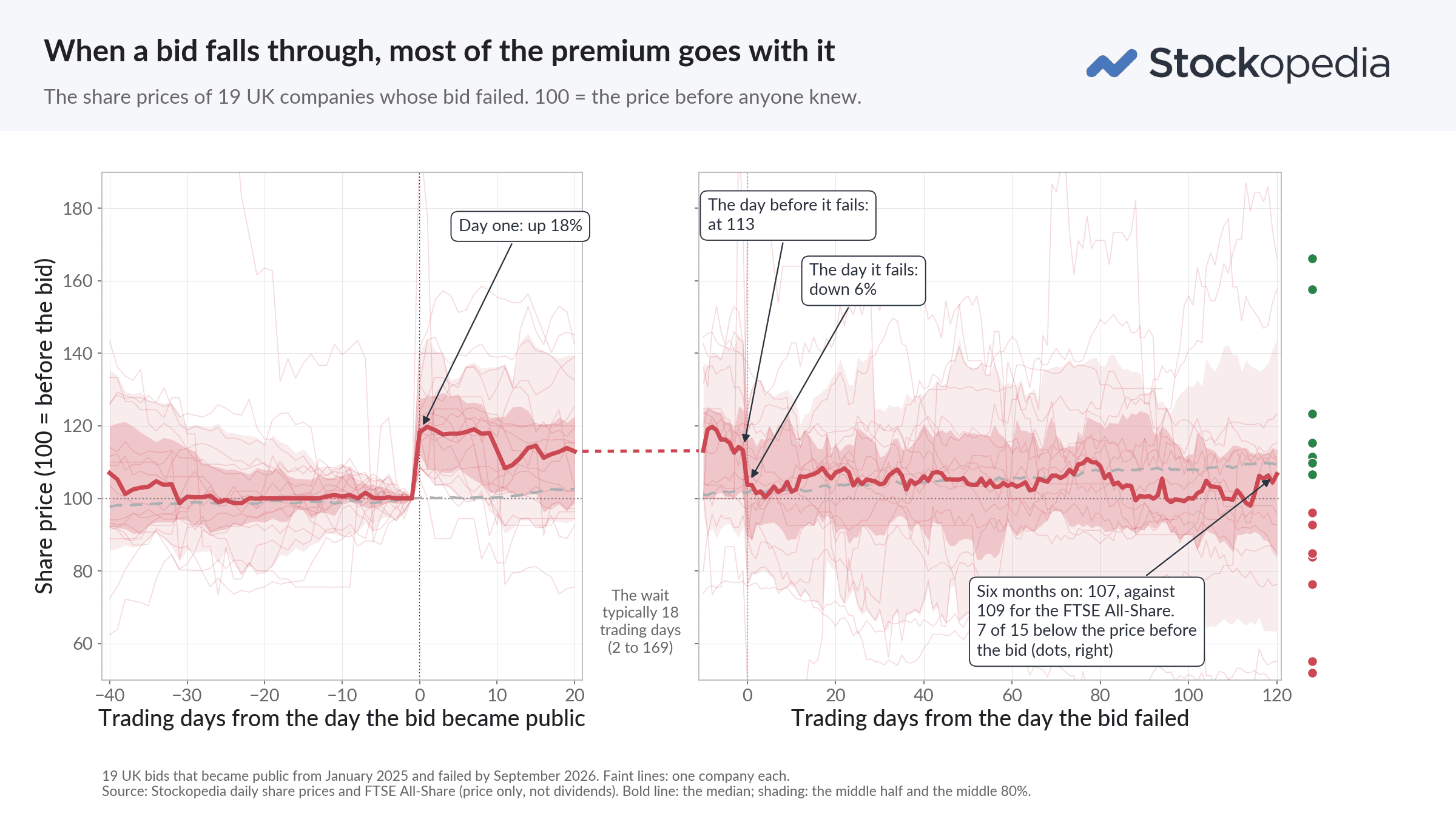
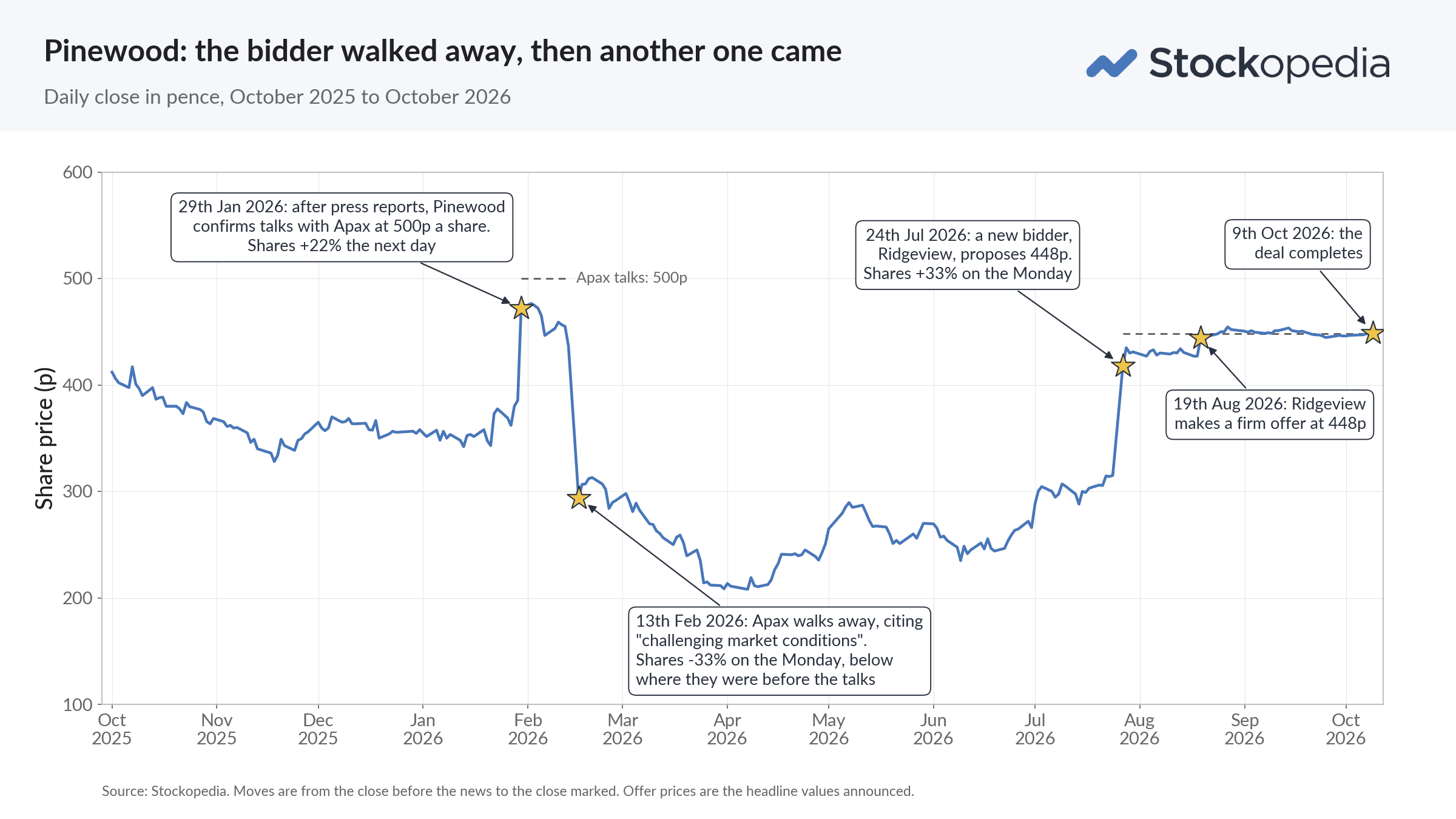
The cases show how far apart the endings can be. Checkit fell 29% in September 2026 when its sale process ended. Pinewood Technologies fell 33% in February 2026 when Apax walked away from talks at 500p a share, which left the shares below where they had been before the talks. Holders who sat tight were paid in the end, but only because a second bidder, Ridgeview, came along five months later and paid 448p.
What to do comes with two potential regrets
Watch your instincts as a bid tempts you to hold out.
Mark Simpson, who co-writes our daily report, frames a shareholder’s choice as two regrets: selling and then seeing a higher bid, against holding on and seeing the bid fail. In the cases we've covered, they haven't cost the same.
Our data puts numbers on this. Once a firm offer was in, waiting for completion typically added about 2% to the price. But a failed bid was typically about a tenth below its day-one price six months later, and nearly half ended below where they started. Pinewood's holders came out ahead only because another bidder turned up.
Once a firm offer is in, selling early has tended to cost a little. Holding a bid that fails can cost a lot, and getting it back has depended on someone else wanting the company.
Two more instincts are worth catching. One is "it's worth more than this", from holders who bought higher. Sometimes it is, and pushing back worked at Alliance Pharma. But the bidder is pricing the business as it is today, and if it walks away, the market often will too.
The other is treating the gap below the offer as free money. Specialist M&A arbitrage funds collect it across many deals, so that one failure doesn't sink them. A private investor holding one bid carries the whole risk, and Mark's view is blunt: "In general, this is not a game that suits the individual investor."
Selling, waiting and voting each rest on something different
Graham held his International Personal Finance (IPF) shares through months of extended deadlines in 2025, and said why in our daily report: "I personally don't mind if this bid fails and if I therefore get to continue holding my IPF shares." That is the question that settles most of what follows: would you be happy to keep holding the shares if the bid failed?
If it's only a possible offer
Nothing is committed yet, and nobody publishes how many possible offers become firm. When bids failed in our data, they typically did so less than four weeks after becoming public. But when a possible offer did become firm and complete, the shares typically rose another 13% from their day-one price. Deliveroo's became a firm offer 11 days after it was confirmed. Pinewood's talks ended after 15 days, and the shares fell below where they had started. Until the offer is firm, the price carries both outcomes, so the gap below a possible offer is wider. Graham's question matters most here, because the bid failing is a real possibility.
Selling in the market now, or waiting
Selling locks in most of the premium, avoids the risk that the deal fails, but gives up any higher bid. But you do receive the money now: the completed bids in our data typically took about four months to pay out, which is potentially an opportunity cost. Waiting relies on the deal completing, or on a rival coming. If your answer to the above question is yes, it costs little: if the bid fails, you keep a share you wanted. If it's no, the small gap may not pay for the risk.
Voting
Most bids are schemes of arrangement, approved by a court: 51 of the 60 firm offers in the Panel's latest year. A scheme needs a majority by number of the holders who vote, and those votes must carry 75% by value of the shares voted. That isn't "75% of the shares", as many guides say. Once the court approves it, it binds every holder, including those who voted against. Very few registered holders vote: only 37 did at Deliveroo's court meeting. Most private investors hold through a platform's nominee, which counts as one holder however many customers sit behind it. Your instruction still counts by value, so make your vote count via your platform.
If you do nothing
In a scheme, you're paid without lifting a finger. In a contractual offer, where each holder chooses whether to accept, it depends how many do. At 90% of the shares it's bidding for, the bidder can buy out the rest on the same terms. Short of that, you can be left a minority holder in a company the bidder controls, and from 75% it can usually take the company off the market. Inspecs's bidder stopped at 68.5% in 2026, leaving what Mark called "a listed company controlled by a failed acquirer".
Some bids offer unlisted shares in the buyer instead of cash. These can't be held in an ISA, and the board's adviser may not vouch for them: at Loungers it was "unable to advise" on the alternative. A cash bid inside an ISA stays in the ISA, free of capital gains tax; for share offers, GOV.UK sets out the tax.
Our view, on the evidence: once a firm, recommended cash offer is in, most of the reward is already in the price. The case for waiting rests on a rival bid, or on being content to keep the shares if the bid fails. Without either, there is little to gain from sitting through the months to completion.
How you should respond
Work out which stage you're at. A possible offer may never become a bid, and if it doesn't, the shares can fall below where they started. A firm offer is committed, but still conditional.
Recalculate the premium from the last price before anyone knew, leaving out dividends.
Read who has signed up, and what still has to happen: the vote, the regulators, the long-stop date.
Ask yourself Graham's question. Would you be happy holding the shares if the bid failed?
Check your wrapper and your platform's deadline. Know whether it's a scheme or an offer, whether any share alternative can sit in your ISA, and when your platform needs your instruction.
You can bank the jump today. What you're deciding is whether what's left is worth risking it for.
From the Daily Stock Market Report. Every bid we cover is flagged TAKEOVER, and Graham and the team read each one the morning it lands: the real premium, whether it's likely to complete, and whether a better offer may come. Read today's report · Sign up to our newsletters
Questions readers ask
What does "minded to recommend" mean?
The board would back a firm offer at that price, but hasn't committed to it. easyJet was minded to recommend Castlelake in July 2026, then recommended Apollo's higher offer a month later. A "formal sale process" is different again: the company has put itself up for sale, with no deadline and possibly no named buyer.
What are all the "Form 8.3" announcements?
During a bid, anyone with 1% or more of the company, private investors included, must disclose their position, then each trade by 3.30pm the next business day. The filings show who owns the shares, not whether the bid will succeed. A Form 8.3 is different from a director's dealing, which our directors' dealings guide explains.
Will I still get the dividend?
It depends on the announcement. Some bids let you keep a named dividend on top of the offer, as Beazley's did. Others cut the price by any dividend paid, as Spectris's bidder reserved the right to do.
Where to go next
More in this series: How to interpret directors' dealings · How the UK's stock markets compare · How to read a UK trading statement · The Ultimate Guide to Reading Company Announcements