What to do when a company beats expectations

A company you own has just said trading is ahead of expectations, or raised its profit guidance, and the shares have jumped at the open. It is good news, but it leaves you with a decision. Take the profit, hold on, or buy more? And how do you know whether the rise has further to go? When we studied UK trading statements, we found that positive news, and a big jump on the day was often the start of a further move that ran for months. Not always, but more often than not. This page explains why good news tends to keep working its way into the price, how to tell a strong beat from a weak one, and what to weigh before you act.
An "ahead" statement means the forecasts were too low
If you've read our guide to UK trading statements, you'll know the key message comes in one of two forms. A company either says profit will be "ahead of market expectations," (meaning the analysts' consensus) or it raises its own guidance to the market. Both say the same thing: this year or next is looking stronger than previously assumed. Either current trading is going well, or the company is already winning orders that will lift next year's profits.
That matters because forecasts will have to rise. Over the following days and weeks, the professional analysts who cover the company raise their earnings forecasts, and the share price often ratchets upwards to stay up with them.
Good news is governed by the same stock exchange rules as bad news - so a listed company is forced to announce anything materially likely to move its share price as soon as it can. While most trading statements are published at 7am, it's not uncommon to see some in the middle of the afternoon. For example, microcap Aeorema published "Further Material Upgrade to FY2026 Expectations" at 1pm on 15 September 2026.
The stronger the words, the bigger the reaction
When companies announce good news, you can learn a lot from the language. At the top end, the words in front of "ahead of expectations" can matter more than it seems. Companies and their advisers choose these carefully, because the market will interpret them accordingly.
When we tracked every UK trading statement and set of results from the start of 2025, the stronger the word, the further the shares jumped. Nine months later, statements that said "significantly", "substantially" or "materially ahead" had left share prices 15% ahead of the FTSE All-Share on average. A plain "ahead" left them 10% higher, and "slightly" or "modestly ahead" 4%. The chart shows the whole scale, down to "significantly below".
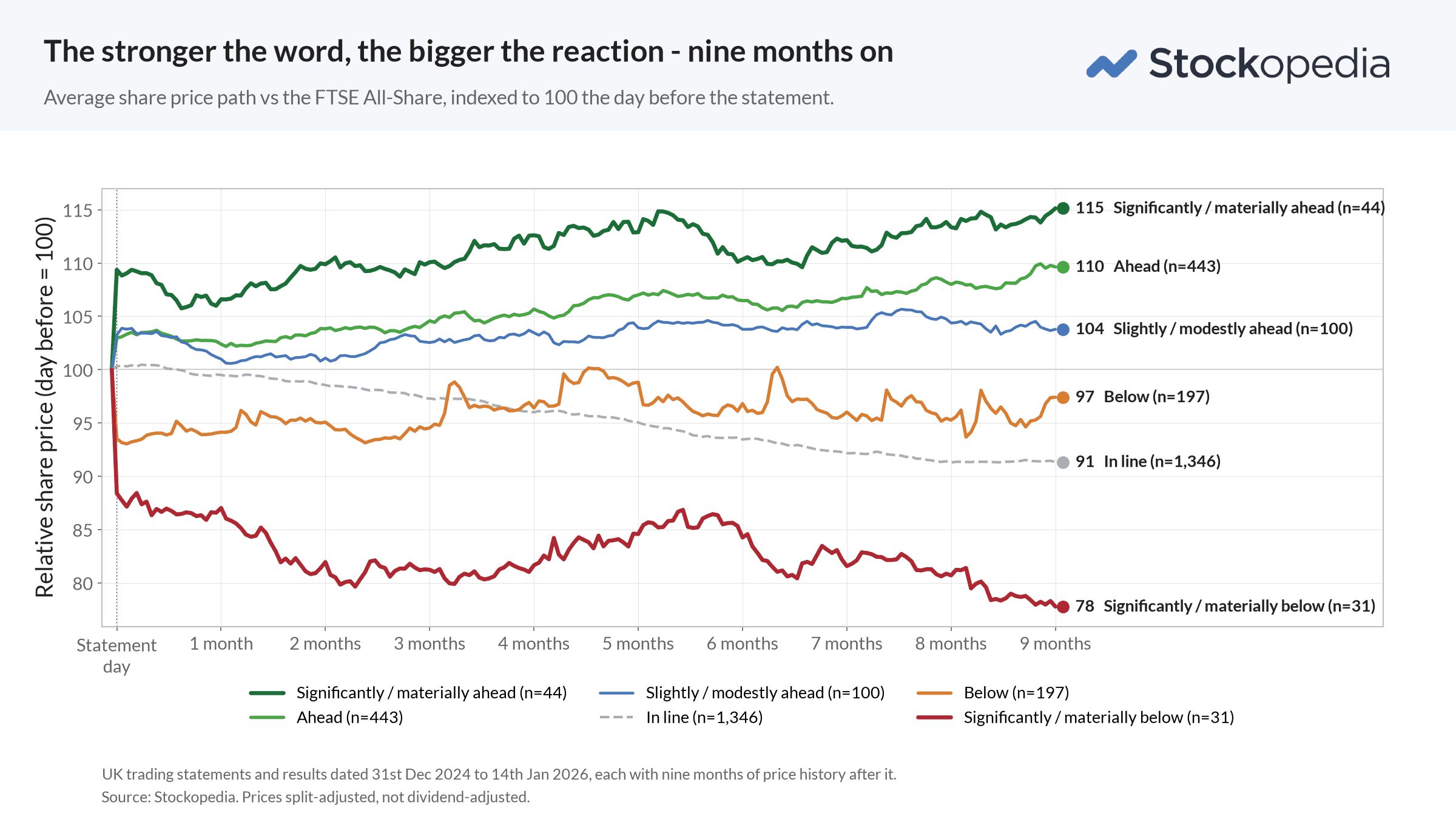
Two phrases near the top are worth reading slowly. "At the top end of market expectations", as Kier put it on 21 July 2026, is still inside the range the analysts forecast, so it may not lift their numbers much. "At least in line", Property Franchise Group's wording on 4 December 2025, leaves room for a beat without promising one.
Companies can also raise their profit guidance. We found that larger companies were more likely to use clear guidance on profits and revenues, than use language comparing results to expectations. We found that companies that increase their profit guidance, into a range 7% or more above previous guidance, were likely to create a similar share price jump as those using direct “expectations” language.
A beat is only as good as what stands behind it
Rather than just relying on the headline, it’s essential to look at what produced it. A beat that comes from the whole business improving is worth more than one that rests on a single contract or a helpful adjustment.
Kromek, which makes radiation detectors, reported results in September 2025 significantly ahead of expectations: revenue up 37% to £26.5m, and a £3.1m profit after a loss the year before. The shares more than doubled. Much of the improvement came from one $37.5m contract with Siemens Healthineers, though, with up to 90% of its revenue booked within a year. A contract like that does little for the year after, and from their January high the shares gave back more than 20%.... and eventually it all.
Adjusted figures need the same care. When The Works said in May 2025 that it was trading ahead of expectations, the shares jumped. Mark Simpson, who co-writes our daily report, looked closer:
"The recent ahead-of-expectations statement for FY25 was based on adjusting out the cost of dealing with some online delivery issues … Including the impact of these would have led to them missing the EPS forecast."
Mark Simpson, Seven Splendid Turnaround Stocks, 29 May 2025
Taking out a genuine one-off cost can be fair. Check which costs went, and whether they are likely to come back.
A big jump on the day is often the start of the move
This is the most useful thing we have found about ahead statements: the size of the share price jump on the day can tell you more about what comes next than the words do.
What our data shows. After "ahead" statements between January 2025 and April 2026, shares that rose 15% or more on the day went on to beat the FTSE All-Share by a further 9% on average over the next six months. A rise of 5% to 15% was followed by 4%, and a smaller rise by 2%. In-line statements trailed the market by 5%. These are averages, the biggest jumps are the smallest group (59 statements), and individual shares varied widely. Our earlier study, of 2,699 statements up to January 2025, found the same pattern on a different measure.
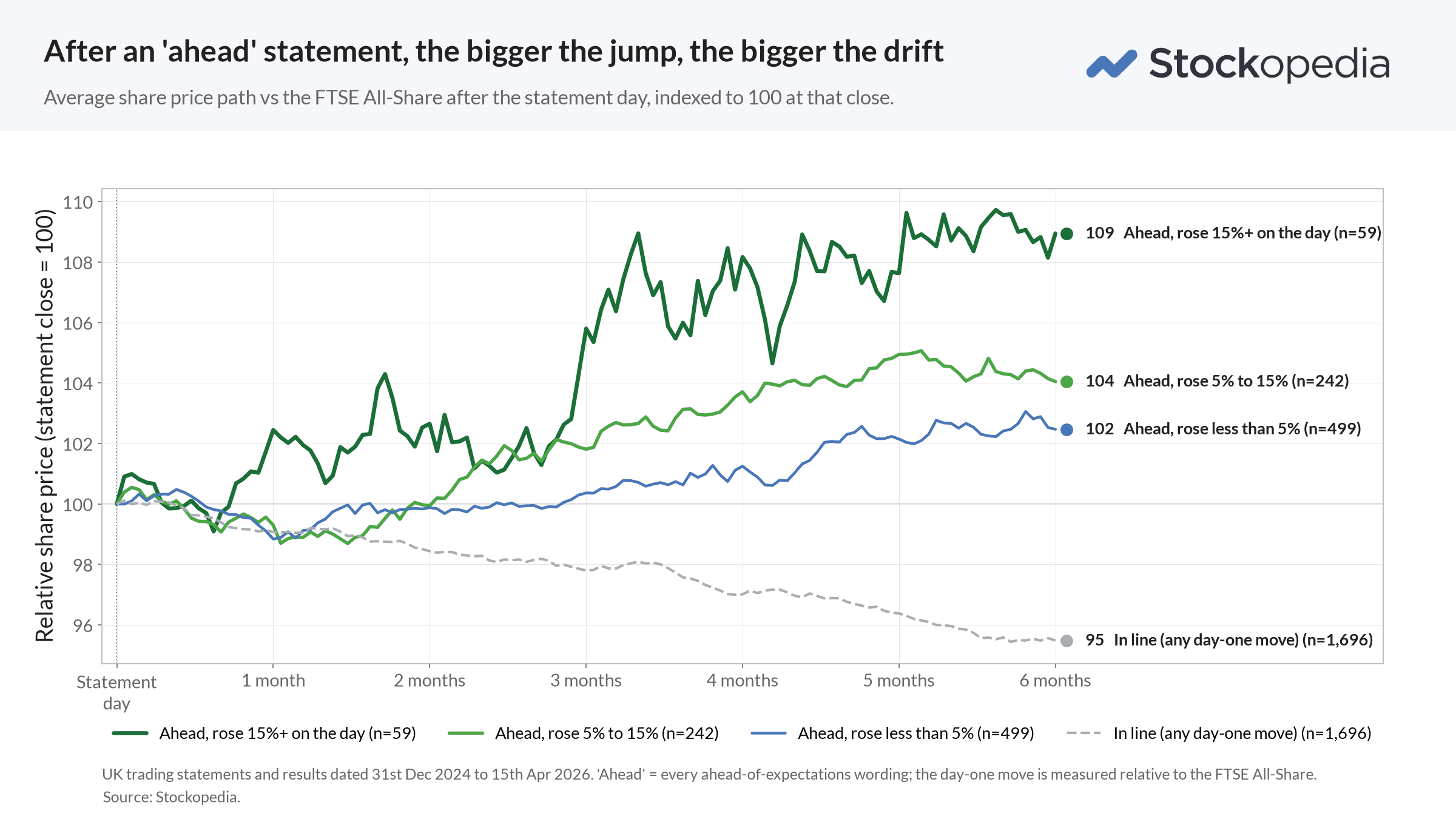
Why would good news take months to reach the price? Partly because analysts move in steps. An analyst who has published a forecast rarely believes their own numbers were badly wrong, so after a beat they nudge their inputs just part of the way, and are forced to again after the next one. Investors are slow too, and many wait for the full results before they buy. In smaller companies, where only one or two analysts follow the shares, the catch-up can take months.
This isn't only our finding. Academics call it post-earnings announcement drift: after a positive surprise, the share price tends to keep moving in the same direction. Ray Ball and Philip Brown first documented it in 1968, and fifty years later it is still at the centre of academic research. It’s known as one of the most persistent anomalies in finance - the market doesn’t price these events efficiently.
The research also finds the drift strongest in smaller, less-traded shares (Chordia and others, 2009). Those are the shares big funds struggle to buy in any size, and that is where a private investor, dealing in small amounts, has the advantage. It isn't completely free money: the same study found trading costs in those shares can eat into the gains, and the effect has weakened in larger shares as more investors have learned of it.
If you see a company’s shares jump after only an “in-line” statement - it’s often an indicator that the true market expectations were far lower. It’s a giveaway that the market is too negative about a share - and it can sometimes signal a turning point.
Good news in big companies often does far less. When the Bank of England looked at statements from large UK companies between 1994 and 1998, positive ones moved shares by about 1% on the day on average. The drift we found belongs to smaller-cap shares that jump the hardest.
Good news tends to come in runs
One beat can lead to another, because forecasts that were too low last time are sometimes still too low. Looking back over ten years of statements, about one in three companies that said "significantly ahead" followed it with another positive statement, and about one in four after a plain "ahead". The next one came about 110 days later on average, well before the next set of results.
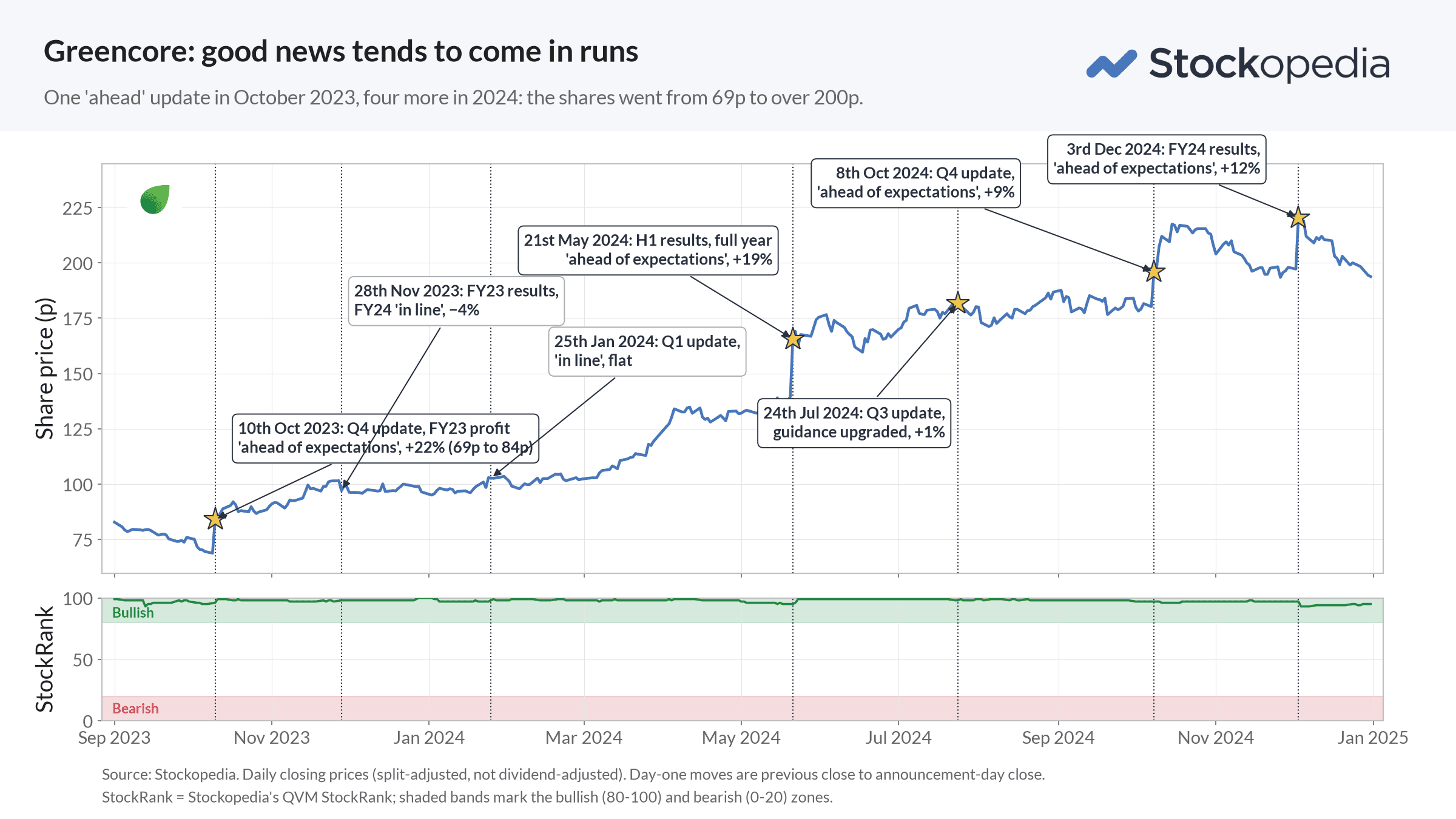
Greencore shows what a run looks like. In October 2023 the convenience-food maker said profit would be "ahead of current market expectations", and the shares jumped 22%, from 69p to 84p. Two in-line updates followed, and the shares kept drifting higher. Then came four more pieces of good news in 2024: "ahead" in May, raised guidance in July, and "ahead" again in October and December. Fourteen months after the first, the shares were at 211p.
Our research on more recent announcements points the same way. Shares with a Momentum Rank above 80, meaning their price and forecasts were already rising, delivered good news 39% of the time, against 19% for the rest.
Streaks do end, though, when prices get ahead of themselves due to profit taking. Of the 106 UK companies with a StockRank above 80 when they first beat expectations in 2026, Morgan Sindall and Peel Hunt were each down by around a fifth by September, despite beating more than once.
When the market expected good news, "ahead" can disappoint
A beat moves the price only if it changes what the market thought. When investors have come to expect good news, a company can say "ahead" and still fall. Tesco did on 8 January 2026 Graham Neary, who writes our daily report:
"The market didn't like this "ahead" update, marking the shares down by 6% on the day, as investors apparently expected even better from this retail giant."
Graham Neary, Post-Christmas Retail Review, 22 January 2026
Mark has made the same point about companies that always beat. Investors come to expect it and bid the price up further than the upgrades justify, then get caught out when the company only meets expectations, or warns. If it warns, read what happens to a share after a profit warning.
Your instincts could pull you the wrong way
Most investors are quicker to sell a share that has risen than one that has fallen. After a jump, banking the gain feels sensible, and plenty of holders do it that morning. People who don't yet own the shares feel the opposite pull. They remember the price before the news, paying 15% more feels like a mistake, and they wait for a fall that often doesn't come. Between the two, there is too little buying after good news, which is part of why the price takes months to catch up.
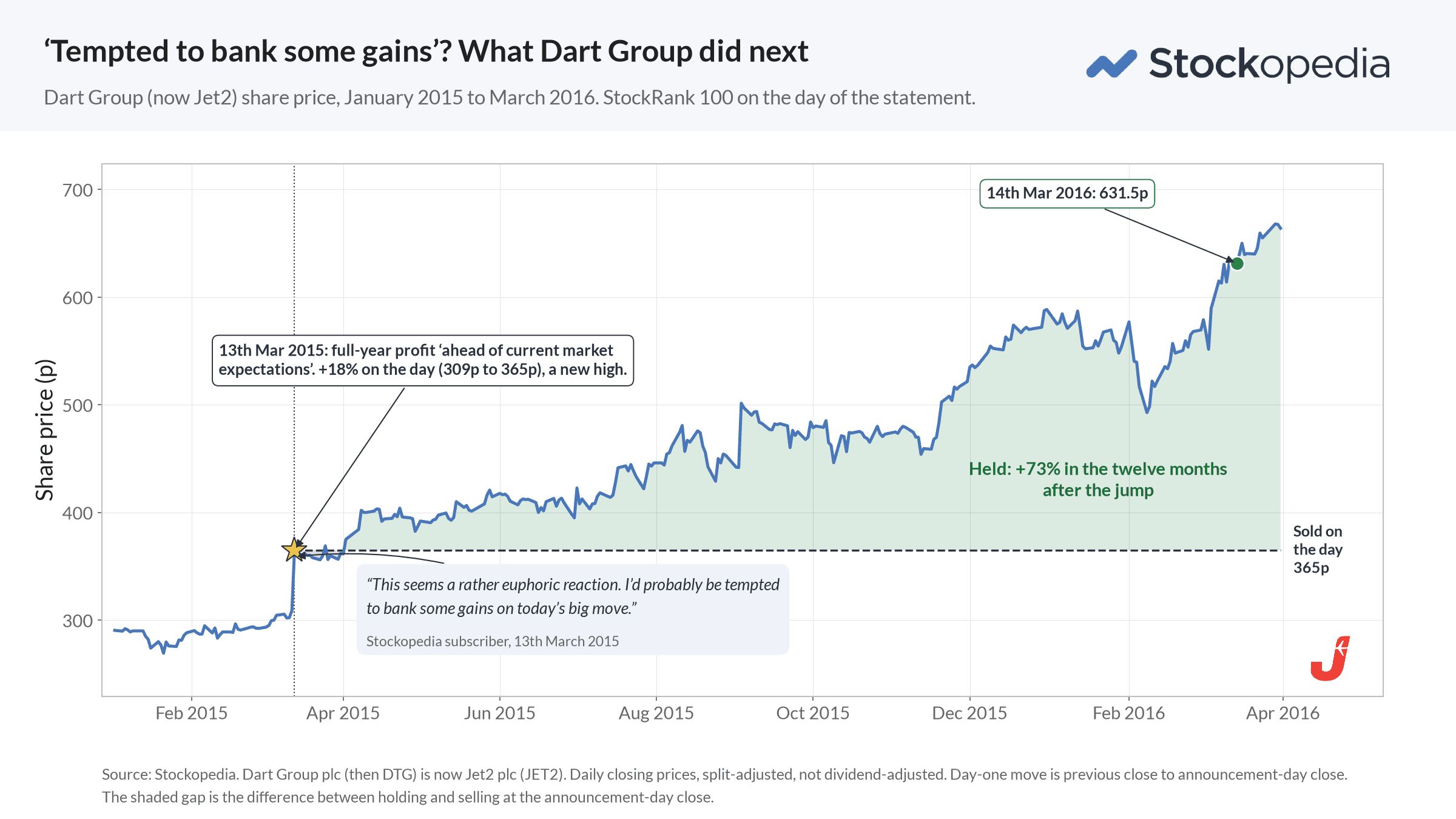
Jet2 shows how strong that pull can be. In March 2015, when it was called Dart Group, it was the only share in the UK with a StockRank of 100. It said it would be "ahead of expectations" for the year, and the shares rose 18% to a new high. The mood among our subscribers that day was to take the profit. One wrote:
"This seems a rather euphoric reaction. I'd probably be tempted to bank some gains on today's big move up."
Twelve months later the shares were 73% higher, and Dart became one of the ten biggest multibaggers of the decade.
It wasn't a one-off. When we looked back at the biggest multibaggers in the UK market, many of their runs began with a string of "ahead of expectations" statements. Games Workshop, Judges Scientific and more. These are all reasons not to dismiss a share just because it has already jumped.
What to weigh before you act
No rule tells you whether to buy, sell or hold after good news. These are the questions that matter most:
What is the surprise made of? Is the whole company impacted, or is it a one-off?
How strong is the word, and whose expectations has it beaten?
How big was the jump on the day?
Is this the first beat, or the latest in a run the market now expects?
Are the analysts raising their forecasts? The consensus on the StockReport shows which way they are moving.
Does it change your own reason for owning the shares?
Our evidence describes averages across many shares over six months. Any single share can go either way, which is why your answers to these questions matter.
From the Daily Stock Market Report. Every weekday morning Graham and the team read the trading statements as they land and pick out the companies running ahead of expectations. Read today's report · Sign up to our newsletters
Questions readers ask
Does good news have to be announced, like a profit warning?
Yes. A listed company must announce anything likely to move its share price as soon as possible, and that covers good news as well as bad.
Is raising guidance the same as being "ahead of expectations"?
It is the same message in a different form. "Ahead" grades the year against the analysts' forecasts; raised guidance gives the company's own higher number. Our 2026 research counts both as good news.
Have I missed it if the shares have already jumped?
Not necessarily. In our study, the shares that jumped hardest on an "ahead" statement went on to beat the market by a further 9% over the next six months, on average. Of course averages can be deceptive - many didn't, which is why the questions above matter.
Where to go next
More in this series: How to read a UK trading statement · What to do on a profit warning · The StockRanks explained · The Ultimate Guide to Reading Company Announcements