How to interpret directors' dealings

A notice headed "Director/PDMR Shareholding" has just appeared on a share you own. Someone on the board has bought or sold, and the obvious question is whether they know something you don't. Often the notice means very little - share awards, tax sales and paperwork all go out under the same headline as a real open-market trade. But when a director buys on the open market with their own money, especially in an undervalued small-cap, it is an extremely useful investment signal. UK studies going back to the late 1980s found that director buys were followed by better share price returns, but that director sales were less reliable. The advantage is small, but it tells you where to look. Copying every director who buys doesn't work - the one UK study that included dealing costs found the edge negligible - which is why it pays to know the full picture. This article shows you how to interpret directors’ deals, and how to spot the ones worth noticing.
Why do directors have to notify the market when they trade?
Directors are allowed to own and trade shares in the companies they run. What they can't do is trade quietly. Every director, and every senior manager with regular access to inside information, must report their own deals in the company's shares. So must their spouse or partner, their dependent children and any company or trust they control. The rules call the first group PDMRs, "persons discharging managerial responsibilities", and the second "persons closely associated".
Nobody knows a business better than the people running it, so the rest of the market is entitled to see when they put money in or take it out. Under the UK Market Abuse Regulation (MAR), a director has three working days to tell the company and the FCA, and the company then has two working days to publish. So you can hear about a deal up to five working days late. Reporting starts once a person's deals in a calendar year reach €5,000.
There is one hard limit. Directors can't deal in the 30 days before their company's half-year or annual results, and AIM companies add their own dealing rules on top (AIM Rule 21). A director may buy or sell lawfully, as long as they aren't trading on news the market doesn't have. Trading on inside information is a crime.
So directors who want to buy usually wait until results are out. TruFin's chief executive started buying on the third working day after his company's interim results in September 2026. By then he knew nothing the market didn't. What he had was a far better feel for what those numbers meant, and he backed it with his own money. That judgement is what you are reading. It isn't secret news.
Not the same thing. A "Holding(s) in Company" notice means someone's stake has crossed 3%, 4%, 5% or another percentage line. It is usually a fund manager or a bank, and it carries no price. During a bid you'll also see "Form 8" disclosures, which our takeover bids guide explains.
Many of these notices are pay, tax or paperwork
Every deal goes out under the same headline, on the same form, whether a director has spent £170,000 of their own money or been handed shares as pay. So the first job is to work out which you are looking at. It takes about a minute, once you know where to look.
Here is a real one. TruFin, a small AIM-listed finance company, published this on 23 September 2026. Every notice follows the same four-part form, and this is how TruFin filled it in:
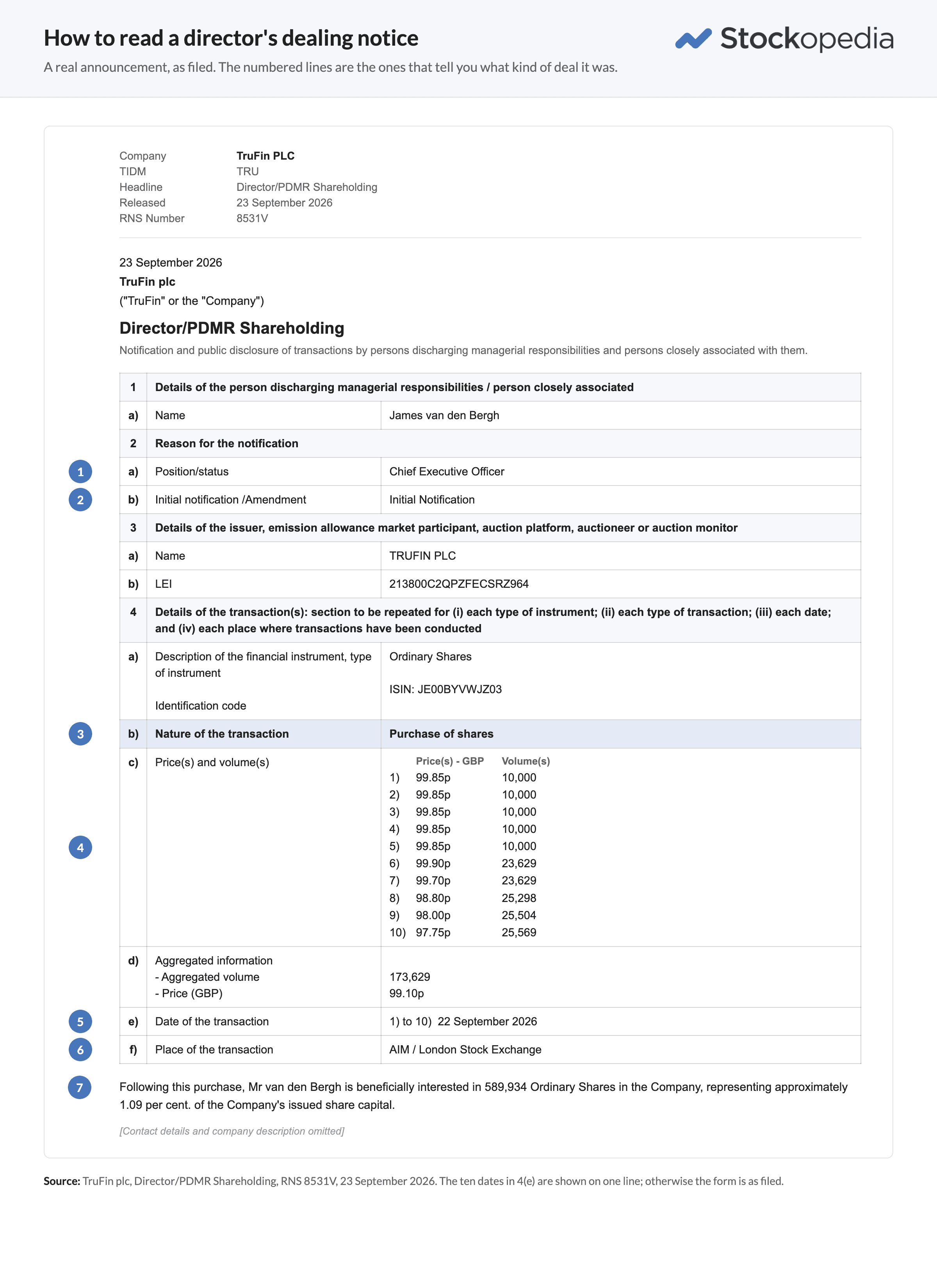
The line that tells you this was a real decision is ③, "Nature of the transaction". "Purchase of shares" means he bought. Had it mentioned options, an award, a share plan, a dividend or a transfer, it would describe something other than a choice to buy.
The rest confirms it. ① says who: the chief executive, not a junior manager. ② says this is the first notice of the deal; an "Amendment" corrects an earlier one, and the correction can change the story. ④ shows ten separate purchases at market prices, and the aggregated line beneath gives the total: 173,629 shares at an average of 99.10p, about £172,000 of his own money. A price of "Nil" here would mean no money changed hands. ⑤ is the trade date, three working days after TruFin's results. ⑥ is an exchange; "outside a trading venue" usually means an award, a gift or a transfer.
Then read the company's own words around the table. Many put a paragraph above it saying why the deal happened; TruFin put one below, at ⑦. It is often the only place you find the director's holding after the deal, because the official form has no line for it. Here it tells you the purchase took his stake to about 1.09% of the company.
The same headline covered very different things in other notices in 2026:
Shares received as pay, part sold for the tax. Jupiter's chief executive took up a share award and sold 48% of it, "sufficient to cover tax liabilities". That is close to the top rate of income tax plus National Insurance. The sale is the tax bill, but he kept the rest.
A monthly staff share plan. Grainger's chief executive and finance director each bought 87 shares out of their salary.
A bed-and-ISA. Conygar's chief executive and his wife sold 320,500 shares, and he bought 320,500 back the same day at the same 25.4p, inside an ISA and a pension. A screen counting sales would log a large insider sale. Nothing had changed.
Gifts and moves within a family. Oxford Instruments' chief executive passed shares to his wife "for nil consideration", and Hill & Smith's chair gave shares to charity.
One kind of notice isn't a trade but deserves a second look. When shares are put up as security for a loan, as a company connected to a Hargreaves Services director did in August 2026, the lender can force a sale whatever the director thinks they are worth. The Director Dealings table on each Stockopedia StockReport does much of this sorting for you, coding each deal by type.
A director's buy matters most when it increases skin in the game
Peter Lynch, who ran Fidelity's Magellan fund, made the case for watching directors in One Up on Wall Street. Insiders sell for all sorts of reasons, he wrote, "But there's only one reason that insiders buy: They think the stock price is undervalued and will eventually go up."
Think about what a buy asks of the director. Their salary, their bonus and usually a large shareholding already depend on the company doing well. Buying more puts even more of their wealth in the same place, with money they could have put anywhere else, and in full view of the market. Nobody does that unless they think the shares are worth more than the price.
So the bigger the buy against the director's own wealth, the more it says. Our analysts measure it that way. Mark Simpson, who co-writes our daily report, worked out in January 2025 that the finance director of Vianet had spent "1.6% of his FY24 total pay packet". Roland Head did the same at Craneware in July 2026, where the chief executive's pension had bought about £100,000 of shares. To most private investors that is a large sum. To the company's largest shareholder it was small:
"I'm less positive about this purchase than I'd normally be for a CEO buy. After all, the amount Neilson spent was around only one-tenth of his annual dividend income of c.£1m from Craneware."
Roland Head, Daily Stock Market Report, 20 July 2026
The holding the company adds to the notice and the directors' interests in the annual report give you what you need.
Who is buying matters too. A company's board is where the most sensitive news about its trading and finances is discussed, so the people at the board meetings see the most information. The investor Jim Slater put it plainly in The Zulu Principle:
"Particular note should be taken of buying by the chief executive and the financial director. They ought to know exactly what is happening within the business and it is always encouraging to see them putting their money where their mouth is."
Jim Slater, The Zulu Principle, preface to the 2008 edition
Several directors buying together tells you more than one buying a lot. UK studies found that buys by several directors (often called cluster buys) within a few weeks carried a stronger signal than a single large one. When three people reach the same conclusion with their own money, it is harder to put down to one person's optimism. Greencore shows what that looks like. When the convenience-food maker's shares fell sharply in late May 2026, the chair, a non-executive and an executive director all bought within days. The chair kept buying through June and July. Edward Sheldon, in our daily report on 13 October 2026:
"When the stock fell sharply in late May, a number of directors including the Chair stepped up to buy shares … This is bullish, in my view."
Edward Sheldon, Daily Stock Market Report, 13 October 2026
Our own 2025 study, The Smart Money Playbook, covered UK director trades from 2014 to 2024. It found the strongest results after the largest buys relative to the size of the company, and after buys by the chief executive or finance director.
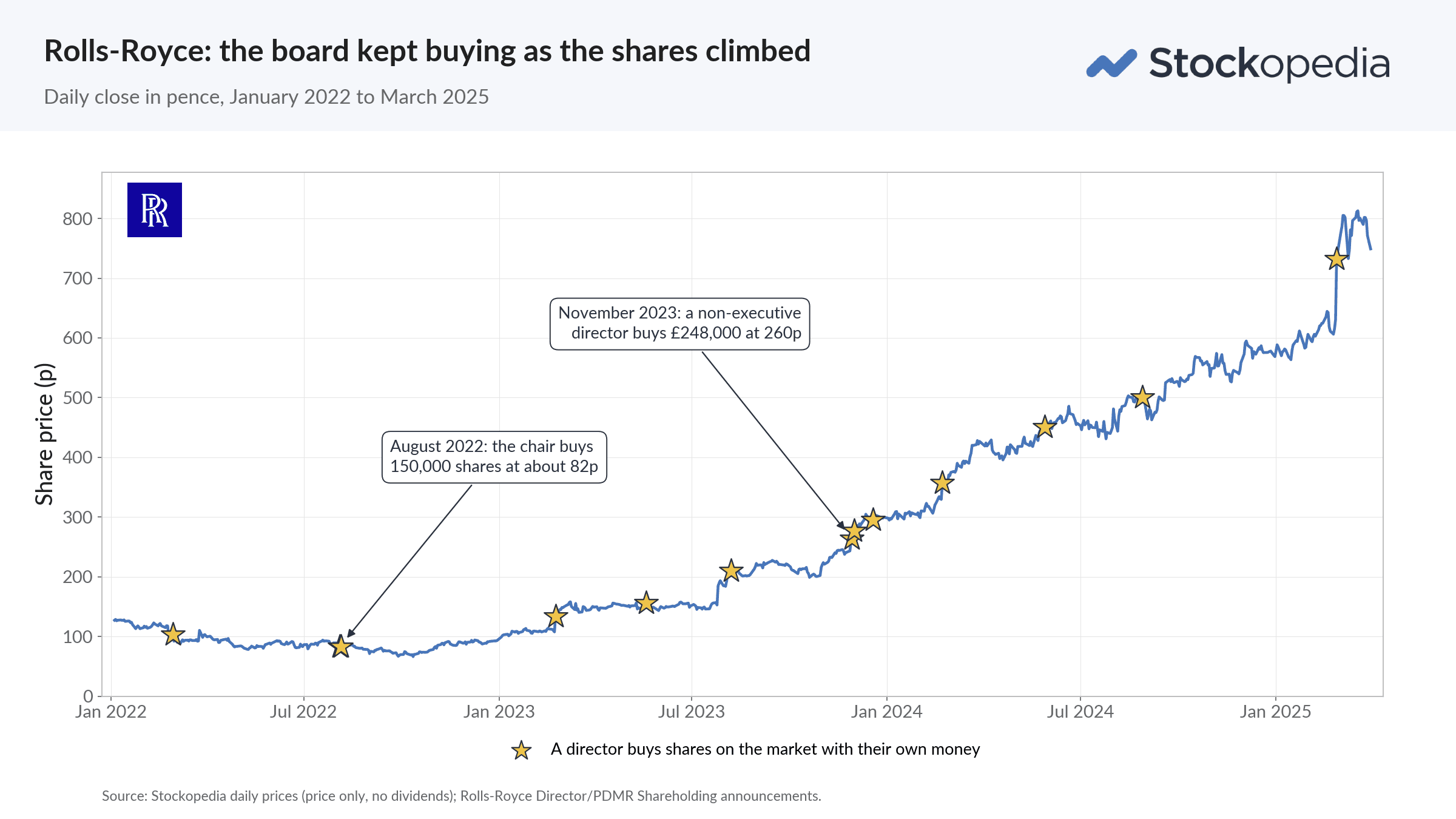
The case our study highlights is Rolls-Royce. Its directors began buying in the summer of 2022, with the shares around 100p, and kept buying at regular intervals. By the start of 2025 the shares were over 630p, more than five times the price, while the FTSE All-Share rose about 15%.
A sale usually tells you little, but a few tell you a lot
Much of a director's pay arrives in shares, so selling is the natural direction, and many sales have ordinary explanations. For example, some may sell due to a tax bill on a share award, as at Jupiter; or a director selling to buy a home or diversify their investments; or for retirement, as when Luceco's long-serving chief executive stepped down in 2026 and sold some of his shares. On its own, a sale tells you little. A large sale by the people running a weak business is a warning.
Finding the context can offer insights. When Lloyds' chief risk officer sold about £4.4m of shares in September 2026, the company added that he "continues to exceed the Group's shareholding policy requirements". Graham Neary, who writes our daily report, read sales by The Beauty Tech Group's chief executive and technology chief the same way on 9 October 2026, a year after the flotation:
"However, they will in aggregate continue to own 8% of the company, so I think their alignment remains very high."
Graham Neary, Daily Stock Market Report, 9 October 2026
A sale may be useful to interpret when it is a big share of what the director holds. Chemring's Michael Ord sold about 35% of his stake in August 2026 during a rally in the share price which then fell back 20%. It matters more when several directors sell, and more again when insiders sell alongside a share issue. Facilities by ADF is the case to remember. When the company raised money in August 2024, insiders sold £10m of their own shares at the same 50p. The business weakened, and the following May Graham wrote:
"Unfortunately it now looks as if that was the smart money."
Graham Neary, Daily Stock Market Report, 6 May 2025
The state of the business matters too. In our 2025 study, sales in companies with weak StockRanks, low on quality, value and momentum, were a much stronger warning than sales in general. The directors may be seeing trouble before the market does, or may simply have little faith in a turnaround. Sometimes, as we put it in the study, the selling signals "cash flow challenges or even an impending capital raise". In the sample we studied, nearly 60% of director sales in companies with weak quality, value and momentum were followed by a falling share price. A sale after a big run may say more about the price than the business.
A director's buy can tempt you into three mistakes
A director's buy is reassuring in a way few announcements are. Someone who knows the business inside out has looked at the valuation and said yes to concentrating more eggs in their basket. It may trigger investors to follow their instincts, which aren’t always smart.
"They know more than I do, so I can't go wrong." They do know more, which is why the notice matters. But they buy on a view of the business over years, while share prices can be very volatile. In March 2026 Roland noted that RS Group's chief executive had spent almost £1m on its shares at an average price of 729p. On the day he reported the price was 560p. Roland's view was to wait for "signs of positive momentum" before buying. A director can be right about the value and still early by a year.
"If the boss is buying, the bad news must be over." Directors tend to buy after bad news, when the shares look cheap to them. Craneware's chief executive bought straight after a profit warning, and Roland moved the shares down anyway. If your share has just warned, our profit warnings guide sets out what usually happens next. Poor momentum begets poor momentum. A director's buy doesn't change those odds on its own.
"A sale means they're getting out." More often it means a tax bill on shares they were awarded, or a stake still well above what the company requires. Sell every time a director does and you will sell a lot of good companies.
Use a director's buy as a reason to look harder, not a reason to act
On the evidence, an open-market buy by a director is worth noticing, and a weak reason on its own to buy the shares. The market often gets there first: many notices land at 7am, before trading opens, and the UK studies found much of the move came on the day of the announcement and the day after. Then costs eat what is left. The one UK test of copying directors after paying the dealing spread, on data from 1986 to 1994, found the extra returns "all but disappear".
So we treat a director's deal as evidence, never as a verdict. In our 2025 study we put it this way: use these signals "more as a confirming factor and in combination with others". That is why we read a director's buy alongside the StockRanks. A buy in a share that is cheap and already rising has more behind it than a buy in a share that is only cheap. Graham showed what that looks like in June 2025, when he raised his view of James Cropper by a notch. The directors' buys were small. What made them count was what sat beside them:
"It's a Super Stock and the Chair, the new CEO and a NED having bought small parcels of shares recently. I also note that the PBT forecast was revised upwards after the most recent trading update."
Graham Neary, Daily Stock Market Report, 9 June 2025
How you should use it
Our own rules for reading directors' dealings come down to five questions:
Is a director buying, rather than selling? Buys tell you more than sales. Check first that it is their own money, spent on the open market.
Are several directors buying at once? A cluster of buyers says more than one.
Is it the most senior people? The chief executive, the finance director, the chair.
Is it a recent, large trade, in a smaller company whose shares look cheap? Large means large against the director's own wealth.
If it's a sale, is the business weak? Sales in companies with poor fundamentals are the ones to take seriously.
Then set the answers against the rest of the evidence: the forecasts, the StockRanks, the last trading update. A director's deal is one well-informed person's opinion, backed with their own money. It deserves a look. It doesn't deserve the final say.
From the Daily Stock Market Report. When a director's deal matters to a company we cover, Graham and the team weigh it that morning against the stake, the pay and the rest of the news. Read today's report · Sign up to our newsletters
Questions readers ask
Can a director buy just before results?
No, not in the 30 days before half-year or annual results. The company can allow a deal in narrow cases, such as severe financial difficulty that forces a sale, or a staff share plan.
Isn't this insider dealing?
No. Insider dealing means trading on news the market doesn't have, and it's a crime. A director who deals outside the closed period and reports it is acting lawfully.
Why would a director buy only a few thousand pounds' worth?
It may be a token buy, partly for show, or part of a pay or fee arrangement. Measure it against their pay and their holding before reading anything into it.
Why doesn't the Stockopedia table match the announcement?
We group trades of the same type made within four weeks into one row, at an average price, and leave out trades under £1,000.
Where to go next
More in this series: What to do on a takeover bid · What to do on a profit warning · How the UK's stock markets compare · The StockRanks explained · The Ultimate Guide to Reading Company Announcements