How to read a UK trading statement

A company you own has put out a regulatory news announcement before the market opens. It mentions "market expectations" or a range for profit, and the share price is about to react. This is a trading statement: the company's own account of how its year is going, published before annual or interim results. Most announcements say trading is "in line" with expectations, but many come in "ahead" and some "below". Others give, raise or cut "guidance" about their revenues or profits. This article shows how to understand the language of trading statements, and how to interpret company guidance.
What a trading statement is, and why UK investors rely on them
A company listed on an American exchange usually reports results every quarter. In contrast, a company on the London Stock Exchange only has to publish two sets of figures a year, a half-year "interim" report and an annual report. Companies fill those long gaps in between with trading statements: short announcements saying how trading is going and whether the year is on course. Much of the news about profits arrives this way, months before the full numbers.
A British trading statement is the company's own judgement about a reporting period that hasn't finished, often against a benchmark it chose itself. So a trading statement can be read as management revealing what it can see inside the business before anyone else can: the contracts, the margins, the cash. Equity Analysts covering the company then raise or cut their earnings forecasts in the days that follow.
Most statements are planned, so an unplanned one is news
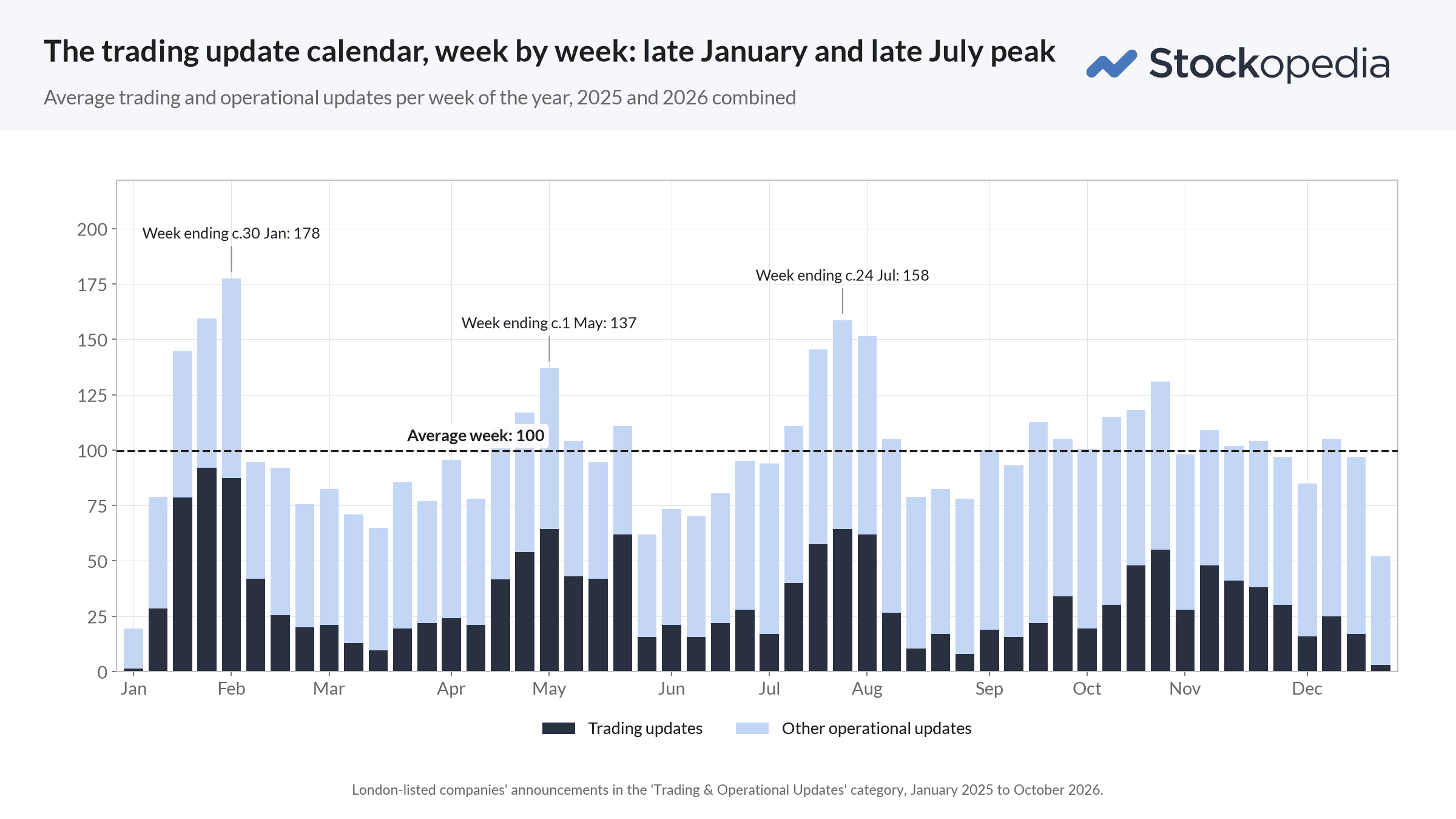
Most trading statements arrive on a calendar the company sets, and they come in waves. When we counted the filings in a typical year, January was the busiest month and July the second. January brings retailers' Christmas trading and an early read from companies whose year ends in December; July does the same for June year-ends. In between come annual-meeting, quarterly and pre-close updates. Our guide to the UK reporting seasons maps the whole year.
None of these scheduled updates is compulsory. What is compulsory comes from the UK Market Abuse Regulation (MAR). A company must announce inside information as soon as possible: news that is precise, not yet public, and that a reasonable investor would use in deciding whether to buy or sell. The FCA, the City regulator, has said there is no fixed threshold, such as a 10% gap from forecasts, that sets off the duty (technical note). MAR Article 17 lets a company delay only in narrow cases, and it must keep the news secret while it does.
So an unscheduled statement is a signal in itself. A company speaking out of turn is telling you trading has moved far enough to matter, and it can do so at any hour. Mark Simpson, who co-writes our daily report, called Vertu Motors' February 2025 announcement "a nasty intraday profits warning".
The obligation is the same on AIM - LSE's junior market. You may find differences shown in the footer of a news story, which names an AIM company's nominated adviser, and in the footnotes, as AIM companies tend to have fewer analysts covering them.
Every trading statement has a similar shape
Some trading statements are a couple of paragraphs long, while others run to pages. A short one can carry good news or bad. What rarely varies is the shape. Here is an illustrative statement for a fictional company, built from wording real companies used in 2025 and 2026:
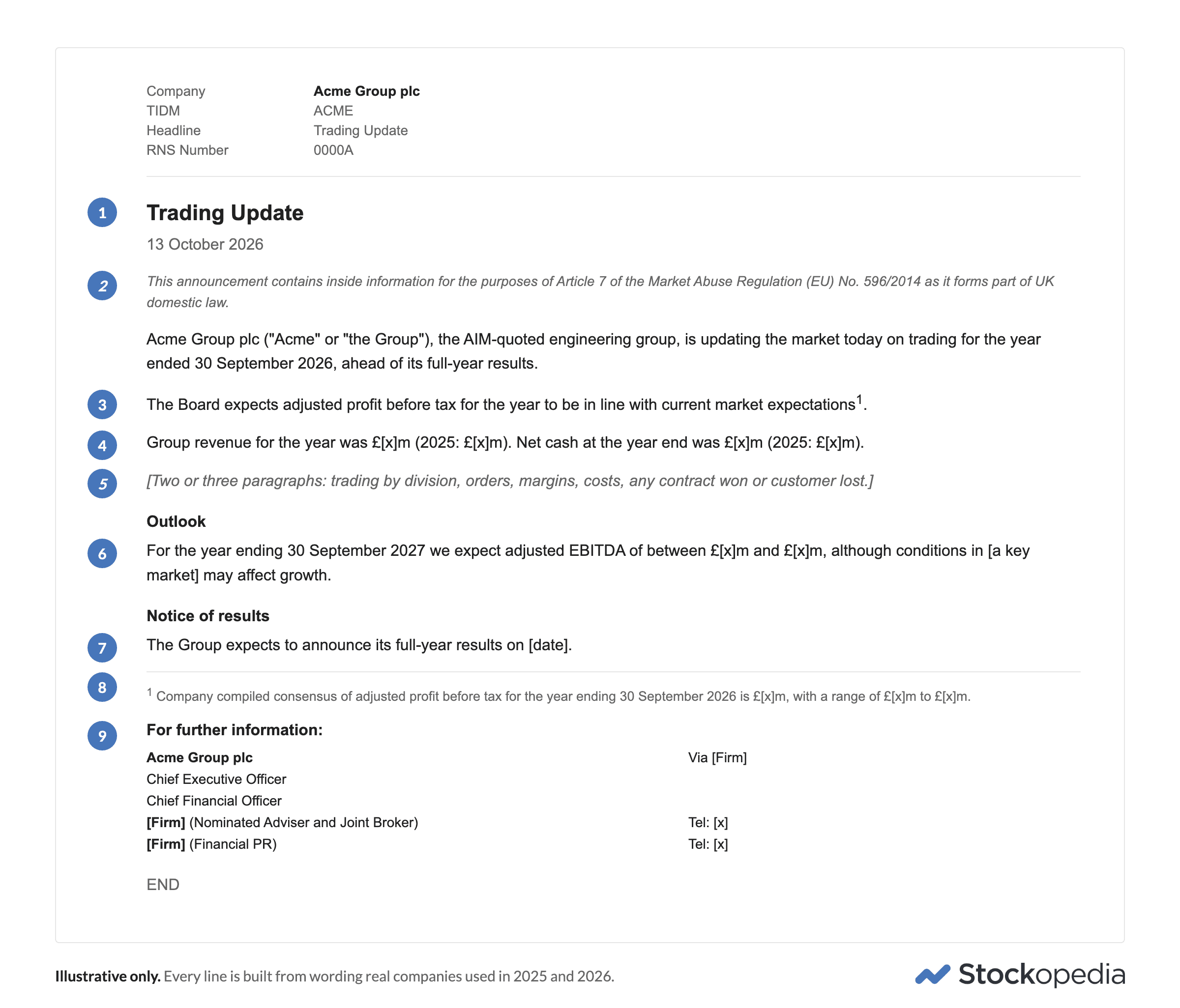
It's normal for the top to carry the key message, though not always in the headline. Many companies head the announcement simply "Trading Update" ①, as Acme does; others put the news there, as Genus did with "FY26 Trading Update – Ahead of expectations".
The inside-information line ② is the company's own judgement that MAR applies. Acme's key message is ③: profit in line with market expectations. It could easily have shared an accompanying number, and while these statements usually sit in the opening paragraphs, it's not unusual to find them in the outlook statement at the end.
The middle ④ ⑤ is the evidence: sales, orders, margins, cash. This is where you can gain some clarity about the company's recent operations, and validate where the guidance has or has not been earned.
The bottom is where awkward news is often buried. Acme's outlook ⑥ gives guidance for next year, its own forecast, with a caution attached, and that can matter more to the share price than the line at the top. The footnote ⑧ often tells you how the company has defined "market expectations". The footer ⑨ also names who stood behind the statement: on AIM, the nominated adviser and the house broker, the firm the company pays to look after its shares.
What to look for: the key message, then the outlook, then the detail
The reading order that gets you to the truth fastest is not necessarily by reading top to bottom:
Scan for the key trading message and any supporting numbers. Is it measured against the analysts’ consensus forecasts, the board's budget, earlier guidance or last year? "Well ahead of last year" is just growth.
For which years, and by what measure? A company can be in line this year and in trouble next, or in line on earnings per share while operating profit falls short, as SSP Group was in October 2026.
What's the outlook? Jump to the end before reading the middle.
The detail. Does it support the message?
What has changed since last time? Wetherspoon went from "slightly below market expectations" in May 2026 to "likely to be below" in July. That drift is often the real news.
The second step can catch some people, because the share price tends to discount the future - a year or two ahead. On 12 October 2026 ActiveOps said its current year was in line. The next sentence said the following year would be "significantly below market expectations". The shares fell by almost half that morning. Graham Neary, in our daily report that day:
"It's definitely the combination of the major customer loss and the reduction in new business activity that has resulted in today's enormous sell-off."
Graham Neary, Daily Stock Market Report, 12 October 2026
From the Daily Stock Market Report. Every weekday morning Graham and the team read the trading statements as they land and set out what has really changed. Read today's report · Sign up to our newsletters
Smaller companies tend to grade themselves, and larger ones give numbers
The key message often comes in two main forms.
Language: Many companies, especially smaller ones, grade the year against “expectations”: ahead of, in line with or below.
Numbers: Larger companies more often publish clear guidance numbers: their own forecast, usually with a range.
Currys said in January 2026 that profit would be £180m to £190m, "ahead of consensus expectations". B&M said the same month that it now expected adjusted EBITDA of £440m to £475m, against previous guidance of £470m to £520m. Next simply raised its number, by £25m to £1,243m. Games Workshop gave only a floor in May 2026: profit "not less than £265 million".
Check which profit is meant, as companies often guide on more than one. EBITDA is earnings before interest, tax, depreciation and amortisation, the most flattering version which many equity investors are sceptical of. Operating profit (or EBIT) comes after depreciation, pre-tax profit is after interest, and earnings per share is what is left for each share once tax is paid. RentGuarantor's October 2026 update put revenue "materially above" market expectations and EBITDA and net profit "materially ahead". When the measures disagree, the one nearer earnings per share usually tells you more as a shareholder.
Oil and mining companies may skip profit altogether. BP's quarterly trading statement and Anglo American's production report often give volumes, costs and guidance ranges, graded against nothing. A cut to production guidance can be the whole warning.
Keep two upgrades apart: the company raising its own guidance, and analysts raising forecasts afterwards. The second kind moves the consensus.
And some language only sounds like guidance. If a company says it looks forward to "profitable growth", the worst thing to do here is assume that the company is profitable. See here for Five Ways That Trading Statements Deceive.
The words run on a scale, and most statements sit in the middle
When defining expectations, the words run from the strongest positives down:
"significantly", "materially" or "substantially ahead of market expectations"
"ahead", sometimes softened to "modestly", "slightly" or "marginally ahead"
"at the top end of market expectations"
"in line with market expectations"
"broadly in line", or "towards the lower end of the range"
"slightly below", then "below"
"significantly" or "materially below"
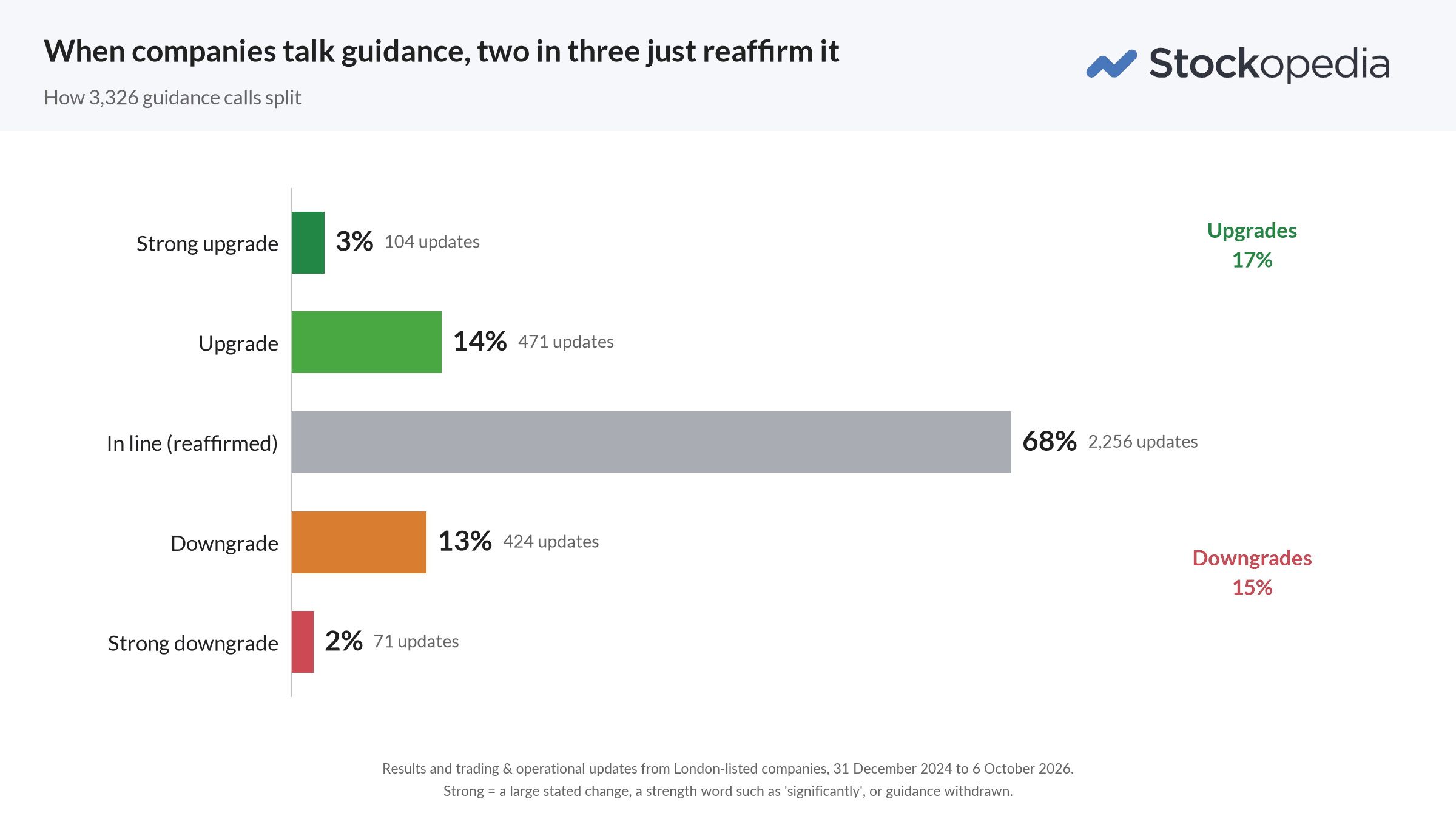
In line is where most land, and on its own it rarely moves a share much. What moves it is what the market had feared or hoped. Hollywood Bowl was in line on 7 October 2026 after a weak run, and closed nearly 4% higher. AEP Plantations was in line five days later and fell about a tenth; its outlook warned of El Niño. The price had formed a view, and the statement moved it only by changing those expectations.
"Market expectations" means whatever the company says it means
In principle, market expectations is the consensus: the average forecast of the analysts who follow the company. A small company may have one or two forecasts, often from its own house broker. Nanoco's August 2026 update measured itself against forecasts "as prepared by Cavendish", its corporate broker. "The Board's expectations" is different again: an internal budget that nobody on the outside may have seen - so check previous announcements.
Find where the company sets out the bar, because it is the line most readers skip. Often it is a footnote; sometimes it is a sentence in the body, and sometimes there is nothing beyond the phrase itself. MJ Gleeson shows why it matters. In June 2026 the housebuilder warned that profit would fall well short of market expectations, which its footnote put at £17.8m. A month later its headline said the year had "concluded in line with market expectations". The footnote now said £10.1m. "In line" meant in line with a bar the company's own warning had lowered.
When a company gives a number, set it against the consensus first and its own last guidance second. Mortgage Advice Bureau said in September 2026 that profit would be about £38.0m: "This compares with current market consensus of £43.4m". That was a miss, stated in numbers. Check, too, how old the consensus is and which year it covers.
What happens next depends on which way the news went
What the share price does next depends on whether the company beat the bar or missed it. For a beat or a guidance upgrade, read our explainer article about "What to do when a company beats expectations", for a miss or a guidance cut, read “What to do on a profit warning”.
Questions readers ask
Why do some updates give sales but not profit?
Quarterly updates often report sales only, with a line saying full-year guidance is unchanged.
Does "This announcement contains inside information" mean big news?
Sometimes but not necessarily. It is the company's own judgement, and the regulator thinks it is overused.
Where do I find market expectations if the statement doesn't say?
The Stockopedia StockReports show the broker consensus and its trend. Free small-company research, on sites such as research-tree.com, is useful but can occasionally be paid for by the company it covers and be labelled as marketing.
Where to go next
More in this series: What to do when a company beats expectations · What to do on a profit warning · How the UK's stock markets compare · Understanding UK reporting seasons · The Ultimate Guide to Reading Company Announcements