
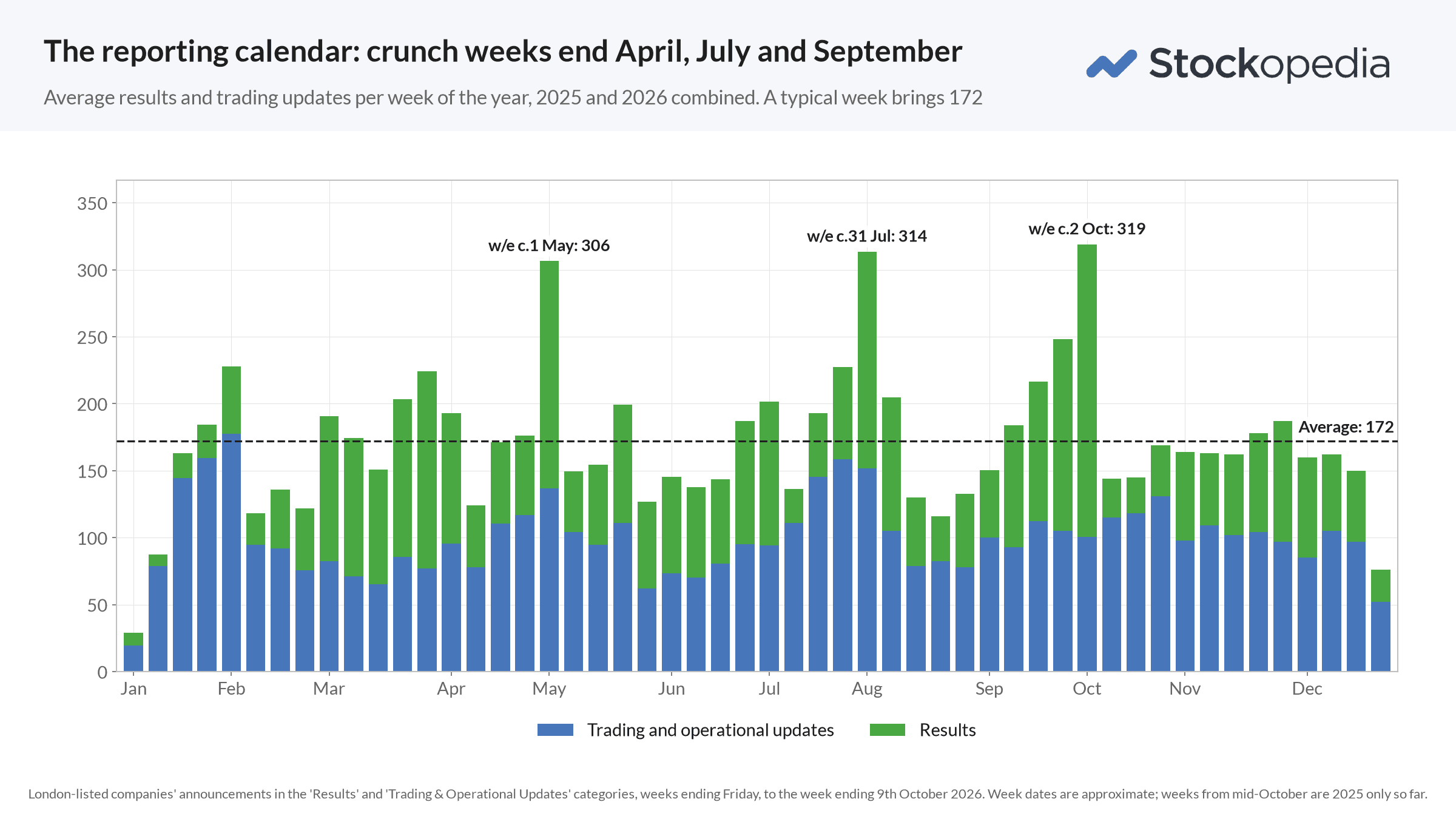
UK companies report on a calendar set by two things: when their financial year ends, and which market they're listed on. Main Market companies must publish full-year results within four months of their year end and AIM companies within six, and both must publish half-year results within three months. Because most companies end their year on 31 December, the news arrives in waves. March is the busiest month for full-year results, September is the busiest month for results of any kind, and three crunch weeks stand out: those ending around 1 May, 31 July and 2 October. If you know the rhythm, you know when news flow will be heaviest, and when the market is most likely to move on fresh fundamentals rather than noise.
Our analysts have read UK company results and trading statements every working day for more than a decade, and the patterns in this guide are what that reading, and our count of every results and trading announcement from London-listed companies in 2025 and 2026, show.
This guide walks through the reporting year so you can plan your research around it, rather than being caught flat-footed by a flood of announcements you didn't see coming.
Why the calendar matters
UK-listed companies face different reporting deadlines depending on where they're listed.
Main Market companies (under the FCA's Disclosure Guidance and Transparency Rules):
Full-year results must be published within four months of the financial year end
Half-year (interim) results must be published within three months of the half-year point
AIM companies (under the AIM Rules for Companies):
Full-year results must be published within six months of the financial year end (AIM Rule 19)
Half-year reports must be published within three months of the half-year point (AIM Rule 18), the same as the Main Market
This two-month difference for AIM annual results matters. An AIM company with a December year end has until the end of June to publish its annual report, whereas a Main Market company with the same year end must report by the end of April. So AIM annuals form a second wave that runs about two months behind the Main Market's, and it shapes several of the peaks in the charts below.
On top of formal results, companies issue trading updates: shorter, less formal statements on how trading is going between results. Some are scheduled, such as pre-close updates. Others are forced by trading moving far from what the market expects, because the Market Abuse Regulation (MAR) requires a company to announce price-sensitive news as soon as possible. That rule levels the playing field for investors, and it gives us a steady stream of market-moving "ahead of expectations" (beats) and "below expectations" (profit warning) announcements.
The result is a year that isn't evenly spread. It clusters into peaks and troughs, driven by two interlocking factors: the financial year ends companies choose (most pick 31 December, the next largest group picks 31 March, and a meaningful minority pick 30 June or 30 September), and whether they're listed on the Main Market or AIM. Each combination cascades into a different reporting window, and once you see the pattern, the year's structure becomes obvious.
The shape of the year
The chart below shows how many results (green) and trading and operational updates (blue) London-listed companies publish in each week of the year. A typical week brings 172. Three crunch weeks stand out, each driven by a reporting deadline: the weeks ending around 1 May (306), 31 July (314) and 2 October (319). Let's walk through the year.
January: the Christmas trading window
The year opens with one of the most-watched moments in the UK calendar. From the second week of January to early February, consumer-facing companies issue Christmas trading updates covering the crucial festive period.
Names you'll see reporting in this window include Next, Marks & Spencer, JD Sports, Greggs, B&M, Tesco, Sainsbury's, Currys, and most other large retailers and hospitality groups. Because Christmas can make or break the year for these businesses, the updates carry significant weight. A strong trading statement can re-rate a share price by 10-20% in a day; a profit warning can do the same in reverse.
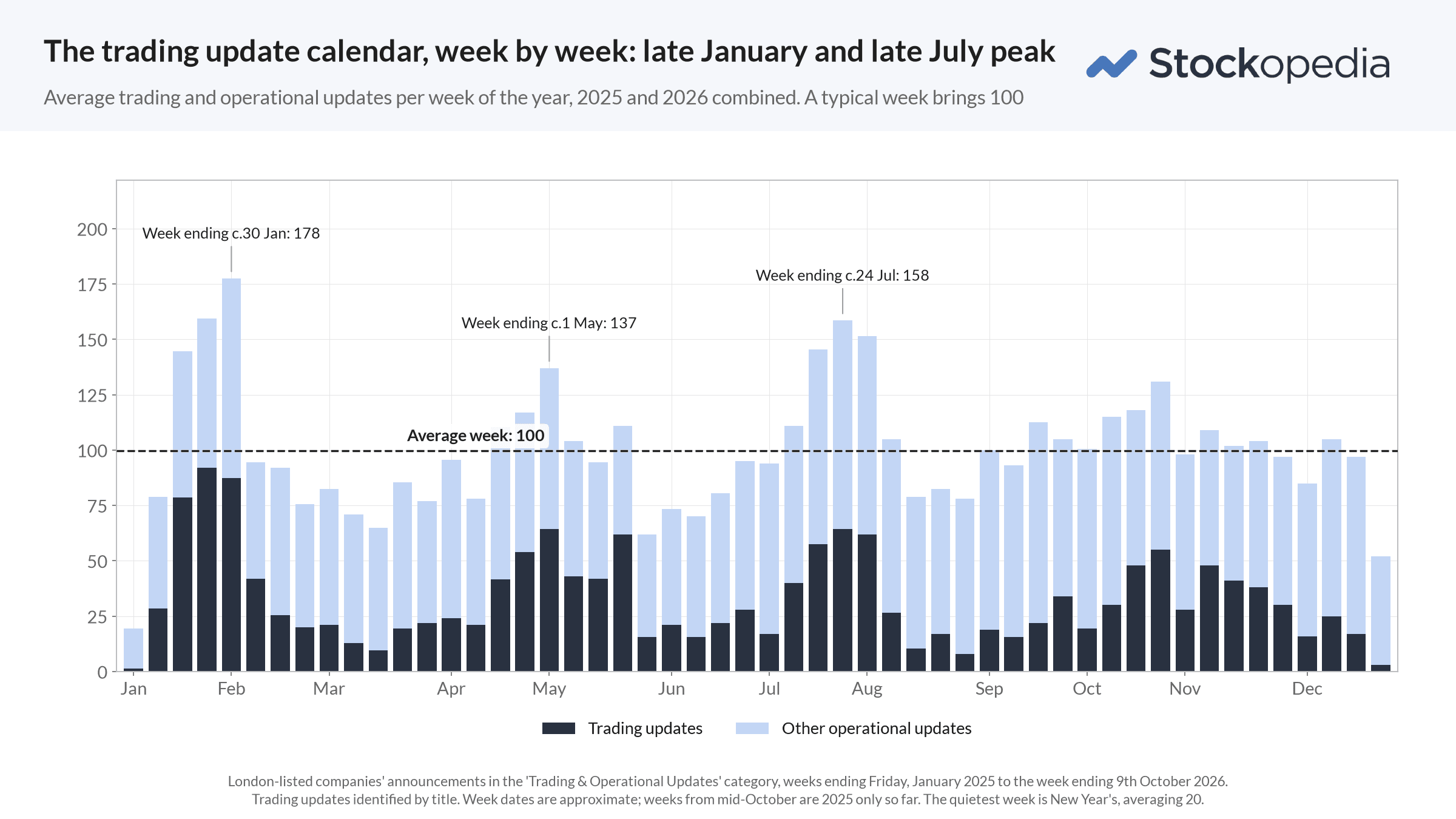
What to watch for: like-for-like sales growth, gross margin commentary, stock position going into the new year, and any change to full-year guidance. The market reads these updates as a barometer for UK consumer health more broadly. Late January is the busiest time of the year for trading updates: the week ending around 30 January brings 178 trading and operational updates, against 100 in a typical week. Our analysts' coverage is among the heaviest of the year in this window, because the sector read-across matters as much as any individual name.
February to April: the December year-end finals
March is the busiest month of the year for full-year results. Companies with December year ends, which means most of the FTSE 100 and FTSE 250, must publish their results by the end of April, and the largest go first. The big banks and oil majors usually report in February: Barclays and NatWest both reported in the second week of February 2026. Most other December year-end companies follow in March, and a final rush of smaller companies, and of annual reports, runs right up to the 30 April deadline, with a gap around Easter. That rush makes the week ending around 1 May the first of the year's three crunch weeks.
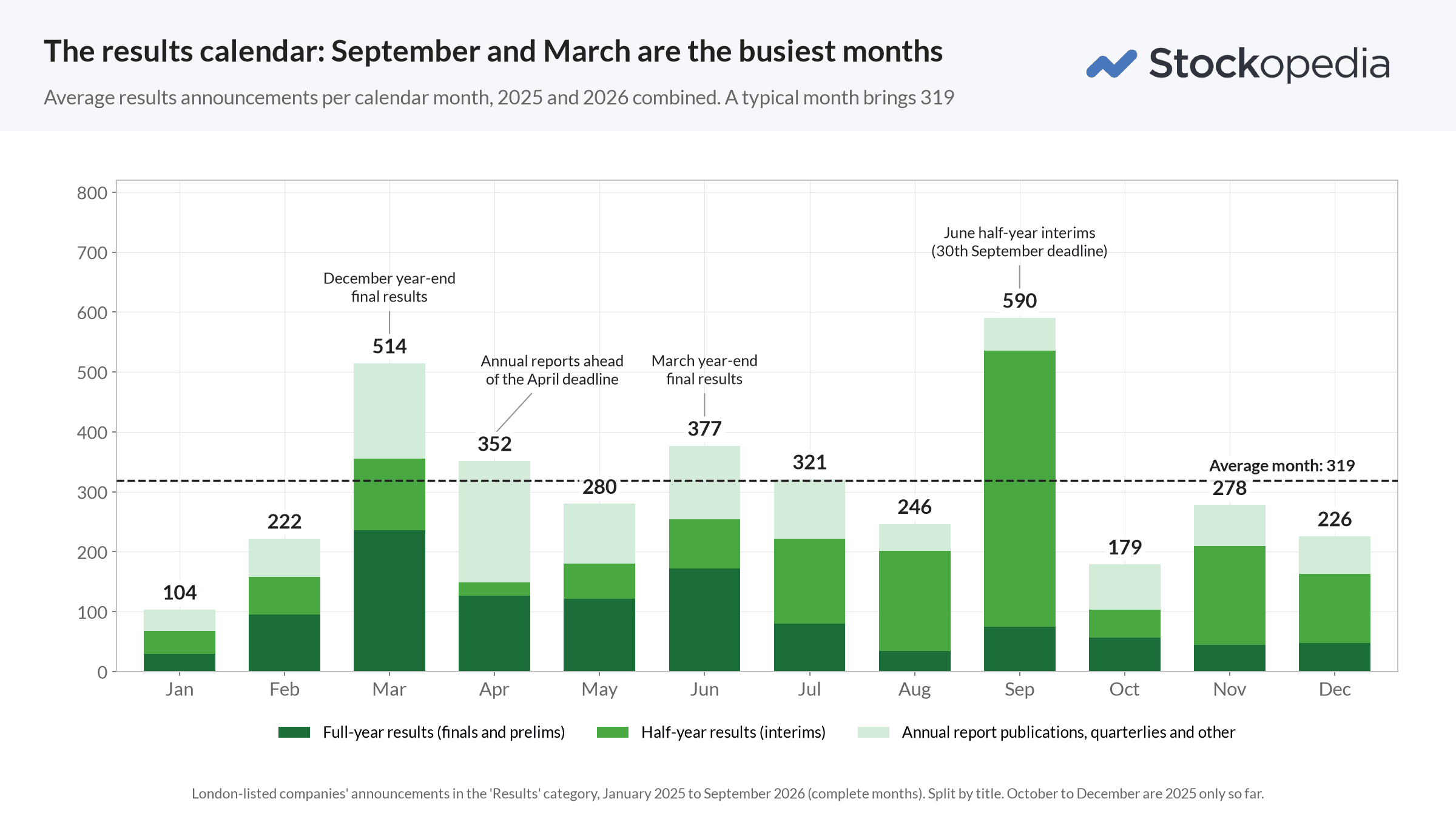
In an average March, London-listed companies publish 514 results announcements. Annual reports land, dividends are declared, and guidance for the new year is set.
What to watch for: this is the window where the previous year's narrative is finalised and the new year's expectations are anchored. Dividend decisions and capital return announcements concentrate here.
May and June: the March year-end finals and AIM December year-end annuals
Two groups overlap here. The first is companies with March year ends, common among utilities, telecoms, asset managers, many investment trusts, and a good number of industrial and software businesses. Main Market companies have until the end of July, but the largest report in May (BT and National Grid both did in May 2026), and most of the rest follow in June.
The second is AIM companies with December year ends hitting their six-month deadline at the end of June. Because AIM companies get two extra months, this is when the smaller-company annual report wave lands, and many AIM names push close to the wire. If a December year-end company is reporting in late June rather than back in March or April, it's almost always on AIM.
Together they make June the second-busiest month for full-year results, with 377 results announcements in an average June. Investment trust results are particularly prominent.
What to watch for: AIM annuals reported right up against the deadline sometimes signal audit complications. It's worth checking whether a late-June AIM annual contains any qualifications, restatements, or going-concern language. These are the kinds of details that drive sharp price reactions in smaller names, and they're exactly the sort of nuance our analysts flag in daily coverage.
Is late AIM reporting a red flag?
Usually not. AIM companies legitimately use the extra time because they run smaller finance teams, use smaller audit firms, and often schedule reporting closer to their AGM. A May, June, or July reporting date for a December year-end AIM company is genuinely normal. Don't panic.
The signal isn't the absolute date, it's the year-on-year pattern. An AIM company that reliably reports in mid-June every year is on a stable rhythm. One that historically reported in April but has progressively slipped is telling you something. Pair that with going-concern language in the auditor's report, an auditor change, or a half-year report that was also late, and you have something worth investigating before the results land.
Late July: the December year-end interims
By the final week of July, the largest December year-end companies are publishing their half-year interim results, covering January through June. UK banks make this window particularly noteworthy: Barclays, Lloyds, NatWest, and HSBC all typically report half-year figures in this period, which is why bank-watchers mark their diaries for late July every year. Trading updates peak here too, and the week ending around 31 July is the second crunch week of the year (314).
Half-year results are arguably the most informative moment of the year for most companies. You get six months of fresh trading data, an updated read on full-year expectations, and management commentary on the second half. Many companies use interims to upgrade or downgrade guidance.
What to watch for: outlook statements. Companies rarely change guidance at random. When they do at the half-year stage, it usually matters.
September: the busiest month of the year
September is the busiest month for results of any kind, with 590 in an average September, and the week ending around 2 October is the busiest week of the year (319 announcements). Three groups collide:
Half-year interims from December year-end companies, both Main Market and AIM, whose three-month deadline falls at the end of September. Most of the month's volume is these.
Full-year results from Main Market companies with June year ends, due by the end of October. The largest report earlier: Diageo in early August and Barratt Redrow in mid-September.
Full-year results from AIM companies with March year ends, hitting their six-month deadline at the end of September.
The AIM March year-end group is the one most often overlooked, but it's a meaningful contributor. Many smaller growth companies on AIM choose a March year end and push right up to the September deadline. Combined with the December year-end half-year wave, the week ending around 2 October brings more than 200 results announcements.
The mix of Main Market and AIM, full-year and half-year, large-cap and small-cap, makes this the hardest window to follow systematically. There's no single dominant theme. It's a structural pile-up of several deadlines at once.
Practical tip: if you hold or follow any December, March, or June year-end company, September is when you need to be most alert. It's also a useful diagnostic moment for the broader market because it pulls together so many different sectors at once. Our daily coverage in these weeks is built to help you triage, separating the genuinely important signals from the noise.
October and November: third-quarter updates and March year-end interims
After the September peak, results slow sharply: October is the quietest month for results after January. Trading updates pick up instead. Late October brings third-quarter updates from many December year-end companies, including the big banks. They're less detailed than formal results but often more market-moving, because they're the first hard read on the second half. Retailers also update here, giving early signals on how the run-up to Christmas is shaping up.
November is busier. Companies with March year ends publish their half-year results, which lifts results back to 278 in an average November, and the small group of September year-end companies (Sage being the most prominent example) publishes full-year results.
What to watch for: management gain far more confidence in their full-year figures the further they get through the year, so positive trading updates at this time can lead to significant gains through the Santa rally into the year end.
December: busy until Christmas
December is busier than its reputation. Results and updates keep coming at close to a typical weekly rate until the final week of the year, which is the quietest outside New Year. Boards avoid putting out material news over Christmas, when liquidity is thin and market attention is patchy, so that last week brings little beyond the occasional investment trust or small-cap announcement.
The trading statement pulse
Underneath the results peaks, trading updates come in four waves: late January (Christmas trading, and the first read on December year ends), late April into May (first-quarter and AGM updates), late July (half-year trading, and pre-close updates from June year ends) and late October into November (third-quarter updates). Add in the unscheduled announcements, especially when performance moves well above or below market expectations, and you get a continuous low-level hum of news flow.
This is where some of the most valuable signals live. A profit warning in a January trading update almost always presages a weaker set of March results. A confident third-quarter update in October typically means a clean set of spring finals. The trading statements act as an early-warning layer; the results confirm. Reading the change in tone between successive updates from the same company is one of the highest-value habits an investor can develop, and it's a discipline our analysts apply daily.
How to use this calendar
A few practical suggestions:
Plan your deep research around financial year ends, rather than calendar months. If your portfolio is concentrated in December year-end shares, March and April, then late July to September, are your heaviest research periods. If you favour investment trusts or other companies with March year ends, May, June and November matter more.
Don't try to read everything in the heavy weeks. In a crunch week of 300 announcements, even full-time analysts triage hard. Use the StockRanks to prioritise, focusing on names where momentum has shifted or where the rank is changing. We like to focus on outlook statements and "guidance upgrades", as positive announcements often come in runs and drive continued share price performance.
Treat trading statements as early signals. They're shorter and easier to read than full results, and they often contain the most important new information of the quarter. Look for "significantly ahead of expectations" announcements, and for price jumps, to identify catalytic moments in shares. A change in tone between a trading update and the formal results six weeks later is almost always meaningful.
Use the quiet weeks for thinking, not reacting. Late August, late December, and early January (before the retail spike) are good windows for portfolio review, framework refresh, and longer-term research. Trying to do this in the middle of September is a recipe for missing things.
The reporting calendar is one of the few genuinely predictable structures in markets. Earnings surprises are unpredictable; the timing of when they'll be announced is not. Building your year around the calendar, rather than reacting to it, is one of the simplest ways to lift the quality of your research without working longer hours.
From the Daily Stock Market Report. Every weekday morning Graham, Roland and the team read the results and trading updates as they land, and pick out the ones that matter, even in the busiest weeks. Read today's report · Sign up to our newsletters
Questions readers ask
When is the UK results season?
There isn't just one. March is the busiest month for full-year results, as December year-end companies report, and September is the busiest month overall, as their half-year results fall due. The crunch weeks end around 1 May, 31 July and 2 October.
How long do UK companies have to publish their results?
On the Main Market, four months after the year end for annual results and three months after the half-year for interims. On AIM, six months for annual results and three months for interims.
Can directors buy or sell shares just before results?
No. Directors can't deal in the 30 days before their company's half-year or annual results (MAR Article 19), which is why director buying often comes soon after results.
What is a pre-close trading update?
A short update a company puts out around the end of its financial year or half-year, before the full results. It usually gives the period's sales and says whether profit will be in line with market expectations, so by results day the headline is often old news.
Where to go next
More in this series: How to read a UK trading statement · How to read a company's annual and interim results · How the UK's stock markets compare · The Ultimate Guide to Reading Company Announcements