How to react to a contract win

Contract wins make some of the most eye-catching headlines a company can put out: a "record order", a "transformational" deal, a "strategic partnership". The share price usually takes them more calmly. We looked at about 750 contract wins from UK companies since the start of 2025. On days when the win was the only news, the typical share rose 2.5%, and four weeks later it had gone no further. What moves a price is a contract that shifts market expectations: the analysts' consensus forecast of what the company will earn. Filtronic's partnership with SpaceX did that again and again, and its shares went from 33p to a peak of 469p.
This page shows you how to tell a routine win, already in the forecasts, from one that will change them.
Whether a contract matters is a few hints and some maths
Companies don't have to announce every contract they sign. Under the UK Market Abuse Regulation (MAR) a company must announce news as soon as possible if a reasonable investor would use it in deciding whether to buy or sell. There is no size threshold to reporting contracts, because what matters depends on the company (FCA technical note). A £1m contract can be big news for a company worth £10m and mean nothing to one worth £10bn. The same goes for losing one.
The distribution channel can give you a first hint.
A contract the company thinks could move the price goes out as a full RNS (Regulatory News), usually headed "Contract".
A contract the company doesn’t consider price-sensitive usually goes out on RNS Reach, the exchange’s service for non-regulatory news such as marketing.
Graham Neary, who writes our daily report, put it plainly about a £0.4m Filtronic order in April 2026: "Not material news for a company of this size: hence this is a 'Reach' announcement." It is only a hint, though. Kier put a contract worth about £500m out on Reach in July 2026.
"We don't always cover contract awards in these reports. They are often already priced into current market forecasts and are effectively business as usual."
Roland Head, Daily Stock Market Report, 8 January 2025
If you read our analysts' write-ups in the Daily Report, the same few checks come up again and again:
How big is the deal against the business? Turn the headline into a yearly figure and compare it with the revenue the company is forecast to make. The StockReport shows the forecast, and many announcements give it in a footnote on "market expectations".
What could it add to profit? Revenue isn't profit. To get from one to the other, use the company's own margin: its operating profit as a share of revenue in its latest results, which the StockReport shows for several years. If the margin jumps around, take an average of the last few. If the company reports the division that won the work separately, its margin is the better guide. Roland did this for a £1.8m Synectics contract in November 2025: at the division's operating margin of 7.1% over the past year, he reckoned it would add about £26,000 of operating profit a year, for a business making more than £5m.
When does the money arrive? A contract won today may pay nothing until next year, or be spread over five. The company will often, but not always, let you know in the announcement.
Was it already in the forecasts? "Underpins market expectations" usually means yes. A contract that changes the numbers usually comes with new guidance, and that is where the share price really moves. Once forecasts go up, the price can keep rising as the market catches up.
How open is the company being? With no value, no length and no customer, you can't do the sum. The customer may have asked for secrecy, but either way you're being asked to trust a headline you can't check. Treat the news as less certain until the numbers show up in a trading update or the results.
In October 2026, MS International announced a three-year contract to supply the US Navy, worth $197m, nearly a third of it in the first year. The shares rose about 11% that morning, and Mark Simpson worked the contract through to profit after tax:
"My initial thought was that a 10% jump in the share price this morning looked a bit low on such a material contract win. However, after running some numbers, my estimated impact on PAT almost exactly aligns with the jump in market cap."
Mark Simpson, Daily Stock Market Report, 1 October 2026
He also caught two words in the announcement: "continued supply". This was a follow-on from a customer MS International already served, not a new one. On Mark's sum, the market had priced the contract at about what it was worth to shareholders.
That is the habit to copy. Before you act on a contract headline, work out what it adds to profit and set it against how far the shares have already moved. If the two roughly match, as they did here, the news is in the price. If the shares have moved much less than your sum, the market may have missed something; if much more, it may have got carried away. And check whether the customer is new, because a follow-on is more likely to be in the forecasts already.
The headline contract value might be worded by marketing
A company picks the number that goes in the headline, and it is usually the biggest one available. Before you do the sum, check what that number counts:
The whole contract, or one year of it? A total contract value covers every year, so divide it by the years.
"Up to" is a ceiling. It may be shared with other suppliers, and may assume extensions the customer can choose not to take.
"Attributable" means the company's own share, after any partners have taken theirs.
New work, or a renewal? A renewal keeps revenue the company already had.
Signed, or not yet? A "letter of intent", a "memorandum of understanding" and "subject to contract" all come before a signed contract. Some never get there.
Public-sector frameworks need the most care. A framework is an umbrella agreement: it sets the terms on which public bodies can place orders with a group of approved suppliers. The government's own guidance says that "in most cases a framework will not commit a contracting authority to enter into a call-off contract" (GOV.UK). Revenue only starts when a buyer places an actual order, a "call-off". So a framework place is a licence to bid for work, not the work itself. When Galliford Try announced a "£59 BILLION NATIONAL GRID FRAMEWORK" in August 2025, the lot it had won had "an anticipated overall value of £9 billion" over five years, and the announcement didn't say how much of that would come to Galliford Try. Its shares moved about 0.1%.
Headlines like "largest in our history" and "worth up to £1bn" are written to be noticed, and a big number makes it tempting to buy before you've checked it. Pathos Communications' "largest ever contract", in May 2026, was worth US$0.7m. Small shares can jump on news nobody can size: Thruvision's shares rose about 31% on each of two Reach releases in 2025 and 2026 that gave no value at all. If you can't do the sum, a rise on the headline is a guess.
The phrases you'll meet most, and what they usually mean:
Contract wins won’t move the shares, unless the forecasts change
Put the sum together with the market's reaction and a pattern shows. In our data, the typical contract win was a small rise on the day, and then nothing much. On days when a contract win was a company's only news, the median move was a rise of 2.5%, and the shares rose on 72% of those days. Four weeks later, the typical share had moved no further. A routine contract doesn't change the forecasts, so there is nothing left to catch up. Studies of US contract awards in the 1990s found the same: a rise of 1% to 2.5% over a day or two, and no drift afterwards.
So the question to ask of any win is whether it changes what the market expected. The wins that move a price come with new numbers. Made Tech's "largest contract in its history", in August 2026, arrived alongside guidance raised "ahead of current market expectations", and the shares rose about 11%. The price followed the forecasts, not the headline. After an "ahead of expectations" statement, the price often keeps drifting for months as forecasts catch up (our guide). And when a company keeps winning and keeps upgrading, those moves add up.
A few contracts transform the company that wins them
Most wins add a little to a year's revenue. A few are big enough to change what the company is. Repeat orders follow, the forecasts go up again and again, and the money pays for the factory, the staff and the products that win the next customers. That is when a share price can multiply.
Filtronic, which makes radio-frequency equipment, shows how far it can go. From early 2023 it announced orders from an unnamed "leading global provider of low earth orbit ('LEO') satellite communications equipment". On 24 April 2024 it named the customer: a "Strategic Agreement with SpaceX", with "an initial irrevocable purchase order of $19.7m". The same morning, a trading update said the next year would be "significantly ahead of current market expectations". The shares closed 48.5% higher, on the contract and the upgrade together.
That was only the start. More SpaceX orders followed, and with them more upgrades. Revenue went from £16.3m in the year to May 2023 to £56.3m two years later, and in the year to May 2025 alone operating profit rose from £3.6m to £13.4m. The shares went from 33p before the agreement to a peak of 469p in May 2026, more than 14 times as much. In October 2026 they were 275p, still more than eight times their price before the deal.
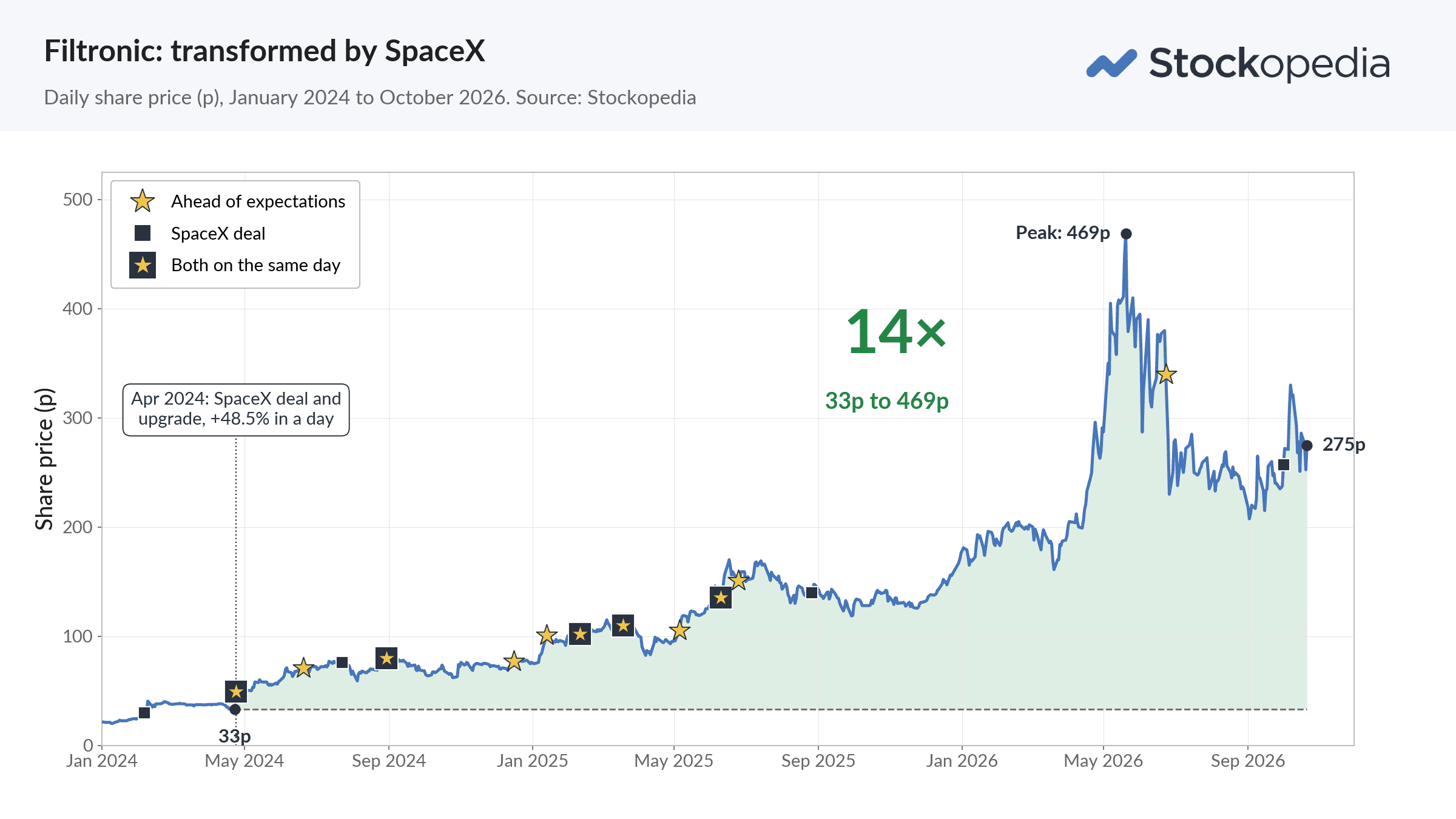
Growth on that scale came from one customer, and that was the worry. SpaceX's share of Filtronic's revenue went from 12% in the year to May 2023 to 48% the next year, then 83%. When Filtronic reported that 83% in July 2025, Roland was blunt:
"That's an astonishing and risky level of customer concentration, in my view."
Roland Head, Daily Stock Market Report, 29 July 2025
Peter Lynch, who ran Fidelity's Magellan fund, made the point in One Up on Wall Street: "The company that sells 25 to 50 percent of its wares to a single customer is in a precarious situation." A customer that big has more power over the price it pays, and if it stops ordering, most of the revenue goes with it. When ActiveOps said in October 2026 that a customer worth around a tenth of its revenue wouldn't renew, its shares halved in a day, as the next section shows. SpaceX was worth more than eight tenths of Filtronic's. You can check how exposed any company is. Under the international accounting rules most listed companies use, the annual report must say if any one customer is worth 10% or more of revenue.
Filtronic saw the risk too, and calls reducing it "a key strategic priority". It said in July 2025 that its work for SpaceX had given it "the funding and products to replicate this success more widely in future years", and it has used them. Since then it has won contracts from a European defence prime (£13.4m), a European space customer (€7m) and a US customer (US$8m).
"It's great to read that the customer base is diversifying away from SpaceX, with 'a broader pipeline of opportunities'."
Graham Neary, Daily Stock Market Report, 12 December 2025
In the year to May 2026, SpaceX's share of revenue fell to 68%, and a second customer reached 10%. Filtronic has also moved into a new factory, paid for from its own cash, that it says can support more than £200m of revenue a year. The SpaceX partnership turned a company with £16m of revenue into a space and defence supplier, and at the peak its shares were worth 14 times what they were before the deal.
Losing a contract hurts far more than winning one helps
Filtronic has been loosening SpaceX's grip, but the danger it was managing is real. A company that leans on one customer is only as secure as that customer's next order. If the customer leaves, the revenue goes with it, often in a single announcement. Forecasts usually assume the work will carry on, so a loss comes as a surprise and the forecasts have to come down. That is why a loss does far more damage than a win does good.
The numbers bear that out. A study of US company press releases from 2006 to 2009 found the price reaction to losing a customer was almost seven times the size of the reaction to winning one, and that the price kept drifting down afterwards. Our own UK cases point the same way. In the contract and customer losses we checked from the start of 2025 to October 2026, the shares fell in more than nine cases out of ten, two in three fell by more than 10%, and the average move was a fall of 27%. Several came with a profit warning the same morning. A win that comes with an upgrade can send the shares sharply higher, and a loss that comes with a warning works the same way in reverse, often harder.
ActiveOps shows how much even a modest-looking loss can cost. On 12 October 2026 its trading update said next year would be "significantly below market expectations", after a major customer didn't renew. The contract was worth "£3.8m of annual recurring revenue", just under a tenth of revenue. The shares closed 50.2% lower. Graham explained the gap: the update also reported weaker new business, so next year's forecasts fell further than the one contract alone would suggest.
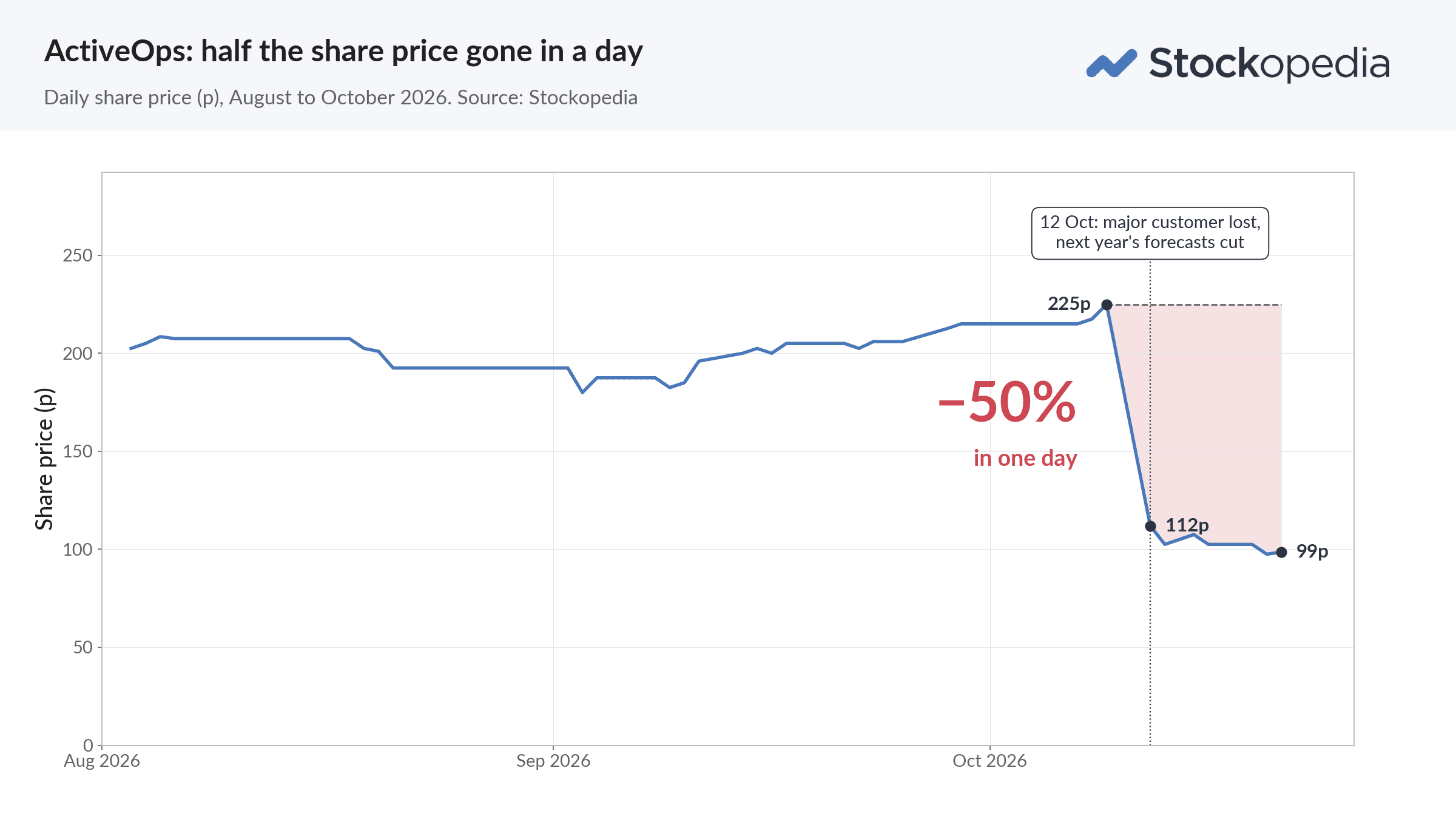
Losses rarely get their own headline. ActiveOps' came inside a half-year trading update, and most arrive the same way, often in the update that cuts the forecasts, so read the whole update and not just its title. Size the loss the way you'd size a win, as lost revenue each year against forecast revenue. Then check how secure the remaining contracts are, because many let the customer leave early. Celebrus said in October 2026 that its lost customer "exercised a contractual break at the end of the first year of a three-year contract".
When a loss comes with lower forecasts, it is a profit warning, and our guide to profit warnings covers what usually happens next.
Do the sums before you act
Our view, on the evidence: most contract wins are business as usual and already in the price. A win matters when it changes the forecasts. A loss matters more than a win of the same size, and a company that leans on one customer carries that risk every day.
How you should respond
Turn the headline into a yearly number and compare it with the revenue the company is forecast to make.
Check whether the forecasts moved. Look for new guidance in the announcement, or "underpins", and watch the consensus on the StockReport over the following days.
Check what's actually signed. A framework place, preferred-bidder status or a letter of intent isn't revenue yet.
Check who the customer is, and how much of the business now depends on them.
Read every trading update in full, because that is where a lost contract usually shows up.
The headline is the company's number. Whether it matters is a sum you can do yourself.
From the Daily Stock Market Report. Graham and the team read contract news as it lands each morning, and say when a win changes the numbers and when it's business as usual. Read today's report · Sign up to our newsletters
Questions readers ask
What is RNS Reach?
The London Stock Exchange Group's service for non-regulatory news, such as marketing and minor contracts. Information a company is required to publish can't go out on Reach, so a contract released there is the company saying it doesn't think the news is price-sensitive. Large companies use it too.
Why did the shares fall on a contract win?
Usually because the win was already expected, or because the same announcement carried something else. If the market was hoping for an upgrade and didn't get one, an "in line" contract can disappoint. Our guide to "ahead of expectations" explains how expectations set the reaction.
Can I check a government contract myself?
Yes. Since February 2025, public bodies have had to publish who won a contract and its estimated value, free on Find a Tender, before they sign it. Sometimes that comes before the company's own announcement.
Where to go next
More in this series: What to do when a company beats expectations · What to do on a profit warning · How to read a UK trading statement · How to read a company's annual and interim results · How the UK's stock markets compare · The Ultimate Guide to Reading Company Announcements