What to do on a profit warning

A company you own has just warned that its profits will fall short. The shares dropped before you had finished reading. It is an unpleasant morning, and a common one: according to Ernst and Young, nearly one UK-listed company in five warned on profits in the year to June 2026. When we studied recent UK warnings, most of the share price fall came on the announcement day itself. But the shares then usually kept slipping for months, and only about one in nine was back to its old level against the market a year later. On the evidence, there is a significant opportunity cost to holding shares after a profit warning.
A profit warning is the company admitting the forecasts were wrong
"Profit warning" is the market's name for a company telling investors that its profit will come in below what was expected: whether below the analysts' consensus (the average of their forecasts), or below the earnings guidance the company itself had issued to the market. Our guide to UK trading statements explains the two forms. The words “profit warning” itself rarely appears in the company announcement. It will usually be headed "Trading Update", or "Revised guidance", as WH Smith's was in August 2025.
Whatever the heading, the key message is the same: the forecasts were too high. Over the following days and weeks, the analysts who cover the company will cut their forecast numbers, and often not only for this fiscal year. A problem that has dented this year's profit may well dent future years too.
As soon as a board knows that profit will fall short of what investors expect, the UK's market abuse rules (MAR) require it to tell the whole market as soon as possible. Nobody can trade on the news until everyone has it. If a profit warning came out of the blue, perhaps in the middle of the trading day, it’s because the company couldn’t hold it back.
The day-one price fall is often far sharper than the cut to profit forecasts, because the market may lose some confidence. A company that has just missed is harder to trust, so investors pay less for each pound of profit it makes until it has shown the bad news is over - resulting in a lower P/E ratio. A warning cuts the profit, and it cuts what investors will pay for it.
The warning itself tells you how deep the problem goes
Read the announcement clearly. Two things in it tell you most of what you need to know.
How big is the miss? Many warnings put some context words in front of a "below expectations" phrase. The language can run from "marginally below" to "significantly", "materially" or "substantially below". These words don’t map clearly to the size of a cut, though now and then a company spells it out: Nexteq said in May 2026 that profit would be "approximately 15% below previous market expectations". Some companies replace the old forecast with a fresh one, a figure or a guidance range for profit. Others say profit will be "below expectations" and leave it at that. The market prefers clarity, so can punish vagueness.
Six months on, profit warnings that gave clear new figures had fallen only about 1% further after the day, while warnings in words alone had fallen another 11%. A number lets the analysts reset their forecasts; words leave them guessing. Weakest of all is a company that withdraws its guidance, as IG Design did in February 2025: "the Board is no longer able to provide guidance for the years beyond FY25".
What does the company blame? A contract that has slipped into next year is a timing problem, and the profit may still arrive, just later. Customers buying less, a lost contract or costs that keep rising are harder: will the cause still be there next year? If the warning reaches into next year's profit as well as this year's, it is usually the more serious kind.
Most of the fall comes on the first day
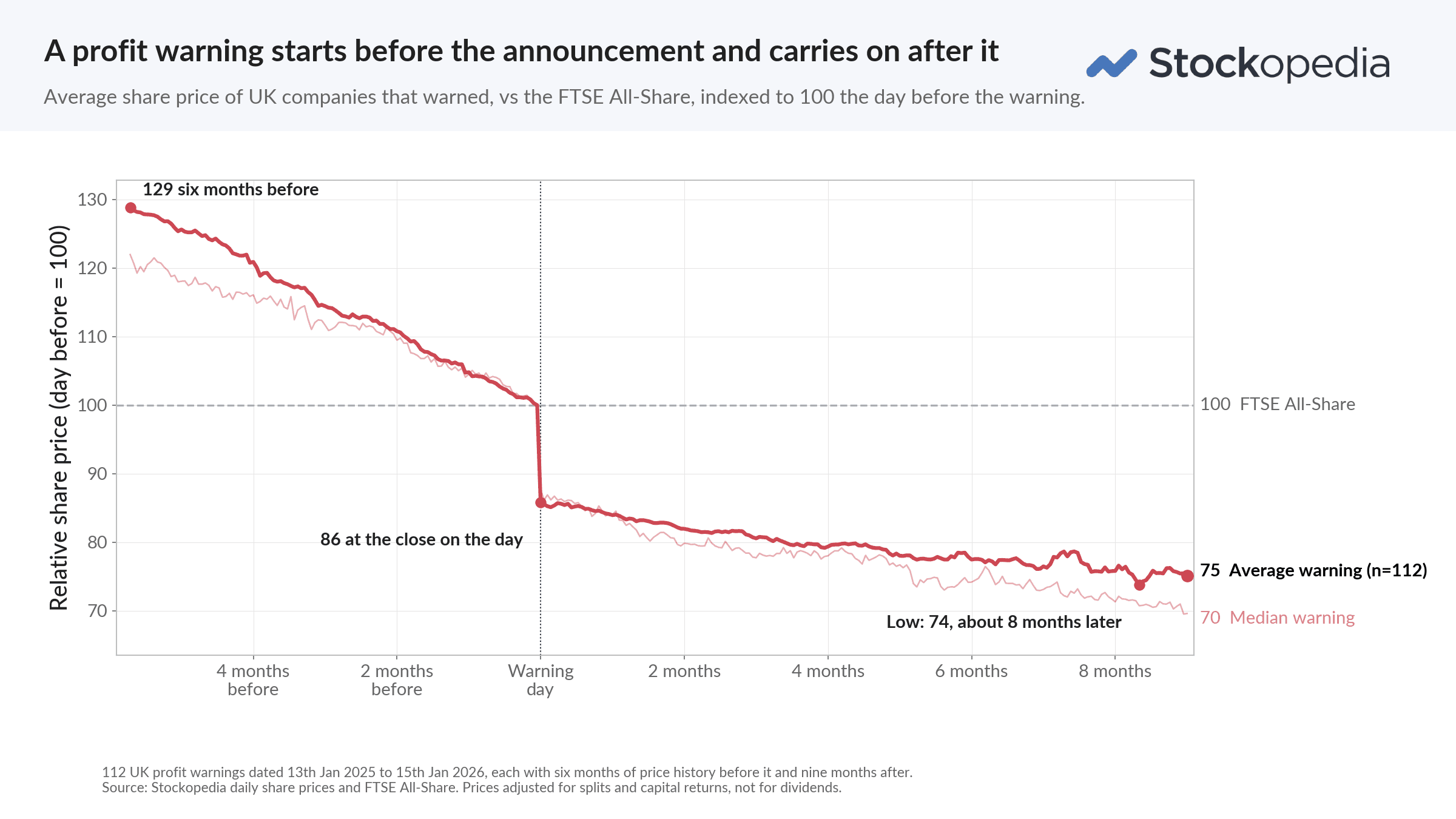
To see what usually happens next, we looked at every UK profit warning our Daily Stock Market Report analysts flagged between January 2025 and October 2026: 208 warnings at 159 companies. On the day of the warning, the shares fell 13.5% on average, close to the 14% that EY (Ernst & Young) found across all UK-listed companies in the second quarter of 2026. Bad news hits harder than good. A "significantly below" statement took 11.1% off the shares on the day, on average, while "significantly ahead" added 7.7%.
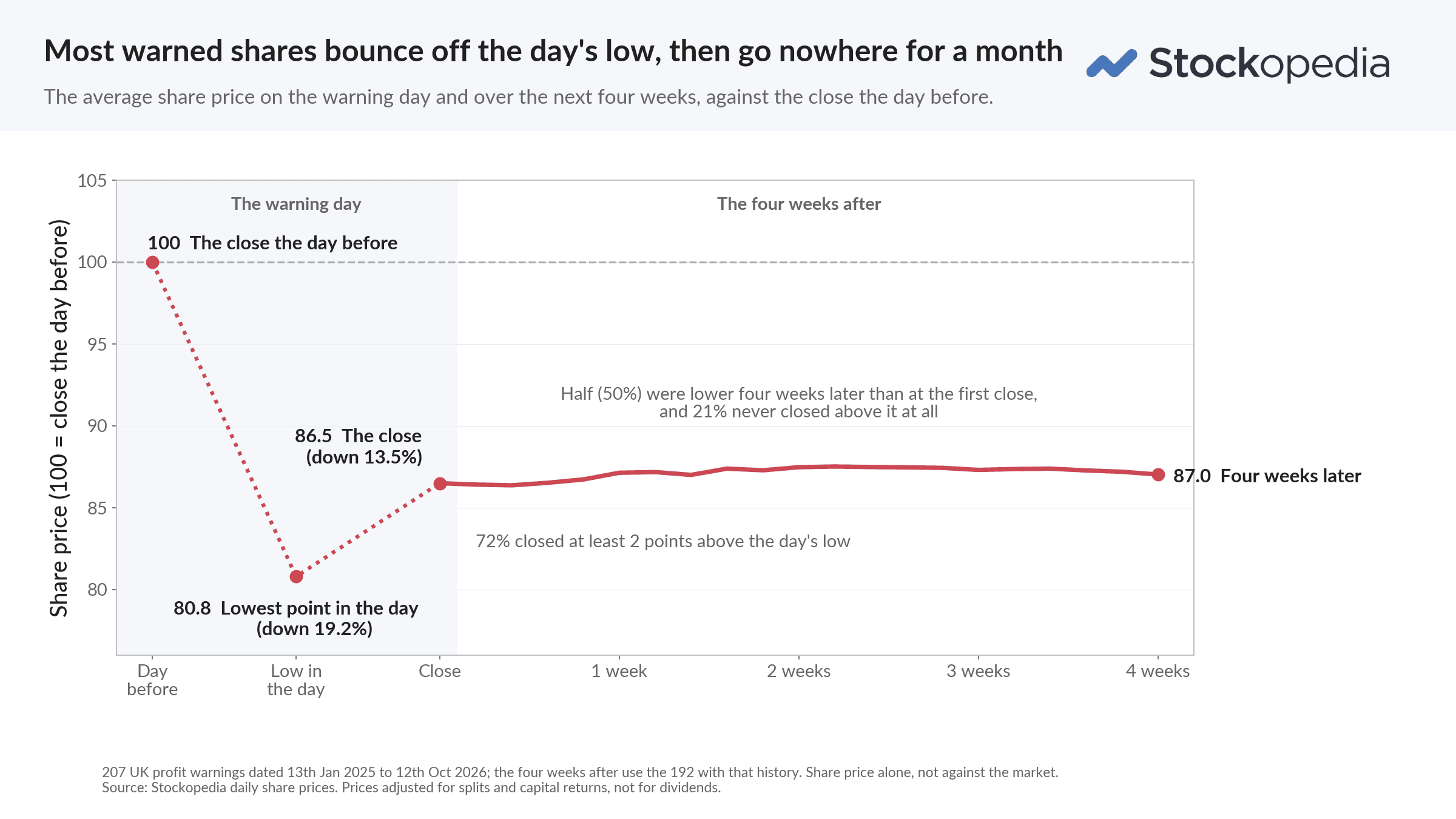
Within the day, the swings are bigger still. At their lowest point we found that shares fell by 19.2% on average, before closing down 13.5%. Our 2016 study, which followed 60 small-cap warnings minute by minute, found prices fell hard at the open and then stayed flat or kept falling, an average fall of 21%.
The close is no turning point. Four weeks later, 50% of the shares were lower than at that first close, and 21% never closed above it at all. If you hold on, the odds are not in your favour: counting from the day before the warning, the day itself accounted for about 60% of the fall over the next nine months, and the other 40% was still to come.
The months after usually bring more bad news
Why would a share keep falling once the news is out? Partly because forecasts take time to come down. Analysts rarely cut all at once: they trim their numbers, wait for the next update, and trim again, and each cut pulls the price a little lower. Investors who were caught out are slow to come back, too. It is the same slow adjustment that follows good news, explained in our guide to "ahead of expectations", running the other way.
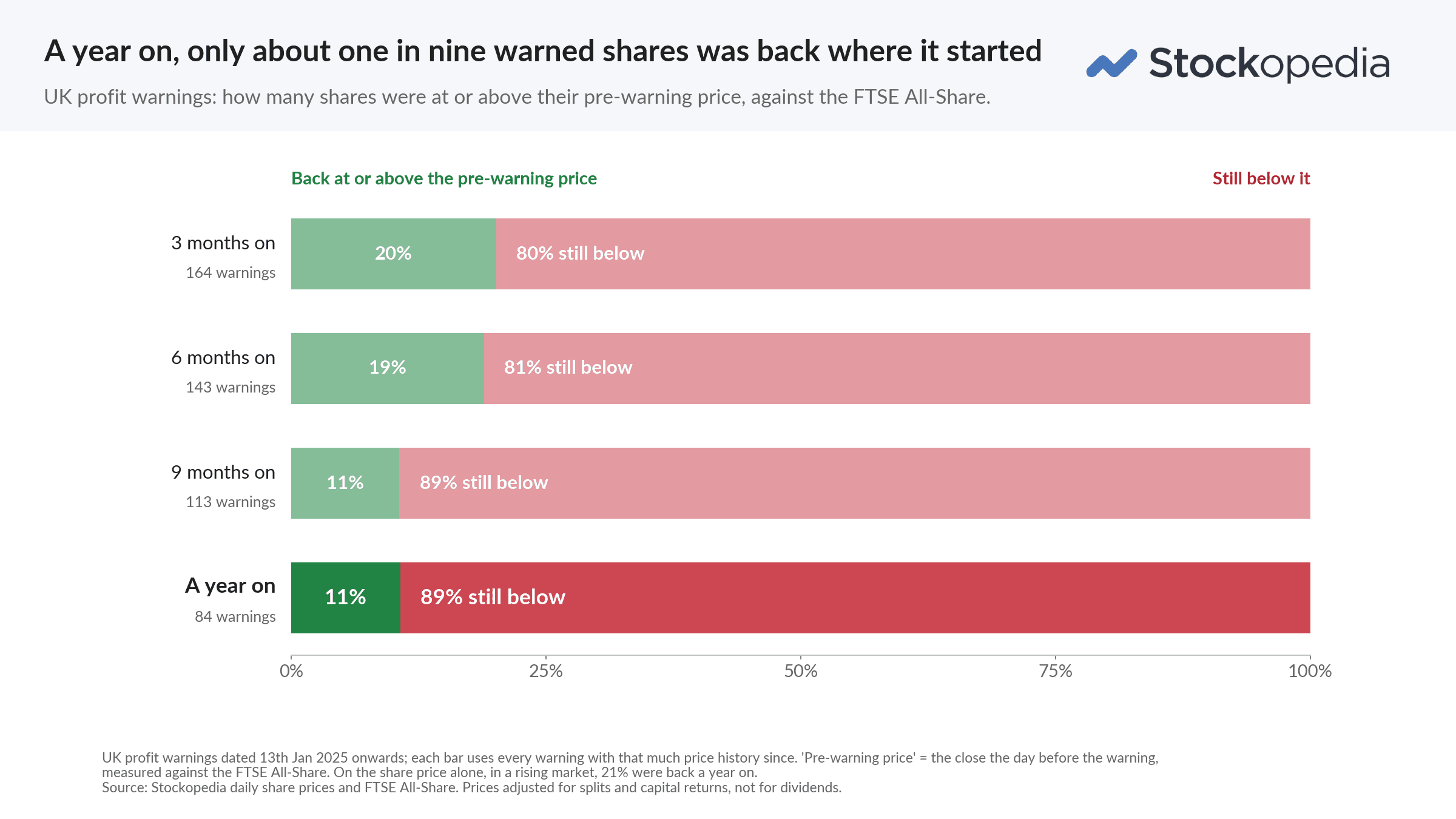
In our data, the average warned share lost roughly another tenth of its value against the FTSE All-Share over the nine months after the warning day, and reached its low eight to ten months after the warning. Our 2016 study found the same shape over eighteen months. A year on, only about one in nine of the shares was back at or above its pre-warning price against the market.
There is also the risk of a second warning. Few companies warn three times, but a second warning is common: a quarter of the companies in our data warned again within a year. A warning is often the first sign of a problem that takes years to fix: a Bank of England study of around 500 companies that warned between 1997 and 2001 found that about four in five still hadn't restored their profit margins two years later.
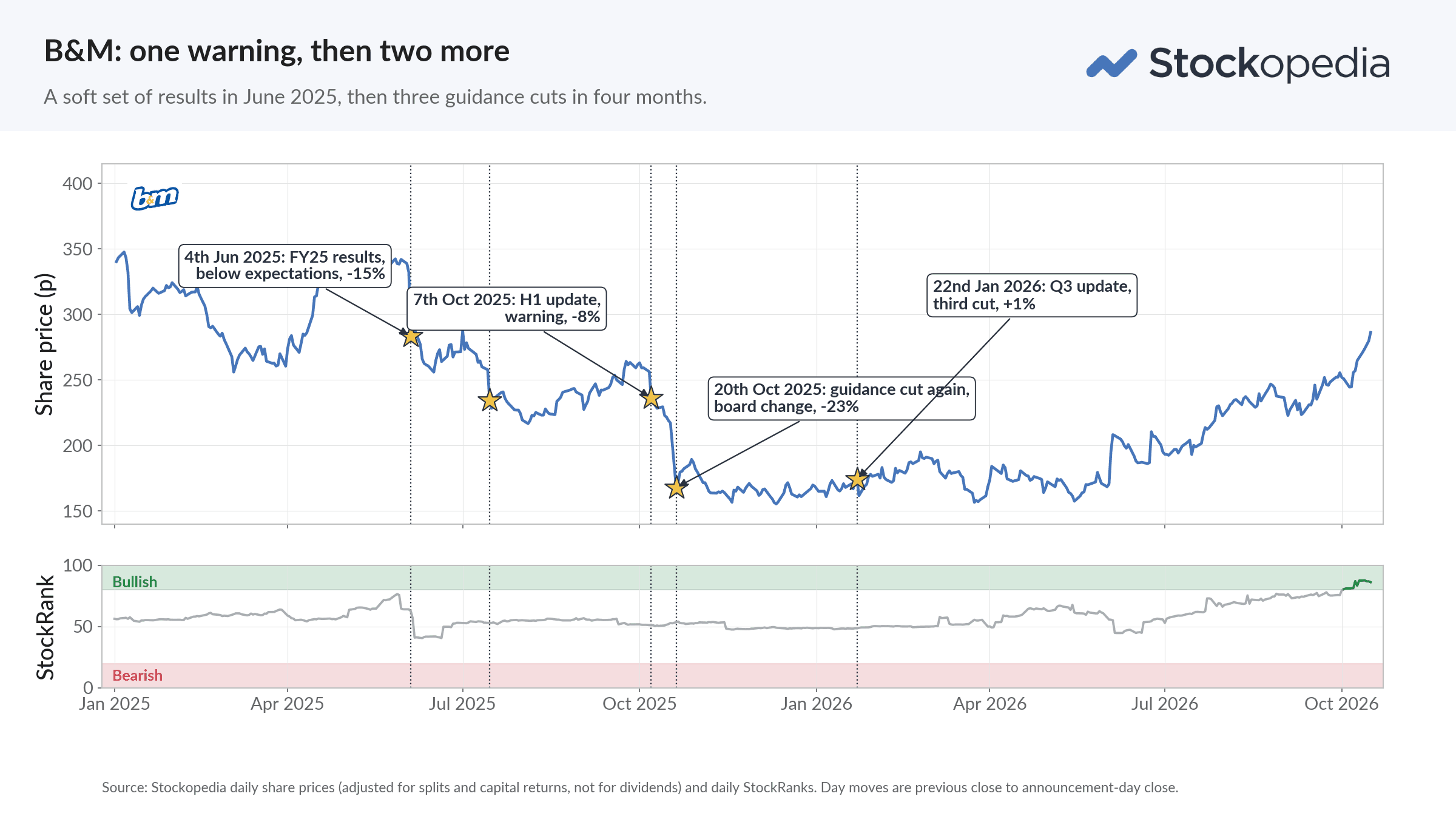
B&M, the discount retailer, shows how a run can unfold. Its results in June 2025 came in below expectations, and the shares fell 15%. In October it warned, and they fell 8%. Two weeks later it cut its guidance again and announced a board change, and they fell 23%. A third cut followed in January 2026. From the eve of those June results to the low that autumn, the shares roughly halved.
Your instincts will work against you on the news
Knowing all this doesn't make reacting to a profit warning that morning any easier. A profit warning can mean a sharp loss, in a company you own and know well, arriving without notice, with limited information - so you have to be very careful with how you react. One of our subscribers put the dilemma plainly after Go-Ahead Group warned in 2017:
"They released some poor results and now the stock rank is showing as 65 but I cannot find any discussion or advice on whether to sit tight and ride it out."
Stockopedia subscriber, 2017
Sit tight, or get out? The evidence says get out. But four behavioural instincts will pull you the other way, and each of them has tended to cost holders more.
"The market has over-reacted." Holders who know a company well often decide the fall is overdone, because they are anchored on what they thought the shares were worth before the news. Our evidence doesn't support it: half the shares were lower a month after the first close, and the slide usually carried on for months.
Waiting for a bounce. Most profit warning shares do bounce off their lowest price on the day. But that bounce often doesn’t last long term, and on average, waiting for the price to come back before selling has meant selling lower.
Buying more because it looks cheap. Against what you paid, the shares look like a bargain, and buying more lowers your average cost. But the average warning share kept falling for most of a year, reaching its low eight to ten months after the news, and a share that looks cheap after one warning can look cheaper after the next. Our 2016 guide suggested waiting at least six months before considering buying a profit warner at all.
Holding on to get back to what you paid. The strongest pull of all. A loss hurts roughly twice as much as an equal gain pleases, so people hold falling shares hoping to break even; economists call it the disposition effect. But the price you paid is a fact about you, not the company, and the market neither knows nor cares what it was. Do read our guide to “keeping losses small”.
Amidst it all sits the act of doing nothing at all. Lee Freeman-Shor, who spent years watching professional fund managers handle their losing shares, found that the worst of them behaved like “Rabbits” in the headlights: when a share fell, they froze. He found that winning investors either act as 1) “Assassins” - cutting losses quickly or 2) “Hunters” - averaging down when they have real conviction. The behavioural analyst James Montier saw the same pattern after profit warnings:
"Evidence clearly shows that stocks which warn continue to do poorly for around a year … Of course, we don't [sell]; we procrastinate and often end up doing nothing for a long time."
James Montier, Maximum Pessimism, Profit Warnings and the Heat of the Moment
On the evidence, selling has usually been the better choice
Put the evidence together and it points one way. On average, holders who sold on the warning did better than those who waited. That has been our view for more than a decade. Our 2016 study, The Profit Warning Survival Guide, concluded that "the best thing to do is to sell on a profit warning", and our data from 2025 and 2026 says the same.
Some do come back, but they tend to be the best businesses which experienced a brief blip. Our 2016 study found that the only profit warning shares with a meaningful chance of recovering were the highest Quality Rank ones: highly profitable companies with a real edge over their rivals, the kind we looked at in Makings of a Multibagger. That gives our rule of thumb, set out in Selling on company news events: sell immediately, and only think about holding if both things are true. The company has to be genuinely high quality, and the warning has to come from a clear one-off, such as a fire or a contract delayed into next year, rather than a problem in the business itself. Gear4music, the online musical-instrument retailer, shows what that can look like.
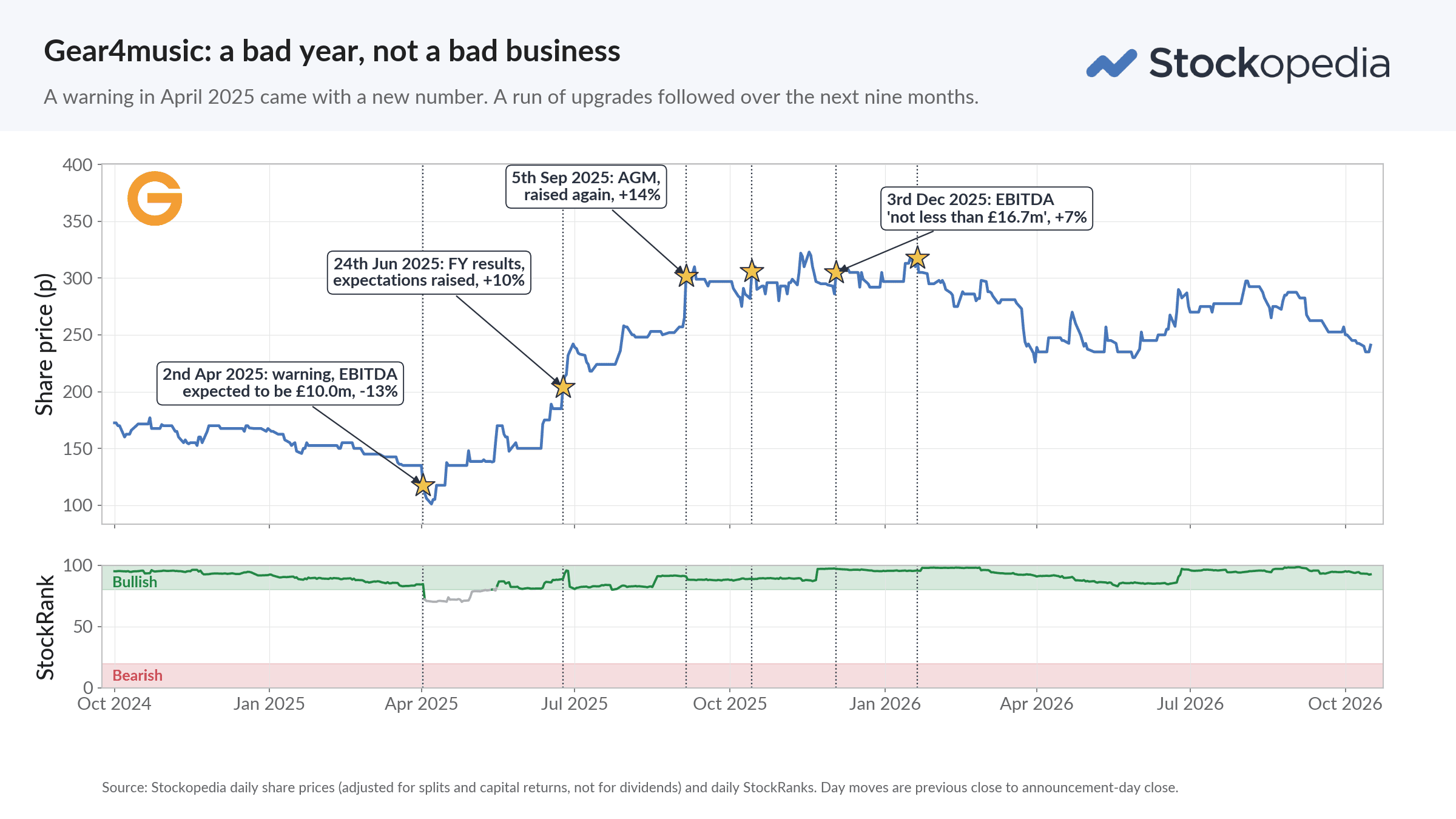
It warned in April 2025, but with a number: earnings before interest, tax, depreciation and amortisation (EBITDA) were "expected to be £10.0m". The shares fell 13%. Over the next nine months it raised its expectations again and again, and the shares more than doubled before giving some of that back. It helped that April 2025 was also the market's low after the US tariff announcements, and remember we went looking for a story like this: it is the exception. For most warning shares, and especially smaller, more speculative companies, the odds say cut the loss, move on and come back when the news gets better.
How you should respond
Every situation is different, and personal circumstances, tax and liquidity can come into play. But here’s what the facts suggest:
Sell and put the money somewhere better. The urge to sell is the right instinct on a profit warning morning. The main thing is to avoid the opportunity cost: the evidence gives no reason to wait weeks or months for a recovery, so it can be wise to make the decision within days. Money left in a warned share has, on average, kept going backwards for most of a year, while it could have been working in shares whose news is getting better. On timing within the day, our 2016 minute-by-minute study found that, if you were going to sell on the day, earlier tended to be better than later. If you are torn, ask yourself one question: knowing what you now know, would you buy these shares today, at this price? If not, the case for keeping them is weak.
Selling isn't a final verdict on the company. If the business recovers, you can buy back in once the news has turned: when the forecasts stop falling, or the company starts beating its new numbers. You may pay more than the price on the warning day, but you won't have sat through the months of opportunity cost and potentially larger losses that came first for most profit warning shares.
From the Daily Stock Market Report. When a company warns, Graham Neary and the team cover it that morning: what has gone wrong, how bad it is, and what they would want to see before trusting the company again. Read today's report · Sign up to our newsletters
Questions readers ask
Should I wait for the price to bounce before I sell?
Most do bounce off the day's low, but half were lower again four weeks later than at the first close. On average, waiting hasn't paid.
Do profit warnings come in threes?
Not usually, but a second warning is common. A quarter of the companies in our data warned again within a year.
Is a guidance cut the same as a profit warning?
Yes, in a different form: both mean the forecasts were too high. Our trading statements guide explains the two.
Where to go next
More in this series: How to read a UK trading statement · What to do when a company beats expectations · The StockRanks explained · The Ultimate Guide to Reading Company Announcements