Quality Compounders screen update: green shoots emerging?

Mark recently explored the idea that after a dismal few years, quality investing might be due another day in the sun.
Noted UK quality fund managers such as Nick Train, Terry Smith and Keith Ashworth-Lord have all seen their results derailed by the de-rating and underperformance of many quality stocks since interest rates started to rise in 2022. The AI boom has only served to worsen this underperformance as traditional software companies were de-rated in a ‘SaaSpocalypse’.
Against this backdrop, news that Terry Smith traded 51% of his Fundsmith Equity portfolio during the first half of this year caught my eye. In his half-yearly letter to shareholders, Smith admits he’s hoping to rejuvenate the performance of this portfolio and stem investor outflows by taking more account of momentum than in the past.
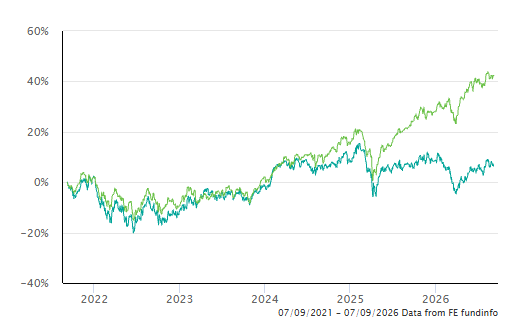
Fundsmith Equity’s five-year performance against the Investment Association Global fund sector highlights the underperformance of this previous high-flyer:
Source: Trustnet
Comparing Fundsmith Equity to the FTSE 100 provides an even starker contrast; the FTSE is up c.55% in five years plus dividends.
Although Fundsmith’s annualised return of 13% since its inception in 2010 remains impressive, the fund has underperformed its MSCI World Index benchmark for the last five years.
Mark’s article rang a bell with me, not least because a number of my own quality stocks have underperformed badly over the last few years.
I was also interested for a second reason. In May 2023 I created a new stock screen designed to find potential Quality Compounders. These are businesses able to generate consistently high returns on capital, while also investing for long-term growth.
A true quality compounder can outperform the market for a long time, but they are relatively rare beasts. I wasn’t sure whether it was realistic to use a screen-based approach for an area of the market that often requires subjective judgements on the quality and durability of a business.
To see what I could learn, I’ve tracked the results of this screen using a model portfolio. In this article I’m going to take a look at performance over the last year or so and share an updated list of the stocks in the portfolio.
Here are the links to my previous articles on this screen for some background:
May 23: Building a screen to find Compounding Quality stocks
July 25: After an eventful two years, has my quality screen beaten the market?
You can find my Compounding Quality screen here.
Portfolio performance
The rules for this portfolio are fairly simple. I rebalance using the latest screen results once a year, selling stocks that no longer qualify and adding in replacements from the screen. My aim is to have 20 stocks, but there’s some flexibility on this.
Last year, I introduced an additional rule to sell shares if they fell more than 25% below their original cost price.
I’ll return to portfolio trades in a moment.
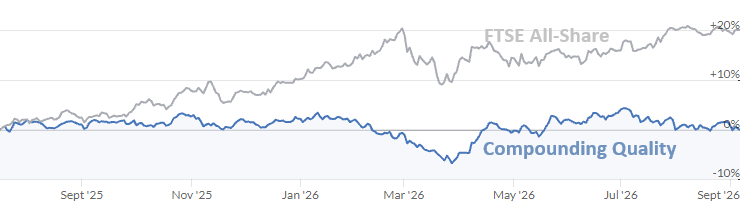
First, here’s a snapshot of the portfolio’s performance against the FTSE All-Share index since July 2025.
I don’t think index trackers will be feeling any FOMO here. The portfolio has delivered a flat result during a period when the UK market gained c.20%:
Of course, a year is a short time for a quality compounding strategy. Performance since May 2023 is slightly better, with the portfolio up 15% versus around 38% for the All-Share:
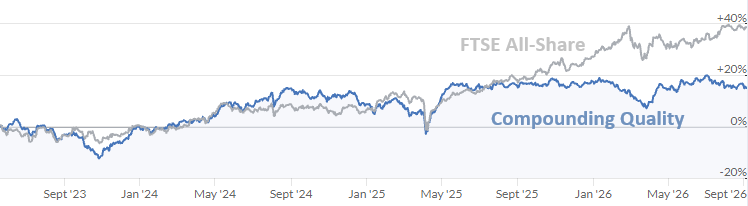
These charts exclude both dividends and costs, but I don’t think their inclusion would have made a big difference to the overall shape of returns versus the UK market.
It’s clear that the performance of my Compounding Quality screen has been disappointing so far, but in my defence I think it’s been a tough period for traditional quality. My performance above is roughly the same as that of the Fundsmith Equity fund over the same period.
Portfolio update & trades
Here is how the Compounding Quality portfolio looked on 7 September, before it was refreshed from the latest screen results:
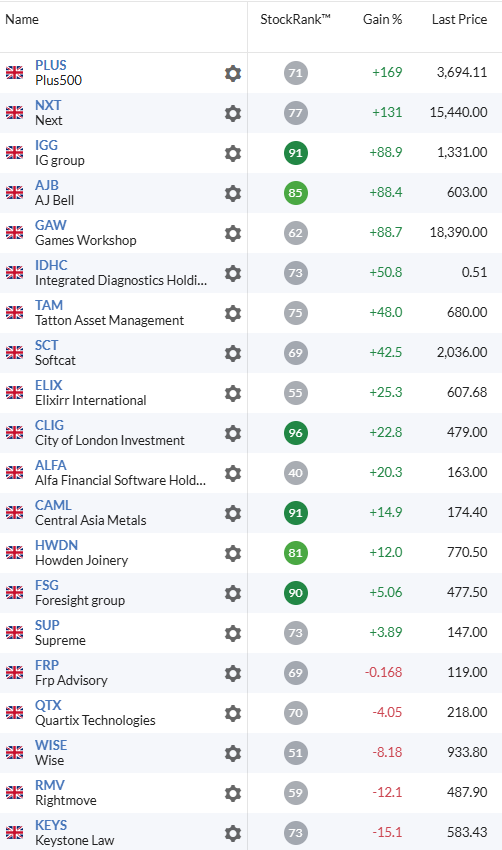
There have been some decent winners here – mostly names that will be familiar to DSMR readers.
This isn’t the whole picture, though. A number of positions were closed at various times during the year when they fell through my 25% stop-loss threshold. Equally, some positions were added.
This chart shows the Jul 25 - Sept 25 price change of all positions held, including those that were sold or bought mid-year:
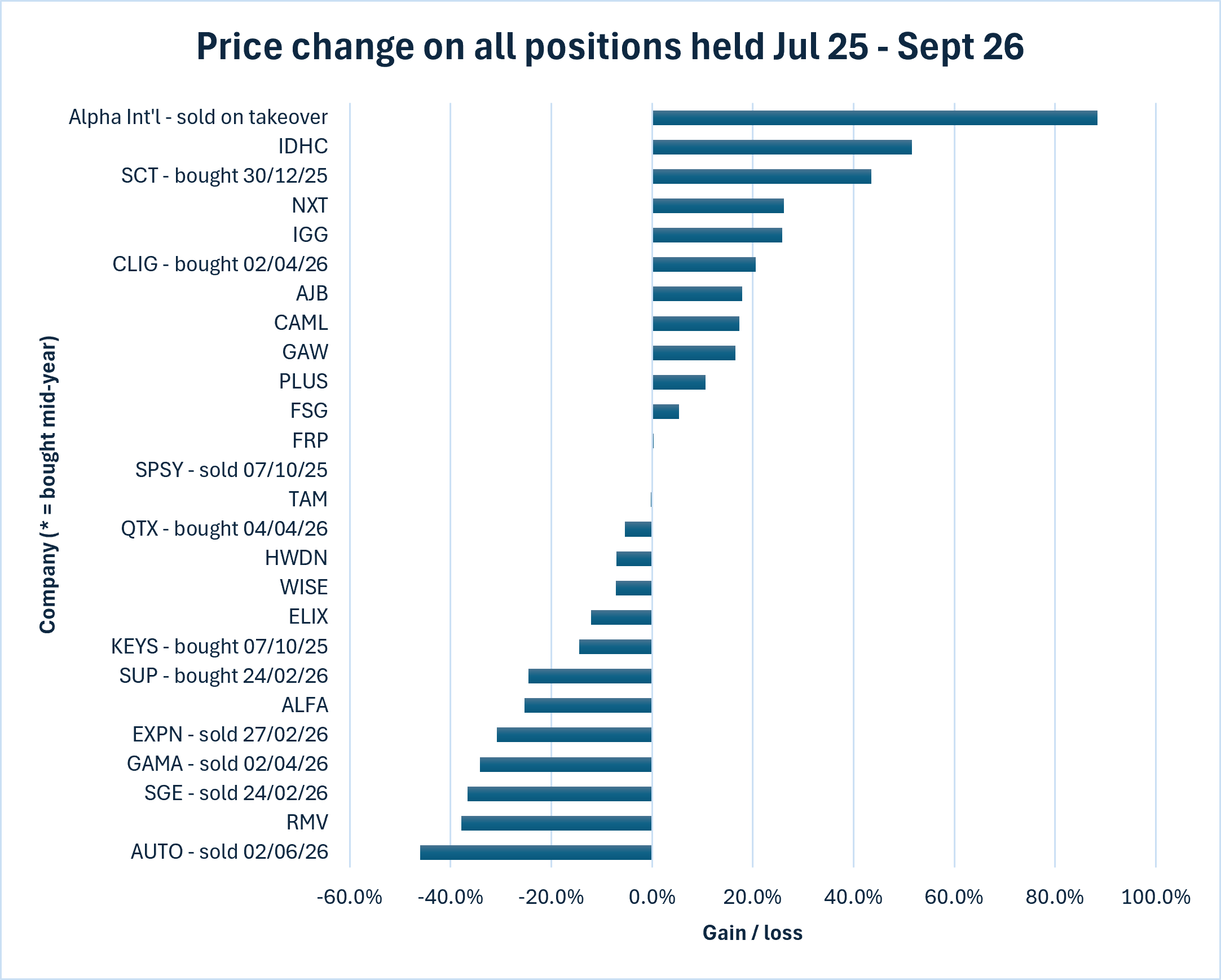
The overall average gain on positions held during the year was 1.6%, including sales and mid-year purchases.
On balance I think my 25% stop-loss rule created more churn than necessary. As I only check the portfolio monthly, some stocks fell much further than 25% before being cut. At the same time, some of the more obvious quality names – Experian and Sage in particular – have rebounded from the lows seen earlier this year.
However, this kind of inefficiency is typical of a systematic approach. In my experience, the impact is sometimes less than the alternative inefficiency and bias that results from a fully discretionary strategy.
I’m going to leave the rules unchanged this year, in any case.
Portfolio changes for 26/27
To prepare the portfolio for another year, I completed a two stage update process.
First of all, I sold all the stocks that no longer qualified for my Compounding Quality screen. Here’s a list of the stocks sold:
Company | Buy date | Buy Price (p) | Sell date | Sell price (p) | Return | Annualised return |
City of London Investment (LON:CLIG) | 02/04/2026 | 390 | 07/09/2026 | 479 | 22.8% | 60.8% |
Central Asia Metals (LON:CAML) | 22/07/2025 | 151.8 | 07/09/2026 | 174 | 14.6% | 12.9% |
AJ Bell (LON:AJB) | 18/05/2023 | 320 | 07/09/2026 | 604 | 88.8% | 21.2% |
Howden Joinery (LON:HWDN) | 18/05/2023 | 688 | 07/09/2026 | 769.5 | 11.8% | 3.4% |
Supreme (LON:SUP) | 24/02/2026 | 141.5 | 07/09/2026 | 146 | 3.2% | 6.0% |
Plus500 (LON:PLUS) | 18/05/2023 | 1371.8 | 07/09/2026 | 3706 | 170.2% | 35.0% |
Elixirr International (LON:ELIX) | 18/05/2023 | 485 | 07/09/2026 | 604 | 24.5% | 6.9% |
Wise (LON:WISE) | 22/07/2025 | 1017 | 07/09/2026 | 930.8 | -8.5% | -7.5% |
After cleansing the portfolio, I sorted the screen results by StockRank and then added the new shares to the portfolio. Where there were duplicates (for example MP Evans and AEP Plantations) I took the approach of choosing the company with the higher StockRank.
As it happened, my new additions took the portfolio up to its target strength of 20 stocks.
Here are the new stocks for this year:
Company | Buy date | Buy Price (p) | Latest DSMR view |
PayPoint (LON:PAY) | 07/09/2026 | 613.00 | GREEN (29/07/26) |
M P Evans (LON:MPE) | 07/09/2026 | 1784.00 | AMBER (12/06/26) |
Serabi Gold (LON:SRB) | 07/09/2026 | 295.00 | AMBER/GREEN (23/07/26) |
MTI Wireless Edge (LON:MWE) | 07/09/2026 | 67.00 | GREEN (17/08/26) |
IMI (LON:IMI) | 07/09/2026 | 3068.00 | n/a |
Kainos (LON:KNOS) | 07/09/2026 | 1230.00 | AMBER/GREEN (18/08/26) |
Experian (LON:EXPN) | 07/09/2026 | 2807.00 | AMBER/GREEN (21/01/26) |
Halma (LON:HLMA) | 07/09/2026 | 3648.00 | AMBER (11/06/26) |
Thoughts on quality: all of these stocks have a QualityRank above 70. They also satisfy the other screening criteria I’ve used to try and identify potential compounders. Even so, I think it’s fair to say that some of these businesses are better quality and potentially more durable than others. This too is in the nature of a systematic approach.
Here’s a snapshot of the updated portfolio on 7 September 26. These are the stocks I’m going forward with for the next year, barring any forced transactions:
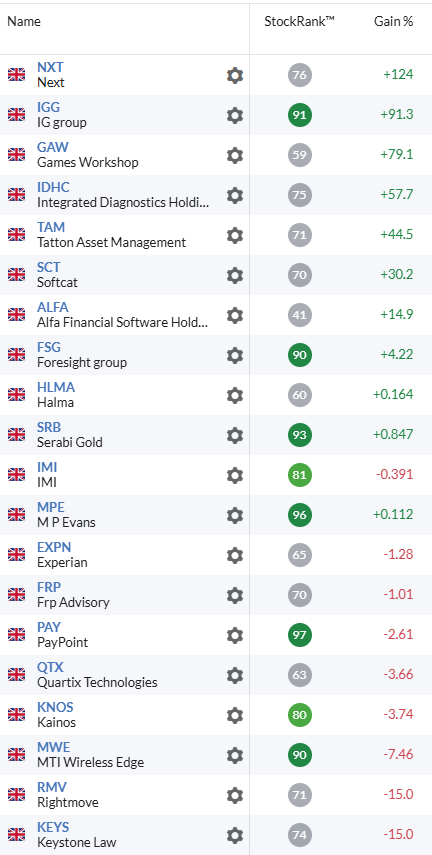
Next step: to follow up this update, I’m going to select one of the new additions to the portfolio to be the subject of a Stock Pitch next week.
Let me know: I’d love to hear your thoughts on quality investing – is it a lame duck approach that’s had its day, or is this strategy about to regain its former appeal (and success)?
Disclosure: at the time of publication Roland owned shares in IGG, CLIG, ALFA and SGE.
Disclaimer
This is not financial advice. Our content is intended to be used and must be used for information and education purposes only. Please read our disclaimer and terms and conditions to understand our obligations.

6 comments
Hi Roland,
Many thanks for your piece on quality compounders. In the article you question if quality compounding shares have a place in a portfolio especially as we have seen high profile funds move to a more momentum approach.
My view is quality compounding shares are a feature of any portfolio, as they have shown in the past to “compound” up their earnings etc. As such these shares are not speculative with possible high returns but are consistent in their returns. As such they should from part of the portfolio and with part in more speculative shares.
However, I would not buy a quality compounding share at any price.
I would look for good quality shares which are currently undervalued. The list of compounding shares is based on past accounting data ( e.g. sales and margins) and does not consider any future estimates of return nor any valuation measures ( e.g. p/e etc.)
I would add three main additional tests to the list of your quality compounders before investing, namely :-
Again many thanks for your article and look forward to seeing the next Stock Pitch
(*) increase in 200 day moving average is the difference in the moving average from now and ten days ago – usually performed using google data. Look for increasing values.
(**) awesome indicator value calculated as the difference between two short term moving averages using the typical (average daily) price - again calculated using google data.
Hi Roland - curious to know when you say "As I only check the portfolio monthly, some stocks fell much further than 25% before being cut." - why wouldn't you set a stop loss or at least an alert for your stocks?
Roland (LON:SRB) Temporary Licence on the larger mine they operate runs out in a few months, surly must be a major risk factor, is that still classify as quality in your opinion ?
Hi Jenny,
Thanks for the suggestions. I can confirm that my Stock Pitch next week will be on one of the companies you mention! Watch this space.
Roland
Thank you Roland