High Flyers - how to beat the market in expensive and highly priced shares

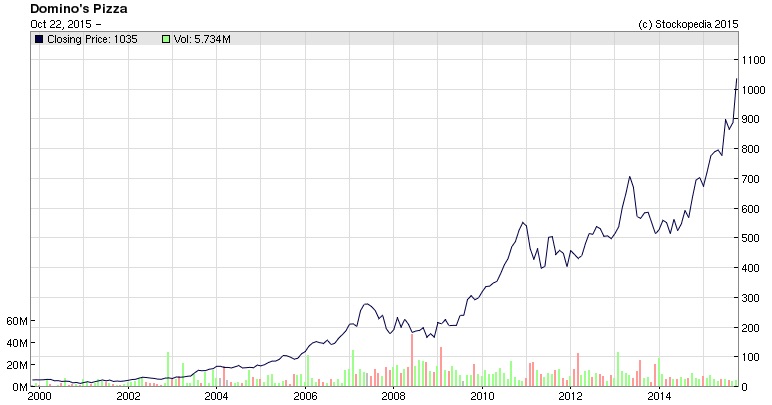
Last week Domino’s Pizza broke out to yet another stunning new high. This is a share we bought at 75p in 2004 for our family investment club and I’m proud to say we still hold. It’s now trading at 1043p per share making it a 14 bagger over an 11 year period - a 27% annualised capital return before dividends. Domino’s hasn’t just been a long term winner…. it’s been a standout performer in almost every 2 year period since it first bounced up from its lows back in 2001. Even in the last 2 years this stock has doubled in price and in all this time it’s almost never, ever been cheap. Since the financial crisis I don’t think Domino’s has traded beneath a Price Earnings ratio of 23, which begs the question of when on earth could a value investor have ever bought this share? If Value Investors admit they couldn’t then isn’t there something that they are missing?
The problem with value investing
We human beings are genetically hard-wired to look for bargains. If you can pick something up for less than it’s worth you might just have a happy outcome and a few spare pennies in your pocket to boot. It’s a strategy that works in the flea market and it works just as well in the stock market. Buying cheap is the core tenet of value investing - the strategy that has minted thousands of stock market millionaires and quite a number of billionaires too.
But there’s a problem at the heart of value investing which leads to a certain blindness. Value Investors have an inability to consider any stock that is even remotely pricey. Take a look at this chart and you’ll understand why.
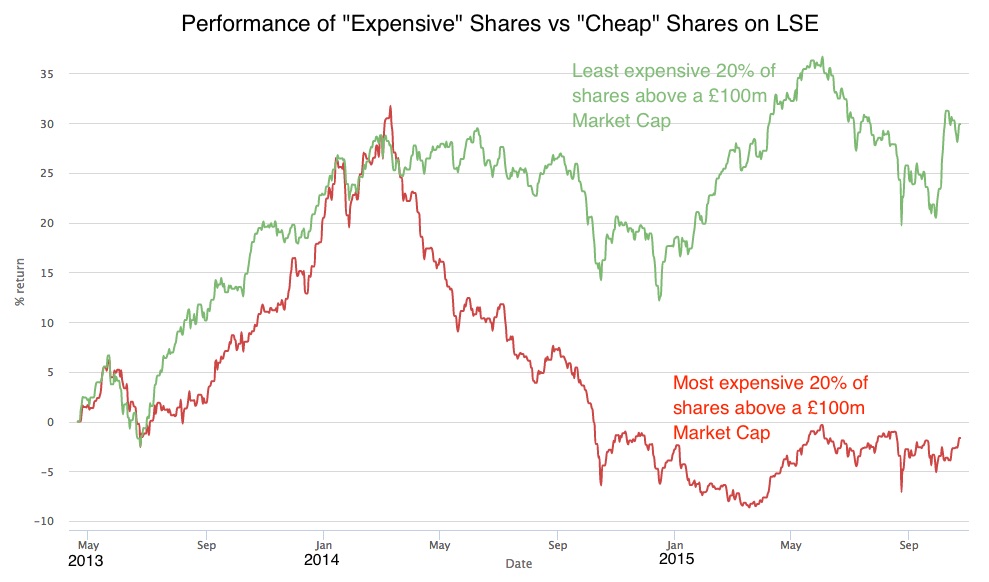
The chart shows the performance of the cheapest 20% of the stock market (green line) vs the most expensive 20% of the stock market (red line) over the last 2 years according to the Stockopedia Value Rank. There’s about 200 stocks in each of those portfolios, but the cheap set of stocks has outperformed the expensive set by a massive 32%.
These results, from the last few years in the UK, are very typical for stock markets. Cheap shares tend to outperform expensive shares. So any rational investor, when asked to pick a winning portfolio of 50 stocks, would most likely go shopping amongst the higher probability set of shares… the cheap ones…. right ?
Lies, Damn Lies and Statistics
Well herein lies the blindness, and perhaps naivety of Value Investors. You see, nestled amongst that set of expensive shares lie some of the greatest companies listed on London Stock Exchange including Dominos’ Pizza, Betfair, Abcam, Next and Rightmove. These companies have trounced the market for years, and most likely some of them will continue to trounce the market in the coming years.
As I’ll be illustrating, there’s a set of 25 shares that could have been very easily selected using the tools at Stockopedia. This portfolio has managed a total return of about 60% over the same time period - a performance that has crushed the 30% average returns of the ‘cheap’ portfolio of value stocks and made a mockery of the -2% returns of the ‘expensive’ portfolio.
Averages, you see, can be highly deceptive - some expensive shares really are worth it. While I hope to show that it’s surprisingly easy to pick them, for Value Investors the process requires a bit of a mind shift. So let’s go a bit further down the rabbit hole to find out why.
The trick to pick’em - a brief interlude
There’s a trick to picking winners from the pool of expensive shares and it comes down to having a solid understanding of the key factors that drive stock returns. Academics bicker and fight over which factors are the most important, but in a nutshell we can simplify the most powerful to the following three which also make up the core triad behind the Stockopedia StockRanks:
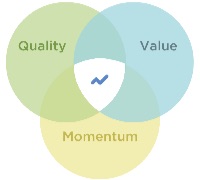
- Quality - i.e. good shares tend to outperform junk shares.
- Value - i.e. cheap shares tend to outperform expensive shares.
- Momentum - leading shares tend to outperform lagging shares.
If you imagine driving a go-kart, you can propel yourself in three different ways - with an engine, using gravity or just by continuing to free-wheel. These three forces are analogous to the quality, value and momentum forces that drive share prices in the stock market. Now in the perfect scenario one might like to find shares exposed to all three drivers but in fact all three aren’t necessary.
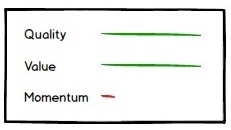
Take one of these drivers away and the other two work just fine without it. Value investors tend to solely focus on just two of the drivers quality and value. They can be thought of as ‘Contrarians’ who look to buy good shares cheaply and don’t mind price action to be weak as it gives them a chance too buy shares when they are marked down. It’s a smart strategy and a profitable one, but it’s a strategy that will never allow them to own a stock like Domino’s Pizza. Contrarians may not realise it, but they are deliberately removing momentum from their model of the universe which may be a costly oversight.
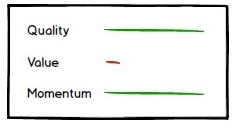
In just the same way, there is a less popular, but just as profitable strategy that removes the concept of “Value” from its model of the universe. By focusing on investing in the highest quality, highest momentum shares regardless of price it’s quite possible to trounce the market. We christened this set of shares “High Flyers” earlier this year in a blog post titled ‘The Taxonomy of Stock Market Winners’ but it’s a strategy that’s been used by some of the greatest investors of all time.
If we use the Stockopedia StockRanks we can see the effectiveness of this approach over the last few years. The following chart was created using the High Flyer Stock Screen to build a portfolio first selected in April 2013 and rebalanced annually in April. It simply searched for shares qualifying for the following criteria:
- Market Cap > £100m (i.e. no microcaps)
- Value Rank < 33 (i.e. expensive)
- QM Rank > 90 (i.e. high quality, high momentum)
- Top 25 by QM Rank.
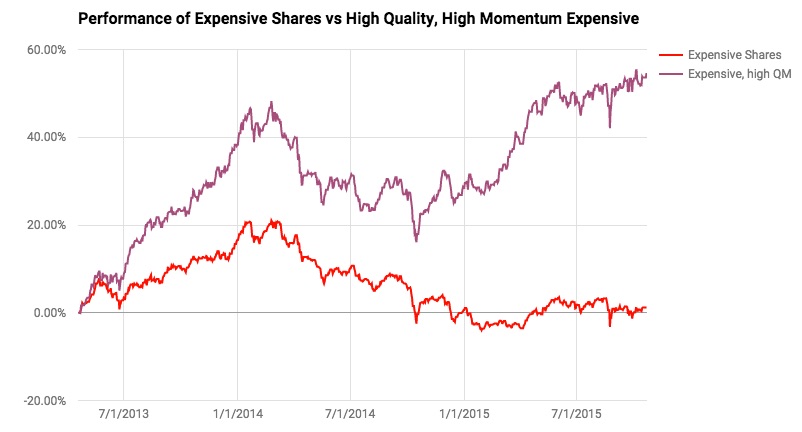
This is a portfolio that has had an average P/E ratio of over 30 with the most expensive stock’s P/E ratio at times being over 100! To those Value Investors who have only a narrow view of the universe that seems an extortionately high price to pay. But clearly, under certain circumstances, ignoring P/E ratios can be a completely rational thing to do with a high probability of favourable outcome. The portfolio listed above showed a capital return of 55% over two and a half years at an annualised return of 19.0%.
High flying investing greats

So who are among great investors who have had the instinct to invest in High Flyers? One of the first advocates was the wildly successful fund manager Richard Driehaus who was profiled in Jack Schwager’s excellent book “The New Market Wizards” . Driehaus looked at the common attributes of spectacular stock market winners and realised he could never buy them on low P/E ratios. “Many of the best growth stocks have high multiples and are psychologically difficult to buy.” So he tore up the rule book and looked for high quality, high momentum shares. His anti-value strategy was summed up in this quote:
“One market paradigm that I take exception to is: Buy low and sell high. I believe that far more money is made buying high and selling at even higher prices. That means buying stocks that have already had good moves and have high relative strength - that is, stocks in demand by other investors.”
It worked very well for Driehaus who generated 30% annualised returns over a 12 year period.
Beyond Driehaus, one of my favourite authors is William J. O’Neil, who wrote “How to Make Money in Stocks” which I thoroughly recommend to all investors. O’Neil spent years analysing what worked in stock markets, and bought a seat on the NYSE from his trading profits. He went on to found investors.com and publish Investors Business Daily - both excellent resources for US bound investors. O’Neil famously disregards the P/E ratio completely.
For years analysts have used P/E ratios as their basic measurement tool in deciding whether a stock is undervalued and should be bought… but our ongoing analysis of the most successful stocks from 1880 to the present shows that P/E ratios were not a relevant factor in price movement.
In his analysis of the greatest stock market winners of all time from 1953 through to 1995 he found that: the “beginning P/Es for most big winners ranged from 25 to 50, and the P/E expansions varied from 60 to 115”. In other words if you really wanted to find the great stocks you had to be willing to completely ignore traditional measures of value.
The nitty gritty - resources, ratios & metrics that can help hunt for High Flyers
So if you don’t have access to the StockRanks how can you isolate these potential big winners amongst expensive shares ? Well they tend to share certain attributes which can be easily screened for using a good data source like Stockopedia. We’ve discussed Quality and Momentum - but those concepts need to be a bit more closely defined so here’s a few links to some of our screening library data which may be of use to the curious:
In general terms - a Quality company is one that is highly profitable ( ROCE, ROE, GPA ) with high industry leading margins, stable, growing and ideally accelerating sales and earnings, with a strong and improving fundamental trend (F-Score), a good shareholder payout (Yield, Buybacks) without having any risky red flags (e.g. Bankruptcy risk, Earnings Manipulation Risk or Share price volatility).
A Momentum stock is one whose share price is up or above it’s 52 week highest price, is within the top 20% of share price percentage winners for the last 6 or 12 months (using Relative or Absolute Price Strength), is beating broker estimates (earnings surprise) and seeing estimate upgrades and recommendation changes.
Some of my favourite stock screens for finding these kinds of shares include the Richard Driehaus Screen and the CAN-SLIM-esque Screen, both of which have massively outperformed the market in recent years. I’ve also linked to our own proprietary StockRanks generated High Flyers Stock Screen. I am not going to list all the current qualifiers as that would be unfair on Stockopedia subscribers but the list of 61 current High Flyers makes fascinating reading. These really are some of the UK’s most excellent businesses, but of course they are highly prized by the market and very expensive !
Where high flyers go next….
There are a few words of caution needing here. These kinds of shares tend to be more volatile than the market and as they have high price momentum they can suffer reversals more strongly than the overall market. This is clear to see in the performance chart above.
In my own experience few shares can stay a High Flyer for too long - especially in the UK as the market just isn’t as big as in the USA. Companies that do, like Domino’s Pizza, are the exception, rather than the rule. Most will spend a couple of years as a High Flyer before one of two things happens - either the stock or the company runs out of steam. So running a portfolio like this requires active management - regular portfolio rebalancing to keep jumping into the next set of High Flyers before the previous set runs out of steam.
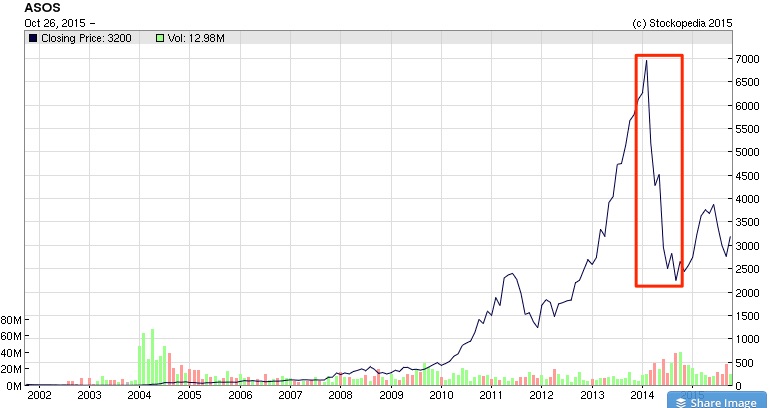
Expensive shares are very fragile as the market has high expectations for them. If those expectations are not met then the market reaction can be brutal. ASOS, the famous online fashion retailer, is a classic example. This stock soared, at times trading at beyond a P/E ratio of 100. But when the company finally disappointed the shares were decimated falling by something like 65% till they bottomed.
1. High Flyers can become Falling Stars
In ASOS’s case the broker expectations proved too high, so the share price ran out of steam (falling momentum). This left it as a high quality company on a very expensive valuation with sentiment turning against it. Finding a floor under a stock with this profile is hard as P/E ratios can contract dramatically. We call this profile of stock Falling Star and it’s one of the worst places to be as an investor.
2. High Flyers can become Momentum traps
The other, less usual, place for a High Flyer to end up is where the fundamentals deteriorate but the share price (momentum) keeps on trucking. These are known as Momentum traps and are most often seen in bubble periods where the market divorces itself from fundamental reality.
The final caution is that there are more stocks qualifying as “High Flyers” than I’ve seen in three years, so it may be that chasing these stocks is becoming a crowded trade.
Final Words
So my general rule of thumb with High Flyers is to watch them like a hawk, and sell as soon as price momentum or fundamentals turn. If you are really sure that the shares have a rock solid economic moat, and the valuation isn’t too stretched then it’s possible to continue to hold these shares through corrections. Your share may turn out to be a magical, multi-year compounder like Domino’s Pizza, the kind of share that comes along only a few times every decade that we’d all love to build our portfolios around.
That kind of masterful judgment, I have to admit, I have long given up on. In the introductory paragraph I boasted about owning Domino’s Pizza in my investment club. Let me sign off by humbly admitting the reality. The only reason we still own it is because the club hasn’t met since 2005. If we had, we’d definitely have sold it. Sometimes it pays to do nothing! Safe investing ;-)
To find out more about the taxonomy of stock market winners, you can browse through the entire series:
- Towards a taxonomy of stock market winners
- Contrarian stocks - how going against the crowd can put you ahead
- High Flyers - how to beat the market in expensive and highly priced shares
- Turnarounds - how to find value shares that are bouncing back
- Falling Stars - how to handle glamour shares that fall from grace
- Value Traps - how to avoid bargain stocks that might never recover
- Momentum Traps - how to avoid the siren song of overhyped stocks
- Sucker Stocks - why do we love to own the worst prospects in the market?
Disclaimer
This is not financial advice. Our content is intended to be used and must be used for information and education purposes only. Please read our disclaimer and terms and conditions to understand our obligations.
32 comments
Ed, I'm afraid none of those links work. The first 2 there is a problem and the second 2 the shares are all blanked out.
Thanks Ed, just two questions.
You give the link to the High Flyer screen in the article. Otherwise how do you get to it - i could not find it using the screens tab.
Any data on the historical performance of the the High Flyer Screen, ideally by region?
I think you need to look under "Ranks", "QM rankings" - gl
@qvg - you can either go here and look at the highest QM Rank screen - https://www.stockopedia.com/screen-groups/top-stock-ranks-8229?edition=gb, or alternatively check in the Styles folder and look for High Flyers https://www.stockopedia.com/screen-groups/stock-rank-styles-8234?edition=gb
Ultimately you'll end up in one of these two screens:
Hello again .
l feel obliged to mention that through years of observation , since 1980 , the Darvas Box system of trading always seemed to be a worthwhile strategy .
Perhaps my inborn tight-waddiness prevented me from buying into any stock's new high per the Darvas method .
Yours , R .
Hello Ed .
As a " life-long " chartist l now intend to use the very best Q + V stocks to trade per my chart method .
Back testing over the last five years on daily , weekly and monthly charts seem to prove the strategy's efficacy .
Thank you for all of your comments and good work .
Regards , Robert .
This is possibly quite an important article, http://www.valuewalk.com/2015/11/39-of-stocks-have-a-negative-lifetime-total-return/. A small number of stocks drive the performance of any index. Outperformance is possibly reliant on owning the right stocks at the right time http://www.bloombergview.com/articles/2015-11-11/why-indexing-beats-stock-picking.
Yes probably true but your second link is not working.
http://www.bloombergview.com/articles/2015-11-11/why-indexing-beats-stock-picking
That's an old argument. One of the best articles on the subject was by William Bernstein. http://www.efficientfrontier.com/ef/900/15st.htm
While I admire Bernstein, I do believe that argument is a nonsense. While it's great to own an Apple or an ASOS at the right time you don't have to to do exceptionally well in the stock market. The StockRanks history has shown that half the market is rubbish, but owning the other half can help you do rather well. Sensible factor investing works well.
The index investing camp is incredibly good at marketing and seeding mantras into the media. There are literally armies of Bogleheads out there who believe that the whole world should join them in their market cap weighted, 'own the world', be-average-to-win, investing philosophy. It's just so much bunk and could well lead to disaster. I wrote this a few years ago and stick by it - http://www.stockopedia.com/content/index-funds-are-parasites-and-are-going-to-kill-the-market-71683/
Hi Ed,
Thanks for the reply, ignoring the significant numbers of junk is clearly important.
The message I have taken home from this article and the other articles such as the ones I posted are not to be afraid of stocks just because they are expensive, and have started to load up on high QM stocks, keeping each position size small. One thing I would be interested to see in this context is the frequency of ASOS type blow-outs whilst a stock has a QM rank of 90+.
Just come across this article, very interesting. I do agree about Next (LON:NXT), always looks too expensive but I'm considering it now it has fallen back. I do hold a few of those on the High Flyers list, in fact considering selling most of them. Another one that probably has been on their before is Ashtead (LON:AHT), thats gone up over x10 in just over 5 years, does not always look expensive as goes up and down quite a bit. Clarkson (LON:CKN) is another, I did hold this year but sold out around 2800p.
Looking at the log graph of Domino's Pizza (LON:DOM), I see that up to 2007 there was a steady geometric rate of increase but after 2009 it rose in fits an d starts with long periods of consolidation. Is there any known reason for this change in behaviour - or perhaps its just chance?
You really didn't expect me not to back test your 200 day moving average Ed. My only reason for the reply is in case a Newbie read about the 200 day moving average and thought it was a gift from the gods. I used an exponential rather than simple 200 day moving average as it gave less trades and starting in June 2004 at 62p assuming one only traded when there were two clear days above or below the average the following is the result. You would have bought and sold 38 times up to June 2014 and although the price had risen to 555p you would have netted approximately 89 points rather than 493 assuming buy and hold, plus costs on 38 trades. By this time even the most determined investor would have probably given up just in time to miss the uninterrupted rise to 1080p. The problem with many such concepts is the sideways movement, I think the Americans call it being whipsawed. As we all know many shares spend some time going sideways. Source ShareScope.
I never suggested an investor should use a moving average crossover system Ken. That's just mindless TA and can lead to endless churn - especially during consolidation phases. Moving averages though can be very useful for timing exits after long trends - that's why I posted the charts - especially the second one.
Judgement based trading requires... judgement. An investor with some capacity for judgement may be able to recognise consolidation phases, and thus not attempt to buy shares right after the climax of a huge move when a stock is likely over-extended w.r.t. valuation. It's better to buy off sound price bases after most of the churn in ownership has occurred - there's lots of great literature on the topic. The consolidation process can take 6 months or more after big price runs have happened. I wouldn't be surprised if Domino's starts to consolidate again soon given the history and given that only 2% of the time has it traded higher vs its 200d MA.
While I've had a lot of success trading stocks out of consolidation bases, I gave up on it as it's too much admin - I don't like watching stock charts every single day.
These days I just run a mechanical cyclically rebalanced portfolio, with some judgement based manual stop losses and variable amounts of short selling to limit downside volatility. Works well for me, gets me far higher returns than I did before and is much less stressful.
"When to sell" for me therefore has become a question of 1. cyclically checking my screens to see if stocks still qualify on a calendar driven basis - if they don't they go, 2. finding suitable short sale candidates for hedging. 3. regularly pruning loss-making trades.
The whole process becomes a bit more like gardening - sowing some crop early in the season, pruning and weeding weekly, hedging in case of bad weather and reaping later in the season.
I really enjoyed your article Ed because until the very last paragraph it caused within me a burning question-- when would you sell? During the period of holding Domino had some very short but sever corrections 48% in 2007 over 6 months and two further periods in excess of 30% since. So we are left with two thoughts neglect isn't a bad thing, "some of the time" and hindsight investment works 100% "all of the time". I go back a very long way starting my investment career around the time that Slater Walker went bust, yes the same Slater. I was introduced to Elliot Wave which was conceived in a bygone era and worked for one man. It has only ever worked in hindsight for me but it does give a possible warning of a major turn. Dow theory was another, Fibonacci another I wont go on. There are two components to investing and only two-- you buy and you sell- my problem and I would suggest many others is when!! Buy and hold works providing you live long enough and you didn't buy at the top, trading works but only until it doesn't. Stockopedia is probably one of the best programmes available to the private investor and is full of useful information to assist with buying, but when do you sell?
Ken - that's easy - you sell when a stock reaches its maximum share price.
But seriously - it's important to set rules for exit as well as entry. If you don't have strict sell criteria you can end up changing your reasons for owning a stock while you own it. Self-deception is rife when owning winners.
There are lots of sell strategies that "work". For high QM shares... the key turning point is normally a loss of momentum so a lot of very standard technical stop loss strategies can work well. If a Domino's investor had used the 200 day moving average as a timing rule they'd have preserved the majority of their gains all the way up.
Hindsight as you say is a wonderful thing.
I've often used the difference between the 200d Moving Average and the current share price as an indicator of whether a share is too over-extended. William O'Neil once said that you should sell whenever a share moves 70% or more above its 200 day moving average. I find that's too 'loose' for UK stock markets. Most UK stocks never get that far ahead of their average prices - story stocks might but they'll have much spikier price action.
Domino's is currently 34% above it's 200d MA... which is quite punchy. If you look at the history above whenever the share has risen this far above the 200d MA it's normally led to a consolidation phase. Here's my spreadsheet analysis:
How much further could Domino's go? Well statistically, since 2008 the share price has only been this far above the 200d moving average 2.1% of the time.
This is surely a question of your definition of Value Investing.
If Value Investing is defined as being reliant on a quantitative search centered on past profitability it will always miss (explosive) growth stocks which will 'look' expensive relative to past profitability. You seem to be using a similar definition in your opening paragraph "in all this time it's almost never ever been cheap"
But what if you define Value Investing as a search for stocks trading well below what they are intrinsically worth, a calculation based on an estimate of future profitability? Back in 2004, value would have been apparent to any investor correctly forecasting rapid growth in 2004.
To quote Buffet:In our opinion, the two approaches are joined at the hip: Growth is always a component in the calculation of value, constituting a variable whose importance can range from negligible to enormous and whose impact can be negative as well as positive.
PS I find your closing remarks confusing. You say on one hand that "my general rule of thumb.. is to watch them like a hawk" and a few sentences later write that you last investment club meeting was in 2005 "sometimes it pays to do nothing"!
Hmmm ............... the graph for Domino's Pizza (LON:DOM) looks very dramatic; hwever using a log plot gives a different picture!

The time to have held Dom was from 2001 - 2007!
Indeed 2001-2007 would have been a great time to own Domino's - it ten-bagged between the low in 2001 to 2007 - and has "only" six-bagged since. I managed to pick some up both for my p.a. and my family account in 2004, right at the arrow in the image below. It took me till 2004 to get fully back into the market after the great bear between 2000-2002.
I think Domino's has been a classic example of Nicholas Darvas' 'box model' - where a stock stepwise breaks out of consolidation zones to dramatic effect - red boxes above. Buying breakouts is a form of momentum trading and it can be wonderfully effective. Most investors wait for new lows - not new highs... but in market leaders like Domino's it really pays to buy when they break out of consolidation phases to new highs on good news. There can be a big opportunity cost if you get stuck in a high QM stock during a consolidation phase - often a good strategy is to set alerts and buy the breakouts. It's ironically often a lower risk way to play them. See Minervini/O'Neil et al.
Cracking article Ed!
Took me a while to find it though. Has it been moved from the homepage for a reason?
Regards,
DS
Linked from abnormal returns today. http://systematicrelativestrength.com/2015/10/26/buy-winners-2/
Hi Ed,
I'm interested to know why you select expensive high QM stocks?
I do select high QM stocks but I refine my selections by looking for a low PEGR combined with increasing EPS.
I guess I'm looking for factors that might justify a more expensive rating rather than buying them because they are expensive.
Thanks in advance
Phil
Phil - the main point of the exercise was to show that while expensive shares in general are a bad bet, there are some expensive shares which do very well... high quality, high momentum, expensive shares. i.e. it's possible to completely disregard value or price and still beat the market handsomely. The piece is really designed to make Value Investors think.
I think strategies like Jim Slater's Zulu Principle are high QM strategies - but they have a small value bias. Slater has a P/E 20 cutoff. That I think helps with performance as there's room for the multiples to grow further. When I bought Domino's it was on a 17x P/E... so that definitely helped.
I guess what I'm saying is that high Q high M are the factors that justify an expensive rating. Hope that makes sense?
Ed,
I like this style of investing and whilst there is loads of O'Neil literature there is much less about Richard Driehaus. So just brought, The New Market Wizards book mentioned above for £3.75 on EBay - A steal? Thanks for the recommendation. Ian
I've got all the Market Wizards books. There's Market Wizards, New Market Wizards, Stock Market Wizards and Hedge Fund Market Wizards. Schwager has also written an excellent book to summarise all the lessons. I couldn't recommend them all more highly.
There are lots of other high Q-M investing style characters out there. I think this is the one style of investing where a full time trader can quite possibly reap 100% gains in a single year. But it requires exceptional discipline and single mindedness - there's a few guys who've won the US annual trading competitions and they tend to be QM or GM traders.
Here's a few pointers for those who are interested in the high QM topic:
You could probably add Jesse Livermore, Bernard Baruch and a few others to this list - as well as any of the William O'Neil proteges like Chris Kacher.
There's an important point about these strategies. A lot of the above books like to focus on the faster moving 'quality' companies. i.e. faster growth leaders - in the US that would include stocks like Facebook (which used to be the highest QM share in our system but the quality rank has started to slip - momentum trap?). The problem with the faster growth stocks is they can have highly erratic price action. So stop losses become quite critical if trading them.
Slower growth/steady 'quality' is often a safer bet for longer term investors who aren't gunning for 100% gains annually. Consumer product stocks like Reckitt Benckiser and Unilever have a much more steady, moderately high QM profile and continue to be sound capital allocators.
I find the whole subject fascinating. I do try to shoe-horn all investment strategies into a kind of unified QVM whole... but it really helps me understand what works and what doesn't. There's so many types of strategy, all are correct, all can build wealth - there is definitely a wrong way to invest - but there's lots of right ways. I wish people would respect each other's methods more - I find that most Value Investors think Momentum Investors are spivs, while most Momentum Investors think Value Investors are dullards. That's a shame.
Thanks for a good article Ed. There is another category of stock that flies high. Only momentum, not quality or value, signals these stocks. I refer to a market revaluation in the light of future expectations that is currently underway with Hutchinson China Meditech and was also apparent with Allied Minds. As Mark Slater pointed out the drug pipeline at HCM was originally in for nothing. These stocks are rare and remain very sensitive to any shift in expectations.
Interesting article and I think it goes to the heart of the "what is quality debate". Clearly Stockopedia can only assess quality through backward looking quantitative tools. Given that quality is the underlying business franchise going forward it seems to me that we need to be cautious in how quant tools can assess it.
A stock can look high quality through quant filters (cash flow etc) but can be seeing its underlying business franchise wane. Or a stock can look expensive but be high quality. ARM Holdings is a good example.
I'd define quality in two ways 1) business resilience 2) business prospects. Domino's Pizza clearly has both in spades. As a franchising business it just collects a franchise fee and in terms of prospects it was a simple roll-out concept.
An interesting thing about Domino's is it highlights the importance of stock selection rather than trading. If we spent all our time just trying to find the highest quality businesses we could buy them and do nothing and still outperform. Instead we try to think we are clever and trade things or sell winners and buy weaker stocks.
Someone mentioned Fundsmith and their approach is very interesting. Just identify the globally best quality stocks using return on capital. Then invest in the ones that are relatively attractive by valuation. This limits the temptation to buy low quality but "cheap" stocks. In the case of Domino's Pizza it is high quality as it has a small high street footprint and so can generate high returns on capital.
A super high quality business is one with resilient demand, is resilient to competition and is low risk. Then it also needs to have strong growth prospects. Probably Facebook would qualify as Google tried to compete but failed so it is a strong franchise. Clearly mobile advertising is growing fast so the long-term prospects are strong.
The crux is that quality should probably be assessed qualitatively. Although ratios such as operating margin and return on capital can highlight quality businesses. However, things can change such as for the newspaper industry where advertising moved elsewhere so we need to keep a watchful eye on the qualitative drivers of quality.
Excellent article Ed and I've very much come around to your thesis regarding quality and momentum (particularly as regards earning surprises). In some ways I find it hard to believe that I used to seek out shares with negative price momentum - talk about fighting the trend!
My personal experience here is with Next (LON:NXT) which I initially rejected a year ago as simply too expensive and not worth bringing on board. More fool me as since then the share price has gone up by 25%! Luckily I did revisit the share and as written about here http://www.stockopedia.com/content/next-a-high-yield-share-in-the-making-91680/ I did come to my senses eventually!
Damian
"A company that I has been talked about quite widely is ARM Holdings (LON:ARM). That has never been on a cheap rating, but is up 875% over a decade. If only ..."
I've owned some ARM shares for many years. It has always been a fantastic quality company and business. Unfortunately, I bought them in 1999, which was during the Tech Bubble, on a crazily high PE ratio - I don't remember the actual figure, but it may have been about 200. Its share price had gone up a lot before I bought my shares, and it continued going up for another year or so, during which the share price doubled, so I thought myself very clever. Then the Tech Bubble burst, but I could not bring myself to sell my Arm shares because its underlying business was still doing well. A couple of years later my shares were worth a small fraction of what I had originally paid for them, as it was by then on a more sensible though still high PE ratio. I decided to keep the shares, as a warning to myself that it is not wise to buy even the most wonderful company's shares on a crazily high PE ratio. The shares have now, of course, recovered and are worth about twice my original purchase price. So ignoring dividends (which have never been high relative to the share price) I've doubled my original investment over 18 years, which is better than losing it, but it has not been a great return over such a long period, even though Arm is a fantastic quality company!
Thanks pka for your story .
As an unreconstructed chartist , l feel obliged to emphasize the importance of using a stop-loss of whatever sort is acceptable to your tolerance of risk .
Take care .
Good article, Ed. Buying quality is something that Terry Smith, fund manager at FundSmith, does with great effect.
Combining Quality and Momentum is a good idea. Although I don't think many people like the idea, momentum should help bail you out of things going wrong in other areas, like quality not being as good as one supposed, or getting yourself into value traps.
A couple of interesting ideas I had recently is, say, looking for high momentum shares with good dividends. Look at Redde (LON:REDD), for example, it has a momentum rank of 93, and a yield of nearly 9%. It has outperformed the market by nearly 59% over the last 6 months.
Perhaps with momentum you need to be careful, and have an "out" strategy. A 20% trailing loss seems like a good idea.
Another idea I had was to look for companies with a 5-year average ROCE of at least 15%, and then buy the highest dividend payers. The aim is to pick up the nice compounders. I think one should combine it with caps on debt, and a minimum compound growth rate in divvies. All those factors combined should give you good odds.
A company that I has been talked about quite widely is ARM Holdings (LON:ARM). That has never been on a cheap rating, but is up 875% over a decade. If only ...