Riding the Rally! Screening for momentum winners

The main UK share indices delivered a mixed but relatively unexciting performance over the summer. Congratulations if your portfolio came out ahead of the market.
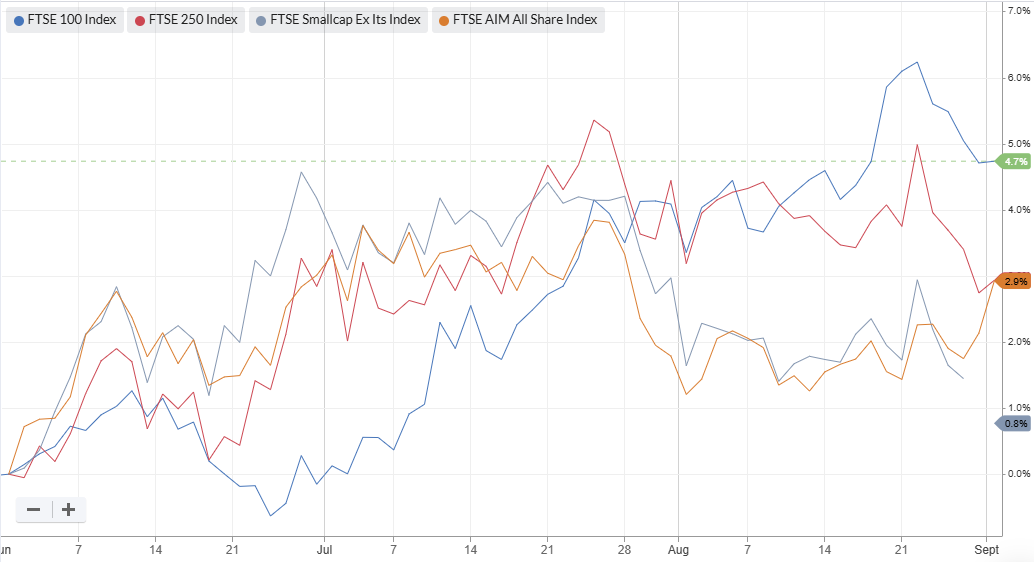
Of course, small movements in an index can mask some big swings in individual share prices. As stock picking investors, we want to be on the right side of these moves if we’re to have a chance of beating the market.
To see if I could find a way of highlighting such stocks, I’ve been working on a new screen designed to help me find shares that are currently riding a wave of momentum.
The end result was a screen I’ve named Riding the Rally. This uses the StockRanks plus some simple rules to try and identify companies with positive share price momentum and above-average volatility.
Screen rules: here’s a summary of the rules I’ve used and the reasons for my choices.

Industry Group: I’ve excluded REITs and Collective Investments as they aren’t regular trading businesses and need different types of analysis.
StockRank Style: I’ve restricted the screen to stocks with High Flyer, Turnaround or Super Stock styling. This is because I only want to consider stocks that fit winning, momentum-driven styles:
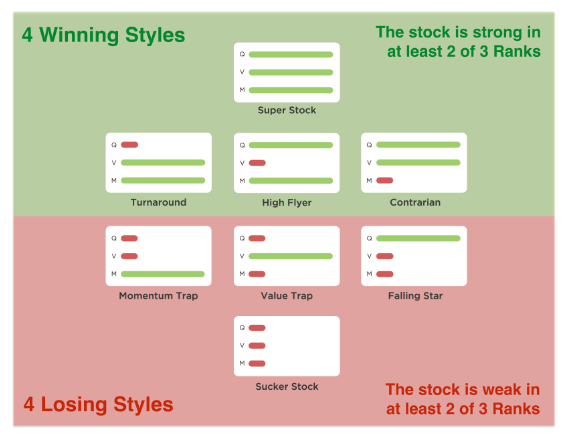
This is a relatively short-term trading approach that isn’t suitable for quality or value-focused investments. There’s a full explanation of the StockRank Styles here.
RiskRating: volatility isn’t always desirable, but in this case I’m looking for stocks that are likely to see bigger share price movements over the short-to-medium term.
Our RiskRating system classifies the most volatile stocks as Speculative or Highly Speculative – so I’ve restricted the search to these stocks. See here for more on RiskRatings
StockRank >80: I want to restrict my search to companies that are statistically more likely to outperform the market. There are no guarantees, but higher-ranked stocks have done better, in aggregate, since the StockRanks launched in 2013.
MomentumRank >80: the MomentumRank scores shares for a blend of factors that are designed to highlight both price and earnings momentum. This is useful because some stocks rally due to earnings upgrades, while share price growth at others (such as Turnarounds) may be more driven by a re-rating.
I want to catch both types, so using the MomentumRank as a filter makes sense to me.
Price Change 6m >10%: for me, this is quite aggressive (although true momentum hunters would probably disagree). I want shares that are already on the move – and heading up.
Market Cap >£25m: the smallest companies tend to be illiquid and poorly understood by the market. In my view, they require careful research and are not suited to this approach.
Sales TTM >£10m: I only want trading businesses with meaningful revenue…
Op Profit TTM >£0m: … and real trading profits.
You can view and copy the Riding the Rally screen here.
In the remainder of this piece, I’ll take a look at the current results from this screen and consider how I might invest in a selection of these stocks.
Riding the Rally: screen results
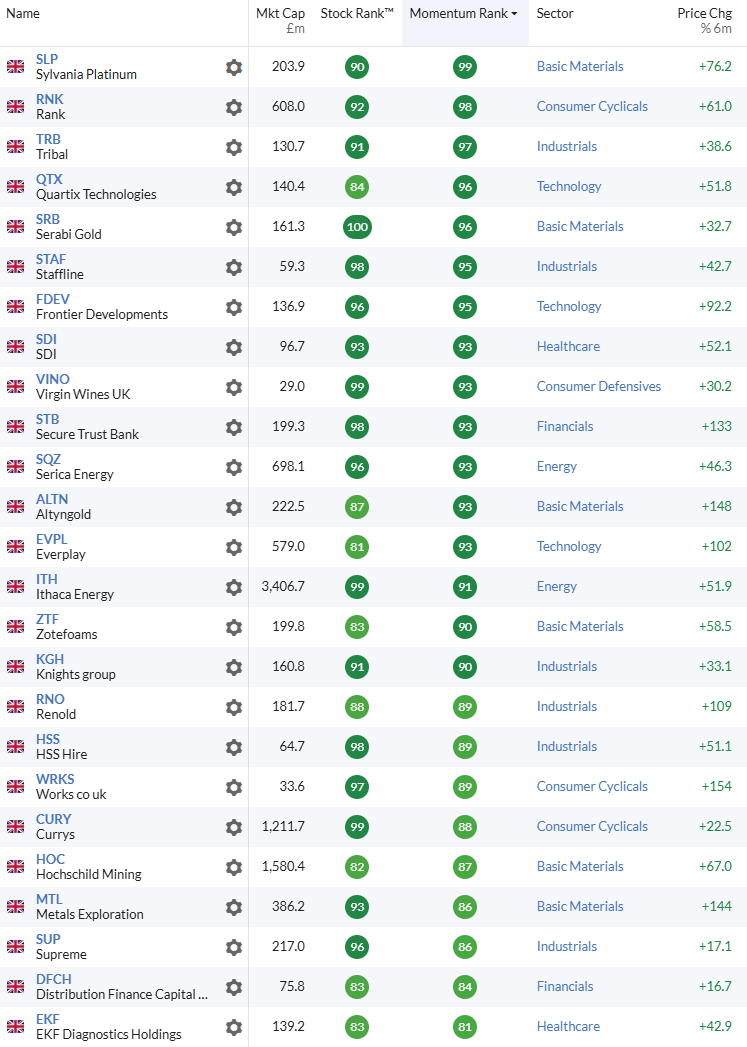
At the time of writing, these screening rules produce a list of 25 stocks for further consideration. Here’s a snapshot of the list, ordered by MomentumRank:
How to ride the rally!
There are – as always – two ways to approach investing in a strategy such as this.
An investor with ample spare time and good analytical skills might try to build a concentrated portfolio after in-depth research. That could work well, but personally, I don’t think it’s the right strategy for this type of approach.
Most of these are unlikely to be multi-year holdings, in my view. I’d expect trading to be relatively frequent, meaning in-depth research will be difficult. In addition, I think it would be very difficult to predict which of these stocks are most likely to deliver the kind of outsized share price gains I’m looking for.
While I would do some basic research, the approach I’d take here would be to invest in a NAPS-style diversified basket of these stocks. I’d probably aim for 15-20 shares, with clear rules for buying and selling.
Here’s an example of how I might do this – and what the resulting portfolio could look like.
Portfolio rules: buying
Eight of the 10 economic sectors are represented in the results as I write, but this won’t always be the case. In addition, some sectors only have one or two stocks in the screen results.
I want to achieve a reasonable level of diversification, without being tied to an inflexible allocation approach.
I also want to weight the portfolio towards the sectors that have the greatest number of stocks in the screen results. Rightly or wrongly, my feeling is that these may also be benefiting from macro or sector-wide drivers.
Here’s an outline of the process I might follow:
1.) Sort the results by sector and choose the stock with the highest MomentumRank from each sector. Rule out any stocks that are under offer – from the selection above, I’d exclude Renold (LON:RNO).
This gives me eight. I’ve listed them below, with a link to the most recent DSMR commentary for each stock
Energy: Serica Energy (LON:SQZ) (05-Aug-25)
Basic Materials: Sylvania Platinum (LON:SLP) (18-Feb-25)
Consumer Defensive: Virgin Wines UK (LON:VINO) (31-Jul-25) - this is also a recent addition to the NAPS)
Financials: Secure Trust Bank (LON:STB) (14-Aug-25)
Technology: Quartix Technologies (LON:QTX) (07-Apr-25)
2.) For sectors with two or more stocks in the screen results, loop back through and choose the shares with the second-highest MomentumRank.
Be careful about selecting stocks that are near-duplicates. From the selection above, I probably wouldn’t want to own both Serica Energy and Ithaca Energy. Both are North Sea oil and gas producers and thus are exposed to very similar market forces.
This gives me another six:
Basic Materials: Serabi Gold (LON:SRB) (29-Aug-25)
Consumer Cyclicals: Works co uk (LON:WRKS) (22-Jul-25)
Financials: Distribution Finance Capital Holdings (LON:DFCH) (08-Jul-25)
Healthcare: EKF Diagnostics Holdings (LON:EKF)
Technology: Frontier Developments (LON:FDEV) (11-Jun-25)
That’s 14 in total.
3.) For one final pass, I’d focus on any sectors with the highest number of stocks in the screen results in order to increase my exposure to these parts of the market.
In this case, Basic Materials and Industrials both have six stocks – at least double any other sector. Again, I’d aim to pick one from each sector, without too much duplication. If necessary, I’d allow some flexibility here to select from another sector if it improves diversification.
This final sweep gives me two further stocks:
That’s 16 stocks, in total.
One option at this point would be to devise a rule to top up the number of holdings to 20.
Personally, I’m comfortable with a minimum of 15 stocks in this scenario, but it’s an individual choice. Increasing the number of stocks can reduce the potential loss if an individual company hits trouble.
The reality is that there are several other similar ways we might approach building a portfolio from these screen results. I am not sure one is definitively better than the other. In my opinion, the most important thing is to devise a consistent system and stick to it.
Portfolio rules: selling
In a short-term, momentum driven portfolio, catching profits is the name of the game. I’m not looking for income or long-term compound growth here. With this in mind, a clear process for selling is also needed.
Given the momentum element, suitable holding periods are likely to be relatively short.
One option would be to review each company’s StockRank monthly and sell anything that falls below a certain threshold. That might work, but for me personally it’s a bit high maintenance and just too frequent.
I prefer to start with a minimum holding period, followed perhaps by a rolling review – the approach I use in the SIF portfolio.
For the Riding the Rally screen, I think a six-month initial hold probably makes sense, but with the following ‘safety net’ rules:
Sell immediately on a profit warning
Sell if a stock drops >20% below its cost price
After this initial six-month period, I’d review each stock to see if it still qualified for the screen.
If it did, I’d continue to hold on a rolling one-month basis. This is the approach I’ve used with SIF for many years. I’ve generally found it to be a good way to hold onto momentum winners for a little longer, without risking too much of a reversal if momentum starts to cool.
Final thoughts...
As an experiment, I will build a model portfolio from these screen results and revisit it in six months – I’ll report back here if the results seem interesting and worthwhile.
In the meantime, please share your thoughts below. Have you tried anything similar, or am I barking up the wrong tree completely?
Disclaimer
This is not financial advice. Our content is intended to be used and must be used for information and education purposes only. Please read our disclaimer and terms and conditions to understand our obligations.

15 comments
using a risk assessed allocation of one's total portfolio - such as 30% max perhaps - one could trade this more aggressively - monthly or even weekly perhaps. I would consider applying a market filter such as a moving average cross over to measure general market direction. If the shorter-term average is below the longer one - don't buy. Choose the top ten stocks in terms of 6-month growth. At the next periodic review run the screen. If a stock one has is still in the top 20, say, keep it. If it is not in the top 20, sell. Replace with another top one in the screening output. The other checks and balances in this article could/should still apply. I also consider viewing the charts. If the 50 SMA is not either upwards pointing, or sideways at least, don't buy.
The screener is certainly a powerful tool. What is inspiring, is that there are actually many ways of actually making a profit from equities- by following these regular articles, and using a screen to pick shares with a better than average chance of success. For me, the most important point in this particular article is the quote from Roland: “In my opinion, the most important thing is to devise a consistent system and stick to it.” Mine too!
Thank you very much, Roland. This is definitely something to consider. In your article, the screen results are ordered by the Momentum Rank. However, when I made a copy of the "Riding the Rally" screen, the results were ordered by StockRank. Just wanted to confirm whether it should be ordered by Momentum Rank. Thank you.
It's worth checking out William O'Neil's CANSLIM model too for ref. Although very US centred his books are interesting. Basically making profits from careful stock selection & timing with some very strict rules
Seems strange to see VINO in a momentum list given the crash in its share price! Can’t see why its price has fallen so dramatically. I hold
Hi @Roland - Thank you so much for making the screener available as a template for us to download into our screener lists—really appreciate you sharing it!
I noticed that when I clicked the "Edit" button (with the intention of adding a link back to your post in the description), two of the rules were listed but not active:
Forecast Earnings Per Share (forecast 2 year) > 1.05 x Forecast Earnings Per Share (forecast 1 year rolling)
FY1 EPS Estimate upgrade 3 months > 0
When I activated both rules, the number of stocks filtered down quite significantly—from 25 to 7.
Just wondering:
Should we ignore or delete these additional rules, or were they intentionally left inactive for flexibility? I'd be curious to know your thinking behind including/excluding them from the active filter.
Thanks again for putting this together—it's incredibly useful.
Hi Money's Moneybox,
Apologies for the belated reply - those rules should have been deleted (and I have now done this).
I think the MomentumRank covers this area in a more nuanced way than the rules would have done, so I don't see the need for both.
Regards,
Roland
I really like your ideas for a momentum screen - I’m going to simulate this for a few months! .
Great point too on the importance of liquidity and research with the smallest caps. That’s a really valuable reminder that momentum alone isn’t enough without considering tradability.
I noticed you’ve set the cut-off at >£25m market cap.
@Roland I’m curious — what made you choose that particular threshold instead of using a spread-based filter (e.g. <750bps like the NAPS) if liquidity was your concern? Or does the small cap >£25m filter reflect another consideration?
One extra thought: it might also be worth adding a selling rule to exit if liquidity worsens, for example if spreads widen beyond a certain point. That could be a useful safeguard against getting stuck in less tradeable stocks.
Roland would you consider using alerts to act as selling triggers? If the portfolio is only 15-20 strong perhaps set individual Momentum Rank numbers at 10 points below current for each stock rather than a standard sell below 75? Or is there a better metric to use to identify loss of momentum that might be more timely? Relative strength perhaps?
Does make me chuckle to see Zotefoams (LON:ZTF) included with miners as a Basic Materials category stock.
There has been lots of director selling at Frontier Developments (LON:FDEV) this year.
Yes quite a few have pullback recently.
Serica Energy (LON:SQZ) always having problems, l used to hold but got fed with them. Ithaca Energy (LON:ITH) maybe a better choice?
Hi Rusty2,
I've noticed the director selling at Frontier Developments (LON:FDEV) - it's founder David Braben who is selling (32.6% shareholding).
The sales are being coordinated with the ongoing £10m buyback. Braben is selling shares so that his holding remains unchanged as a % of the company.
This suggests he's selling 1/3 of the number of shares required for the buyback, or around £3.3m of stock. Recent RNSs seem to confirm this 1/3 ratio.
My sums suggest Braben will still have a stake worth c.£40m after the buyback, so he'll still have a lot of skin in the game.
However, the company is effectively buying shares from Braben (both deals are being handled buy the same brokers). I suppose that a cynic might suggest the buyback has been planned partly to provide a liquidity event for the founder to sell without depressing the share price.
Personally, I don't see this as a big issue, given Braben's continuing ownership and leadership. My bigger concern would be whether the buyback is likely to deliver an attractive return - consensus forecasts show a sharp dip in earnings next year, albeit this could easily change given limited visibility on forward sales.
Frontier is due to issue results on 10 September, so I we should soon get an update on trading.
Roland
Thanks Roland, that is reassuring, l don't hold Frontier Developments (LON:FDEV) at the moment, but it is one l'm considering buying. I will look out the results next week.
That rally has come to a shuddering halt. A good summer but not sure rest of year and next year will be any good
You could argue sell the rally take profit and await the next sector to be in favour. Which I thought 18 months ago would be bricks and builders alas I must wait another winter. Historically from the ashes rises the housing mkt but cost of production has risen horribly and now I'm not so sure they will have the pricing ability to correct the situation. Labour need to walk the talk not just talk and secretly pile on taxes eg landfill tax this is adding hugely to the cost of building, I'll throw in absurd industrial energy pricing making bricks costly and why not NI . Why are we taxing soil as heavily as rubbish ? its absurd. All these factors are killing confidence.
Just look at recruitment the top 100 UK companies have reduced graduate reduction by 20% (in 23/24 they were forecasting a rise) and only 45% of graduates over the past 18 months have graduate entry jobs. These are facts BBC R5 Wake up to money today. Yesterday an good piece about demonising making money.
mikebianchi,
I also thought bricks and builders might be more in favour by now, but timing the market is hard!
I'm planning a longer look at brick producers over the next couple of weeks - watch out for this.
Roland